Up to 37% in savings when you subscribe to hi-fi+
hifi-logo-footer

Begin typing your search above and press return to search. Press Esc to cancel.

Purist Audio Design Diamond Revision HDMI cable

The audio world is a conservative one. We tend to be dismissive of the new and those products we think unconnected to audio. As a result, HDMI gets a bad press from audio enthusiasts, as it’s a ‘video’ cable and writing about HDMI brings the taint of video to an audio magazine! Nothing could be further from the truth.

As the name suggests, Purist Audio Design is not a company that’s known for video cables, and yet the company has been making high-performance HDMI for years. There’s good reason for this; it’s also an excellent digital audio connection, especially when used in an I2S digital interface using the LVDS pathway (Audiobyte, PS Audio, Rockna, Sonore). The advantage to the I2S connection is it’s basically the native digital format of the DAC itself, obviating the need for a S/PDIF or USB receiver to interpret a digital audio datastream. The requirements of an HDMI cable in this context are that it is fast enough, and at 18Gbps rated bandwidth, the Diamond Revision is certainly that. Using triple-shielded, triple cryo-treated copper, gold, and silver alloy conductors that also deliver the video goods (4K, HDR TV) and supporting all the usual benefits of High-Speed HDMI.

In use, the cable didn’t exhibit a significant degree of run-in and worked well out of the box. Video isn’t really a thing for us here, but it performed extremely well in this setting and would certainly be a recommendation for use in a high-performance AV system. Although notionally using HDMI in an Ethernet context is a way forward, the products that capitalise on HDMI’s potential here are hard to come by, and we’ve not received any such products as yet. However, it just so happens we do have a couple of excellent Audiobyte products in the pipeline, and I2S connection over HDMI is a core part of its performance. The ferrite ring also helps quieten down an already quiet link. 

Diamond Revision sparkles in this setting. It brings a shimmering detail, fine soundstage, and excellent, architectural and stentorian bass to the presentation. It’s also a very big sounding cable, in a good way. 

In fact, this is the musical motherlode. We are talking the most direct, uncontaminated, unconverted digital audio you can get, and it needs a cable that can provide that digital signal with the least attenuation, sins of addition or commission. To date, I’ve used Nordost’s excellent Blue Heaven, but the power of Diamond Revision makes it hard to resist.

It’s the directness of the signal that is so exciting, and that’s why this needs to be a cable with a lot of leading-edge control. In fact, too much leading edge can be a bad thing as there is so much information on offer it’s almost head-spinning. Purist’s Diamond Revision cuts a fine balance between all that leading-edge detail and the quality of the sound that follows that attack. This is why the soundstage size and shape, that deep, powerful bass, and the detail shine through the performance, in a format that can be so immediate and immersive that you find it hard not to be swamped by the onslaught. Purist’s detailed dynamics win you over! 

It might seem odd to discuss what seems ostensibly a video cable in purely audio terms, but I2S is increasingly a thingin audio today and it deserves and demands the best because it’s the purest form of digital you can get. Using a Purist cable for the purest digital might sound fitting, but it also works!  

Price and contact details

Product: Purist Audio Design 

Length as tested:1m

Price: $275

Manufactured by: Purist Audio Design

URL: puristaudiodesign.com

Distributed by: HMF Solutions

URL: hmfsolutions.com

Tel: +44(0)7740 799753 

International Distributors

Beethoven, Piano sonatas (complete), Paul Badura-Skoda – period pianos

I recall buying Beethoven’s late sonatas with Paul Badura Skoda on vinyl way back in 1980/81.The recordings were made between 1978 and 1989, Alas, the original Astree LPs/CDs were always hard to find, and never around for very long; blink and you’d missed them!  But let me digress…

In 1976/7, Maurizio Pollini recorded Beethoven’s late sonatas for Deutsche Grammophon – a release that set fresh standards, both musically and sonically. Pollini offered Olympian interpretations, with amazingly clear fingerwork. Aided by DG’s bright detailed sound, his set was something to marvel at.

While Badura-Skoda’s technique was never comparable to a virtuoso like Pollini, his playing of the late Beethoven sonatas (Pollini notwithstanding) made a deep impression on me – not least because of the deliciously-luminous translucent sound of his 1824 Conrad Graf fortepiano.

This instrument was used for the five late sonatas (Op 101 to Op 111) recorded between 1978 and 1980. Sonatas Op 78 and Op 90 (recorded in 1980) were played on a Viennese fortepiano made by Georg Hasska (c1815), and that was it for a while. 

The next set of sessions took place in 1985, and the cycle was finally completed in 1989. A total of 7 different fortepianos (from six makers) were used, and each instrument sounded very individual and highly characterful. Badura-Skoda’s playing was likewise characterful, and always interesting. 

These early pianos do not sound as refined and sonorous as a modern concert grand, but that’s the point! There’s something bracingly-authentic about the silvery tonality (and occasional roughness) of these period instruments that brings you closer to Beethoven’s sound-world. 

Listening, you better-sense the struggle that went into the composition of each sonata. Highlights include extremely good performances of the Waldstein and Appassionata sonatas. It sounds as though Badura-Skoda had played these works many times; he really has them in his fingers. 

Although the cycle covered an eleven year period, the recorded sound is very consistent in terms of technical quality. The late sonatas (recorded first) are definitely analogue. But whether the later recordings from 1985-9 were analogue or digital isn’t stated.

Where there seem to be variations in sound quality, much of the time this can be put down to sonic differences between the individual instruments themselves. The chosen venue was the Baumgartner Casino in Vienna, and the balance presents each piano fairly close-up and immediate.

This closeness means you sometimes hear a few rattles and buzzes. But the lighter sharper tone of these period pianos really clarifies Beethoven’s densest writing. The tangy resonant low notes never blur the sound. Beethoven’s scrumptious boogie-woogie bass parts are revealed in all their glory!

Of course, it’s fanciful to state that this is what Beethoven must’ve wanted, or even how his own playing might’ve sounded. Yet listening to Badura-Skoda, it’s easy imagine yourself in a dimly-lit room eavesdropping on LvB himself – as he manfully grapples with these often knotty sonatas. 

Of the various instruments, the Conrad Graff and John Broadwood instruments sound really good, while the Georg Hasska (disc 6) seems a touch more flawed – less luminous in tone and a bit ‘noisy’ in terms of the action. The sonatas on each disc are played with a single instrument.

All come from Badura-Skoda’s own personal collection of period pianos. Makers range from Beethoven’s own favourite John Broadwood (London), to Conrad Graf, Johann Schantz, Georg Hasska, and Anton Walther (Vienna), and Caspar Schmidt (Prague)

The booklet that comes with the set is unusually comprehensive. 68 pages in English-only, with detailed notes on each sonata by the distinguished Belgian musicologist Harry Halbreich. There are colour photographs of each instrument, and the soloist. 

Today, the market for complete cycles of the Beethoven piano sonatas is an immensely crowded one; considerably more-so since Badura-Skoda started this recording over 40 years ago. Back then, his accounts of the late sonatas really stood apart, and they still do today. Not bad!

Despite many others having trodden the same path, these performances remain hugely enjoyable.  Hopefully this set will be around for years to come, but – with CD rapidly becoming an endangered species – don’t bank on it. It will probably disappear for good once the original print run sells out… 

WIN! One of four fantastic Synergistic Research cables worth up to $699!

We have partnered with our friends from Synergistic Research to bring you an exciting competition and a chance to win one of four cables worth up to $699.

Alan Sircom reviewed the Synergistic Research Foundation series cables in issue #185 (page 59). He wrote, “Synergistic Research’s Foundation Series cables uses 6N purity pure silver conductors using Synergistic’s own handmade Air String geometry with the company’s UEF (Uniform Energy Field) Matrix shielding. This last is pulled from the more up-scale Atmosphere X cables, placing UEF technology in a grid pattern inside the cable and with a graphene sleeve extending around the connector itself.

The RCA cables feature four of these Air String conductors per channel, while XLRs use six per channel, woven in an air dielectric, all wrapped in a tight braided jacket. The loudspeaker cables look almost identical to the interconnects, using identical materials, techniques and jacketing.

He went on to say, “Consistency and detail are uppermost with Synergistic’s Foundation cables. They are remarkably revealing, both of equipment, but in particular of the music played through that equipment.”

He concluded the review by saying, “Synergistic Research has taken the technologies used in its top cables and trickled down to an affordable level without sacrifice. Foundation is an excellent, er, bedrock in audio that can make a potentially good system into a really great one.”

Prizes

1 Foundation Interconnect – 1m, ($599 value, the winner will select either RCA or XLR terminations)

1 Foundation Speaker Cable – 8ft, ($649 value, the winner will select either spade or BFA terminations)

1 Foundation 12 gauge Power Cable – 5ft, ($599 value, the winner will select either 15A or 20A IEC and North American, Schuko, Australian or UK wall plug)

1 Foundation 10 gauge High Current Power Cable – 5ft, ($699 value, the winner will select either 15A or 20A IEC and North American, Schuko, Australian or UK wall plug)

Competition Question

What is the name of Synergistic own handmade geometry?

A. Air String

B. G-String

C. Absorbitex Stringettes

To answer, please visit the Synergistic Research dedicated competition page at https://www.synergisticresearch.com/hifi-plus-giveaway/ Alternatively, send your answer on a postcard (including your name, address, and contact details) to Synergistic Research Competition, Synergistic Research, 11208 Young River Ave, Fountain Valley, CA 92708, USA

Competition Rules

The competition will run from August 6th 2020 until October 1st 2020. The competition is open to everyone, but multiple, automated or bulk entries will be disqualified. The winner will be chosen at random from all valid entries, will be contacted via email (where possible) and their name will be published in the magazine. The Editor’s decision is final and no correspondence will be entered into. Absolute Multimedia (UK) Ltd. is compliant with the Data Protection Act and UK laws apply. Our policy is such that we will not pass on your details to any third party without your prior consent.

Linn’s new Majik DSM: a classic revamped, inside and out

Majik digital streamers have been an integral part of Linn’s industry-leading range since their introduction in 2009. Now, Linn’s best-selling streaming product of the last decade has been completely reimagined to deliver a stunning new look, an all-new feature set and, most importantly, an impressive boost in performance.

Gilad Tiefenbrun, Linn Managing Director said, ‘Recent years have seen the rapid expansion of Linn’s product portfolio, both in terms of category and technology, creating exceptional new products that have enabled more and more people to bring Linn quality sound into their lives. 

Now, with the brand new, next generation Majik DSM, we have the perfect one box solution to outperform the competition and offer the ideal first step into authentic hi-fi. It remains a powerful combination of network music player, pre-amp and power amp in a single enclosure, and this update gives it a unique combination of connectivity features to transform the sound from every source.’

Performance

Drawing on over 10 years’ experience in developing network music players, improvements have been made throughout the product to enable new Majik DSM to outperform both its predecessor and the competition. Updates to the DAC implementation, power amplification and volume control are all underpinned by a new, higher power processing platform.

The DAC architecture is derived from the development of Linn’s industry-leading Katalyst technology, including improved upsampling, a lower noise reference voltage and an ultra-low jitter clock for greater timing accuracy throughout. 

The bespoke, Linn-designed Class D power amplifiers offer better performance thanks to lower noise and distortion and more efficient signal conversion, allowing even greater musical detail to be extracted.

New Majik DSM also benefits from digital volume control which removes a lossy component from the signal path for lower noise and distortion. 

These technical improvements alongside Linn’s unique Space Optimisation technology, which optimises performance for an individual room and speaker, ensure the stand-out performance of Maijk DSM.

Connectivity

Majik DSM is the ideal entertainment hub as it contains all the analogue, digital and wireless connectivity needed to connect any source, from TV to turntable, and make it sound better.

Four HDMI 2.0 4K-compatible inputs make it the perfect central point for AV sources, with no compromise on high res audio discs or movie soundtracks – Majik DSM will play them as they should be heard. 

An innovative flexible analogue input is configurable to either Moving Magnet (for turntables) or Line Level (for other analogue sources). The phono stage benefits from a hybrid architecture derived 

from Linn’s reference Urika II phono stage, combining digital and analogue processing to precisely implement the RIAA curve, resulting in more accurate vinyl reproduction. 

A Type-B USB port allows high res audio to be played directly from a PC, enabling Majik DSM to function as an audiophile-quality standalone DAC.  

In-built Wi-Fi enables the highest quality streaming with the convenience of no wires, while Bluetooth provides a simple way to get started playing music wirelessly with the minimum of set-up.

For personal audio, there is a ¼” headphone jack on the front panel with the integrated headphone amplifier specifically designed to power high quality, audiophile-level headphones. 

Easy to use

Taking design cues from Selekt DSM, Majik DSM’s timeless, precision-engineered styling and tactile interface invite interaction: a product that looks as good as it sounds for an enriched listening experience. 

Six customisable smart buttons offer personalised and immediate access to pinned content directly from the product; this can be audio from any source, whether that’s a favourite track, a new album or a music source such as a radio station, streaming service or turntable.

The menu button provides comprehensive control and feedback via a new larger and higher resolution monochromatic display. A Linn remote control is also included, and Linn’s dedicated apps – Linn App and Kazoo – provide full control of the product from the most frequently owned devices.

The complete first audiophile system

The full Majik System – Majik DSM partnered with a Majik LP12 and Majik speakers – offers a streamlined package that delivers high performance streaming and vinyl playback, with a look that can be personalised for every individual.

Customers can choose any high gloss colour finish for their speakers and LP12 plinth. Whether that’s a shade from a favourite shirt or from a best-loved album cover, Linn can match any colour for the perfect personalised finish.

Products and pricing 

Majik DSM will appeal to both first-time hi-fi buyers seeking simplicity and authenticity, as well as existing customers who want high-end hi-fi in more rooms. Whether as a dedicated music system in the living room, or as a second room system where there are other home entertainment sources, it offers audiophile performance streaming from a dedicated one box solution.

New Majik DSM – and the wider range of Majik products – is available through Linn Specialists worldwide now. To find out more and book your personal listening session, find a Linn Specialist near you: www.linn.co.uk/find-a-shop

Link on linn.co.uk website (live from 6pm Thursday 6th August): http://www.linn.co.uk/sources/network-music-players/majik

Majik DSM

£2950

Majik LP12 featuring new Karousel bearing

£2930

Majik 109 speakers

£990

Majik 140 speakers

£1800

Special finish for LP12 plinth

£330

Special finish for Majik 109 speakers

£450

Special finish for Majik 140 speakers

£600

Full system price for the full Majik System, including special finish Majik LP12 and Majik 109 speakers: £7650

New Majik DSM is available in black finish. Majik LP12 and Majik speakers come in a variety of wood finishes as standard.

With immediate effect, the previous model of Majik DSM is no longer available to order.

Exclusive: Linn’s new Majik DSM – First Impressions

I’ve been fortunate in being the only person not working for Linn who got an exclusive pre-release listen to the new £2,950 Majik DSM. OK, to bring myself into line I had to change my name from ‘Sircom’ to ‘Sirkom’ for the duration, but that’s a small price to pay for the privilege. And listening to the Linn Majik DSM in advance was a bit of a privilege.

Let’s be honest. Hi-Fi has got a bit po-faced. We’ve gone down a snobby route that can work against us. We shun any form of wireless connection, think HDMI or video connections are the devil’s own work, and the idea of hooking up a games console to our shrine to the audio gods is an abomination.

On the other hand, in the real world, people do all those things without turning a hair. They stream music wirelessly to their audio systems, then flip to streaming Netflix to their TV, then playing games, and so on. We can snooty our way into a corner by saying “it’s not hi-fi” but home entertainment in its wider context has diversity today. By taking this more modern and pragmatic path, Linn’s new Majik DSM is one of the rare audio components that takes on modern life… and wins.

I had the opportunity for a one-on-one session for the new Majik DSM in the swanky Linn Concession store on the fifth floor of Harrods in Kensington, London. In that concession is a small space that’s set up like a living room and although not fully soundproofed, it does make for a good approximation of the kind of living spaces people in London might have today. Also, it’s the perfect size to put together a small Majik system with Linn’s own Majik 109 loudspeakers (and a Majik LP12 turntable complete with shiny new one-point Karousel bearing and latest RAL colour scheme options). The soundproofing used in the room does absorb a lot of sound in the room too; it’s both dead and you need to wick up the volume higher than usual, but this gave an example of just how good the system was at a range of volume levels. `

I’m not going to trawl through the specifications, as they are on the press release. Instead, the easy way to think of this is ‘yes, it can do it.’ Roon – yep. AirPlay – Yep, with AirPlay 2 on the cards. HDMI? Yep, loads of them, bi-directional and one-direction; even HDMI ARC (audio return channel) for simplicity of cable layout. But more importantly, the Majik DSM pushes all the buttons for the person who has never heard the word ‘audiophile’ but simply wants to play sounds in a bloody good way, this box does it all. You can use the Majik DSM as your AV hub, switching from music to PlayStation to cable TV box without tears. Sound quality aside, the nearest we get to nerdy is the ¼” headphone jack with a good amp behind it, meaning you can play some of the more gnarly headphone loads.

Of course, Linn cut its teeth on vinyl replay and the Majik system wouldn’t be complete without the option to play LPs. Here, the MM-only phono stage is a part-analogue, part-digital affair derived from Linn’s top devices. 

What matters here is performance, though. And ‘performance’ in this context is more than just ‘how it sounds’, although it actually sounds pretty damn good too. Performance in a modern context is how seamlessly it connects to the outside world, how effortlessly the app drives the system, whether or not using it is a frustrating experience, and so on. When properly set-up, a good system should be as effortless in use as a good toaster. Almost.

Everything from this is driven by the app, and the app (Android and iOS) works well. Linn has more than a decade of understanding whether people are using local music storage or online streaming services and the trend is very much toward online streaming services, and the app is well geared toward that, seamlessly blending local and online libraries. If you are used to using Tidal’s own app – for example – there’s a touch of learning curve while you learn to live in the Linn ecosystem, but the length of time it will take you to read this first look is about twice as long as most people will take to get with the programme. The large front panel display deliberately goes for large white on black text rather than colour touchscreens or showing off album covers. Having spent some hours trying to download the right album art into metadata to prevent looking at the ‘Quavers of Doom’ greyed-out beamed eighth notes used to depict an absence of album cover, a simple text display is all you really need.

Ease of use only gets you so far, though. It’s got to sound good. And it does. Played in the context of an all-Majik system – the aforementioned Majik 109 speakers and Majik LP12 in a fine shade of Lambo orange – we also had the best-selling, previous generation Majik DSM to compare and contrast. I thought the original was extremely good, but in comparison it sounds flat and lifeless, with bass that is indistinct and ‘flubby’. In other words, all the things the original did well, the new one does so well it makes the original sound almost mediocre.

The sound is clean and dry (like a good Martini, not like the Gobi Desert) in the typical Linn way, and is perfectly suited to speakers like the Majik 109s. Like its predecessor – but to a greater degree – it’s tidy and ordered with a fine sense of rhythm. And if it’s a big change on the digital side, it’s huge in vinyl, with a more detailed, focussed and precise sound that also retains all of the melodic and rhythmic properties that made the older DSM good. We usually flub the issue about ‘should you upgrade’, but this time it’s a distinct ‘yes’… if you have the older model, the upgrade is worth doing.

Playing to the old crowd is not enough, and it’s here where the Majik DSM really shines. The sonics push this to the top of the pile of one-box does-it-all devices (or at least at the top of the pile that doesn’t cost as much as a decent second-hand car), and it’s inherent flexibility and the quality of the Komplete Majik Kit makes a lot of sense to someone who’s decided there’s more to life than Sonos. That it can then talk to other streaming devices around the home (especially Linn-flavoured devices like the Series 3) is icing on the cake. This is one of those easy recommendations someone like me would make round the dinner table to hi-fi and non-hi-fi types alike… if only we could sit round the dinner table!

It’s odd but hi-fi is shining once more. If 2020 has taught us anything, thanks to the eldritch horrors beyond our front doors, staying in is the new going out. This means, we make the best of our homes once more, and that includes making the best of our home entertainment in its widest sense. Linn’s Majik system – with the new Majik DSM – makes that home entertainment sound better. We hope to have a deeper play with this system soon.

Marantz unveils its 12 Series Special Edition models

Eindhoven, August 6th, 2020 – Marantz, a world leader in advanced audio reproduction, is proud to announce its 12 Series Special Edition models, the PM-12 Special Edition Integrated Amplifier and SA-12 Special Edition SACD Player with DAC-Mode

Our dedicated in-house Sound Masters occasionally identify products with higher potential than expected, then hone them into Special Edition models through extraordinary attention to detail, embarking upon more considered component selection and tuning over countless listening sessions. The original SA-12 and PM-12, solely created for the Japanese market, proved themselves worthy of such attention.

Drawing additionally upon achievements made while developing the acclaimed KI Ruby series, the Marantz Sound Master together with our European sound engineers have meticulously crafted the new 12 Series Special Editions.

Pure Analogue Amplifier

The PM-12 Special Edition Integrated Amplifier is built with just one aim – squeezing the ultimate audio performance from the core PM-12 concept – which is why it uses a fully discrete two-stage design with separate power supplies for the pre-amplifier and power amp section. The circuitry offers the cleanest signal path to the amplifiers, which deliver 100W per channel into 8ohm speakers, or 200W per channel into 4ohm. High-quality nickel-plated copper input terminals and high-purity copper speaker connections ensure this signal purity is maintained from the moment it enters the amp until it’s sent to the speakers.

The PM-12 Special Edition draws on the design of the PM-10 and PM-KI Ruby Amplifiers by including a moving coil/moving magnet phono stage, complete with Marantz Musical Premium Phono EQ circuit and Marantz HDAM technology throughout, again to ensure uncompromised signal purity. 

The completely analogue design of the PM-12 Special Edition contributes to its supremely low noise floor and its clean build. While building a DAC into an amplifier may offer convenience, the digital circuitry is, by its very nature, electrically noisy and can interfere with the delicate analogue signals passing through the amp. That’s why Marantz chose to retain this all-analogue ethos, keeping the PM-12 Special Edition as sonically pure as possible and dedicated the DAC-Mode to the SA-12 Special Edition player.

Sophisticated Digital Engineering

Drawing on the development process for the flagship SA-10 and SA-KI Ruby, the SA-12 Special Edition was created to celebrate the love of music and to connect listeners to the music without losing that all-important emotional connection.

A disc mechanism built purely for audio, the “SACDM-3” is able to play SACDs, CDs, and compilations on CD-ROM or DVD-ROM. It also has an asynchronous USB input, able to handle formats all the way up to PCM/DXD 384kHz/32bit and DSD11.2MHz. The Marantz Musical Mastering Stream transforms all PCM file formats to DSD format, using advanced filtering and proprietary processing before the Marantz Musical Mastering Conversion converts the 1-bit data stream directly into an analogue signal without the use of a conventional digital-to-analogue converter. 

The result is a wonderfully refined SA-12SE player that perfectly accompanies and complements the PM-12SE, forming a glorious hi-fi partnership that’s capable of bringing you closer than ever to the music you love. Because music matters.

The Marantz PM-12SE and SA-12SE will be available in September at authorised Marantz retailers in a black or silver gold finish, each priced at €3300/£2,999. For additional product specs, visit www.marantz.co.uk

PM-12 Special Edition Integrated Amplifier – at a glance:

•       Engineered and extensively tuned by European and Japanese sound engineers drawing on more than 65 years of Marantz amplifier design knowledge

•       Marantz high-resolution preamplifier stage using proprietary HDAM technology

•       Switching power amplifier design derived from flagship PM-10 and PM-KI Ruby

•       Load independent frequency response allow connection of any speaker

•       Generous output: 100W + 100W (8 ohm), 200W + 200W (4 ohm)

•       Fully-discrete two-stage design for signal purity, with separate power supplies for preamp and power amplifier sections to reduce interference

•       Toroidal transformer dedicated to preamp for clarity and precision sound

•       Current feedback design with newly developed wide-range circuitry

•       HDAM ® SA3 circuitry for clean signal and optimal dynamics

•       MM/MC Phono input with new discrete Marantz Musical Premium Phono EQ circuit

•       Thick nickel plated independent input terminals for CD and Phono, plus Marantz original high-quality/high-purity copper speaker terminals

•       Linear volume control with new electric volume system

SA-12 Special Edition SACD Player with DAC-Mode – at a glance:

•       Engineered and extensively tuned by European and Japanese sound engineers drawing on more than 35 years of Marantz expertise in CD players and digital audio

•       In-house-developed SACD/CD mechanism “SACDM-3”, designed purely for audio

•       SACD/CD playback, and playback of compilations on CD-ROM and DVD-ROM

•       Asynchronous USB input for hi-res audio up to PCM / DXD 384kHz/32bit and DSD11.2MHz

•       Isolation of USB and digital inputs (optical and coaxial) to block noise from internal and external sources 

•       Innovative Marantz Musical Mastering ‘MMM-Stream’ upsampling to DSD and filtering

•       Custom-designed 1-bit direct ‘MMM – Conversion’ from DSD to analogue

•       New analogue output stage with Marantz HDAM-SA3 and HDAM-SA2 technology and low impedance output

•       Power supply using toroidal transformer

•       Dedicated headphone amplifier with all-discrete construction featuring HDAM-SA2

About Marantz:

The company can trace its roots back to the dawn of the first mono LP, when Saul Bernard Marantz, a native of New York, was unhappy with the equipment available to play his cherished record collection on. So, he had to build his own! Saul officially founded the Marantz Company in 1953. Then, as now, the company’s cornerstones were quality and innovation. For over half a century Marantz has been developing unique technologies and bringing landmark hi-fi and home entertainment products to market through its tireless and extensive R&D programs. Such commitment to audio and video excellence ensures each Marantz design delivers class-leading performance. Additional information is available at www.marantz.eu. Marantz is a part of Sound United.

WIN! A fantastic Computer Audio Design GC1 Ground Control worth £1,695!

Computer Audio Design has teamed up with Hi-Fi+ magazine to bring you an exciting competition and a chance to win a GC1 Ground Control and CAD Ground Control Cable worth £1,995.

Roy Gregory wrote the most recent Computer Audio Design review on the company’s Reference £20,500 GC-R Ground Control in Hi-Fi+ issue #185 (pages 33-38).

Roy Gregory wrote: “The premise behind the GC-R is to provide a separate, clean ground for the system’s signal bus, independent of and in addition to the (essential) AC ground – although they can also be connected to the star-ground of an AC distribution block. That they work is, frankly, beyond dispute if you actually bother to listen to them.”

He further ruminated, “So the real questions posed by the GC-R are not, “Does it work?” – it does, spectacularly well – but should it be viewed as an addition to a separate AC ground, a substitute for one – or both?”

Roy went on to say, “As to the connections themselves. the GC-R offers eight ground points as standard, although the number of ground points and the necessary ground cables can be specified to suit a given system and are included in the price.”

Competition Question

How many ground points does the GC-R have as standard?

A. 4

B. 6

C. 8

To answer, please visit the CAD dedicated competition page at http://www.computeraudiodesign.com/hifiplus-cad-competition/ or send your name, address, phone number and correct answer to ‘CAD competition’, Unit 3, Sandleheath Industrial Estate, SP6 1PA, UK.

Competition Rules

The competition will run from August 6th 2020 until October 1st 2020. The competition is open to everyone, but multiple, automated or bulk entries will be disqualified. The winner will be chosen at random from all valid entries, will be contacted via email (where possible) and their name will be published in the magazine. The Editor’s decision is final and no correspondence will be entered into. Absolute Multimedia (UK) Ltd. is compliant with the Data Protection Act and UK laws apply. Our policy is such that we will not pass on your details to any third party without your prior consent.

Sonus faber and Fine Sounds UK

3rd August 2020, Glenrothes, Scotland: McIntosh Group, the leading group in the high-end audio sector comprising some of the biggest and most iconic brands in the industry, including McIntosh Laboratory, Sonus faber, Audio Research and Sumiko, has launched Fine Sounds UK, a new high-end audio distributor set to specifically focus on further developing McIntosh and Sonus faber in the United Kingdom.

Fine Sounds UK is a joint venture between McIntosh Group and McIntosh Laboratory’s British distributor of 15 years, Jordan Acoustics. Fine Sounds UK will be headquartered in Great Britain, where it will have warehousing and customer service facilities. 

Starting life with two giants of the audio world, both of which value hand-made craftsmanship, uncompromising quality and ultimate performance, Fine Sounds UK will be actively investing in the UK audio industry by developing an unrivalled portfolio of world-class audio brands, broadening both McIntosh’s and Sonus faber’s dealer base, and expanding its world-famous foundations.

Fine Sounds UK’s formation has been perfectly timed to facilitate a raft of exciting new product launches from both McIntosh and Sonus faber in the second half of 2020; Fine Sounds UK plans to make both brands more accessible to UK consumers than ever before. 

Commenting on the creation of Fine Sounds UK, McIntosh Group CEO and McIntosh Laboratory President Charlie Randall said, “After 15 successful years of working with Jordan Acoustics in the UK market, we felt this venture of creating Fine Sounds UK was the next logical step to strengthen our position in the market.” 

McIntosh Group co-CEO and Sonus faber President Jeff Poggi added, “Combining together with McIntosh under one business will enable us to expand the reach of Sonus faber to more UK customers, including our new line of home theater and custom installation products.” Mr. Randall and Mr. Poggi will be directors of the new company. 

Tim Jordan, owner of Jordan Acoustics, has also been named a director of Fine Sounds UK and said, “To have these two world-class stablemates alongside each other as the foundation of our new venture is incredibly exciting. Both brands offer sensational looks, build quality and performance, and we look forward to growing their footprint in the coming months.” 

Andy Oattes, previously Sales Director at One AV and Head of Sales at Naim Audio (along with over a decade of experience at Linn), has been appointed as Fine Sounds UK’s Sales Director. He will work with both existing and new specialist retailers, as well as custom installers in the UK, to develop and grow the McIntosh and Sonus faber brands.

Music Interview: Amy LaVere

Painting Blue, the new album by Memphis-based singer-songwriter Amy LaVere, was penned against a backdrop of doom and gloom and global issues, including Donald Trump’s 2016 election victory, global warming and racist and civil tensions.

In the wake of the coronavirus pandemic, the moody and anthemic first single, ‘No Battle Hymn’, is eerily prescient – “No one’s ready to admit we may be out of time,” she sings, over a slick, blues-pop groove, with some chunky organ riffs and mean electric guitar licks. Although its lyrics tackle defeatism, it’s ultimately a hopeful song, which calls for unification – “we need a victory march in our hearts.”

When I speak to her, she’s on tour in the Northeast of the US, with her husband, musician Will Sexton – who produced the album and also co-wrote ‘No Battle Hymn.’

“I love touring – Will and I tour most of the year. We hope to return to the UK and Europe in the fall – that said, gigs have been cancelled due to the coronavirus. I’m very worried about the future of our industry and society in general, for that matter,” she says. 

It’s not just world issues that have inspired her new record – she also tackles personal politics and lays herself bare more than once. ‘Painting Blue On Everything’ deals with depression, the emotional, string-laden ‘No Room For Baby’ outlines the reasons she hasn’t had children – “I stay in a little house that’s not even mine…. I’m always low on money, I work all the time – ”, and the intimate country song ‘Love I’ve Missed’ is about the fear people can experience in the early stages of a relationship. There are also some lighter moments – ‘Girlfriends’, which pokes fun at cliques, has a ‘50s Latin jazz feel, while the playful, laidback and funky soul of ‘Not In Memphis’ takes a tongue-in-cheek look at what happens to someone when they’re stuck at home while their partner is away travelling.

There are also three cover versions on the album: Elvis Costello’s anti-Falklands War protest song ‘Shipbuilding’, John Martyn’s ‘I Don’t Wanna Know’ and Texan singer-songwriter David Halley’s ‘Stick Horse Kid’.

Sexton’s production is very impressive, as is his guitar playing – the album sounds rich, warm, intimate and immersive, and the songs are nicely arranged. 

I ask LaVere, who had a cameo as rockabilly queen Wanda Jackson in the 2005 Johnny Cash biopic Walk The Line, if making the record was an enjoyable experience? 

“Yes – it was. After the writing and song choices have been made, the recording process is the fun part. Watching the musicians make the songs come alive is the most rewarding part of the process,” she says.

“We recorded the record one day at a time, over a year at Archer Records’ studio, Music + Arts, in Memphis, which is where I’ve made several of my records. There’s nothing super-funky or ‘clubhouse’ about it. There are no band posters or paintings hanging about. There is modern and vintage equipment and a lot of natural wood – it’s very comfortable and it’s a clean slate. You bring the spirit you need to the space, instead of the other way around. I truly love it there.”

SH: What kind of mindset were you in when you were writing?

AL: Melancholy mostly. I began to gather songs from old notebooks and some from the air that felt “together”.

In the few years prior, I had been newly in love and blissfully travelling and performing – my writing had become less prolific and I was happy. Then, with the doom of the election of Donald Trump and the dark cloud that fell over our country, my desire to write swelled. Not about the election necessarily, but I came down from my love bubble and needed to write again. 

Around the close of 2016, I was struggling with all the noise and disappointments around me. Nothing in my work of the past year seemed important anymore. The material I had amassed since my last record release felt rather small when played over the backdrop of the election, global warming doom, racial and civil tensions and the general feel of combativeness and fear that was coming in from everywhere.

Did you know what kind of record you wanted to make? 

I didn’t have a plan – I just moved forward when compelled by a lyric or a sonic choice. 

Your husband, Will, produced the album. What’s it like working together?  

Working with Will feels like merely an extension… there is a reason we married five years ago. We work seamlessly together. I couldn’t even say that I trust his suggestions because they feel almost like my own.

He was most helpful in articulating to the other musicians my desires. He has a larger technical music vocabulary than my own. While I was speaking in ethereal terms, Will was making charts. 

What can you tell me about ‘No Battle Hymn’? 

It was a song that Will started years ago. I was in the kitchen while he was in his den and I heard him play the opening few lines of it. He was digging through his old notebooks, researching ideas to finish for a new solo record he was getting ready to make. He quickly moved on to another idea, so I raced into the room and asked him to play the rest of the song for me. He didn’t have anything else, it was unfinished, so I asked if I could finish it for him. I was very inspired by it. 

On ‘Girlfriends’, it feels like you’re calling for people not be bossed around. Is that a fair assessment? 

That is a perfect assessment of the song. I wrote it in the hope that it could perhaps save a friend’s marriage. Too bad the record took too long to release…

‘Not In Memphis’ has a great, funky soul groove to it. What’s the story behind it?  

Hah! It’s a tongue-in-cheek song for Will – a teasing warning about his upcoming travels. It’s also the first song I’ve written that mentions Memphis. It’s a rite of passage. Having now lived there for 20 years, I felt I had earned permission. I’m fortunate to live in Memphis. The town allows me to be myself, and the quality of the studios and musicianship there are ideal for creating.

There are three cover versions on the album: ‘I Don’t Wanna Know’ by John Martyn; ‘Shipbuilding’ by Elvis Costello and ‘Stick Horse Kid’ by David Halley. What attracted you to those songs in particular and why did you choose to include them? 

It’s hard to put into words other than to say that they all fitted importantly into my collection of songs for this project and they said well what I wanted to express.

What’s the secret of a good cover? 

I had been performing that song live for some time before we recorded it. The feel and slight lyrical alterations were just the organic evolution it took in the live setting. We recorded just what we had been playing. 

Your version of ‘Shipbuilding’ has a folky, jazzy feel – largely thanks to the accordion on it. It’s a political song that was written about the Falklands War in the ‘80s. Does it still feel relevant now?

I believe so. Hopefully one day it will feel out of date, but alas, it’s still relevant. 

What can you tell me about ‘Stick Horse Kid?’ It’s not a song I’m familiar with…

Will produced a record for the songwriter David Halley several years ago. That song always spoke to me. It’s another one that I started to cover in my live shows and wanted to record it to see if it would be a good fit for this record. I decided it was. 

There are some personal and very honest songs on the album. ‘Love I’ve Missed’ deals with the fear people often experience in the early stages of a relationship, and ‘No Room For Baby’ is about the reasons you haven’t had a child. Were they difficult songs to write and record?

‘Love I’ve Missed’ not so much. It was an older song of mine. ‘No Room For Baby’ is indeed a painful tune. It wasn’t fun to write, record or play live. It’s not even fun for the audience, I believe…

What was the inspiration behind the title track?

I’ve been in relationships with someone who is depressed and, at times, I’ve been the one dragging each day through the mud. Although the song’s not written in the first person, I truly was the one I was addressing. I was trying to shake myself out of the darkness.

What music – new and old – are you enjoying at the moment and what’s your preferred way of listening to it?

Will’s newest record, Don’t Walk The Darkness, is amazing! Otherwise, Wes Montgomery has been my go-to lately. I don’t have the luxury of having a listening preference. If I did, I’d be sitting in a studio with 5.1 surround sound and the lights off. 

Painting Blue by Amy LaVere is out now on Archer Records. 

amylavere.com

Chord Electronics Huei phonostage

Huei is not the first phono stage from Chord Electronics, but it does have a number of ‘firsts’ in its own right. Specifically, this was something of a labour of love by Chord Electronics designer Matthew Bartlett, and something he was extremely passionate about when it was first discussed at Munich 2019. Between Munich and the actual launch of the Huei, Matthew Bartlett replaced Chord Electronics founder John Franks as Managing Director of the company (Franks moving over to the role of Chairman). Any way you slice it, that’s a bumper year for Bartlett.

The Huei comes at an important time for the brand. Chord Electronics initially made its name as a maker of high-performance audio amplifiers, especially power amplifiers using switch-mode power supplies. This was back in 1989, when precisely no-one in audio had ever considered using switch-mode power supplies in high-performance audio amplification and the trend at the time was amplifiers with gargantuan transformers and enough reservoir capacitance to jump-start an aircraft carrier. Although it made more than just power amplifiers, the brand became known for its power amps. Then… Hugo happened. The personal audio digital powerhouse was quickly followed by desktop and traditional audio digital products, with such a commanding reputation within the audio world, that people almost forgot that Chord Electronics made amplifiers. New amps using Chord’s latest feedforward/feedback circuit design (such as the Étude (reviewed in issue 168) and the new Ultima models help reacquaint an ever-changing group of Chord Electronics buyers with the company’s core product line, but many of these models are in the distinctly aspirational part of audio. By way of contrast the Huei MM/MC phono stage costs £990.  That puts it firmly on the map for those wishing to buy a phono stage in the ‘high-performance yet attainably priced’ stakes.

The Huei is built to the same basic form factor as the company’s Qutest DAC. It’s a small rectangular box with the distinctive scalloped insets with combination controls and indicators that Chord has been using since the Hugo. The box itself is too small for a power supply, so is fed by a plug-top unit.

An extremely clever part of the Huei’s design is that it is microprocessor controlled. This means that all those functions regarding switching between MM and MC, and impedance and gain, are all controlled by pushbutton instead of futzing around with DIP switches. The load itself is divided into individual gain and impedance settings, which are identified by colour codes on the polychromatic round ‘buttons’ on the front panel. Huei includes twelve settings for impedance matching, including 47k ohm for MM and 30 ohm to 47k ohm for MC, and there are eight settings for gain (MM from 25dB to 35dB and MC from 48dB to 70dB). There’s also a subsonic ‘rumble’ filter at -24dB per octave below 50Hz, using a Rausch Slope profile. The use of polychromatic controls does make set-up easy and fast compared to peering inside or underneath a product and adjusting tiny switches with a toothpick.


In fact, the only real omission here is other tone/EQ curves. It’s RIAA all the way for the Huei. Once again, how you relate to this depends largely on where you sit in the tone curves debate, and how many records you own that fall within the zone where an extra tone curve or two might prove handy!

I used the Huei with both balanced and single-ended outputs (not at the same time) into a Mark Levinson 5805 integrated amplifier. The Huei was fed by a VPI HW-40 with an EAT Jo No 5 MC cartridge for the most part. Cables were primarily from Nordost.

Chord’s electronics have sometimes been damned with faint praise. They were considered clean, lean and very detailed, but not very musical or rhythmically integrated. That all began to change with the Étude power amplifier, and it’s a trend that’s set to continue with the Huei. This is not some soft and laid-back phono stage, but neither is it stark, etched, or musically bereft. It’s really excellent.

The Huei is all about the excitement, but without being either so brightly lit or so overly excitable and detailed that it leaves you cold. The excitement is key, though; that doesn’t just mean you reach for that collection of Technical Death Metal albums you don’t have. It’s more about the excitement underlying the music itself, whatever that music happens to be. Basically, unless your collection of music came out of an elevator, there is usually some creative force at work wanting to convey a theme or two they consider exciting, and the Huei is perfectly optimised to extract that energy from the groove. It doesn’t matter whether it’s Beck coming to terms with lost love on Sea Change [MoFi], Bill Evans digging where his next fix is coming from or Mahler just being, well, Mahler, the Huei is adept at finding that musical communications centre.

This musical insight comes from a position of great – yet not stark – clarity and terrific soundstage properties. Basically, if the LP has some imaging, Huei will resolve it as well as the player and cartridge will allow. More importantly, the amount of detail pulled off a record is remarkable; I had a great deal of respect for the Jo No 5 before this review and afterwards I heard that it was even better than I first thought. It’s ability to dig deep into a record is outstanding and the Huei lets it do that with such aplomb and forthright accuracy, it’s hard not to be captivated. If knowledge is power, the Chord Huei is a small, colourful information tank.

I even played the good/terrible and almost ubiquitous Vivaldi Four Seasons by Marriner and the ASMF [Argo]. This  first venture into period instruments predates engineers knowing how to record period instruments without them sounding like audible paint-stripper, but the best products cut through the brightness and give you the detail and information that is being presented beneath that forward sound, and the Huei does that extremely well.

In short, like all the best in audio, the Huei gets out of the way of your music, letting you make the musical decisions rather than having to temper them even slightly to adapt to the nature of the electronics. It’s surprising just how hard this can get, especially in phono stages and especially in this category.  Imaging in particular highlights just how far some fall from the musical truth. Many phono stages truncate the width, depth or height of a recording. Many high-end models somehow also tend toward flattening the ‘pan pot and delay’ staging made in most studio albums. The Huei does neither of these things, and instead just plays the soundstage on the record. It’s not rocket surgery, but many fall at this hurdle.

Let’s put this into some perspective. The Huei is perfect for resolving the performance of £1k cartridges on £5k turntables. If you are really ‘going for it’ with £50k’s worth of turntable and a Moving Coil that cost as much as a new car, there are even more resolving phono stages out there, including Chord’s own Symphonic. It’s all about context.


The Huei is not without criticism, but the criticism is functionality-led rather than performance-led. The polychromatic colour-coded controls are a clear indicator of set-up but do require a look-up table to determine precisely what ‘orange’ denotes in terms of loading. Also, even though they can be dimmed, this means the often fit-and-forget phono stage is potentially the most illuminated and colourful part of a whole system. Finally, there’s the power supply. In fact, Huei has a secondary switching power supply internally to create the operating voltages from the external supply, so whether you use linear or switch mode external it doesn’t matter; although changing the power supply will void the warranty! Not many people realise, and it’s not clear anywhere, really, that the main power supply is inside the unit and Chord just uses the external brick to feed ‘raw’ power into the product; the external power supply doesn’t directly power any of the audio electronics. However, the fact remains that audiophiles are allergic to ‘wall-warts’ and I hope this doesn’t put people off what is a stunning phono stage.

There’s clearly the start of a trend here. The Qutest and Huei look to be the start of a range of very small, but immensely strong, components from Chord Electronics. It’s also not hard to see that this emerging collection of attainably priced, high-performance audio products coming to dominate that part of the audio world through the early years of the 2020s. If the Huei is anything to go by; the future’s polychromatic!

TECHNICAL SPECIFICATIONS

MM/MC phono stage

  • Input Impedance: Moving magnet: 47,000Ω, Moving coil: 100Ω – 3,700Ω, 12-step user selectable
  • Gain Range: Moving magnet: 21dB–42dB, 8-step user selectable, Moving coil: 49dB–70dB, 8-step user selectable
  • Input Noise: 1.1nV/Hz
  • Max Output Voltage RMS: 20v RMS
  • Equalisation Response: RIAA Curve
  • Equalisation Accuracy: +/- 0.1dB
  • Frequency Response: RIAA Curve = 12Hz to 25kHz
  • Rumble Filter: Rausch Slope -24dB per octave below 50Hz
  • Output Impedance: 520Ω (resistive)
  • Input Power Supply: 12v–100v to 240v 50/60Hz PSU
  • Dimensions (H×W×D): 4.1 × 16 × 7.2cm
  • Weight: 657g
  • Price: £990

Manufactured by: Chord Electronics

URL: chordelectronics.cu.uk

Tel.: +44 (0) 1622 721444

https://hifiplus.com/reviews/

Synergistic Research Foundation Series cables

Synergistic Research’s Foundation Series cables uses 6N purity pure silver conductors using Synergistic’s own handmade Air String geometry with the company’s UEF (Uniform Energy Field) Matrix shielding. This last is pulled from the more up-scale Atmosphere X cables, placing UEF technology in a grid pattern inside the cable and with a graphene sleeve extending around the connector itself. The RCA cables feature four of these Air String conductors per channel, while XLRs use six per channel, woven in an air dielectric, all wrapped in a tight braided jacket. The loudspeaker cables look almost identical to the interconnects, use identical materials, techniques and jacketing. They even physically separate the positive and negative, with two distinct conductors for each speaker terminal connection… but they are thin and flexible enough to be unobtrusive, and they come in a choice of black or white too.  

Foundation Series comprises loudspeaker cables, interconnects, phono cables and headphone cables, but Synergistic Research has that name for a reason – synergy. So, we went with an entire system’s worth of cables, including UEF Blue Series power cords from the range below Foundation and digital cables from the Atmosphere X Series above the Foundation line. These dovetail perfectly with the Foundation Series cables and should be considered as part of the full cable system but will be the subject of a later test. 

Consistency and detail are uppermost with Synergistic’s Foundation cables. They are remarkably revealing, both of equipment, but in particular of the music played through that equipment. Consistency in this case means both cables perform equally well and deliver a well-balanced sound that is coherent and precise from the lowest notes to the highest. A good vocal is projected – but not ‘pushed’ – into the room and neatly delineated from the rest of the band, with a coherence, stage presence, and microdynamic precision that makes the band sound like a band, not simply a collection of musicians vaguely playing together and never once falling foul of the ‘audiophile disease’ of making a huge soundstage at the expense of the cohesiveness of musicians in that mix. The sheer amount of detail the Foundations produce does mean thin and compressed-sounding pop can sound, frankly, bloody awful… but in fairness, revealing more of what goes on in the studio sometimes reveals more bad than good. Just be prepared to re-evaluate those tracks you thought ‘good’; the trick of using Shure SM57 microphones on drums to give a ‘live’ feel comes across as more ‘trick’ than ‘benefit’ here.


Foundation has the added bonus that for more attainably priced systems, it covers its tracks well and could stay in a system for the long haul; in fact, it’s only when you insert them in a monumentally high-end wide bandwidth system do you begin to crave even more detail and extension… which points you further up the Synergistic range. And best of all, it makes systems sound coherent and entertaining and both of those qualities seem to evaporate at Synergistic’s removal. 

Synergistic Research has taken the technologies used in its top cables and trickled down to an affordable level without sacrifice. Foundation is an excellent, er, bedrock in audio that can make a potentially good system into a really great one. 

Price and Contact details

Synergistic Research Foundation interconnect cables: $599 1m RCA (as tested)

Synergistic Research Foundation loudspeaker cables: $648 8’ spade lugs (as tested)

Manufacturer: Synergistic Research

URL: synergisticresearch.com

UK Distributor: Electromod

URL: electromod.co.uk

Tel: +44(0)1494 956558

NODE INVITED TO SHOWCASE THE FUTURE OF LOUDSPEAKER DESIGN AT LONDON’S ELECTRONIC MUSIC EXHIBITION

London’s famous Design Museum plays host to an exciting new exhibition: Electronic: From Kraftwerk to The Chemical Brothers. Curated by Jean-Yves Leloup, the comprehensive collection charts the 50-year history of electronic music – from experimental studio production and the underground raves, to the pioneering Chicago and Manchester club scene. 

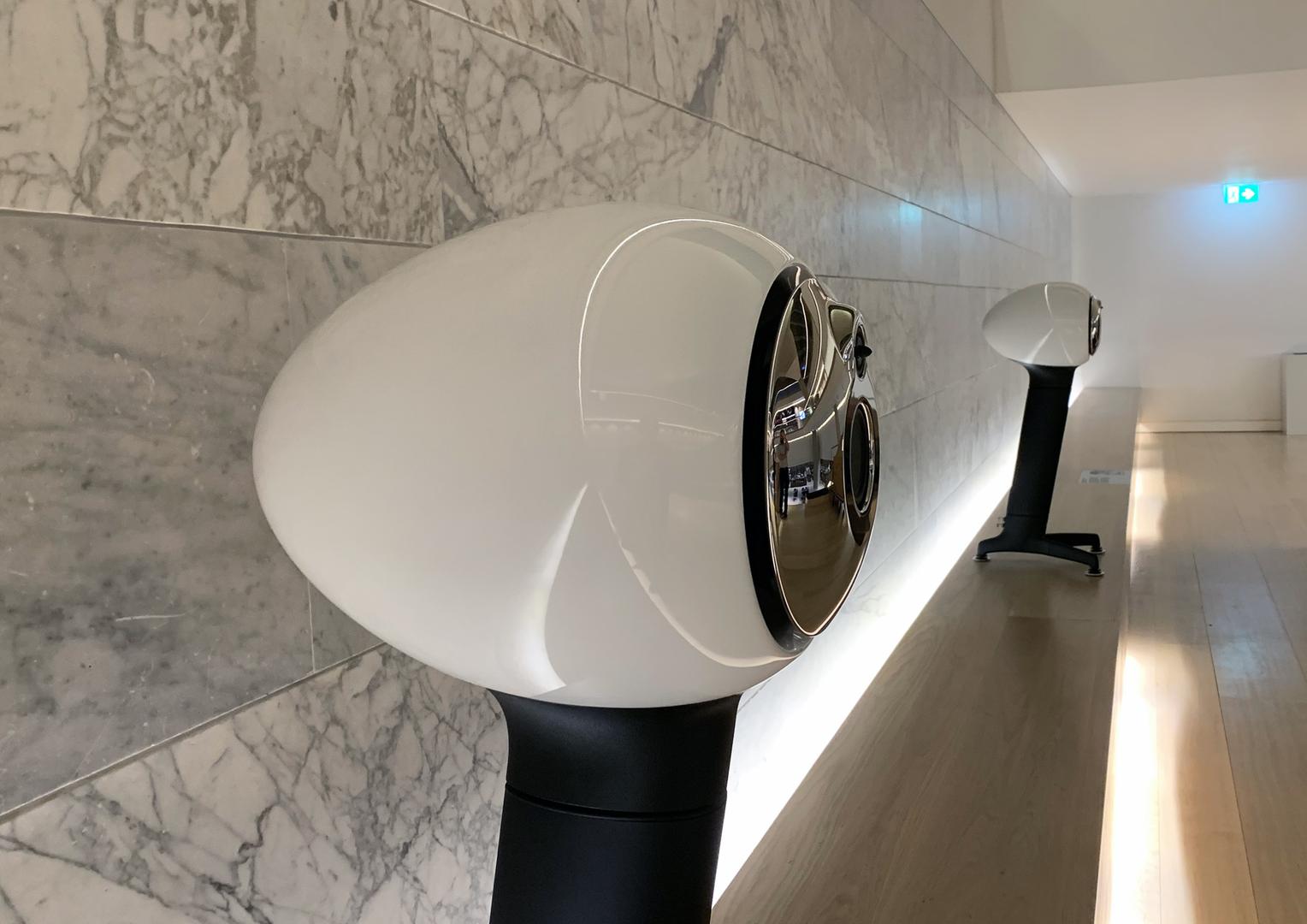
With electronic music now firmly part of mainstream culture, visitors to the exhibition will be greeted by Node’s iconic laser-manufactured Hylixa loudspeakers, showcasing the cutting-edge of music playback. Guests are then taken back in time, through the history of the electronic genre, in an audio and visual experience like no other, as Node’s director Ashley May explains:

“Electronic is more than music. The innovation, culture, graphics and design of the movement is inseparable from the music itself. It resonates with our innovative approach to speaker design – complete synergy in acoustics and aesthetics for a real multi-sensory experience. Leloup’s exhibition highlights that poetic relationship between man/woman and machine. To capture that innate human beauty is the aim of our out-of-the-box speaker design”. 

The exhibition highlights how audio quality has always been at the forefront of digitally created music. From the sparse, but expertly mastered Kraftwerk recordings, to the ambient, spacial works of Brian Eno, as well as the more complex, bass heavy Chemical Brothers and Daft Punk. 

“The holographic imaging of our speakers helps deliver a large soundstage, separating each element in an ambient electronic mix” explains Ashley. “Extended, articulate bass provides the foundation fundamental to the beat of electronic music, with a mid-range able to resolve densely-layered synth tracks”. 

Aside from cutting-edge audio, guests are treated to 3D Kraftwerk films, a pulsating 20,000 LED light installation to a soundtrack by DJ Laurent Garnier, and a new audio-visual experience from The Chemical Brothers show directors Smith and Lyall.


London’s famous Design Museum plays host to an exciting new exhibition: Electronic: From Kraftwerk to The Chemical Brothers. Curated by Jean-Yves Leloup, the comprehensive collection charts the 50-year history of electronic music – from experimental studio production and the underground raves, to the pioneering Chicago and Manchester club scene. 

With electronic music now firmly part of mainstream culture, visitors to the exhibition will be greeted by Node’s iconic laser-manufactured Hylixa loudspeakers, showcasing the cutting-edge of music playback. Guests are then taken back in time, through the history of the electronic genre, in an audio and visual experience like no other, as Node’s director Ashley May explains: 

“Electronic is more than music. The innovation, culture, graphics and design of the movement is inseparable from the music itself. It resonates with our innovative approach to speaker design – complete synergy in acoustics and aesthetics for a real multi-sensory experience. Leloup’s exhibition highlights that poetic relationship between man/woman and machine. To capture that innate human beauty is the aim of our out-of-the-box speaker design”. 

The exhibition highlights how audio quality has always been at the forefront of digitally created music. From the sparse, but expertly mastered Kraftwerk recordings, to the ambient, spacial works of Brian Eno, as well as the more complex, bass heavy Chemical Brothers and Daft Punk. 

“The holographic imaging of our speakers helps deliver a large soundstage, separating each element in an ambient electronic mix” explains Ashley. “Extended, articulate bass provides the foundation fundamental to the beat of electronic music, with a mid-range able to resolve densely-layered synth tracks”. 

Aside from cutting-edge audio, guests are treated to 3D Kraftwerk films, a pulsating 20,000 LED light installation to a soundtrack by DJ Laurent Garnier, and a new audio-visual experience from The Chemical Brothers show directors Smith and Lyall.

The exhibition opens at the London Design Museum on the 31st July 2020, and runs until the 14th February 2021. Visit the design museum webpage to learn more and to book tickets: https://designmuseum.org/exhibitions/electronic-from-kraftwerk-to-the-chemical-brothers 

To find out more about Node’s unique Hylixa speakers, or to arrange a personal demonstration, visit: https://www.node-audio.com/