Up to 37% in savings when you subscribe to hi-fi+
hifi-logo-footer

Begin typing your search above and press return to search. Press Esc to cancel.

Nordost Valhalla V2 tonearm cable

Anyone familiar with Nordost’s bottom-up cable hierarchy could be forgiven for wondering why we should invest heavily in a tonearm cable. Nordost, like most cable specialists, started by promoting the primacy of quality loudspeaker and interconnect cables. And then the Valhalla power cable joined the range, when the sanctity of the mains power link became indisputable. The company’s interconnects and speaker cabling are all justly praised, but if one is upgrading piecemeal, the power cable is demonstrably the place to start.

Several months’ experience with the Valhalla v2 Tonearm Cable + has convinced this listener though that there’s plenty of mileage remaining in nurturing the audio signal at the other end of the system, where voltage levels dwindle from 240 down to microvolts. The care with which Nordost has wrought an extremely well-shielded, low capacitance conduit to pass pick-up cartridge signals from tonearm to phono amplifier ultimately reaped dividends well beyond expectation.

The V2 tonearm cable was relaunched this year with some mild revisions, and is now marked out by an additional ‘+’ sign. Like the rest of the V2 overhaul, the first V2 tonearm cable saw substantial improvements designed to uprate performance, making the V2 series in general a serious performance threat to the original Odin series. In place of the trademark Micro Mono-Filament layout came a dual-filament principle of applying two twisted strands of FEP dielectric, further reducing contact area around the conductor; and likely responsible for the lowered capacitance, from around 72 pF/m to 56 pF/m. Terminating each end of V2 were brand-new plugs, Nordost Holo:Plugs that replaced a generic right-angle DIN plug at one end and locking WBT NextGen phono plugs on the other.

The new ‘plus’ edition builds on all this, and takes a new layout internally, with the left and right channels wound individually as a twisted pair inside their own shield, in place of four insulated conductors all wound loosely together. The new approach is said to minimise any crosstalk and electromagnetic radiation between channels, although conducting copper had to be reduced slightly in cross section from 22 to 24AWG in order to maintain flexibility. That was probably a wise move: some compliance is essential in a tonearm cable that must be carefully ‘dressed’ in a sub-chassis turntable, to avoid unwanted mechanical loading on the delicately tuned suspension bounce. Perhaps tellingly, Nordost no longer trumpets the specification of V2+ capacitance, so this has likely increased in the new twisted-pair configuration.

Also new to this year’s plus-rated cable is a clever new earthing arrangement that allows more options when grounding the arm and turntable. Unusually, the earth lead, or ‘Bond Ground Wire’ does not connect to any part of the DIN plug. It runs parallel to the left and right channels, straight through to the other side (completely isolated in its own FEP extrusion and shielding). In my setup this resulted in the turntable chassis and arm mount being effectively earthed, and in practice was found to be enough to provide totally hum-free operation. There are two whip leads or “Detachable Ground Wires”; one that plugs into the amplifier end, and the other the tonearm end. On the amplifier end, when it is plugged in, this whip connects to the main shield of the cable. On the SME tonearm at least, this could enable the armtube plus cartridge body to be earthed independently of the turntable chassis, such that one earth line could be bonded to phono stage ground and the other to mains distribution ground, for example. For the most part though, the single default ground wire was sufficient and preferred.

Many plug configurations are offered, with prices starting at £4,470 for the simplest 1.25 m length with phono plugs both ends, for those turntables that include RCA outputs. A 90º DIN plug that befits many popular tonearms adds £100, while each subsequent half metre in length is £575. For the holy grail in cartridge wiring, connected to a fully-balanced phono stage, XLR terminations are available at the same price as RCA.

When measuring up for installation, bear in mind Nordost’s ‘over-delivery’ in cable lengths, which are described as mechanically tuned to optimise performance. In the case of the tested 1.25 m cable, this was 110 cm from DIN plug to the metal barrel that marks the stereo cable split, then a further 30 cm to RCA Holo:Plugs, a total of 1.4 m.

Listening tests were with a Michell Orbe SE and SME 309 arm, connected by the Nordost cable to MFA step-up transformer and Longdog Audio Reference Phono amplifier, the latter combination a perfect partner to witness the extreme resolution and low-noise potential of the cable.

Shortly after installation it became evident that my reference vdH Grasshopper III SLA cartridge was showing the early signs of advancing age – now plain to hear through the new cable – so was away for service in the Netherlands for part of the testing. A search through the cartridge spares box turned into a marathon spree to hear every pickup again and afresh, as it quickly became evident how much this augmented front-end was telling me about each cartridge for the first time.

Setting up a cartridge can be considered a chore – that’s certainly been my view at various times – or conversely an odyssey into what’s musically attainable, as more and more fine fettling brings greater rewards. Time spent with this cable reawakened the eternal tweaker in me. Half a dozen cartridges later I realised what an exceptional tool the tonearm cable had become in cartridge setup, as literally microscopic changes in VTA and azimuth were laid bare between (and all around) the loudspeakers. When the sweet spot in alignment is near, the increasing cohesion in sound is usually recognisable as ‘getting better’; here it was simply and unmistakably either close, or bang on.


So how does this piece of wire sound? In line with the revised Valhalla 2 series, the ‘plus’ tonearm cable follows a lean and mellow voicing, in contrast to original Valhalla interconnects which were sometimes found bearing a sin of commission through their spotlit treble.

There’s no such over-exposure here, just guileless revelation from bottom to top. The comparatively darker shading is nonetheless entirely natural in character, refusing to draw unwanted attention to the upper registers, instead allowing more relaxed attention equitably throughout the musical spectrum.

Listening through the Valhalla 2 Tonearm Cable + was more like unlocking the back door to the recording studio, or blagging the best concert seats in the house. Once the deck/arm/cartridge are perfectly tuned, which as discussed becomes a whole lot easier with an effectively transparent conduit carrying tiny signals from deck to amp, an LP side becomes a personal musical event.

Barenboim is at the seat of the piano, a grumbling monster of lacquered wood, cast iron and steel from which he coaxes these tender melodies as his right hand ripples back and forth, while the left punctuates with heavy yet deft low groans of bass in the opening of the Waldstein [EMI SLS 794/12].

The fine patina of tape hiss from the 50 year-old recording is part of the event and easily ignored, and instead I’m always captivated – in turn for instance by the incredibly soft vibration of barely touched keys in Der Sturm’s first movement. With the Nordost cable, I was hearing deeply into the incredibly long sustained open chords that drift through the piece, seemingly lost to the faint hiss but no, still there and ringing on and gently on.

A recently acquired box of the cycle by Alfred Brendel [Philips 6768 004] shows the Czech pianist’s touch with wider dynamic shifts but similarly thoughtful musical timing. Beethoven sonatas have never sounded so conversational, ranging from somnolent to downright scary but always uncannily expressive.

King Crimson’s debut album has just seen its anniversary reissue, replete with ruinous digital mastering, but a pink-rim Island pressing sounded the fresher after the cable upgrade, and crucially with correct on-the-beat timing. With the aid of a supporting cast of the LCR phono stage and a transformer volume control, surface noise melts away to inconsequence, another unexpected dividend of V2+. Somehow, more mortal tonearm cables seem to accentuate impulsive clicks where the Nordost ushers them through without emphasis.

A final word must go to bass replay, as the cable truly opens this area up being variously lean and fast, but rich and thunderous when demanded. Low-octave content comes across as staggeringly honest, whether delivering tuneful bass figures from an accomplished player, or the incidental effects of distant train and road traffic rumble, inadvertently captured at the edge of perception in 1960s recordings of chamber music. It may come as a surprise how much the stylus is reading when a tonearm cable is finally able to retell the whole story it receives. It’s only natural that one of the most sensitive cables in the whole audio pantheon should garner big differences in performance, but even so… wow!

The V2+ tonearm cable follows the house V2 sound of exceptional transparency and stunning transient playback, without ever falling to the temptation of over-sharing the treble content. The midband and top are deliciously open and see-through, seamless and nearly organic in naturalness, while bass is disarmingly honest and musical in its flow. This is a staggeringly insightful wiring upgrade to hear what’s hiding in the groove.

TECHNICAL SPECIFICATIONS

  • Type: Tonearm cable
  • Insulation: High purity 1.1 extruded Fluorinated Ethylene Propylene (FEP)
  • Conductors: 4× solid-core, Dual Mono-Filament design
  • Construction: 2× twisted pairs, individually shielded
  • Mechanically tuned lay and lengths
  • Material: 24AWG silver-plated, 99.999999% Oxygen‑Free Copper solid core conductors, 24 AWG silver‑plated, stranded Oxygen-Free Copper, Micro Mono-Filament design for bornd and grounding whips
  • Velocity of propagation: 87%
  • Termination: HOLO:PLUG® Straight or 90º low-mass 5-pin Din, RCA, or XLR connectors. Whips and bond wire terminated with gold-plated 5mm spades
  • Price: from £4,470

Manufactured by: Nordost

URL: nordost.com

Distributed in the UK by: Renaissance Audio

URL: renaissanceaudio.co.uk

Tel: +44(0)131 555 3922

https://hifiplus.com/reviews/

Meet Your Maker: CH Precision

This has been a long time coming. I visited CH Precision’s small, efficient manufacturing and design facility in the middle of last year. CH Precision was named after the first letters of the surnames of founders Florian Cossy and Thierry Heeb, although ‘CH’ also just happens to be the data-code for Switzerland (‘Confoederatio Helvetica’, meaning in theory that CH Precision’s website could have been ‘ch.ch’ instead of ‘ch-precision.com’). The two cut their audio teeth at Goldmund before founding the OEM company Anagram Technologies in the 2000s. We spoke to Florian Cossy (above, centre).

CH Precision has two sites within metres of one another in a business park in the small Swiss town of Préverenges, just west of Lausanne. The ground-level site combines a manufacturing facility, an upgrades and repairs section, and warehousing. The second is across the way and up two levels, and sports prototyping, R&D, sales, marketing and other admin, and a dedicated listening room. This last is used in part for listening to new components during development, and for dealer and distributor demonstrations and training. Put together, the whole CH Precision workforce combined could just about field a soccer team, so long as it was unisex and there weren’t too many substitutions.

That places significant demands on the workforce; with over half the personnel dedicated to design, there’s no room for an “I just make the power amp” team member. However, to ensure quality and consistency, that workforce is extremely well-trained and highly self-motivated. The company also relies on exacting documentation in its build-up plans and flexible work-benches/assembly lines. The products are typically constructed in batches of up to six at a time. The workforce is divided between those who prepare for assembly, and those who actually assemble the products, with sub-assemblies and modules built, tested, and stocked. Final assembly itself is more of a ‘Lego Brick’ process than ‘board stuffing’; true to the atelier tradition that supports the Swiss-watch industry, the boards themselves are built by a third-party also in Switzerland, however testing, additional processes and tuning, and final assembly is all performed in house. Having someone potentially building a CD transport one day and a power amp the next helps prevent worker boredom (there is no excuse for a ‘Friday afternoon car’ in high-end audio, but CH Precision’s manufacturing schema practically guarantees a happier work-place environment, and more satisfied workers means better built components).


However, CH Precision is not about making custom products for the sake of it; “We design from scratch,” says Cossy. “But we use off-the-shelf products whenever we can. There is no point designing a new op-amp if there is a perfectly good op-amp already in production.”

Alongside a flexible construction environment, another big element in CH Precision’s ethos is the upgradable nature of its components. Since making its first products in 2009, the only ‘legacy’ components that are no longer available are the company’s two ranges of interconnect and speaker cables. All other products, save the A1 amplifier, made over the last 11 years are still on CH Precision’s order books. Of course, there have been periodic upgrades to these products, with the aforementioned A1 power amp being extensively redesigned to create the A1.5 and the M1 upgraded to create the M1.1. However, these upgrades are available to existing CH Precision owners, A1s being traded in at advantageous terms and M1s being upgradeable in situ – which given the weight of the unit and the cost of shipping is no small thing. Often, when it comes to upgrading a CH system it’s more about additions to the system itself rather than swapping out one product for another (as highlighted in our Issue 175 test that turned a single-box stereo L1 line preamplifier into a full-blown, four-box mono L1 preamp with twin X1 power supplies, or in adding a more advanced streaming input card to an existing DAC). They might also come in the shape of repairs, but as is often the paradox; those companies with the best repairs departments are also the companies with the least need for a repairs department. As CH Precision started from the outset thinking of ‘the long game’ in terms of product supply, the products are built – and the components are chosen – in terms of longevity and performance. Although these are claims common to manufacturers in the audio world, surprisingly few ‘walk the walk’, but with a product range that remains effectively unchanged in more than a decade, CH Precision lives by this ethos.

CH Precision strives to break down boundaries, in an industry that loves to pigeonhole. This hasn’t always been easy, “We were long considered as a maker of digital sources (because we manufacture a drive and a DA converter)” says Cossy, “but we fought against this. Now, thankfully I think that fight is over and people recognise us as a designer of amplifiers as well.” Similarly, and perhaps more importantly, the same line-blurring applies to the products too. “We have enough expertise in both digital and analogue domains to create products that ‘have enough digital in them’ to counteract the inherent drawbacks of an analogue circuit, but in the digital domain. The other way round is happening too; we take something like the external clock and treat it like it is producing an analogue signal.”


Nevertheless, in a large range of electronics, there are products that designers feel best highlight their outlook. For Cossy, there are two products that demonstrate that; “The power amps, for the ability to adjust the ratio of global to local feedback circuit. This controls the damping factor and allows better loudspeaker and room matching. But also the P1 phono stage and its current mode inputs: These moving coil inputs remove the need for impedance matching and make for superior signal to noise ratio when compared to voltage inputs.” Demonstrating understated Swiss reserve, it’s clear that while all CH’s products are important to Cossy, these two design blocks best demonstrate what the company stands for.

I visited CH Precision at the time of one of its biggest changes in years; it announced and showed in early prototype form, the L10 and M10 amplifiers destined to sit atop the already mountainous peaks of CH Precision’s amplifier hierarchy. Alongside these ‘concept’ amplifiers came the substantial updates to the A1 stereo and M1 mono power amplifiers and – as seen in pre-release form – a Roon-Ready Ethernet streaming HD board for the C1 and C1 mono digital controllers and the I1 integrated amplifier. For a company as deliberately compact as CH Precision, this is a lot of heavy lifting for the R&D team in the company’s 10th anniversary year.

The longevity of each product – both in terms of the length of time it remains on sale and potential time it stays in a system – does impose unique disciplines on the brand. In 11-years of audio manufacturing, a company that has only ever discontinued one product that places severe strictures on both its designers and their designs; you don’t want the next model to be the first one that only stays around for a few years. That eradicates any complacency in product development, even if it does make for unchanging industrial design. This can make the brand a victim of its own success in terms of visibility; owners tend to upgrade or add more CH Precision products, and that means there are more unicorn horns on sale than second-hand CH kit. Also, a company that doesn’t launch a new product every six months doesn’t get the exposure of a brand that panders to the ‘yes, but what have you done for me lately?’ cabal of high-end audio buyers (and reviewers). Instead, CH Precision appears to sell its products on the revolutionary idea of making products that sound good, knowing their investment will still be current a decade or more from now. As such, distributors, retailers, reviewers, and listeners alike who have matured past the ‘flavour of the month’ club find themselves in lock-step with CH Precision’s approach.

The CH Precision concept posits that an owner of their products need not change their electronics, ever. The products are kept up to date through their modular nature and periodic and optional upgrades. Should you wish to improve the system, there’s a whole extended family tree of additional power supply and dual-mono options, a structure that applies to almost every core component and that can be worked through before you run out of CH Precision road. Should you decide to change your cartridge or loudspeakers, the electronics have unique flexibility to adapt. And with every component wearing a CH Precision logo still closely related to (or upgradable to) a current model, listeners aren’t likely to find themselves left with a discontinued ‘white elephant’.

It’s an approach that imposes its own rigour but creates its own opportunities too. Longevity brings long product cycles and modular design allows both future proofing and upgradability. But just as importantly, the design and technology remains common and complementary, the company agile and true to those original goals. 

ch-precision.com

LOUD & CLEAR REOPENS – SAFE & SOUND

Scotland’s leading hi-fi and home cinema specialist, Loud & Clear, has welcomed its first post-lockdown customers. Complete with an outdoor greeting area and an indoor reception desk offering hand sanitisers plus complimentary gloves and masks, the Edinburgh store offered a safe and sound welcome to its visitors. 

The customers were able to enjoy some of the world’s finest hi-fi equipment on display in the spacious store. Amplifiers, streamers, turntables, DACs and loudspeakers combined in a selection of stunning systems to produce inspiring performances. Particularly popular was the multi-award winning VPI Prime Signature deck which customers had recently read about in the hi-fi press and were keen to give an audition to. 

The Loud & Clear team is pleased to now be back on the path to offering their industry-renowned levels of hospitality and, as soon as conditions allow, hopes to be able to serve refreshments once again. In the meantime, many of the first customers brought in their own drinks (purchased from one of the many cafes on the historic Leith Waterfront) to enjoy whilst listening to the fine products on demo. 

Loud & Clear’s Glasgow store has also reopened and the team there was pleased to be able to welcome many old friends back into its experience centre. 

John Carroll, managing director, said, ‘We are delighted to welcome our first customers back into Loud & Clear. Our Edinburgh store was carefully designed to be the U.K.’s finest hi-fi experience showroom and over the last few months we have missed the social side of the business. I am particularly happy that on our first day back we have had both existing and new customers join us for a (safe) listen to some of the world’s finest audio equipment.’

Initially, Loud & Clear is running shorter opening hours: 

Thursday: 12:00 – 20:00. Friday: 12:00 – 19:00. Saturday: 09:30 – 17:30. 

Tuesday and Wednesday: by appointment only. 

A new online facility allows customers to save time and reduce one-to-one contact when purchasing products or booking one of the many services at: www.loud-clear-edinburgh.myshopify.com

 For more information: www.loud-clear.co.uk

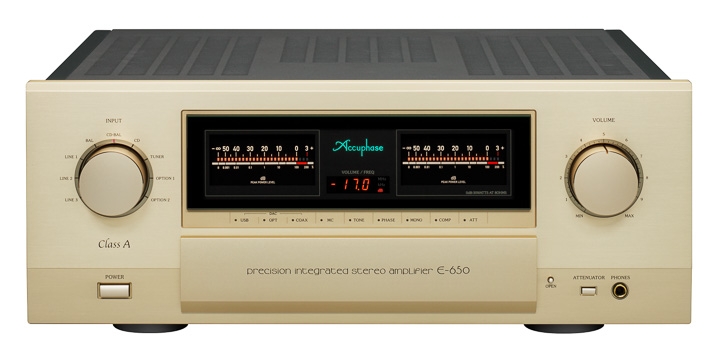
Accuphase E-650 Integrated Amplifier

Having recently spent several happy weeks with Accuphase’s E-370 integrated amplifier for issue 178, the prospect of spending yet more quality time with one of its bigger siblings, the 30W Class A E-650 was too good to pass up. It duly arrived, right in the middle of the global pandemic lockdown, which meant its delivery and receipt had more overtones of Bridge of Spies than is usual for such matters. Still, once here, duly disinfected and installed, one obvious benefit to lockdown is somewhat more time stuck at home and available for music listening.

Accuphase offers two amplifier technologies, Class A/B and Class A, with the Class A models positioned at the upper end of the product range in terms of performance and price. Until the recent introduction of the 50W E-800, the E-650 was the flagship integrated amplifier, offering a conservatively-rated 30W per channel into an 8Ω load, doubling into 4Ω and 2Ω loads respectively. The E-650 uses Accuphase’s proprietary AAVA preamp circuitry, here in dual balanced mode, and the power amplifier employs their ‘instrumentation amplifier’ topology, for fully balanced operation from source input to speaker output terminals.


One rule with Accuphase power seems to be ‘don’t get hung up on the numbers’; the company states ‘guaranteed’ performance specifications, and the real-world performance usually comfortably exceeds these. So Accuphase Watts tend to be beefier than regular Watts, and Accuphase Class A Watts are beefier still. In terms of ability to deliver a satisfyingly visceral musical experience, the 30 Class A Watts of the E-650 easily bested the 100 Class A/B Watts of the E-370. I suspect this is partly down to the fact that Class A is ‘always on’, the power supply delivers the same output regardless of the music demands, so there’s no additional strain in the hot and heavy bits. I’ve heard other Class A amplifiers in the notional 25-30 Watt range, and they all do this to a degree but the Accuphase is definitely one that makes it possible to simply ignore the numbers as, frankly, rather irrelevant.

And that’s as it should be, really. We’re here to enjoy our music, the numbers are for those who have a use for them. Taken together with the low output impedance and high damping factor it all seems more than sufficient, and unless you listen at stadium levels in a room the size of a squash court, the E-650 feels entirely likely to be able to rise to the occasion. It doesn’t seem to run particularly hot, either, which is great when you’re tied to the house and the weather turns warm…


The more I listen, the more I’m becoming undecided about whether there’s a definite ‘house sound’ to Accuphase. Conventional wisdom often describes it as tending to ‘warm’ rather than ‘lean’, though I think that’s a mis-characterisation. I can see where it comes from: take ‘After the Gold Rush’ on Hymns of the 49th parallel [Nonesuch], the bass has real texture, strings are full and lush, the piano has power, a richly sonorous presence, and kd lang’s voice is creamy and full of character. But these are just reflections of the true sounds of the instruments, it’s not any kind of euphonic coloration. I think, rather, that it’s less of a ‘house’ sound, and more about the form of experience. When you listen to live musicians perform, there’s no tendency to analyse the sound as warm, bright, lean, or any of the other adjectives we fumble around with, it just is what it is. And that’s where I find myself with the Accuphase E-650: it’s easy to forget about the sound and just experience the music. Any perceived warmth is the natural warmth of real live musicians, the sort of warmth you experience in a concert hall with a live orchestra: living, breathing souls playing real physical instruments in your presence. The music as rendered by the E-650 simply has more shape, solidity and definition; it is what it is.

The Jacques Loussier Trio’s Theme and Variations on Beethoven Allegretto from Symphony No. 7 [Telarc] is a case in point, it’s not simply that the trio’s phrasing and timing is absolutely on the money, it’s that the whole musical envelope is more natural and convincing. The instruments are richly coloured and three-dimensional, and dynamics and timing are so effortless you don’t even notice. The overall effect is to refresh the music and show it in a new light; old and familiar tracks are newly interesting, but the music is brought out, rather than forensically examined. I didn’t find myself marvelling at the Renaud Garcia Fons trio’s timing on ’40-Dias’ from Arcoluz [Enja], because I was too busy enjoying it’s ‘rightness’ and the renewed sense of intrigue that gave it, right from the opening bars. Listening to Keith Jarrett, ‘Hymn of Remembrance’ from Hymns and Spheres [ECM], it was suddenly apparent that he wasn’t just improvising at the organ, but also making use of the vast and reverberant acoustic space to contribute to the music. These are not subtle musical experiences, but they derive from something being ‘right’ rather than ‘good enough’.


Talking of subtlety, there’s as much fine detail as you could wish for, including those vital ambience cues. It’s not a smooth, airbrushed presentation – any beauty is entirely down to the music. Unlike some more analytical amplifiers, detail isn’t pushed at you for its own sake; it is layered but not separated or highlighted, so the Accuphase seems to trigger the ‘music appreciation’ part of my brain more than the ‘music analytical’ part. You perceive the music as a gestalt rather than as a collection of elements, which is closer to what happens in a live experience. It’s that ‘rightness’ thing again. Key musical touch points: timing, pitch, tonal colour, dynamics, and no doubt a myriad of other parameters such as phase relationships, all rendered just a little bit more convincingly, so the brain has less work to do in maintaining a ‘willing suspension of disbelief’. So, I now find I have the capacity to notice that when Tord Gustavsen plays piano on ‘At Home’ from Being There [ECM], while this is unquestionably jazz, his precision of touch has much in common with classical technique, for example V.kingur .lafsson’s exquisite rendering of Philip Glass Piano Pieces [DG]. And that’s not me getting all analytical again, it’s just the sort of thing I’d notice in a live gig, when I’m engrossed and not having to process the signal just to make sense of it. Dave Brubeck, ‘Unsquare Dance’ from Time Further Out [Columbia] and the little miracle of how everything comes to an end ‘just so’, is even more miraculous when you can hear how the quartet plays with the timing without ever letting it get away from them.

And on the subject of detail, I’ve already mentioned Keith Jarrett’s use of acoustic space, but live albums are also a particular pleasure. The audience appreciation in ‘Hotel California’ from Hell Freezes Over [Geffen], or the applause on Arcoluz [Enja] is not just window dressing, it contributes to the feeling of presence, of an event. And have you ever been to a live gig, then bought the CD and been disappointed?I remember being astonished by a set by a Joshua Redman quartet a year or two ago, but the CD of some of the same music, Compass [Nonesuch], sits largely unplayed. I dug it out again, and the music now makes more sense and I’m starting to remember why they blew me away when I was there.


It helps, of course, if you have the right speakers. I started with the Amphion Argon 7LS floorstanders, and the Accuphase amplifier seems to have the knack of bringing out their considerable talents. Solid, weighty, tight, tuneful bass underpinning a subtly expressive musical message. Happily though, and again thanks probably to a certain global pandemic, I still had the Fyne Audio F702s on hand, which worked so well with the E-370. Twice the price of the Amphions, but fed by the E-650 they were simply captivating. I suspect it’s a feature of Accuphase’s AAVA preamp architecture, but the performance is much less leveldependent than with many amplifiers, too. It’s possible to get this immersive effect even at modest volume. Edvard Grieg, ‘Varen’ [Chandos] had an almost tangible sense of presence even at late night listening levels.

Sometimes you encounter a product that makes you reassess what you expect from your system. That’s just happened to me with the Accuphase E-650. It is transparent, not in the sense that the signal is preserved (though it surely must be), but in the sense that it makes it easy just to forget that it is there at all. There’s just you, and the music. It’s not so much transparent as invisible


TECHNICAL SPECIFICATIONS

  • Type: Solid-state 2-channel, Class A integrated amplifier
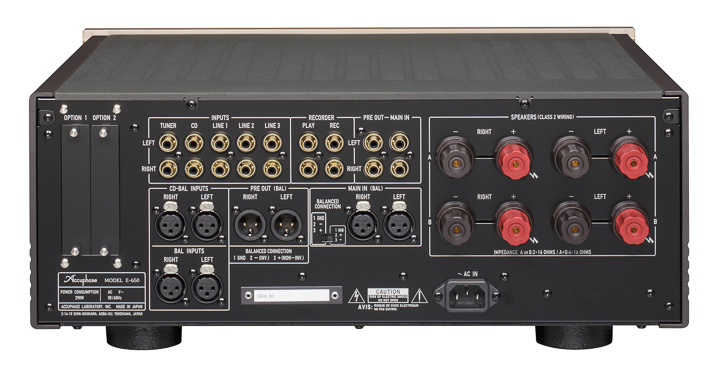
  • Analogue inputs: 5 single-ended line level only via RCA
  • jacks; 2 balanced via BNC connectors; 1 power
  • amp input (for external preamp); Optional mm/mc
  • phono stage board
  • Digital inputs: Optional DAC board: co‑axial, optical,
  • USB inputs
  • Analogue outputs: 1 tape loop; 1 pre-amp output
  • 2 pairs multi-way loudspeaker binding posts
  • Input sensitivity: (line level input) 77mV for rated output
  • Input impedance: 20kΩ
  • Signal to Noise Ratio: 102dB (at max. gain)
  • Frequency response: +0 / -0.5dB 20Hz–20kHz
  • Bandwidth: (@1W output) 3Hz–150kHz +0/-3.0dB
  • Distortion:THD 0.03%, 20-20,000 Hz, 4–16Ω load
  • IMD: 0.01%
  • Rated power into 8Ω: 30 Watts, both channels working
  • Rated power into in 4Ω: 60 Watts, both channels working
  • Rated power into in 2Ω: 120 Watts, both channels working
  • Damping Factor: 800 (8Ω load; 50Hz)
  • Gross Weight: 25.3kgs
  • Dimensions: 191 Å~ 465 Å~ 428mm (hwd)
  • Price: £10,600.00
  • £1,250.00 (optional DAC board)
  • £1,000.00 (optional MM/MC board)

Manufactured by: Accuphase Laboratory, Inc.

Yokohama, Japan

URL: accuphase.com

Distributed in the UK by:Music Works (UK) Ltd

Tel:+44 (0)161 491 2932

URL:musicworks-hifi.com

Dealers

https://hifiplus.com/reviews/

Rupert Neve Designs Fidelice Precision Digital to Analog Converter

If you saw Dave Grohl’s documentary about the Sound City studio in LA, the hallowed ground where Rumours, Nevermind, Damn the Torpedoes and many, many great albums were made, you will have realised that the real star of the show, and the reason for Grohl’s interest was the Neve mixing desk. Rupert Neve is a British engineer who’s still designing at the tender age of 93! Neve sold the original Neve Company in 1976, but he has been very active in the recording business (and mixing desk business) since then. His current company is Rupert Neve Designs, which manufactures high-end mixing desks and recording equipment. ‘Fidelice’ is a sub-brand of Rupert Neve Designs, producing high-fidelity playback equipment. Alongside this DAC, there is currently a headphone amp and phono stage in the Fidelice line.

The Fidelice Precision DAC bucks a number of trends found in contemporary converters, it has no wi-fi capabilities, Bluetooth and Airplay are for kids as far as Rupert is concerned and when it comes to sound quality I’m with him all the way. Just listen when someone switches to BT enabled hands free on their mobile and you’ll get the picture. It has analogue inputs in both balanced and single ended form so can be a preamp for a whole system. There is no mention of Roon readiness but there are extensive notes on how to get good sound from a PC in the manual. It also features seven filter settings and the response curves for some of them are included in the manual. Volume can be controlled with the red knob on the front or switched to line level on the back, the front of this DAC is professionally executed and the back is no different, there are just a lot more connections. Many of them for headphones, three in fact: four-pin XLR balanced, Pentaconn balanced and regular quarter inch jack. 

Despite its comprehensive preamplifier functionality there is no remote control, you literally have to get out of your seat and walk over to the device, however as fitbit users will know this is a good thing. Also a little odd is the absence of a power switch on the front, there is one by the mains inlet on the back and the box is fairly shallow so it’s not hard to reach. There are more switches than usual on the back, including fixed or variable output, variable input gain for analogue connections and the aforementioned filters. The RCA inputs are inverted with red/right at the top and the XLR inputs have TRS jack sockets in the middle for full pro credentials. For this is what the Fidelice is, a pro audio DAC with some audiophile features and a nice box with inlaid wood on top. 

Inside it has an AKM converter chip that’s capable of reproducing PCM up to 32-bit/384kHz and DSD512 (4x), the filter set includes one called AKM ‘high quality sound’ as well as another dubbed DSD high pole. The majority of the filters relate to roll-off and group delay and you can have hours of fun trying the various options, alternatively you can connect to one of the three digital inputs and enjoy your music. Given Neve’s frankly awesome pro-audio credentials and background, it’s odd that there is no AES/EBU digital input, something that’s pretty well de rigueur on hi-fi DACs at this price.


My listening started off with an Innuos Zenith SE server connected to an Auralic Aries G1 and the USB output of that hooked up to the Fidelice, I used fixed output to begin with and noted that that output is pretty high although it is specified as a Red Book 2V RMS. Playing EST’s Live in Gothenburg [ACT] revealed wide dynamic range and clearcut leading edges, the sound is solid and taut with strong dynamics and excellent low end extension. Given that bass is a clear strength of digital audio you would think that it was the easiest bit to get right, but clearly the efforts that many engineers make to voice the critical midrange and treble have a softening/smoothing effect on the bass. That is not the case here, it’s not hard or edgy but it doesn’t hold back and the result is glorious, especially with live recordings where the bass is what gives such events their power, or, the bass isn’t carefully tailored as it often is in the studio.

I tried one of the alternative filter settings to the standard slow roll-off/standard group delay at this point, not realising that the DAC still wasn’t at optimum operating temperature and thus a little more hard edged than it could be. I opted for super-slow roll-off because the graph showed this having a more (but not very) rolled off treble, which did sound more relaxed but ultimately lacked the energy to bring music to life. So I returned to the standard setting and enjoyed the cavernous scale of Leifur James’ A Louder Silence [Late Night Tales], this contemporary piece of electronica has acres of reverb and juicy bass, which sounded very nice indeed on the Fidelice.

In an attempt to focus on the hardware and not be distracted by the music I checked out how the volume control compared with a Townshend Allegri+ passive preamp. The comparison made the passive Townshend sound very clearcut and well defined, the Fidelice volume being relatively soft and vague by contrast. Later on I did the same thing with a Moon 700i integrated by setting one of its inputs to bypass mode, this time the DAC sounded a little congested compared to the onboard volume, but the Moon is a £13k amplifier so you’d expect it to have a decent volume control. 

I also contrasted the USB and coax inputs from the same source but not with same brand cables, so the fact that USB sounded quite a lot more revealing, better defined and timed more precisely could be put down to the CAD USB cable. The result with an Atlas coax cable was very musical however, a bit short on detail but very enjoyable thanks to a warmth that might appeal to some ears. 

Some of the other filter settings were also tried and while the changes were subtle it was always preferable to come back to the setting that Fidelice have chosen for the default. This was also true with DSD where the DSD high pole filter seemed to make the balance more forward leaving the default option sounding more natural. I tried contrasting DSD and PCM versions of Kind of Blue but the difference in mastering outweighed any differences in sound quality, the 192 PMC having a much heavier bass and clearer cymbal work (‘So What’), but it did seem to time better which is something I’ve noted with this contrast in the past.

I really like the way the Fidelice brings out the power and vitality of a good live recording, the EST album mentioned above has an electricity about it that you don’t get with many studio albums and the Fidelice goes a long way to placing the listener in the time and the place of the original event. This is to do with the extension in the bass but also because of its even handed resolving powers, Zappa’s Roxy Performances (Zappa Records) is an ancient recording, but there’s an awful lot of the energy on the tape and this DAC brings this out to compelling effect. 


I like the combination of precision and weight that this DAC brings to the music, it seems entirely neutral but there are always decisions made about which parts to use in an analogue output stage. The difference here is that those decisions were made by people with experience in the recording side of music production, not, as is usually the case, by those trying to make the most of what comes out of the studios. That doesn’t necessarily give Rupert Neve Designs an advantage though, audiophiles are not necessarily interested in the unvarnished truth, we want transparency but not to the limitations in the recording. This is why there are some very smooth and rich sounding products on the market, a lot of people want an aesthetically appealing result when they play their favourite records, but embellishing digital sound for this purpose often gets in the way of the power and energy in the music. By virtue of its designer’s pedigree the Fidelice gets us pretty close to what the artist hears in the studio, this may not be as sweet as is found with many high end converters but it’s probably closer to genuine high fidelity than most. 

TECHNICAL SPECIFICATIONS

Type: Solid-state high-resolution PCM, and DSD-capable digital-to-analogue converter/preamplifier

Digital Inputs: One Coaxial, one Toslink, and one USB

Analogue Inputs: One stereo single-ended (via RCA jacks), one balanced (via XLR connectors)

Analogue Outputs: One stereo single-ended (via RCA jacks), one balanced (via XLR connectors). Both outputs are configurable for fixed or variable level operation

DAC Resolution/Supported Digital Formats: All PCM from 44.1KS/s to 384KS/s with word lengths up to 32-bit, DSD64 (2.8224MHz), DSD128 (5.6448MHz) and DSD 512 (22.4MHz)

Frequency Response: 5Hz–112kHz, ± 0.1dB (unbalanced RCA jacks) 

Distortion (THD + Noise): <0.0003%, 10Hz–22kHz (unbalanced RCA jacks) 

Output Voltage: not specified

Headphone output impedance: 0.02 Ohms (via 4-pin XLR connector), 0.01 Ohms (via 1/4inch unbalanced jack)

User Interface: front panel LEDs

Dimensions (H×W×D): 89 × 450 × 235mm

Weight: 5.5kg

Price: £4,749

Manufacturer: Fidelice, by Rupert Neve Designs

URL: fidelice.com

Tel: +44 (0)7860 153950 

Cyrus One Cast Integrated streaming amplifier

Having a ‘lifestyle’, rather than a plain old-fashioned ‘life’, can make significant demands on your possessions. After all, if you just live a ‘life’, then your belongings are simply part of it. Aspire to a ‘lifestyle’ and suddenly everything you own has to complement it and enhance it. Simple functionality is no longer enough when you’re enjoying a ‘lifestyle’.

For some of the more dogmatic brands involved in the hi-fi industry, the ideal of ‘lifestyle’ is anathema. If concessions are going to be made, they’ll be made by the lucky owners of these manufacturers’ products rather than the other way around.

But more sensible – or pragmatic – audio companies accept there’s no longer any virtue in complexity for its own sake. Consumers’ lifestyles don’t allow for it. Products have to be simple to set up and operate, wide-ranging in their functionality, and impeccable in their performance. Because if they’re not, then they’re hardly enhancing their owners’ lifestyle. Are they?

Probably the most resonant recent example of a previously rather hairshirted company seeing the ‘lifestyle’ light and amending their products accordingly is that of Naim. Its ‘Uniti’ range of streaming amplifiers has done wonders, both for the company’s profile and its balance sheet, and at the same time has made a few nominal rivals look rather like Luddites.

Mind you, Cyrus – to choose a brand not entirely at random – has, perhaps inadvertently, been pandering to the lifestyle-obsessed ever since its very first product launched in 1984. The Cyrus One amplifier set the Cyrus ‘half-width/shoe-box’ design template, and the company has enjoyed this particular USP ever since.

36 years is a fair while, though, even in two-channel hi-fi. To keep up with Naim et al, and to convince lifestylers of its credentials, Cyrus has served up the One Cast. It’s the usual half-width box comprising amplification and extensive connectivity, including streaming–on paper, at least, it has everything it needs to compete in this brave new lifestyle world.

‘Everything’, in this instance, means 100 watts per channel of Class D amplification with a heady 78 amps of instantaneous current available. It means a fair number of physical inputs: digital optical, digital coaxial, HDMI ARC, stereo RCA line-level and stereo RCA moving magnet phono stage. There are a pair of stereo RCA analogue outputs for connection to a power amp, and chunky speaker binding posts for just a single pair. It also means aptX Bluetooth, Apple AirPlay 2 and wi-fi connectivity for use with any Chromecast-compatible apps and services. Even Amazon’s Alexa gets a look-in.

The USB is a Type-B socket you’re probably more used to seeing on the back of a printer. Connected to a laptop, it can handle incoming digital files of up to 32bit/192kHz or DSD128 standard–both the optical and coaxial inputs are restricted to PCM stereo only. All incoming digital signals are dealt with by a 32bit/192kHz (and heavily breathed-on) ESS Sabre DAC.


What ‘everything’ doesn’t include is an Ethernet socket. The One Cast has a pair of Wi-Fi aerials, can operate at 2.4 or 5GHz and proved rock-solid in its connectivity during this test–but still, we’re all serious people aren’t we? Is the lifestyle market really so cavalier about signal stability?

Control of wireless devices is via the app of the relevant streaming service, and the basics can also be controlled using voice commands–the One Cast can be prompted if there’s an Amazon Alexa or Google Assistant mic-equipped device on the network or can be Siri’d via an Apple HomePod. If all else fails, though, the Cyrus is supplied with a basic remote control that feels as inexpensive as it looks.

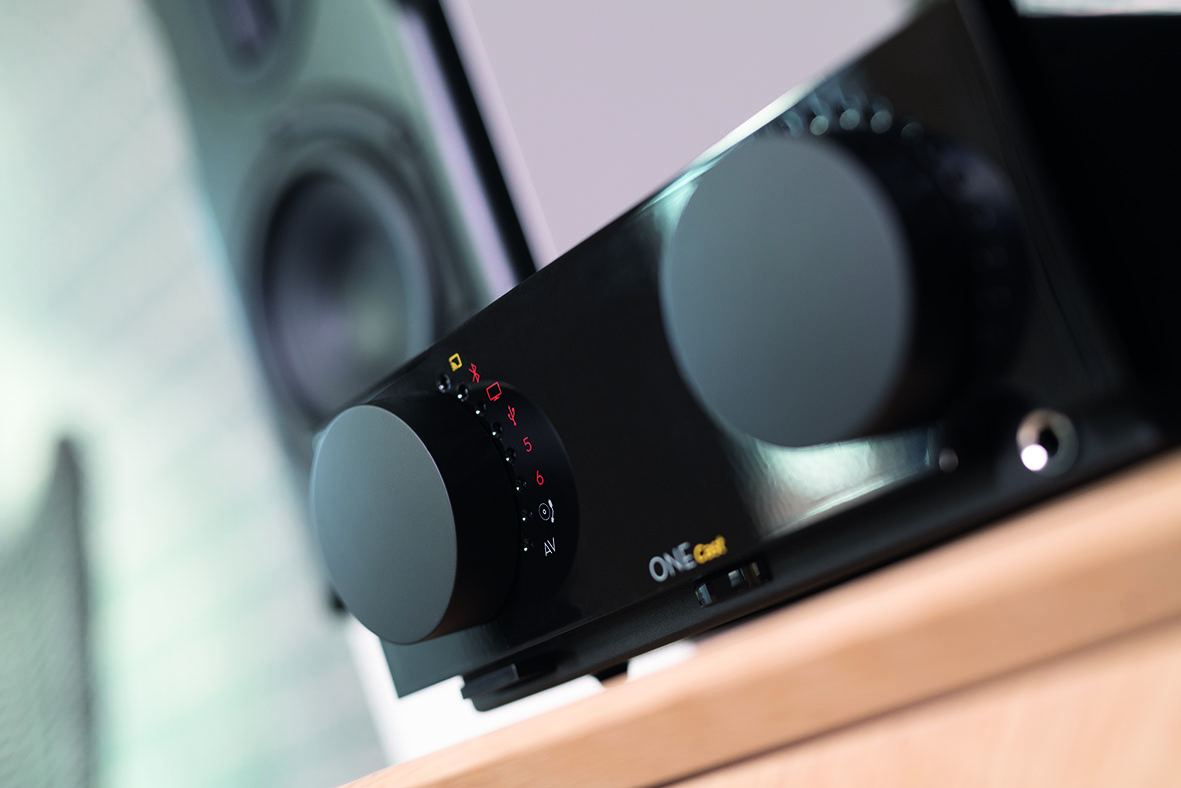
The ‘look’ and ‘feel’ undermine the One Cast a little. While we’ll soon come to just how great the Cyrus sounds, it doesn’t make much of a case for itself where looks, ergonomics, finish or (to a far lesser extent) build quality are concerned. For example, the lacquered plastic that forms the fascia resonates if tapped with a fingernail, while the two big control dials that govern input selection and volume feel no more luxurious. Meanwhile, the lights that indicate the volume level and input selected are a nice enough touch, but for some inexplicable reason Cyrus has chosen very small, unilluminated icons to indicate input.

Three of those inputs (Chromecast, turntable, and the analogue line-level input marked ‘AV’) are in white, and the other five (Bluetooth, HDMI, USB, optical and coaxial) are in that traditional Cyrus tricky-to-read dark red. They’re very difficult to see under normal domestic lighting conditions, meaning you either commit the sequence of inputs to memory or be prepared to shine your smartphone’s torch on them every time you want to change input. That being said, this graphical layout gives it minimalist chic, something Cyrus does well.

On the rear panel, everything is well laid out. However, in the review sample the HDMI and USB sockets weren’t quite central in their cutaways, and the digital optical Toslink input wasn’t level. In and of itself, this is hardly a catastrophe, and speaks of an early sample. And, as a reviewer, I would far rather see a “warts ‘n’ all” sample that was one of the earliest models (which usually end up as dealer demonstrators) than a pimped up hot-rod made specifically to impress the reviewer. But, regardless, these minor fit and finish shortcomings should be noted.

These shortcomings are doubly frustrating–because in purely sonic terms, the One Cast has plenty to recommend it and sounds like it’s worth the money all day long.

All it needs is some appropriately talented (and priced) speakers strapping on to form a system. Alternating between Acoustic Energy AE1 mkIII SEs and KEF LS50s, and between QED XT40i and Atlas Equator 2.0 speaker cable, allows the One Cast to confirm itself as a rapid, lavishly detailed and whippet-lean listen in the long-established Cyrus manner.

Chromecasting to the One Cast is a simple here as it is with any other Chromecast product. Once the Cyrus is on the wi-fi network, simply fire up the app of your favourite streaming service on your phone or tablet. Then all that’s required is a tap of the ‘cast’ icon. Spotify, Tidal, Apple Music, Deezer and Qobuz are all available in this painless and intuitive manner, as well as a stack of podcast providers and so on. We didn’t spend long with Amazon’s app, however, simply because Alexa’s music-wrangling properties fall into the ‘must try harder’ part of the report card.

With DJ Shadow’s Walkie Talkie [MCA] casting from Tidal via a Sony Xperia 5 smartphone, the One Cast fairly motors along. Like every digital Cyrus product (and, let’s be honest, the majority of its analogue products too), it puts the emphasis on precision, detail and manoeuvrability. It’s conceivable you’ll encounter more meat on a butcher’s pencil than on the One Cast’s low-frequency reproduction, but that’s not to say it lacks extension. And it’s certainly not lacking detail–the textures and second-stage dynamics of the tune’s kick drum and grimy analogue bass synth sounds are unambiguous. But there’s just no fat on the One Cast’s bottom end – it has the profile of one of those rangy long-distance runners rather the power-packed, muscle-bound weightlifter alternative.

It’s similarly balanced through the rest of the frequency range. Lawrence’s vocals throughout Felt’s Forever Breathes The Lonely Word [Creation] aren’t done any favours in absolute terms–the poor lad’s just not much of a singer. But the Cyrus allows all his character, all his effort and all his commitment to shine, and the result is thrillingly informative. And though the organ is right at the front of the mix too, the One Cast doesn’t sound in any way crowded. It lays out a properly defined stage and allows every element a bit of breathing space.

Broadly speaking, the fundamentals of this sound–the deftness, the sheer quantity of information, and the even-handed tonal balance–is maintained across the Cyrus’ physical inputs too. Everything from a heavyweight reissue of Can’s Tago Mago [United Artists] via the phono stage to the blaring, grinding soundtrack of Christopher Nolan’s Inception [Warner Bros] using the HDMI ARC socket sounds full (but not rich), fast (but not hurried) and subtle (but not analytical). The headphone amp (accessed via a 6.3mm socket at the bottom right of the fascia) is similarly talented and enjoys a similar sonic balance.


Despite the emphasis on alacrity, the Cyrus has no difficulty managing the club-footed rhythm of My Little Airport’s Love Is Not A Romantic Song [Harbour Records] or knitting the many disparate threads of Talk Talk’s Laughing Stock [Verve] into a convincing whole. This facility with timing consolidates the Talk Talk album into a unified statement, despite the One Cast having sufficient insight to occasionally allow you to hear the join, or the splice, where different takes have been bolted together.

So as far as audio quality is concerned, the Cyrus One Cast needs no excuses made for it. The company’s specific sonic flavour is evident throughout, and while it’s an acquired taste, years of Cyrus amps prove that’s an easy taste to acquire and there’s more than enough here to keep many a listener coming back for seconds. With the debatable exception of the missing Ethernet socket, it’s hard to pick a hole in the way the Cyrus is specified, too – the One Cast could conceivably form the heart of an expansive two-channel system for years to come. (In fact, thanks to ‘AV Direct’ mode it can power the front channels of a home cinema set-up too). 

Flexibility, and thoroughly enjoyable audio performance? Is that enough for you? Cyrus will have its fingers crossed–because if you’re going start bringing up all the other stuff, about finish and perceived value and other intangibles, then it’s possible you’ll pass the One Cast by. Which, while understandable, would be a pity. 

TECHNICAL SPECIFICATIONS

Type: Solid-state, two-channel integrated amplifier

Analogue inputs: One MM phono input (via RCA jacks), one single-ended line-level input (via RCA jacks)

Digital inputs: Two S/PDIF (one coaxial, one optical), one USB port (Type B), HDMI ARC, wi-fi (2.4/5GHz), aptX Bluetooth, Apple AirPlay 2, Google Chromecast, Amazon Alexa

Analogue outputs: One pre-power loop (via RCA jacks), one 6.3mm headphone socket

Supported sample rates:

Coaxial and optical S/PDIF: 16-bit, 24-bit/32kHz–192kHz

USB: 16-bit, 24-bit, 32-bit/32kHz–192kHz

Input impedance:

High-level: 47kOhms

Phono: 47kOhms, 50pF

Output impedance (preamp): 47 Ohms

Headphone Loads: min 8 Ohms

Power Output: 120WPC @ 6 Ohms

Bandwidth: Not specified

Distortion: THD </+ 0.02% with both channels driven (1kHz, 33% power)

Signal to Noise Ratio: 95dBA

Dimensions (H×W×D): 86 × 220 × 390mm

Weight: 5.2kg

Price: £1,295

Manufactured by: Cyrus

URL: cyrusaudio.com 

Tel: +44(0)1480 410900

Allnic Audio ZL-5000 power cord

I’m more disposed toward reviews of complete cable systems than individual cables, but Nicholas Ripley’s review of Allnic’s clever Zero Loss Technology in the ZL-3000 power cord piqued my interest, so it’s time to try out the flagship. 

To recap, Allnic’s ‘Zero Loss Technology’ system was designed to minimise or eliminate signal losses by functionally by-passing three regions where active cable resistances might muster — connection, contact and wire.  To overcome resistance issues in connection, many companies deploy a cold-welding system, but Allnic goes in the other direction; welding at 1000°C between terminations and conductor. That way, Allnic can eliminate solder joints or screw-in terminals, which is especially useful in power cord terminations. It also uses a Four Surface Contact IEC receptacle instead of the line contact clips commonly found inside IEC plugs. Both terminations feature beryllium copper, with rubber insulation between the wires for safety at high temperatures (useful in the unlikely event that the cable is in an unprotected open-short state).

In the cable itself, Allnic uses large gauge nickel-plated oxygen-free copper conductors set in a double-shield of aluminium and nickel-plated alloy and copper mesh rather than conventional screens and shields for the power cords. This was chosen because while copper or silver are fine electrical shields, they are still influenced by magnetic fields; this three-metal shield is less magnetically prone.

Allnic presents the ZL-5000 in the way all good cables should be packaged; kind of like a gift, but not in an overtly ostentatious way. The box is a hefty slip-case with a warranty card and the cable in its own black velvet bag. The cable itself is relatively thick, although by audio-anaconda standards, not so much, and there are no flattened carbon-fibre ducks, 1980s hard drives, or designer soda cans set into the cable. Perhaps this is why although the cable represents the top of Allnic Audio’s power cable range, and has all the trimmings of super-exotic wire, the price is not in the “you can get a new BMW for that much!” level, even if its performance certainly does reach the top tier.

What first strikes you about the Allnic Audio ZL-5000 power cords is just how well-balanced they are. These are impressive performers by dint of being extremely expressive and subtle, but without having any obvious tweaks to the performance of the equipment. If you are rebuilding your system from the cables outward, and doing that step-by-step instead of a single, substantial investment, it’s usually best to start from the amplifier or even preamplifier outward. This is because they are the nerve-centre of every system, and some of the most demanding in power delivery terms. In addition, preamplifiers are the hardest nut to crack in audio, and if a cable gets it right here, it gets usually gets it right throughout. I used the ZL-5000 from the amps on out. 

The ZL-5000 maintains a very deft touch on the music, with a strong accent on detail resolution, but not at the expense of warmth or musicality. What I found particularly attractive was the way it could help unmask subtle microdynamic cues in the musical performance, ones that usually lurk at or just below the sonic waterline. Here, quiet finger squeaks can be clearly picked out over the acoustic guitar onslaught of Rodrigo y Gabriella’s ‘Diablo Rojo’ from their eponymous album [ATO]. This recording also highlights the impressive amount of detail these cables deliver (more accurately, the impressive amount of background hash they remove allowing all that detail to shine through). And yet, for all this immediacy and detail, these aren’t overly bright or forward and ‘shiny’ sounding power cables. They are neutral and natural sounding; normally functions that take time to reveal themselves to listeners, especially in the context of a power setting. Here they shine out, but without being overly flashy. That makes them ideal for playing good jazz (of course… Everyone Loves Bill Evans, and almost every system loves to play his music because it sounds so good), but more importantly the ZL-5000 brings that even-handed naturalness to less than natural-sounding music. I played ‘Pale Green Ghosts’ by John Grant (from the album of the same name, Bella Union records) and the lo-fi electronica (all buzzes and bleeps) were given the same honest treatment. There’s almost nothing on the track (Grant’s voice aside) that isn’t electronic or heavily treated so there is no ‘absolute sound’ baseline to check against, but the recording ‘seemed’ more like the real deal than often heard at this price.


ZL-5000 is possibly not the first choice for those looking to recapture their early years of punk or thrash metal. When something gets that spikey, nothing can really change it. Playing ‘Theme from Sparta FC’ by The Fall [Live at the Knitting Factory, Hip Priest] sounds like it was recorded in a garage with a broken tape recorder, and nothing will change that. But the ZL-5000 doesn’t get in the way of the raw energy, which is a good thing.

My only regret with the Allnic cables is there is at present no UK plug option, only EU/Schuko and US plugs. With the uncompromising stance put upon the plug by Allnic, I can’t imagine seeing a ZL-5000 with a Furutech plug any day soon – it kind of defeats the object of at least part of the exercise. If enough UK audio enthusiasts express an interest, that plug will happen; otherwise from a strictly legal perspective, you are going to have to use them with Schuko plugs with an adaptor, or conversion plug. Which defeats the object in a different way.

Fully half our readers fall into the other two territories however, and they don’t get the benefit of the ZL-5000 in its native form. The Allnic cables are the perfect answer to the power cord sceptic, as the difference in performance is marked, easy to spot and entirely positive in sound quality. Granted the willfully tin-eared will not hear a difference, but those who hear differences between amplifiers can hear similar grades of improvement brought about by the ZL-5000. It’s hard not to be impressed by their innate sense of rightness, making the sound of a good system really come to life, but without over-exaggerating anything. 

TECHNICAL SPECIFICATIONS

 Allnic ZL-5000 power cord: 
$2,000/1.8m (20A version $2,200)

Additional 0.5m is: $150

Power connections: 
Schuko/US male plugs only

Manufactured by: Allnic

URL: allnicaudio.com

Globally Distributed by: 
Hammertone Audio

Tel: +1 250 826 6872

URL: hammertoneaudio.com

Music Interview: Jerry Leger

Canadian singer-songwriter Jerry Leger is a voracious collector of vinyl records. When I spoke to him on his last UK tour, ahead of a gig with his band, The Situation, in East London, he told me: “When I get into a record, I dissect it – I listen very closely to it and it means something to me. Over a beer, I can talk all night about music I love.”

His new record, Time Out For Tomorrow, has been heavily influenced by two albums that he adores – Lou Reed’s Coney Island Baby and Nick Lowe’s The Impossible Bird. “Coney Island Baby was the first solo Lou Reed record I heard. I think it was my brother, Shawn, who bought it at a garage sale or something. I was still pretty young, maybe 14 or so. I had got into The Velvet Underground a couple of years earlier,” he says.

“It’s an album that has always stuck with me. It’s not trying to prove anything – it’s there to discover. I love the production, especially the drum sound, which is what I really wanted on this record.”

He adds: “Nick Lowe’s The Impossible Bird is just a beauty of an album. It has a wonderful bright sound to it. I get the same feeling listening to an Everly Brothers or Jack Scott record. 

“Have you ever listened to Jack Scott? He was one of the first Canadian rock ‘n’ rollers to break through abroad and he’s one of my dad’s favourite singers. I suppose he influenced me to some degree. I know my parents did, musically. They have great taste in music. When my parents like my album, then I know I’ve made a good one.”

Image by Laura Proctor

Time Out For Tomorrow – the ninth studio album by Toronto-based Leger – should meet with his parents’ approval. It’s a brilliant record – from the Dylanesque country-rock of first single ‘Canvas of Gold’, to the melancholy, piano-led ballad ‘That Ain’t Here’, the blues-folk of ‘Burchell Lake’ – inspired by a ghost town in Ontario – and the haunting mountain tune, ‘Survived Like A Stone’ – with fiddle and saw – these are raw, powerful and emotional songs that deserve to be heard by a much wider audience.

Through a gruelling touring schedule, Leger has slowly started to build up a following in the UK and Europe. In spring 2019, he released a limited edition, retrospective compilation album, called Too Broke To Die, which was put together especially for the European market and was available to buy from his merchandise stall. 

Six months after our first meeting in London, I caught up with him again to talk about the making of his latest album and find out more about the influences behind it…

SH: Could Time Out For Tomorrow be the your ‘breakout’ album?

JL: I hope it does – just to make it easier to keep travelling and making albums. I certainly think that there are enough people that would dig it to make that happen, but it’s hard these days. Once upon a time the music would come to them, now they gotta dig for it, unless there’s a lot of money behind it, pushing it. We’ll definitely be back [in the UK and Europe] in the spring. We’re just starting to figure that out. I’m really looking forward to it.

2018’s Nonsense and Heartache, was a double album – the first half had a raw, electric, blues feel, but the second half was much more stripped-down and alt-country. The new album feels less bluesy and more Americana… 

Yeah – that’s a fair comment. I think the Nonsense portion of Nonsense and Heartache was basically a blues record. It’s just where I was at for those sessions. They’re all kind of blues records, but this one swings more.

With 10 tracks, it feels very direct – it doesn’t mess around…

The last record was a double because we were making two very different records at the same time. [Producer] Michael Timmins said, “why don’t we just release them together under the same roof?” I knew this one was gonna be a single album and I wanted it to be short and sweet – to say what it needs to say and then move on to the next thing.

Some of my favourite albums are doubles for the reason that the artists do it because they need to let it all out at that moment, for better or worse. On the other hand, some of my favourite albums are the ones where they’re there and then they’re gone – just like some of the best memories you have. You get a natural high and all you wanna do is re-live it. I wanted to make a record like that – that made you feel good.

Your basic band set-up on this album is very mid‑‘60s Bob Dylan…

Bob Dylan has influenced everything and everyone, whether they like it or not. As Warren Zevon once said, ‘He invented my job.’ Having said that, it wasn’t anything intentional. We just have a good buddy, Alan Zemaitis, who plays the organ like you’ve never heard. He recently played with Buddy Guy in Chicago, and Buddy gave him the nod and thumbs up. I really wanted him as part of the family on this record.


How were the recording sessions? 

Smooth and quick. It basically took a week, but a few tunes were recorded during the rehearsals and they ended up as final takes. Unlike the other records, the band and I met up more to try out different arrangements of the tunes or hammer out parts that we really dug. There was still spontaneity and some songs were re-arranged on the fly, but we definitely took more time finding the world each song lived in. We recorded it at the Cowboy Junkies’ studio, The Hangar, in Toronto.

What’s Michael Timmins (Cowboy Junkies) like to work with?

He doesn’t interfere, but he’ll suggest things when he feels like he needs to. A lot of times he’s right. I trust him. There are only a handful of people that I really trust with my music. I think this record is the closest sound-wise that I’ve ever got to what’s in my head. You can never get there 100%, but I’m very proud of it.

Did you have many songs left over from the album sessions? 

Yeah – every record has that. Sometimes the best song is dropped because it just doesn’t fit. This record had about eight or nine other tunes that didn’t make the cut. They were some of my favourites, but I trusted the vision of the album. 

Are all the songs on Time Out For Tomorrow new, or do some date from a while back?

There was just one song, ‘Tell A Lie’ that we recorded for the last album. I knew it didn’t fit, but I also knew that it had something – a great chorus and feel, so we re-recorded it for Time Out For Tomorrow. The rest of the songs were new. I wrote ‘Canvas of Gold’ days before we started recording.

The title of the new album is taken from a ‘60s dime store collection of sci-fi short stories that a friend gave you. Why and how did that inspire you and why did you feel it summed up the record?

I just couldn’t get the title out of my head. It seemed to make sense to me for this record. Sometimes I know exactly what it means and sometimes I think it could be something else. I dig that.

The first song on the record – and also the first single – is ‘Canvas of Gold’. Is the song autobiographical?

Well, my dad had a rough upbringing – not a lot of money in a very full house in St. John’s, Newfoundland. He always worked very hard – he did a few jobs to make sure that we didn’t grow up the same way. His work ethic is still inspiring to me. He always had pride in what he was doing. My Dad was no sell-out. 

As a full-time musician trying to earn a living, do you feel like a hustler?

Yeah. Life is a hustle for people that don’t rely on luck, or rely on someone to create the illusion for them.

One of my favourite tracks on the album is ‘Burchell Lake’, which was written about a ghost town in Ontario. Can you tell me more about the song?

I read about Burchell Lake in a book on ghost towns, which was written by Ron Brown. The gas station was still there, with some products left behind on the shelves, a row of houses, a general store… I wrote the song in five or 10 minutes. ‘Burchell Lake’ just seemed like a song that needed to be around. 

The song ‘Survived Like A Stone’ has a folk feel to it and a fiddle and a saw on it. It has an eerie and dark atmosphere, and sounds like a mountain ballad… 

I wrote it on piano, but it felt better on guitar. I pictured it in an old Western film – coming off the mountains. That’s why the choruses have that atmosphere to them. Once Upon A Time In The West is one of my favourite movies and I love Ennio Morricone’s scores. I really like the words to ‘Survived Like A Stone’. I thought it was a cool idea – stones and rocks, some have been here forever and we come and go. There are spirits in those stones…

Would you say this album is more personal than some of your other records? It feels like it is…

I think they all have a degree of that. It’s intertwined with make believe and random thoughts, too. 

What music are you currently enjoying? You’re a big record collector. Have you bought any vinyl recently?

I’ve been listening to a lot of Butch Hancock. I finally got my hands on a few of his albums – they’re not easy to find. I was in Newfoundland recently and picked up an album by a legendary artist from there named Ron Hynes. When you get a chance, check out a song called ‘1962’. It’s beautiful.

Image by Laura Proctor

If you could get some ‘time out for tomorrow’, what would you do?

Probably just write more songs, or maybe try and write and direct a good, old haunted house movie. Something that is simple and creepy. I hope that someday someone asks me to write music for a spooky film. 

Time Out For Tomorrow by Jerry Leger is out now on Latent Recordings. https://jerryleger.com

All images by Laura Proctor

The reopening of the hifi industry

From the Clarity press release:

100% of hi-fi retailers surveyed by Clarity, the UK hi-fi industry trade association, have confirmed they have, or are, re-opening their shops following the government’s easing of the lockdown rules.

“Music lovers and hi-fi fans will now be able to once again visit their local hi-fi retailers and indulge their passion for better sound and better gear,” says Tom Barron, chairman of Clarity.

In a survey conducted in the run-up to the 15th June date set by the government for the reopening of non-essential retailers, the industry was asked how it has been affected by the lockdown, what efforts were made to continue trading and what its plans are for the reopening of shops.

Unsurprisingly the general trend seen was a reduction in customer spending, for both retailers and manufacturer/distributors, but no companies reported a complete cessation of business activities. The majority of respondents reported that business had continued during lockdown, but with slightly reduced levels of sales. A big switch to online selling and click and collect was evident, which helped mitigate the effects of having to close down retail outlets.

A number of manufacturers and distributors had responded to the needs of their retail customers by instigating a ‘drop-shipment’ model, where retailers were able to order products to be delivered direct by the supplier.

Looking at the measures being put in place to enable the re-opening of traditional bricks and mortar hi-fi shops, the vast majority of companies have introduced PPE for staff, hand sanitiser for customers and staff and greatly increased cleaning, particularly of frequent contact points like door handles, washrooms, display/demo products and remote controls. In order to maximise protection for customers and staff alike, government guidelines regarding queuing systems, distance markers and limits to the number of people allowed into the shops are being put in place. A number of retailers have moved to an appointment only system.

Tom Barron adds, “I am very pleased to see the retailers making concerted efforts to make the environment as safe as possible for shoppers and staff. We operate in a very people-focused business, where personal contact and consultation is key to helping customers achieve their aims and requirements. And, while it is obviously going to be impossible to continue with business as normal, the retailers will all be doing their best to make the hi-fi experience as enjoyable and rewarding as they possibly can.” He continues, “Over the past few months it has been heartening to see how resourceful the retailers and manufacturers have been in helping customers with their hi-fi requirements – a sign of what a great industry it is that we work in and the excellent levels of service we collectively offer.”

Chord Electronics’ Gofigure app for 2go and Poly updated and ready for new 2go firmware roll out

25th June 2020, Kent, UK: Chord Electronics’ Gofigure set-up app for the company’s portable streamer/servers, Poly and 2go, has been updated to provide better performance across a number of key areas. The update forms part of the Kent company’s commitment to a continual improvement programme for its network audio products. The new version of Gofigure also prepares the new 2go streamer/server for a forthcoming firmware roll out. 

The latest version, Android 1.2.90 and iOS 2.05 for iOS, benefits from enhancements to AirPlay, Wi-Fi and MPD, as well as several improvements affecting playlists, battery status and network switching. 

The new and improved version of Gofigure has been released on both Android and Apple platforms simultaneously and can be downloaded directly from the Google Play Store and Apple’s App Store; users are advised to undertake a fresh install for best results. iOS 13 and Android 7 (or higher) are also recommended.

2go users are strongly advised to update to the latest version of Gofigure, in order to optimise their devices for new 2go firmware (the first since the product’s January debut) which will automatically roll out via an over-the-air update this month.


About Gofigure

Gofigure is an intuitive configuration app for Poly and 2go that provides easy network set-up and simple settings management, all within a slick and powerful interface. The app offers effortless navigation through both 2go’s and Poly’s main configuration options and benefits from an easy-to-use set-up wizard. 

Gofigure is a configuration companion, designed to complement existing third-party control point (playback) apps, such as mconnect and 8 Player. Gofigure simplifies many of 2go’s and Poly’s advanced processes, and offers simple control over the various set-up options, in one simple app.

Gofigure’s wizard makes it easy to configure both new and existing devices to available Wi-Fi networks, quickly enabling music playback. The wizard also facilitates direct Bluetooth set-up and playback, and also offers step-by-step configuration using Hotspot Mode. 

Price and availability

Gofigure is free and is available now for iOS and Android devices: search ‘Gofigure’ 

Media contact: 

Dan George +44 (0)7899 808918 or [email protected]

Chord Electronics contacts for publication

Tel: +44 (0)1622 721444 
Email: [email protected] 
Web: www.chordelectronics.co.uk

About Chord Electronics Ltd

Chord Electronics Ltd is a world-leading manufacturer of high-performance hi-fi and audio products. Since 1989, from its spectacular riverside base in Kent, England, Chord Electronics has been creating some of the planet’s finest hi-fi, home cinema and professional audio equipment. A technology-driven innovator, Chord Electronics continues to deliver excellence through exemplary audio engineering, cutting-edge design and a true aesthetic understanding. 

Chord Electronics is trusted and admired inte­rnationally and its global customer base includes: Metropolis Studios, Abbey Road Studios (London); Sony Music Studios (New York), Skywalker Sound (California) and more. www.chordelectronics.co.uk

Bowers & Wilkins 700 Series Signature

Earlier this month, we attended an e-press conference about the two new models forming the 700 Signature range. This is not a replacement to the 700 Series nor is it intended to be an alternative or a replacement to the 800 Series. Instead, it takes two of the most popular models in the existing 700 Series, and uses concepts seen in limited-edition Signature models from the brand. However, as these Signature models have traditionally improved upon existing top-end models (such as the Silver Signature of the early 1990s, which developed the then-current version of the popular 805 stand-mount) it’s easy to see where some of the confusion lay.

Traditionally, the Signature editions have been released during significant years for the brand (such as its 30thanniversary). The 700 Signature coincides with Bowers & Wilkins 54th year in business, so we’re not quite sure as to the historic company event this Signature model celebrates. Regardless, we’ve got a pair coming for review soon… so watch this space!

From the Bowers & Wilkins press release: 

Worthing, England, 10th June 2020: Signature product launches are rare and special events in Bowers & Wilkins’ 54-year history, but when the world-leading specialist audio brand attaches the name Signature to its loudspeakers, you can be sure the results are very special.

This month sees the introduction of two new Signature versions of premium loudspeakers from the Bowers & Wilkins 700 Series range: the stand-mount 705 Signature and floor-standing 702 Signature. 

The new 705 Signature and 702 Signature models share a common philosophy with their predecessors: like previous Signatures, the new models are carefully upgraded and lavishly finished loudspeakers that represent the apex of current Bowers & Wilkins design, engineering and manufacturing processes. A huge amount of care and attention has been paid to improving their acoustic performance via an upgraded crossover design, and also to carefully crafting the luxurious new cabinet finish.

Launched in 2017, the elegant Bowers & Wilkins 700 Series range of speakers already delivers exceptional performance thanks to its careful use of technologies first seen in the high-end 800 Series Diamond, such as the Solid Body Tweeter-on-Top assembly, unique Continuum cone drivers and Aerofoil profile bass drivers. Used in combination with bespoke 700 Series technologies such as the Carbon Dome tweeter plus carefully optimised and rigid cabinets, the result is a range of loudspeakers as superb to listen to as it is to look at. 

As Signature products, the new 705 & 702 Signature have received further, detailed improvements enabled by upgraded crossover designs and components. 

Both models now feature specially treated and upgraded bypass capacitors sourced from Mundorf, larger heatsinking and, in the case of the 702, an upgraded LF capacitor on the bass section of the crossover. In tandem with the immense benefits both models enjoy as a result of their Tweeter-on-Top configuration, these upgrades improve the already-remarkable resolution, openness and spatial retrieval on offer, lending them an even-more polished, refined and involving sound.

Upgraded finish 

Keeping up with established Signature practices, the 705 and 702 Signature boast a stunning new Datuk Gloss ebony-coloured veneer with a distinctive, beautiful grain. This custom-designed finish combines the beauty of exotic real-wood veneers with the environmental benefits of a sustainably-sourced supply, in this case from specialist Italian wood company Alpi. 

Each pair of speakers is unique, with no two models sharing the same grain pattern or figuring. Bowers & Wilkins adds to Alpi’s painstaking workmanship by applying nine coats of finish – including primer, base coat and lacquer – to create a deep, lustrous appearance. To further accentuate and highlight the quality of finish on each model, both Signature speakers have bright metal trim rings around the mid/bass and midrange cones plus bright, silver-finished tweeter grilles. Finally, both models have a Signature identity plate to their rear panel, turning each speaker into a genuine and unique piece of art.

Exceptional engineering on-board

Carbon Dome Tweeter 

Both 700 Series Signature models feature Bowers & Wilkins Carbon Dome tweeter technology. Designed to bridge the performance gap between the Aluminium Double Dome used in the 600 Series and the Diamond Dome used in the 800 Series Diamond, the Carbon Dome is composed of two sections. The front portion is a 30-micron aluminium dome that has been stiffened by a PVD (Physical Vapour Deposition) coating of carbon. The second section is a 300-micron carbon ring that has been profiled to match the form of the main dome. This is then bonded to the inner face of the structure. The outcome is exceptional stiffness and resistance to distortion without undue mass and a first break-up point of 47kHz.

Solid Body Tweeters 

As with all preceding Signature products, the 705 Signature and 702 Signature are Tweeter-On-Top designs featuring, in this case, Solid Body Tweeter technology. This design is derived entirely from the approach used

in the 800 Series Diamond and has the same performance benefits. As with the 700 Series speakers, instead 

of using a hollow zinc housing, the new Signature models use the same shape milled from a solid mass of aluminium to provide a stiffer and less resonant structure. Weighing over 1kg, it is exceptionally inert, and benefits from the same decoupling mechanism and acoustically transparent grille design as the 800 Series Diamond. This design also allows the use of the mass of the tweeter body as a heatsink for the dome.

Continuum cone 

Continuum cone midrange drivers were first seen in the 800 Series Diamond. The Continuum cone’s design is based on the concept of optimised and controlled flexibility. This helps the cone to avoid the abrupt transition from pistonic to break-up mode behaviour that drastically impairs the openness and neutrality of a conventional drive unit. Continuum is a woven composite that gives highly controlled break-up, for a more transparent and detailed midrange. 

Midrange chassis 

The 702 Signature is equipped with a dedicated midrange FST drive unit using a FEA-optimised aluminium chassis with a very stiff optimised form, further enhanced with the addition of a tuned mass damper on the  

front face of the chassis. This dampens any remaining resonance in the structure, resulting in a cleaner midrange presentation.

Midrange decoupling 

The midrange decoupling system simplifies the design used in the 800 Series Diamond for a significant improvement in midrange spaciousness across the board.

Aerofoil-profile bass cone 

A new implementation of the Aerofoil cone used in the 800 Series Diamond is featured on the 702 Signature, using a composite structure of inner and outer skins filled with EPS. The result is a dramatic uplift in bass performance.

Specifications

702 Signature 

Availability June 2020 priced at £4,499 

Floorstander 

Three-way vented-box 

Tweeter-on-Top 

3 x 165mm Aerofoil Profile bass 

1 x 150mm Continuum FST midrange, decoupled 

1 x 25mm Carbon Dome tweeter in Solid Body Tweeter-on-Top

705 Signature  

Availability June 2020 priced at £2,699  

Stand-mount 

Two-way vented-box

Tweeter-on-Top

1 x 165mm Continuum bass/midrange

1 x 25mm Carbon Dome tweeter in Solid Body Tweeter-on-Top

About Bowers & Wilkins 

Bowers & Wilkins, founded in the UK in 1966, has been at the forefront of high-performance audio for more than 50 years. Bowers & Wilkins designs and manufactures precision home speakers, headphones, custom installation and performance car audio products that set new standards for innovation and sound quality, earning countless awards and accolades from the world’s leading recording studios and musicians. Bowers & Wilkins’ reputation is based on the unwavering pursuit of the best possible sound and an unsurpassable music listening experience. Learn more at bowerswilkins.com

Novafidelity N15D Network streamer

Changing a brand name can sometimes be tricky. When ‘BackRub’ decided to become ‘Google’, for example, it worked out just fine–mostly because no one had the first idea what ‘BackRub’ was (or ‘Google’ at first, for that matter). When ‘Prince’ became ‘The Artist Formerly Known As Prince’, on the other hand, everyone just kept on calling him ‘Prince’.

The reasons for ‘Cocktail Audio’ to become ‘Novafidelity’ in the UK don’t all concern just how dicey the word ‘cocktail’ is when it comes to spam filters. Nevertheless, it seems reasonable to expect a transition like this to be smooth–but try Googling (or BackRubbing) the word ‘Novafidelity’ and then try to look beyond all the ‘Cocktail Audio’ results. But nevertheless, for the purposes of the UK (a country which seems to think it’s a special case at every turn) what we have here is a Novafidelity N15D network streamer.

It’s the entry-level product in a fairly comprehensive range of network audio streamers. And as the ‘affordable’ Novafidelity option, it’s a combination of quite lavish specification and some fairly understandable cost-cutting.

The ‘merit’ column is the more extensive, though, so it’s probably best to start here. The N15D is a compact, all-aluminium network streamer/USB DAC into which it’s possible to slot a 2.5in hard disk or solid state drive. It’s able to access DLNA network attached storage devices (it’s also Roon ready, which is useful), and has a Giga Fast Ethernet socket for just that purpose. It can incorporate accounts from many of the planet’s more discerning streaming services (such as TIDAL, Qobuz and Deezer, for instance) into its Music X Neo control app. Internet radio is available directly, from the i-Radio app. There’s Apple AirPlay connectivity (rather than Bluetooth), and it will accept a connection from a Spotify account via Spotify Connect (albeit as ‘cocktailAudio N15D’).

Music X Neo control is both better than before and better than most, if not all, small-to-medium sized companies’ alternatives. But it’s not flawless–and its readiness to reset the volume level to ‘uncomfortably loud’ when moving from track to track on the internal hard drive is at once startling and annoying. Novafidelity suspects this issue is restricted to Android control devices and is working on a fix. iOS controllers don’t exhibit the same eccentricity and, given the UK’s fetishisation of Apple smartphones and tablets, it may not be a deal-breaking fault. But out in the wider world, where Android rules and Cocktail Audio is still a thing, it could make all the difference.

There’s also a USB type B input–which, along with the Ethernet socket, is about it for physical connectivity. No matter how music gets on board the N15D, though, it’s dealt with by an ESS Sabre ES9018K2M DAC–this is a 32bit/384kHz device, with DSD256 and DXD 32bit/352.8kHz capability. The digital outputs, however, are capped at 24-bit, 192kHz resolution. It can handle all popular file types (including MQA) and most of the unpopular ones too.

There are a single pair of stereo RCA analogue outputs for connection to an amplifier, and–in the unlikely event you have a system with a more capable DAC than this and yet are in need of a digital audio streamer–digital optical and digital coaxial outputs too. At the front of the N15D is a 6.3mm headphone output, and a big volume/mute control.

Conspicuous by their absence are a display on the device itself or a remote control with which to operate it. All functionality, in fact, is taken care of by the Music X Neo app, which is generally a fair bit better than most control apps from companies of equivalent size. Typing in the IP address into a browser on the network also controls the N15D.

As luck would have it, there’s three-and-a-half-grand’s-worth of Naim Uniti Star network streamer/amp up and running when the Novafidelity arrives for testing–so in the spirit of experimentation the N15D is attached to one of the Naim’s digital optical inputs using a QED Performance optical cable. At the other end, the Uniti Star is hooked to a pair of Acoustic Energy AE1 mkIII SEs (still one of the most accomplished and likeable stand-mounting designs of this century) using Chord Company Rumour X speaker cable.


As well as having access to TIDAL Hi-Fi and Spotify Premium accounts, the N15D is also able to access some networked audio files and has been fitted with a hard disk drive loaded with a selection of Novafidelity favourites in a range of formats. Out of politeness more than anything, then, the hard drive is used to select the first tune: a PCM file of The Beta Band’s The Three EPs [Regal].

Used purely as a digital streamer, the N15D seems content to get out of the way of music and simply hand it over to an external DAC. As a result, the hard drive-derived songs of The Beta Band sound broad-shouldered, carry a lot of low-frequency momentum and enjoy very acceptable levels of detail–especially in the midrange, where the vocals sit in a pleasant little pocket of space while the music seethes and fulminates around them.

The same is true of a TIDAL Masters stream of Donny Hathaway’s Everything Is Everything [Atco]. There’s credible drive and attack across the board, detail- and character-packed midrange communication, and a pleasing sensation of unity to the individual performances that contributes no end to the overall timing of the recording.

And sure enough, step down in bandwidth to France’s FIP radio station via the i-Radio tuner (a measly 128kbps)  and everything becomes more closed in and round-shouldered. Detail levels fall away and clarity diminishes. This relative lack of positivity and resolution doesn’t prevent FIP being one of the world’s most enjoyable radio stations, mind you.

Make the obvious switch, and connect the N15D to one of the Naim’s analogue inputs (using Chord Company’s Clearway interconnect) and thus let the Novafidelity’s internal DAC do all the heavy lifting, delivers across-the-board sonic improvements. It may not come as any great shock to realise the N15D’s digital-to-analogue conversion process is more accomplished than that of a Naim Uniti Star, but what is quite startling is just how much more adept and convincing the Novafidelity sounds.

First things first: the N15D has no problem dealing with a DSD (1bit/2.8224MHz) rip of Bob Dylan’s Highway 61 Revisited [CBS]. And after it’s served the decoded analogue information to the Naim, the resulting sound is wide, tall and simply loaded with fine details of instrument timbre and vocal toil. The leading edges of individual notes are described with absolute certainty, their decay is similarly well controlled, and the minor harmonic divergences are highlighted just as fully as broader dynamic variances.

And there are equivalent improvements in the way the other selections are delivered. The Donny Hathaway album, in particular, benefits no end from the N15D’s greater insight and fidelity–his voice, so warm and pure in its tonality, is given even greater emotional resonance as the Novafidelity brings the listener closer to a true understanding of his technique.


The N15D is capable of significant drive and attack if the music demands it, but it’s just as comfortable being tender as it is muscular. The emptiness of Ólafur Arnalds’ Ljósið [Erased Tapes] carries just as much significance as the delicate instrumental strands, and the Novafidelity gives both the presences and the absences in the recording equal importance.

In short, then, if you’ve a cherished system of let’s say a certain vintage, the N15D is a thoroughly effective way of upgrading it with some high-quality streaming. It’s compact, discreet, well made and, given the right stuff to work with, is capable of very agreeable sound indeed. The lack of Bluetooth connectivity is a minor drawback, but it’s more than balanced out by the Novafidelity’s readiness to incorporate some internal memory. Not for the first time where products like this are concerned, though, the user interface is a cause for concern.

TECHNICAL SPECIFICATIONS

  • Type: Solid-state music server with DAC and optional plug-in storage
  • Storage: Plug-in 2.5in HDD or SSD
  • Analogue inputs: None
  • Digital Inputs: USB type B
  • DAC Resolution: 32bit/384kHz; DSD256; DXD 24bit/352.8kHz
  • Supported Digital Formats: FLAC; WAV; MP3; WAV; WMA; ALAC; AIFF; MQA; PCM; DSD; DXD; M4A; AAC
  • Analogue Outputs: 6.3mm headphone socket; unbalanced stereo RCA
  • Digital Outputs: One coaxial S/PDIF (via RCA jack), one TOSLink
  • Frequency Response: Not specified
  • Distortion (THD + Noise): Not specified
  • User Interface: Music X Neo app (iOS and Android)
  • Other Features: Roon Ready; Apple AirPlay; i-Radio internet radio
  • Dimensions (H×W×D): 45 × 180 × 180mm
  • Weight: Not specified
  • Price: £599

Manufacturer: Novatron Co Ltd

URL: novatron.co.kr 

UK Distributor: SCV Distribution

Tel: +44(0) 3301 222 500

URL: scvdistribution.co.uk

https://hifiplus.com/reviews/