Up to 37% in savings when you subscribe to hi-fi+
hifi-logo-footer

Begin typing your search above and press return to search. Press Esc to cancel.

Mytek Digital Brooklyn Bridge streaming DAC

Mytek’s half-width and affordably priced D-A converter is now in its fourth incarnation after the line began with the Stereo192-DSD in 2011. Successive models were dubbed the Brooklyn and each time they gained upgrades in converter silicon.

Each time, that is, until the Brooklyn Bridge, which launched this year with not a new DAC chip, but added network, Wi-Fi and USB connectivity and no longer requiring a separate streamer or computer to deliver the digits.

Mytek has long turned exclusively to ESS Technology and its Sabre series of DAC chips, and the Bridge here takes the same ES9029PRO as the previous Brooklyn DAC+. It’s a well-respected high-specification converter that decodes PCM up to DXD-spec (24-bit and either 352.8 or 384 kHz), as well as the highest commercial DSD files at 4x baseband rate – DSD256 – albeit with the usual ceiling of DSD128 when used in a DoP setup.

It’s a very tidy unit, available in black or silver finish, with a multi-faceted fascia to provide some textured interest. A quick tour around the Bridge shows it really doesn’t want for much in features, serving as an all-round digital (and analogue) pre-amplifier.

Menu navigation is via the main encoder knob plus four concealed buttons, two either side of a colourful and detailed OLED display that’s replete with dancing peak meters when active. The company M logo lights up in a choice of 16 intense colours, or the backlight can be disabled if desired. For remote control, Mytek includes the aluminium Apple Remote.

On the rear are RCA and XLR balanced outputs, plus four digital inputs – two
S/PDIF through RCA, Toslink optical and USB Type B. The S/PDIF pair can be combined to create an SDIF-3 three-wire connection with the help of a BNC word clock, the professionals’ choice for piping raw DSD.

An extra power supply input is a useful feature, instated after Mytek dropped its linear power supply for the first Brooklyn. It allows in one easy move to sidestep the internal switched-mode unit, a custom SMPS inside its own semi-Faraday cage. More on that later.

Besides its core D-A function, the Brooklyn Bridge can serve as pre-amp. Two volume schemes are offered – purely digital attenuation, and an analogue resistor-ladder volume. The final choice is left to the listener’s taste. A relay-switched bypass mode disables either option for a clearly audible better sound, providing one has a half-way transparent pre-amp already.

By default, the line-level output is rather hot, at 4.8 V unbalanced and 9.7 V through the XLR sockets, but thankfully this can be trimmed down through the menu by –12 dB in 1 dB steps. Unlike the previous global attenuation, this works per input, so it’s necessary to adjust for every digital source. In practice a –6 dB adjustment works well to bring volume down to similar levels as with most other consumer audio kits.

There’s a phono stage ready to work with either moving-magnet or moving-coil cartridges, and this can be disabled to access a regular line-level input. There’s no adjustment for sensitivity or impedance, and in practice the MC input proved too high in gain and in noise, with added MW radio intrusion. The MM on the other hand is very good, clean and revealing. Two 1/4-inch sockets on the front will either drive two pairs of headphones, or with the help of an additional XLR adaptor can be combined to provide balanced-mode operation. As such, the 6 W headphone stage is no afterthought.

For its network streaming function Mytek has added a UPnP module from Korean developer ConversDigital, overseen by the ‘mconnect Player’ app for Android and iOS (£5.99). This mostly works well, giving a slick interface to navigate through thousands of albums on a NAS drive, for example. The same app is used for logging into rental services Tidal and Qobuz, and it can find your own music files stored on certain cloud accounts, namely Dropbox, Microsoft OneDrive and Apple iCloud Drive. Unfortunately, missing currently is any means to access internet radio.


There does seem to be a formatting limit on high-res audio via the network input though, as I was unable to play PCM beyond 192 kHz and DSD higher than standard DSD64 when using MinimServer on various Synology and QNAP NAS drives. Gapless playback is a tick box in the app settings – two in fact for ‘by App’ and ‘to Renderer’ – although no combination would successfully play albums through without a fractional pause between tracks. For some listeners that could be a deal breaker if this was the primary input source. The app suffered a few random quits over several months of use, still making it one of the more stable when set against the worst offenders here.

In core sound quality, the Brooklyn Bridge is a neutral and highly resolving digital convertor, able to extract the musical essence from a variety of digital formats. A good starting point is with CD audio, here played from a Mac mini running Audirvana Plus with CAD USB cable.

Before finishing the setup though, it’s wise to find the preferred digital interpolation filter for PCM, from a selection of seven that are hard-coded into the ESS convertor chip. By default, the Brooklyn has an MQA decoder enabled with a supplemental minimum-phase filter running in DSP. This gives the semblance of a detailed and spacious sound, at the expense of coherent musical timing. High frequencies are delayed behind mid and bass, making for an ultimately confusing and soulless listening experience.

Even after disabling the proprietary phase-distortion feature, a FRMP (fast roll-off minimum-phase) filter is still enabled. If you wish to preserve musical timing, switch to linear-phase. There’s a choice of four: fast and slow roll-off linear-phase filters (FRLP and SRLP), brickwall and what ESS calls an Apodizing filter, which in this instance is actually also linear-phase. FRLP and SRLP were the favourites; the former more incisive and fractionally more impulsive, the latter slightly more flowing and organic.

Wideband high-resolution formats are renowned for rendering bass textures with realism, but even with 16/44.1 material there’s notable depth and timbre to be found from the Brooklyn. An apt example is the five-string electric bass and acoustic piano on Minione (Universal Polska 573 980 8), Anna Marie Jopek’s beautifully sparse collaboration with Cuban jazz pianist Gonzalo Rubalcaba. Bassist Armando Gola’s fretless underpins the underplayed piano and Jopek’s breathy purr throughout, tripping playfully through ‘Kogo nasza miłosc obchodzi’ to delightful low-toned effect.

Halfway between standard and high-res releases are those odd fellows mixed down to 24/44.1, such as Medeski Martin & Wood’s Omnisphere (Indirecto Records), a strangely beguiling blend of the jazz chameleon outfit’s humoured funk supported by avant-garde classical collective Alarm Will Sound. The opener ‘Kid Tao Mammal’ is a kaleidoscopic journey from rocky jazz with John Medeski on echoed Wurlitzer electric piano, to an other-worldly collage of winds and strings before settling back into the offbeat funk groove for which the trio are celebrated. The Brooklyn laps up such challenges, keeping the pace where needed, revealing the scratchy timbres of slow string glissandos, the strangled mute-brass squeaks, before focusing on the crisp timing of drummer Chris Wood.

Against the original Mytek Brooklyn, the Bridge certainly benefits from the later ESS DAC chip, with a lighter and more revealing mid-band and sweeter top end. There’s more light on the upper treble, already a hallmark of the ESS sound, more vivacious overall but never tiring unless the music wants it so.

A step forward in that excitement was also found using the streamer module, versus USB connection to PC. With the Ethernet cable in place, the Bridge plays well from UPnP-enabled NAS drives on the network, sounding a little crisper and more resolving, if losing some of the low-level subtlety I heard through a decent USB connection.

Mytek doesn’t make its own upgrade power supply. However, of the third-party units I’ve tried, the Longdog Audio PSU rings the nicest changes. It brings a more rich, cinematic telling, airier and more spacious.


The Brooklyn Bridge is truly a jack of many a trade, and will suit, well, anyone looking for a compact do-it-all DAC plus pre-amp plus headphone amp. It even makes a good stab at vinyl when set to MM mode. For the most part it was tested as an audiophile stereo DAC though, and here it has mastered its trade. There are even sweeter sounding DACs if you have another £1,000 or so in your budget, but for under £3,000 it is very hard to better. And if streaming isn’t your bag or you already have that covered, the Brooklyn DAC+ is still available at around £800 less.

TECHNICAL SPECIFICATIONS

  • Conversion: up to 384k, 32bit PCM, native DSD up to DSD256, DXD, 130dB DR, ES9028PRO chipset
  • Mqa hi-res decoder: built in certified hardware MQA™ decoder, full unfold to original sample rate
  • Network inputs: Ethernet CAT5 (PCM up to 24/192k, DSD64, WiFi (PCM up to 24/192k, DSD64)
  • Digital inputs: USB2 Class2 (OSX, Linux driverless, all formats up to 384k), 2x S/PDIF (PCM up to 24/384k, up to DSD128 DOP), Toslink (up to 24/176k, DSD64 DoP)
  • Clock: ‘Mytek Femtoclock Generator™’ 0.82ps internal jitter
  • Analog outputs: RCA, balanced XLR, simultaneous, 75 Ohm impedance
  • Headphone outputs:
    Reference High Current, High transient Headphone Amp, 500mA, 6 Watts, dual headphone jacks, designed to drive hard to drive headphones
  • Built-in attenuator: Choice of 1dB step analogue attenuator, separate for main out and head-phones, 1dB step digital 32 bit attenuator and purist relay bypass
  • Built-in analog preamp: Line level input or Phono M/M, M/C input, relay controlled
  • Audio interface function: All digital inputs can be routed into computer via USB2. Allows connection of digital sources
  • Remote:  universal remote capable

Price: £3,000

Manufacturer: Mytek

URL: mytekdigital.com

Product supplied by: MCRU

URL: mcru.co.uk

Tel: +44(0)1422 250590

https://hifiplus.com/reviews/

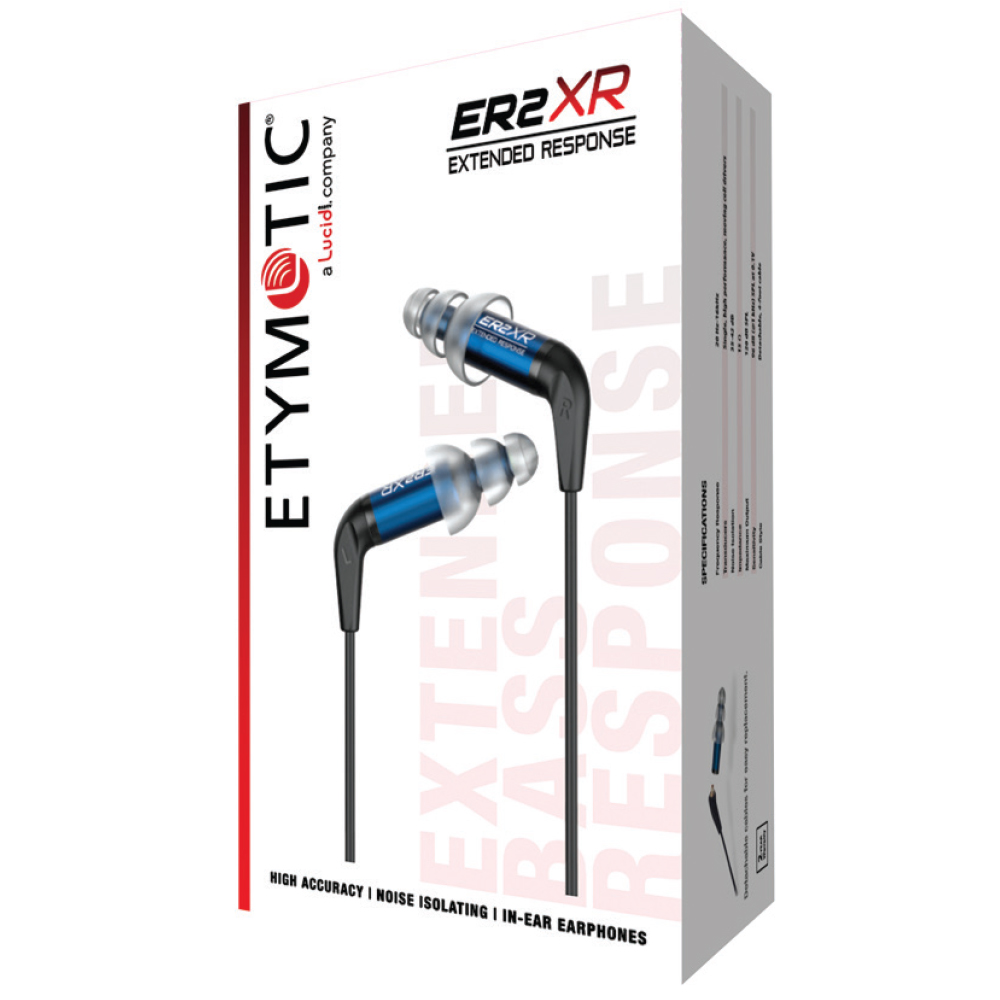
Etymotic Research ER2SE and ER2XR earphones

The Elk Grove Village, Illinois-based firm Etymotic Research is arguably one of the oldest, if not the oldest, makers of high performance earphones in the world. Long before Apple created the iPhone or iPod and long before Beats by Dre came into existence, Etymotic was building its iconic, high accuracy ER•4p-series earphones. The operative phrase there “high accuracy”; from day one Etymotic was fiercely committed to building earphones that delivered linear, neutrally balanced and true high-fidelity representations of the recordings being played. In sharp contrast to the tonal ‘flavour-of-the-month-club’ approach we so often encounter these days, Etymotic was, is, and probably ever shall be an accuracy-first earphone maker.

The early ER•4p earphones were marvels of miniaturisation and were among the first commercial earphones to be based upon purpose-built, precision-matched and custom-tuned balanced armature-type drivers (then more uncommon than they are now). The tiny ER•4p’s featured extremely slim cylindrical earpieces fitted, in most cases, with Etymotic’s signature triple-flange silicone ear tips. Remarkably, those earphones offered between 35dB – 42dB of passive noise isolation, making them the world’s first true noise-isolating earphones—ones that even today offer unmatched levels of noise reduction.

While the ER•4p models remain in production today, Etymotic has expanded its product range to include three new families of earphones: the top-of-the-range ER4SR/XR models, the mid-level ER3SE/XR models, and the new entry-level ER2-series models selling for $159 or £169. Present-day ER4 and ER3 models use balanced armature-type drivers, while the ER2 models introduce new high performance dynamic (or moving coil) type drivers. At Etymotic’s suggestion this review focuses on the ER2 models, partly because they are the firm’s newest offerings, but also because they represent the lowest cost means of accessing Etymotic’s famous high accuracy sound.

Like most Etymotic earphones, the ER2s come in two versions: the ER2SE (Studio Edition) that promises dead neutral tonal balance and flat frequency response, and the ER2XR (Extended Response) that adds a generous but not egregious dollop of added bass lift. From the lower midrange on up, the two models sound more or less identical, so that bass output is the real differentiator between the two. Rest assured that whether we are talking about the ER2SE or XR-version earphones, Etymotic simply doesn’t do grotesque sonic colourations; it’s not in their corporate DNA.

Etymotic’s founders were audiologists who have a deep, abiding concern for hearing health and hearing preservation. This concern manifests itself in Etymotic’s commitment to building earphones offering extremely high (35dB – 42dB) levels of noise isolation. Etymotic explains that the ER2 models feature “a variety of ear tips to provide 35dB+ of noise reduction so you will hear all the detail buried in the mix without raising the volume to compensate for ambient noise” (italics are mine).

The ER2SE/XR earphones feature slim, cylindrical metallic blue metal earpieces embossed with white text on the earpiece barrels to indicate which model is which. Accessories include a set of protective filters and a filter removal tool, a shirt clip, one set of compressible foam and two sets of 3-flange silicone ear tips (sizes M and L), a detachable four-foot signal cable and a compact zipper-closure storage pouch.

For my listening tests I ran the ER2SE and ER2XR earphones in side-by-side comparisons, while driving them with Astell&Kern’s excellent SP1000M digital audio player. The player was loaded with standard and high-res PCM and DSD music files and also provided access, via Tidal, to a wealth of MQA material. Here are my findings.

First, as a long-term user of Etymotic ER•4p-series earphones, I was struck by the strong sonic family resemblance between the classic ER•4p’s and the new and far more affordable ER2-series earphones. The ER2’s carry forward Etymotic’s traditional deep-insertion ear tip and earpiece design motif (more on this later), but they introduce slightly revised (and nominally more comfortable) versions of the firm’s signature triple-flange ear tips. The ER2’s also feature detachable and user replaceable signal cables—a feature the venerable ER•4p’s did not have.


I’ve referenced Etymotic’s ‘high accuracy’ house sound several times in this review, so it’s only fair to ask what sonic characteristics define that sound. To my ears, Etymotic’s sound is defined first and foremost by notably neutral tonal balance in the SE (Studio Edition) models or by mostly neutral balance with audible but not overblown levels of added bass lift in the XR (Extended Range) models. Next, the Etymotic sound brings unexpectedly high levels of focus, resolution and transient speed and definition at every price point in the line—even for the entry level ER2 models (which, speaking candidly, are ‘entry level’ in name only). Finally, the tiny ER2’s offer, once properly fitted, downright astonishing levels of bass extension, impact, clarity, and low-end grip. In short, the ER2SE is voiced much like a high quality, high accuracy and decidedly full range loudspeaker, while the ER2XR is voiced much like that same loudspeaker, but with the bass dialled up to about ‘11.5’.

What my words perhaps do not convey is the extent to which the ER2 models are sonic overachievers of the first rank. Most of us who have spent significant time in the personal audio world will have formed opinions about the levels of performance we can expect from sub-$200/£200 earphones and I found the ER2SE’s and XR’s surpassed those expectations in a truly major way. In terms of focus, articulacy, dynamic expression, and extended frequency response the ER2’s could easily pass for models three or four times their price, which I consider remarkable.

To appreciate what I mean, try listening to the track ‘Goodjinns’ from Renaud Garcia-Fons’ Oriental Bass [Enja Records, 16/44.1], which offers intricate slapped acoustic bass passages, delicate and equally intricate percussion accompaniment, brilliant contributions from a forceful horn section, and soaring statements from violins. The ER2’s did a superb job of delineating the signature transient characteristics and timbres of each of the instruments, while also conveying the distinctive dynamic ‘feel’ of each instrument—neatly showing how each in its way helps bring the composition to life. The net effect is of hearing a rich, thoroughly engaging, and masterful presentation of the recording—one that left me thinking, “Can these really be sub-$200/£200 earphones; they sound much too good to be sold for that price.”

Similarly, listen to Brad Mehldau’s original soundtrack for the Yvan Attal film Mon chien Stupide [My Melody, 16/44.1] and note both the purity of timbre and also the rich, vibrant and accurate tonal colours the ER2 models deliver on each of the instruments represented. The interplay between the acoustic bass, piano, and drum kit on ‘Henri’s Lament’ sounds terrifically delicate and soulful, while the voice and textures of the piano in particular are spot on. On ‘Breakfast’, note how both the ER2SE and XR capture the deep, woody, and swinging voice of the acoustic bass as set against lilting piano lines and the incisive ‘clack’ of wood-block percussion accents. Then, on ‘Cecile I’ observe the deft way that both ER2 earphones define and delineate differences in textures and timbres between the bowed cello and pizzicato acoustic bass heard on the track (there is enough overlap between the ranges of these instruments that their voices can become muddled through some earphones, but this was not a problem at all for the Etymotic ER2’s). The point I mean to make is that the Etymotic ER2SE and ER2XR are sufficiently revealing that they invite close and careful listening, much as one might do with far more costly earphones in play.

Given my positive comments thus far, some will surely ask, “But is there a catch?” Indeed there is, sort of, in that Etymotic earphones use a so-called ‘deep insertion’ design involving use of the firm’s steeply tapered triple-flange ear tips. To get satisfactory sound and proper isolation the ear tips must seal properly in the ear canals, which is a proverbial ‘piece of cake’ for some listeners, but much easier said than done for others (sadly, I fall in the latter camp). The solution turns out be a shorter and less sharply tapered new dual-flange ear-tip design from Etymotic, which worked a charm for me, providing ease of insertion, an excellent seal and long term comfort.

It’s not often we find earphones that are accessibly priced yet can be recommended enthusiastically for listeners of all experience levels, up to and including jaded audiophiles. Just try a pair of ER2SE’s or ER2XR’s (we’ll leave the voicing choice to you) and see if you don’t agree.

TECHNICAL SPECIFICATIONS

  • Type: Dynamic driver equipped universal-fit earphones with flat frequency response (SE version) or a moderate degree of bass lift (XR version)
  • Driver Complement: One miniature, full‑range, high performance dynamic (or moving coil) driver per earpiece
  • Frequency Response: 20Hz–16 kHz
  • Noise Isolation: 35dB–42dB
  • Impedance: 15 Ohms
  • Sensitivity: 96dB @1kHz at 0.1V
  • Maximum Output: 120dB
  • Accessories: One pair compressible foam ear tips, two pairs (sizes M and L) trip-flange silicone ear tips, one pair of inline filters and filter insertion/removal tool, detachable and user replaceable four-foot signal cable, shirt clip and compact zipper-closure storage pouch
  • Weight: Not specified, but extremely light!
  • Warranty: 2 years
  • Price: £169 UK, or $159 US, the SE and XR models are identically priced

Manufactured by: Etymotic Research, Inc.

Tel: +1 (847) 228-0006

URL: etymotic.com

Distributed in the UK by: Etymotic UK
and Europe

Tel: +44 020 8772 2700

URL: pcwerth.co.uk

https://hifiplus.com/reviews/

A Nation of Shopkeepers

Napoleon famously dismissed the English as “a nation of shopkeepers”. It’s a criticism that holds more than a grain of truth… but in the last three months, any non-essential shopkeepers were shut down as part of UK-wide COVID-19 lockdown plans. Those lockdown requirements were loosened on Monday 15 June. We spoke to some of that shopkeeper nation in the audio sector to see what happened next.

It’s worth bearing in mind that although the UK’s lockdown has begun to lift, restrictions are still fairly rigid. Non-essential retailers in Scotland and Wales are still closed. Currently people are advised to keep 2m apart, handwashing and/or cleaning stations are to be provided, some facilities (like public toilets) are restricted or limited and there are strict limits on how many shoppers are able to enter a store. These have resulted in images of huge queues with shoppers waiting hours in line to enter a store. While it’s hoped these restrictions will reduce over time, they are also dependent on the reproduction rate (the ‘R0’) of the disease… fewer people with the disease, we get closer to how things were in 2019; too many people getting infected and the lockdowns come back.

But for now, at least, the stores are reopening, and a few days in, here’s what many have to say about throwing their doors open again. OK, so the two-hour snaking line to pick up a pair of underpants from Primark are not commonplace in audio retail stores, but neither have stores opened to stony silence…

Brian Morris and Trevor Liddle from Brian and Trevors

Brian Morris: “We’re open. During lockdown our business hardly suffered, and we’re already filled up with appointments. But we’ve been appointment based since we started, so in a way the social distancing aspect for us is easy. However, other dealers are going to have to change to an appointment-based model to keep numbers manageable at least until COVID-19 goes away. Which is why we changed our mission statement recently to read ‘stay alert, make an appointment with us and play safe’!”

Trevor Liddle: “We didn’t technically close, but demonstrations dried up completely because people weren’t able to visit. However, we were able to collect and deliver. Now, we have sanitisers and masks available, but no one has taken up the offer of masks yet. We’re not offering tea and coffee at the moment, but that’s it. There have been a couple who said, ‘let’s wait’ at the start of the lockdown, but many are getting back in touch now. We don’t have a queue outside the door because we’d never work like that anyway.”

Alain Abensur, Choice Hi-Fi 

“I may be bucking the trend, but I did the same turnover in the first six months of the year as I did for all of last year. I could barely keep up with sales. So… “lockdown, what lockdown?” The further we got into the lockdown period the more people upgraded their equipment, possibly as a little treat to themselves. Couriers didn’t stop and everything was by mail order, of course. A lot of people thought this might have a size or weight limit, but I don’t think size or weight had much to do with anything; invariably there was always a way around the issue.

“I have a number of landmark products that people have come to hear – like the Avalon PM3 – and since lockdown has eased, people are keener to make appointments. Paradoxically, whole the interest is still there, sales have slowed since the lockdowns eased… perhaps they are thinking more about returning to work and planning holidays. Or maybe they are taking a little longer to evaluate now.”


Simon Griffin, Decent Audio

“It’s got off to a reasonable start. We have demonstrations booked in for the next 10 days. And a lot of people just wanted to come in and talk, again. We’re a bit relieved, although we’ve been very lucky during the lockdown because of our second hand and mail-order, vinyl cleaning etc. As a result, we’ve managed to keep 70% of our business going. And in fairness, if you were known as having an online presence beforehand, you’ve probably also done well. But much of that business was smaller and more entry level equipment; few people have been buying 100kg amplifiers when there’s no-one allowed to help install them!” 

John Roberts, Midland Audio xChange

“I think the big thing was not to treat that time away from the store as ‘time off’. Social media has long been a big thing for me, but the interaction and the constant posting of new things online kept people’s attention during the lockdown. And I spent a lot of money on a new website, which makes a huge difference. People can now move quickly from seeing a product to our eBay store, and there’s a sense of trust through PayPal that’s hard to get from simply leaving credit card details on a website. 

“As a result, we doubled our mail order business year-on-year in May, and the first day we opened, we took a huge amount of business: I did two demonstrations on Monday, three on Tuesday, and so on. Naturally, we had and continue to have everything professionally cleaned to be COVID-19 compliant. We have cleaning stations, and offer masks should people need them, but most bring their own anyway.”

Rob Wilson, Sonata Hi-Fi

“During the lockdown, we did a lot of work in social media, and Evie sent out several newsletters to keep people engaged. We also did a lot of home demonstrations where we did non-contact drop-offs and told people to quarantine the boxes for a day, etc. But we’re lucky in that we work from home, so our overheads are low anyway. Now we’re back open, we’ve had lots of enquiries about home demos and they’re starting to happen for us again. Demonstrations that we had lined up can now take place, our phone is ringing and there is a bit of momentum now. As we’re appointment only, social distancing is quite easy: It’s not like we have to worry about two or three people at a time.

“We have created a pathway to the listening room that allows for 2m distancing, we have sanitisers and masks, and it’s fairly easy to show how something works and remain distanced. I think people have been twiddling their thumbs at home during the lockdown and have been craving good music; if the home is to double up as workplace, entertainment centre, school and holiday destination for the appreciable future, just as you might want more than basic cable TV, so you might want more than basic audio. The new normal is going to be different; we all need to adapt!” 

Not every store has opened its doors, however. Stephen Harper, of The Audio Consultants, explains:

“We’re not a high street store and operate by appointment. We’re kicking home dems down the line until its safe for all us. We have been doing mail order, home trials, etc. That has resulted in reasonable business; in fact, we’ve coped better than expected under the circumstances. We’re going to continue that for a least another month and then see whether or not to reopen or wait even longer. When we do, it will be one person at a time with all the precautions.”

Magico M9

Magico has announced its new M9 floorstanding loudspeaker. Designed to sit at the pinnacle of the already lofty M Series from the brand, with each loudspeaker standing over 2m, weighing in a 454kg, requiring an external crossover and power supply that enforces the use of mono power amplifiers and sporting six drivers including two 380mm bass units, the new M9 will cut an imposing figure in the listening room. And, with a price on application expected to be in the region of £840,000 per pair, it cuts an imposing figure on a bank balance, too! The M9 is expected in the last quarter of 2020.

From the Magico M9 Press Release:

Hayward, CA, June 2020 – A summation of our no-holds-barred assault on the limits of dynamic loudspeaker design, the new Magico M9 establishes new benchmarks in musicality, transparency and fidelity. This four-way, six-driver floor standing system features the world’s first loudspeaker enclosure to combine inner and outer skins of carbon fiber with a revolutionary aluminium honeycomb core. Included with the M9 is a state-of-the-art analog outboard active crossover, the MXO. Designed in-house, this carefully crafted unit handles bass/midbass frequency separation. In addition, the M9 benefits from our latest generation of Nano-Tec speaker cones, featuring Aluminium honeycomb cores. The result is a revelation, a loudspeaker that can present intense crescendos with unconstrained power, yet reproduce the most delicate musical passages with transparency and stunning microdynamic detail.

Size comparison with the Magico M6

Carbon fibre enclosure with Aluminium honeycomb core 

From the very outset, we’ve known that the loudspeaker enclosure must enable sound to pass through completely, without “singing along” with the music. Controlling cabinet vibration without storing energy remains one of the greatest challenges in loudspeaker design. Our quest for the ultimate in enclosures has driven us to pursue the latest in materials science, computerized modelling and meticulous assembly. The M9 represents a new milestone in that journey: the world’s first loudspeaker enclosure with carbon fiber inner and outer skins over an aluminium honeycomb core. This technology reduces overall weight yet doubles the structural stiffness.  

The enclosure also incorporates our latest application of constrained layer damping using aerospace composites, plus familiar features of Magico construction including a baffle board of 6061 T6 aircraft aluminium and front-to-back tensioning rods. Through many rounds of Finite Element Analysis modelling, we fine-tuned the enclosure design to suppress resonances and any possibility of stored energy. We also calibrated the organic shape of the enclosure and machined the front baffle to reduce diffraction effects to near zero. Sound waves from the drivers propagate without obstruction. You can hear the difference. The resulting soundfield replicates that of the recording space. Even though the M9 has a commanding physical presence, in sonic terms, it completely vanishes. 

New beryllium-diamond dome tweeter 

Magico has long recognized that the bending and flexing of non-pistonic motion in a soft dome tweeter leads to large-scale distortion. That’s why we chose the high strength and light weight of Beryllium. And we went even further, enhancing Beryllium with the incredible stiffness of diamond, carefully applied by chemical vapor deposition. This enabled us to go larger, building the world’s first 28 mm Beryllium dome and improving performance without the weight penalty that diamond normally incurs. Now the M9 raises the stakes with an even more refined 28 mm Beryllium-diamond dome tweeter. The new drive unit delivers high-frequency reproduction of extraordinary accuracy, confirmed by Laser Interferometry testing and by careful listening. You’ll hear microdynamics of even greater subtlety, revealing musical detail with even greater clarity.  


Eighth generation Nano-Tec cones with Aluminium honeycomb core 

Our insistence on diaphragm rigidity and pistonic motion also drove us to offer the world’s first loudspeaker cones with incredibly strong Graphene nanotubes. Every cone in the M9 incorporates our eighth generation Nano-Tec design. With this design, Magico became the world’s first to feature an Aluminium honeycomb core sandwiched between Graphene/carbon fiber skins. In previous Nano-Tec cones, the skins provided all the stiffness and the core provided damping. The Aluminium honeycomb changes everything, providing a core material so stiff that we need to apply 26,500 pounds (12,000 kg) of pressure to shape our 15-inch cones. This added stiffness pushes resonant frequencies far beyond audibility, requiring hardly any damping at all.  

Graphene, the hallmark of the Nano-Tec cones, is a hexagonal lattice of carbon just one atom thick. Graphene combines incredible stiffness with the highest tensile strength of any material known to science – some 40 times that of carbon steel. The resulting cone is so rigid that, inverted on the ground, it will not deform after being run over by a sedan. With our eighth-generation refinements, this unprecedented strength results in the closest ever approach to pure pistonic motion.

3, 4 and 5-inch voice coils on vented pure Titanium formers 

As a cone driver plays intense musical peaks, voice coil temperatures can climb over 100° F (40° C) in a single second. Heating can double the voice coil’s DC resistance, alter the frequency response curve and compress the music as much as 3 dB – a substantial nonlinearity. Magico drivers overcome these distortions. The M9 cone voice coils are huge – 3, 4 and 5 inches in diameter – for much faster dissipation of heat and greater control over the cone. Vents in the voice coil formers provide another level of heat dissipation. We chose formers of pure Titanium for its ideal combination of stiffness and resistance to eddy currents. 

Underhung voice coil and oversized Neodymium magnets 

The force that the magnetic circuit applies to the voice coil can drop as much as 50% as the voice coil moves away from the central, rest position. This drop-off can be asymmetrical. Motion does not faithfully track the input signal, generating substantial harmonic and intermodulation distortion. Magico Nano-Tec drivers exercise absolute control over voice coil movement by providing underhung voice coils in a magnetic circuit of tremendous power. We use Neodymium magnets with 16 times the magnetic energy per unit volume of Ferrite. In preference to an array of small Neodymium magnets, we select uncommonly large Neodymium ring magnets. As an extra measure against asymmetry, these drivers deploy a matching magnet on top. The result is prodigious flux density, up to 1.7 Tesla (17,000 Gauss), maintained across uncommonly long air gaps, up to 36 mm. This enables distortion-free output up to 120 dB SPL at 1 meter. 

•          6-inch midrange driver (x1). The new midrange features a remarkable 4-inch voice coil to help maintain linear output all the way to 120 dB SPL at 1 meter. This results in unmeasurably low distortion throughout the driver’s operating range.

•          11-inch mid bass drivers (x2). This entirely new driver incorporates an N48H grade Neodymium ring magnet of unusual size: 120 mm diameter x 8 mm height, plus a second matching magnet on top for complete control of voice coil movement. It is a new benchmark in linearity.

•          15-inch bass drivers (x2). The new bass driver features a cone moulded by 26,500 pounds of pressure. An uncommonly long 36 mm air gap facilitates tremendous linear excursion, ±15 mm, at high sensitivity. You hear the lowest three octaves of bass with full extension and no mid-bass exaggeration.  

From cone materials to voice coils to magnetic circuits, each one of these features improves linearity and reduces audible distortion. Taken together, they represent the literal state of the art. These are the most advanced dynamic drivers ever made.  

As always, we simulate, optimize, test and re-test every driver design with the latest Finite Element Analysis tools. Computer testing enables us to simultaneously evaluate acoustical, mechanical, electromagnetic and thermal behaviours. As the driver designs near completion, we conduct the same testing and optimization process on the entire loudspeaker system.

Magico Analogue Crossover (MXO) 

The 120 Hz crossover frequency between the bass and mid-bass drivers poses a special challenge. At such a low frequency, a passive crossover would require huge inductors and capacitors. Even if the very best parts were auditioned and selected with care, such large circuit elements would incur unavoidable, substantial losses. To overcome this issue, we created an analogue, active 2-way crossover, the Magico Analogue Crossover or MXO. This substantial component provides steep filter slopes without any sacrifice in signal quality.  

The crossover’s meticulous design features Linkwitz-Riley filters to deliver 24 dB per octave slopes at the crossover frequency of 120 Hz. Designed in-house from our own platform, the analogue crossover is fully balanced with completely discrete circuitry from input to output. Open architecture accommodates additional filter topologies. Precision step attenuators provide 0.5 dB/step control of each output, using a proprietary technique to ensure purity in the signal path. The external power supply chassis regenerates AC and applies active regulation to every part of the circuitry.  

A pair of M9 loudspeakers requires two stereo or four monaural amplifiers. 

The M9 tweeter, midrange and mid-bass drivers are controlled by a three-way passive crossover with acoustical target 24 dB-per-octave Linkwitz-Riley filters. Magico’s elliptical symmetry crossover design preserves maximum frequency bandwidth with minimal IM distortion.  

SPECIFICATIONS

Driver complement:  

1.10-inch diamond coated Beryllium tweeter (x1) 

6-inch Gen 8 Magico Nano-Tec cone with Aluminium honeycomb core (x1)

11-inch Gen 8 Magico Nano-Tec cones with Aluminium honeycomb core (x2) 15-inch Gen 8 Magico Nano-Tec cones with Aluminium honeycomb core (x2)

Sensitivity: 94 dB 

Impedance: 4 ohms 

Frequency response: 18 Hz – 50 kHz 

Power handling: 20 W (min) to 2000 W (max) 

Dimensions:  

Loudspeaker: 80” H x 40” D x 20” W (203 x 102 x 51 cm)  

Crossover: 8” H x 18” D x 20” W (20 x 46 x 51 cm)  

Crossover power supply: 8” H x 18” D x 20” W (20 x 46 x 51 cm)

Weight:  

Loudspeaker: 1000 pounds (454 kg) each 

Crossover: 40 lbs. (18 kg) 

Crossover power supply: 60 lbs. (27 kg)

Dan George Communications

15th June 2020, Tunbridge Wells, UK: Britain’s hi-fi stores are opening their doors once again this week, following an extended lockdown period. Like other shops and public-facing retailers, hi-fi stores are closely following government safety guidelines to ensure the wellbeing of their customers. 

Digital and analogue audio expert Chord Electronics’ extensive UK dealer network is largely open, with potential visitors advised to check their local store using the company’s online dealer locator tool: https://chordelectronics.co.uk/locate-dealer/. The Kent company has posted further details on its website


Digital music library specialist, Melco Audio’s UK retailers are also opening this week, along with the Japanese company’s top-tier Melco Master Dealers (which have undergone extensive specialist training) with all outlets listed on the company’s dealer page online: https://www.melco-audio-masters.com/approved-dealers.html. Melco Audio’s recent lockdown-inspired Free Home Demo scheme successfully kept music lovers in hardware while bricks and mortar stores remain closed.  


McIntosh Laboratory distributor Jordan Acoustics is also opening its luxurious Bournemouth store by appointment only, with most UK McIntosh dealers also welcoming customers through their doors this week; a list of UK stores can be found at: https://www.mcintoshlabs.com/dealers/find-local-dealer.


Welsh hi-fi specialist, Leema Acoustics, is also reporting its dealers are opening their doors this week and the Welshpool factory has remained (safely) open throughout the lockdown, hand-building to order for music lovers around the world. The company’s UK dealers, along with its Centres of Excellence, can be found on its website: https://www.leema-acoustics.com/search-dealers.html


The UK’s leading A/V cable specialist, Chord Company, who recently launched its own hardware brand, English Electric, is welcoming back its dealers this week, many of whom offer a speaker cable termination service following the rollout of the ChordOhmic Hex Gun this time last year. Chord Company (and English Electric) dealers can be found online: https://chord.co.uk/dealers/


Hi-fi stores stocking and demonstrating Japanese speaker specialist ECLIPSE’s range are also opening this week, with customers advised to check in advance first: https://www.eclipse-td.com/uk/stockists/index.html. Confirmed stores include: Audiologica; Cool Gales; Doug Brady Hi-Fi; Hi-Fi Sound; Ripcaster; Robert Taussig and Sonata HiFi plus Richer Sounds’ Southampton, Reading and Plymouth stores by appointment only.

Loud & Clear

Scotland’s leading hi-fi and home cinema showroom, Loud & Clear, is nearly ready to open again. Its team of audio experts are busy readying the Edinburgh premises to ensure that it both meets and exceeds current government guidelines. 

With over 2,600 square feet of retail space, customers will be able to experience the range of carefully selected performance audio and video products whilst more than adhering to social distancing guidelines. 

Loud & Clear is renowned for its hospitality and the team aims to place the emphasis on the social aspect of social distancing. Located on the historic Leith Waterfront, it is surrounded by a selection of cafes and coffee shops offering takeaway services. Customers are welcome to bring their refreshments into this beautifully renovated whisky bond and enjoy some great music played on some of the world’s finest turntables, streamers, amplifiers and loudspeakers. 

Upon arrival at Loud & Clear, visitors will be greeted at the reception desk where they will be asked to use the hand sanitising equipment before being provided with a complimentary mask and gloves. Inside the store, floor markings clearly indicate the separate areas for customers and staff to guarantee safe distancing. To ensure a comfortable visit, fully accessible toilets are available.

A gazebo and picnic table at the front of the store, gives customers a place to wait before entering. Should they wish to achieve extra social distancing, they can also relax in the spacious conservatory. 

For the first few weeks, there will be a new set of opening hours designed to meet customers’ needs. 

Thursday: 12:00 – 20:00. Friday: 12:00 – 19:00. Saturday: 09:30 – 17:30. 

Monday – Wednesday: by appointment only. 

Loud & Clear’s new online facility allows customers to save time and reduce one-to-one contact when purchasing products or booking one of its many services at: www.loud-clear-edinburgh.myshopify.com 

The lively and friendly Loud & Clear team is looking forward to meeting and inspiring both new and existing customers as soon as government guidelines allow.

 For more information: www.loud-clear.co.uk

Effect Audio Vogue series earphone signal cables

In the past, Hi-Fi+ and Ultimate Headphone Guide have favourably reviewed some of Effect Audio’s higher-priced earphone cables. However, there has been great interest recently in Effect’s more affordable three-model Vogue-series range comprising the Maestro ($99 US), Virtuoso ($149 US), and Grandioso ($199 US) cables. Vogue is at once Effect’s most affordable and cost effective family of cables.

Effect’s Maestro cables use 26 AWG, ultra pure OCC copper conductors with a ‘Golden Ratio Dispersion, Triple-Size Stranded Design.’ For added strength, Maestro uses a woven Kevlar-infused, multi-stranded Litz cable configuration. Three earphone connector options are offered: 2-pin/CIEM (Flat) connectors, 2-pin/CIEM (standard) connectors, and Shure/Westone Pro MMCX connectors. The only amplifier connection offered is a 2.5mm balanced plug. Cable connector and Y-split yoke housings are made of machined aluminium with Effect Audio logos and easy-to-read channel markings on the outside.

The Virtuoso cables are much like the Maestros, but with a crucial difference: they feature 26 AWG, ultra-pure OCC silver-plated copper (SPC) conductors. Meanwhile, Grandioso cables are similar to Maestro and Virtuoso, but they raise the performance bar by using a hybrid combination of 26 AWG ultra pure OCC copper conductors and pure silver conductors, plus what Effect claims as an “upgraded cable geometry design.”

All three Vogue cables offered a substantial step up in performance vis-à-vis stock cables. I heard greater dynamic impact and sharper dynamic contrasts, cleaner and quicker rendition of the leading edges of notes, purer and more vibrant tonal colours, and significantly improved focus and resolution for upper midrange, presence region and treble details. Effect’s Vogue-series made my resident Massdrop x Noble K10 sound as if it had magically stepped up to an altogether higher performance class. However, each of the Vogue cables has a distinctive sonic persona.

The Maestro cables, for example, convey an organic and slightly warmer rendering of the music than the other Vogue models. In particular, this takes the form of a somewhat richer, more impactful rendering of bass content with upper mids and highs that are clear, but silky smooth and blessed with just a hint of delicate sweetness. A 1973 recording that illustrates these qualities is the title track from bassist/composer Eberhard Weber’s The Colours of Chloë [ECM, 16/44.1], which some have described as symphonic jazz. The Maestro cable helped draw forth the deeper, earthier elements of Weber’s bass sounds (which can otherwise sound a bit ‘thin’ on this album), while also unlocking the clarity and expressiveness of the bass’ upper register. At the same time, the Maestro cables clarified keyboard and percussion, yet without pushing them forward in the mix or introducing any excess brightness.

In contrast to the somewhat earthy and organic vibe of the Maestros, the Virtuosos are all about transient speeds, crisp delineation of notes, and sharpened focus and resolution on upper midrange, presence region, and treble details. Virtuoso sound uncommonly agile and highly resolving from top to bottom, complete with delicately filigreed high harmonics and textural and transient details. To hear what I mean, listen to the percussion tour de force ‘Talking Wind’ from Marilyn Mazur and Jan Garbarek’s Elixir [ECM, 16/44.1]. With the Virtouso cables in place, the sheer richness and variety of the percussion voices on the track suddenly come alive, though not in a brash or overbearing way, but rather with a terrific blend of speed, refinement, and elegance.

Finally, the Grandioso cables stand as something of a best of two world’s design, neatly fusing the best sonic qualities of the Maestro and Virtuoso models. In practical terms this means Grandioso captures the bass weight and articulation plus the gentle touch of treble sweetness of the Maestro, while also embodying the cat-quick reflexes and heightened focus, resolution, and three-dimensionality of the Virtuoso—all in one beautifully integrated package. To appreciate what this means in musical terms, listen to ‘Moten Swing’ from Clark Terry’s The Chicago Sessions, 1995-96 [Reference Recordings, HDCD]. This amazing recording captures the DePaul University Big Band accompanying Clark Terry on trumpet in a recording with extraordinary dynamic range. Early on, the big band rhythm section establishes a soft but definitely swinging groove, where the Grandiosos help clarify and add gravitas and rhythmic punch to the band’s acoustic bass, piano, and percussion sections. But, against the backdrop of this groove, the band’s horn section and Terry’s trumpet fairly explode into action, with the golden tonality and appropriately biting attack of the horns and the pure, penetrating voice of the trumpet conveyed with real authority and conviction. The combination of speed, delicacy, and sheer dynamic clout is irresistible.


Downsides? The only small point I noted is that the signal pins for Effect’s two-pin/CIEM earphone connectors seemed slightly larger than most. This means cable installation could require a considerable degree of force, though with the upside that the resulting connection is very firm and secure.

Effect’s Vogue series earphone cables use top shelf materials, sophisticated geometries, and well-made hardware, but their primary benefit involves a jump in perceived earphone sound quality that exceeds expectations in light of their moderate prices. In short, Effect’s Vogue-series cables may well represent your most direct and cost-effective path to next-level earphone sound quality.

TECHNICAL SPECIFICATIONS

  • Effect Audio Maestro earphone cables
  • Conductors: 26 AWG ultra-pure OCC copper
  • Construction: Golden Ratio Dispersion, Triple-Size stranded design featuring woven Kevlar-infused, multi-stranded Litz wires
  • Earphone terminations: 2-pin/CIEM (flat) connector, 2-pin/CIEM (standard) connector, Shure/Westone Pro MMCX connector.
  • Amplifier terminations: 2.5mm 4-conductor balanced plug
  • Price: $99 US for 1m cable
  • Effect Audio Virtuoso earphone cables
  • Conductors: 26 AWG ultra-pure OCC silver-plated copper (SPC)
  • Construction, Earphone terminations, and Amplifier terminations: As for Maestro, above
  • Price: $149 US for 1m cable
  • Effect Audio Grandioso earphone cables
  • Conductors: Hybrid combination of 26 AWG ultra-pure OCC copper and pure silver
  • Construction, Earphone terminations, and Amplifier terminations: As for Maestro and Virtuoso, above
  • Price: $199 US for 1m cable
  • Manufactured by: Effect Audio

URL: effectaudio.com

Tel: +65 8200 3584

https://hifiplus.com/reviews/

Zesto Audio Andros 1.2 Vacuum Tube Phonostage Preamplifier

Back when you could conceivably do such a thing, walking the halls of any audio show of size can be a bit exhausting. After three days and over one hundred rooms navigating the crowds and the noise (Good sound loud or not so good loud) can give your ears a fatigue that makes one long for silence sometimes. For this reason, I tend to schedule a trip to the Zesto Audio room for the final day of a show. George and Carolyn Counnas always have a room of impeccable sound quality that, for me, is an audio oasis where my ears can recover. I had been hoping for the chance to have their gear in house.

Imagine my delight when the Zesto Audio Andros 1.2 tube Phonostage preamplifier arrived for review. The Andros 1.2 is crafted with the same graceful aesthetic as the rest of the Zesto line-up which is to say four glorious ECC83S gold pin tubes set in a reflective case that shows the glass off like jewellery.

After installing the valves with the included white glove, I adjusted the settings on the back to match my Ortofon Cadenza Bronze moving coil cartridge. The switches and dials for the settings are well labelled. MM and MC connections and setting are each located in specific zones making setup straightforward. I used the single ended output from the moving coil area utilizing AudioQuest Water cables. Input cables were from VPI from my VPI Prime Signature turntable.

Zesto Audio’s very well written user manual is specific about turning on the Andros 1.2 before the rest of your audio system and giving it five minutes of warm-up first. Each Andros 1.2 arrives with a factory burn in of 50 hours and will reach optimal performance at 100 hours. My experience concurs with these recommendations as the output reaches peak fullness around the 100-hour mark. The manual gives some recommendations for tube rolling. I used the supplied valves for my listening.

I had recently watched the movie Rocketman about the life of Elton John. Inspired by this I started listening to Captain Fantastic and the Brown Dirt Cowboy’s ‘Someone Saved My Life Tonight’ [Mercury]. Jumping out at me was the attack on the piano keys; precise but not strident. Tonality was pure and uncoloured. The drum kit is centred with excellent decay of the strike. Compared to my reference Simaudio Moon 610LP phono pre the Zesto Andros 1.2 offered up slightly more colour. A bit more body reminding me of my Cary SLI-80 integrated; it has ‘tube sound’ but does not distort or dominate the performance. The difference in character was quite enjoyable.


Moving on to something with great dynamics, I queued up Tower of Power’s What is Hip [Sheffield Lab]. This album is a direct to disc recording and the performance really pops. Valve gear in general has a mostly unfair reputation for slow response and overly ‘tubey’ or ‘valvey’ sound. Gear like that will struggle with this recording. Not so the Zesto Andros 1.2. Tower of Powers’ terrific speed and precision is shown to great effect as the horn section alongside the bass and drums deliver a staccato performance. Fortissimo peaks rise, transitions fall to seeming silence as this fast paced and powerful tune moves forward. The Andros 1.2 was up to the challenge. This tube-based phono pre effortlessly delivered to range and power required. The jump of the band translated through without any hesitation. Complex horns and saxophones offered up perfect tone and rasp alongside precise guitar work. There are several versions of What is Hip out from the band, but this live direct to disc version is my personal favourite. It was blissful listening to it via the Andros 1.2. I had been concerned that the Andros 1.2, being valve-based, would not be able to offer the precision and speed I enjoyed so much from the Moon 610LP. After the Tower of Power demonstration those concerns were completely removed.

Now it was time for a classic nuance and sense of space audio trip with Shelby Lynne’s title track to Just a Little Lovin’[UMG Recording]. An audio show favorite, this tune showcases many desired traits audio fans seek in their gear. One of these is a sense of space within the recording room. You can almost sense the room dimensions within this recording. The rim shots from the snare drum reverberate and decay in a way that allows the listener to ‘walk’ the room during the playback. The high hat has the appropriate sizzle and the bass is powerful but controlled. The instruments frame Shelby’s beautiful and haunting voice with a firm delicacy setting the mood of a lazy morning. The Andros 1.2 helps draw you in and feel the connection with this nuanced imagery in a way only a well-engineered component can. In short, it’s all very well done!

Certain bands are fun not just because of great song writing and musicianship but also because they offer unusual instrumentation. Morphine is one such band featuring two stringed slide Bass Guitar, Baritone Sax and Drums. Led by two string Bass player, Mark Sandman, they were a Popular Boston based group until Sandman’s early death from an on-stage heart attack at age 46. The fun rhythm’s and unique sound due to their choice of instruments makes for a great discovery for new fans. Their album Cure for Pain (1993 Ryko) features a track called Buena that showcases their great sound and unique delivery putting lower register instruments to the fore to great effect. Sandman’s plucking and tapping drive the song as the Baritone Sax played by Dana Colley provides a deep and powerful melody. Jerome Dupree’s drum’s provide foundational rhythm and syncopation. Once again, the Andros 1.2 lets the fun come through. The vibration from the two string slide bass brackets the guitar’s tone while the baritone rasp of the saxophone plows the lower registers. The drumstick tip on skin is presented as live with just the right amount of “snick” for an authentic strike. The ability of the Andros 1.2 to offer a holistic presentation is a trait I greatly appreciate and one that places the Andros 1.2 in fine company among high end Phonostage Preamplifiers.

Wrapping up my time with the Andros 1.2 I selected a long-time personal favourite, ‘Fires at Midnight’ from Jethro Tull’s Songs from the Wood album [Parlaphone]. A song that evokes late nights around a fire with friends, Fire’s at Midnight features some great licks from Ian Anderson’s flute. Tones are perfect and the breath through the instrument comes through nicely. Surrounded by guitars, bass and drums the signature sounds of the band shine through. It is a sprightly tune with a relaxed and calming message that the Andros 1.2 delivers beautifully as the dénouement for a wonderful experience.


So why did we review an amp with no local distribution? Simple – Hi-Fi+ is an international title and we included the Andros 1.2 in a UK-based magazine because Zesto should be in the UK – get the hint, distributors!

The Phonostage Preamplifier occupies an interesting spot in an audio system. It is a pre-pre-amplifier. Matching it with the rest of a system is critical as it is amplifying the likely weakest audio signal in the systems chain. We hear the phrase, if the first watt is bad then more won’t help, well if the attenuation of the first 0.2 is bad then the rest of your gear won’t matter either. It is important to find that component that offers synergy with the rest of your carefully chosen system. The flexibility of the Zesto Audio Andros 1.2 Phonostage Preamplifier provides a solid foundation for that compatibility. In addition, the high-quality hand-built assembly process offering audiophile grade components and gold pin tube choice will add to the qualities of your results. From Moving Magnet to a wide range of Moving Coil cartridges the Andros 1.2 can accommodate most cartridge choices. The device itself is right sized to allow a wide range of system placement and at 20 lbs. it will not break your back moving it around. Did I mention it is a visually beautiful unit? Great sound for listening and pride of ownership build quality and aesthetics make the Zesto Audio Andros 1.2 a must audition piece for your system and a reasonable price of $4,700.

TECHNICAL SPECIFICATIONS

  • Inputs: MM and MC Single ended or MC transformer balanced phono stage
  • MC Ground On/Off Switch
  • MM Impedance: 47K or 15K Ohms
  • MM Capacitance: 200pf
  • MC Impedance: 1000, 800, 600, 400, 300, 200, 100, 50, 20 Ohms
  • MC High/Low switch: with -3dB for high output MC cartridges
  • Outputs per channel: Impedance 10k Ohms, +6V max output level
  • Power consumption: 27W, 0 drain when off
  • Voltage: 110/120 AC 60Hz standard (Optional factory installed 220V or 230/240V AC 50/60Hz)
  • Connector: Standard 3 Pin IEC
  • Power: ON/Off switch on the side
  • Power Supply: Two internal high quality linear regulated power supplies 250V and 12V
  • Tubes: Four (4) Gold Pin ECC83S vacuum tubes
  • Sockets: High quality Gold pin ceramic sockets
  • Gain MM input: 47dB
  • Gain MC input: 67dB
  • Noise: -75dBu below max output
  • Frequency response: Complies to RIAA curve within +or- 0.5dB
  • Features: RIAA curve achieved using a passive filter
    1% metal film resistors throughout
    Polypropylene capacitors throughout the audio path
    All units are made by hand
  • Dimensions (WxHxD): 43 × 12.7 x 30.4cm
  • Weight: 9.07kg
  • Two-year limited warranty – six months on original tubes
  • Price: $4,700 USD

Manufactured by: Zesto Audio

URL: zestoaudio.com

Tel: +1(805) 807 1841

https://hifiplus.com/reviews/

Gold Note IS-1000 Deluxe Network streamer/amplifier

The law of unintended consequence is not always a harsh mistress. Take the Gold Note IS-1000 Deluxe integrated amplifier for example. Meant to be collected after the last review, a series of ‘locational complications’ (the polite term for ‘the courier kept delivering it back to the collection point’ style cock-ups) meant we retained the product long after the original review appeared in print; long enough to benefit from the latest round of software and firmware updates. The Gold Note IS‑1000 Deluxe was a good integrated amplifier when we first met it in Issue 175 and it’s a good integrated amplifier today. Physically nothing has changed – it’s the same physical product under test, with the same serial number… because it never even made it back to the factory, so hasn’t been upgraded in component terms. What’s changed is the ‘appvailability’, and a couple of firmware upgrades.

What’s changed is almost everything.

A quick recap on the IS-1000 Deluxe is in order. The Gold Note IS-1000 Deluxe is essentially what happens if you let Gold Note’s P-1000 preamplifier and PA-1175 power amplifier meet on a hot date. Well, almost. OK, so the IS-1000 Deluxe doesn’t bristle with the same number of RCA and XLR inputs, and sports a built-in DAC and phonostage, while the PA-1175 is four and a half times more powerful than the IS-1000 Deluxe , but the similarity in circuit design makes the integrated model a very close blood relative to the pre and power.

The all-in-one concept of the IS-1000 Deluxe is clear; it talks to online streaming services like Tidal, Qobuz, Spotify/Spotify Connect, and Deezer like a native speaker, and its Roon Ready standing, vTuner support and UPnP/DLNA network streaming/USB stick replay means almost all the quality post-CD stereo bases are covered. The optional DAC board connectes to USB and Ethernet with equal aplomb, and it supports MQA and even converts DSD64 files to PCM where required. Furthermore, Gold Note steps away from the ‘arms race’ here by opting for the quality Burr-Brown PCM1792A DAC chip (which supports files to 24/192 precision) instead of a numerically superior and sonically inferior chipset.

As discussed in the previous review five issue ago, power is Class A/B and rated at 125 watts per channel into an 8 ohm load, with nary an op-amp in sight. A function unique to Gold Note (I believe) is an adjustable damping factor – ‘high’ is intended for bigger, less sensitive speakers while ‘low’ (which Gold Notes claims enables the IS-1000 Deluxe to mimic a low-power valve amp) is for high-sensitivity/monitor-type speakers. Note that these are damping rather than ‘gain’ settings, so the IS-1000 is adjusting its power output to accommodate different loudspeaker designs rather than changing its volume ceiling to match more or less sensitive loudspeakers.


One of the two pairs of analogue RCA inputs is switchable between line level, moving magnet and moving coil – the phono stage circuitry is derived from Gold Note’s excellent PH-10 phono stage, but without that model’s control of equalisation and loading. With an additional XLR input, three digital optical sockets, a digital coaxial RCA input and a type-A USB socket, Ethernet and Wi-Fi (this supports Apple AirPlay (although not AirPlay 2 or Bluetooth). There are two basic models – the Classic (which includes a PCM1796 DAC) and this Deluxe model. We’d go with the Deluxe, even if there is a price premium.

As discussed, physically speaking nothing at all has changed. The amplifier is still the same solidly-built ingot of silver, gold or black, with high-grade connectors all round. And it hasn’t functionally changed the way it sounds, either. Although upgrades to firmware can radically shift the sound of products, there’s a good deal of ‘if it ain’t broke, don’t fix it’ here. The sound quality of the Gold Note IS-1000 Deluxe remains rich and satisfying in the midrange, with expressive vocals rising out of a wide soundstage. There is a tendency in audio circles to think every Italian designer spends their down-time gesticulating to operatic arias; it’s largely myth of course, but has a kernel of truth in that amps like the Gold Note make good opera sound wonderful.

If it simply delivered additional diction to hear Joyce DiDonato as she should be heard, I’d be OK with that, but the Gold Note IS-1000 Deluxe has the speed of attack and precise timing that set it apart from the masses. It’s refreshing to have an amplifier that can keep up with the back beats and Mach 2.0 grime on ‘Audacity’ from Stormzy’s Heavy Is The Head [#Merky] just as well as it can with the deceptively simple and gentle key changes of ‘Time Has Told Me’ by Nick Drake [Five Leaves Left, Island]. Reading back the review from issue 175, the phrase that repeats is ‘sure-footedness’; the Gold Note sticks to music like a mountain goat sticks to a hillside.

Gold Note provides a tidy app specifically for the IS‑1000, for both iDevices and Android. Early iterations of the IS‑1000 relied on the generic Mconnect streaming app, but the dedicated app brings a greater degree of amplifier control and integration to the table. The app has been available in the relevant app stores since late Spring 2019, and any owners of the Gold Note IS-1000 still relying on Mconnect are strongly advised to update both the app and the amp’s firmware; although neither is mandatory and one does not ‘unlock’ the other. It just seems odd not to have the latest software and the latest firmware, when there are no downsides to using either.

The firmware changes came about toward the end of 2019. They just seemed to make the integration between app control and the onboard streamer more direct, and that means it both is and isn’t transforming; the basic sonic performance of the IS-1000 Deluxe remains essentially unchanged – it’s still the elegant, open-sounding, detailed performer it has always been. There is a slight bit more ‘pace’ to the ‘grace and space’ sound of the DAC, but the difference is subtle and probably won’t turn the heads of the beat-obsessed (who only appear to be open to just one or two audio electronics brands anyway), but the rest of us get an amplifier that is that bit more beguiling, more refined, and more capable of providing the musical goods for unfatiguing hour upon hour.

The crucial change is in ease of integration and use. In the new millennium, hair-shirt products may have their place, but that is increasingly not the top slot. Instead, on the global stage, the winners are the products that make listening easier, both in terms of sonic performance and ease of accessing local and online streamed sources. The changes to the IS-1000 Deluxe make integration more seamless and makes access faster. In fairness, accessing online sources wasn’t exactly leaden before the updates, but the combination of app and firmware that came as an early Xmas present to Gold Note users gave the IS-1000 Deluxe a greater snappiness to musical access. Granted, we are talking the difference between ‘an eyeblink’ and ‘two or three eyeblinks’, but we are now so used to instantaneous access to material that ‘near-instantaneous’ seems ponderous. The change is noticeable.

In all, I’d give Gold Note’s combination of app and firmware a solid 8.5 out of 10, making it considerably better than most and on a par with the likes of Naim and Moon. Using Roon, Linn’s open-source system and AURALiC’s excellent (and suitably well-named) Lightning arguably pip these systems, and Sonos remains the apex predator in the app world.


If I’m honest about things, products like the IS-1000 Deluxe make a bit of a mockery of the whole review process. A review of the Gold Note amplifier taken early in its life will discuss the product in the context of an app that is completely different to the one used today, and as that app may form most of the way you interact with the Gold Note amplifier, that early review is almost completely invalid, and yet we live in a world of ‘exclusives’ where a follow-up six months later is lost in a sea of ‘now, now, now!’ reviews. The same applies to any streaming device.

Regardless, the IS-1000 Deluxe is one of the many contenders for the ‘why do you need anything more?’ award that defines top-end integrated amplifiers. Amps like the Gold Note invite difficult questions when it comes to box counting; sure, separate pre/power systems offer more power, more dynamic range, sometimes better separation, detail and so on, but do so at a price – financially, physically or operationally. In the case of the Gold Note IS-1000 Deluxe, each baby step forward in app and firmware makes the move to separates less needed.

TECHNICAL SPECIFICATIONS

  • Type: Solid-state two-channel integrated amplifier, with integrated DAC, phono stage, and network streamer
  • Analogue inputs: One switchable MM/MC phono input (via RCA sockets) , one single-ended line-level input (via RCA sockets), one balanced input (via XLR sockets)
  • Digital inputs: Three digital optical inputs (via TOSlink sockets), one digital coaxial input (via RCA socket), one USB input (type A), one ethernet (via LAN socket), wi-fi (dual band)
  • Analogue outputs: One line-level unbalanced (via RCA sockets), one line-level balanced (via XLR sockets)
  • Power Output: 125wpc @ 8 ohms
  • Bandwidth: 20Hz – 20kHz
  • Distortion: THD </+ 0.015%, 20Hz to 20kHz; IM </+ 0.015%
  • Signal to Noise Ratio: 100dB
  • (phono stage)
  • Type: Solid-state, switchable MM/MC
  • Input Sensitivity: 3mV for full power.
  • Input impedance (MC): 47kOhm
  • Input capacitance (MM): 220pF
  • Output impedance: 100 ohms
  • Output level: 1V for 3mV input
  • RIAA linearity: +/- 0.1dB, 20Hz – 20kHz
  • Distortion: </= 0.015% THD, noise levels covered by S/N ratio specification, below
  • Signal to Noise Ratio: 80dB
  • (DAC)
  • Type: Solid-state high-resolution PCM and DSD-capable Burr-Brown digital-to-analogue converter
  • DAC resolution/supported digital formats: All PCM from 44.1KS/s to 192KS/s with word lengths up to 24-bit, DSD64 (2.8224MHz)
  • Frequency Response: 20Hz – 20kHz, ± 0.005 dB
  • Distortion: (THD + Noise): <0.00015%, 20Hz–20kHz at 0dBFS
  • Price: £4,718 (IS-1000 Deluxe)

Manufactured by: Gold Note

URL: goldnote.it

Distributed in the UK by: Audio Pinnacle

URL: audiopinnacle.co.uk

Tel: +44(0)1420 544140

https://hifiplus.com/reviews/

Thorens TD 1601 suspended semi-automatic turntable

As a teenager my close friend had a Thorens TD 160 with a SME Series 2 arm. I was jealous. All that I could muster from my meagre pocket money was a Trio KD1033B, and whilst that turntable was well respected in the hi-fi magazines of the day as a starter spinner it could never compete with the Swiss made Thorens, a turntable considered as one of the best in the 70’s. It and its forerunners, notably the TD 150 (1965) and TD 125 (1968) were the company’s first models to have a 3-point spring suspended sub chassis, an idea originally conceived by Acoustic Research and later also taken up by Linn and Ariston amongst others. Thoren’s TD 126 and its extensions the TD 127 and TD 226, plus the Reference from 1980 and Prestige from 1983 were also designed with this kind of suspension. At the 2019 Munich hi-fi show amidst retro designs from a number of famous manufacturers I was quite excited to see TD 160 look-alikes, in the form of the TD 1600 and TD 1601 (£2,299 and £2,799 respectively). They were being presented alongside the TM 1600, a reel to reel player of the same size, due out this year developed in cooperation with manufacturer Ballfinger. Thorens had a great reputation in the past for turntables – and I’m honoured to possess both a TD 124 and TD 135 – but it is the TD 160 that I always wanted to own. 

Thorens began its long history in 1883 by producing musical boxes and clock movements; it even made Edison-type cylinder players, harmonicas and cigarette lighters. Whilst most of its turntables were iconic there were a few ‘original’ ideas that perhaps the company would like to forget about; from the TDW 224 that had a record changer for eight discs sat next to the player so that they didn’t rest on the spindle, to even the development of a concrete plinth. The company was indeed prolific in terms of its designs and numbers of models. Whilst it effectively hit the bumpers a while back it has been given a new lease of life in the form of Gunter Kürten who took over in May 2018. His CV is impressive; former CEO of ELAC, General Manager of Denon and various roles at LG, Sharp and Sony. His acquisition of the company brings a desire to carry forward some of the company’s history into the 21st century and it is fitting to see a new incarnation of the TD 160 albeit with significant developments in the form of the motor, arm, suspension and also semi-automation in the case of the TD 1601. Gunter wants to reflect the original ethos of the brand; things like high performance, engineering innovation and good value. Indeed, there are a large number of models (17 on their website!) being made under the Thorens label.

The three-point suspension and damping on the TD 1600 and TD 1601 is important to mention, as rather than having the three conical coil springs suspended from above (as it is in the models mentioned earlier) it is now supported on the baseboard. This means that the sub-chassis doesn’t hang but rather it stands on these springs, and is free from wobbling using a clever system that stops lateral movement; a stiffening plate is there to ensure rigidity of the sub-chassis and ties the location of the main bearing precisely with the arm mounting point. A tension wire is in place to oppose the pull on the suspension from the drive belt and to lessen ‘suspension stagger’ by stabilizing the movement of the sub-chassis in the vertical plane, restricting any lateral movement specifically in the direction opposing the drive belt. 

Both new models come supplied with a tonearm, the gimball bearing 9” TP 92. Where the TD 1600 is a basic manual model the TD 1601 here for review is semi-automatic with motor stop and arm-lift at the end of the record, allowing you to fall asleep at the end of the LP without fear of wearing out the stylus or motor. The extra £500 for this turntable is simply for the addition of this mechanism. Setting up the cartridge weight requires plugging in the unit and pressing the “lift” button on the right of the plinth to lower the arm as there is obviously no traditional manual viscous cue. Placing the stylus on the record is easy; turn the motor on, move the arm to where you want it to be and press the ‘green’ illuminated lift button and when the record has been lowered onto the record it will change to ‘red’. Selection of 33rpm and 45rpm is made using buttons to the left. The exact point at which the arm raises at the end of the record can be adjusted internally, and the turntable has a separate and fairly quiet motor that lifts the stylus off the record. Both models also have balanced XLR output and come in a choice of piano black or beautiful high-gloss walnut variants. XLR outputs have a little ‘form’ with Thorens, having previously been used on the TD 900 series, which were released in May 2017. However, Thorens only released three such models (903, 905, 907) and they are being phased out this year, making the TD 1600/1601’s XLR output unique in the Thorens line. The similarity with the iconic TD 160 is evident in the classical wooden plinth, two-part platter with inner belt drive, thick rubber mat, the arm board and acrylic dust cover. That cover particularly makes the turntable look retro. 


The players come supplied with external power supplying +/- 16V to the turntable chassis mounted printed circuit board. A quartz referenced synthesized AC signal of low voltage of around 12v is then generated to power the synchronous AC motor of a type used by other notable turntable manufacturers. A stable and smooth AC signal is switchable between two frequencies which enables the player to play both the speeds. The circuit also allows fine adjustment of each speed via two trims at the rear of the turntable. Like the TD 160 this is a belt driven turntable with the belt feeding the inner of the two part-platter. The main platter fits carefully over the smaller one making for a very tight fit, so care must be taken in placing it on the smaller platter. The original TD 160 platter could ‘ring’ quite a bit but this platter is heavier and quieter. The plinth is also significantly better than the original turntable; the MDF base is thicker and the unit sits on three feet. The arm is an excellent improvement on the company’s earlier TP 82 unipivot arm, though the elder is still seen on other turntables in the current line-up. The TP 92 has a multilayer aluminium tube for increased internal damping, plus there is a non-moving damping ring added at the first bending node midway along it. This helped to maintain a very quiet operation with no noise created. The tube is terminated and clamped at the cartridge mount end making for a larger surface area of connection resulting in stable mechanical contact. Mechanical energy could therefore be dissipated from the stylus to the arm and then to the sub-chassis and stiffener plate. The counterweight is positioned at the height the stylus touches the record, therefore minimising changes in downforce if the LP is warped. Where my pre-production sample had a counterweight screwing into the back of the arm relying on my stylus scales to get the weight at the right point, the production model will have a conventional styled counterweight where you can balance to zero and then dial to your chosen weight. I always rely on weighing scales, whatever the counterweight says! The arm looked very good and worked very well with the supplied Audio Technica AT-OC9XML, an excellent cartridge with micro-linear stylus and boron cantilever. While Thorens has returned to Germany, a country steeped in record deck production, the manufacture of these decks is being performed in Taiwan. The standard of manufacture is very good, as is the separate power supply which has an on-and-off rocker switch at the rear.

I listened to a large variety of music for the review. Amplification was a Manley Steelhead EQ, a Music First Audio pre and Krell power. Firstly, I decided to play something appropriate for this time of year, the white-vinyl In Winter from Katie Melua [BMG]. Her voice and the relaxed and ostensibly quiet instrumentation allowed me to hear how silent and accurate the turntable worked. I needed to add a little force to the cartridge for the louder sections to get it sounding at its best; 2.1g. Once I had got things just right I could really hear the music start to breathe. The sound was very open and clear from top to bottom, though particularly good with the very low frequencies. Track 3 ‘Perfect World’ was very well defined and controlled, whether it be the vocals, guitars, piano or percussion. This is a natural and musically confident player.

Time for David Bowie’s Legacy album [Sony] so I could hear some of the music from the TD 160 era. Everything was clear and accurate covering all frequencies, especially the bass end, though I reduced that somewhat going up to 400 ohms load. Audio Technica only advise 100 ohms plus, so play about with your settings if you have them! If you want excessive excitement then look elsewhere, this turntable is all about accuracy and honesty. A bit like my old headmaster at school at the time of the TD 160; he wasn’t extravert, rather he was ‘to the point’, but he knew his stuff and was very reliable. Similarly, this turntable was honest and showed authority over the music being played with nothing sounding out of place, just perhaps a little too polite. Turning to a bit of excitement, Nielsen’s 4th symphony (DG, Herbert von Karajan), the instruments were clearly positioned in their designated seats with brass and percussion coming across precisely but still allowing the quieter strings to have their say. The turntable never felt strained and was detailed and dynamic, with the quieter sections as exciting as the louder, the arm showing no signs that it couldn’t cope. There were also no fluctuations in speed from this electronically controlled motor. Dr John’s City that Care Forgot [Diverse Records] was next to hit the platter. ‘Keep on Goin’ opened up the sound with lots more gusto and the AT-OC9XML allowed it to sound at its best. The cymbals came across as clearly as the bass. Headroom was excellent with no signs of panic from either the cartridge or arm. I can see why Thorens want to utilise an Audio Technica cartridge for their own brand. I have been using AT cartridges for years as they are excellent and certainly cost effective. The modified three-point suspension worked a treat, there was no noise making its way to the stand nor any vibrations to the stylus; I always tap plinths and tables to test for vibrations – a bit like folk kicking tyres when they go to buy a car, except that my tapping makes a point. It is imperative to have a turntable free from external vibrations as well as able to dissipate or quell internal energy from the stylus. Similarly, the effect of the motor pulling on the belt didn’t give any problems, that thread of steel doing its job. Mike Valentine’s Espana album [Chasing the Dragon] is one of my favourites, one that was directly cut to vinyl in one go, so any noises between movements can still be heard, such as the performers turning pages. This was a very realistic and ‘careful’ performance, not far from how I heard it when it was recorded at Air Studios. There was no colouration from the arm or platter, or from the substantial MDF base. The rubber mat is fairly thick and heavily damped and ‘branded’ and it worked well with all the records I played. There is no record clamp, since this would take away links with its DNA, though I did find my aged free gift puck (from Richer Sounds) that I was given at the same time as my friend bought his TD 160. It just gave slightly better contact between record and mat and on some records more command of the music. 


All in all, then, the sound quality was what I would expect from Thorens; both good control of all the music and an excellent control of the speed. The arm was also surprisingly good for a P&P turntable, with no colouration. Only on a few occasions did I find the arm wouldn’t lift at the end of the LP, though as mentioned earlier that can be adjusted. Performance of the TD 1601 was well controlled and refined, doing everything well, if perhaps just a little too well-behaved, but if you want a retro looking turntable with all the history to go with it then this is certainly a good choice. 

TECHNICAL SPECIFICATIONS

Type: Suspended semi-automatic turntable

Suspension system: Stabilised sub chassis on three conical springs

Platter: two part aluminium with rubber mat

Belt: Polished precision, with adjustable tension

Motor: electronically controlled, with contactless auto shut-off

Arm: Thorens 9” precision tonearm (TP 92) with electrical lift

Finish: Black, aluminium

Price: £2,899

Manufactured by: Thorens

url: thorens.com

Distributed in the UK by: UKD

URL: ukd.co.uk

Tel: +44(0)1425 460670

Chord Electronics appoints new US/Canada distribution partner

3rd June 2020, Kent, United Kingdom: Chord Electronics is delighted to announce a new partnership with US company, The Sound Organisation, to distribute its British-built audio ranges in North America and Canada; the Kent company’s decision to appoint The Sound Organisation is effective immediately.

Chord Electronics would like to take the opportunity to thank Jay Rein and his team at Bluebird Music for their hard work in helping to raise awareness of the Chord Electronics brand over the past 20 years. 

New distributor The Sound Organisation will stock and ship Chord Electronics products from its centrally located facility in Arlington, Texas, USA.

The Sound Organisation contacts

Tel: +(1) 972-234-0182
soundorg.com
[email protected]

Chord Electronics’ media contact

Dan George +44 (0)7899 808918 
[email protected]

Chord Electronics contacts 

Tel: +44 (0)1622 721444 
Email: [email protected] 
www.chordelectronics.co.uk

About Chord Electronics Ltd

Chord Electronics Ltd is a world-leading manufacturer of high-performance hi-fi and audio products. Since 1989, from its spectacular riverside base in Kent, England, Chord Electronics has been creating some of the planet’s finest hi-fi, home cinema and professional audio equipment. A technology-driven innovator, Chord Electronics continues to deliver excellence through exemplary audio engineering, cutting-edge design and a true aesthetic understanding. 

Chord Electronics is trusted and admired internationally and its global customer base includes: Metropolis Studios, Abbey Road Studios (London); Sony Music Studios (New York), Skywalker Sound (California) and more. www.chordelectronics.co.uk

Triangle Borea BR03 stand-mount loudspeakers

“Never mind the quality, feel the width”. Citing the title of a ‘60s UK sitcom is not the most zeitgeisty way to begin a review, I realise – but it’s nevertheless appropriate, for no other reason than Triangle’s brand-new Borea BR03 standmounting loudspeakers aren’t the most zeitgeisty product.

These days, a modestly priced pair of speakers like this tends to be designed as either a gateway drug into a life of hi-fi hedonism or as an accompaniment to a compact all-in-one system. And, first and foremost, they tend to be of manageable size. Look at the companies who have dominated the entry level during this century (Q Acoustics, Monitor Audio or DALI, for instance) – if their £300–£400 standmounters have anything in common (beyond excellent pound-for-pound performance), it’s that they’re usually small enough to remain discreet.

Well, Triangle doesn’t roll like that. 

If there’s any such thing as a typical Triangle loudspeaker, it features a large cabinet and a large number of drivers. And while Borea BR03 is just a two-way design, its cabinet is (by prevailing standards) undeniably on the large side. There’s no replacement for displacement and significant internal volume never held a loudspeaker back before, so that the Borea BR03 are a shade larger than the typical ‘bookshelf’ design normally touted at the price should prove popular.

What is certain, though, is that Triangle hasn’t allowed the need to hit an extremely modest price point to compromise its engineering principles. Yes, that hefty cabinet is covered in the sort of vinyl wrap that’s much more the norm than the exception at this price. But after that, Triangle’s Borea BR03 are specified like more expensive speakers. 

Inside the precisely-cornered cabinet, for example, Triangle has deployed its Driver Vibration Absorption System: perforated MDF panels and foam gaskets stiffen the enclosure, and both reject and absorb unwelcome vibration at the same time. At the back of the cabinet there are nice chunky gold-plated binding posts capable of accepting a 4mm banana plug. 

And up front, the bottom of the baffle is dominated by a couple of forward-facing tubular reflex ports – these should offer a degree more flexibility when it comes to positioning the BR03s, if a little less opportunity for fine-tuning low frequency response, than the more usual rear-firing arrangement. Above them sits a 165mm mid/bass driver with a diaphragm built of natural cellulose paper, bulleted in the centre for the usual reasons. Triangle is 40 years old this year and has been designing and building its own drivers for the last 35 of them – this particular driver technology has trickled down from Triangle’s more expensive Esprit Ez range. Up top is a 25mm silk dome ‘Efficient Flow System’ tweeter – it’s sited behind a phase plug designed to make the highest frequencies less directional,  and thus the speaker (once again) easier to position. The speaker grilles are attached magnetically, although the grille-off appearance of the BR03s is so fashionably retro that a quartet of grille-holes would look appropriate too.


There are some other worthwhile numbers attached to the BR03 beyond the 38 × 21 × 31cm cabinet dimensions. Frequency response is a claimed 46Hz–22kHz, which is impressive even by ‘chunky stand-mounter’ standards, while sensitivity of 90dB/W/m and a nominal 8 Ohms impedance shouldn’t make the Triangles all that taxing a load. A 7kg kerb weight per speaker is pretty significant, too.  

Securing the BR03s on a pair of Atacama Moseco 7 stands brings them up to a good operating height, isolates them as effectively as they ever can be, and gives a strong visual suggestion of a big, boxy lollipop.

The majority of the critical listening is done using the Marantz M-CR612 (or Melody X to its friends) all-in-one stereo system. It’s as compact as the BR03s are beefy, and during the testing process serves up audio from CD, internet radio and many of the world’s most popular streaming services. Naim’s excellent pocket-rocket NAP 100 power amp (in conjunction with the equally compact UnitiQute 2) is also pressed into service – purely to examine the limits of the Triangles’ capabilities, you understand. Speaker cable is QED’s splendid new XT40i Reference – at £11 per metre it’s at the upper end of what’s appropriate.

It doesn’t take long for the BR03s to establish their modus operandi – once through Count Basie’s technicolor version of The Beatles’ Do You Want To Know A Secret? [Verve] is more than enough for them to lay their cards on the table. 

Fundamentally, the Triangles want to entertain you. It’s not that they’re ignorant of the concepts of accuracy and fidelity, it’s simply that they don’t prioritise them. Instead, the BR03 put their emphasis on drive, vigour, punch and all the aspects of music-making that can turn every tune into a party-starter.

The midrange is the attention-hogger here. A biggish band arrangement like this one can too often result in the middle of the frequency range getting crowded and consequently indistinct, but the BR03s do sterling work in keeping competing elements distinct. This lack of clutter gives a reasonable impression of breathing space on what could easily descend into sounding like a congested soundstage, and while the Triangles won’t unseat the (admittedly way more expensive) leaders in the field in the clarity stakes, they’re an enjoyably organised and upfront listen.  

Unlike quite a few price-comparable rivals, though, the BR03s don’t confuse excitement with shouting. The hefty dynamic variances in the Basie recording are ramped up confidently, but the Triangles are never in any danger of letting things get out of hand. And their powers of midrange communication are spotlit even more effectively by a listen to Nick Cave & The Bad Seeds’ (Are You) The One That I’ve Been Waiting For? [Mute]. There’s an unequivocal quality to the singer’s delivery that brings makes the character and sincerity of his vocal more significant than the finest details – which is just as well, really, because the finest details tend to go astray in the BR03s’ never-ending quest for scale and dynamism.

Swapping over to Blawan’s Why They Hide Their Bodies Under My Garage? [Hessle Audio] switches the emphasis to the top and bottom of the frequency range, and here too the Triangles are determined, like Viv Savage in This Is Spinal Tap, to have a good time all the time. Treble sounds attack with proper verve and purpose. Nothing in the nature of the Marantz, Naim or QED partners in this test suggests that the Triangles are adroit and direct at the highest frequencies. Place them in a system with a very forthright treble and they could be provoked into brightness, however.

By way of contrast, bass sounds are altogether more disciplined. There’s the necessary punch and heft, but enough control and square-edged rapidity to initially make that claimed 46Hz seem a possible false alarm. In fact, there’s no shortage of extension here – but the control that’s at such a premium at the top end is far more apparent down at the bottom.

Overall tonality is generally convincing (though the bass response can rob some recordings of richness) and that’s true of timing too. Only when a recording gets complex and multi-faceted (as the Basie does, constantly) do the Triangles demonstrate a mild lack of unity and togetherness. 


In every other respect, the BR03s fluctuate between ‘pretty good’ and ‘really quite impressive’. They generate scale even greater than they look like they might; their soundstaging is believable; low-level harmonic dynamics are alluded to while broad-strokes dynamism is available in spades. But they’re capable of decent subtlety, too, even if you know they’re drumming their fingers while waiting for the next opportunity to pounce.  

This magazine is far from unfamiliar with speakers costing anywhere between ten and one hundred times the price of the Borea BR03s. But keep the Triangles firmly in context – of their likely partnering electronics, mostly. Then their enthusiasm, verve and straightforward musicality makes them an intriguing choice. And, as is obvious by now, any shortfall in perceived quality is more than made up for in straightforward quantity.

TECHNICAL SPECIFICATIONS

Type: Two-way, two-driver stand-mount monitor with front-ported bass reflex enclosure

Driver complement: 25mm EFS silk dome tweeter; 165mm cellulose paper mid/bass driver

Frequency response: 46Hz–22kHz

Crossover frequency: 

Impedance: 8 Ohms

Sensitivity: 90dB/W/m

Dimensions (H×W×D): 380 × 206 × 314mm

Weight: 7kg/each

Finishes: Black; White; Walnut

Price: £399/pair

Manufacturer: Triangle

URL: trianglehifi.com   

UK distributor: Elite Audio

URL: eliteaudiouk.com