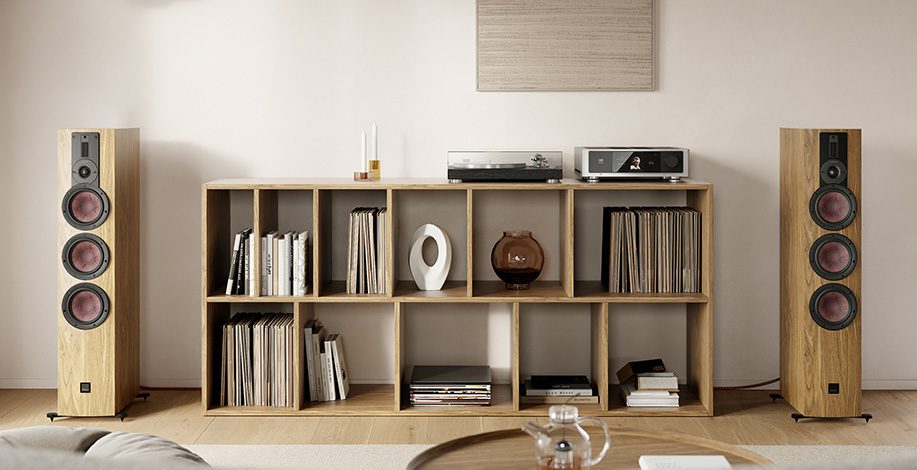
First there was the Kore, the mahoosive mighty Kore at £85k, then came the marginally more affordable Epikore 11 at £40k. Now, the trickle has turned into a flood and borne fruit in the shape of Rubikore at £2,299 and up. DALI has followed classic loudspeaker design practice with Nordic efficiency in turning the ideas developed for their flagship into an affordable range of ambitious loudspeakers in just two years, the engineering department must be a busy place.
The Rubikore range consists of three stereo models plus an on-wall and an LCR for films and that, the price mentioned above relates to the Rubikore 2 standmount, the Rubikore 6 floorstander is £4,499 and the Rubikore 8 under consideration here is a pound under six grand. And it is a lot of very nicely finished loudspeaker for the money. Hopefully the pictures will reveal the range of finishes available and the glossiness of their lacquer. Compare this with similarly equipped and scaled models from other brands and you will see that DALI is making a very good case for itself in the hard fought mid market.
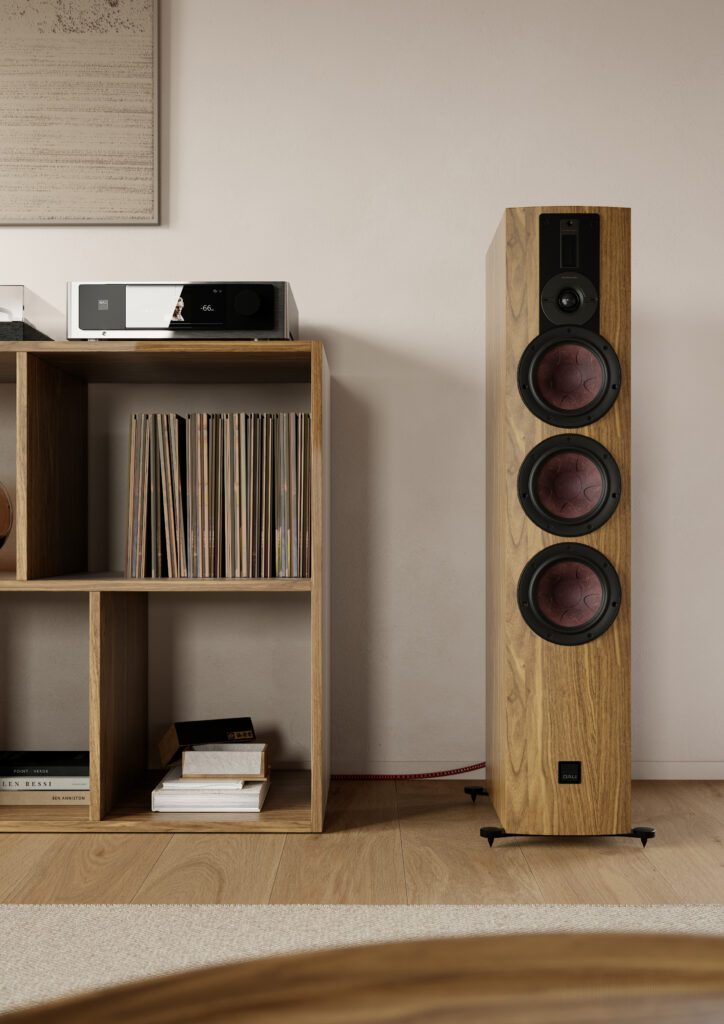
Starting at the top of the 110cm tall Rubikore 8 cabinet you have the high frequency section of the loudspeaker, this consists of not one but two drivers in the form of a 29mm soft dome and a 45mm planar magnetic, the latter covering the highest frequencies and the larger than average tweeter doing the (relatively) heavy lifting of highs that you might just be able to hear. DALI makes a big point about the dome being free of ferrofluid, an oil that is used largely to keep voice coils cool. Its claim is that this fluid impedes movement in the driver and slows down its transient response but say that without it the voice coil has to be more precisely centred in the magnetic gap than is conventionally the case.
DALI calls the paper and wood fibre cones on its mid and bass drivers ‘Clarity Cones.’ These have a light coating to provide the desired degree of damping. They are embossed to pool the coating, which increases damping without adding too much weight. This aims to make the midrange smoother. The SMC (or Soft Magnetic Compound) magnet system on these drivers uses insulated iron granules rather than solid iron, this is because the latter conducts electricity and current in the voice coil creates eddy currents in the iron that restricts movement due to a braking effect. DALI’s SMC also gives the Rubikore a more linear impedance and thus makes the amplifier’s life easier, they suggest that the Rubikore 8’s 90.5dB/4 Ohm load can be driven with a 30W amp. SMC has also been used in the crossover inductors where it is said to measurably reduce distortion by a significant amount, DALI also uses fancy Mundorf capacitors in the network.
Which way?
It points out that the “bass reflex port is a driver” which at low frequencies is generally the case. Here DALI has used three continuously flared ports to avoid the turbulence that makes these ‘drivers’ non linear. The whole loudspeaker is described as being a 2.5+0.5+0.5 way design which is kind of confusing, what it means is that the three 165mm mid/bass drivers are considered to be 2.5-way plus a half-way while the two high frequency drivers only constitute a half-way. Essentially the three cones are separated at 500Hz and 800Hz and hand over to the dome tweeter at 2.4kHz, however all of them cover the bass, so the lower one goes from the 38Hz cut-off up to 500Hz, the middle one goes from 38Hz to 800Hz and the top one includes everything from 38Hz to 2.4kHz. The high frequencies are covered by two drivers but there is no crossover between the two, instead DALI relies on the natural roll-off of the dome as the planar driver takes over between 11 and 14kHz. Clearly the crossover network is not straightforward, but the results suggest that it does a very good job.
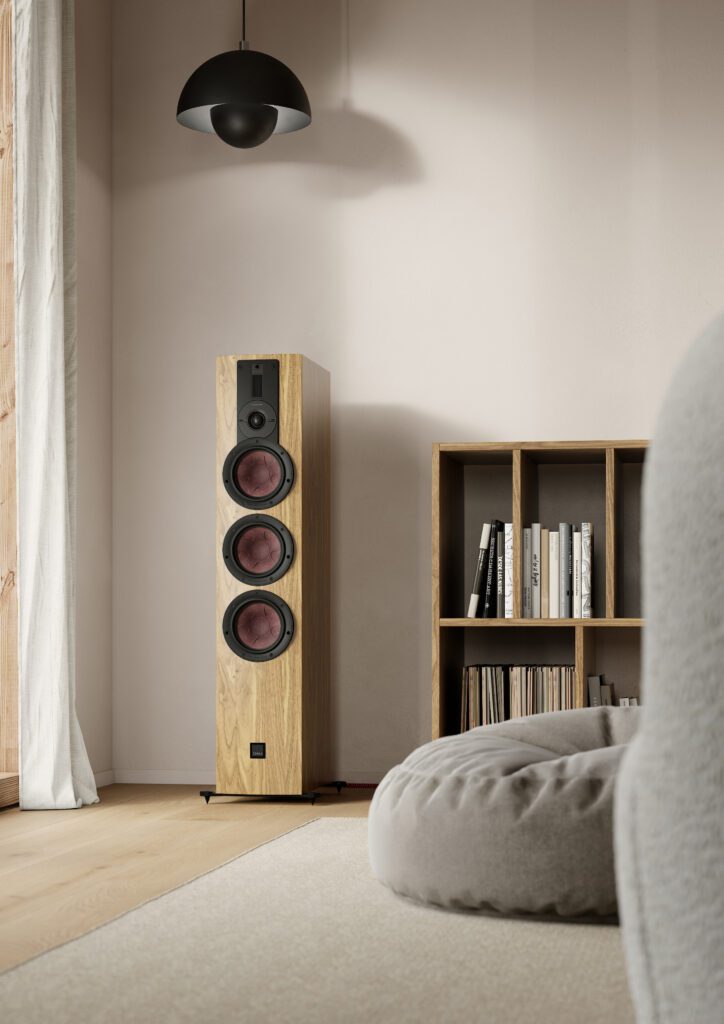
The Rubikore 8 is a substantial and attractive loudspeaker that’s available in a range of four finishes, I was sent the high gloss white but there is also a very attractive walnut and ‘maroon’ which looks more like a veneer than a paint finish. A pair of grey fleck grilles are included and attach magnetically so that there are no ugly sockets to see when they are left in the box. Each speaker comes with a pair of cast outrigger stabilising bars that bolt onto the bottom and can be fitted with supplied spikes, they provide the requisite stability without extending the footprint to an excessive degree. Speaker cables connect to bi-wirable terminals supplied with bridging plates for single wiring.
It’s easy to take such things for granted but unboxing the Rubikore 8s did enhance my experience with them. You know that they have been designed and packed by a company that has considered every last detail. Sadly, this is not always the case. The box for accessories is very nicely done too and the whole shebang should be good for several courier journeys before the 30kgs of loudspeaker start to become vulnerable.
Low end theory
I reviewed the Epikore 11s last year and got a superb result, the smoothness of midrange left a very positive impression as did their ability to make such a wide range of music sound engaging and detailed. The Rubikore 8 doesn’t quite match that model as one might expect but it has some of the same characteristics, notably in the absence of glare or grain in the midrange and the articulation of the bass. I started with e.s.t. 30, a live concert celebrating that much loved trio’s anniversary albeit without the late Esbjorn Svensson, it’s a good recording and one that revealed the impressive low frequency extension of the DALIs. The piano shimmered in the mid and top while double bass and kick drum were nicely articulated in the bass, the notes of the ‘bull fiddle’ being well differentiated and revealing just how clean the low end is from the biggest Rubikores.
Someone recommended Eric Dolphy’s version of ‘God Bless the Child’ (Live at the University of Illinois, 1963), a recording that the DALIs show has depth and stereo solidity that is surprisingly good for the time. They also make it clear that Dolphy was a musician of not inconsiderable talent even if he is overshadowed by his peers today. Another vintage jazz piece, ‘Mercy, Mercy, Mercy’ by Cannonball Adderley was recorded in front of an invited audience by David Axelrod who created a club of sorts in his studio. The Rubikore 8s make it clear that this was a great idea because the atmosphere is tangible and the playing superb, you clearly cannot underestimate the benefit that putting an audience in front of a musician has on the end result.
These speakers proved to be very adept at throwing around the spatial dynamics of a far less natural recording in the shape of Gryphon Rue’s 4n_Objx which is largely electronic but uses vintage synths and minimal beats. The DALIs reveal that it has been mixed to sound three dimensional in a synthetic but very effective fashion that few among its audience is likely to appreciate on their earbuds. These DALIs offer a high level of transparency for the asking price but don’t have the slightly exposed character found with some of the competition. They deliver detail but don’t emphasise shortcomings within recordings and that’s a bonus with releases like this. While not as smooth as the Epikore 11s the Rubikore 8s do reflect this aspect of their character which I suspect has a lot to do with the SMC in their motor systems.
Prince meets Zappa
Of course if a piece of music is limited when it comes to something like dynamics they don’t gloss over it, I found this with the new Hiatus Kaiyote album Love Heart Cheat Code, which the DALIs make clear is a fabulous piece of inspiring jazz funk from down under. The speakers allowed me to appreciate the originality and playing/singing abilities on an album that has touches of Prince, hip hop and even Zappa, by making it easy to hear into the layers of a production. One that has been compressed in order to fit everything in and make it accessible to an audience that doesn’t have the luxury of loudspeakers of the Rubikore 8’s calibre. I suspect that this album will sound rather harder and less easy to enjoy through other loudspeakers, especially those that seek to reveal as much detail as possible.
This capability is at least partly down to the remarkable timing qualities that these DALIs possess. As a rule, the more ‘ways’ that a loudspeaker has the more difficult keeping them all in precise synchronisation becomes, which is why it’s hard to beat a two-way and also why some won’t give up on full range drivers.
Timing really is the key to making complex music accessible and enjoyable, without it the less obvious musical forms can easily sound hard, bright and uncomfortable. That the Rubikore 8 deals with vintage jazz and mixes cut for contemporary tastes indicates that it has its finger firmly on the timing pulse.
Power handling is also a strong point, this you would expect given the size of the box and the quantity of drivers, however while plenty of big boxes can give high levels not many of them can do it as with the ease of this DALI. It remains controlled and dynamic while delivering above average volume levels and simultaneously delivers a strong stereo image, with instruments like piano having real solidity without masking other elements in a performance. More importantly than all of this is that the Rubikore 8s draw you into the music by delivering the sound in an engaging and easy to follow fashion.
Generous spirit
These are not monitors, they don’t seek to expose every bum note or the fact that a vinyl record could probably do with a good clean, they are revealing in a generous fashion which is usually much more enjoyable than warts and all presentation styles. Tonal contrast is for instance excellent, this was apparent with all manner of instruments and voices, especially the acoustic variety. The Liv Andrea Hauge Trio play piano, bass and drums and sometimes do so in a seemingly chaotic fashion, it’s almost free jazz except there’s no screeching and no one pushes the piano down the stairs. And this can be hard to follow if the system isn’t able to keep up, to distinguish between notes and to keep everything in perspective. The Rubikore 8s proved to be more than up to the job, pulling out the dynamic characteristics of the various instruments and presenting it along with the tonal palette in a totally coherent fashion.
This was apparent on the more familiar Steely Dan tune ‘Babylon Sisters’ which I regularly play as a test of engagement, it can all too easily sound plush but boring, but the DALI’s ability to clarify what each element in the mix is contributing and to show you how they connect with the rest of the band means that before you know it “Shake it” escapes your lips as you attempt to match the perfection of the backing vocals. Some call it dynamic expression, this ability to reveal the full envelope of each note or to at least deliver the most important elements. The Rubikore 8s are not as polished as some speakers but in exchange they provide the key ingredients for anyone who is really interested in what the musicians are playing, in how they are communicating with each other and the listener. And that for my money is worth a whole lot more than the veneer of sophistication. It’s a vivid, lifelike delivery that works with electronica, acoustic jazz and classical and the ferocity of modern prog that The God In Hackney lay down on The World in Air Quotes.
I am very impressed with the DALI Rubikore 8s, the Rubicon model that preceded it was good but with the trickle down from Kore this Danish company has managed to leverage huge amounts of resolution in an effortless fashion from a speaker that would cost significantly more if it were made by a boutique brand. It may well be time to forget about snob appeal and embrace a brand that delivers serious bang for your buck.
Technical specifications
- Type: 2.5+0.5+0.5-way, five-driver, reflex loaded floorstanding speaker.
- Driver complement: One 29mm low loass soft dome; one 17x45mm planar magnetostatic tweeter; three 6.5 inch Clarity Cone paper and wood fibre mid/bass drivers with SMC magnets.
- Crossover frequencies: 500Hz, 800Hz, 2.4kHz, 14kHz
- Frequency response: 38Hz – 34kHz
- Impedance: 4 Ohms
- Sensitivity: 90.5 @ 2.83V/1m
- Dimensions (HxWxD): 1100 x 220 x 444mm
- Weight: 30kg/each
- Finishes: High Gloss Black, High Gloss White, High Gloss Maroon, Natural Walnut.
- Price: £5,999, $12,000, €6,998/pair
Manufacturer
DALI A/S
+45 9672 1155
Trending Articles
See all
hi-fi+ issue 250: the Awards
- Dec 02, 2025
Audiovector R 5
- May 13, 2026
Wilson Audio Autobiography preview
- Apr 28, 2026

By Jason Kennedy
More articles from this author
Read Next From Review
See all
Jadis I-88
- Jun 16, 2026
Chord Company PhonoARAY
- Jun 16, 2026
Connected-Fidelity CF-1010 tonearm
- Jun 16, 2026
Karan Acoustics Master Collection POWERb MONO
- Jun 09, 2026