Advance Paris is a well-established player in Europe, selling in more than 40 countries worldwide, but when I spotted it at the Bristol Hi-Fi Show earlier this year, it was still a new name to me.
Established in 1995 in France as Advance Acoustic, it started with a range of five loudspeakers and only branched out into electronics once it launched its first integrated amplifier in 2004. The first product under the Advance Paris brand came along in 2013.
As the name suggests, Advance Paris products are designed in France but manufactured in China. But what impressed me at Bristol was the breadth of the product range, the many facilities, and the versatility offered by the amplifiers. Whenever I asked, ‘And how much is that?’ I responded, ‘Really?’, as they all seemed to offer a lot for very little money. I couldn’t wait to get my hands on something from them.
Its range is extensive, with eight integrated amps ranging from £500 to £3,750. There are two preamps (£1,500 and £3,500) and two stereo and two monobloc power amps, priced between £1,500 to £4,000. Then there are two CD players for £650 and £890 and transport for £1,000. It also offers wireless speakers, Bluetooth receivers, a range of streamers, and all-in-one systems.
Two hybrids
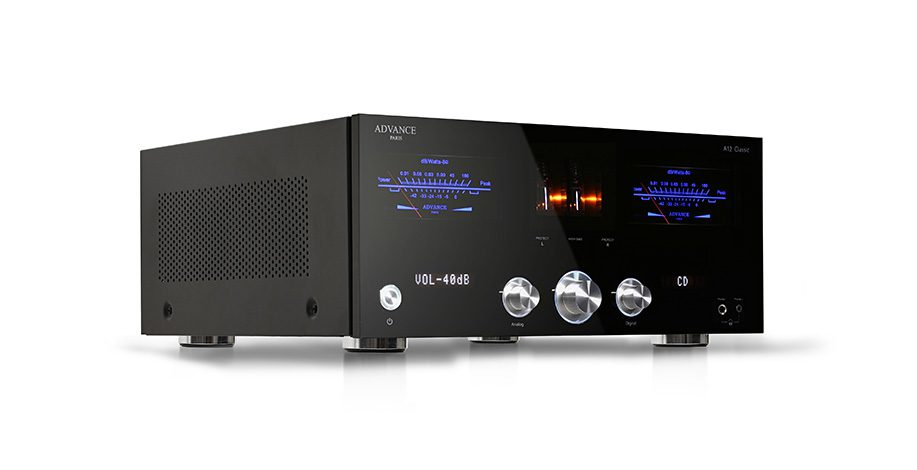
I was particularly interested in their two hybrid integrated amps, the 130W A10 Classic priced at £2,000 and the 190W A12 Classic reviewed here (£3,000).
The A12 Classic impressed me with its wide range of inputs, tube preamp stage, powerful transistor power amp stage, built-in DAC, moving coil and moving magnet phono stage and two headphone outputs, all for the modest asking price of £3,000. This amplifier comes in a very smart package with a substantial metal case and stylish black acrylic front panel sporting two large, blue VU meters and a window to showcase the two low-noise, triode ECC81/12AT7 preamp tubes.
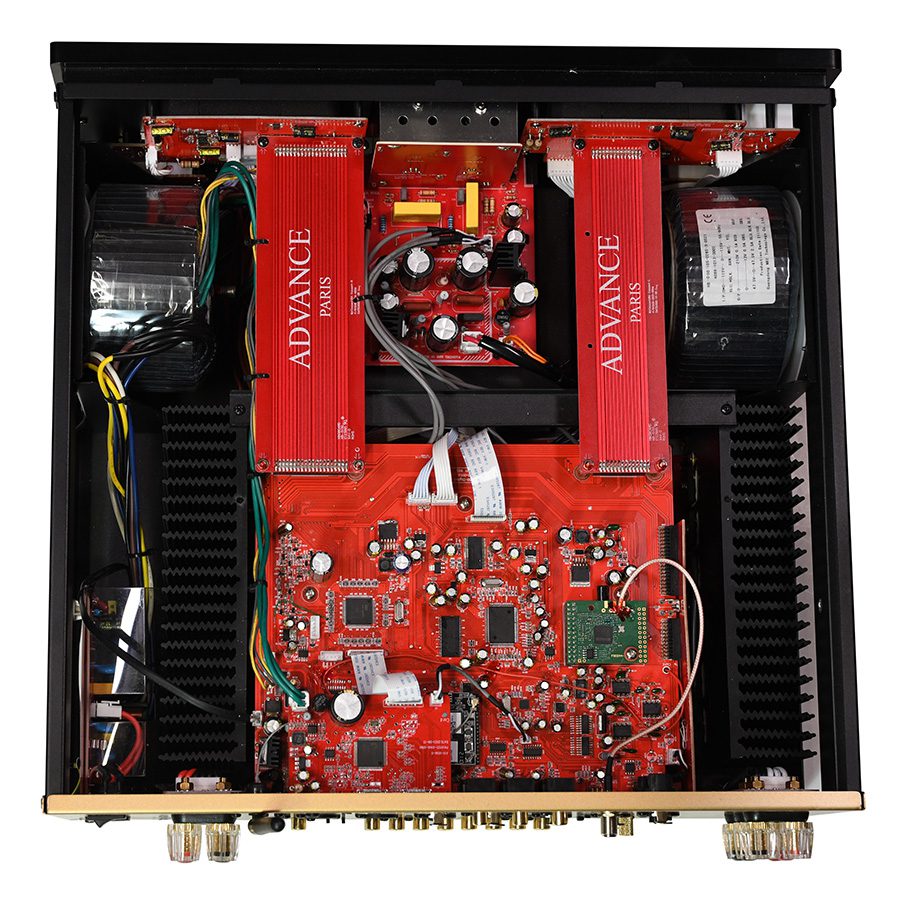
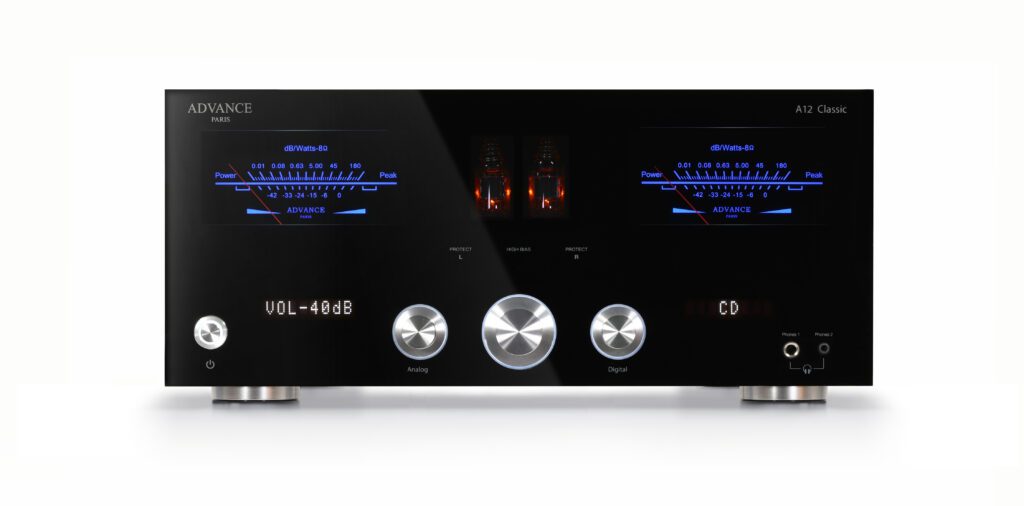
Advance Paris says the heart of its philosophy combines good sound quality with a wide choice of digital and analogue inputs. The Classic A12 uses a dual-mono circuit topology, and although its front panel looks minimalist, don’t be fooled—it gives access to a broad selection of input and output options.
On the far left at the bottom is the on/off/standby button, then a small display next to it shows the chosen volume and when the valve preamp section warm-up is complete. A similar display towards the far right displays the desired input and, in conjunction with the large central volume/multifunction knob, allows the user to select one (or both) of the two speaker outputs, adjust or bypass the tone controls, tailor the automatic switch-off timer operation and select ‘TV Audio’ and ‘Amp In’ so that you can use a different preamp with the A12. Bottom right are outputs for two pairs of headphones, which are individually adjustable for both gain (-4dB, -0dB, +6dB) and headphone output impedance (100Ω for phones with a middle or high impedance between 100Ω and 600Ω, and between 0Ω and 32Ω for lower-impedance models).
Unusually, there are two separate rotary input selector knobs on either side of the volume control, analogue on the left and digital on the right.
Two sets of binding posts provide two pairs of speaker outputs, which can be selected individually or together to provide sound in two rooms or bi-wiring a single pair of speakers.
Versatile
When it comes to inputs, it is not so much a question of what the A12 Classic has as what it doesn’t have.
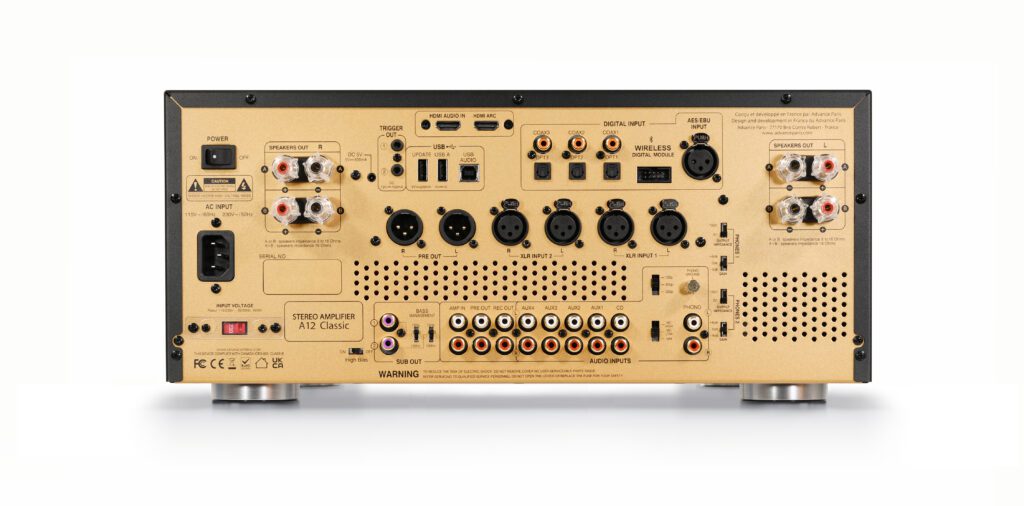
Let’s start with analogue inputs. There are five RCA line-in sockets plus an RCA input for phono, with adjustable input capacitance (100pF, 200pF and 300pF) and adjustable gain for moving magnet and moving coil (high and low). There are more RCAs for preamp out, record out and power amp in. There are also two sets of balanced XLR inputs and one XLR balanced preamp output.
The A12 Classic has a built-in DAC based on the well-respected and widely used Burr Brown PCM1796 chipset. There are seven digital inputs, including three optical, three coaxial, one AES/EBU and one USB, and connectors for optional aptX Bluetooth modules (the £100 X-FTB01 or £150 X-FTB02).
It is also fully ready to be hooked up to a home cinema system, with two subwoofer outputs with adjustable roll-over points of 75Hz or 150Hz, an HDMI input for a DVD player, and an HDMI ARC for use with a TV.
Although a streamer is missing from the A12 Classic, Advance Paris offers a compact WTX MicroStream plug-in high-definition streamer module, which operates via wi-fi and plugs into one of the auxiliary RCA inputs. At £150, this allows the A12 Classic to offer the user streaming for around the same overall price as some integrated amps with a streamer built in. Setting up the app to control it proved straightforward enough.
For most of my listening, I used a Gold Note CD10 CD player with Marten Oscar Duo loudspeakers. I used an Audio Note TT3/PSU3/Io1/AN-S9 front end to evaluate the phono input.
I started with CD as a source, initially feeding the CD10’s digital output into the A12’s DAC. The sound was dynamic, detailed and syncopated with great snap and poise to drums and percussion, deep tuneful bass guitar lines and open, articulate male and female vocals.
Street Racing
On Bruce Springsteen’s ‘Racing in the Streets’ from his Darkness on the Edge of Town CD, I was impressed by the openness of his vocals, the presence and body of the piano on the intro, the crispness of drum rimshots, and the sheer power and weight of the bass line when it kicked in. One well-respected rival sounded colder in its balance, and the A12 better separated the various strands of the music.
On ‘All I See is You’ from saxophonist Dave Koz’s Saxophonic CD, the A12 again offered a clearer insight into percussion, conveyed the body and bite of his sax better and conveyed the rhythmic impetus and flow of the music better.
I also tried the A12’s built-in DAC against the onboard DAC in the CD10, and it was not found lacking. Bass lines were tight, snappy, and moved well, while vocals, piano, guitar, and saxophone were well-voiced and natural. The music has a good sense of rhythmic impetus and structure. If you pair the A12 with a CD player priced between £1,000 and £2,000, try its digital output into the A12’s DAC.
I next tried streaming using the Advance Paris WTX MicroStream. I quickly set up the app and searched Tidal for the track ‘A Place for Skipper’ from guitar legend Larry Carlton’s Discovery album.
Despite the modest £150 asking price of the streamer, I was impressed by the delicacy and detail in the percussion lines and by the natural voicing and note detail on the guitar. The bass line was weighty, tight, and agile, and compared with one well-respected competitor’s built-in streamer; it performed extremely well.
Skip to Linda Ronstadt’s gorgeous ballad ‘Lo Siento Mi Vida’ from her Hasten Down the Wind album. It nicely differentiated the sonic signatures of the two guitars in the intro, and Ronstadt’s vocals were open, sensual, and packed an excellent emotional and dynamic punch. When she turned up the volume on a note, the A12 rose to the challenge without becoming harsh or strident.
It would be easy to dismiss the tiny WTX MicroStream as a cheap add-on. But it’s better than that. It punches well above its weight and does not let the A12 down.
Earning Ears
My ears were really earning their keep checking out the multiple inputs of the A12. Next up was the phono input. This phono stage features adjustable capacitance for MM and adjustable gain for MC.
I used my Audio Note Io1 with its S9 transformer into the MM input set to the lowest capacitance. From the first few bars of the title track of the wonderful half-speed mastered version of John Martyn’s classic Solid Air, the A12 proved that its phono stage was more than fit for purpose. The double bass was powerful, tight, and tuneful, Martyn’s guitar was delicately painted and nicely separated, his vocals were open and articulate, and the staccato rhythm that drives this wonderful track along was well captured.
Next, I tried ‘Red Lights in the Rain’ from Canadian singer/songwriter/guitarist Stephen Fearing’s The Secret of Climbing album for Rega (get one if you don’t have one!). Here, his vocals exhibited delicacy, power, and emotional impact but without any harshness or sibilance, while his guitar had a good body and note shape detail. All in all, it was an excellent performance.
But we are still going! There were two things I still wanted to check out. First, I tried the headphone output and, finally, the effect of using the High Bias setting. You select High Bias by operating a toggle switch on the back panel with a small blue light on the front panel to indicate when it is in use. Advance Paris says that in High Bias mode, the sound “is comparable to that of a Class A amplifier on the first few watts of use”. Gotta be worth a try.
Trying it out on ‘Never Too Far to Fall’ from George Benson’s In Your Eyes album, the vocals seemed a bit more open and sweeter on High Bias, but on the downside, the bass line lost some weight and impulsion.
On ‘The Bright Side’ from Dave Koz’s The Dance: Yes, the overall sound was sweeter, but the percussion lacked impact, and his sax was softer and lacking bite. Again, the bass line seemed fuller and more melodic in normal bias mode. On balance, I concluded that the High Bias setting wasn’t for me, so I left it out of the circuit for all my listening. The amp was more than good enough without it.
From experience, I know that the headphone output can be an afterthought in many amplifiers, but I am pleased to say that this wasn’t the case with the A12 Classic.
Plugging in my Focal Clear headphones, after the first few bars of ‘I Can See Clearly Now’ from guitarist Peter White’s excellent Groovin’ CD, I could put any such fears to one side as the A12’s performance was detailed, dynamic, well balanced and articulate. I could hear how White shaped each note and what the backing players were doing, while that great, reggae-like bass line was weighty and moved well.
‘No One Emotion’ from George Benson’s 20/20 confirmed the competence of the A12’s headphone amp. The track was conveyed with great speed, poise, and impetus, and the driving synth bass line was weighty and pacey, keeping the rhythmic energy of the track flowing. Benson’s vocals were open and articulate, and that screaming guitar solo from Michael Sembello was well-voiced, with great power and inner detail but without sounding harsh or strident.
Magnificent multitasker
I was wondering if there was anything that the Advance Paris A12 Classic couldn’t do. It is a great-sounding amplifier with more than enough power for any speakers you care to throw at it, and it benefits from a valve preamp stage that gives it an edge in sound quality over many similarly priced competitors.
It has a built-in DAC and adding £150 to your bill for the tiny but excellent WTX MicroStream plug-in streamer allows you to add another source with great sound quality from Tidal or Qobuz.
It not only performs well on its analogue line and digital inputs but also has a very capable moving magnet/moving coil phono stage that allows you to enjoy high-quality vinyl playback. Meanwhile, its excellent built-in headphone amp is more than good enough to satisfy most listeners, saving you from shelling out on a separate one.
At £3,000, the A12 Classic is a bargain, and I recommend it enthusiastically.
Technical specifications
- Type: Class AB, two-channel hybrid integrated amplifier
- Analogue inputs: 5x analogue RCA line input, 1x phono (MM/MC), 2x XLR balanced line inputs
- Digital inputs: 3x optical, 3x coaxial, 1x AES/EBU, HDMI ARC, USB
- Power output: 190Wpc into 8 ohms, 280Wpc into 4ohms
- Distortion: 0.007%
- Frequency response: 10Hz-35kHz (-3dB)
- Signal-to-noise ratio: 103dB
- Channel separation: >75dB
- DAC: Burr-Brown PCM1796
- Phono stage gain: MM: 38dB (47kohms), MC: 48dB (low), 58dB (high) (47ohms)
- Dimensions: (WxHxD) 43x19x45.5cm
- Weight: 17.9kg
- Price: £3,000, $3,799, €2,690
Manufacturer
Advance Paris SARL
+33 (0) 160 185 895
UK distributor
Decent Audio
+44 (0) 1642 263765
Trending Articles
See all
Krell Vanguard integrated amplifier
- Apr 07, 2015
Trending Articles

By Chris Frankland
More articles from this author
Read Next From Review
See all
Eversolo T8
- Oct 13, 2026
Acoustic Energy AE Active
- Oct 13, 2026
Reiki Audio SuperSwitch X/Pro X PSU
- Oct 06, 2026
Audiobyte SuperVOX
- Oct 06, 2026