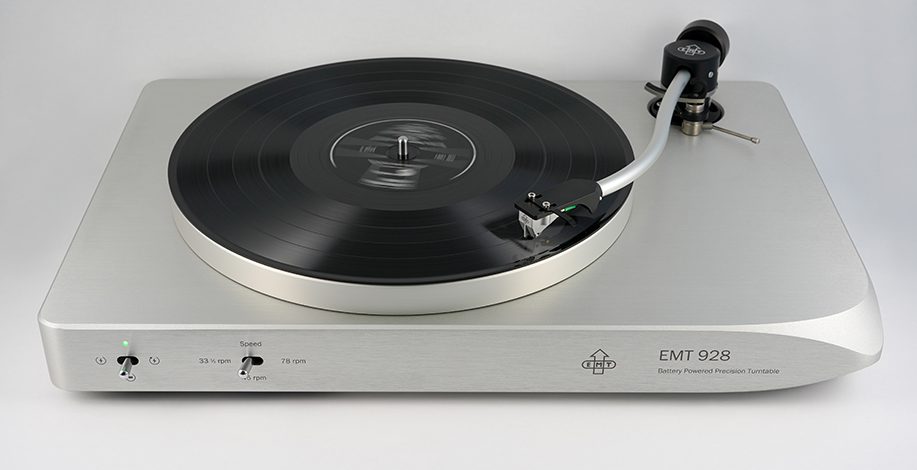
Vinyl replay is replete with brand names that have been in the business of making turntables for a very long time; given the fundamental… maturity… of the technology in question, it could hardly be otherwise. Even among the more illustrious names though, some companies manage to maintain more of a mystique to them than others. In the case of EMT, the brand’s formidable reputation was built around a family of broadcast and laboratory specification turntables that took the concept of overengineering and ran with it. These turntables are still highly regarded and sought after today, such is the level of performance that they offer.
This means that any device that sports an EMT badge has a tremendous heritage to upkeep and, taken at face value, the lineage between those vast pro models and this usefully compact belt driven device presented for your consideration is not something that is automatically obvious. The pro models used either idler or direct drive rather than belt and the reduction in controls on the current deck to two (more on which in a bit) is in contrast to the plethora of buttons and switches on the older models.
Lineage
Crucially though, the 928 does have a lineage of its own. More accurately, it is described on the company site as the 928 II because the original 928 was another belt drive model that borrowed underpinnings from the Thorens TD125 and was sold as a semi-pro design. Like its titular ancestor, the EMT 928 II shares some underpinnings with the TTT Compact II turntable from sister brand Thales but winds up being a rather different beast.
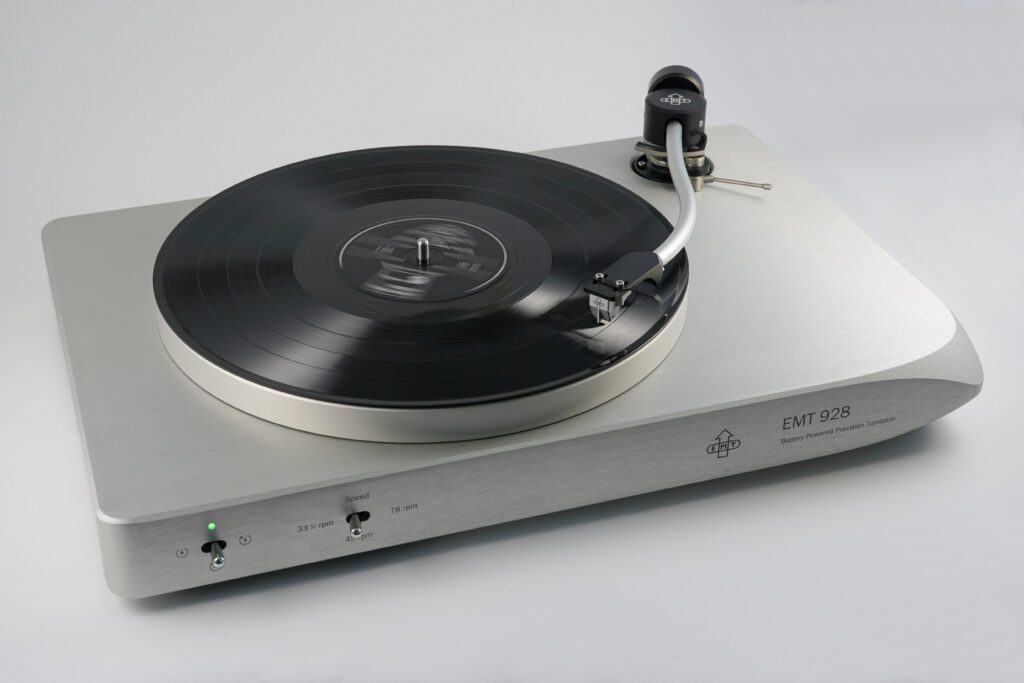
Key to the design of the 928 II is the motor and power supply. A 20 watt motor offers 33, 45 and 78 rpm operation and this is intended to run on battery power in most use cases. An internal battery is built into the plinth and, so long as the IEC socket is connected to power, the battery will be topped off when the 928 II isn’t playing. Should you drain the battery (no small undertaking as it offers 30 hours at 78rpm, rising to 40 at 33rpm), the third position on the power switch allows the EMT to run on mains power as well.
What is tricky to get across is how astonishingly dense the EMT is. It’s barely larger than a Rega Planar 3 in terms of surface area but the platter alone (5.5kg) is barely less than the total weight of the Rega (6.0kg). The complete turntable tips the scales at 23kg which grants it a fairly significant degree of isolation simply down to mass, even before the pliant feet on the underside are taken into account. It might look almost dainty in appearance but it really, really isn’t.
Package deal
The 928 II is available as a package with the EMT 909 tonearm for £13,800; a considerable saving over buying both separately. The 909 is much more visually in keeping with the designs from the broadcast era and is a shallow S shape design using an aluminium alloy for the majority of components, all mounted to a stainless steel base. The 909 is available in different configurations to suit your requirements; a detachable SME headshell and Ortofon A compatible versions also being available. The version supplied for test though is designed to connect directly to the ‘Tondose’ family of cartridges that date back in concept to 1965.
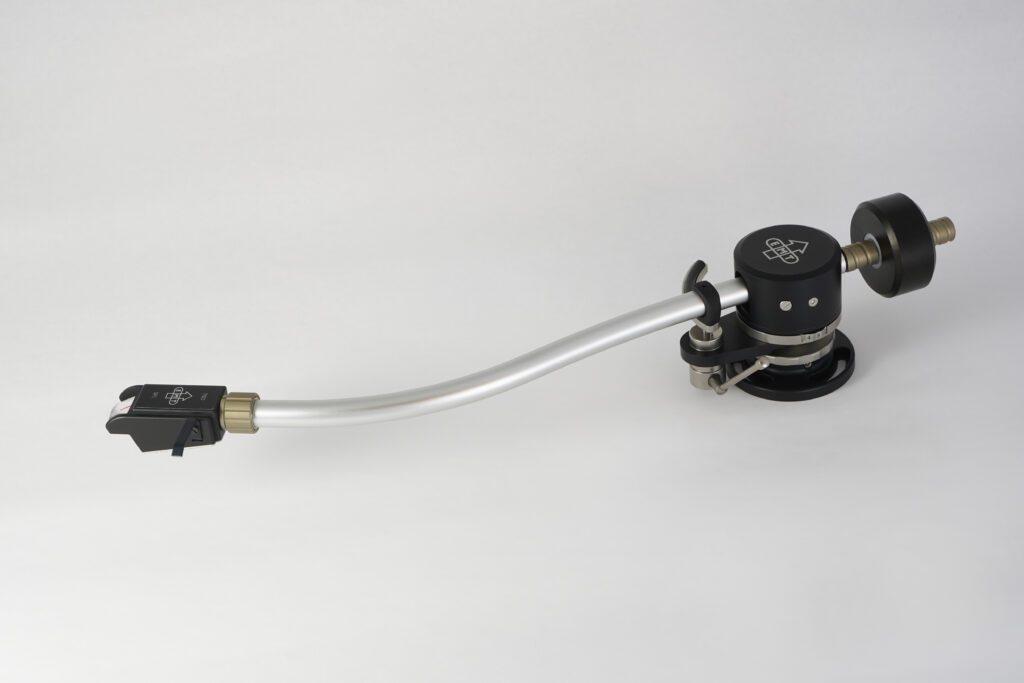
The 909 looks simple but comprises over 150 parts and the more you interact with it, the more confidence inspiring it becomes. The build is every bit as substantial as the turntable and it’s a wholly pleasant and logical thing to use. A twelve inch version is also available and EMT has recently released an adapter that connects to the rear left hand corner of the 928 II that allows it to run one of these in addition to the 9” unit in the standard position without significantly increasing the overall footprint. EMT will also cut armboards to allow for other arms to fit the 928 II as well.
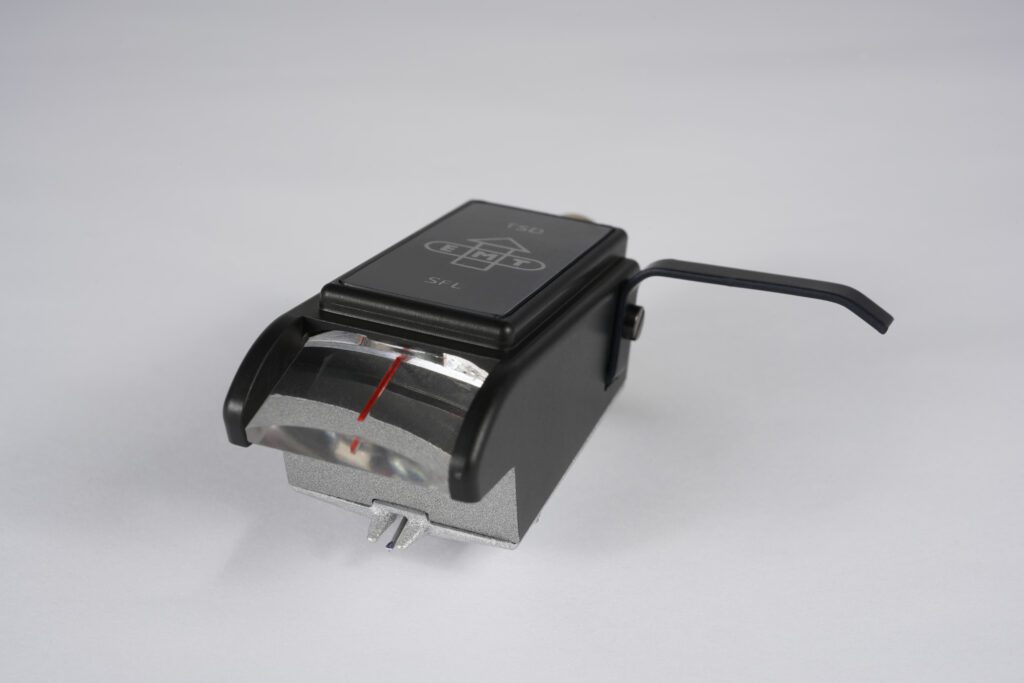
While the 909 will work happily with a decent spread of low and medium compliance cartridges, I can see the temptation to keep everything in house and go with the fitting for the Tondose designs. Despite looking very similar to the post 1972 models, with their cast magnesium bodies and prominent Perspex front section complete with red line to aid alignment (as the short stylus is pretty much invisible when viewed from above). These new models have a body that is entirely made from magnesium and gold and silver coil windings are available as cost options. As befits a turntable that can spin at 78rpm, there are both mono and specialist shellac mono variants available which gives the EMT the ability to handle a huge variety of records, fairly easily.
EMT and UK distributor Fi Audio supplied three different Tondose models to try. The TSD SPH and TSD SFL are both £1,680 and represent two different eras of broadcast standard model; the SPH using a conical stylus commonly encountered pre 1980 while the SFL has a nude elliptical stylus as used in the eighties and onwards. The final model is the £3,600 TSD Novel, the range topping flagship which is a rather more sophisticated device with a sapphire and titanium cantilever and highly polished line contact stylus which gives it something of the feel of a retromod car; all period correct on the outside but entirely of the moment under the hood.
Set up
Setting the EMT up is genuinely pleasurable experience, free from anything that could be described as ‘faff’ and it serves to demonstrate just how well made it is; the manner in which the platter slides onto the bearing is a source of almost ASMR like satisfaction. EMT supplies a lead out cable and ground lead and you should be up and running inside of fifteen minutes. The lack of dustcover is a mild annoyance but the shape of the 928 II isn’t so radical as to preclude an aftermarket option. The only other operational remark I’ll make is that the Tondose carts need to be lowered carefully at the start of a record; they are very prone to bouncing a few seconds into the opening track if lowered too fast.
With setup completed and a Luxman L509-Z offering up its extremely capable phono stage as a source, I started with the simplest SPH Tondose cartridge. I will go on record as not being a huge fan of conical stylus designs; often the presentation isn’t so much ‘big picture’ as ‘loosely outlined in crayon’ but the results here demonstrated that the fundamentals of the EMT package are seriously good. The suggestion that the SPH is happiest with early stereo recordings led to me picking a repress of Nina Simone Sings the Blues [RCA] to get acquainted with the EMT.
The result walks a beautifully balanced line between neutrality and engagement that is hard not to be smitten by. The upbeat Real Real is presented with the energy and spark that Simone was so effortlessly good at bringing to her performances and both she and her supporting instruments are tonally convincing and possessed of convincing scale. There are points at the peaks of this track where the limitations of the recording give it a slightly hard edge. The EMT doesn’t minimise this; it’s the scion of broadcast equipment after all, but it doesn’t become the focus of your attention over above the music.
Perfect masters
This ability to make sense of less than perfectly mastered material survives leaving the 1960s as well. A spirited run through Destroyer by Black Mountain [Jagjaguwar] reveals the same ability to extract music from less than magnificent mastering. It also reveals that the EMT is perfectly capable of being tremendously good fun when the opportunity arrives. In presentation terms, the 928 II is interesting because when you listen initially, it doesn’t sound particularly ‘fast’ but after a bit of time and a few records, you realise that it is quite astonishingly articulate. This articulation means that it never shows the slightest hint of breaking sweat as tempos increase and time signatures become more complex. The sequence in The Cinematic Orchestra’s Ode to the Big Sea [Ninja Tune] where the drums are layered half a beat apart can become an ill defined mess, even on turntables at this sort of price point. On the EMT they’re perfectly recreated.
Good though the performance is, the 928 II and 909 are capable of delivering more. Swapping the conical SPH for the elliptical SFL is a significant step forward for me and, given that the bulk of my record collection is from post 1980 and the two models are the same price, it would be the one I would pick of the two. My time with the EMT coincided with the arrival of a copy of Another Lonely Night [Dear Boss], a live Kraftwerk recording, originally broadcast on Italian FM radio. This is not a good recording; it’s a joy because it hasn’t been given the Kling Klang treatment and actually sounds like Kraftwerk used to. The ability of the SFL to dig more information out of this record is considerable and it consistently performs this feat with more conventional material too.
This trio, 928 II, 909 and SFL is the sweet spot of the lot as far as I’m concerned. The TSD Novel is better still but, at the best part of nearly two grand more, it demonstrates that the SFL is exceptionally good value. Crucially, the SFL has the resolving capability to show just how good the deck and arm really are. After a few days with the EMT, returning to other turntables, even ones that cost as much or more than this one does can leave you finding them sounding fussy and unsettled. The 928 II has an almost supernatural ability to create a three-dimensional image of what is being played and places performers, regardless of their number or what they happen to be doing, in such a way as to be utterly logical.
Quality values
It does this while possessing the quality I value above all others in absolutely any piece of audio equipment at any price, in that it’s fun. I had some concerns before the EMT arrived that it would be a serious, slightly overbearing device that responded to any effort to play something like the eponymously titled debut album by Bentley Rhythm Ace [Skint] with the acoustic equivalent of a sneer. I needn’t have worried. What actually happens is that the 928 II gets stuck into the gloriously odd Why is a Frog Too? with truly exceptional enthusiasm. Be under no illusions that the performance is technically excellent; the bass in particular is better than I can ever recall hearing from this record, but more than specific abilities, it captures the essence of hearing it on a night out on the South Coast in the late 1990s. I don’t doubt that the EMT would hold its own being judged as a reference source but it’s capable of rather more than that.
Of course, there is degree of faith required in the mechanics of the EMT to leap into this world that needs to be taken into account. Most people shopping for a turntable at this price point will not be buying their first unit and, to hear the EMT as I have in this review, requires your existing deck, arm and cart to all be dispensed with in one fell swoop. Having done so, if your 909 arm is wired as this one is, you are tied into the Tondose family of carts as nothing else will fit. That said, the fixed headshell version of the 909 arm suits regular hi-fi cartridges. Against rivals that allow you to pick and choose, it might feel restrictive, but I am extremely confident that on hearing what this trio of EMT components can do together, many people won’t care. EMT has carefully curated their past in the 928 II and, in doing so, has created an absolutely sublime turntable for the present.
Technical specifications
Model EMT928 II
- Platter speed 331/3rpm | 45rpm | 78rpm
- Wow and flutter ±0,07% | ±0,07% | ±0,10%
- Rumble -85dB | -80dB | -75dB
- Speed-up time 10s | 12s | 20s
- Battery service life; 40h | 38h | 30h
- Dimensions 480x340x100mm
- Weight 23kg
- Input voltage 100-240VAC, 50-60Hz
- Output terminal RCA, with separated tonearm ground
- Mounting distance tonearm 215-245mm, prepared for EMT 9-inch tonearm
909 II Tonearm
- Effective mass 10.2g
- Cartridge weight 10…25g
- Effective length 246.75mm
- Offset angle 22.25°
- Overhang 16.75mm
- Null points 120.9 | 66.04mm
- Output (Standard) Wire outlet 20cm
- Output (Option DIN) 5-pin DIN outlet
Price as package £13,800, $14,995, €14,490
Manufacturer
EMT Tontechnik
UK distributor
Fi Audio
+44(0)1563 574185
Tags: CARTRIDGE EMT 909 HI EMT 928 II EMT TONDOSE TONEARM TURNTABLE
Trending Articles
See all
Trending Articles

By Ed Selley
More articles from this author

Read Next From Review
See all
Eversolo T8
- Oct 13, 2026
Acoustic Energy AE Active
- Oct 13, 2026
Reiki Audio SuperSwitch X/Pro X PSU
- Oct 06, 2026
Audiobyte SuperVOX
- Oct 06, 2026