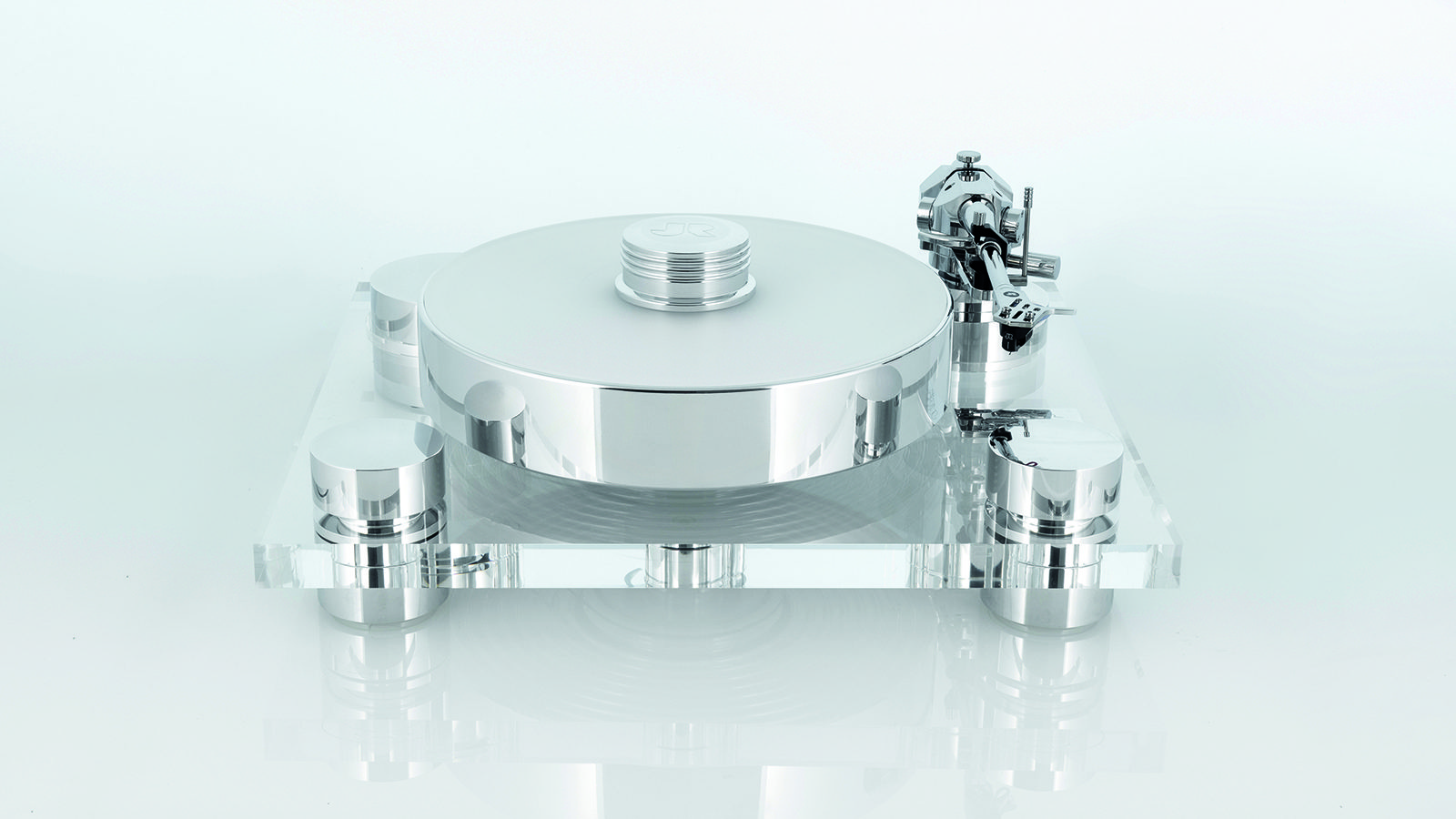
Despite being established over half a century ago, Transrotor remains relatively unknown in the UK. If the Transrotor Bellini TMD turntable (with TRA-9 arm and Figaro cartridge from the brand) is anything to go by, it’s our loss. Starting in 1971, founder Jochen Räke began as a distributor for Transcriptors and Michell turntables, only launching his own designs some years later. Transrotor designs weren’t distributed in the UK, so it hasn’t developed the following it has in its native Germany.
The company remains family-owned and is managed by Jochen’s son, Dirk. Transrotor’s main goal is to create the ideal platform for a high-quality arm and cartridge. This has led them to select high-mass platters for speed stability and vibration damping, along with careful use of mass within the deck’s structure, primarily using acrylic. The Bellini also offers an upgrade option with a slate plinth.
Extensive range
The Bellini TMD is positioned toward the upper middle of the extensive Transrotor range, which spans from the sleek simplicity of the Max to the Art Deco meets Bauhaus style of the Metropolis FMD—a design Fritz Lang would likely have approved. The Bellini TMD features a belt-drive, slab-chassis configuration resting on three sturdy feet, each equipped with a silicone ring to interface with the shelf and finely adjustable for height, making levelling straightforward.
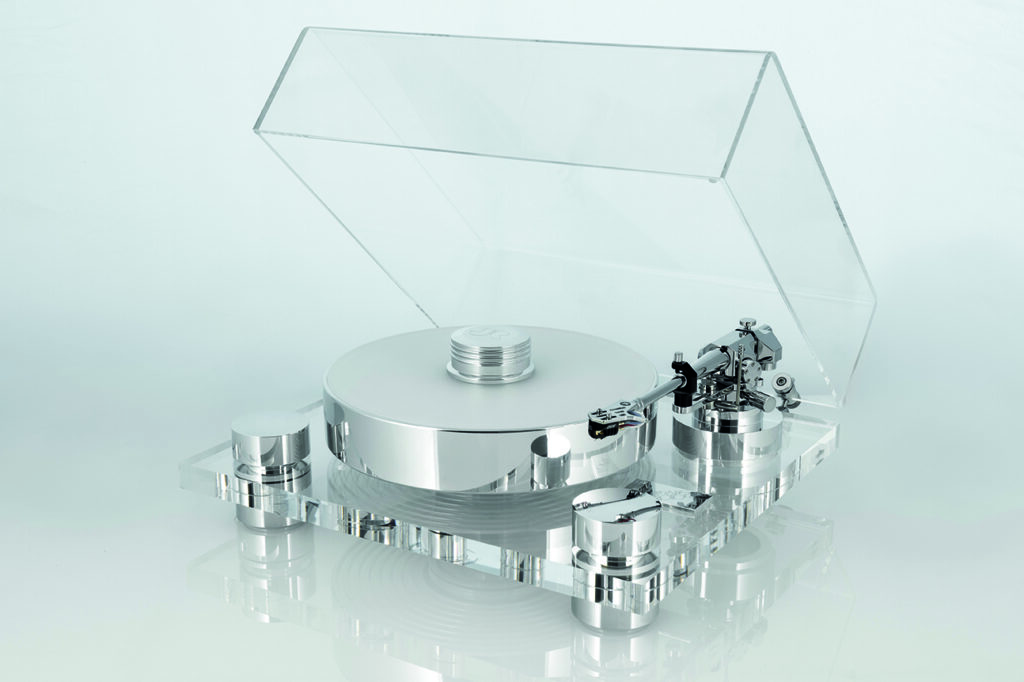
A substantial aluminium platter is powered by a freestanding motor unit situated in a circular cut-out within the plinth. This unit, called the Konstant, features an external power supply and speed controller, offering speeds of 33 and 45 rpm with adjustable speed correction.
Traditionally, Transrotor used SME tonearms, but they developed their own models three years ago. The TRA 9 tonearm is a gimballed design, stylistically reminiscent of the SME V, with carefully selected hybrid steel and ceramic bearings to ensure optimal breakaway force with low friction, and an armwand made of two tubes in different aluminium alloys, designed to cancel mutual vibrations through the interaction of the tightly-fitting tapered and straight sections.
There’s easy tracking force adjustment using a calibrated wheel, a magnetic anti-skating mechanism, and fine settings for VTA and azimuth. Each arm is individually calibrated before shipping to ensure the bearings move freely without being too loose. While this isn’t groundbreaking, the level of engineering care, fit, and finish applied to all parts of the turntable, tonearm, and electronics is outstanding, and there’s obvious careful attention to the critical design elements.
What is TMD?
What is quite special, however, is the way the belt drive system is implemented. The simpler models utilise a conventional belt configuration between the motor pulley and platter. Still, Transrotor has also developed two drive decoupling systems, dubbed Transrotor Magnetic Drive and Free Magnetic Drive, which are employed as the range expands. Here, the TMD system uses a two-part subplatter that sits on the bearing shaft, mounted on the chassis.
The lower subplatter connects to the motor unit via a circular-section polymer belt and couples magnetically but not mechanically to the upper subplatter, on which the main platter rests. When you fit the two parts, you feel them lock firmly together as the three internal magnets couple, ensuring a secure connection while also providing a drive mechanism that is mainly physically decoupled from the motor itself. Between the flexibility of the belt and the slight ‘float’ in the magnetic coupling, isolation from motor-induced vibrations is significant.
Speed stability is achieved through the significant moment of inertia of the large main platter, which has an integrated acrylic mat. The platter reaches speed rapidly—without any hand assistance—and stabilises within seconds. The FMD system, used in the highest models, enhances this by placing the subplatter and main platter in separate bearing housings, connected solely via magnetic coupling.
Ah, Figaro
Transrotor also offered one of their own range of moving coil cartridges, specifically the Figaro. These cartridges are primarily designed and manufactured by Goldring to Transrotor’s specifications. The magnesium-bodied Figaro features an exposed generator design, developed entirely to Transrotor’s requirements, with an emphasis on achieving a flat frequency response and consistent channel balance.
Each cartridge is tested to perform within strict limits of better than ±0.5 dB, and those below the standard are rejected. It’s a lively, expressive performer, more than capable of revealing the music in any track I played it. It’s also more than capable of uncovering the fluff in any track I played, which might be a testament to how deeply it digs into the groove.
One-hour set-up
Transrotor states that one design goal was to make the Bellini TMD quick and simple to set up. In fact, we had it producing music in less than an hour after opening the box. The review unit arrived with the cartridge already fitted, so it was mainly a case of checking the settings before playing. However, if you wish to fit your own, almost everything you need is already included in the box.
The Bellini TMD is visually appealing in a way only large slabs of thick, transparent acrylic and numerous shiny, plated metal parts can be. Its finish is flawless, with careful attention to detail and much hand-finishing. It should complement any style from mid-century modern onwards. However, if your taste leans more towards earlier eras, you might find it difficult to pair with your antimacassars and aspidistras. But, as jazz saxophonists have been known to say, “you can’t play the shine”.
Happily, the sound matches the visual promises. The Bellini is prominent, confident, secure, and stable, while skillfully avoiding the typical risk of sounding blocky and dull with high-mass designs. The unconventional, reggae-influenced emphasis on the pizzicato strings in ‘An Englishman in New York’ from Nothing Like the Sun [A&M] is appropriately driving, working seamlessly with the neat, tight, and quick percussion. Nevertheless, Sting’s vocals glide easily and fluidly above the mix, and the saxophone cuts through clearly, rich in tone and expressive in its phrasing. The presentation is lively, confident but not overbearing, with just the right touch of quixotic charm.
Experimentation
As you’d expect from reading Issue 244, I experimented a bit with the setup and ancillaries. The flawlessly finished Konstant power supply benefits from decoupling from the shelf; I used either Lateral Audio Arena APX isolating footers beneath the Konstant’s silicone feet or AcouPlex AC40 cones directly on the supporting bars on the underside of the unit, and the presentation immediately becomes livelier and more expressive. The turntable also includes a reasonably weighted 360g record weight, which contributes to the overall sonic character of the Bellini TMD.
Sibelius’ Finlandia [BPO, Karajan on DG] possesses all the majesty, gravitas, and solemnity you could wish for in the opening brass, along with the string and woodwind responses. Replacing this with a lightweight, 35g, AcouPlex puck is enlightening. It sacrifices some of that weight and solemnity for added impact and texture. The trumpet calls end more decisively; the strings now carry a more wistful tone, heightening the contrast between the two sonic worlds created here, perhaps suggesting a hint of homesickness. The integral acrylic platter mat works well, but a thin PEEK sheet on top introduces a little more sense of freedom and vitality. Sting’s track not only features that irresistible reggae beat, but now it also exudes an air of insouciant stylishness in the phrasing, reminiscent of the man himself.
No domination
All of which I believe demonstrates that the deck does not dominate the sound, but its responsiveness to setup and tweaking highlights the inherent neutrality of the platform. I’m more accustomed to a suspended subchassis turntable, and each design approach has its supporters. The Bellini TMD has bridged the gap between the two camps in a manner I have not heard a high-mass turntable achieve at this price point. If you’re not convinced that a high-mass approach suits your preferences, the Transrotor Bellini TMD might challenge your assumptions. I am confident that the goal of creating a stable platform for the arm and cartridge to operate from has been successfully realised.
Technical specifications
Transrotor Bellini TMD
- Type: belt drive, acrylic chassis turntable with free-standing motor and 9” TRA tonearm
- Rotational Speeds: 33 1/3 RPM; 45 RPM, accuracy better than 0.04% adjustable via offboard speed controller
- Platter type: aluminium/acrylic,
- Platter weight: 7Kg
- Bearing type: inverted hardened bearing with Transrotor Magnetic Drive
- Suspension: solid, adjustable feet for isolation and levelling, silicone ring
- Turntable Dimensions: (HxWxD) 220 x 460 x 430mm
- Weight: 32Kg
- Price: £4,500, €4,590, $7,190
Transrotor TR9
- Tonearm: 9” straight, gimballed tonearm with hybrid steel/ceramic bearings, 2-part semi-tapered aluminium armtube; adjustable VTF, VTA, azimuth.
- Tonearm Effective Length: 232.8mm
- Pivot to spindle distance: 215mm
- Overhang: 17.8mm
- Offset angle: 23.66 degrees
- Effective Mass: 18g
- Price: Black/chrome finish £6,300, €6,300, $7,250
Transrotor Konstant Reference M1
- Output voltage: 2 x 18V AC (2-phase)
- Speed correction range: +/- 5%
- Dimensions: (HxWxD) 75 x 176 x 170mm
- Price: £1,120, €1,120, $1,535
Transrotor Figaro
- Type: Magnesium bodied, exposed generator, low output moving coil cartridge
- Stylus/cantilever: vital nude diamond, aluminium cantilever
- Tracking force: 1.7g
- Output (@ 3.45 cm/s): 0.25mV
- Compliance: 16 um/mN
- Recommended loading: 100-200Ω
- Weight: 9g
- Price: £2,800, €2,800, $2,500
Manufacturer
Transrotor
UK distributor
Kog Audio
+44(0)2477 220 650
Tags: CARTRIDGE TONEARM TRANSROTOR BELLINI TMD TRANSROTOR FIGARO TRANSROTOR TRA 9 TURNTABLE
Trending Articles
See all
Trending Articles

By Steve Dickinson
More articles from this author
Read Next From Review
See all
Eversolo T8
- Oct 13, 2026
Acoustic Energy AE Active
- Oct 13, 2026
Reiki Audio SuperSwitch X/Pro X PSU
- Oct 06, 2026
Audiobyte SuperVOX
- Oct 06, 2026