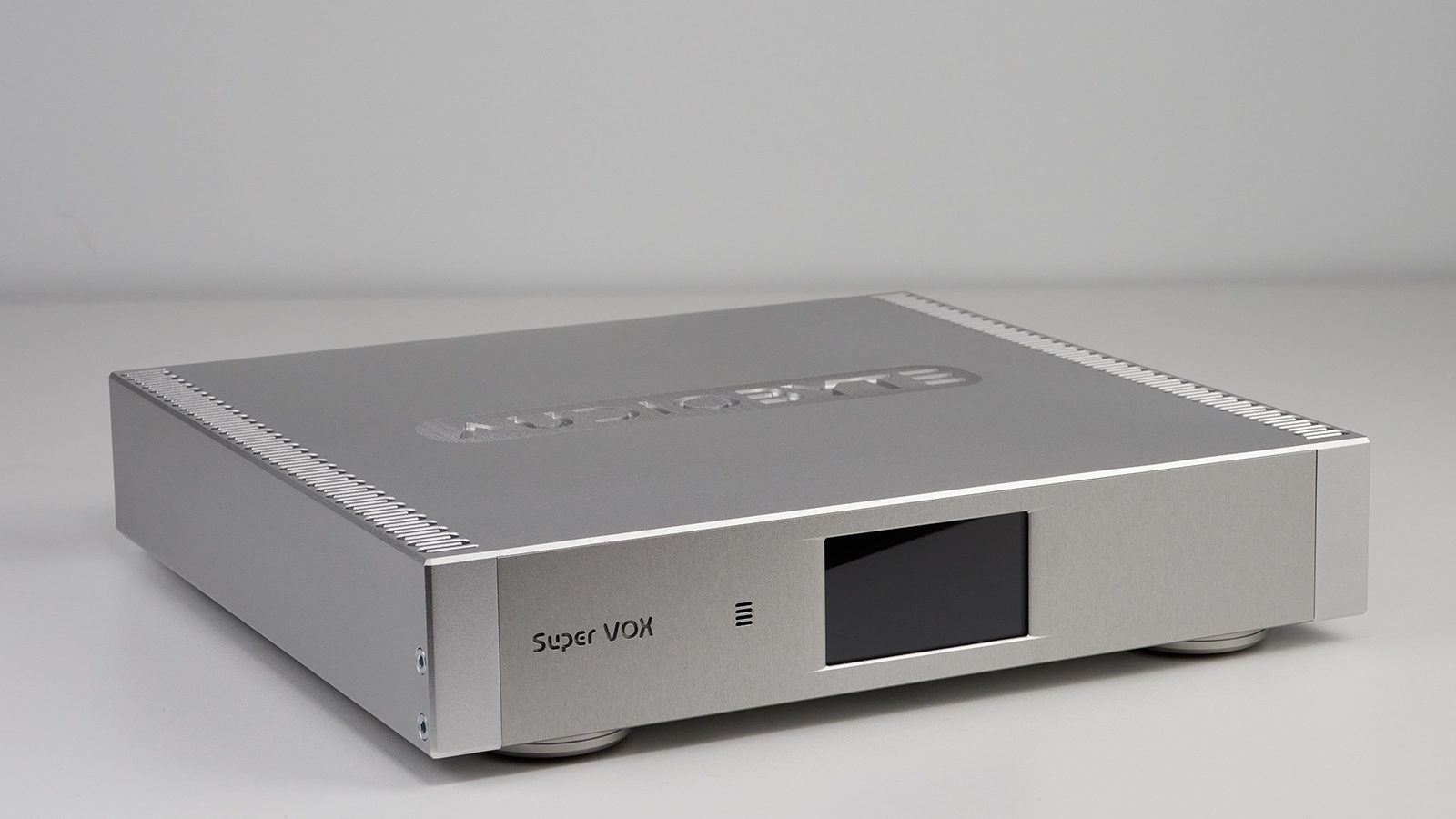
I tested the Audiobyte SuperHUB streamer here (and in Issue 231). In that review, I found the streamer excellent but questioned whether its I2S output made it a device seeking a partner. With the Audiobyte SuperVOX digital converter, that partner has now been found. It’s much more than a mere marriage of convenience.
Let’s recap. Audiobyte is one of two digital companies that directly utilise the design skills of Romanian digital engineer Nicolae Jitariu. The other is the considerably more premium Rockna brand. Audiobyte is the more affordable branch. It is seemingly aimed at the personal audio market (a SuperHEAD headphone amplifier is also part of the range). Moreover, it could also be seen as a sort of ‘skunkworks’ project, developing ideas that influence the wider digital audio industry. As Jitariu is also highly respected for his digital design expertise and has been employed by many of the leading names in digital audio, this is more than just a copycat or diffusion brand.
Contradiction in terms?
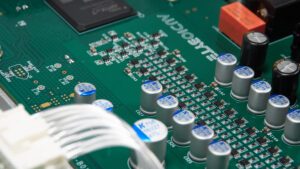
SuperVOX is a multibit DSD digital converter. Some might see that as a contradiction in terms; DSD being a one-bit data stream. However, it’s actually a five-bit FPGA DAC. This is a step up from the one-bit design in the HydraVOX it replaces (tested in Issue 187). This is effectively a 33-level delta-sigma architecture built around an AMD 7-Series Artix FPGA (Field-Programmable Gate Array) programmed to handle all processing. Additionally, Audiobyte developed a proprietary hardware-defining code alongside a dual cluster of high-performance switches. According to Audiobyte, this architecture outperforms commercially available switches. It does this without resorting to ladder DAC solutions at great cost to the end user.
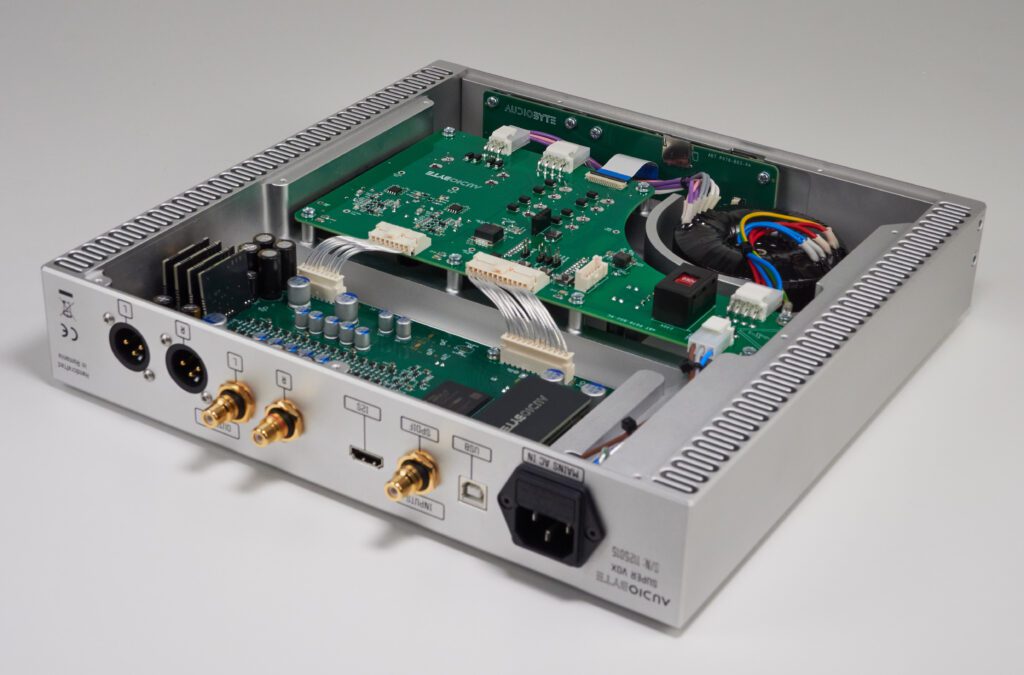
Audiobyte’s SuperVOX employs Inter-Symbol Interference (ISI) mitigation techniques as a key component of the digital platform. ISI occurs when the energy of a digital pulse (symbol) overlaps with subsequent pulses, making them difficult to distinguish. DACs generally rely on reconstruction filters (low-pass filters) to smooth the output, transforming discrete digital samples into a continuous analogue waveform. However, imperfections in filtering or timing mismatches can cause earlier samples to ‘leak’ into subsequent ones. As a result, this can result in ISI as described. The effects of ISI on a digital audio datastream are a form of distortion. This kind of distortion reduces the accuracy of the analogue signal compared to the original digital data.
Ladders that aren’t
To combat this and maintain very high precision and exceptional audio fidelity, Audiobyte uses what appear to be ladders, but are, in fact, high-performance arrays of equal-valued elements. This innovative design enables the SuperVOX to achieve impressively low noise floors without relying on aggressive filters. Consequently, it preserves the music’s natural dynamics and depth. This custom hardware mitigation system is the result of thousands of hours of testing.
The SuperVOX is fully balanced and uses advanced clock solutions borrowed from the Rockna products. It also features a fully discrete output stage used for both RCA single-ended and XLR balanced outputs.
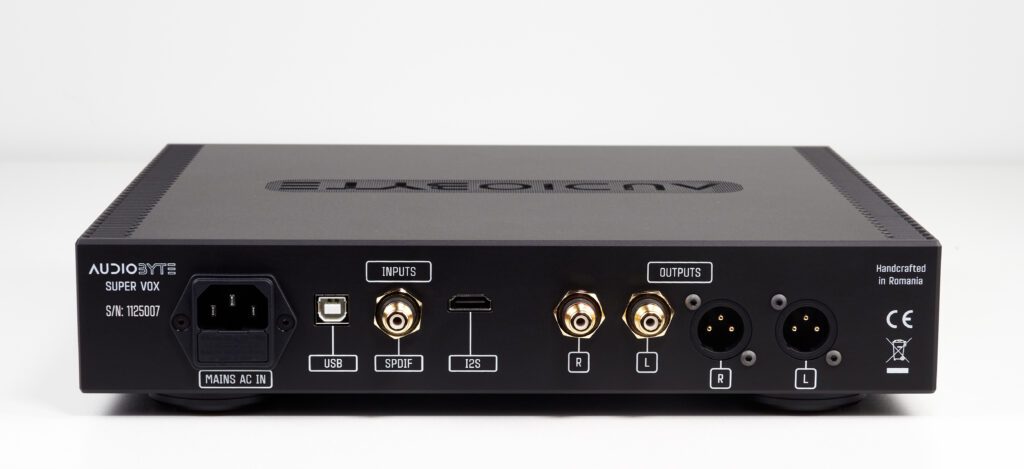
Alongside these outputs, the SuperVOX offers just three digital inputs: I2S over HDMI, an RCA coaxial digital input, and a USB port. Compared to modern DACs that are packed with AES, optical, and even Ethernet inputs, having only three might seem quite basic at first glance. However, with SuperHUB and its compatible I2S over HDMI, any other input is arguably unnecessary. Of course, if you want to connect a CD player or someone arrives with a laptop to play music through your system, SuperVOX provides that option. Nonetheless, I believe most Audiobyte SuperVOX DACs will typically be used with SuperHUB streamers. They will be connected via a single HDMI lead.
Simple interface
A straightforward interface fully controls the SuperVOX… front panel touchscreen; even turning the Audiobyte DAC on or off requires tapping the screen. Since the DAC’s digital code is stored on an FPGA chip, it takes a few seconds to start up and shut down. The latter is a two-step process; press the power icon, then confirm on a screen. Don’t confuse ‘simple’ with ‘basic’, however.
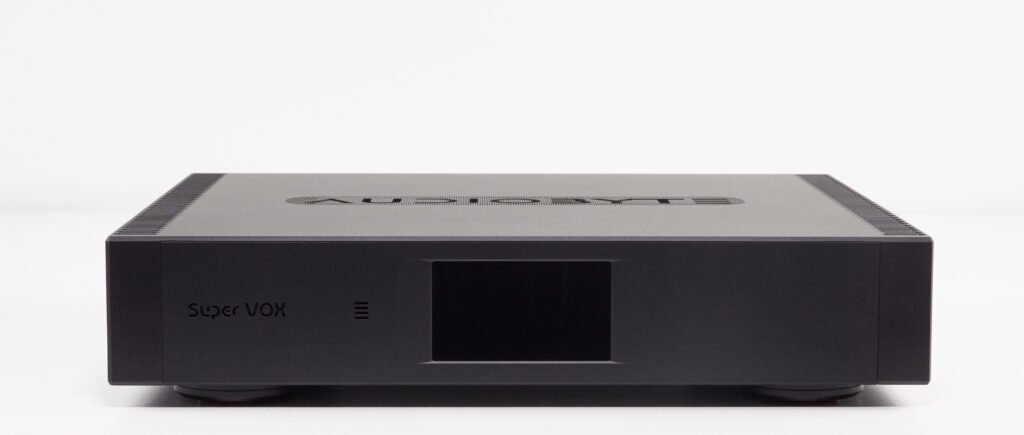
Drill a little deeper into those menus as you configure the SuperDAC, and you’ll find many options available. For example, you can reconfigure the I2S port to create a custom setup. Since I2S is not a standardised architecture, the 19 pins of an HDMI cable may be used differently on other digital platforms. If you know the other device’s pinning configuration, you can adjust the SuperVOX to work with almost everything with an I2S output.
SuperVOX features many standard elements of a modern DAC, such as level adjustment and the option to choose Linear, Hybrid, or Minimum Phase Response for a digital input. I preferred ‘Hybrid,’ with ‘Minimum’ being a close, slightly more relaxed second, and the direct, analytical ‘Linear’ coming third for being a little too stark. You might have a different preference, but these options are available. Additionally, you can set the volume level either as a variable output DAC or by specifying a suitable attenuation value and fixing it to match other inputs. I desire slightly finer control between channels; the output was perfectly balanced. However, the same may not apply to every preamplifier or integrated amplifier. That said, this might be unnecessary, especially since most modern amplifiers feature precise channel matching.
Full potential
There’s even more to the SuperVOX that carries over from the HydraVOX, such as the company’s own Femtovox clock management system, but ultimately it all depends on one question: how does the SuperVOX sound? In fact, it hinges on two factors: how it sounds and how it sounds through the I2S input. The latter is especially significant.
In fact, all three inputs appear quite similar at first. All three feature a deep, full-bodied bass, agile midrange, and natural, unforced treble (especially on the Hybrid Phase Response setting). Each delivers detailed sound, with excellent soundstaging and a good level of refinement. When connecting the SuperVOX via S/PDIF or USB, it produces a charming sound that rival devices like the Chord Electronics Hugo TT (tested in Issue 138 and, incidentally, another FPGA-stored DAC). Overall, the Hugo TT slightly outperforms in detail and dynamic expression. However, the SuperVOX offers a more immersive soundstage and is marginally easier on the ear.
A dramatic transformation occurs when SuperHUB and SuperVOX communicate via HDMI. Suddenly, there is a clarity of sound, with precision and a ‘snap’ that is rare and delightful to experience. The SuperVOX remains rich and captivating, contrasting sharply with the bright, intense quality that some associate with ‘digital’. Even on lively tracks like Kraftwerk’s ‘Numbers’ [Minimum-Maximum, Kling Klang], the focus of the performance is compelling enough that it’s hard to look away. It’s truly enchanting.
Instruments have more defined texture and shape. Vocals are clearer and flow more smoothly. It’s as if everyone rehearsed a bit more. And then there’s the soundstage, which becomes slightly wider and deeper, with significantly more physical solidity to the instrument sounds.
No more hollow
Used with the SuperHUB, there’s a synergy and closeness of sound that makes the whole so much better than the sum of the parts. Yes, there will be those who prefer their digital audio to sound a bit more ‘digital’ and seek something more forward and intense. While you can approximate that with the ‘Linear’ setting, this will never be the DAC of choice for those who favour over-sharpened and tightly wound sound. Instead, those who experience that sound all too often and desire something more musically effortless and beguiling have just found a new DAC to enjoy.
The Audiobyte SuperVOX is more than just the SuperHUB’s partner DAC. However, the duo works together so harmoniously that it’s hard to justify splitting the pairing.
Read more about the development of the SuperVOX here.
Technical specifications
- Type: Digital to analogue converter
- Inputs: USB, I2S (LVDS via HDMI), S/PDIF
- Outputs: XLR and RCA
- Chip basis: AMD 7-series Artix FPGA;
- Fully balanced design;
- Digital precision: 11.28/12.28MHz sample rate, fifth order, 36bit precision, 33 level delta-sigma modulator;
- Error correction: Dual loop element error mitigation, employing a combination of noise-shaped and minimum activity selection patterns.
- Volume control: Bypassable high precision digital volume control with 256 steps of -0.5 dB attenuation
- Clock: Advanced Femtovox clock manager
- Upsampling filters: Minimum, hybrid, linear
- Output stage: Discrete
- THD: -110 dB @ 0dB, -116 dB @ -6dB, -120 dB @ -12 dB, -77 dB @ -60 dB
- Signal to Noise Ratio: -120 dB;
- Maximum output amplitude: 2.9V RMS.
- Dimensions: (WxDxH) 31x29x6.4cm
- Weight: 3.8 kg
- Price: £2,995, €3,499, $4,000
Manufacturer
Audiobyte
+40 745 167 868
Trending Articles
See all
By Alan Sircom
More articles from this author

Read Next From Review
See all
Reiki Audio SuperSwitch X/Pro X PSU
- Oct 06, 2026
Unitra WSH-805
- Sep 29, 2026
Wilson Audio Sabrina V
- Sep 29, 2026
Meze Audio 99 Classics (2nd Generation)
- Sep 22, 2026