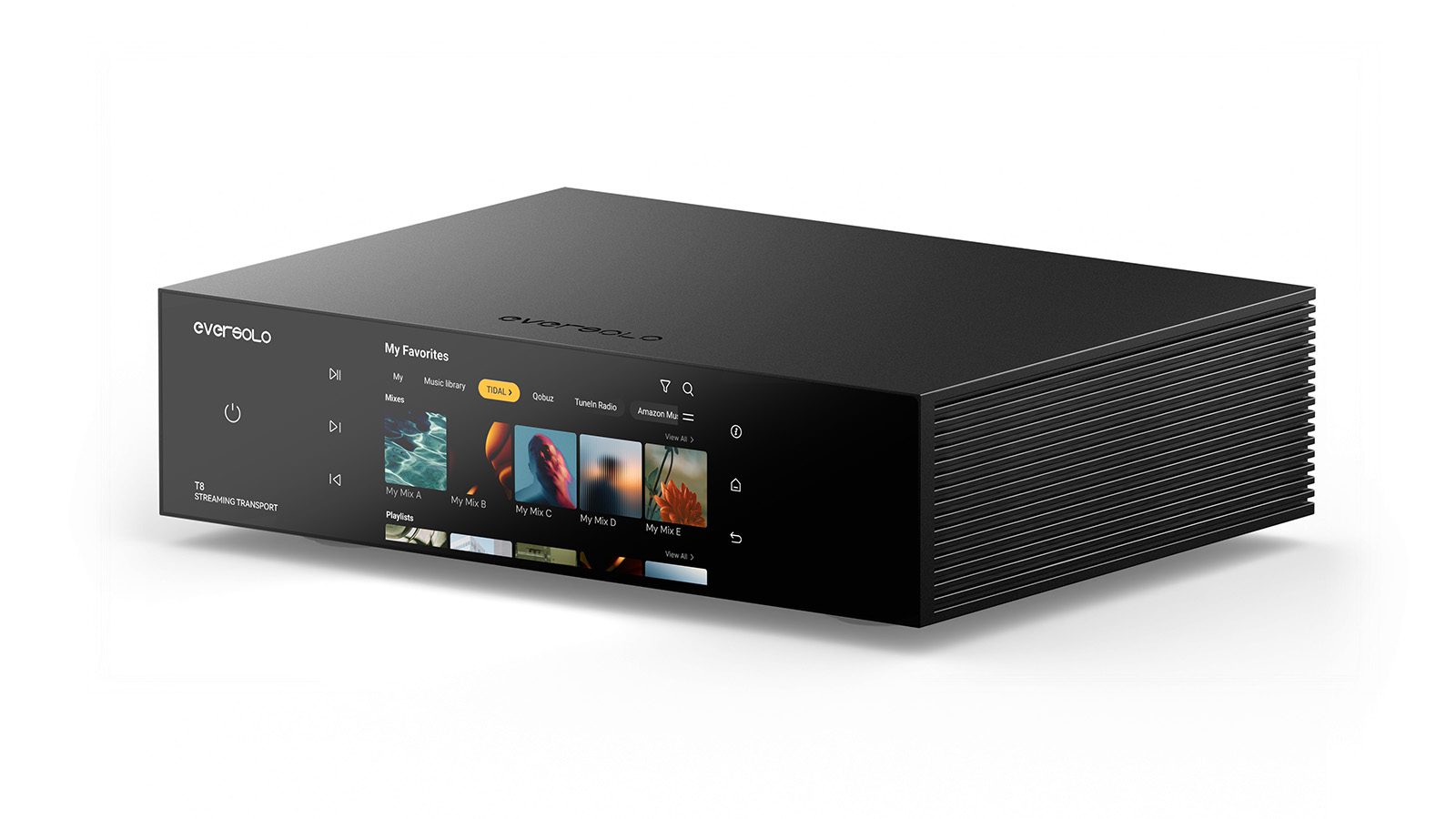
The streaming transport is a device that exists in a somewhat fragile state. Its ability to improve a system heavily depends on how the connected digital input utilises the signal it sends, which means that debates over their value often shift to issues of functionality. This approach can sometimes seem uncertain when compared to simply using the digital outputs of a streamer from the same company.
The Eversolo T8 exemplifies this situation. All Eversolo streamers feature digital outputs, including USB, which enables them to send any sample rate they can handle to an external DAC. Since that is all the T8 is designed for, it raises the question of why you wouldn’t simply opt for a DMP-A6 Gen2, save a few hundred pounds, and get some backup analogue outputs included for free. Even before considering other options, the T8 seems susceptible to internal competition.
Refining the T8
Eversolo states that, by refining the T8, it offers higher performance, and the engineering within the T8 significantly supports this. It has been designed from the outset to minimise electrical and mechanical noise. A custom 4N oxygen-free copper toroidal transformer is paired with internal wiring shielded with Teflon insulation. Eversolo claims noise levels as low as 30μV, with suppression of high-frequency interference and ground noise through precise voltage regulation and high-grade filtering components. The T8 further incorporates an ultra-high precision femtosecond clock into the circuit. The aim is that, regardless of the output chosen, the performance will be maximised.
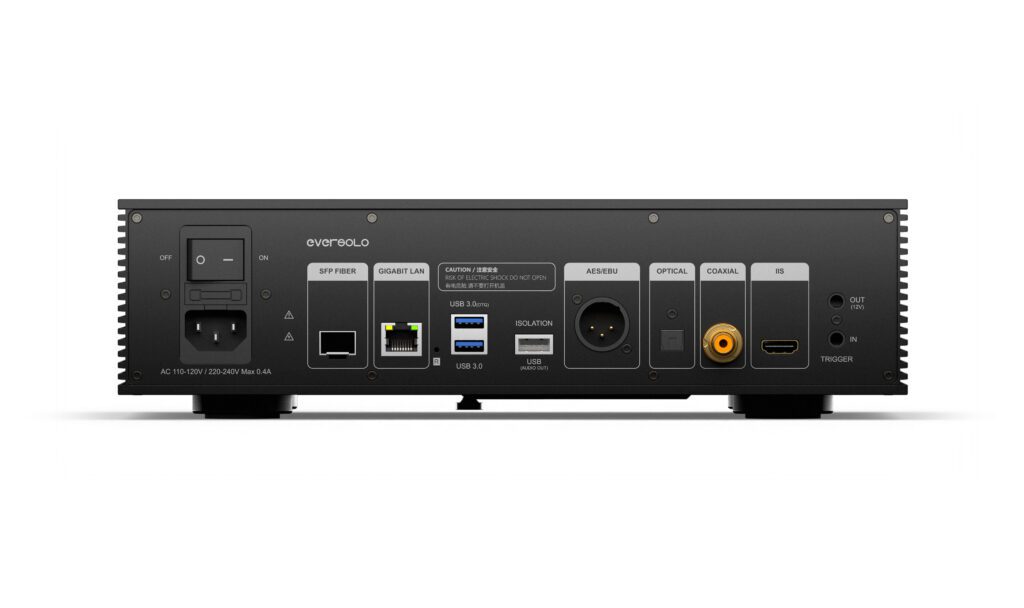
There are five digital outputs in total: optical, coaxial, AES, I2S, and USB. USB and I2S must be selected as the sole output, but optical, coaxial, and AES can all operate simultaneously. Evidence of the careful design of the T8 is seen in the I2S implementation, which can be customised through no less than eight different wiring profiles. Sample rates up to 768kHz and DSD512 can be transmitted, provided your DAC supports these formats.
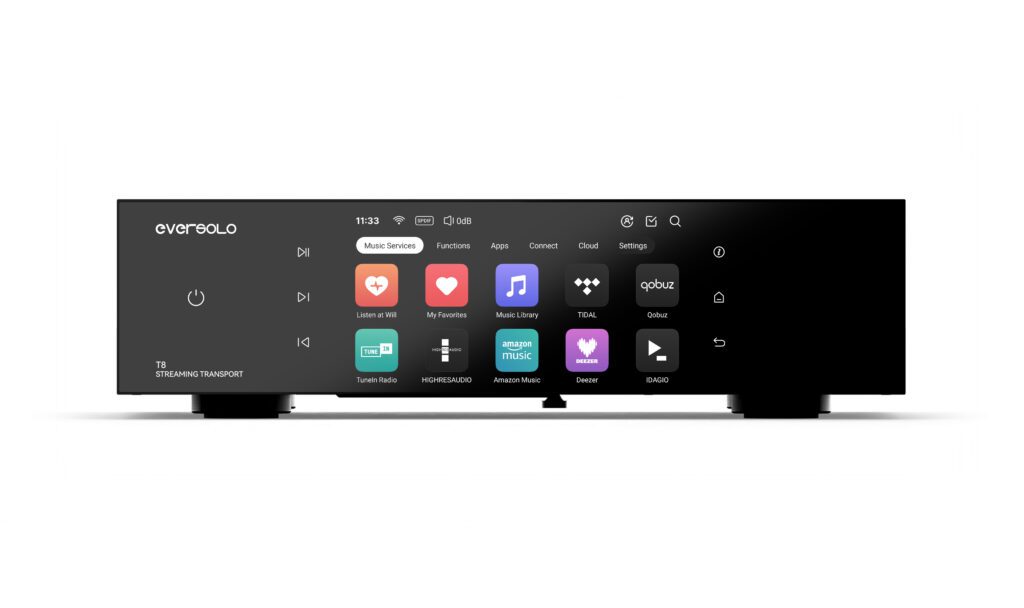
The T8 utilises Eversolo’s streaming platform, which remains one of my favourite such pieces of software. The app provides access to all major on-demand streaming services, as well as the ability to create its own library of stored content rather than relying on the server to render it. This feature not only enables faster and smoother browsing but, when combined with an internal hard drive bay capable of handling up to 16 terabytes of storage, allows the T8 to operate with minimal additional network hardware. AirPlay is also supported, but Bluetooth is omitted, and there is still no Google Cast. Roon compatibility, however, is present.
On-board EQ
One refinement I’m testing for the first time is the onboard EQ system. Eversolo devices have long been able to adjust their output via DSP, but now they can perform a frequency sweep themselves and use your phone microphone or a chosen external mic to measure the room and make adjustments accordingly. The process is utterly straightforward and, while not as comprehensive as some competitors, works very effectively. I find this a highly appealing aspect of the overall offering, as it means the decoding and amplification you already enjoy (or at least, I assume you like the sound of) can be fine-tuned with the EQ adjustments applied from the start.
Not everything is a clear advantage for the T8, though. There is a reasonable argument for removing the digital inputs on the standalone streamers, as some signals (such as HDMI) simply won’t be passed to a USB output, which negates their value. A further annoyance for multichannel users is that the HDMI output on the DMP-A6 Gen2 is not available here, meaning multichannel SACD rips cannot be managed.
The metalwork is recognisably Eversolo but has changed slightly from its streamers. There is no physical volume control (one remains in the app but is unlikely to see much use in most setups) combined with a new, marginally larger display. The result is clean, modern, and a pleasure to use, enhanced further by a decent remote control and that excellent control app. At the asking price, the Eversolo looks and feels worth the money, and it compares favourably to other streaming transports on the market, including some at a significantly higher price point.
Cannonball polishing
I have previously observed that when I tested the HiFi Rose RS130, the clear difference a network streaming transport makes in any system depends on what it is connected to. That difference mainly affects the ‘polishing the cannonball’ aspect of the performance spectrum. The Eversolo does not alter this perspective. When used with the resident Chord Electronics Hugo Mscaler and TT2 — two devices almost deliberately resistant to changes in their input and power supply — the Eversolo does not significantly alter how they sound.
This is not a bad thing, though. The lovely Not For Lack of Trying by Dodie [Decca] is presented in all its delicate and catchy glory, with Dorothy Clark’s soft and engaging vocals sounding tangibly real and serving as the centre of a soundstage that manages to feel both intimate and enveloping. The deceptively complex arrangements are revealed in detail. Even when the Eversolo is simply facilitating, if you like what is being facilitated, that is no bad thing.
More tricks
Even here, the T8 has more tricks up its sleeve. Running the EQ setup allows it to gently limit the effects of a 50Hz room node and compensate for slightly different low-frequency responses from the resident Kudos Titan 505s due to furniture in the room. These are minor tweaks; incremental changes rather than serious room correction, but even so, they make a difference. The percussion that underpins Duke Garwood’s Satin Warrior [God Unknown] sounds cleaner and more distinct as a result. Applying this correction before sending the signal to your chosen decoding device is a profoundly satisfying experience because it doesn’t alter any traits of your system, but simply adds a degree of correction to the signal before it works on it.
Not all digital inputs are entirely source agnostic either. The USB input on the Cambridge Audio Edge A that I am using is a more effective partner for the T8, as the reduction in noise and carefully implemented clocking cause the performance offered by the internal decoding to improve noticeably. The beautifully recorded but highly unusual Ness by Hayden Thorpe [Domino] reveals more fine detail and provides a significant boost to the stereo image, while Thorpe himself sounds more convincing and tangible. If you prefer not to use the EQ functionality and you are a Roon user, switching the T8 to convert to DSD before outputting over USB delivers one of the best performances I have experienced from the digital board of the Edge A. Even with some minor room-related issues, this is how I would use this combination of devices.
Asking nothing
All this time, the Eversolo asks nothing of you in operational terms. At no point during heavy use has the T8 even hinted at needing attention. I’ve hotplugged it, switched between the dedicated app, Connect functions, Spotify, and Roon freely across various control points, and it has remained completely reliable. Aside from Chromecast, it will accept content in nearly any form you send and never feels tense or demanding to operate. There are streamers that cost much more than this one that won’t withstand such treatment.
What results is one of the most convincing devices of its kind that I have yet to test. By combining a brilliant interface, respectable EQ, and meticulous engineering at a relatively sensible price, Eversolo has created a solution that transforms any digital input into a peerless streamer, and the T8 is among the company’s most impressive offerings yet.
Learn more about what went into developing the Eversolo T8 here.
Technical specifications
- Type: Audio Streaming Transport
- Digital Outputs: 1x USB-A port; 1x coaxial; 1x optical, 1x I2S
- Supports sample rates up to 32-bit/768kHz PCM and DSD512 via USB and I2S
- Supports sample rates to 24/192kHz PCM, DoP64 over optical, coaxial and AES
- Wired and wireless networking, Roon compatible
- Streaming support: Qobuz, Tidal, Deezer, Spotify, Apple Music, Amazon Music HD
- Hard drive bay supports up to 16Tb internal drives
- Dimensions (WxHxD) 31.5×8.8x23cm
- Weight 8.45kg
- Price £1,290, €1,380, $1,380
Manufacturer
Zidoo
UK distributor
Audio Emotion
+44(0)1592 407700
Trending Articles
See all
By Ed Selley
More articles from this author

Read Next From Review
See all
Acoustic Energy AE Active
- Oct 13, 2026
Reiki Audio SuperSwitch X/Pro X PSU
- Oct 06, 2026
Audiobyte SuperVOX
- Oct 06, 2026
Unitra WSH-805
- Sep 29, 2026