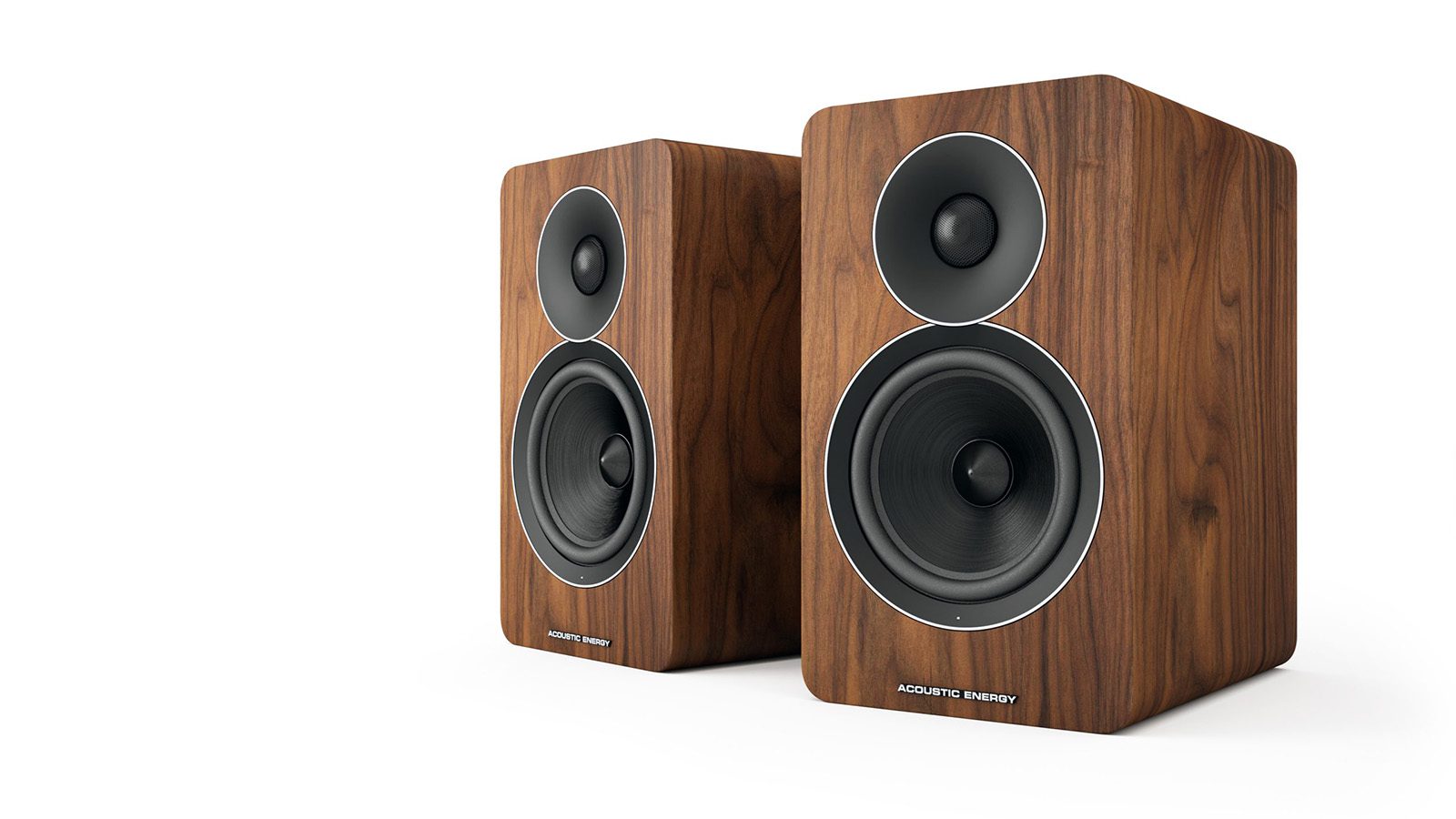
For many years, active speakers had a practicality problem. Sure, the engineering argument for powering the crossover and placing amplification after that point, directly coupled to each driver, was easy to make, but the practicality argument was trickier. The difference between a system with passive speakers and one with active models was effectively half an amplifier.
However, more recently, this calculation has changed dramatically as a huge swathe of equipment has gained preamp functionality. All of a sudden, active speakers can be added to one or two boxes to create a fully functional system. Oddly, at almost the same moment, many companies pivoted to self-contained ‘smart active’ designs, but Acoustic Energy took a more traditional approach. The original AE1 Active launched just under a decade ago and has been doing very well ever since. Acoustic Energy has now decided to update it (and remove the ‘AE1’ branding, as that’s now back in use on a passive speaker), and the result is the AE Active.
Close relationship
Although it has been divested of the AE1 name, the AE Active maintains a close relationship with the AE1. Having completed the extensive engineering programme to create the 40th Anniversary model, Acoustic Energy has used the 125mm mid-bass driver developed through that research. This looks like a classic Acoustic Energy drive unit, but while it still has the spun, straight-sided cone of the original, it’s now ceramic-backed and even more rigid.
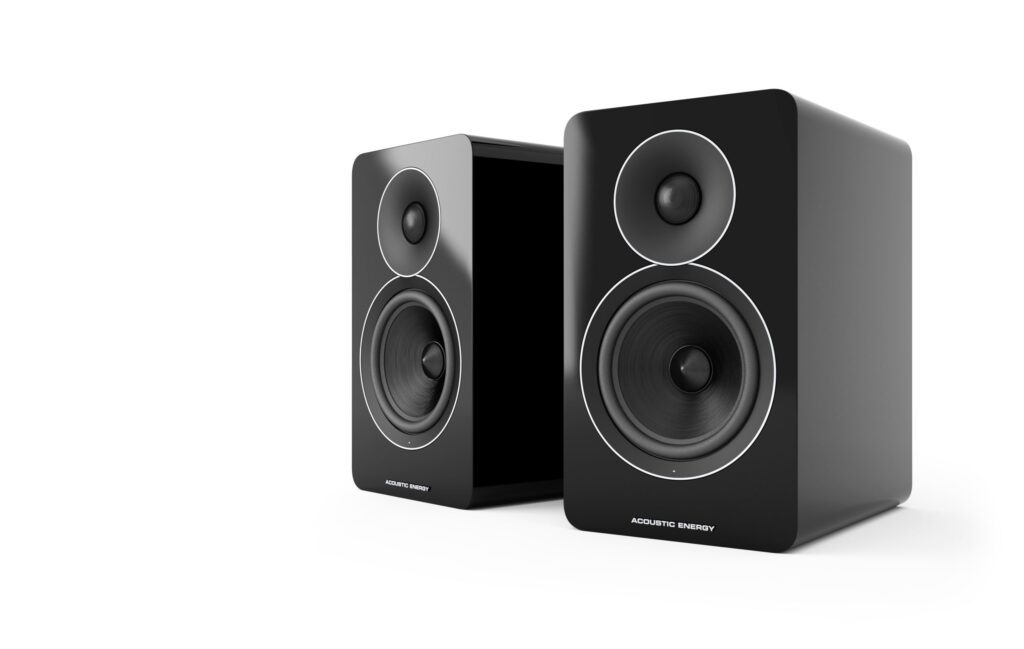
The tweeter is not a direct transfer from the AE1. It’s a 27mm aluminium dome unit mounted in an example of the company’s WDT (Wide Dispersal Technology) waveguide, a relatively wide but shallow indentation on the front fascia. The two units cross over at 3.1kHz via a second-order crossover. Because this crossover has adjustable HF and LF shelves, Acoustic Energy quotes a bandwidth of 42Hz-28kHz with no roll-off, as output depends on the chosen settings.
It is important to stress that even the old AE1 Active was never simply an AE1 with amps in it, and the AE Active further evolves this. The tweeter has a new rear chamber, significantly reducing distortion around the crossover region. The mid-bass is assisted in its excursions by an example of the slot port technology that Acoustic Energy has been working on for over a decade, which combines a large surface area with reasonably low air velocity while still fitting in a fairly small cabinet.
Tradition!
The active sections have also been revised. Acoustic Energy is keen to emphasise the traditional engineering elements they’ve included and that haven’t changed in the AE Active. It retains Class AB amplifiers with linear power supplies and an exclusively analogue crossover arrangement.
Rather than any wholesale changes, Acoustic Energy has tweaked the amps to deliver greater dynamic capability and reworked the analogue filters to minimise phase loss. A low-power mode has also been added, which powers the speakers on when they detect a signal. This has been very effective in use, with a small red LED turning white to denote when the speaker has come out of rest mode.
Just add electronics!
As before, the AE Active is designed to partner with electronics rather than be a self-contained system. Each speaker is fitted with a single XLR and RCA input (the latter upgraded to be more resilient in the face of hefty audiophile cabling) and an IEC mains socket. Two trim pots allow you to adjust the HF and LF trim, and together with the low-power mode switch and main power switch, they round off your connections. In a perfect world, the audio inputs would be nearer the base of the cabinet for neatness, but this is not the end of the world.
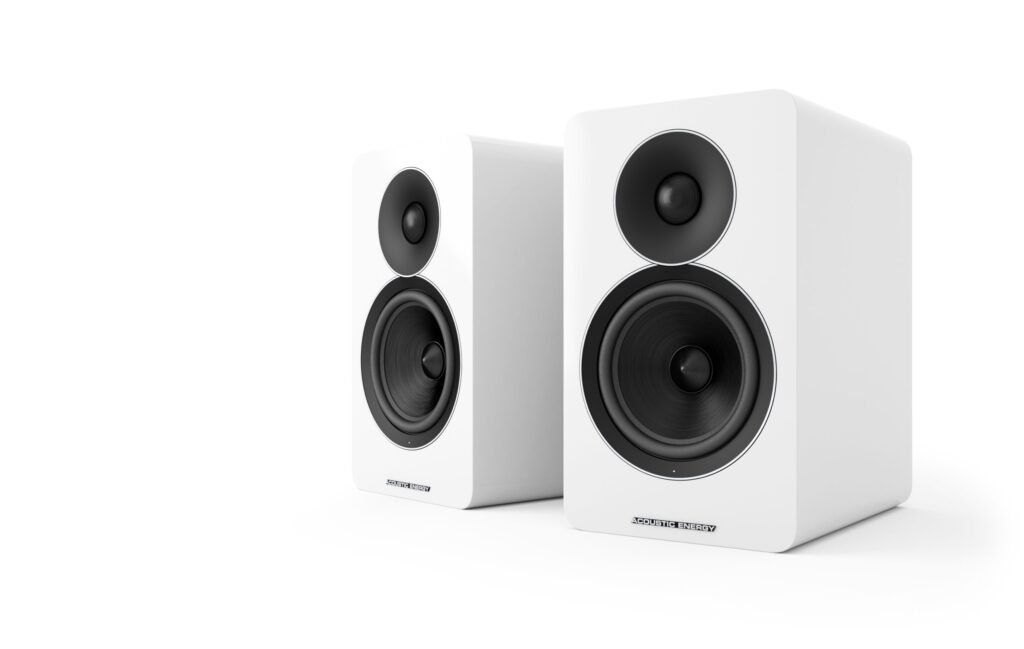
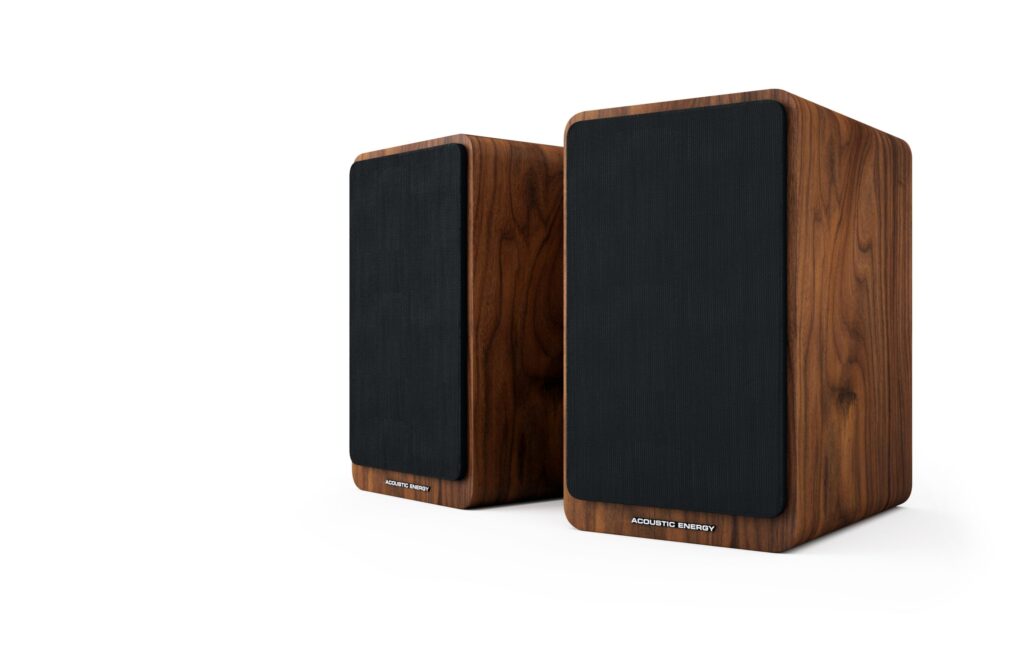
Aesthetically, Acoustic Energy hasn’t rushed to make significant changes to the AE Active, which suggests they got the styling of the AE1 Active right the first time. It could really only be an Acoustic Energy speaker, thanks to details like the pointed dust cap, yet it achieves this without being unashamedly nostalgic. I feel that the black and white finishes are better at emphasising the design’s strong points than the walnut, but all three finishes are well applied, and the standard of build and finish is extremely good for the asking price.
Care and feeding
I initially set the AE Actives to run with a combination of Eversolo T10 Transport and DAC-Z10 DAC Preamp, a combination significantly more expensive than the Acoustic Energy but both flexible and very revealing. The analogue preamp in the Z10 is not the highest-gain device, so it was immediately notable that the AE Active has enough input gain that all but the most anaemic of preamps should have the output needed to achieve any domestically acceptable volume you might need from them.
There’s more than simple volume on offer, too. Listening to Massive Attack’s 100th Window [Virgin] (an album that time has been incredibly kind to), the AE Active’s output when Everywhen really gets going is genuinely surprising. From a cabinet that is a smidge over 30 centimetres tall, the AE Active extends effortlessly below 50Hz, with a frequency response that moves seamlessly down from the lower midrange without so much as a hint of unevenness.
Agility and delicacy
There is also an agility and delicacy to what the AE Active can do, ensuring that when you wind the tempo up and ask them to deliver the breathless fury of You’re a Woman, I’m a Machine by Death From Above 1979 [679], the intensity and drive are reproduced exceptionally well. These are dense and congested tracks, but the Acoustic Energy maintains a sense of order and cohesion even at high levels. There is even, dare I say it, a smidge of tonal sweetness as the closing ‘Sexy Results’ plays out.
You don’t need the source to be digital either. Making use of the Z10’s analogue input and using the resident Vertere MG-1 MkII and Cyrus Classic phono sees the AE Active successfully reflect the greater warmth and richness of the Vertere while ensuring that the unflappable resolving power of the MG-1 MkII is used to complement its own ability to make sense of things. St Germain’s Tourist [Blue Note] is handled with its infectious funkiness and lovely mix of instruments and electronica all very much part of the experience. There are quite a few smart active speakers that boast a phono stage but you’d need to be the very confident sort to feel it would have an advantage over sending a signal that is analogue from start to finish to the Acoustic Energy.
Impressively unrepresentative
Connecting the Acoustic Energy to £4,000 worth of Eversolo decoding and preamplification (to say nothing of the Vertere) is impressive but not terribly representative of what most units will see in use. To this end, I set them up with a Bluesound Node ICON, which would give a total system price of £2,249 (and one of the smallest total footprints of any complete system I can remember testing).
While it wasn’t needed in the space I tested them in, the option of Dirac to help with more complicated rooms is hard to ignore. The ICON can’t match the sheer resolving power of the Eversolos at four times the price, but the AE Active retains its formidable punch and cohesion. Even when you slow things down with Sturgill Simpson’s Cuttin Grass Vol I [High Top Mountain], there is still an immediacy and, well, Energy to what the AE Active does. It’s not an AE1… but it’s definitely a blood relation.
What the ICON does brilliantly is highlight that the AE Active is still very much the right product for the moment. It would be a stretch to call the resulting three boxes significantly bulkier than the majority of smart active systems on the market at the moment. By leaving the customer to choose the features they need in their front end, Acoustic Energy is more flexible and more future-proof than any of them. The AE Active takes a speaker that still wasn’t really broken after a decade and makes it that little bit better. There’s no better time to go active, and this is one of the most brilliantly realised affordable options out there.
Find out more about the Acoustic Energy AE Active here.
Technical specifications
- Type: Two-way Active Speaker
- Woofer: 125mm chassis with Alu/Ceramic cone
- Tweeter: 27mm Alu dome with WDT waveguide
- Bandwidth: 42Hz-28kHz
- Amplifier: Class A/B with linear power supply
- Amplifier power: LF: 50W / HF: 50W
- Crossover: 3.1kHz 2nd order
- Cabinet: 18mm MDF
- Inputs: RCA and Balanced XLR
- Controls: Volume adjust 0dB to -inf (HF shelf +/-2dB / LF shelf +/-2dB)
- Power connection: IEC C13
- Auto power on: 24mV
- Auto power on/off: 15 minutes
- Voltage selection: Manual switching
- Grilles: Slim, cloth magnetic fit
- Finishes: Walnut Wood Veneer, High Gloss Black and High Gloss White
- Dimensions (HxWxD): 31.2 x 18 x 25cm
- Weight: 7.5kg (each)
- Price: £1,250, €1,499, $1,999 per pair
Manufacturer
Acoustic Energy
+44(0)1285 654432
Trending Articles
See all
By Ed Selley
More articles from this author

Read Next From Review
See all
Eversolo T8
- Oct 13, 2026
Reiki Audio SuperSwitch X/Pro X PSU
- Oct 06, 2026
Audiobyte SuperVOX
- Oct 06, 2026
Unitra WSH-805
- Sep 29, 2026