
Nigel Bell is the founder of Reiki Audio, a British specialist audio company known for network-based hi-fi and noise reduction. Drawing on his background in IT, software, and large-scale change management, he took an unexpected path into high-end audio after becoming fascinated by how switches, cables, and network topology can affect streaming performance.
That curiosity led him to develop products designed to reduce electrical and radio-frequency noise in digital audio systems, helping listeners hear more of the music and less of the artefacts around it. Reiki Audio has built a strong reputation among enthusiasts for its practical, engineering-led approach and for products such as its network switches, Ethernet cables, and power supplies. Bell is also known for his straightforward, experiment-driven style and for encouraging listeners to trust their own ears rather than assumptions about what “shouldn’t” matter in a digital system.
We spoke to Nigel about Reiki Audio’s history, the SuperSwitch X and the future of the company…
AS: How did Reiki Audio get started?
NB: Almost by accident. I’m a chartered IT professional, and my background is in the software applications side of the industry with a focus on user experience and large-scale change management rather than deep technical engineering. My experience is rooted in large IT projects, with an emphasis on how people use technology more than the technology in its own right. Over time, that work became less satisfying; I moved into sales because I could work with both people and technology but I didn’t enjoy that role. I disliked the temporary, transactional nature of the role—the constant cycle of “we’re best friends,” deal closure and then being asked to move on to the next client. I eventually took the opportunity to step away and focus on something else.
What happened then?
That shift began almost by accident. Several years ago, I saw an advert for an Innuos PhoenixNet on one of the hi-fi forums and noticed people debating whether it could make a difference. As an IT guy, I ‘knew’ it couldn’t make any difference. But I tried a cheap switch, plugged it in just before the streamer, and used an unshielded cable. It made a noticeable difference, and I remember thinking, “What the hell is going on here?”
That’s when I started to understand that it was about noise not bits. I then removed all the LEDs from the board and fitted a copper-lined case to seal the side vents, which weren’t especially necessary anyway. Each change made it sound better.
It got to the point where I realised that if I cracked the last performance-limiting factor, the case, then I would have a commercially viable product and said to my wife, “if I can sell one or two of these a month as a pension top-up, I’ll be happy.” It has been quite a journey. I’m having the time of my life, and I still pinch myself every time we get an award or a good review!!
Was this the cable or the switch? Which came first?
The Switch. I thought an unshielded cable was OK at first, but then I thought: what if you take an Ethernet cable with an extra shield, but the noise couldn’t travel down the shield because it wasn’t connected at both ends? That ultimately led to careful spacing of the individual conductors and to the JundoStream cable!
However, the rationale is the same throughout: to stop noise going via the streamer to the DAC, which is where it intermodulates with the analogue signal and makes its mischief.
That drive created the first Reiki Audio switches?
Exactly! We started with a 3mm-thick case but as we were iterating prototypes, we realised a 5mm was better. A 5mm case was an order of magnitude better. But guess what? A 10mm case is even better! We blanked out excess ports, got rid of the LEDs, used galvanic isolation as much as possible, but it still seems like the big thing is a tightly engineered case. There’s no sense in trying to rid a system of noise from removing LEDs and blanking out ports if the case is just letting the noise back in!
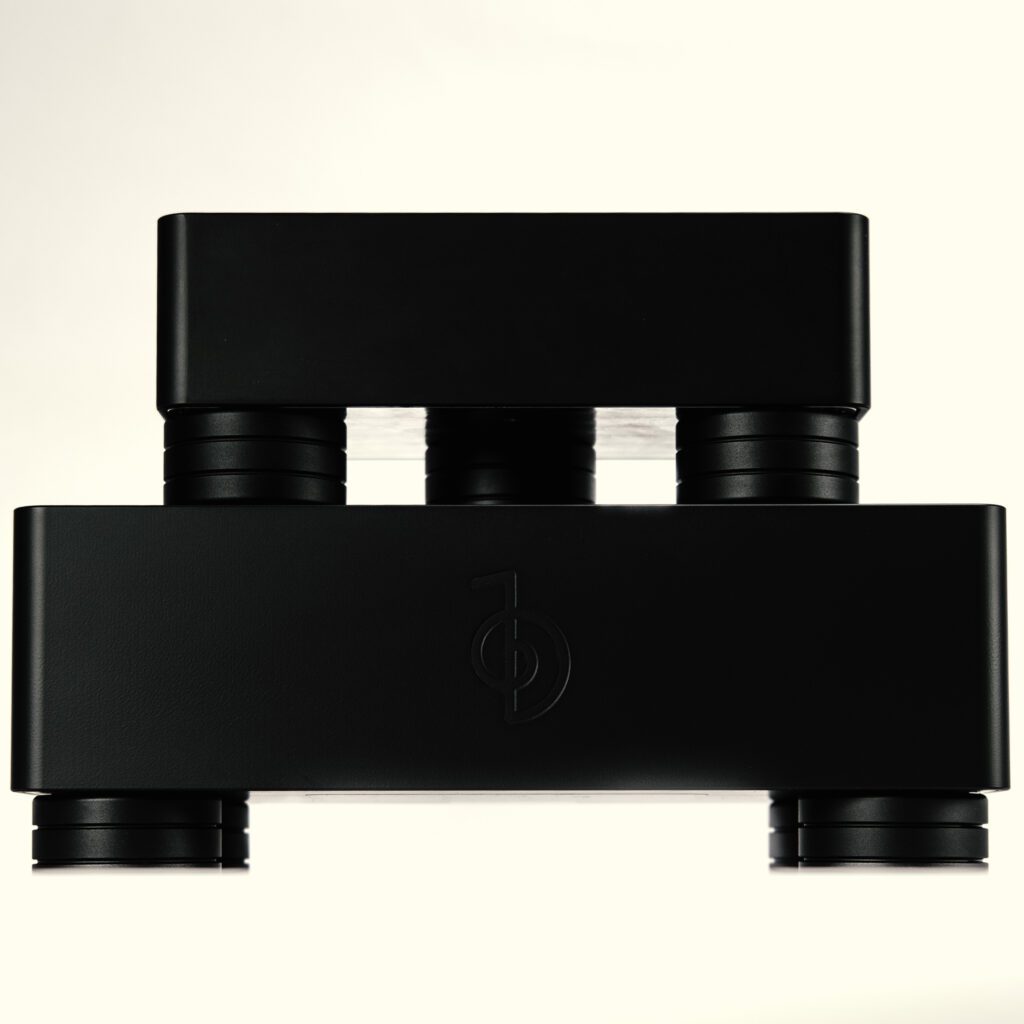
The final ‘secret sauce’ seems to be vibration. I was almost in my cynical, “it’s all smoke and mirrors and unicorn hair” mode, but vibration control has really surprised me, and some of that comes down to working with the very talented Theo Stack of Stack Audio.
Is the improvement limited to local server playback, or does it help online streaming too?
That is one of its most compelling aspects. Some server-side products are most convincing when they are revealing a well-set-up local source. The Super Switch X appears to do more than that: it improves locally stored music, but it also gives online streaming a meaningful lift. Given how much listening now happens through services rather than local libraries, that makes the improvement particularly valuable.
What’s with the absence of a power indicator light?
There is no obvious light to confirm that the unit is powered, so the reassurance comes from the fact that music is playing rather than from an LED on the front panel. During set-up, that can feel slightly counterintuitive. In listening terms, however, it is a sensible choice: removing always-on indicators avoids a potential source of electrical noise and keeps the room visually cleaner.
So, SuperSwitch and SuperSwitch X are in the portfolio… is there a third grade of Reiki Audio coming?
I’d prefer not to talk in any detail about that just yet, but yes, the aim is a straightforward three-tier range: three network cables, three power supplies and three switches. That gives customers a clear good-better-best route without pushing the line into extreme pricing. There will always be a market for very expensive network products, but for most listeners a carefully judged hierarchy is more useful than a switch priced beyond the rest of the system. That might address the power-indicator issue you mentioned: we have a solution in the works that will give users a clear indicator of device status for diagnostics, but will disengage itself automatically to allow for noise-free listening. It’s a detail, but that’s what we do.
Read the full review of the SuperSwitch X and Pro X PSU here.
Manufacturer
Reiki Audio
Trending Articles
See all
Acoustic Energy Corinium floorstanding loudspeaker
- Dec 23, 2024
Xavian Unica
- Apr 07, 2026


By Alan Sircom
More articles from this author

Read Next From Blog
See all
Tech Talk: Nicolae Jitariu of Audiobyte
- Oct 06, 2026
Tech Talk: Wiktor Schulfer of Unitra
- Sep 29, 2026

Tech Talk: Daryl Wilson of Wilson Audio
- Sep 29, 2026

Tech Talk: Antonio Meze of Meze Audio
- Sep 22, 2026