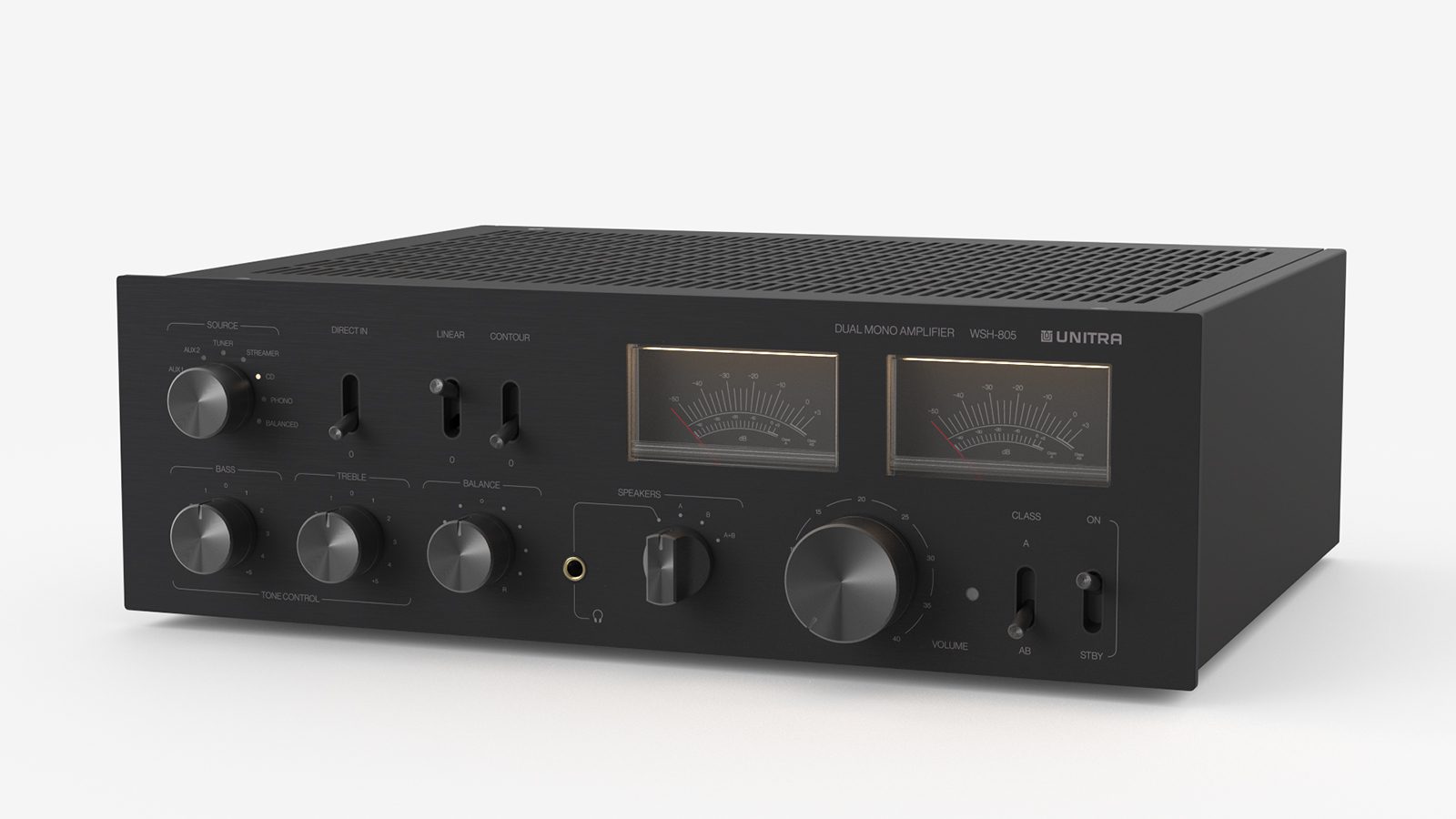
Unitra is a legendary Polish brand. Unitra’s history dates back to 1961, when the Union of the Electronic and Communications Industry (Zjednoczenie Przemysłu Elektronicznego i Teletechnicznego) was established. In a short time, the brand became a driving force in the Polish electronic industry, bringing together as many as 28 manufacturing companies, supported by technology sales centres and design and engineering offices.
During its period of rapid growth, Unitra became synonymous with cutting-edge consumer electronics, offering a wide range of audio products that reached millions of Polish homes. By setting new standards in design and manufacturing, Unitra firmly established itself as the industry leader in Poland. Despite its success in its early years, by 1989 Unitra was no more.
However, the story didn’t end there. In 2021, the company re-established itself, giving the brand a new lease of life. In the process, Unitra is creating a new audio product lineup that remains true to its 20th-century traditions while embracing modern principles of sustainability and repairability in high-performance electronics.
One of the creators of the brand identity, who had the privilege of shaping the visual and tactile identity of the new Unitra is Wiktor Schulfer, Lead industrial designer.
Tell us more about the reborn Unitra.
At Unitra we believe that the engineering team is more than just a group of employees. They are the backbone of our company and the heart of our product design efforts. Their commitment and knowledge are crucial to our success. It was a rare chance to help revive a legend, build a brand from the ground up, and define what ‘Polish design’ in high-end audio means today.
We focus on materials, proportions, tactility, and timeless forms. I believe that good design should be both honest and personal: the kind of object you want to interact with every day, not just look at from a distance. That’s why our products are engineered and assembled in Poland, using locally sourced components whenever possible, and crafted by people who genuinely care about the details.
Describe the development cycle of a new product.
Every product begins as a concept that grows through sketches, material studies and careful consideration of form, function and user interaction. We design collaboratively, with engineers working across three teams: developers, electronics and mechanical engineering. Prototypes are developed and refined in SolidWorks, allowing us to test mechanics and performance before moving to production. The path is rarely linear; challenges with materials or geometry often require rethinking, but each iteration strengthens the final design.
By the time a product reaches full-scale production, every turntable, amplifier and loudspeaker has been carefully crafted to blend timeless simplicity with advanced technology, ready for users worldwide.
What is the story behind the WSH-805?
The development of the WSH-805 was far from a solo effort. It involved a highly collaborative team, bringing together expertise in industrial design, electronics and mechanical engineering.
The process was highly interdisciplinary, with designers, engineers and audio specialists working closely together and regularly exchanging feedback. Even minor adjustments — from the layout of the power supply to the damping of the chassis — were tested, listened to, and re-evaluated in various locations. Every decision was driven by a combination of technical performance and a commitment to providing a seamless, intuitive user experience.
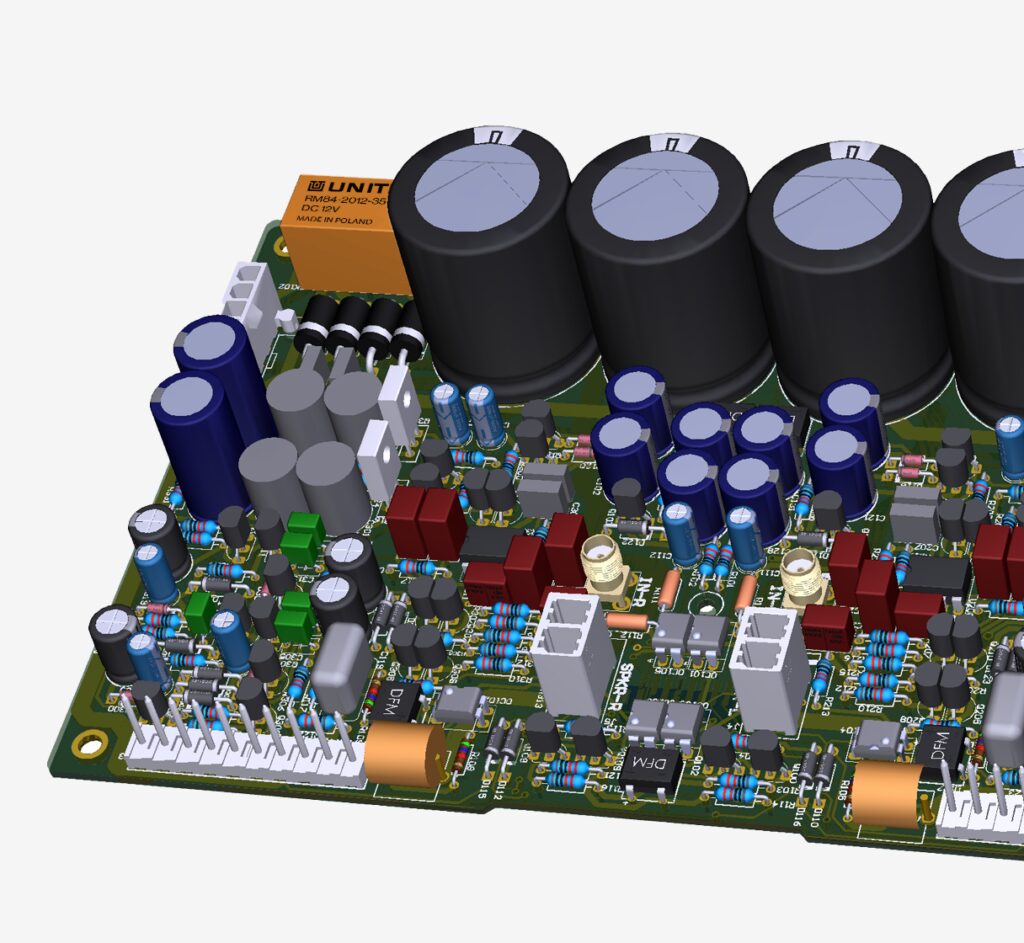
Our patented, automated switches combine classic design with advanced technology, providing the convenience of remote control without sacrificing the tactile feel of physical components. We have maintained the timeless appearance and sensation of our toggle switches while enhancing their functionality to meet 21st-century standards of convenience, reliability and precision. The careful attention to detail in the design and operation of these switches reflects our engineering philosophy, where tradition meets innovation.
The amp has a classic look and feel. How does Unitra’s past shape its new products?
We regard vintage equipment as reference points. The WSH-205 was the first Polish amplifier designed as a dual-mono model. It wasn’t officially classified as such, but it had two separate mains transformers powering four-way potentiometers. At the time, it was the very best available, and it’s almost impossible to find a WSH-205 with the Unitra logo today, as it was one of those devices that rarely reached the Polish market, or if it did, only to resorts and other high-end institutions.
Back then, it cost as much as a mid-range car, but this iconic 1970s amplifier influenced today’s WSH-805. Therefore, the WSH-805 is entirely and undeniably inspired by the WSH-205. However, it’s not a clone because times have changed, and while many of its components look similar, they are now completely different. What remains is its DNA—the soul of this device, brought into the present day by us. Similar to the Unitra logo, this amplifier may seem almost identical at first glance, but even its proportions have slightly changed. It’s simple – the old front panels were sharp and could cut you, but the new ones are no longer like that. What’s more, it even looks similar when you open the cover – the topology is very similar, but the circuitry on the WSH-205 is outdated.
What difficulties does this present?
The most difficult part was managing expectations. People remember Unitra fondly, but they demand high-end quality. We had to demonstrate that we could produce devices that not only competed with Western brands but also stood out with their own sonic character.
The second major challenge was establishing a new supply and production chain in Poland—from sourcing suppliers for each component to hand-assembling the devices. It required a great deal of time and effort to lay the groundwork for direct entry into the global market. This process included obtaining certification, because you can assemble a device that functions and shines, but it doesn’t necessarily meet the requirements for market approval, or in our case, for various markets.
If you sell one or two units, maybe no one will bother you, but when you speak to a distributor in the United States, they’ll immediately ask you about the FCC. The safety certification requirements, interference emissions, and immunity are very serious matters that we had to address. Moreover, there are various tensions in other countries and a range of other issues. This is what sets us apart, because from the very beginning we wanted Poland to be known for Pope John Paul II, Wałęsa, Bocian, Zubrówka, Lewandowski… and Unitra!
Read the review of the WSH-805 here.
Manufacturer
Unitra
+48 780 781 430
Trending Articles
See all
Krell Vanguard integrated amplifier
- Apr 07, 2015
Hegel H400
- Dec 23, 2025
Trending Articles

By Ed Selley
More articles from this author

Read Next From Blog
See all
Tech Talk: Daryl Wilson of Wilson Audio
- Sep 29, 2026

Tech Talk: Antonio Meze of Meze Audio
- Sep 22, 2026

Tech Talk: Dominique Poupart of MOON
- Sep 22, 2026

Quinton Barnes: Black Noise
- Sep 16, 2026