
Daryl Wilson is the CEO of Wilson Audio, the brand founded by his father, Dave Wilson, in 1974. That story could easily follow a predictable path: the father hands over the brand to the son, the son focuses more on making money than on developing the brand, wastes its potential, and the brand eventually fails. But that’s not what happened at Wilson Audio. Daryl had the loudspeaker designer training the rest of us dream of, as he was a fixture in the family firm almost from the very beginning. He learned his craft, both in business and engineering, by putting in the hours at the factory and in the lab. He learned to listen and developed his own designs.
Wilson Audio’s output today continues to embody the principles established by Dave Wilson over 50 years ago, while also showcasing the design and engineering expertise of Daryl Wilson and his team. The range of 14 models includes loudspeakers and subwoofers for high-end audio and home theatre, from the two-way bookshelf Tune Tot (which we first reviewed in Issue 169) to the impressive WAMM Master Chronosonic (which we reviewed in Issue 145).
Wilson Audio’s output is extensive; revised versions of classic models are a regular feature in the company’s production cycle. New materials, improved drive units, and better methods to adjust a loudspeaker’s components all contribute to improved products with each iteration. However, at their core, each loudspeaker reflects a Wilson Audio house style and sound. Each is part of a family. We caught up with Daryl to discuss design and how that relates to Sabrina V.
How did Wilson Audio start?
People believe it started in 1974, but it actually began much earlier. It all began when my father, Dave Wilson, was about 14 years old. One Christmas Eve, he heard carol singers outside his room. He thought to himself, ‘This is nice!’ but after about four or five songs, he looked out of the window and, to his surprise, saw a Klipschorn loudspeaker that his neighbour had set up on his patio, playing Christmas music for the neighbourhood. The fact that a loudspeaker fooled him into thinking there was something really there fascinated him. That planted the seed. He was searching for a sound closest to the real event—live, unamplified music. This pursuit shaped Wilson Audio and remains our guiding principle.
And then, in 1974…
Wilson Audio started very modestly with two people, Dave and Sheryl Lee Wilson, who were chasing the American dream and aspiring to be entrepreneurs. They began in a garage beside a duplex in Waukegan, Illinois, with Dave recording and making LPs and customising turntables, while Sheryl Lee handled the business side. However, Dave’s aim was always to create the perfect audio reference instrument, one that could be tuned and matched to the listening environment. That aim resulted in the launch of the Wilson Audio Modular Monitor in 1981.
He had been developing a mechanism that could adjust and synchronise the midrange and treble modules in the time domain. This technology not only aided in the creation of the original WAMM but also remains a fundamental part of our loudspeaker technology today.
So, Wilson Audio began with two people in a garage. It’s still a family-owned business. How large is the company today?
We’ve come a long way since that duplex in Illinois or the place in Novato, California. We now have a custom-built 46,000 sq ft factory in Provo, Utah, with 60 people who work at Wilson Audio and dedicate themselves to creating what we believe are the very best loudspeakers in the world! I don’t consider Wilson Audio a ‘family-owned’ business just because my surname is associated with it. I think of the families who work here.
People like Joe Allen, who carefully inspects every loudspeaker that passes through the manufacturing process; his sons and brother work here. We have husbands and wives working together in the factory. That’s what I consider a ‘family-owned business.’
Back to the design…
In a very real sense, that is all part of the process. Those concepts of time alignment accuracy that Dave had been developing over a long period became a consistent framework, fostering a culture of excellence within our brands from the very beginning. We are always striving and seeking excellence and doing our best to uphold it in all aspects. That’s what motivates us to improve products like the Sabrina.
Each aspect of the design is viewed through that lens. So even something as simple as the port is tested and reworked to see how it can be improved. In this case, we took SabrinaX’s 8” port and modified it to have larger round-overs. This resulted in a port with improved air-flow dynamics, creating a quieter port than the previous model in the 20-40Hz region. It would be a lot easier to use the last version of the port – it worked well – but it doesn’t fit within our culture of excellence.
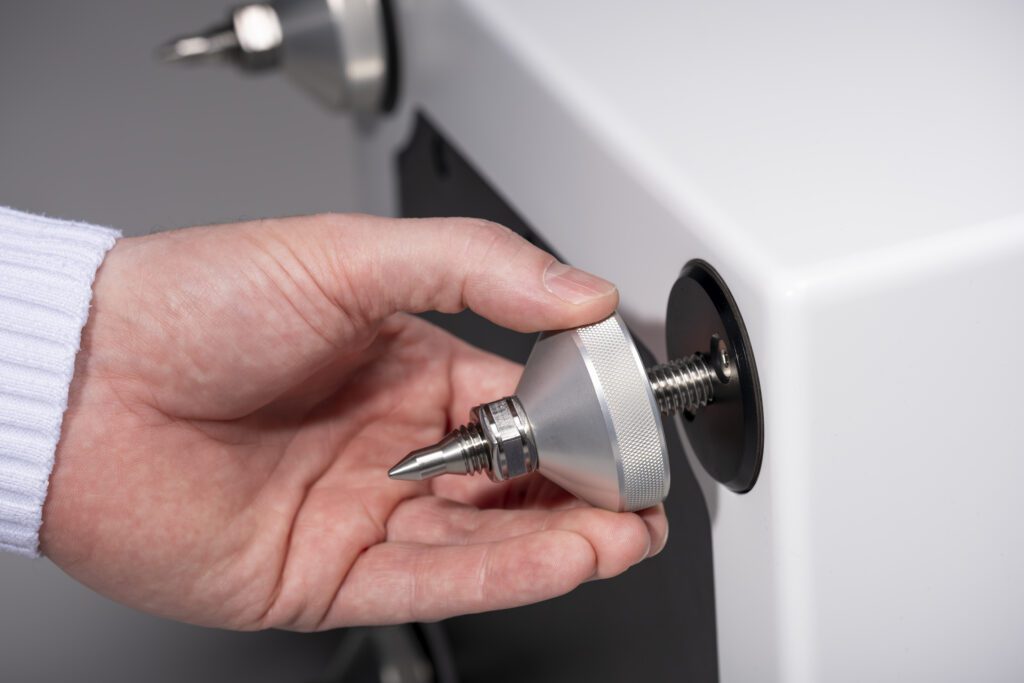
The same principle applies to the V-Material inserts. By integrating and nesting them at the bottom of the enclosure, they form a coupling for the spike. Increasing the contact area with V-Material improves vibration control, reduces noise, and functions like the Wilson Audio Acoustic Diode. It also allows for further upgrades with the Acoustic Diode itself!
How was V-Material first used?
When we designed the Chronosonic XVX, we developed V-Material to be placed between the upper gantry and the woofer, aiming to isolate woofer vibrations from migrating into the upper gantry. We later discovered it was effective across the entire range in isolating vibrations.
Sabrina V is in a unique situation because this material is usually used to isolate vibration between enclosures. Since Sabrina is a fixed enclosure, the only interface is between the loudspeaker and the floor. We were uncertain if it would make a difference. It turns out… it really does!
Tell us about the technology behind the Convergent Synergy Carbon tweeter.
The tweeter was initially developed for the Alexx V and is now used in the Alexia V, Sasha V, The WATT/Puppy, and the Sabrina V. It features a rear-wave chamber and is 3D-printed in-house from carbon fibre. The result is a more natural high-frequency response, improved linearity, and finer harmonic detail. It’s a step-change.
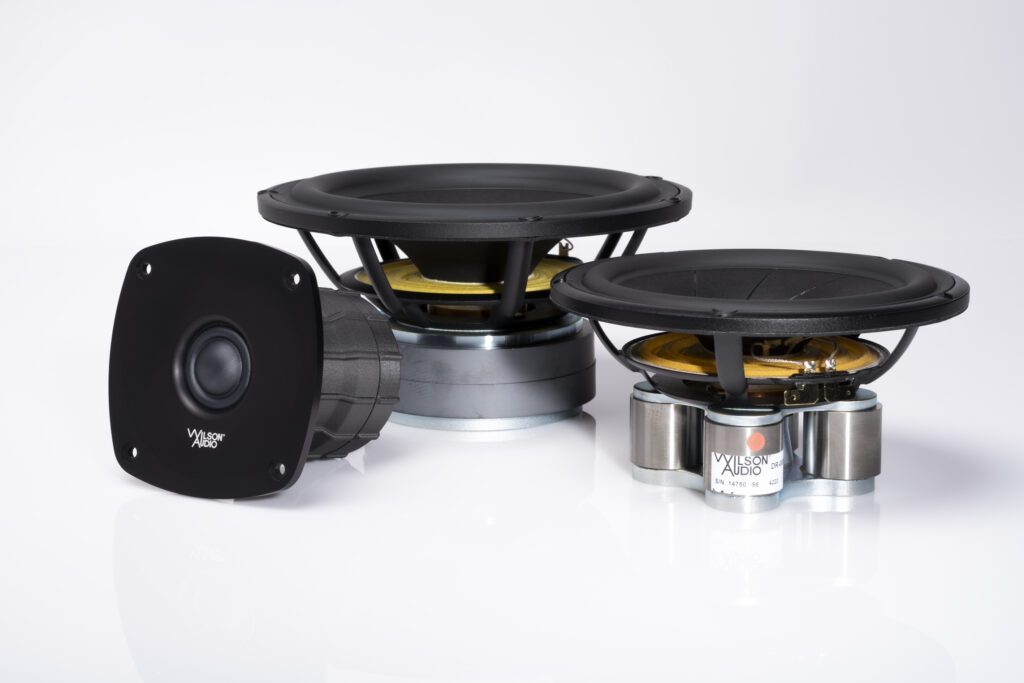
In fact, all the drivers used in the Sabrina V are also featured in the Sasha V and WATT/Puppy. This shows consistency and our commitment to that culture of excellence. The 7” AlNiCo QuadraMag midrange from the Chronosonic XVX is one of my favourites; it provides that exquisite tonal richness right where the ear is most sensitive in the audio spectrum.
Read the review of the Sabrina V here.
Manufacturer
Wilson Audio
Trending Articles
See all
By Alan Sircom
More articles from this author
Read Next From Blog
See all
Tech Talk: Wiktor Schulfer of Unitra
- Sep 29, 2026

Tech Talk: Antonio Meze of Meze Audio
- Sep 22, 2026

Tech Talk: Dominique Poupart of MOON
- Sep 22, 2026

Quinton Barnes: Black Noise
- Sep 16, 2026