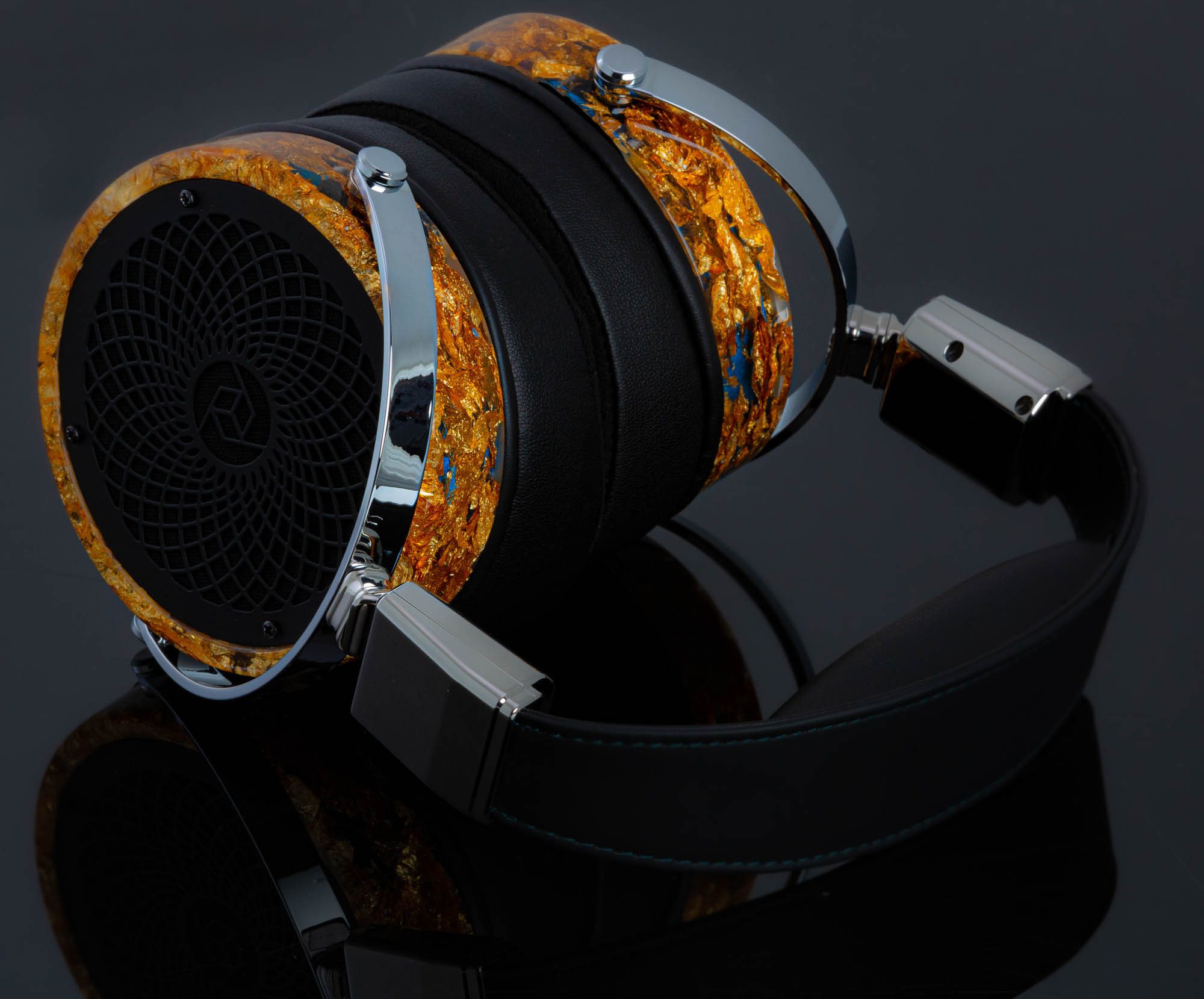
The transducer is mounted in an open-backed frame, the retaining ring of which can be constructed from any material that can realistically fit into the Rosson casting mould. Micarta is a go-to material, but wood, rock and/or gems are all viable. Apparently one customer (whose anonymity is understandably guaranteed) requested the ashes of a departed loved one be incorporated. And, as I say, someone has acquired a section of Jerry Garcia’s kitchen counter and had it turned into the housing of the RAD-O I’m listening to. If it can be cast, it can be used – and once it’s cast, Rosson’s team sand and polish the resulting ring zealously before the holes for input ports and yoke are drilled.
Despite offering a remarkably wide range of possibilities where materials are concerned, though, Rosson is anxious to keep the weight of the RAD-O manageable and the comfort uncompromised. Supposedly no pair will ever weigh more than 650g – which is nonetheless a not-inconsiderable number, so Rosson attempts to mitigate this figure by very carefully focusing on headband curvature, clamping force and earpad density. Certainly my review sample stays comfortable for literally hours on end (the rakishly angled earpads help no end in this respect), adjusts with real solidity and generally feels much lighter and less cumbersome than it looks. These are big headphones, though, no two ways about it – so don’t go thinking RAD-O ownership is for everyone. Those of smaller cranial dimensions will have to look elsewhere.
You can take quality of assembly for granted, and ditto longevity. The parts of the RAD-O that are supposed to move do so with an almost decadent sensation of damping, while the parts that aren’t supposed to move simply don’t.
And to keep your RAD-O in tip-top condition, they’re supplied with the sort of heftily padded, flagrantly over-engineered travel-case you might reasonably expect to see handcuffed to the wrist of a burly man in a suit and sunglasses. In the case there’s a 2m length of nylon-shrouded OFC cable, terminated at one end with a 3.5mm plug and at the other end with two dual-mono 3.5mm plugs marked ‘L’ and ‘R’. There’s also a 6.3mm adapter. Alternatives are available, including 4.4mm and XLR balanced options.
The open-backed configuration, the price, the length of the supplied cable and the, um, idiosyncratic looks all dictate the RAD-O are for domestic (and, ideally, solitary) use. For the purposes of this test, they are connected to the headphone output of a Naim Uniti Star and of an EarMen TR-Amp attached to a MacBook Air. Sources extend to the Naim’s disc drive, a Clearaudio Concept turntable with a Leema Elements phono stage sitting between it and the Naim, and Qobuz and Tidal top-tier, high-resolution streaming accounts.

It turns out there’s nothing mysterious about the Rosson Audio Design RAD-O, no shyness of which they need to be disabused, no secrets of performance that can only be teased out after an extended listen. The RAD-O lay their cards on the table right from the off.
And it doesn’t really matter if you (as I have throughout this test) are listening to a 180g reissue of Nina Simone’s deathless In Concert (Live at Carnegie Hall, New York, 1964) [Philips/UMG], the MQA equivalent via Tidal Masters, a compact disc of My Bloody Valentine’s Loveless [Creation], Prokofiev’s Piano Concerto No. 3 [Deutsche Grammophon] performed by Martha Argerich and the Berliner Philharmoniker as a 24bit/96kHz Qobuz stream, or a vinyl copy of The Bug’s London Zoo [Ninja Tune], the broad results are the same. The RAD-O are an uncoloured and unopinionated listen, seemingly on a mission to ensure you’re completely and explicitly informed.
Trending Articles
See all


By Simon Lucas
More articles from this author


Read Next From Review
See all
REL S/850
- Aug 25, 2026
Rotel DX-5
- Aug 25, 2026
Magico S2
- Aug 25, 2026
Synergistic Research PowerCell 8 SX
- Aug 25, 2026