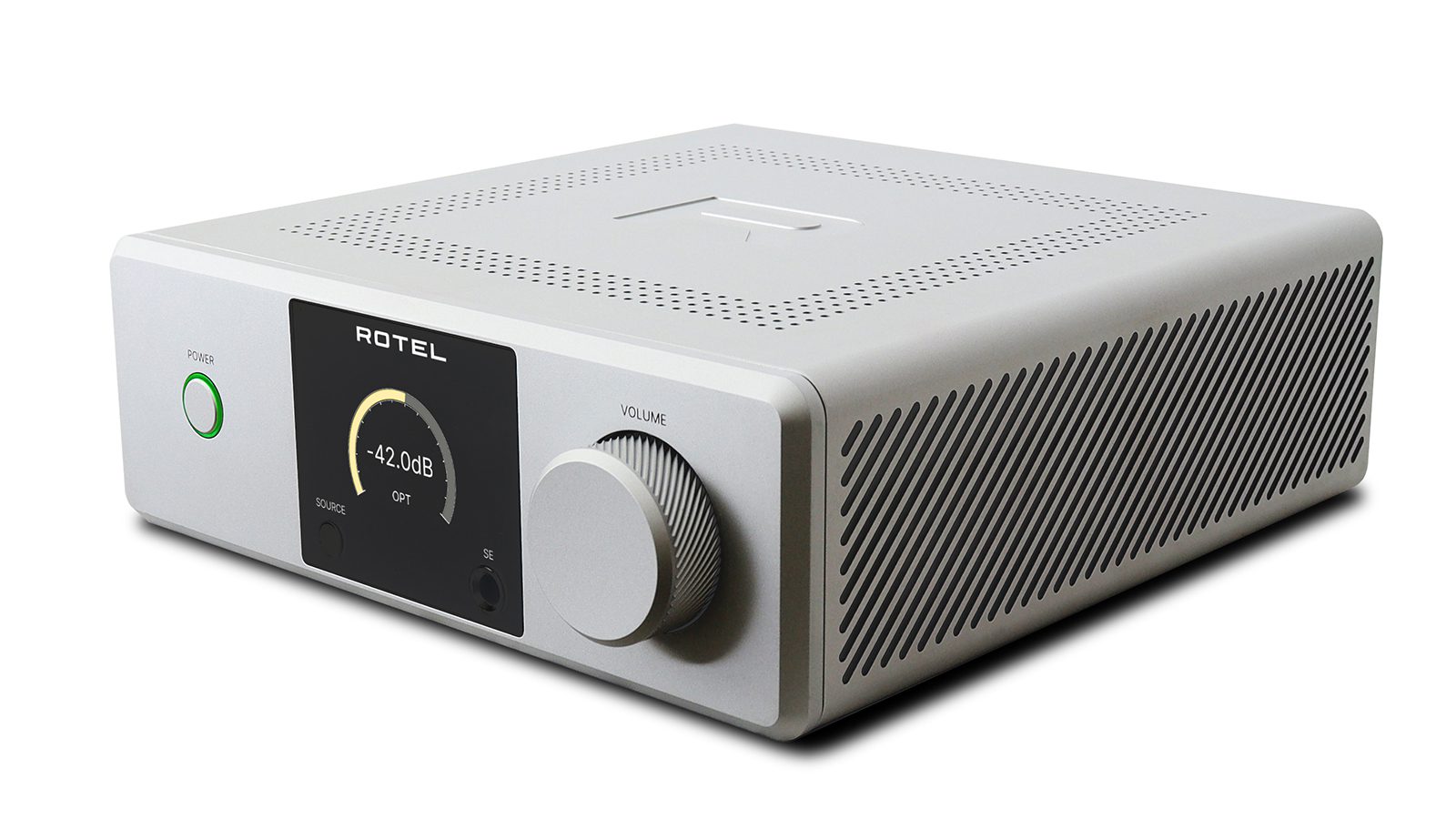
It has taken decades, but the Proper Hi-Fi World is finally embracing the ‘singing shoebox’ form factor. The Rotel DX-5 integrated stereo amplifier is just the latest product from a respected manufacturer aiming to extract considerable performance from a compact case. Traditional, full-width electronics were an understandable function of discrete components, power supplies with massive capacitance reserves, and output transistors requiring giant heatsinks. But it’s no longer the 1980s, and more efficient audio electronics with surface-mount devices do not need all that excess real estate.
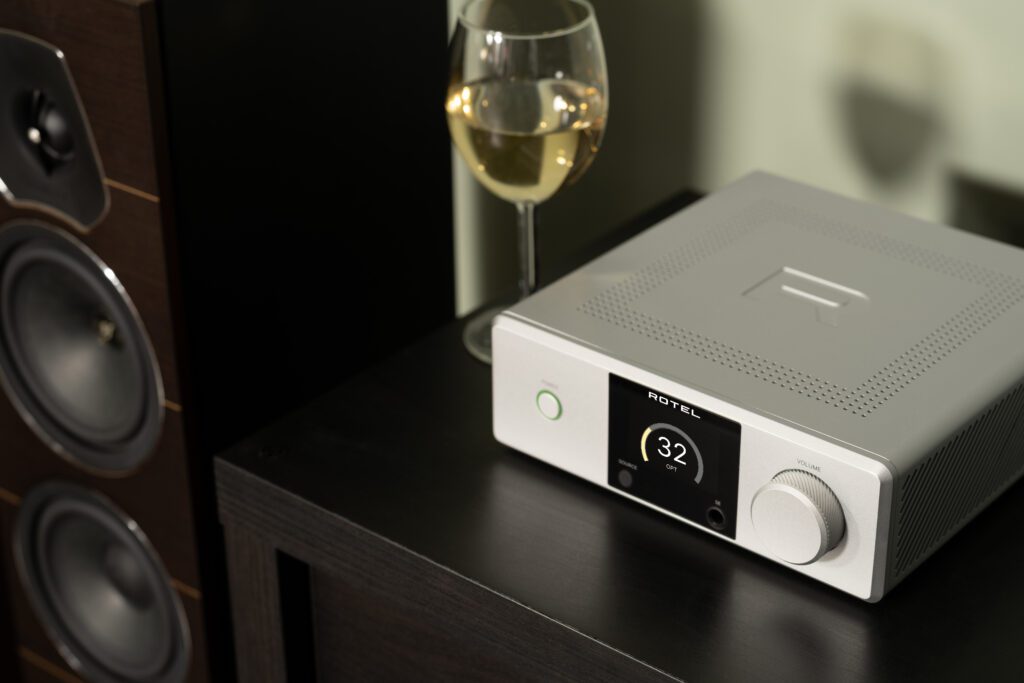
The DX-5 represents Rotel’s vision of what a modern integrated stereo amp should look like, sound like, and be specified like. Its dimensions are 76 x 215 x 251mm (H x W x D), and the case exudes visual and tactile appeal through the generous use of anodised aluminium and charming details in the industrial design. Of course, a good audio product involves more than just a pleasingly knurled volume control and a big, confident ‘R’ embossed into metal—though these features are a good starting point.
Intricate
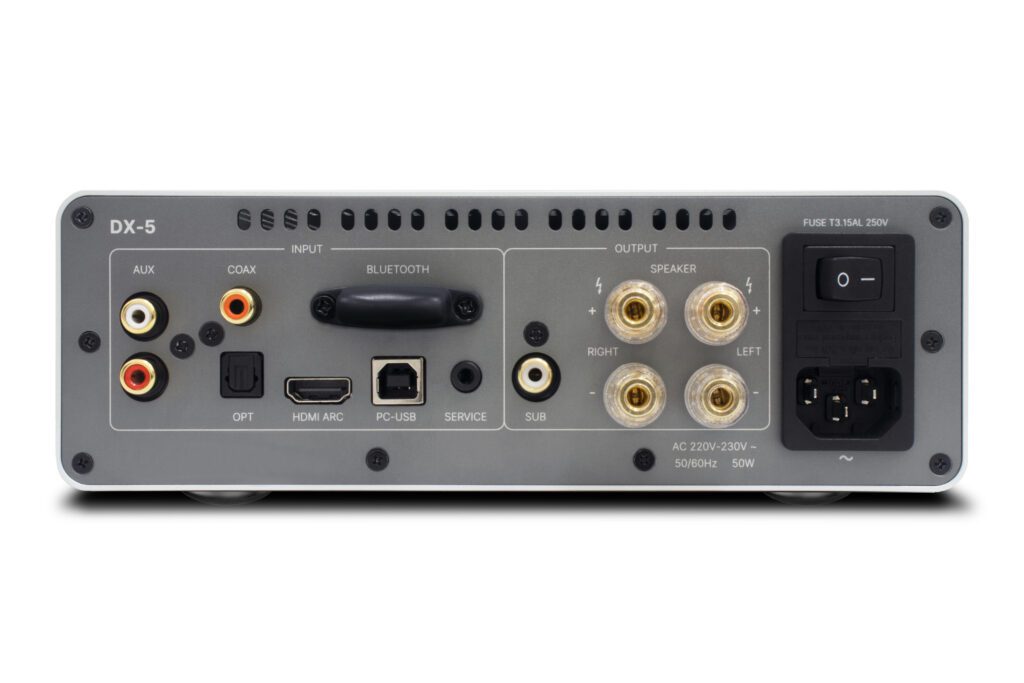
Alongside the well-engineered volume dial, the fascia boasts a large, sharply rendered full-colour TFT screen featuring a ‘source selection’ button and a 6.3mm headphone output integrated into its lower part, as well as a power button. At the back, you’ll find a pair of speaker cable binding posts (compatible with bare wire, banana plugs, and spades) and a pre-out for a subwoofer. Physical inputs are connected to a single line-level analogue input via a pair of stereo RCA sockets, along with an HDMI ARC input, coaxial and optical sockets, and a USB-B input.
Beneath the ventilated and branded lid, the space is dominated by a high-current toroidal transformer, wound in-house, capable of delivering 25 watts of Class AB power into an eight-ohm load (rising to 33 watts per channel into four ohms). Digital-to-analogue conversion is managed by the increasingly common ESS Sabre ES9039Q2M chipset, which supports 32-bit/384kHz PCM and DSD512 via the USB-B input (with the necessary driver installed on the source device), and 24-bit/192kHz PCM through the coaxial and optical inputs. The DX-5 is certified Roon Tested, and Rotel suggests that the device can achieve a prodigious 10Hz – 80kHz frequency response, while also claiming extremely low intermodulation distortion and signal-to-noise ratios. Meanwhile, wireless connectivity is established via Bluetooth, and the device supports SBC, AAC, and aptX HD codecs. A smaller and more discreet-than-normal Bluetooth antenna is integrated into the rear of the chassis.
Omissions
That’s your lot regarding meaningful specifications, so it’s probably at this point you’ll start to wonder about the more obvious omissions. The absence of a phono stage is perhaps understandable. This is a small device, after all, and pre-amplification for a turntable is disproportionately space-consuming even before considering shielding and the like. A single analogue input feels a bit limited, though – what Rotel is effectively saying is “our DAC is better than any DAC fitted to your digital source equipment,” which seems to be assuming quite a lot. A lack of Wi-Fi also seems a bit restrictive – no one’s suggesting the DX-5 should be a full-blown network streamer, but the ability to use the ‘Connect’ version of your favourite music streaming service(s) would be a welcome addition. And so would a control app, especially given the idiosyncrasies of the remote control handset Rotel supplies with the DX-5.
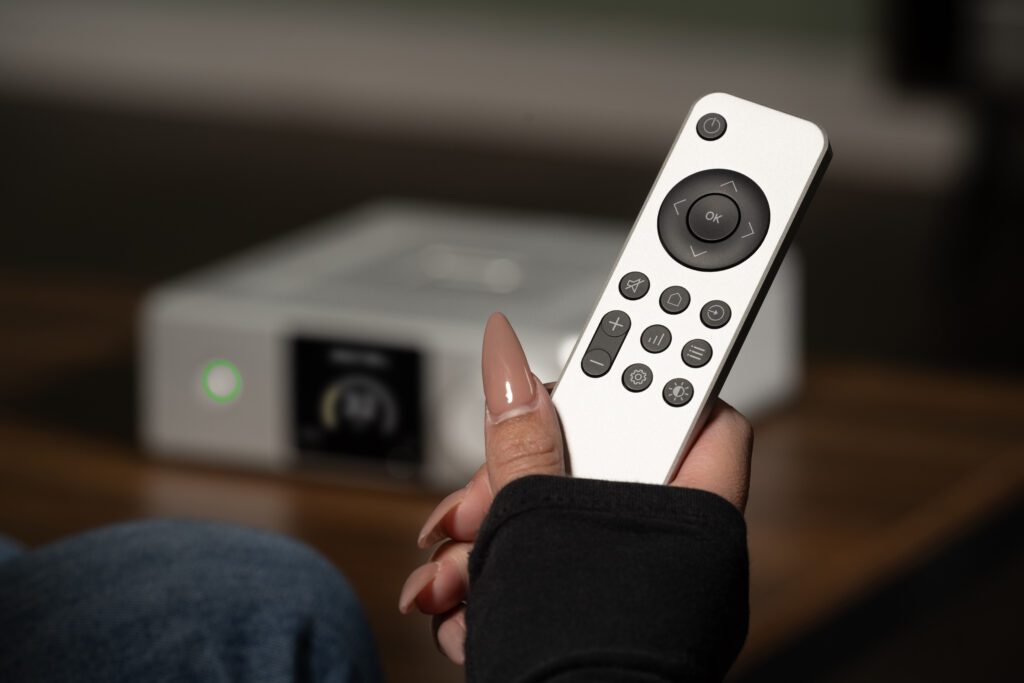
There’s nothing wrong with its perceived value. This remote control stands out thanks to its relatively heavy aluminium build, ergonomic proportions that fit in the hand, and thoughtfully arranged buttons. However, it’s likely the most line-of-sight-dependent remote I’ve ever used. Point it exactly at the DX-5, and it works. Shift it a degree or two away in any direction, and… nothing.
My aim is true
Let’s imagine your hand is steady and your aim is true, and you’ve been able to specify the input you’d like and the volume level you prefer. I used a Naim Uniti Star acting as both a streamer and a CD player (connected to the analogue input), a Colibri-equipped Apple MacBook Pro handling hi-res audio via USB-B, and a range of speakers from ‘sensible’ to ‘only a reviewer would put those two together.’ However, in each case, the Rotel DX-5 has plenty, sonically speaking, to recommend it.
The soundstage the DX-5 creates, for instance, is spacious, well-defined, and, simply put, large. The layout of a relatively complex recording like Fela Kuti’s Colonial Mentality [Kalakuta] is made clear, and each element of the recording gets the space it needs to express itself without interference from others. The Rotel can unify the recording at the same time. However, despite its ability to isolate each element into its own space, they still interact most naturally. The concept of ‘performance’ is not compromised in the name of ‘separation’.
There’s plenty of dynamic variation in this recording, both in terms of fluctuations of attack, intensity, and sheer volume, and of harmonic variety within individual instruments. The DX-5 has no trouble identifying and revealing these fluctuations and can easily convey the vehemence of the massed voices behind Fela when the vocal line finally kicks in. The gap between the quietest and loudest moments is quite substantial, despite the rather modest power output figures Rotel quotes.
Impressive retrieval
Detail retrieval is equally impressive – the DX-5 does excellent work in locating even fleeting or minor occurrences in Belle and Sebastian’s Lazy Line Painter Jane [Jeepster], placing them into proper context, and does so while maintaining an overall tone of entertainment rather than measured analysis. The Rotel can probe deeply into the somewhat flat, two-dimensional mix and offer a variety of relevant observations.
Throughout these recordings and the many others I listen to, the DX-5’s frequency response remains consistently even. Low frequencies are deep and textured, and the control the Rotel exerts over the attack of bass sounds ensures the rhythm delivery is confident and precise. The midrange is articulate and well-formed, with a directness and positivity that allow voices to communicate clearly. The upper end of the frequency spectrum is presented with the same emphasis as the lower, rich in detail and clarity.
It’s really only when the amp is pushed to its limits that the DX-5 ever feels anything less than coherent and self-assured. From the very bottom of the lowest frequencies to the uppermost part of the midrange, the Rotel remains winningly even and consistent – its tonality is quite carefully neutral, with very little heat or chilliness to colour the inherent tone of any specific recording. However, when pushed, the midrange transitions into the upper frequencies, the DX-5 experiences a noticeable change in character — treble sounds become relatively thin and insubstantial. They can turn slightly edgy and sibilant as a result. An uncooperative recording like Dying For It by The Vaselines [53rd & 3rd] played loud and driving difficult loudspeakers can sound genuinely tiring, but most people using sensibly partnered speakers playing at a volume level of about 0.8 Mogwais will never experience that harshness.
Startlingly insightful
Unless you are determined to stress-test the DX-5, the amp sounds accurate in its music-making, and the Rotel spends much of its time being an entertaining, engaging, and occasionally quite startlingly insightful device. It’s one of those products where its on-paper specifications have little in common with its real-world performance. Yes, that needs to be tempered by the choice of loudspeaker, but the sort of loudspeakers that match a 25W, £1,500 amp are a perfect match.
In short, I enjoyed my time with the Rotel DX-5 to an almost unlikely degree. It’s not without its shortcomings, but they rarely intrude upon the music, and it’s hard not to think of this little star as a bit of a pocket rocket!
Technical specifications
- Type: class AB integrated stereo amplifier
- Analogue inputs: line-level RCA
- Digital inputs: coaxial, optical, HDMI ARC, USB-B
- Analogue outputs: subwoofer (pre), loudspeaker
- DAC: ESS Sabre ES9039Q2M
- Power output: 33wpc (4ohms) / 25wpc (8ohms)
- Bandwidth: not specified
- Sensitivity: 680mV
- Distortion: <0.03%
- Signal to Noise Ratio: >100dB
- Damping factor: 140 (20Hz – 20kHz @ 8ohms)
- Dimensions: 76 x 215 x 251mm (HxWxD)
- Weight: 4.1kg
- Price: £1,499, €1,499, $1,499
Manufacturer
Rotel
UK distributor
Henley Audio
+44(0)1235 511166
Trending Articles
See all
Krell Vanguard integrated amplifier
- Apr 07, 2015
Trending Articles

By Simon Lucas
More articles from this author
Read Next From Review
See all
Reiki Audio SuperSwitch X/Pro X PSU
- Oct 06, 2026
Audiobyte SuperVOX
- Oct 06, 2026
Unitra WSH-805
- Sep 29, 2026
Wilson Audio Sabrina V
- Sep 29, 2026