European hi-fi powerhouse Pro-Ject has come a long way since it invited us to “go analogue in the third millennium”. In addition to the turntables that established its reputation, it now produces a bewildering array of goods, including CD players and DACs (going digital in the third millennium?), tonearms, phono stages, amplification, speakers, and accessories (including records). Like home-grown manufacturers Rega and Linn, Pro-Ject assembles some of its products into systems, complete with interconnects. The consumer gets a well-matched and hassle-free route to musical nirvana, while the manufacturer gets to sell more stuff.
The whole system
One such system – or ‘hi-fi set’, in Pro-Ject’s quaint terminology – features the Speaker Box 5 E Carbon speakers, which are reviewed here. The ‘true analogue’ Colourful Audio System E is, as its name suggests, available in a range of six hues and shades to complement domestic décor. Retailing for £1,099, it is designed (appropriately enough!) with vinyl as the primary listening medium. To this end, it features a belt-driven Debut E turntable, with an 8.6-inch diameter, aluminium tonearm and Ortofon cartridge – the only part of the package that isn’t a Pro-Ject product. Not available in any matched coloured finish (it’s only available in black or silver), the Stereo Box E integrated amp boasts an onboard phono stage and a Bluetooth-capable 24/192 DAC.
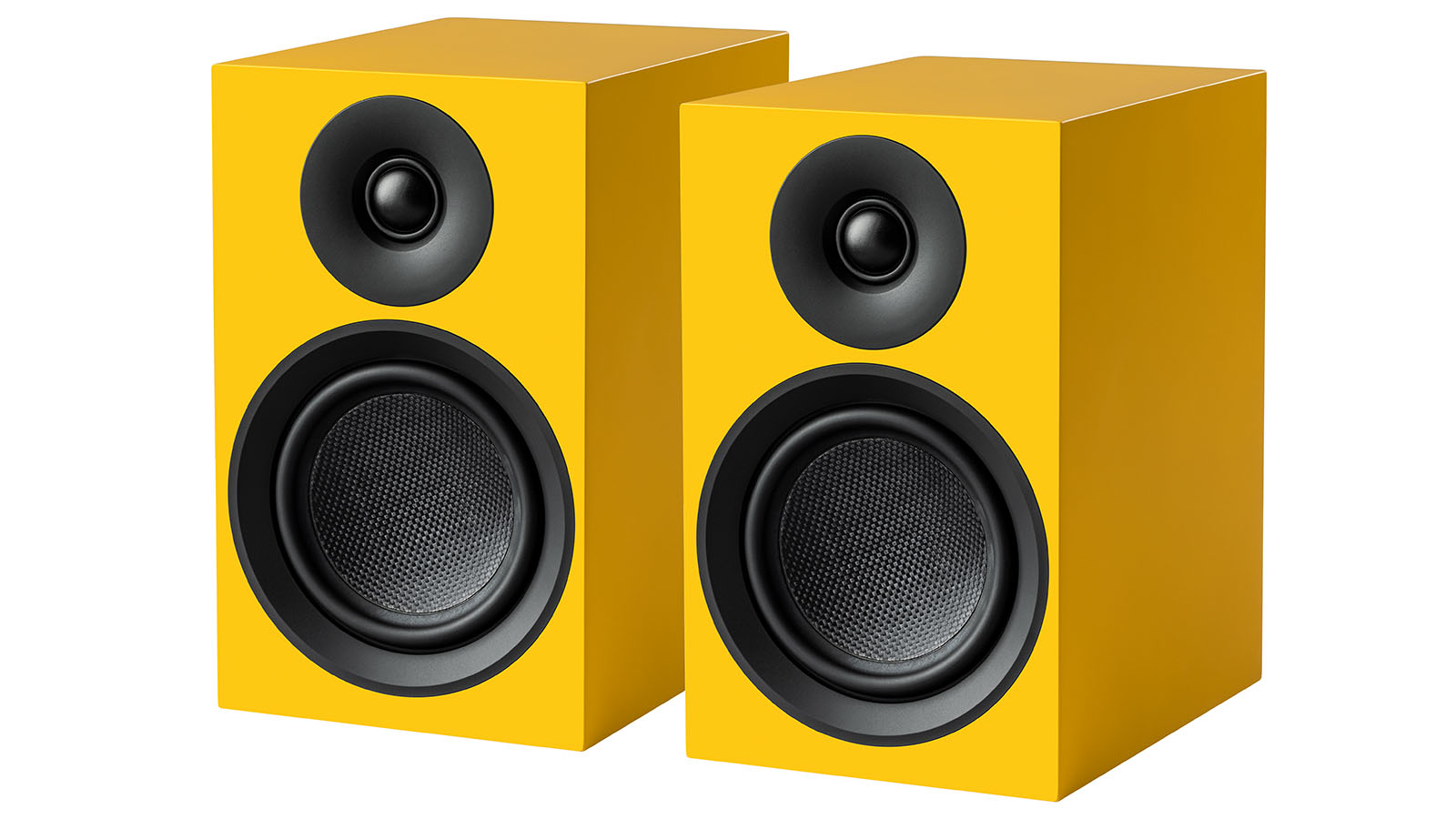
The output stage of this diminutive 1kg wonder is rated at a mere 21 watts per channel of Class-D power (into an eight-ohm load, that is). This, however, doubles to a more capable 40 W if you’re using four-ohm speakers, such as the Speaker Box 5 E Carbons. Colour-matched to the turntable – our review pair, out of interest, came in a fetching satin yellow – these bass-reflex bookshelf speakers are descended from Pro-Ject’s very first speakers (the Speaker Box 5s). They are, however, also available separately for £459 a pair (you will note that the speakers therefore account for nearly half the total purchase price of the Colourful Audio System E, which goes against conventional hi-fi budgeting wisdom). Given the Stereo Box E’s relatively low power output, you would expect the speakers to make the most of what’s available—and they do.
Health and efficiency
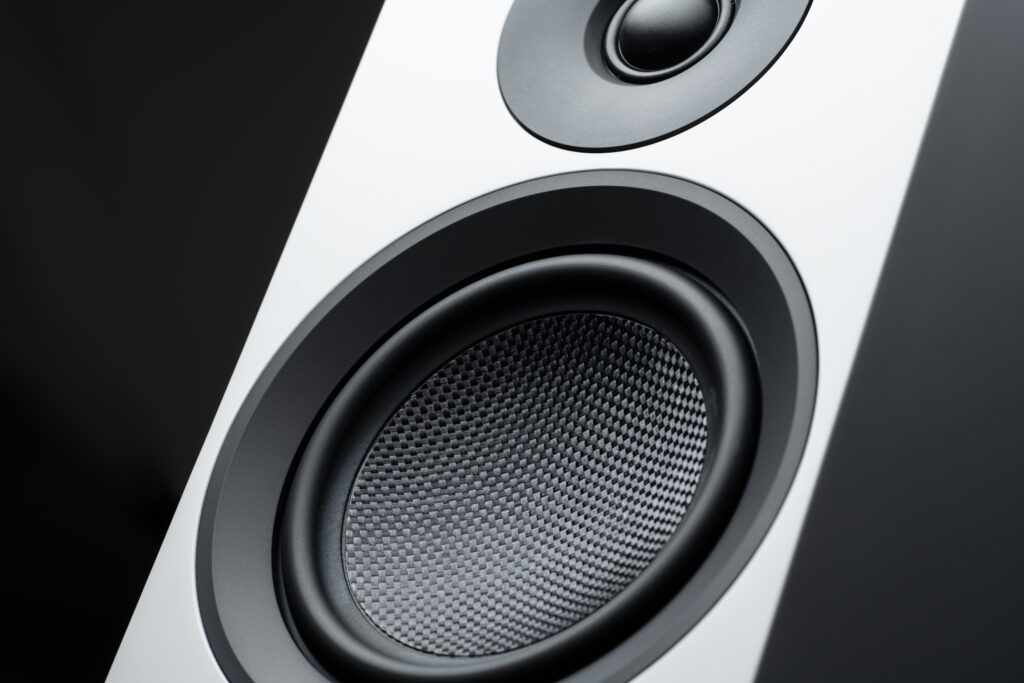
There’s a precedent here; the original Speaker Box 5 (circa 2010) were, according to Pro-Ject, released to meet the goal of “looking and sounding consistent with its amplifiers”. Pro-Ject quotes an efficiency of 86dB (1m/1W) for the 5 E Carbons. This makes them more efficient than, say, the B&W 607 S3, which has a sensitivity of 84dB (1m/1W), and on par with Klipsch’s very different RP-600Ms. While the similarly priced Klipsch speakers (since replaced by a pricier and slightly less efficient Mk 2 variant) make distinctive use of treble horns, the 5 E Carbons rely on somewhat more conventional drivers, specifically one-inch (25mm) silk-dome tweeters. Bass and mid-range, meanwhile, are the responsibility of a long-excursion five-inch (125mm) woofer with a carbon fibre-reinforced diaphragm – hence the product’s name. The stiffer material yields, Pro-Ject assured me, “a more detailed and punchier sound reproduction”.
Both drivers are made to Pro-Ject’s specifications by one of its suppliers – a “highly-respected manufacturer that also produces drive units for other brands”. Internally, these transducers interface with your amp; models rated between 10W and 150W are suitable, via a basic 5-component crossover that makes no provision for bi-wiring or bi-amping. This is a pity, as such connectivity can pay dividends in terms of clarity, speed and tautness.
Single pair
The single pair of recessed terminals provided is of a high standard, though, and will accept either 4mm banana plugs or bare wire. The rear-ported 165x270x220mm (WxHxD) MDF cabinet, accommodating the said components, is impeccably finished and features two threaded back-panel holes for optional wall-mount brackets. Rubber feet are supplied for placement on a shelf or similar surface.
Another nice touch is that the front-panel grilles are discreetly held in place by magnets – no ugly holes to spoil those elegant lines, if removed (as per Pro-Ject’s recommendation) for optimal sound quality. Interestingly, given the emphasis placed on its European heritage, Pro-Ject admitted to me that the speakers are made entirely in China. However, the core design of the speakers was done in-house, with “advice taken from other design partners to ensure they were to the expected standard “ and “extensive listening sessions in Austria”. In all fairness, Pro-Ject is hardly the only global hi-fi brand to manufacture in China. It must do so for reasons of competitiveness and proximity to those all-important supply chains.
Are you sitting comfortably?
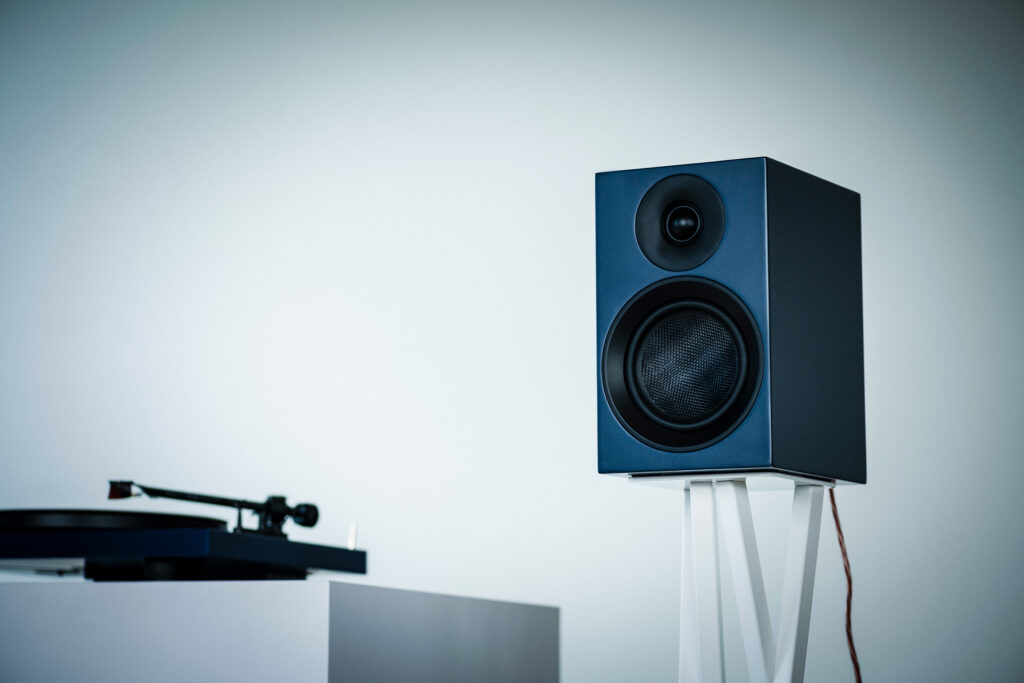
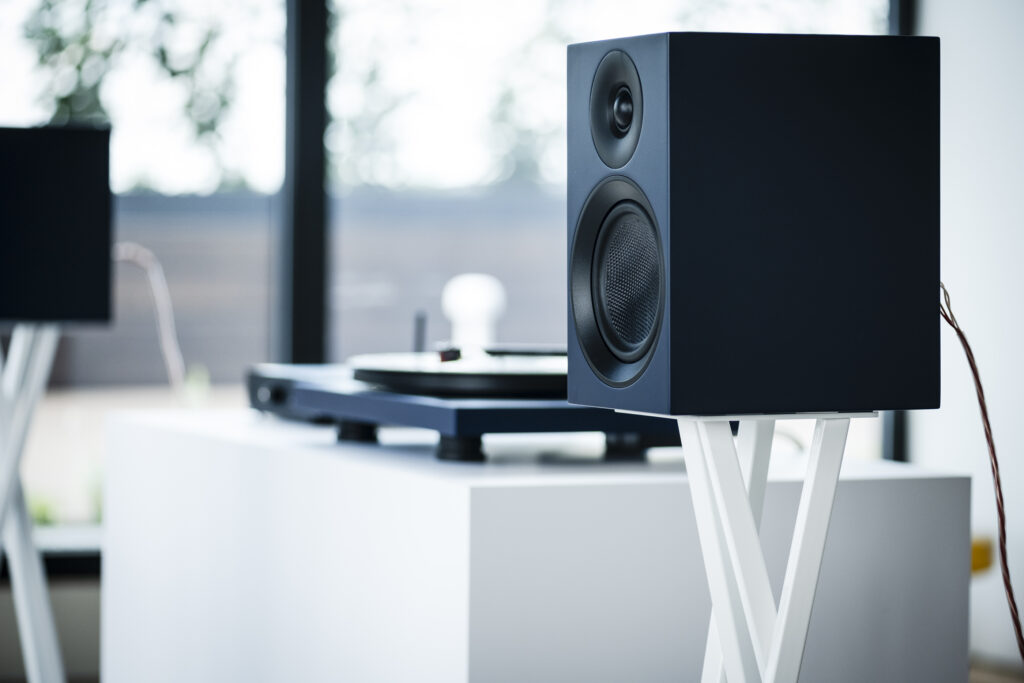
The instruction leaflet contains little guidance on installation. I found, through trial and error, that the 5 E Carbons gave their best results, in terms of imaging and tonal balance, when placed approximately a metre from the rear/side walls. During the review period, they were put on stands to achieve ‘ear height’, and ‘toed-in’ slightly towards the listening position. The two speakers were spaced approximately 2m apart, with my listening position around 3m from the midpoint of the line between them. Such an arrangement may have worked in my acoustic environment, but your experience may be different; anyway, experimentation is undoubtedly part of the fun. Listening took place with the grilles removed (in place, they were heard to ‘smear’ higher frequencies a little).
One of my ‘party tricks’ is to attempt to drive speakers from a very low-powered amplifier – specifically, an A.N.T. Audio Amber 3T headphone amp. Efficient speakers should provide you with listenable results, if not at ear-shattering volumes! The 5 E Carbons acquitted themselves well here, with sound levels sufficient to fill a small ‘box’ room with well-reproduced music, for most of the time. Hardly surprisingly, this little amp showed signs of strain doing a job for which it was not designed! From this point, I switched to more suitable amplification, including a Roksan K2 BT and a Cambridge AXR100D. My primary source was a Cambridge CXN player, fed with CD rips and high-resolution vinyl transfers. All cabling and interconnects were from Black Rhodium’s Intro range.
Serious listening
The speakers were ‘burnt in’ over a fortnight before serious listening began – this is particularly important for electromechanical devices like speakers. Right from the start, it was apparent that the 5 E Carbons had one outstanding virtue – that of imaging. Listening to relatively early stereo material (for example, DG’s 1955 recording of Tchaikovsky’s 6th Symphony as performed by Herbert von Karajan and the Berlin Philharmonic) proved to be a rewarding experience, thanks to the sheer immediacy and imaging conjured up between the speakers. You become the audience of a performance that took place seventy years ago, captured on an analogue tape that, a mere decade earlier, was being deployed as a German propaganda tool.
Across the decades, the Blumlein-type stereo has mainly been eclipsed by more sophisticated techniques that utilise multiple microphones, positioned among the performers and selected for their specific roles. The signals from these microphones are mixed, in terms of level and stereo positioning, into a two-channel recording that, in the judgment of the sound engineer, accurately conveys what was heard in the performance venue. More often or not, the recordings made in the venue are multi-track and will be ‘mixed down’ later in a studio (as are those delicious examples of artifice, otherwise known as rock/pop!). Over the same period, recording has migrated from analogue tape to digital systems of increasing sophistication.
Fizzed-up
Multi-mike recordings (described by one ‘70s scribe as ‘fizzed-up stereo’) tend to be more detailed than their vintage predecessors, but are not quite as natural and immersive. In the hands of a skilled engineer, however, this approach can provide both detail and believable stereo. As such, the 5 E Carbons make the most of more recent material, such as the 2012 Noseda/LSO/Eltham College Choir/London Symphony Chorus 24-bit recording of Britten’s War Requiem, which I frequently use as a reference. The clarity on offer here is praiseworthy, as is the ability to position performers within the space. Within our modestly dimensioned room (4m x 5m x 3m), the dynamic swings of this piece did not overwhelm the 5 E Carbons.
Neither did intensely percussive material, notably a Columbia recording of compositions by Edgard Varèse, which was made around the same time (1960) as the Tchaikovsky symphony mentioned above. Rhythmic attack and decay are conveyed as believably as tonal colour, demonstrating that speed is not a problem with these speakers (in this regard, they were a good match for the Roksan amp). Spinning some classic house music cuts backed this impression, although doing so exposed the apparent limitations of these speakers in another sense. Although the bass you get is tuneful and uncoloured – the latter is particularly evident with the spoken voice, as it dominates Radio 4 – you’re not going to experience floor-shaking slam here!
That may be why the Stereo Box E amplifier, which also forms part of the Colourful Audio System E, makes provision for an active subwoofer – examples of which are also available from Pro-Ject. Even as things stand, though, the 5 E Carbons are very good-sounding speakers that are well worth auditioning if your budget is under £500. I’d love to hear them in that system!
Technical specifications
- Type: Two-way bass-reflex speakers
- Drive units: 1” Silk-dome tweeter, 5” midbass with carbon-fibre composite cone
- Frequency response (no limits specified): 65Hz-20kHz
- Nominal impedance: 4Ω
- Sensitivity: 86 dB (1W/1m)
- Finish: Satin Golden Yellow, Satin Fir Green, Satin Steel Blue, Satin Black, Satin White, Walnut
- Weight: 4.76kg
- Dimensions (WxHxD): 165x270x220mm
- Price: £459, $649, €499
Manufacturer
Pro-Ject
UK distributor
Henley Audio
+44(0)1235 511166
Tags: PRO-JECT SPEAKER BOX 5 E CARBON STAND-MOUNT LOUDSPEAKER
Trending Articles
See all
By Martin Pipe
More articles from this author
Read Next From Review
See all
Eversolo T8
- Oct 13, 2026
Acoustic Energy AE Active
- Oct 13, 2026
Reiki Audio SuperSwitch X/Pro X PSU
- Oct 06, 2026
Audiobyte SuperVOX
- Oct 06, 2026