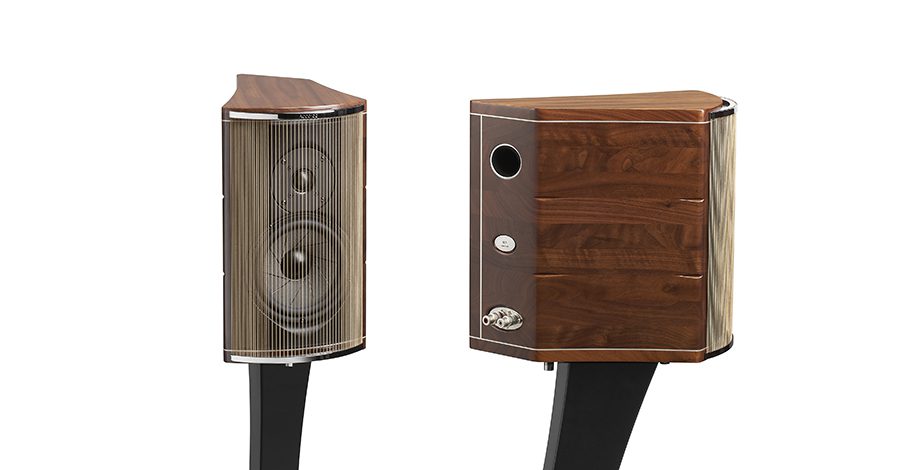
Accordo is the two-way stand-mount loudspeaker the late Franco Serblin designed for the brand that would carry his name. The original Accordo remains in the Franco Serblin catalogue. Recently, that company released a variation of the Accordo with a larger cabinet and mid-bass driver. In upscaling the enclosure, the company moved the crossover network from the stand back into the speaker cabinet. Containing the most cerebral, Bach-esque pun in audio naming, the variation is the Franco Serblin Accordo Goldberg stand-mount loudspeaker.
Moving the crossover into the loudspeaker makes the design more conventional than its smaller, older brother. It also allows a wider choice of speaker stands—at least in theory. No one will use the Accordo Goldberg without the matching stands. This isn’t because the stand has some magic properties but because they combine to look and sound beautiful! Over the following few pages, you’ll often read variations on the ‘look and sound beautiful’ theme.
Size matters
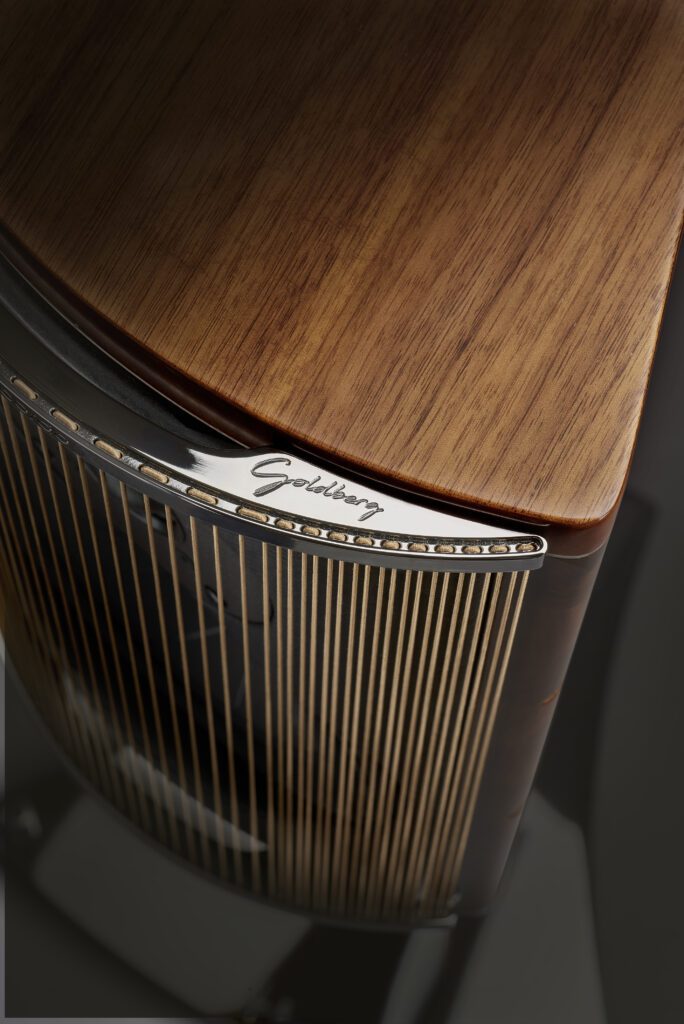
Unless explored closely and side-by-side, the original Accordo and Goldberg variants look nearly identical. They have the same asymmetric arch shape, which, from the top down, resembles a pair of wooden quotation marks. They have the same essential form factor, whatever angle you view them from. Neither looks ‘stretched’, ‘shrunken’, ‘overblown’ or ‘miniaturised’. It’s a tribute to the original design that you can increase its cabinet volume so markedly and retain perfect proportions. That was one of the reasons why Franco Serblin remains so well-respected more than 11 years after his passing.
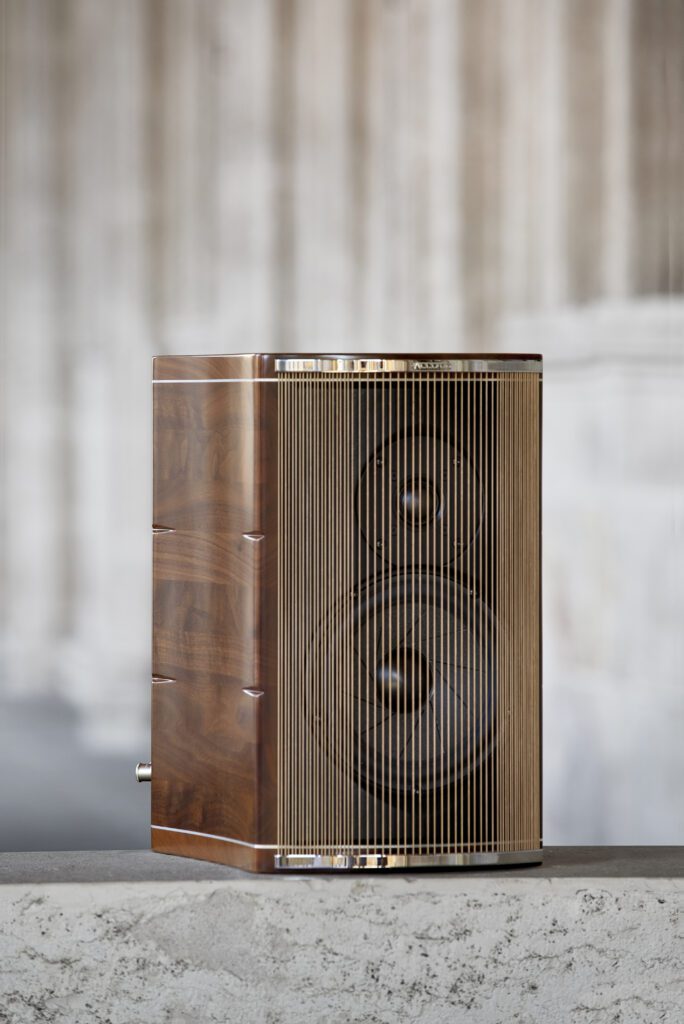
The on-paper differences between the two stand-mounts are comparatively minor. The Goldberg cabinet is 4.5cm taller, 5cm wider, and 7cm deeper. It has a 180mm microsphere mid-bass with an aluminium dust cap. Compare this to the 150mm sliced paper cone with a phase plug used in the original. All of this, and the internal crossover, adds an extra 7kg to the loudspeaker’s total weight.
Now, look at what they both share. They have the same Ragnar Lian-designed 29mm silk dome tweeter. This description is typical of Franco Serblin and harks back to the days when he was making and designing loudspeakers. Most companies would simply say ‘Scan-Speak D2905’ because that is the 29mm silk dome from the company’s Classic series. And it really counts as a classic, both in terms of popularity and longevity.
The Lian’s share
The driver was designed by one of the founders of Scan-Speak, Ragnar Lian. Serblin would always credit the man, not the company. It was his way. Lian has not had input into the D2905s used in the Franco Serblin Accordo Goldberg, because Ragnar Lian passed away in November 2008, aged 75. But holding people in high esteem doesn’t stop when they pass away. That was the Franco Serblin way, and that sense of respect has been passed down to Massimiliano Favella the designer of the current line.
The cabinets of both rear-ported speakers are made from solid wood decoupled with aluminium/magnesium components for internal resonance control. And even though they are sited in different places, both crossovers are designed to be phase coherent.
The raw specifications don’t show many significant differences, either. They both have a rated sensitivity of 87dB. The nominal impedance rating of the Goldberg is seven ohms, against the slightly more challenging four ohms of the original. You also get a notional 39Hz lower frequency response cut off against the 40Hz of the Accordo. While Franco Serblin is extremely conservative in its ratings, these specs tell you nothing about the real-world performance.
Real-world ease
In the real world, the Accordo Goldberg is an easy loudspeaker to drive, but a hard one to drive well. In that respect, it’s a little like classic Franco Serblin designs from the 1980s. Yes, you could run it from practically any amplifier on the market today, but you’d probably not want to. This speaker needs some driving, but that’s more about quality rather than quantity. In particular, the high-frequency performance of an amplifier marks it out as a good or ill partner for the Goldberg. Any hint of brashness or ragged treble extension from the amplifier and it gets translated to the speakers. Something with a bit of power, but smooth and detailed power is absolutely perfect.
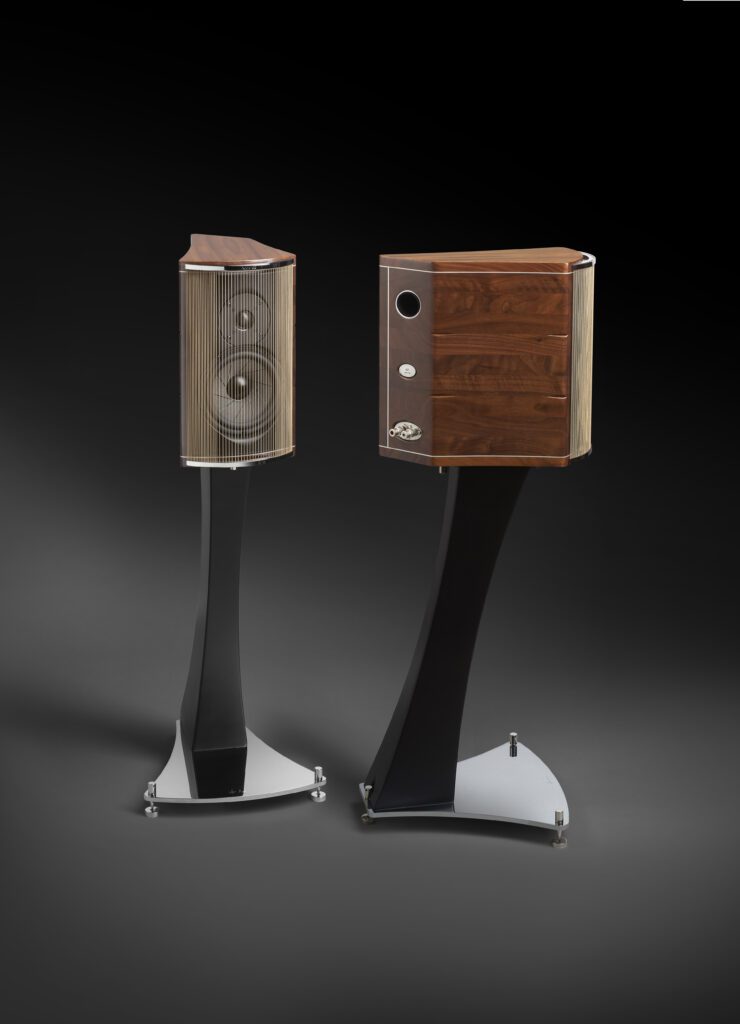
Similarly, installation needs some care and attention, but this is not a speaker that demands nanometre-precise set-up. There is a distinct point where the sound ‘snaps’ into focus. That’s likely to be a sharp toe-in, where a beam from the centre point of the speaker crosses in front of your nose. You also need to be especially careful about having the loudspeakers level from front to back, but the knurled knobs above the chromed, fan-shaped baseplate make that relatively easy. The loudspeaker is also provided with handy floor-protecting spike feet. Because of the layout of the speaker, a completely rigid loudspeaker is unlikely, but you should aim to have the loudspeaker barely moving even when you try to move it with your hand on the top plate.
More than looks
This is not a loudspeaker sold on looks alone, although those looks make the Franco Serblin Accordo Goldberg very appealing, indeed. But in some audio circles, that’s the kind of talk that gets you burned at the stake. There’s an inherent hair-shirtiness to some audiophiles, who seem to think, “If it looks good, it sounds bad!” This is usually closely related to those who think everything in audio sounds the same and any audio device that uses a chassis that’s even remotely better made than a cereal box is a crazed spendthrift who spends their money on unnecessary luxuries, like bread and shoes.
Here’s the thing. If it sounds good, that’s usually because it was well-engineered. If it looks good, that’s also usually because it was well-engineered. And very often the people who work on the sonics work with the team that work on the aesthetics. In smaller companies… it’s the same team. And by ‘team’, I mean ‘person’. Having a product that looks good is no impediment to its sound. They can do both. They can look good and sound good. A guy who made nice looking and great sounding loudspeakers proved that back in the 1980s.
His name was Franco Serblin.
All the world’s a stage!
It’s strange. We use the word ‘soundstage’ a lot in audio reviewing, but rarely think of it in terms of the sound being ‘a stage.’ The Franco Serblin Accordo Goldberg goes some way to addressing that. But, in the same way I am wary of the hair-shirted getting the wrong idea about a loudspeaker that looks this good, so I am concerned that what I am about to write conjurers up visions of ‘luvvies’ talking about playing ‘the Dane’: The Accordo Goldberg gives music a sense of the theatrical!
No, that doesn’t mean it turns every piece of music into an opera, but it maximises the feeling of a performance taking place in front of you. We often discuss that in the abstract, even when the music is holographic and you’re transported into the studio or the concert hall, it’s always an ‘observational’ event. Maybe the drama of the music is the more important aspect.
It’s a little odd saying this because a lot of my listening notes describe a three-dimensional soundstage and how enticing that was. In fact, from a purely observational ‘listening test’, the review would be all about the loudspeaker’s ability to form a wonderful three-dimensional soundstage in front of the listener. But, the more I listened to the Accordo Goldberg with my critical listening facilities put into ‘park’ for a few hours, the more I was drawn to that feeling of enjoying the performance, not just the music.
Brutalist ambient
Oddly, this applies to even the least performance pieces of music. For example, take the brutalist ambient electronica of ‘Rocksavage’ or ‘Daresbury Laboratory’ from retro-futurist Warrington-Runcorn New Town Development Plan The Nation’s Most Central Location [Castles in Space]. There’s no performative aspect to this. Musically, it’s like reading a report on cement production from the 1970s. But regardless, you feel a theatrical connection to the music that doesn’t happen too often.
That music grips you. And getting back to the word ‘soundstage,’ that might be the reason for that theatrical connection. It really is the defining feature of these loudspeakers; a layering of sound that is usually the stuff of electrostatic loudspeakers and point sources. It didn’t matter what you played, that sense of dimensionality and staging was always present and a central focus of the sound. One of my go-to tests for staging is ‘Memphis Soul Stew’ by King Curtis {King Curtis Live at Fillmore West, ATCO]. It’s a slow-build way of introducing the band, musician by musician. It’s basically a live feed taken off a mixing desk back in 1970.
Who’s who
The track is a complete roll call of ‘who’s who’ in funk and soul, with Jerry Jermont on bass, Bernard Purdie on drums, Cornell Dupree on guitar, the Memphis Horns… essentially one of the best funk bands this side of The JBs. The mix gets heavier and harder to process as layer upon layer of talent takes their bow, but within this wall of sound, you can follow individual instruments through the whole mix. Rhythm guitar legend Cornell Dupree for example. On the Accordo Goldberg he’s always there, just slightly stage right, always on the beat and in the pocket, and playing the sort of licks that are impossible for the rest of us, and just another couple of bars for him.
This track also highlights a Serblin trait, that has always held. The combination of horn section and King Curtis’ sax playing is bright and sometimes too intense. This music can get almost aggressive played through the wrong speaker. The Accordo Goldberg, however, is perfect for taming brightness. They manage to convey the excitement of the music without making it sound too exciting.
This track is also a test of scale and level. Put simply, if it copes with the band at full stretch, the next album can be Tool’s Fear Inoculum [RCA] played loud. Or it could be Infected Mushroom or Mahler. It means the loudspeaker can move from a small band to a large orchestra and back again with confidence. That’s not something you normally hear from stand-mount speakers, whatever the price. It can play surprisingly loud, too.
Composed performance
Are there downsides to this composed performance? Well, I guess those who are wanting wide and expansive soundstages instead of precise and holographic experiences between the loudspeakers will not warm to the Accordo Goldberg’s big ball of sound in front of the listener. In some respects, that describes a lot of large scale orchestral works, where the listener wants the impression of hearing instruments at the back of the hall. Put simply, those bass and percussion instruments get a little closer here, and some will prefer something wider.
That aside, the obvious limitations of stand-mounts not being honking great floorstanders with 12” bass drivers apply, with the caveat that the Accordo Goldberg plays bass surprisingly deep and surprisingly well for a relatively small loudspeaker, and in the kind of rooms where a speaker like this will end up, too little bass is rarely the problem. In fact, in most rooms, the Accordo Goldberg’s bass, and its volume headroom, glorious soundstage, relaxed charm and sense of the theatrical all combine to make a loudspeaker that deserves a serious listen.
High-end cliché
There’s a cliché in high-end circles; “the pictures don’t do it justice.” This is usually a get-out clause to justify something that looks like it was hammered into shape. That’s “hammered into the shape of a broken Dalek made of dropped cheesecake, with a finish to match.” However, in the Franco Serblin Accordo Goldberg, it’s because they are so damn pretty. The eye is drawn to the shape and finish in photos, but the real thing is exquisite.
The contrast between the grille finials’ chrome and the cabinet’s rich satin finish is excellent. Add that distinctive patterned leather front behind the grille ‘strings’ and the slight chamfers cut into the sides… delightful. The product name is Serblin’s signature laser-etched into the base of the stand, with ‘Accordo’ and ‘Goldberg’ on the finial. The only negative is that the company name is repeated on the back panel on a transparent sticker. I’d prefer that it was either embossed or just not there.
And that’s the thing. If you are at the point where you are forced to discuss labels, you are not looking at a loudspeaker with many strikes against it. This is one of those loudspeakers. It has a sense of charm as all loudspeakers that carry the Franco Serblin genome do. But it’s not simply some nice sounding loudspeaker from a bygone age brought back. This is also a powerful and exciting loudspeaker designed to make anyone take notice. And yes, it sounds as good as it looks!
Technical specifications
- Type: Two-way, rear ported stand-mount loudspeaker
- Drive units: 29mm silk-dome tweeter, 180mm microsphere cone, aluminium dust cap
- Frequency Response: 39Hz-23kHz
- Nominal Impedance: 7Ω
- Minimum Impedance: 3.8Ω at 5.5kHz
- Sensitivity: 87dB/2.83V/1m
- Dimensions (HxWxD): 40.5x24x43cm
- Stand height: 74cm
- Weight: 25kg per pair, stands 16kg
- Price: £8,888. Stands £2,798
Manufacturer
Franco Serblin
UK distributor
Absolute Sounds
+44(0)208 971 3909
Tags: FRANCO SERBLIN ACCORDO GOLDBERG STAND-MOUNT LOUDSPEAKER
Trending Articles
See all
hi-fi+ issue 250: the Awards
- Dec 02, 2025
ProAc Tablette 10 Signature
- Sep 06, 2022
Dynaudio Confidence 20A
- Aug 03, 2026

By Editor
More articles from this author
Read Next From Blog
See all
Tech Talk: Ben Lilly and Richard Newman of ATC
- Aug 18, 2026
High-End Vienna 2026: Part Two
- Jun 16, 2026

Meet Your Maker: Atlas Cables
- Jun 16, 2026

AXPONA 2026 Show Report
- May 19, 2026