1. Bowers & Wilkins new Px8 Flagship Headphones
2. High End by Oz partners with Hemingway Audio Cables for North American distribution
3. Hi-Resolution Downloads Now Available for David Chesky’s “The Great European Songbook”


Begin typing your search above and press return to search. Press Esc to cancel.
Articles
MOON Voice 22 to debut in North America
*From the MOON news release
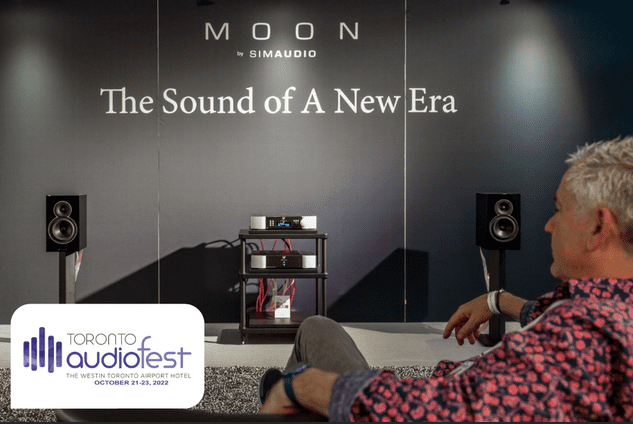
MOON’s award-winning Voice 22 loudspeaker will make its first North American show performance at this weekend’s Toronto Audiofest. Visitors to the show will be able to discover why MOON’s very first speaker has received such fantastic global acclaim.
The Voice 22 loudspeaker realizes Simaudio’s dream of being able to offer a complete all-MOON music system with its very own voice. The new speaker delivers the renowned rich and natural signature MOON sound with a precise clarity that will delight any music lover.
At Toronto Audiofest, a pair of Voice 22 speakers will be partnered with a MOON 330A power amplifier and a MOON 390 network player/preamplifier. The 330A delivers natural and accurate tones as well as a tight, extended and superbly authoritative bass with power, weight, and articulation. The 390 is the gateway to great sound and offers a complete high-end listening solution featuring a DAC, preamplifier, headphone amplifier, phono stage and network streaming capability. The combination of the 330A and 390 provides a complete and satisfying musical performance and the Voice 22 loudspeakers let every note be heard exactly as MOON’s audio designers intended.
The MOON team will be running demonstrations of this superior system on each day of the show. Visitors will be able to sit back, relax and enjoy as the Voice 22, 330A and 390 combine to deliver an unforgettable listening experience.
Etienne Gautier, MOON export sales and marketing manager, said, ‘The new Voice 22 loudspeaker was extremely popular when it made its debut at the High-End Show in Munich earlier this year. We are delighted to now be able to demonstrate its award-winning abilities at a North American show for the very first time.’
Toronto Audiofest will take place at the Westin Toronto Airport hotel from the 21st to 23rd October.
MOON will be in the Lounge room.
For more information, click here.
Apple AirPods Pro 2 have several pros and a few cons
Nextscreen, LLC CEO Tom Martin reviews the Apple AirPods Pro 2, the latest ear buds from the Cupertino company.
Tom discusses the problems faced by most Bluetooth earbuds and if the new AirPods can compensate, but ultimately answers the question, “Are Apple AirPods Pro 2 suitable for high quality music?”
Watch the video below to see the entire review.
You can see this video and more on the Hi-Fi+ YouTube Channel, such as Tea Time with Alan and Pete.
Hi-Fi+ Editor Alan Sircom and Publisher Pete Collingwood-Trewin talk about what’s happening in the high-end audio world.
Tea Time with Alan and Pete is just one of several new series on the Hi-Fi+ YouTube channel designed for audiophiles of all levels.
Another series is History of Audio, which aims to teach viewers a little about the History of Audio, which might be a trip down memory lane for many. It also hopes those who watch will learn from the varying experiences of other audiophiles through their trials and tribulations with different equipment.
While you’re on our YouTube channel, be sure to check out our Audio Basics series. So far, this series has covered what makes a great stereo system and how to find a great stereo system.
Soon, you can find reports from manufacturers at audio shows from around the world. You can see the likes of Aurender, Focal Naim, AudioThesis, Schiit Audio, and Magnepan, just to name a few. Right now, you can see what debuted at AXPONA 2022 and a bit from the Texas Audio Roundup, including background on the Magnepan LRS+. You can also see videos from Pacific Audio Fest in Seattle, CEDIA 2022 in Dallas, and you’ll see reports from Capital Audio Fest coming next month.
You can also see additional product reviews as well as more from CEDIA Expo 2022 in Dallas on the hi-fi+ YouTube channel coming soon.
Be sure to subscribe to the YouTube channel so you don’t miss any episodes!
Click to go back to homepage.
The Hanseatic League was a form of proto–European Union that started in the mid fourteenth century and lasted for over 300 years (I wonder if the current one will last as long). It was formed by cities in Germany and around the Baltic Sea and stretched from Bruges right round to Turku in Finland and Bergen in Norway and created for trading purposes; the cities involved have remained wealthy to this day. One of them is Riga in Latvia and this is where loudspeaker maker Aretai is based.
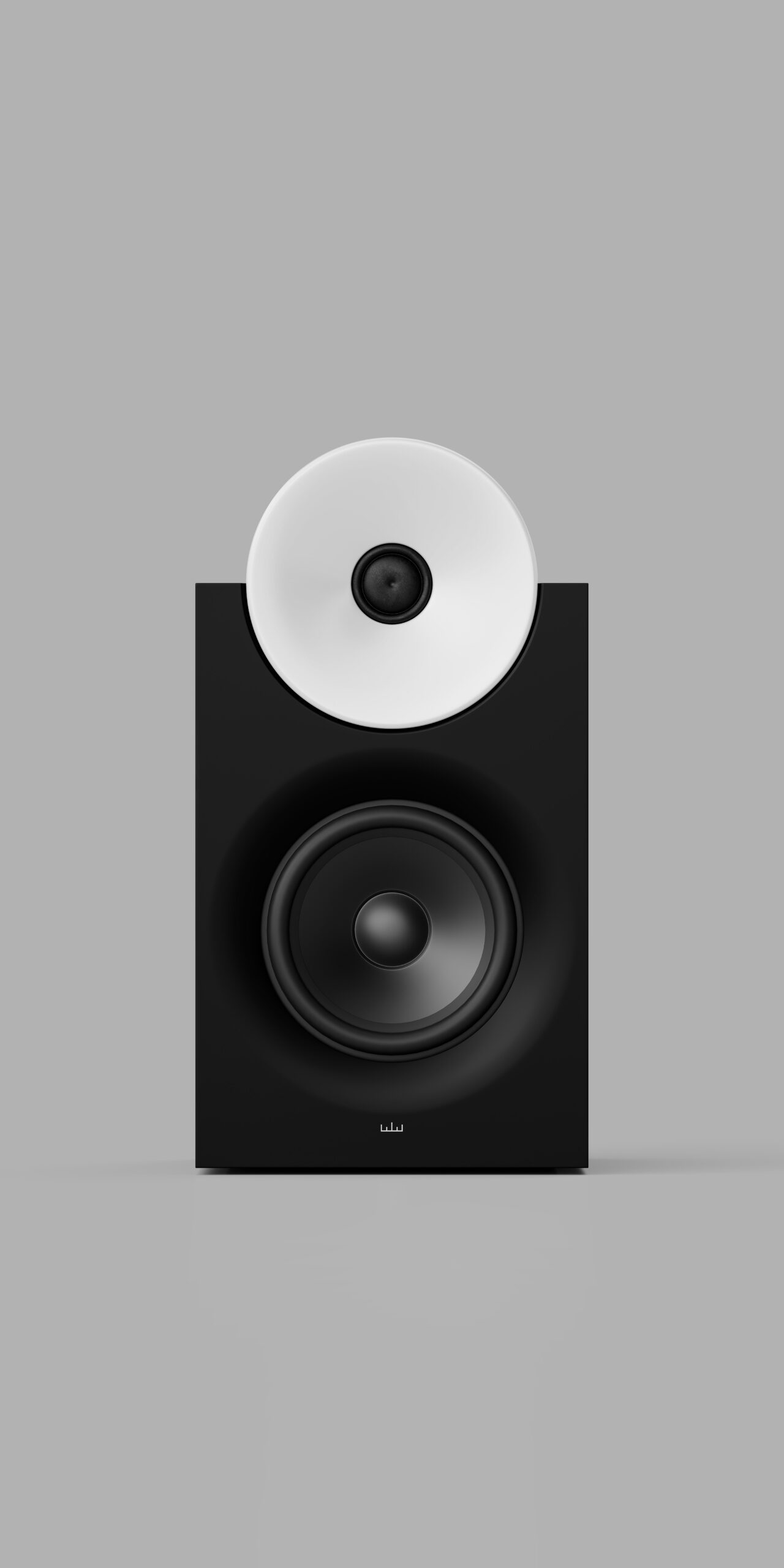
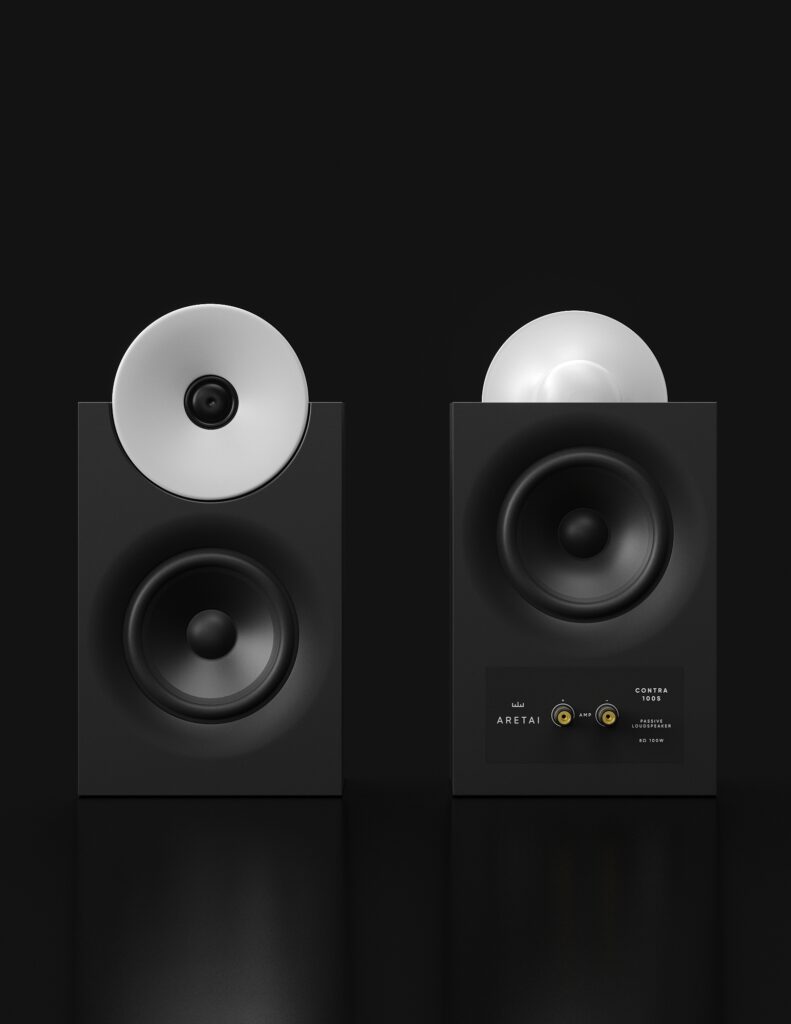
The Contra 100S is Aretai’s only bookshelf speaker and the entry-level model in a three-strong range where all the models are distinguished by a white tweeter horn sitting on top of a contrasting black cabinet. On the Contra 100S, this horn is 157mm (about six inches) in diameter and the way it’s built into the top of the otherwise rectilinear cabinet is particularly well done. It looks as though there is a channel carved out of the flat top of the box in which the back of the horn sits; a job that would have been easier to achieve by cutting the cylindrical horn body in half and placing it atop the box. But this is why when you glance at the price and size of this speaker it looks a little ‘spendy’, but the detailing is perfect across the board and some of the details are not immediately apparent.
The first thing you spot when looking around it is that there is another driver on the back which is identical to the front firing cone. It turns out that this is the bass driver in a two-and-a-half-way sealed box design. Both drivers sit in a shallow horn achieved by machining the MDF if that’s what it is, the Aretai website is rather scant on detail for such a detail obsessed company. The company must be ‘young’ because there’s more info on social media and thankfully the distributor Val Hi-Fi has the specs to hand.
The Contra 100S has a built-in plinth that angles the cabinet upwards but is separated by a vibration decoupling pad that provides a degree of isolation from whatever surface it sits on. This could be a speaker stand or a desktop according to Aretai who would probably like to get this speaker into studios among other places but show them on a (presumably) quite large desk in some of their literature.
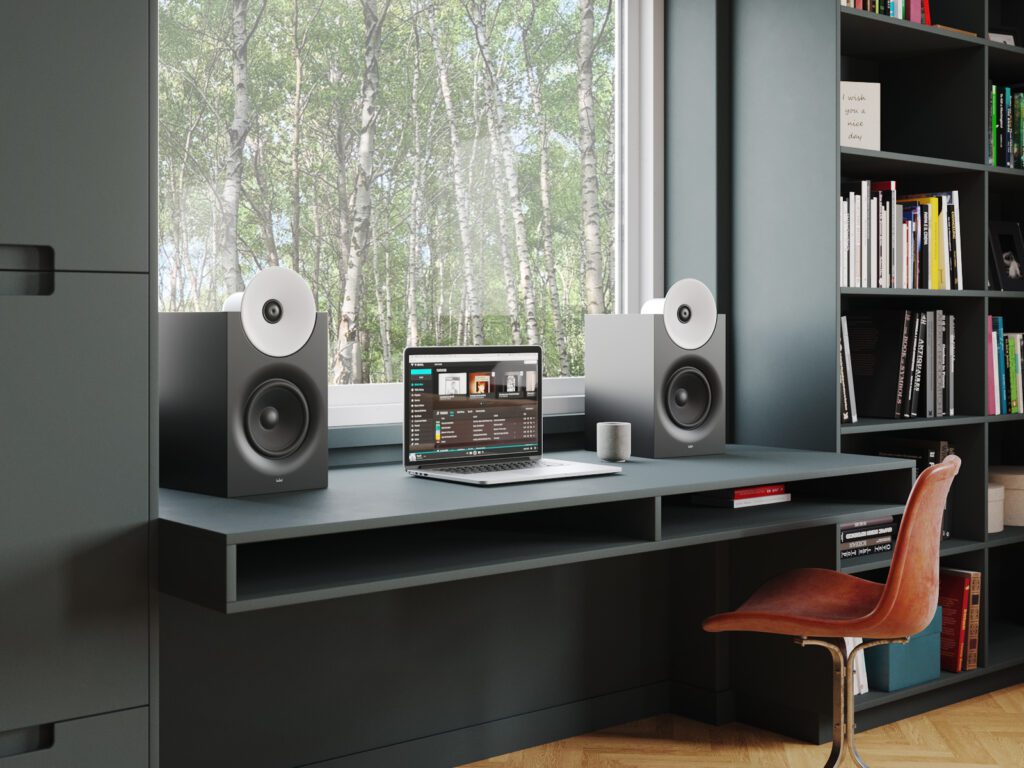
The horn that surrounds the tweeter was developed to aid dispersion and increase sensitivity but is shallow to avoid the negative characteristics found with some conventional horns, such as beaming and a cuppiness. The tweeter itself is a large ring radiator type that could theoretically be used down to around 2.5kHz but Aretai founder/designer Jānis Irbe has put the crossover point much higher at around 6kHz. He has however allowed tweeter and the mid/bass unit below it to roll off gently so that there is more overlap between the two than usual. The mid/bass and bass drivers are six inches in diameter and run polypropylene cones, I’m told that they were selected for their “extremely low THD and IMD distortion values and very smooth breakup characteristics”.
Jānis’ background is in IT, but he clearly has had the hi-fi bug for a long time and spent seven years researching the ‘virtues’ of the perfect loudspeaker before launching the company in 2018. The name comes from Aretaic theory, which argues that laws should be created that bring out human virtues. This seems like a good idea if a bit challenging to execute effectively.
Jānis has come up with a (figurative and literal) sound concept to encompass what he is trying to achieve with Aretai, and this includes purity of sound and minimal yet expressive design where sound follows form, room energising sound at that. He agrees with PMC and others when it comes to direct and indirect sound, since both need to be the same if the sum that you hear is to be coherent. That is the sound that hits the room boundaries before it gets to your ears should have the same balance as that which has a direct path. Another laudable point that Jānis makes is that Aretai products are sustainable; making them largely out of wood goes a good way toward that goal, as does the use of purely cardboard packaging.
The overall sensitivity of the Contra 100S is 85dB with a four Ohm impedance so it’s not the most efficient of designs, but Jānis says that good results can be had with a range of amplifiers including single ended triodes, although solid-state amps will naturally get the best bass performance from them. The cable terminals are high quality single wire types as standard, but the option exists to have tri-wire terminals for those looking for maximum control.
There are various finish options too including veneer in matte or gloss finish, but the black paint finish contrasts particularly well with the white horn.
UK distributor Greg Chapman of VAL Hi-Fi brought the Contra 100S over with a pair of Solid Steel SS-5 three-legged stands which he said are a little short for my listening position, but he likes the way the speakers sound on them. Listening started with the Aretai being driven by a Moor Amps Angel 6 power amplifier with the speakers placed about a foot from the wall which worked well for the mid and treble, but the bass was a little boxy on some tracks. That said Joni Mitchell’s voice sounded rather good on ‘The Man I Love’ and the bass on Kraftwerk’s ‘Radioactivity’ had more gravitas than expected for a box of this scale, the reverb on the live mix giving real depth to the soundstage. Moving the Aretai closer to the wall meant that the soundstage got bigger, but the bass didn’t really change which was surprising, having an active rear bass driver clearly brings benefits in terms of control. Deadmau5’s ‘Seeya’ was delivered with real spatial precision at high levels without any sense of glare or hardness, a characteristic that was to become more apparent the further the listening went on. Aretai favour pro drivers which are generally designed to cope with higher playback levels without distortion and this certainly came through.

To get more mid and treble from the Contra 100S I put them on some higher 60cm stands from Custom Design, my listening seat is a little higher than average and this stand brought notable improvements in image precision. The scale and depth that the Aretai found on a number of albums was impressive but Brokeback’s Looks at the Bird was particularly good in this respect, with the bass and electric guitars sounding unusually articulate with plenty of low-level detail. Crosby, Stills and Nash’s ‘Helplessly Hoping’ didn’t have as much scale as I expected but this is probably a realistic reflection of the recording whose strength lies in its tonal beauty as much as the quality of performance. Massive Attack’s ‘Man Next Door’ has become a go to for assessing bass extension and power and these relatively compact speakers delivered more weight than most thanks to that active rear bass driver. But it’s the mid and treble that provide the powerful sense of presence in the vocal, something that’s not affected by the deep thump of the drum and the general air of menace that the band managed to capture so effectively.
The bass is also pleasingly tuneful and strong, the Grateful Dead’s ‘Cumberland Blues’ is a fabulous live track, but the bass line frequently gets lost in the organised mayhem that erupts when the singing stops and two guitarists, a pianist and a drummer get busy. It can usually be heard if you make the effort but often gets masked by louder sounds, this was not the case with these black and white beauties, they give you the depth and the power that many other speakers seem unable to find in the recording. This could be because they were a little close to the wall and the bass was reinforced but whatever the reason the result was rather good, especially if you wind up the wick. My chamber music piece of the moment, which has become quite a long moment I realise, is the Engegård Quartet’s take on Haydn’s String Quartets which these speakers reproduced in an attractively natural fashion, placing the musicians behind the cabinets and providing a perspective that was wholly convincing. A more recent recording of the eight strong Locrian Ensemble made by Mike ‘Chasing the Dragon’ Valentine on valve mics in front of the editor and myself was a lot more relaxed and open, getting close to the result we heard in the Henry Wood Hall a couple of weeks earlier. Which given how good it sounded there is an achievement of note.
Again imaging was a highpoint with this piece, these speakers gave a good sense of the scale of the location and likewise of the instruments being played which were modern rather than ‘original’ as is often the case with chamber pieces. Comparing the Aretai with an admittedly more affordable pair of speakers was a bit like contrasting an oil painting with a cartoon. There is a depth of detail that is very agreeable and this is apparent with pretty well any type of music.
I also tried a lower powered amplifier in the form of Rega’s Elex-R integrated, which while a little bit too affordable to be a likely partner for the Aretai does have many excellent qualities and not just for its price. One of them is excellent communication skills which these speakers were more than happy to exploit when Nina Simone is on the turntable, her voice on ‘’Don’t Smoke in Bed’ is perfect, full of feeling and sad beauty. This despite the dual mono nature of this particular version making it sound even older than it is. I played quite a lot of vinyl through a couple of phono stages and the Aretai made it absolutely clear that there were significant differences between them. One being warm and relaxed and the other distinctly more focussed and precise, as ever when presented with two extremes like this the tendency is to want something in between. Such is the odious nature of comparisons.
Playing vinyl through these monochrome speakers was a very enjoyable experience however, Ryley Walker’s ‘I Will Ask You Twice’ being deliciously relaxed, warm and inviting through them, which encouraged further listening of this and many other albums. The acoustic guitars and voice being the standout elements thanks to the effortless nature of the Aretai’s midrange and treble. This is in many ways the key strength of these speakers, their ability to deliver detail, extension and scale in a relaxed fashion from a compact enclosure. It means that they will lay down a banging beat in powerful fashion without becoming aggressive or losing coherence and that live recordings can be reproduced in surprisingly convincing fashion if said recordings are of a high enough calibre. Ryan Adams encourages fans (if he still has any – Ed) to record his concerts in much the same way that the Grateful Dead did, and many of them can be found on the Archive website. One in particular, Live at Das Haus, is exceptional and with a speaker like this fills the room with energy and sound to fabulous effect. It makes you wonder why more official releases aren’t as good.
Aretai has its own take on loudspeaker design and aesthetics. The use of a shallow horn allows the tweeter to deal with higher sound pressures without difficulty and the use of two bass drivers gives what is a fairly compact box more low end fire power than usual. They are a little more tricky to position than average as a result of that rear driver and need more space than similarly sized bookshelf models but the resulting sound is attractively easy on the ear. Combine this with the appealingly post modern styling of the Contra 100S and you have a loudspeaker that’s ready to make its mark in a competitive market.
Aretai
URL: aretai.com
Tel: +371 2922 3823
VAL HiFi
+44(0)333 577 2005
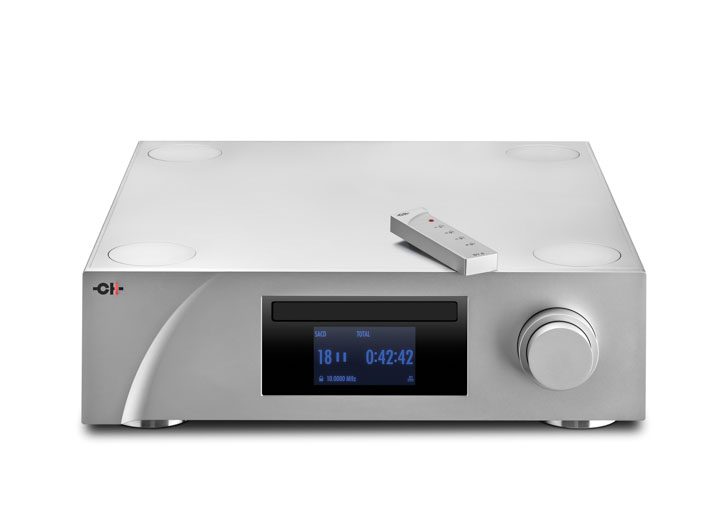
Even by the already ‘husky’ standards of high-end audio, the CH Precision D1.5 is an absolute unit of a CD/SACD player. And yet, the closer you look at the player, the more you realise that none of that heavy build is ‘filler’; it’s a solidly built and designed player, with genuine ‘future proofing’ written into the very fabric of both this player and the company itself.
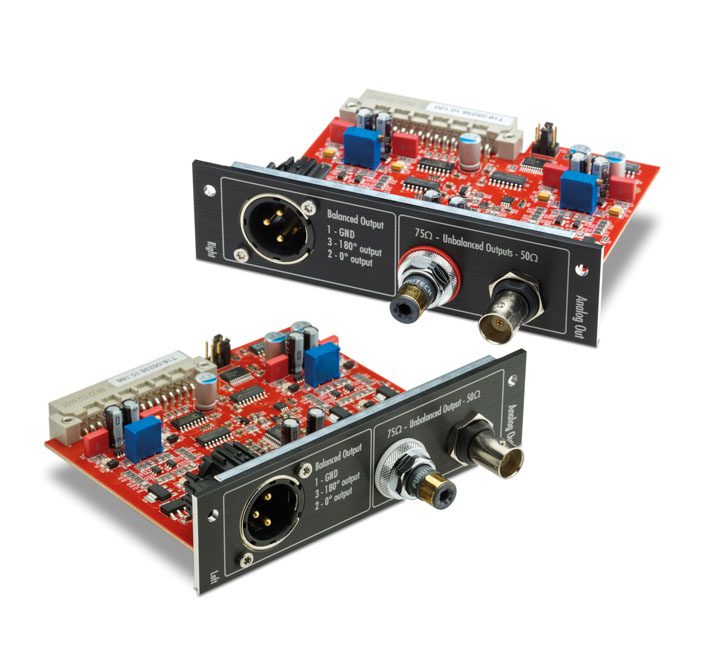
At its core, the D1.5 shares a modular approach common to all CH Precision designs, using a mother/daughter circuit board arrangement. If you cast your mind back to the computer world of the early 2000s (or are a ‘power user’ computer gamer today), the idea of placing every device on one circuit board was a nonsense; graphics, sound, network connections, even connections to external hard-drives and printers were all placed on separate daughter boards, with the main motherboard tasked with the heavy-lifting of memory and processing.
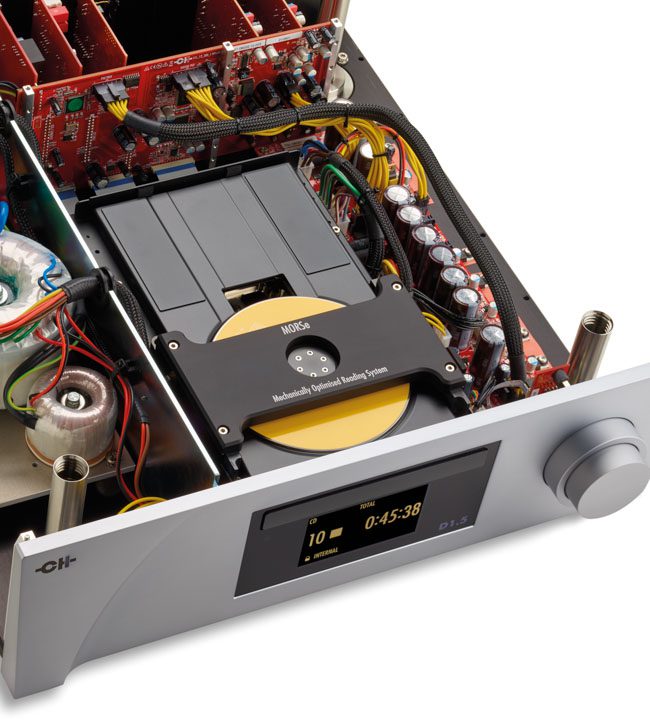
This not only means each subsystem could have its own dedicated processing, but it allows for easy upgrading of those daughter boards should the need arise. Of course, in the computing world where a two-year old motherboard is so old that it might as well use Latin as its assembly language, the idea of upgrading a computer over time is pointless, but when it comes to a digital source device that costs as much as a nice Mercedes, longevity is important and the modular nature of the CH Precision D1.5 guarantees that longevity. This isn’t just an empty statement and might apply as much to the listener as the machine; you can specify the D1.5 purely as a CD/SACD transport, but if later you decide to add analogue outputs and turn it into a player instead (getting MQA on enhanced CD as a bonus) then you can add a pair of dual-mono DAC cards with the twist of a TORX driver. There’s the option to add an X1 external power supply and with the appropriate SYNC-IO board, you can add a T1 Time Reference master clock. If a new digital standard or connection appears, the option cards can be updated to accommodate it. And, if some time in the future, the D1.5 becomes the D1.6, those upgrades are baked into the CH Precision chassis.
Major upgrades will require the player taking a trip to either the local distributor or to Switzerland itself, but periodic firmware upgrades can be applied through a USB thumb drive… I prefer this approach to the potentially hackable online firmware update.
That all being said, owners of the original D1 cannot upgrade to the D1.5. This is because the changes to the transport mechanism are too great to be able to retrofit into the D1’s chassis. But true to CH’s ‘upgradable and expandable’ doctrine, the company offers D1 owners a generous trade-in if they trade-up.
A core part of the CH Precision design is the case itself. Sure, there’s the simple aesthetics of the design, from the power indicator embedded into the ‘CH’ logo, through to the curve of the front panels, the simple two-layer rotary control that does everything and the magnetised small remote handset… it’s all extremely elegant, solid and clean. ‘Clean’ extends to having a front, top and sides in the same smooth brushed finish with no visible screws or vents. Meanwhile, ‘solid’ means a rear panel and baseplate that feel as thick as the front. Finally, ‘elegant’ must include the kit supplied to mount the feet, the clever mounting for those feet, and the potential for stacking CH Precision builds into its units.
It’s 2022 and any review of a digital disc-spinner notionally needs a healthy dose of justification to warrant its existence. This varies from country to country, but many go with the populist ‘CD is dead’ view. However, while there have been significant advances in streaming, CD is still proving extremely popular with collectors and there is even talk of a revival, although to a great many high-enders CD never went away. Perhaps more importantly though, this is not some rehashed relic from the 20th Century; the CH Precision D1.5 adds both SACD and MQA support, as well as being able to adapt its architecture to respond to further disc development. If there is a CD fight back, the D1.5 is the tip of the spear.
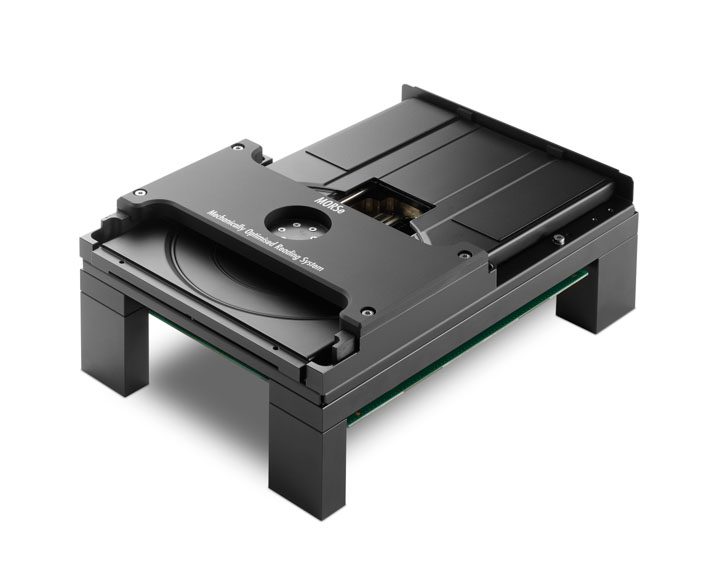
A big part of the reason for the D1.5’s significance in 21st Century top-notch disc-spinning comes down to the transport. That high mass transport mechanism (MORSe to its friends) is a thing of beauty. There are two parts of a transport that are ludicrously expensive to fabricate for a company that isn’t making transports by the millions; the laser eye and the spindle. Technically, a company could even fabricate the spindle if it went a little crazy, but even in the highest of high-end there’s a degree of pragmatism that holds when facing vast tooling costs to make something that is already well-designed and engineered elsewhere. The laser eye… well, that’s simply outside of the wheelhouse of almost all companies in the audio world. In making its transport mech, CH Precision used the spindle-housing and laser eye from top-end Denon/Marantz CD/SACD players and engineered the rest. In other words, this is a massively engineered, 3kg transport mechanism that uses two parts from another company’s CD/SACD sled. The cynics in audio – of which there are many – will doubtless claim this means the D1.5 ‘is built around a Denon or a Marantz’ but that’s like saying a gin and tonic that’s in the same room as a bottle of vermouth is a martini!
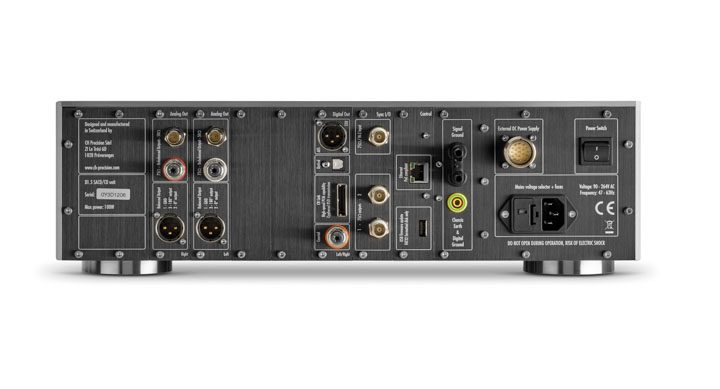
While the CH Precision D1.5 won’t accept a streamed audio input, the Ethernet socket on the back enables owners to run a complete, networked CH system via their excellent Android-only app. Around about now, the iDevice Police will get jolly batey, but buying a dedicated Android tablet (or similar) to act as a remote handset is no big deal. Especially as I’m pretty sure most dealers will include one as a deal sweetener. Load up Roon and Qobuz et voila, a dedicated tablet for all your audio system requirements.
The DAC chip in the D1.5 is a WM8742 delta-sigma design by the Wolfson arm of Cirrus Logic. However, CH Precision only uses the conversion stage of the chip, primarily because this stage can process datastreams at DXD rates. Sample-rate conversion, MQA decoding, CD upsampling and filtration are all performed within the DSP daughter board, using programming from CH’s own codesmiths and their ‘PEtER’ filtration algorithms. This interpolation filter uses a form of polynomial known as a ‘spline’ that significantly reduces pre- and post-ringing, thereby limiting time-domain distortion. Digital theory gets a bit ‘Heisenberg Uncertainty Principle’ here, in that you can either have outstanding time-domain or frequency-related performance, but you can’t have both as they are related variables. By using the PEtER spline filter algorithm, CH has chosen ‘time’. The resulting DXD stream is then fed to the core of the WM8742.
The key to getting the most out of the D1.5 is getting it extremely level during set-up. The four large screw-threaded spikes that fit into each corner of the CH Precision D1.5 (and can be used to stack CH Precision devices one atop the other… if your rack is capable of holding that kind of mass) are adjustable and should be used to make a perfect fit. A tip here is to use some lubricant in the threads as they have close to interference fit; this was a tip I discovered after trying to adjust these spikes for levelling. If you use a good lubricant (ask a cyclist, but steer clear of silicone lubricants) levelling allows you to equalise the weight distribution of the D1.5 through some very fine tuning. Skipping this fine set-up won’t destroy or even drastically undermine the performance of the D1.5, but if you want the last and best from a top-end player, both the player and the hole in your bank balance deserve the time spent getting every last iota of performance from the player.
High-end digital audio has two schools of thought; either convergence toward incredibly close compliance to what is effectively the Platonic form of ideal measured performance, or a conscious effort to abandon that goal in favour of a euphonic musical ideal. Both have their merits and downsides; ‘compliance’ is more universal, but can sound a touch sterile, ‘euphonic’ sounds excellent until you play a recording that doesn’t gel with that kind of sound. In general, I think the high-end is trending toward ‘compliance’ designs and has done for some time, but the question then becomes ‘compliant to what’? High-end digital is a broad enough church for there to be multiple ‘right’ answers to this, albeit one ‘right’ will likely fit your listening requirements closer than others. That’s definitely the case here, and despite the potential for digital zealots to grind down their teeth about why one set of ‘excellent’ results are ‘more excellent’ than the others, the CH Precision’s time-domain based performance makes a very strong case for its inclusion in the absolute top-tier of digital audio.
I’ve noticed a change in my listening notes across several products that those rare ‘ne plus ultra’ products. Normally, there might be badly scrawled proto-lines from the review with terrible mixed metaphors (“in terms of dynamic range, it pushes the envelope over the edge”) or Newspeak-esque gnomic information (“bass… double-plus good”). But when it comes to the handful of without parallel products, I find music reviews where there should be descriptions of audio performance. Every time I try to focus on what the product does, my mind draws me toward the music.
This inability to describe the performance of the CH Precision D1.5 without the description purely being a reflection of the music played is telling. It speaks of a digital replay system that actually does what all claim and so few achieve; neutrality. Through the player, I can hear the difference between PCM and SACD files, or between these and their MQA equivalents, but those differences in resolution come across in terms of the music, not the sound it makes. I strongly suspect this comes down to that time-domain approach to musical replay; we are acutely aware of transient response in audio and as this player is directed toward limiting the impact of the digital replay process on transient response, you end up drawn to the music instead of the audio performance.
When you can finally drag yourself away from the music itself, the CH Precision D1.5 acquits itself on all fronts really well and does so irrespective of the type of music or format played. One of my go-to test recordings – Joyce DiDonato [Stella di Napoli, Erato] covers all the ground here. Her vocal range is excellent and beautifully articulate (as always) and unsullied by even the slightest peak or trough in the frequency domain. That ability she has to go from fff to ppp and back again almost within the same breath is powerfully exciting and the D1.5 performs precisely no changes to that dynamic range. The orchestra sits in a perfect sphere behind her, gradually fading into near silence save for plucked bass strings and a lone French horn, all presented in a three-dimensional space that you feel you could walk into. And then the sound has a fluid coherence and grace that is so cat-like, you almost expect Sir David Attenborough to be narrating. However, above all this is always that sense of losing yourself in the music because you are not constrained by the temporal limitations of digital audio.
We’re truly spoiled at the cutting edge of digital audio, and CH Precision D1.5 is very much at that cutting edge. I feel that any review that fully covers what this player does would probably run longer than a Proust novel, so this barely scratches the surface of what the player does and how it does it. Regardless, the sound it produces is so ineffably musical I can’t help but be drawn into listening to the D1.5 every time I walk past it. I just wish we had the vocabulary that matches its sublime performance.
CH Precision
URL: ch-precision.com
Tel: +41 (0)21 701 9040
Ansuz Darkz D2W – Limited Edition release to help celebrate 10-year anniversary
*From the Ansuz Acoustics news release
Ansuz Acoustics is celebrating 10 years of groundbreaking innovations, unrivalled passion for music, and an unwavering scientific curiosity to tap into unchartered realms of audio technology.
10 years ago, Ansuz Acoustics was founded by Lars Kristensen and Michael Børresen. After more than 20 years in the audio cable business, Lars had actually vowed at the time never to enter the cable business again. But when Michael presented Lars with his groundbreaking ideas for audio cables, he was absolutely thrilled with the idea. Both had immediately recognized the potential of these innovative and groundbreaking cables. A short time later, they began developing the necessary production equipment, and eventually, Ansuz Acoustics was born.
They founded Ansuz out of a desire to produce cables that would make the music sound much more natural and authentic. Both Michael and Lars felt that conventional cables when connected to an audio system did not let all the music through and compressed the sound. Through testing and thorough research, they found that induction, poor mechanical stability, and unwanted noise were a big part of the problem. The goal, therefore, was to develop cables and other audio devices that would improve resonance control, reduce unwanted noise, and decrease inductance.
The word Ansuz comes from Nordic mythology and is originally one of Odin’s runes, meaning wisdom. For Ansuz Acoustics, the meaning of the word wisdom implies the knowledge one possesses, but also the curiosity and quest to gain new knowledge and thereby become even wiser.
Over 100 years ago, Dane Peter L. Jensen built one of the world’s first loudspeakers, laying the foundation for decades of Danish dominance in sound and audio. Since then, Denmark has had a proud tradition of producing the highest quality audio and hi-fi equipment. This is based on years of experience that has led to a great wealth of knowledge in the field of design and production of audio equipment in Denmark.
Since Lars Kristensen and Michael Børresen have spent a large part of their lives in the Danish audio and hi-fi industry, they are very familiar with the Danish design and development culture of audio equipment. Both are curious by nature and therefore always seek new insights to become even better when it comes to designing and developing innovative audio equipment.
This boundless inquisitiveness to gain new knowledge and wisdom that Lars and Michael posses has always been the driving force for Ansuz, since the company was founded 10 years ago. Their quest to open up new areas of audio technology by gaining new insights into materials science and unlocking the potentials of innovative electronics is a fundamental element of both Ansuz’s philosophy and vision. A philosophy and vision that aims to bring music closer to people by creating access to great, authentic and emotional musical experiences.
“If you are curious and really want to know what is going on, it is impossible not to develop. Developing a product is the foundation for 10 new ideas.” (Michael Børresen)
Since Ansuz’s beginnings 10 years ago, our philosophy has been reflected in the way we develop and manufacture our products. The development process of a new product also provides the basis for further, new and deeper insights, and is thus the source for more new ideas for future projects. This has led to the
development of many products, ranging from a very wide selection of different types of audio cables to a wide range of noise reduction tools and resonance control devices. However, the basic idea, philosophy and vision of Ansuz are the same today as they were 10 years ago, and it is exactly the same motivation, philosophy and vision that inspire our sister companies Aavik and Børresen.
“The basic idea of Ansuz, from the beginning to where we are today, is the same. But the small details that matter are much clearer to us” (Michael Børresen).
Over the past 10 years, Ansuz has grown continuously, both in terms of production capacity and scope of new product developments. The number of employees has steadily increased and now exceeds 30.
As of 2019, Ansuz Acoustics has established its new headquarters in Aalborg, Denmark, together with Aavik Acoustics and Børresen Acoustics. This is also where our production facilities, R&D department, test labs and business administration are located. Ansuz has several audio showrooms on the site, where we present and demonstrate our products to customers, partners and hi-fi enthusiasts from the region and around the world.
Over the past 10 years, Ansuz has continuously expanded its dealer network to be able to offer our audio products in large parts of the world. This allows us to share our enthusiasm for outstanding and authentic music experiences with more people across borders and cultures.
At the end of 2020, Audio Group Denmark was established as the umbrella company for Ansuz-, Aavik- and Børresen Acoustics to strengthen all three brands. We have learned that the technological development and innovation that takes place in the product development of each of our three brands, Ansuz, Aavik and Børresen, can often be leveraged across brands.
Our goal for the future is to continue Ansuz’s growth trajectory and to keep redefining the existing boundaries in audio technology. This is because we firmly believe that in our quest to unlock the full acoustic potential of music, we have so far only scratched the surface. Beneath this surface still lies a vast, as yet unexplored territory just waiting to be discovered for the benefit of outstanding musical authenticity. Doing this defines the essence of Ansuz: gaining new knowledge and implementing that knowledge into audio devices to bring people closer to music that sounds absolutely natural and authentic.
“We feel, Michael and I, that we have only scratched the surface of what we can do. And that’s a nice feeling” (Lars Kristensen).
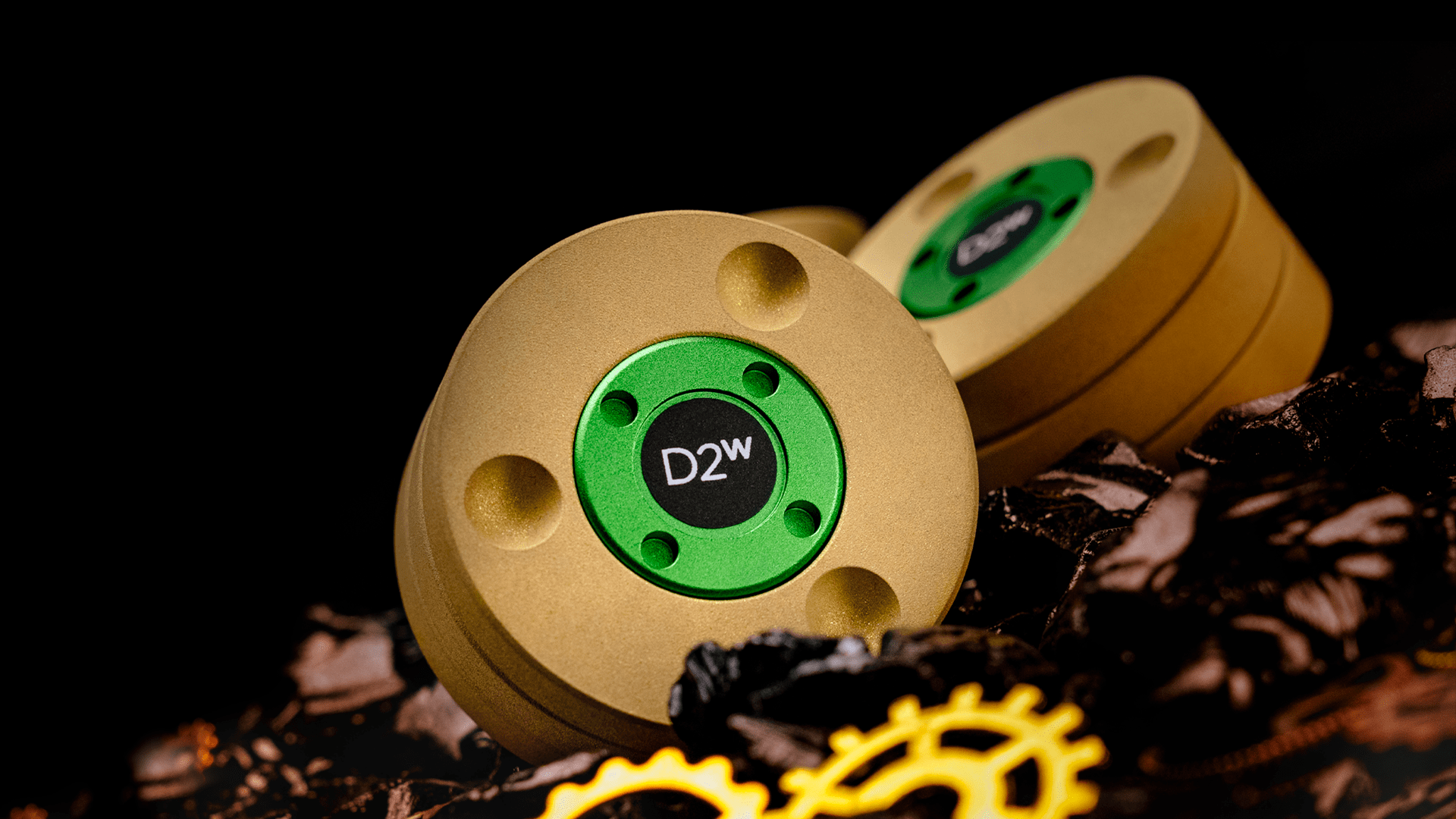
To celebrate the 10th anniversary of Ansuz, we have developed a limited edition of a special Ansuz Darkz. The Darkz is one of Ansuz’s absolute best-selling audio products and represents the essence of Ansuz’s product development philosophy in terms of resonance control.
The Ansuz Darkz consists of 3 discs. Each of the top two discs floats on three balls for excellent handling and absorption of sound vibrations. Ansuz Darkz absorb vibrations that are not directly related to the signal
path. The absorption results in audible vibration feedback that affects the sound quality. It is the natural and authentic sound that Ansuz Darkz resonance control devices are designed to preserve. There is no change to the authentic sound reproduction that often makes the sound seem unnaturally cold and harsh when conventional grounding materials are used.
This limited edition Anniversary Darkz includes both an exclusive selection of materials not yet used in our current Darkz variants, as well as a unique look that visually sets this Darkz apart from the other variants.
The Ansuz Darkz D2W anniversary limited edition features a range of exclusive materials to provide the listener with an enjoyable musical experience with the highest level of sonic precision. The three discs of the Darkz are acoustically optimized with a unique coating of zirconium and tungsten – followed by an exclusive layer of zirconium nitride. Finally, the interlayer balls are made of tungsten, a premium material in terms of stability and resonance control. These tungsten interlayer balls are normally only used in our top-of-the-line Darkz model, the Ansuz Darkz Z2 Signature, but have been added to this limited edition anniversary model to make it even more unique.
The discs of the Anniversary Darkz are further acoustically optimized by the Ansuz anniversary coating. This coating is applied to the discs in a Hi-PIMS (High Power Impulse Magnetron Sputtering) machine to create the finest and most uniform layer of zirconium and tungsten, followed by a layer of zirconium nitride.
In selecting the material composition and dimensions of the Anniversary Darkz, Ansuz was guided solely by its core philosophy, which is to always strive for the ultimate in sound quality.
“We strive to put our customers in a situation where they have that magical smile on their face” (Lars Kristensen).
Join us in celebrating Ansuz 10th anniversary and contact one of our Ansuz dealers or contact us at [email protected] – we would be delighted to arrange a personal appointment for an Anniversary Darkz auditioning for you. Find out what this unique Ansuz Darkz can do to unleash the full acoustic potential of your Hi-fi system.
Products that aim to mitigate the sonic damage being done to audio reproduction by electromagnetic and radio frequency interference are common. Not least because the latter is a higher frequency version of the former. However, there is a third corrupting influence that is less frequently addressed. It is microphony. Quiescent is one of the few brands attempting to reduce EMI, RFI and microphony.
If we leave aside micro-tremors from the earth’s crust and from traffic, microphony in our audio systems has the same primary source; the speakers. The acoustic energy from them modulates ambient air pressure against our eardrums, but it also vibrates our audio system too. Inside most speaker cabinets, the crossover is bombarded by energy from the rear of the speaker drivers. Meanwhile circuit boards in system components such as amplifiers are effectively palpated by the modulated air in the room.
Those who paid attention at school will recall that physical energy applied to a conducting material is converted to electrical energy. During normal playback, our systems are processing not just the musical signal that we want to hear but, electrical artefacts that we don’t want to hear. These travel back down the speaker cables to the amplifier, and propagate from discrete components such as capacitors in system separates. They become particularly audible when contending fundamentals or harmonics beat against each other to produce intermodulation distortion, typically heard as ringing.
Even if our audio system is powered through a filter or regenerator, and even if we turn off everything electrical in the house and listen through headphones, we still cannot escape radiated electrical energy and microphony. Audio separates, in particular digital devices, and some discrete components too, are themselves active emitters even when simply passing an audio signal. Once EMI, RFI and microphony have entered the signal chain our costly wires simply perform as conduits for the unwanted noise.
Quiescent has been ploughing something of a lone furrow in its focus on EMI, RFI and microphony mitigation, and in particular on both prevention and removal. The company’s approach is two-part: speaker, interconnect and mains cable designs that resist mechanical excitation and which absorb EMI/RFI, plus passive devices — the company calls them Couplers and Modules — that drain microphony, EMI and RFI. Quiescent is patenting globally the technology used in a new generation of Couplers and Modules, and invited this publication to be the first to try them.
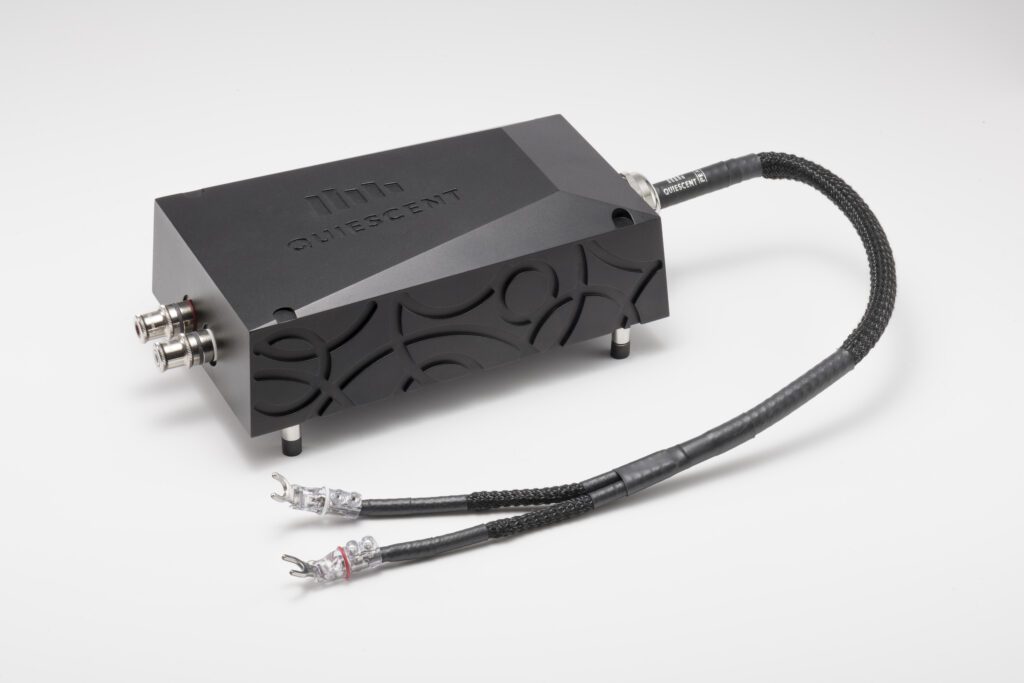
The Apex Speaker Module is a block of black anodised aluminium, machined from billet, with no parallel faces and an acoustically disruptive milled pattern on the outside. It is about the size of a house brick, but weighs rather more at some 4.5 kg. Two continuous lengths of solid silver conductor wire run internally, starting at a pair of silver WBT binding posts and emerging at the other end as a length of captive speaker cable terminated in silver WBT bananas or spades. The first generation Module clamps the naked conductors between two halves of a multi-directional, multi-length labyrinth formed of ceramic. Designed to present a virtual black hole to acoustic energy, the labyrinth prevents transmission either from the speaker to the amplifier or vice versa. The module also contains a passive electrical network to burn off radiated RFI.
I tried this early version of the Module in 2018, sceptical in the extreme, but in my system, with two types of amplification and three different speakers, the noise floor was lowered, tonal density and timing cues were enhanced, dynamic energy increased and sound-staging improved. I bought the review pair and for over two years they were a key element in my system, allowing me to hear more deeply into recordings, and to discern more clearly how review kit performed.
Quiescent’s revised Peak Speaker Module has the same form-factor and operational principle as before, but the labyrinth is now made from a composite of granite, ceramic and a high-carbon polymer, the latter material being the subject of the in-process patenting. The company is opaque about the ratios of the three elements, and over what bandwidth the new Module works, except to assert that it is effective on microphony over a wider range than before, and that the carbon polymer increases the bandwidth over which unwanted electro-magnetic energy is absorbed.
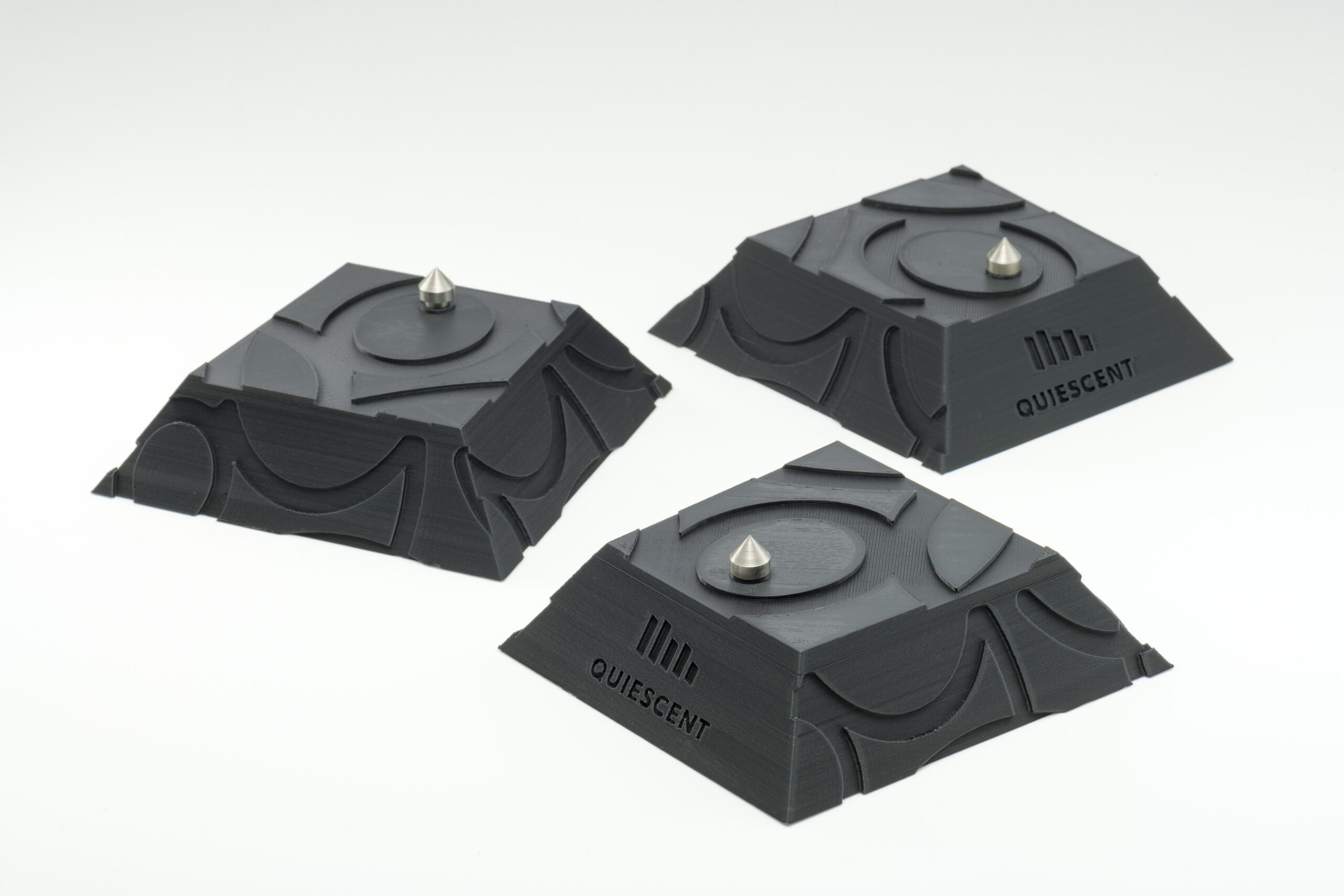
The new Apex 40 Couplers are not footers or supports as we might understand the terms, but 3D printed shallow boxes, overall a little less than the size of two packets of playing cards laid side by side. Like the Modules their exterior is irregular with a deep acoustically disruptive pattern. They contain the same tri-material and a passive RFI absorbing network. A sharply pointed electrode on top allows the Couplers to drain acoustic vibration that would otherwise cause microphony, and to terminate radiated electrical energy.
Meanwhile, the Peak Speaker Modules were compared back-to-back with the previous model in my review system, placed between a Bryston 4B Cubed stereo amplifier and PMC MB2se speakers. They brought a far-from-subtle further lowering of the noise floor, the increase in dynamic headroom partnered by greater tonal density, and better focused spatial detail. Improved intermodulation suppression tamed piano recordings that had previously been teetering on the edge of offensively bright and ringy, while excessively sibilant voices were calmed. Bass weight and definition also increased – a finding that Quiescent says results from even more unwanted artefacts being stripped from the signal chain leaving the amplification with less work to do.
The company says the Apex Couplers should be placed under a component either side of the power supply with the third opposing, like a tripod. A firm press from above on the review system DAC enabled the Couplers to make electrical contact with the chassis, and there was an immediate reduction in background hash, stridency and hissy sibilance.
Further sets of Couplers were then added in turn under other components. The sonic gains were cumulative, particularly striking with the CD transport, DAC, pre-amplifier and phono stage, slightly less so, but still very worthwhile, with the power amplifier and turntable power supply.
Fully equipped with Couplers and the Speaker Modules, the review system, no slouch before, was transformed in every dimension, delivering greater dynamic agility and power, tonal density and timing cues; in all posting a quite remarkable cumulative uplift in performance that most listeners familiar with the system put in the order of 50%.
Improvements in perceived timing were particularly noted, there being a greater immediacy and drive that made complex, multilayered and polyrhythmic programme easier to listen to and appreciate. It reminded me of my ‘yikes, this is closer to live’ epiphany on first hearing a pair of Kii Three speakers, phase-correct right across the audio band and thus able to deliver more of the you-are-there experience. There’s no suggestion of equivalence here; but by doing what they do do, the Modules and Couplers brought about a very obvious reduction in the degree of damage being done to phase by the review system’s non-DSP disk-to-speaker audio chain.
The elephant in the room is of course cost. Using the Quiescent products in even a simple system is not for the faint of heart or shallow of wallet. It would take particular bravery to put a pair of £4,500 Modules with £1,000 floor standing speakers. Would the result be at least £5,500 worth of sonic value?
However, in the context of the total RRP of the review system, the cost/benefit ratio of the Quiescent products can, in my view, be easily be justified; does it need to be said that a 50% gain in sonic quality is not trivial?
The most likely explanation for Quiescent’s shyness over measurements is not that it hasn’t done any — come on, of course it has — but, probably correctly, the company understands that expensive products like these are not bought by customers on the basis of metrics, but of audition. And that is the market model that Quiescent is now returning to after a three year dalliance with direct selling. Dealers who will carry demo stock and facilitate no-risk in-home evaluation are being appointed across the UK.
Quiescent
URL: quiescent.co.uk
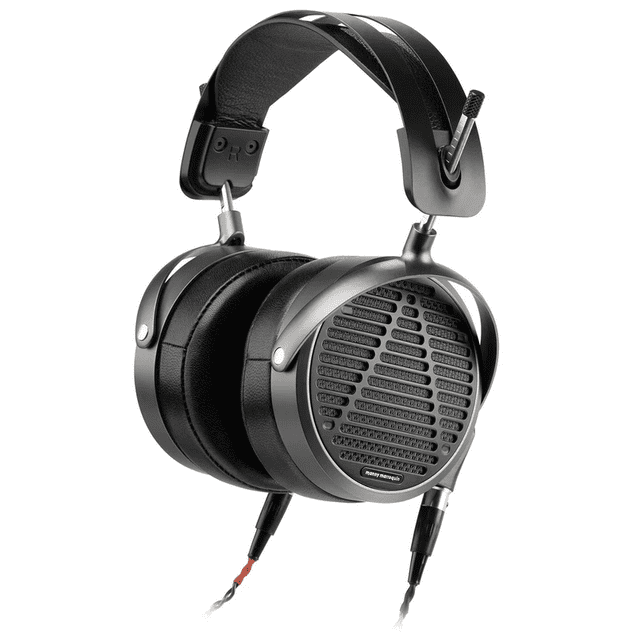
Audeze MM-500 headphones are now shipping.
*From the Audeze news release
Now’s the time to hear the headphone that audio professionals around the world are buzzing about, the Audeze MM-500.
Every week, more top pros are discovering how the accuracy of the MM-500 makes their workflows more efficient.
Created in collaboration with 11-time Grammy-winner Manny Marroquin, the MM-500 is built to deliver studio-quality sound wherever you work.
Engineered and made in California to the highest levels of fit and finish, the MM-500 offers quality and comfort that will last. Order yours today.
For more information, click here.
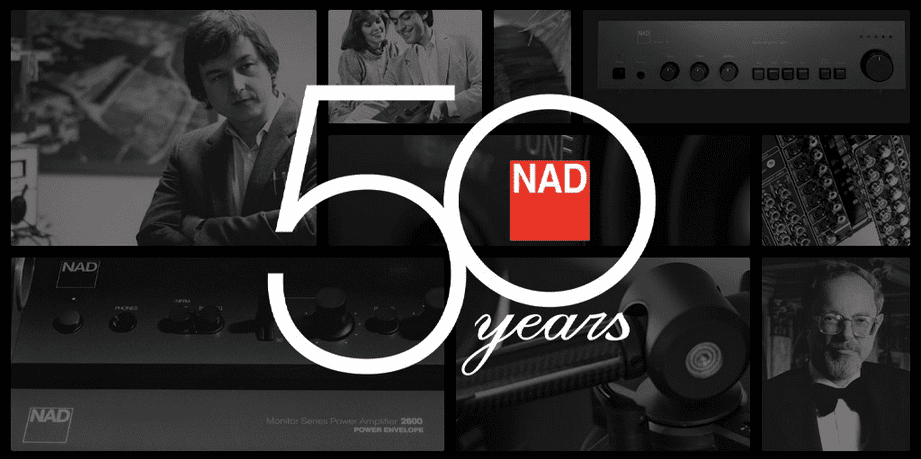
NAD Electronics, the iconic hi-fi audio brand, commemorates its founding in 1972 with a limited-edition product and virtual and in-person events through the remainder of 2022 and into 2023
*From the NAD Electronics news release
OCTOBER 18, 2022, PICKERING, CANADA – NAD Electronics, the highly regarded manufacturer of high-value, high-performance audio components, is celebrating the 50th anniversary of its founding in 1972. The brand will mark the milestone with a series of virtual and in-person events, as well as the launch of a vintage-inspired limited edition integrated amplifier, starting in October 2022 and rounding off around the Munich Hi-Fi Show in May 2023.
Over the past 50 years, NAD Electronics has been celebrated for its commitment to producing award-winning and future-oriented and high-performance electronic components that include amplifiers, source products such as turntables, CD and cassette players and more recently, streamers and A/V receivers – all while bringing music lovers and hi-fi enthusiasts enormous value and truth in their specifications. The brand became a household name in hi-fi with the success of the 3020 integrated amplifier, which over time became the highest-selling budget amplifier in history, achieving the feat by astounding hi-fi enthusiasts with its dynamic power despite its modest 20 watts per channel rating, and exciting music lovers with its detail and clarity at an affordable price point. In so doing, NAD ushered in a completely new generation of hi-fi customers and drove the creation of a strong foundation for the continued growth of the industry.
In the decades since, the brand has pioneered many amplification technologies, including its ground-breaking work to perfect class A/B and class G amplification, class D digital and hybrid digital amplification, and the introduction of early protocols for network streaming for audio. Throughout, NAD Electronics has championed truth in specifications, creating its own Full Disclosure Power standard that rates amplifier power based on real-world listening scenarios versus laboratory conditions, which sometimes put it at a “disadvantage” on the retail floor versus competitors who did not share that same commitment to transparency in measurements.
“Rating power at one frequency, one volume level, using a simplified test load is fine for submitting documentation to regulators but in reality, music impacts our emotions by being complex and dynamic,” says Greg Stidsen, Chief Technology Officer of Lenbrook International, the parent company of NAD Electronics. “It’s easy to create an amplifier that performs well in narrow conditions, but we are music lovers designing products for music lovers, so we rate our amplifiers across the whole frequency band and dynamic range to give our consumers a realistic expectation of amplifier performance for all the music they enjoy. That often meant the power rating on paper of NAD’s products were lower than what our competitors would publish, but our ratings better reflect the full and rich sound that great recordings contain.”
This principled way of designing products comes from deep within the core values of the brand, which include value for money, performance, simplicity, and innovation, and were present from the very beginning with Founder, Marty Borish, and legendary amplifier genius, Bjorn Erik Edvardsen. Both have since passed away – Borish in 2017 and Edvardsen in 2018 – but not before they mentored a global team who now carry on Borish’s market development work and Edvardsen’s innovative approach to technology development. Today, the brand remains one of the most respected and award-winning brands in the hi-fi industry.

The brand kicks off the North American portion of its anniversary activities at Toronto Audio Fest the weekend of October 21-23, 2022, and the European portion at the Paris Audio-Video Show the weekend of November 4-6, 2022. At these shows, NAD will debut a limited-edition anniversary product, the C 3050 LE Stereophonic Amplifier. With only 1972 being manufactured, the retro-look integrated amplifier harkens back to the heyday of hi-fi and incorporates LED illuminated left and right VU metres, as well as a satin walnut veneer wooden case that conceals fully modern features like hi-res multi-room streaming, ability to decode MQA studio master recordings, and Dirac Room Correction via the included BluOS-D MDC2 module, as well as AirPlay 2, two-way aptX HD Bluetooth, and HDMI eARC. Other inputs and outputs include a phono stage and dedicated headphone amplifier. It is powered by the latest version of NAD’s HybridDigital amplifier rated at 100 watts per channel of Full Disclosure Power and features a high-resolution audiophile-grade DAC.
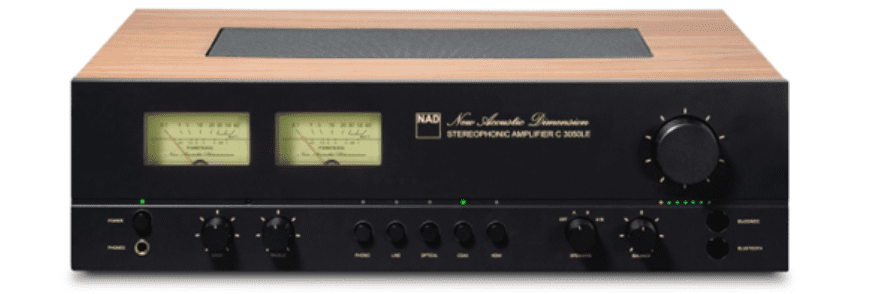
The NAD C 3050 LE will have a suggested retail price of USD $1972, and each unit is uniquely numbered from 1 through 1972 and will come with a certificate of authenticity. These very special and very limited amplifiers will be available at select NAD Electronics retailers around the world starting mid-November, 2022.
“The C 3050 LE is based on a 1974 industrial design of the original 3030 stereophonic amplifier, which in its day, produced 30 watts per channel using a class A/B design and offered audiophiles and music lovers an affordable performance-oriented amplifier option versus its contemporaries,” says Cas Oostvogel, Product Manager for NAD Electronics. “The original 3030 had a matching companion tuner but the C 3050 LE modernizes it as a ‘just add speakers’ product that comes equipped with BluOS, a hi-res multi-room streaming platform, giving music lovers access to thousands of internet radio stations, as well as over 20 music streaming services.”
Also in mid-November, the company will premiere a documentary titled NAD Electronics: 50 Years of Truth in Power, which covers the early days of the brand and its evolution to its position today as a hi-fi innovator. Mixing archival footage and materials with interviews with key personalities associated with the brand, the film takes viewers from its founding through to the launch of the legendary 3020 and the subsequent growing pains brought on by its outstanding growth and success. Its story arc concludes with the brand’s journey as a principled defender of truth in specifications with its Full Disclosure Power standards and staunch belief in ultimate value-for-money for consumers with its Modular Design Construction concept. Produced by 1Project, a Toronto-based media production company, the film runs around 30 minutes and features expert pacing and beautiful cinematography.
“Anything less than a documentary feature film would have short-sold the brand of its influential history, and its fans of key pieces of the story,” says June Ip, Vice President of Marketing for Lenbrook International. “More importantly, it was the only way we could adequately pay tribute to the foundations laid down by Marty Borish and Bjorn Erik Edvardsen, and their passion project that was NAD, and the impact they had on the hi-fi industry over five decades.”
Stretching into 2023, the brand will continue its celebrations in March with the launch of the NAD C 3050 integrated amplifier, the more widely available version of its “LE” sibling. Offered at a lower suggested price point than the limited-edition version, the C 3050 will retail for USD $1299, allowing consumers the choice to upgrade the unit to include BluOS and Dirac via its MDC2 feature for an additional USD $549. The C 3050 LE will be available at all NAD Electronics retailers worldwide. Rated at 100 watts per channel, the C 3050 includes line inputs, HDMI eARC, two-way aptX HD Bluetooth, phono stage, and a dedicated headphone amplifier.
The arrival of the C 3050 will be accompanied by a series of global retail events jointly sponsored by NAD Electronics and its dedicated network of distributors and retailers, kicking off the weekend of March 3-5, 2023, and concluding the weekend of May 18-21, 2023, at the Munich High End Show, where the idea to create NAD Electronics first germinated back in 1972. During this period, NAD retailers around the world will throw open their doors and welcome consumers for unique listening events, as well as exclusive promotional offers, all in celebration of the brand’s 50th anniversary.
“NAD’s success is a result of the dedication to the values the brand was founded on, that Marty & Erik led and mentored us with, and that we have maintained throughout our 50-year history,” says Gordon Simmonds, President and Chief Executive Officer of Lenbrook International. “The mutually profound relationships amongst our present-day team and our global industry partners, together accounts for many hundreds of years of NAD experience, and that means that the multiple generations of hi-fi enthusiasts that form NAD’s fan base continue to benefit from excellent value for performance, without sacrificing the modern conveniences of music enjoyment. This is something few remaining brands can claim and something we are very proud to be able to claim.”
As the various activities for the anniversary are launched, fans of the brand can keep up to date with the details by visiting https://NADelectronics.com/50years.
ABOUT NAD ELECTRONICS
Founded in 1972 and now sold in over 80 countries, NAD Electronics is renowned for its award-winning line of high-quality components for audio, home theatre and custom installation applications. Since the beginning, NAD’s commitment to four core values – innovation, innovation, simplicity, performance, and value – have earned it a cult-like following that catapulted it to becoming a household name amongst audiophiles and music lovers alike. To this day, the brand continues to design and manufacture some of the most acclaimed and affordable hi-fi components that include modern features and technologies meant to appeal to a new generation of audiophiles.
Poland Audio Video Show takes place this weekend.
Hi-fi+ Editor Alan Sircom sits down for a chat with Adam Mokrzycki, who quite literally runs the show: the second largest high end audio show in all of Europe.
Mokrzycki previews the Audio Video Show happening in Warsaw, Poland this weekend.
For more information about the show, follow the link below:
https://audioshow.pl
You can see this video and more on the Hi-Fi+ YouTube Channel, such as Tea Time with Alan and Pete.
Hi-Fi+ Editor Alan Sircom and Publisher Pete Collingwood-Trewin talk about what’s happening in the high-end audio world.
Tea Time with Alan and Pete is just one of several new series on the Hi-Fi+ YouTube channel designed for audiophiles of all levels.
Another series is History of Audio, which aims to teach viewers a little about the History of Audio, which might be a trip down memory lane for many. It also hopes those who watch will learn from the varying experiences of other audiophiles through their trials and tribulations with different equipment.
While you’re on our YouTube channel, be sure to check out our Audio Basics series. So far, this series has covered what makes a great stereo system and how to find a great stereo system.
Soon, you can find reports from manufacturers at audio shows from around the world. You can see the likes of Aurender, Focal Naim, AudioThesis, Schiit Audio, and Magnepan, just to name a few. Right now, you can see what debuted at AXPONA 2022 and a bit from the Texas Audio Roundup, including background on the Magnepan LRS+. You can also see videos from Pacific Audio Fest in Seattle, and soon you can catch videos from CEDIA 2022 in Dallas.
You can also see additional product reviews as well as more from CEDIA Expo 2022 in Dallas on the hi-fi+ YouTube channel coming soon.
Be sure to subscribe to the YouTube channel so you don’t miss any episodes!
Click to go back to homepage.
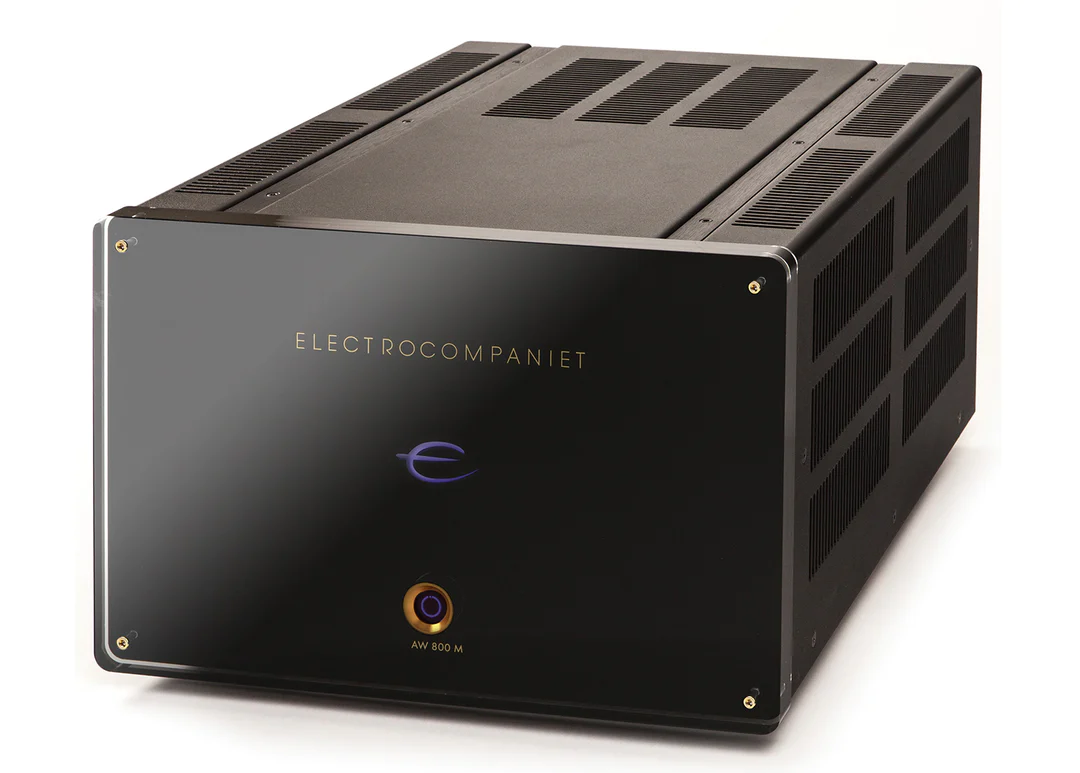
Electrocompaniet AW800M launched as company’s new, flagship power amplifier.
*From the Electrocompaniet news release
Electrocompaniet, the Norwegian manufacturer of HiFi equipment entirely produced in their own factory in Norway, are launching their new flagship power amplifier.
Coinciding with their 50-year anniversary and the 25-year jubilee since the legendary AW600 NEMO was first launched, the new AW800M is set to have a big impact in the marketplace.
The AW800M is Electrocompaniet’s brand new, from the ground up re-engineered flagship power amplifier. The AW800M is an 800 watt into 8 ohms monoblock amplifier, that can also be run in stereo mode, as well as bi-amping mode with the flick of a switch at the back.
The amplifier showcases an updated, yet unmistakable and distinctive Electrocompaniet design that is a perfect match for all current and legacy Electrocompaniet products. With all the changes and improvements made in the AW800M, one thing that has not changed is the unique Electrocompaniet design philosophy and sound signature. The AW800M encompasses the Electrocompaniet direct coupled high open loop bandwidth topology, further enhanced with high slew-rate and very high bandwidth amplifier stages.
In addition, a brand-new output stage is designed that heavily shields the input and driver stages from the load and makes the output extremely stiff and unaffected by the connected load. This has the added benefit of significantly simplifying the workload of the already gently working feedback system and thus provides vanishingly low distortion figures. The output stage incorporates a total of 32 high bandwidth, high current bipolar output transistors that unstrained can deliver very high currents to the load.
To feed the output stage the power supply is heavily updated and now has a total of 210000 uF supply filtering. Mains power input is DC and RF filtered ahead of the wire gauge upgraded, twin toroidal transformers that are magnetically and electrostatically shielded to keep any noise from intruding. The internal ground reference has been vastly over dimensioned and kept fully free of rectifying and output currents. The result is a very clean, noise free output signal regardless of output power, providing a very stable sound stage with the blackest background possible at any sound level.
An intriguing new attribute of the AW800M is the ability to switch between mono, stereo and bi-amping operating modes, enabling you to upgrade your system or change your configuration while retaining your initial investment.
Comfort upgrades are on/off switchable auto power down and switchable feature lighting, as well as trigger input-ouput.
We are confident that from the first note of any familiar recording, you will be captivated by the AW800M and by the musical enjoyment it will give you.
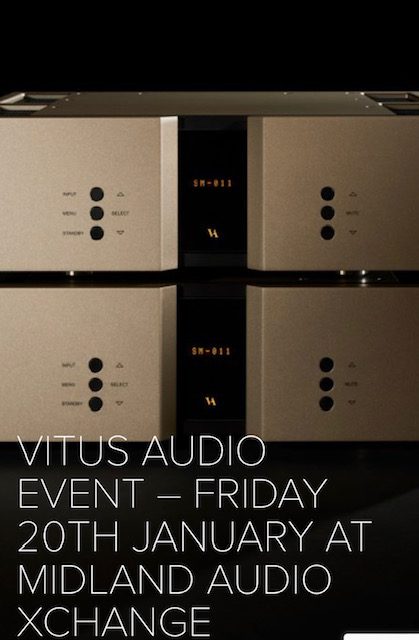
The Vitus Audio Event will be happening in January of next year.
The event takes place on Friday 20th January 2023 at Midland Audio xChange, The Old Chapel, Forge Lane, Belbroughton, DY9 9TD.
Those who want to attend will need to book their places soon.
You can do so by contacting John Roberts from Midland Audio xChange on 01562 731100 or by email to [email protected].
Experts will be present at the event to answer all questions.
This will be a rare opportunity to hear incredible components in a fantastic setting.

Whether you prefer the feel of print or the convenience of digital, hi-fi+ keeps you connected to the world of high-performance audio.