Up to 37% in savings when you subscribe to hi-fi+
hifi-logo-footer

Begin typing your search above and press return to search. Press Esc to cancel.

WIN! A fantastic pair of Final D8000 headphones worth €3,499!!!

We have teamed up with the innovative folks at Final to bring an exciting competition with the chance to win a fantastic pair of D8000 planar magnetic headphones. The Final D8000 were reviewed by Chris Martens in issue 157 of Hi-Fi+. In that review, Chris wrote, “Stated simply, the D8000 combines in roughly equal parts the following qualities: accurate and neutral voicing, high levels of resolution, superb transient agility from top to bottom, finely shaded dynamic contrasts, energetic expressiveness and impact, and— here is the trickiest part of all—remarkable freedom from audible ringing, overshoot, compression, and other forms of sonic ‘gunk’ that might ordinarily cloud the sound.”

Chris Martens also said,“…one challenge some planar magnetic drivers face is diaphragm over-excursion on high amplitude, low frequency bass notes (this typically occurs at the diaphragm’s centre where bass excursions are usually at a maximum). Final addresses this problem partly through its ring-shaped voice coil/diaphragm magnet assembly, but primarily through an ingenious air film damping system (AFDS).”

He concluded by saying, “To be candid, few headphones have captured my attention and musical imagination in the way that Final’s D8000 has. Heartily recommended.”

The Final D8000 is one of the best headphones we have ever heard, irrespective of price. As one lucky winner will discover.

Competition Question

What does the acronym AFDS stand for?

A. Absolute Final Design Scenario

B. Almost Fully Detached Socket

C. Air Film Damping System

To answer, please visit Final’s dedicated competition page at:

http://snext-final.com/en/news/detail/id=592

Alternatively, send your answer on a postcard (including your name, address, and contact details) to:

Final Competition, C/o KS Distribution, 11 Chartwell Business Park, Chartwell Road, Lancing, West Sussex, BN15 8FB, United Kingdom

Competition Rules

The competition will run from April 5th 2018 until June 7th 2018. The competition is open to everyone, but multiple, automated, or bulk entries will be disqualified. The winner will be chosen at random from all valid entries, will be contacted via email (where possible),and their name will be published in the magazine. The Editor’s decision is final and no correspondence will be entered into. Absolute Multimedia (UK) Ltd. is compliant with the Data Protection Act and UK laws apply. Our policy is such that we will not pass on your details to any third party without your prior consent.

Feliks Audio Euforia headphone amplifier

In the vacuum tube audio world, perhaps the most rarefied air is reserved for OTL or ‘output transformerless’) designs. As the name suggests, an OTL design directly couples the output from the tubes/valves to the transducer itself (or at least, to the crossover of the transducer in most cases), avoiding the need for a transformer.

The problem for most OTL designs is that the high output impedance of valves is not a good match for the low impedance of most loudspeakers. This meant banks of valves were required to drive most loudspeakers, and that meant lots of heat, and lots and lots of tube replacements (David Berning’s hybrid Z-OTL circuit being the exception). However, in the personal audio world, where headphone impedances are typically one or two orders of magnitude higher than most loudspeakers, many of these problems simply go away, and the OTL amplifier should be more commonplace. The reason it’s not is the design process requires more knowledge than simple copying. All of which means the Feliks Audio Euforia (made in Lubliniec, Poland) so damn remarkable.

The amplifier is a single-ended OTL design (like I said… headphone impedances make that possible), using two new old stock 6N13S/6AS7G power and a choice of 6SN7 driver tube pairs (typically, the 6SN7 of choice is the Psvane CT181-TII Gold). These are fed by a custom made toroidal power transformer and the circuit features solid-state ripple suppression and rectification, while all the internal wiring is hand-soldered Teflon-coated pure silver cable. The component roll-out is similarly high-spec, with a quality Alps volume pot, and Mundorfs and Nichicons under the hood.

The Euforia is small, if you are used to handling valve amps… light, mostly basic in operation, and very, very well made. The ‘mostly basic’ nature of the amplifier means there is but one stereo RCA input, and a matching line output. There is a power switch next to the inlet on the rear, a central volume control, an indicator light, and a ¼” headphone jack on the front. With one exception, that’s it… no channel switching, balance, or remote control, and no provision for a valve cage: you are on your own recognizance not to burn, cut, or electrocute yourself here, so no amp juggling! It even autobiases, so there is no need for multimeters and no glowing LED indicators to dial out.

The one exception to its basic specification is a rear switch, marked like the track crossing section on a Scalextric track. This is a ‘Cross-Feed’ circuit, which deliberately injects a small amount of low-frequency crosstalk into the two channels. This sounds contra-clever, notionally making stereo imagery less accurate in the process, but in reality, what it seems to do is draw images out from their ‘lateralised’ position inside the front of the listener’s head, and is particularly well-liked both by traditional stereo listeners, and those who listen for hours at a stretch. This is not my first rodeo with cross-talk introduction, as it was briefly popular in the mid-1990s when hold-out vinyl lovers were trying to come to terms with the ‘perfect sound, forever’ of CD. By adding a small amount of low frequency crosstalk to a digital circuit, many would report a more ‘natural’ soundstage and less fatiguing listening. Feliks Audio recognises this is more to do with the listener’s preference than specific recordings, so the Cross-Feed switch is set near to the power button. Experiment, then fit and forget.


Although the Euforia comes on song inside of 15 minutes, the valves need a good 30-50 hours of playing to settle in. They run hot, too, so should you need to replace a valve, you need to give it a good 15 minutes without power for the valve to reach room temperature. As this gives time for the capacitors to discharge, this is a good idea for more than just preventing scorched fingers. However, Feliks Audio tacitly encourages a spot of tube-rolling, by giving you a list of usable substitutes. This is useful in two ways; you can play with the tonal balance to your heart’s content, and if the stock tubes blow and Feliks Audio is temporarily out of replacements, a pair of ECC32, and a pair of 6N5Ps can take the respective places of the driver and power tubes.

The Euforia is snug working with headphones with an impedance between 32Ω and 600Ω and includes a little rider in the English/Polish manual – “including planar magnetics.” Actually, what it should say is “especially planar magnetics” because the two go together brilliantly. Let me temper that… most headphones go well with the Euforia (Feliks say the Euforia is used with models like Audeze’s LCD2, BeyerDynamic’s T1, Focal’s Utopia, Sennheiser HD 800 and HD 800 S, and the ZMF Eikon), but the detail, dynamic range, and absence of background noise the Euforia brings to the table are extremely well suited to the properties inherent to planar magnetics. I used it both with my trusty-but-crusty HiFiMAN HE-500 and the Sennheiser HD 800 S (reviewed on page 14), as well as some more prosaic dynamic monitor-like/ENG designs from Audio Technica, Sennheiser, and Sony.

Those 50 hours pass slowly, because the Euforia gives you glimpses of what is soon to offer but coupled with a sense of veiling and dynamic limitation as the valves grow accustomed to their task in life. Then, the mists clear, and you are presented with… exactly the sound you heard when you heard good audio for the first time. It’s an ear-opening experience, with effortless dynamics, precise sounds within a focused – but not expansive – stereo soundstage (I preferred the Cross-Feed circuit in place), detailed, extended treble, deep, powerful bass, and exceptional ‘disappearing’ clarity to the midrange. Vocals in particular stand out for being just right sounding, and exceptionally articulate.

The amplifier has incredibly low colouration, with just a hint of richness and bloom at the lower end. With most of the headphones I played through the Euforia, this was only really noticeable on instruments like piano, making them sound even richer than they are in reality. On just one pair (the Audio Technica ATH-MSR7), the richness of the bass of the headphone plus the richness of the bass of the amplifier tipped the sound toward too dark a sound, but even here this balance was never less than attractive. On all other headphones I used with the Euforia, it just sounded like the real deal, just more enticing.

The Euforia exposes the lie that valve amplifiers have background noise. If anything, this amplifier is so low noise, it makes solid-state amps sound like they are laden with background hash.


A really good OTL design makes your transducers sound like they are direct-coupled to the music, and that is precisely what the Feliks Audio Euforia does to your headphones. For some, I can see that being too much of a good thing; and they will want an amplifier with more guts, more drive, more volume, and more distortion. OK, at the limits, it goes for refinement rather than edginess, and this might not be my first choice for thrashing out old Guided By Voices albums. On the other hand, the sound of the system with the Euforia in place is so sophisticated and dynamic, I might not want to put those old GBV albums on the playlist; it won’t make ‘Hardcore UFOs’ from Bee Thousand[Scat] sound awful, but the lo-fi quality of the album is not enhanced by being played with refinement. And that’s what the Euforia does so well – make music sound refined.

I can truly say that I’ve loved my time with the Feliks Audio Euforia. It’s not just a neutral performer with a quiet background; it’s just so damn nice to listen through. While it won’t be for those who either want their music raucous and edgy, or those who want more than just the one input, as a solid, no-nonsense headphone amplifier that sounds wonderful and just happens to sport a few valves, it’s hard to think of better at the price, or even double the price. Music sounds honest through this amplifier; even when that music is sharp-edged, the Euforia does its level best to make that sound good. Heartily recommended!

TECHNICAL SPECIFICATIONS

  • Input Impedance: 100 kOhm
  • Frequency response: 8 Hz–75 kHz +/- 3 dB (300 ohm)
  • Power output: 250mW
  • THD: 0.4 % (300 ohm, 20 mW)
  • Supported headphones impedance: 32–600 ohm including planar magnetics
  • Price: €1,999 (including Premium PsVane CV-181 Mk2 “Gold” driver tubes)

Manufactured by: Feliks Audio

URL: feliksaudio.pl

Back to reviews

Read more Feliks Audio reviews here

IsoTek EVO3 Ascension power cord

As makers of power products that reach from the high-value to the high-end, it would be obvious to expect IsoTek to have followed suit with its range of power cords. But, in fact, most of the brand’s power cords have been very much geared toward that value end of the market. Ascension is the first cable from IsoTek to plant its flag on terra audiophilia extremus, although such is the heady wine from that region, a £2,750 price tag for a 2m cable doesn’t seem thatextreme. I mean, you can’t even exchange it for a small car!

IsoTek are playing the purity card with Ascension. It uses a trio of 4mm2high-purity OCC (Ohno Continuous Cast) copper conductors, which are then silver-plated, and encased in a extruded FEP (Fluorinated Ethylene Propylene) with an air dielectric barrier. Each of these assemblies are then matched with FEP/air tubes to act as spacers. This is then wrapped in Mylar, shielded with a similarly high-purity oxygen-free copper braid, and given the deep cryo treatment, down to -196°C. The resultant cable is jacketed in a purple PVC outer and rated at 16A.

EVO3 Ascension’s outer diameter of 17.5mm does limit the kind of connectors used, and IsoTek uses high-quality bespoke devices throughout. It means that finding a two-pin figure of eight ‘Telefunken’ plug might be difficult, but you can get the cable terminated for UK, EU, US, and Australian mains sockets.

A big part of the design of the Ascension cable is what the company calls an “IsoTek VAD Barrier”. The best permittivity (dielectric constant) would be a vacuum, but that is impractical in a power cord (unless you live on a space station), so IsoTek goes for the next best thing; air, or at least as close as you can get to free air inside a cable. By creating a Virtual Air Dielectric, IsoTek claims a dielectric constant of just 1.0548 (air alone is 1.00059 in the same conditions). This is achieved by minimal conductor contact and using FEP to act as a bridge.

My take, however, is the use of solid-core conductors is one of the more important parts of Ascension. OK, so it’s solid-core conductors with all the trimmings (otherwise you get ‘Twin & Earth’ used to hook up your cooker), but solid-core is key to Ascension’s sound.

IsoTek’s EVO3 Ascension faces some stiff competition – literally and figuratively. Once you get past a certain price point, money almost doesn’t matter when it comes to power cords, and a £2,750 power cord might well go up against the really big guns costing £10,000 or more. So, it carries the full load of IsoTek on its back. If it fails to reach the heights of high-end audio, those audiophile enthusiasts might look less favourably upon the company’s power conditioners and filters. But similarly, it needs to represent a tangible upgrade on existing IsoTek cables for the faithful who already own a collection of IsoTek products and want the best of the best.


Ascension scales both those heights and, while it’s not an ‘Odin-killer’, it makes a lot of sense for the absolute top-end of audio performance, both in absolute and relative terms. Let’s start with the easy one. If you have one of IsoTek’s EVO3 power cords, Ascension does a lot more of the same and is the logical ultimate step in the mains lead chain. The only reasons not to buy it are that you can’t afford it or that you have a device with a two-pin Telefunken input, and if you can’t afford it… start saving!

The question is more nuanced for the ‘clean sheet’ buyer, but not by much. EVO3 Ascension brings a hush to your system like an audience preparing for a concert. It’s like the system is running a little quieter, and sounds rise from a quieter, darker background. There’s more going on in the music as a result, especially in those quicksilver microdynamic shifts in level that come with live instruments and good performances. This makes the cable a little more John Zorn than ZZ Top, but where some of the lower IsoTek orders make for a presentation that’s big on staging and sometimes not so good on drive and energy, Ascension brings both strands of musical performance together.

There is a point where Ascension scores over many of the high-end superheroes. This doesn’t overstate the treble in the way some can. A lot of high-end designs have a distinct ‘flavour’ to them, and if you like that sound, you love the cable to the exclusion of all others. Ascension is more even handed than this, in a manner akin to Cardas, but with more leading-edge attack and definition.

Our ‘systematic approach’ to audio is fairly well drummed into most Hi-Fi+writers, and the idea of using power cords from a different family to the interconnects and speaker cables is something close to apostasy. And IsoTek doesn’t make interconnects or speaker cables… it just does power. The thing is, it just does power so well that you can’t help viewing Ascension as a chink in the ‘systematic’ armour. This is a cable of balance and poise, doing all the background-noise-lowering processes we have come to expect from good aftermarket cables, but doing so without grace of favour, or exaggeration of performance. Yes, there are more exuberant sounding power cords and there are more ‘phat’ sounding power cords. There are even power cords that make for a bigger soundstage. But most of them do these things at a cost elsewhere; either elsewhere in the overall performance, or elsewhere in terms of leaving your bank balance lighter to the tune of tens of thousands. IsoTek offers the best balance in that respect.

EVO3 Ascension is not IsoTek’s first cable. Its not even the company’s first ‘real’ cable. But it is ‘born to the purple’; the first cable that will be taken really seriously by audio’s glitterati, who don’t get out of bed for less than £10,000. Highly recommended!

Specifications

IsoTek EVO3 Ascension

Available in UK, EU, US, AU, and CH power plugs, C15 IEC socket only

Price: £2,750/2m cable as tested

Manufactured by: IsoTek Systems:

URL: isoteksystems.com

Distributed in the UK by: Sound Fowndations:

URL: soundfowndations.co.uk

Tel: +44 (0)118 981 4238


Back to reviews

Read more IsoTek Systems reviews here

Meridian Audio Ultra DAC digital converter

Meridian has always had a reputation for thinking outside the box, dating right back to the strikingly original 104 series amps. More recently, Meridian is compatible with MQA, which in case you haven’t heard, rolls a higher bit quantity into the noise floor of an existing CD or streaming service, to get in the phrase used in the BBC spoofW1A– ‘More for less’! The other benefits of MQA, which seem particularly appealing to music producers and musicians is the notion that what the end user hears bit-wise is exactly the same as the recording engineer has signed off on. MQA was started by Meridian’s co-founder, Bob Stuart, but separated from Meridian in 2015 and runs as a distinct business entity. When the MQA light on the receiving MQA compatible DAC goes on, you know you are getting the whole truth and nothing but the truth. There are different levels of unfolding, a standard DAC can get the benefit of the first ‘unfold’, when played from a PC or Mac using the appropriate player – Audirvarna in the case of Mac. However, to release ‘the full Monty’ that MQA has to present, you will need an MQA compatible DAC.

Enter the Meridian Ultra, a £15,000 offering, fresh from the Meridian stable. On seeing this chunky black box, my son asked why the new printer, was sitting next to my valve amp!

The DAC’s array of outputs covers the usual suspects, balanced and unbalanced outputs driven by four 192kHz converters; inputs comprise two BNC, coax, optical, AES, a USB 2.0 input as well as a Ethernet connection for Meridian’s Sooloos system. There’s no analogue input, which means that using the Ultra as a preamp excludes analogue sources.

The power supply is a good old-fashioned linear affair, which normally emits less noise into the surrounding audio eco-system. The front panel has an electrically quiet static dot-matrix display, there are controls for source selection, DSP with a choice of three filters: short, with fewer stages of processing to provide the best time response thereby creating the most accurate soundstage, medium, and long, which has more filters and a steeper response while lessening some of the artefacts caused by pre-echo, said by Meridian to be more musical. The display can be altered from the front panel to show sample rates and other relevant information. An elegant and solid remote control exudes the build quality of the rest of the product, giving comprehensive control of the DAC.

My first curiosity with this particular DAC, is how it sounds when fed with a more standard source than an MQA file. This doesn’t necessarily let the DAC play to its strengths, but gives a real-world picture of its talents.

Listening with the dCS Network Bridge/USB hard disc as a source to the LSO live recording of Brahm’s Second Seranade – last movement, Bernard Haitink and the LSO, it is clear from the get-go that this is a DAC of substance and refinement. The presentation of this fabulously made recording is engaging musically, and has a timbre which is far closer to the mellow than the harsh. The sound of the orchestra is a very beautifully beguiling one, not the last word in analytical detail, but warm and rich. Chocolate cake – sachertorte, not a low-calorie healthy alternative!


The stage is well presented, with plenty of detail, but without being etched. A warm bouncy bass exudes a sense of fun in this gripping saga. Surveying the filter situation, my audio taste-buds were more drawn to the precision and slightly more natural sounds of the short filter, through which the orchestra sounded a little more lithe and real. Compared with the Chord DAVE, there is a slight understatement of the bottom octave of the double basses.

Switching to my MacBook and with the latest download of Audirvarna, as recommended by Meridian, and listening to the same track on hard disc, there is a noticeable fall in the clarity of the recording. The bass is more smudged, the soundstage narrowed, and an audio step backwards. There is a graininess to the sound which isn’t there with the dCS as a transport. Of course the dCS is a class-leading source, and by the standards of other DACs, the Ultra’s USB input is really quite good. My point is that from this example, a good transport can show a laptop a clean pair of heels.

So going back to the dCS as a transport, and listening to Tidal, I now want to see how the DAC performs when fed with MQA versus a PCM recording. Although this on the dCS app isn’t obvious, I have found two different versions of the same recording on Tidal of the Amadeus Quartet playing Schubert’s “Trout Quintet” with Emil Gilels. Having owned the LP of this which dates back to the 70’s, and having never been impressed by the recording/mastering/pressing quality, to hear this remastered is truly a revelation. The 44.1K version sounds a massive improvement over the original LP, and with MQA, there is a far greater sense of the individual instruments – separated and the quintet’s place within the hall. I can feel the presence of the back wall of the hall with MQA; without it, the instruments seem to blend to a paste!

Rather oddly, my dCS has stopped feeding Tidal in MQA through to the Ultra, and I’m unable to replicate this comparison with other recordings. I have a strong suspicion that what I’m hearing with MQA is beneficial when it comes to real acoustic recordings, done in a real space, as opposed to laid down electronically, or spatially created at a mixing desk. Hence MQA would favour classical music above other types of recordings – just a thought, and this would need a great deal more listening to ascertain with confidence.

In the coming months, dCS is going to make the Network Bridge MQA compatible; there has been a press release to this effect. I look forward to the time I can really enjoy and assess what MQA is doing, using a top quality source, and not a laptop, as I can compare MQA and non-MQA files played on a Mac, but this is in my opinion a second-best source. I can certainly hear some exciting potential from MQA, but I would find it difficult to pronounce on the basis of a laptop as a transport. I did hear a demonstration at the Windsor Show of Mahler’s 5th Symphony as an original master, and then having been MQA’d. Rather miraculously, I heard the same traits as I’d heard at home, a more chiselled sense of space, greater separation, and the sense of the hall – a clear difference – no equivocation. Quite what goes on in the later stages of the unfolding process seems to be shrouded in mystery. There are plenty of things one takes for granted – what’s inside a Coca-Cola bottle, apart from the 20 heaped spoonfuls of sugar or whatever it is. There will be those who want to understand the process, and then there are those that won’t mind the not-knowing. Personally, I’d like to know.


Anyway, this is perhaps a bit of a side-show for the current object of the review, the Meridian Ultra, which turns out to be a very well-built and executed DAC, which is on the pricier end of things, but sounds always civilised and rather beautiful to listen to. If you are looking for a super-analytical DAC that is on the cold side of presentation, then this DAC isn’t for you, but for all others it warrants serious consideration, especially with the growing potential of MQA and what it can and will do.

TECHNICAL SPECIFICATIONS

  • Type: MQA compatible high-resolution DAC
  • Audio outputs: 2-channel balanced audio output
    2-channel unbalanced audio output
    Outputs driven by four 192 kHz digital to analogue converters
  • Audio inputs: One USB 2.0 input for connection to a computer. Up to 384 kHz sampling and up to 24-bit precision
    Two 2-channel balanced AES3 XLR inputs. 44.1kHz to 192kHz sampling and up to 24-bit precision
    Two 2-channel 750 Ohm BNC coaxial inputs. 44.1kHz to 192kHz sampling and up to 24-bit
    Two 2-channel digital coaxial S/PDIF inputs. 44.1kHz to 192kHz sampling and up to 24-bit One 2-channel Meridian Speakerlink input. 44.1kHz to 192kHz sampling and up to 24-bit precision
    Two 2-channel digital optical TOSLINK inputs. 44.1kHz to 96kHz sampling and up to 24-bit precision
    One network input (Ethernet) for connection to a Meridian Sooloos System
  • Control signals: Two Meridian Comms 5-pin 240° DIN sockets • RS232 interface for maintenance
    Three 12VDC/100mA trigger outputs configurable by source
  • Controls: Front-panel: Source, DSP, Display, Mute, Off, Volume +/-, Setup, and Menu keys
  • Dimensions (H×W×D): 175 ×480 ×411mm
  • WEIGHT: 16kg [35.2lbs]
  • Price: £15,000

Manufacturer Information: Meridian Audio

URL: meridian-audio.com

Back to reviews

Read more Meridian Audio reviews here

Focal Kanta No.2 floorstanding loudspeaker

The 2017 Rocky Mountain Audio Fest in Denver was due to start in a couple of hours. Audio fans were already queueing up at the door waiting to wade into the annual milieu of many of the audio world’s top companies. For us media types there was an early treat in store. Focal, the French speaker giant was about to unveil the first product in a new line of speakers called the Kanta N°2 in the main floor Cottonwood room. As we filled the room there were a number of fabric covered floor standing speakers waiting to be discovered. At the appointed hour, the Focal team pulled the literal cover off the new Kanta N°2’s and we all got our first look at the newest member of the Focal family. The first to combine their flax driver technology with their Beryllium tweeter.

The Kanta line occupies a place below the Sopra, which is currently held by the Electra series. Coming in at a height of 112cm and weighing in at 35kg, the Kanta N°2’s have a fairly compact floorstanding footprint. Focal has brought in the full breadth of design options for its new three-way offering. Four high-gloss front panel colour options with a high-gloss black rear shell including Carrara White, Gauloise Blue, Black Lacquer, and Solar Yellow. There are also four matt colour options including Ivory, Warm Taupe, Gauloise Blue and Dark Grey, with a Walnut wood finish shell. All colours complimented the subtle tan/white shades of the flax drivers. Magnetic grilles are included but not required for best sound. The overall aesthetic was very refined and struck a great pose. The Solar Yellow was by far the most visually striking making the other colour options more laid back and less likely to dominate the eye in a living room space. Clearly Focal was seeking to have the Kanta N°2’s integrate successfully with a wide number of interior décors.

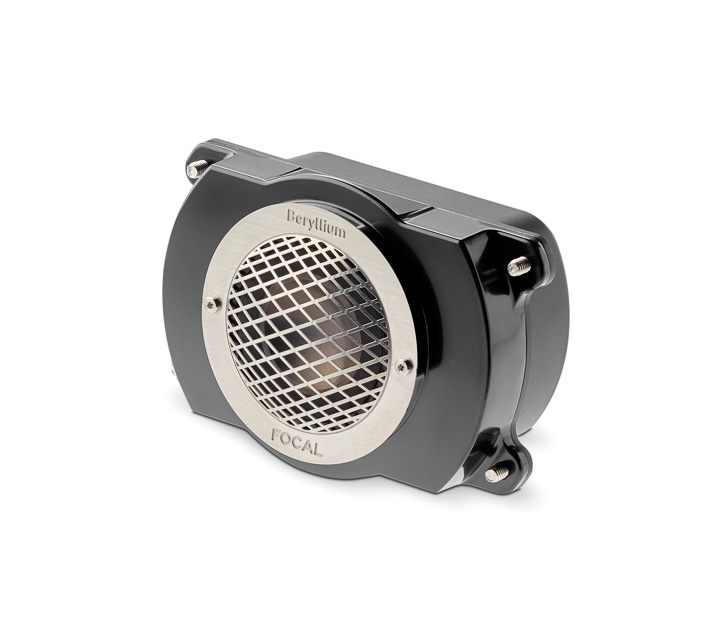
Taking some time with the pair closest to me in bright Solar Yellow, I was struck by the modern style of the Kanta N°2’s. First there is a clear family resemblance to the higher end lines. The bend near the top to facilitate the Focal Focus Time alignment while not adjustable like the Utopia line was similar to the Sopra’s. The new IAL3 tweeter is similar to the Sopra’s IAL2 utilising the same principles of infinite acoustic loading and infinite horn loading that, according to Focal research, “helps with the absorption of waves, thus lowering the tweeter resonant frequency.” Focal’s stated goal is to reduce distortion in every register and their continuing research toward this end has, in their view, moved one more step forward with the new IAL3 tweeter.


I was certainly happy with my first impression at the show and was anxious for them to be delivered for review. Six weeks later I received a phone call from the shipping company to meet them for pickup. After removing the speakers in their boxes from the shipping pallet in the back of the Semi-trailer truck, we were able to just fit them both into my Ford Explorer for the ride home. After some maneuvering with the hand truck with my indentured servants (a.k.a., son and godson) we had them installed (Yes, they were the Solar Yellow pair from the show!) and ready to begin optimal adjustment.

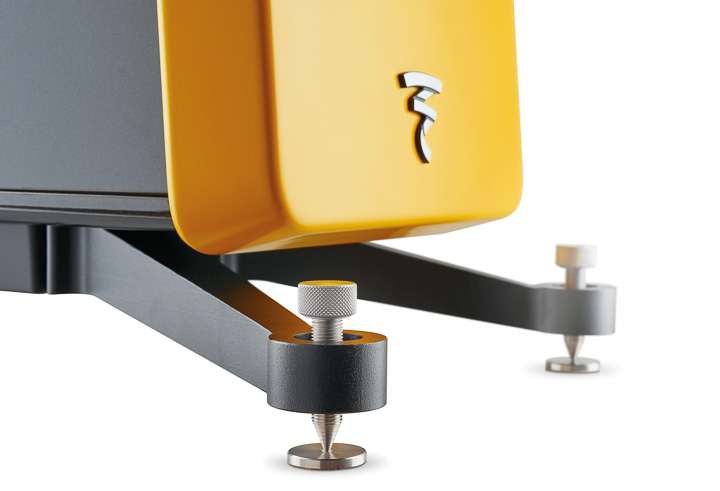
The Kanta N°2’s Zamac base offers a very firm support while not taking up too much space. Each of the four feet has an adjustable spike that allows users to choose how they want to anchor the feet to the floor while also enabling them to level the cabinets. You also have a goodly amount of front/back adjustment via the feet to refine and to level the angle of the IAL3 tweeters. I made the decision to not toe in the speakers. In the end, they did not require it to throw a wide and accurate soundstage or a pinpoint image.

Sitting in my listening room with my black PS Audio BHK 300 monos in between the Solar Yellow Kanta N°2’s made the room look like an audio bumble bee. The black lacquered bodies and glass cover top were very attractive combined with the high-gloss Solar Yellow. The Focus Time tilt near the top of the Kanta’s to me gave the speakers a rakish look I liked. My wife’s reaction was they looked like big bananas! If so they are certainly the best sounding ones I have heard and a tribute to the fruits (I had to go there) of Focal’s labours. The single pair of multi-way binding posts on the back made connecting my AudioQuest CastleRock banana plug (naturally!) speaker cables a snap. The magnetic speaker grilles were an attractive dark grey that complimented the Solar Yellow, and they take up similar space to my reference Vandersteen Treo CT’s.

I decided to go vinyl for the start of critical listening. First up on the VPI Prime Signature was Billy Gibbons and the BFG’s album Perfectamundo [2015 Concord Music Group]. The first cut is a James Moore arrangement of ‘Got Love if You Want It’. This bluesy rendition begins with a strong drum beat with Billy on his Telecaster throwing a classic twangy sound between the solid rhythm of the drums and bass guitar. Enter the Hammond B3 organ as a counterpoint to the guitar and it is a fabulous performance. The Kanta N°2’s offered up the crispy twang of the Fender Tele, delivering every bend with perfect tone. The whirling sound of the Hammond came through in classic style. The supporting pace of the drum kit was accented by the crisp click click of the drumstick on the snare drum edge. Bass notes descended into the mid 30Hz range and the Kanta’s delivered them with authority via the twin 16.5cm flax woofers with the Focal staple NIC Motors (Neutral Inductance Circuit). For those new to Focal the goal of the NIC Motors is to enhance definition by stabilizing the magnetic field. This promotes bass that is better controlled while remaining authoritative or subtle as needed.

Speaking of powerful well controlled bass I next went SACD via the PS Audio DirectStream memory Player and Grover Washington Jr’s Prime Cuts The Columbia Years 1987–1999 [1999 Columbia]. There are a number of great renditions of the jazz classic, ‘Take Five’. Grover’s ‘Take Five (Take Another Five)’ is quite singular in its approach to the classic tune. This version showcases the exceptional tenor sax talents of Mr. Washington as well as seemingly added arrangements by a Foley artist as well as musicians. The EDM style background delivers almost infrasonic depth to the bass. The Kanta’s definitely rolled off from this subterranean assault yet the twin woofers behaved in a wonderfully controlled manner offering up tremendous low-end power with nary a wobble or strain. They delivered what they could and let what was beyond them roll off in an effortless and smooth transition. I began to really appreciate the development of the flax drivers. The combination of the woven flax between two thin layers of glass fibres had achieved a light and highly rigid driver. This results in an ability to move at high velocities while maintaining their structure. Resulting dynamics were very impressive. The single 16.5cm flax mid-range was treated to the best of Mr. Washington and took full advantage of the vaunted Focal TMD (Tuned Mass Damping). I was enthralled with the Kanta’s ability to deliver this thoroughly modern take (no pun intended) on the jazz classic.

I went back to my show notes from RMAF at this point and perused my initial thoughts around the Kanta N°2’s sounds from that show. Keeping in mind that this pair, when I listened to them there, were basically straight from the factory new and now had over 150 hours of listening time on them here at my home. Early impressions at RMAF suggested a speaker a bit bass shy. Perhaps some thin sound through the mid-range. Of course, virtually every speaker is going to be underwhelming out of the box. Clearly the Kanta N°2’s bloom beautifully with 100+ hours on them. Both the mids and lows were impressive with seamless crossover work throughout this 3-way design. The beryllium tweeter provided incredible top end air far beyond what I was capable of hearing. The seamlessness of the presentation was quite enjoyable.

Speaking of that presentation another room at RMAF featured the Sopra N°3’s using the same electronics as I use. At twice the price the Sopra’s are also much larger. The Kanta’s ability to offer a similarly powerful (if not as deep) presentation had me researching their new High-Density Polymer cabinet material (HDP), which Focal explains is 70% denser than MDF, 15% stiffer, and provides 25% more damping. Combined with their PowerFlow technology pairing a front and rear port to limit bass compression gives a smaller volume cabinet the ability to perform at a very high level. Given the amount of driver rigidity being paired with the new HDP material and PowerFlow tech the Kanta’s truly perform at a standard unexpected for their price.

Returning to listening it was time for some female vocals. A first hit single is always exciting and Sofia Carson’s ‘Ins and Out’s’ [via Tidal] showcases the outstanding talent of this latest Disney vocal ingénue. So, you want to test your midrange and tweeter? Try a soprano voice and listen for sibilants. There were none here as the vaunted Beryllium tweeter and Flax midrange drivers combined to let her lovely voice soar cleanly. This track also has the ultra-lows that EDM offers and a variety of claps as well as clicks and other fills that emerge around the soundstage. There is a nice three-dimensional space with Sofia in the centre as a focus for the sonic action. This is a track that will give your system a workout without it being so busy you get a headache from the session. It will give you some insight into your speaker’s capabilities and see how they can show off female vocals without using the usual options.


I wrapped up with a track that combines sweeping orchestral work with guitar, mandolin, and male vocals; ‘The Last Goodbye’ performed by Billy Boyd from the soundtrack to The Hobbit: Battle of Five Armies [2014 Warner Bros]. Once again vocals were incredibly smooth and natural. Billy was front and centre and sized appropriately. After a strong EDM track, it was fun to hear massed double basses creating powerful bass from string and bow. Mandolin and guitar had great tone and resonance. The sense of scale from the orchestra was sweeping and a true delight. This recording offers a nuanced vocal performance in the midst of orchestral grandeur and the Kanta N°2’s were able to serve it up in as good a presentation as I have heard for this song (I have played it with every pair of speakers I’ve had in the room, some far more expensive than the Focals). That the Kanta No2’s could deliver music as enjoyable as this is a true testament to the skills of the designers and engineers at Focal.

The creativity of designers continues to amaze. What is especially heartening is to find a leading company clearly not resting on their laurels. Focal has been around since it was founded as JM Labs in 1979, and is vying for top spot of Euro-makers with B&W and KEF. Focal has the facilities to create and manufacture all of its own drivers and it builds all of its cabinets as well. With that size and success has not come complacency. The company continues to strive and innovate, and the new Kanta N°2 as the progenitor of a new line proves. If you cannot afford or accommodate the flagship Utopia’s, if the Sopra’s are a touch too far, you can now rest easy. The Kanta N°2’s will provide. Give them a good listen and maybe a good home. Very highly recommended!

TECHNICAL SPECIFICATIONS

  • Type:  Three-way floorstanding dual ported speaker
  • Driver Compliment: 1 – 27mm “IAL3” pure Beryllium inverted dome tweeter
    1 – 16.5cm flax midrange driver with TMD suspension and NIC Motor
    2 – 16.5cm flax woofers with NIC Motor
  • Frequency Response (+/-3dB): 35Hz–40kHz
  • Low Frequency Point: 29Hz
  • Crossover Frequency: 260Hz–2,700Hz
  • Impedance: 8Ohms – Minimum 3.1Ohms
  • Sensitivity (2.83V/1M): 91dB
  • Dimensions (HxWxD): 111.8×47.7×32.1cm
  • Weight: 35kg with Grille
  • Finishes: High Gloss Carrara White, Gauloise Blue, Black Lacquer and Solar Yellow with Black enclosure. Matt Finish in Ivory, Warm Taupe, Gauloise Blue and Dark Grey with Walnut enclosure.
  • Price: £7,000 per pair

Manufacturer: Focal

URL: www.focal.com

Telephone: 0845 660 2680 (UK only)

Back to reviews

Read more Focal reviews here

First Listen – Naim ND5 XS 2, NDX 2, ND 555 streamers

Naim Audio changed its Uniti line of integrated amplifier/streamer products in 2016/17. This left the Classic models holding to Naim’s older streaming system. That is all to change (almost) with the launch of three new standalone network streaming players designed to fit into the company’s XS Series, Classic Series and – for the first time – its 500 Series lines. The ‘almost’ part is that the NAC-N 272 network streaming preamplifier remains unchanged… at least for now.

The three new network streamers are built on a good-better-best framework, utilising the same basic core devices, just dealt with to a higher degree in each successive model. The key feature to this is the use of I2S over LVDS (low-voltage differential signalling). LVDS is becoming increasingly popular in high-speed computer network systems because it offers very low radiation but retains the packetised data advantage of a separated clock signal. This is further enhanced by the company’s new ClockMaster device on the new NP800 streaming board. In the ND5 XS 2 and NDX 2, this board is mounted next to the converter, power supply, and amplifier boards, while in the ND 555, the board is isolated inside its own faraday cage.

The ND 555 is the first product launched in the 500 Series in more than a decade and replaces the discontinued CD 555 as the source of choice for this reference grade line. The ND 555 has no internal power, requiring a separate 555 PS DR power supply (or two of these £6,999 power supplies, if you are exceptionally well-heeled). Like the rest of the 500 Series, it places great accent on PCB isolation and vibration control, with the circuit boards for conversion and amplification resting on high mass brass SpringBoard platforms, to decouple the PCBs from any vibration above 10Hz. The step up to the 500 Series comes with a lot of Naim’s own DR voltage regulators for the power supply feeds for each section – 13 in total. Add to this two laser-trimmed, selected PCM1704U-K resistor ladder DAC chips and a fourth generation SHARC chip for DSP, 6th order Sallen-Key filtration, and buffer wrangling.

In essence, the NDX 2 and ND XS 2 are derived from the 500 Series platform, featuring a single PCM1792A and discrete filtering in the NDX 2 and a PCM1791A chip in the ND XS 2. Where the ND 555 can only be driven by a separate PSU, the NDX 2 and ND XS 2 are self-powered, although the NDX 2 can be upgraded with external power supplies. Naim has addressed the somewhat tricky problem of power management in the modern era, by including a switch-mode power supply for standby purposes, and the full linear PSU system for active playing, the SMPS disabling itself when the unit is fully powered up.

All three devices are designed to perform to higher sampling rates than their predecessors; up to 32-bit, 384kHz PCM, and DSD 128. The new platforms are also Roon ready from the get-go, support gapless playback, Apple AirPlay and Google Chromecast (up to 192kHz if so supported by service providers), Tidal, and Spotify Connect. They all feature faster start-up times, bigger buffers, come with full multiroom connectivity, and support practically everything aside from MQA. They are also all controlled from a single app. This is especially important in the ND5 XS 2, as – unlike its stablemates (but similar to the Muso models from the brand) – it has no front panel display or controls, aside from a green light and an on-off button. The larger NDX 2 and ND 555 feature the five-inch TFT colour display and a quartet of hard-buttons.

A select group of UK audio journalists had an exclusive tour of Naim’s factory and listening room in (now suddenly world-famous for more than just a cathedral) Salisbury. The new models require a new form of construction, too: where Classic products have been built on a conventional production line, the new Uniti and these new network streamers are built around two-person cell workstations. Every aspect of build and test is brought together into the single workstation in order to streamline production workflow. This was first developed by Naim for the Statement amplifiers and relies on sophisticated 3D modelling build diagrams. Presently Naim has five such cells in its factory and a sixth is being constructed.

We were also given an exclusive audition of all three streamers, played through a Naim 500 Series pre/power amplifier into Focal Utopia Scala V2 loudspeakers using SuperLumina cable throughout. Each streamer was played, then take out of the system to prevent any form of cross-contamination. This is no more than a brief snapshot of the performance, but the ND5 XS 2 did not disgrace itself in the context of so lofty a system. However, a short burst of NDX 2 quickly showed where the money was spent and how easy it was to justify sonically. This simply had more information presented: we were played a Ryan Adams track and his voice became more plaintive and less whiny in the upgrade, with more body, substance, and separation to the instruments sitting behind him in the mix.

We then moved from the NDX 2 to the ND 555 in the same system, this time moving over to Lyle Lovett. Once more, there was a greater sense of physical presence of singer and musicians, with at once more separation and – not as paradoxically as it sounds – more cohesion between the players in the band. After this we played a number of tracks (not just alt-country) through the ND 555, and it retained a sense of richness and organic depth to the sound, but not at the expense of the pace of the music (understandably, given the company it hails from). This was just a slice of how these players perform and the sound of the system wasn’t giving the kind of stereophony or bottom end definition I would necessarily seek on any of the tracks, but it did show up the good-better-best differences well. One for more investigation, I suspect.

At this time, international prices are not forthcoming, but the UK prices (including VAT) are £1,999 for the ND5 XS2, £4,999 for the NDX 2, and £12,999 for the ND 555 (PSU not included). The products are expected for Summer 2018, although on recent form (both from the company and the weather) ‘Summer’ may come with snow on the ground.

Magico S3 Mk II floorstanding loudspeaker

Magico is a perfectionist brand, run by perfectionists, for perfectionists. If you read this as a vague insult or back-handed compliment, Magico clearly isn’t the brand for you. Magico folk pride themselves in their perfectionism. It’s what defines everything they do, and everything they buy. As these are expensive loudspeakers for perfectionists, it wouldn’t be surprising to see a high percentage of Porsche 911 drivers among Magico’s owners – not because a 911 is fast or showy, but because of the purity of its engineering ethos. Like Porsche, Magico is that kind of brand, and attracts that kind of clientele.

So when Magico began to uprate its S-series of loudspeakers, Magico owners simply nod their heads in approval of what they consider to be the best receiving a series of improvements. No gnashing of teeth or wailing about ‘simply change for change sake’ or how their S3 of a few years ago is now out-of-date… just the same quiet understanding of perfectionist engineering that applies to a Porsche 911 driver buying the latest Porsche 911 because it is better than their existing model. There is an implicit trust between owner and manufacturer – that improvements aren’t just for their own sake – and that is something that is earned by the manufacturer by years of providing good, consistent products and product upgrades.

So it is with the Magico S3 Mk II. Magico has systematically applied changes to its S-series that draw heavily from designs like the limited run M-Project and the Q7 Mk II. These upgrades are internally consistent, in that the changes brought to a design like the S1 to bring it to S1 Mk II status apply to the S3 Mk II, just on a far larger scale. And, just like the S1 Mk II, although the loudspeaker looks on the surface very similar to its predecessor model, in fact practically everything aside from the main enclosure and loudspeaker terminals have been changed. The one downside to that is there is no upgrade path, and owners of existing S3 loudspeakers have to sell on their older design if they want to enjoy the benefits of the S3 Mk II, but audio is one of the few aspects of modern consumerism that even has an upgrade path – imagine taking your 2014 MacBook Pro back to the Apple store and asking them to update it to 2018 specification! This has an added bonus for those with aspirations on the Magico S3 but not the funds to buy one new – suddenly there are some original Magico S3 models for sale at more attainable prices.

The move from S3 to S3 Mk II is extensive, even if that might not seem the case if you take a cursory look at the two loudspeakers. The key stories here are the addition of the new 25mm MBD7 beryllium-diamond tweeter, the 152mm M390G XG graphene-coated Nano-Tec midrange driver, and two 229mm M905G XG graphene-coated Nano-Tec bass drivers. The sealed solid aluminium monocoque chassis/enclosure remains the same curved cabinet with a diameter of an impressive 40cm, however, the internal bracing in this enclosure has been significantly beefed up.


We’ve discussed the high-techiness of these drive units extensively in reviews of the M-Pro and the S1 Mk II, but it bears repeating. Graphene is a very new material developed in the University of Manchester in the last decade and has only recently come to the commercial world. It’s effectively a molecule-thin lattice of carbon. As such, Graphene is a super-light material with the kind of tensile strength that makes steel look like chocolate mousse by comparison. The results of using graphene with Magico’s existing Nano-Tec carbon-fibre material are obvious, as at a stroke the cone is three times stiffer and at the same time 20% lighter. It also has what Magico describes as a new “underhung neodymium base motor system” and a long-throw voice coil, both of which contribute to better power handling. The tweeter, too, is a trickle-down design from the M-Pro, and the 25mm MBD7 dome tweeter is unique to the brand in that it combines a thin layer of beryllium with an even thinner layer of diamond. This really is high-tech stuff, in that these drivers not only didn’t exist, but couldn’t have existed a decade ago.

Naturally, changing the drive units means redrawing the crossover, utilising the ‘elliptical’ design that trickles down from the M-Pro (this limited edition, 50-strong thank you present to Magico’s most loyal buyers on the occasion of the company’s tenth anniversary has proved to be the seed-bed for an enormous amount of modern Magico loudspeaker design). In the process, Magico has managed to make the S3 Mk II slightly less demanding of amplifier than before, upping the nominal and minimum impedance.

Unless you look hard at the rear of the aircraft-grade aluminium cabinet, you might not notice that extra internal bracing (hint: look for bigger bolts), and you definitely won’t see the improved chambering (with ‘angel hair’ damping) for the midrange driver. What you will see, however, is the new plinth and reflection reducing elliptical top plate, both gently rounded and made in-house. The speaker comes with armour-piercing spikes (and feet) as standard, but Magico’s QPod vibration-dissipation devices are recommended as for the best performance. These don’t come cheap, but are addictive and people end up using them under power amps, stands, and more. There are grilles, but they are best only used to hide drive units from the passing thumbs of children!

The days of Magico uttering the ‘you can have any colour you want, so long as it’s black’ policy Ford used to deploy are long gone. The loudspeaker is available in the standard textured M-Cast or a high-gloss M-Coat finish, both of which come in six colours. OK, so if you want your loudspeakers to match the plumage of your flock of flamingos, other brands are available, but the refined and restrained Magico colour palette fits the requirements of those perfectionists we described earlier.

Installation is actually remarkably easy, with the obvious caveat that manhandling just over 77kg of loudspeaker is never that easy and best performed with multiple people used to manipulating loudspeakers. The ‘easy’ part here is because it is a sealed box, the S3 Mk II – like all its Magico siblings – is relatively room independent. It needs less than a metre from the rear and side walls, and at least 2m between them to fall into the right zone, and then careful adjustment to get the toe-in right. Fortunately, these are not loudspeakers that require any kind of tilt or rake, so rigid and level is the way forward. Also, once settled they stay settled, and there is no need to fine-tune the installation after a few days of bedding in.

Electronics selection is largely dictated by loudspeaker price, in that no-one’s going to partner a £36,000 loudspeaker with a £100 second-hand amplifier. The use of graphene-coated drivers and their stiffer, yet lighter measured performance has opened up the options, however, and it’s now no longer mandatory to partner a S3 with a solid-state powerhouse. Good sounds can be had with good tube amplifiers, too, and demonstrations have been made using CAT and Jadis valve amps to great effect.

That all being said, the Magico S3 Mk II is at its most comfy being driven by something beefy and solid-state, and the obvious choices here are Constellation or D’Agostino. Constellation and Magico often demonstrate side-by-side, and in the UK at least, all three brands have the same distributor. I listened to the S3 Mk II through good mid-range Constellation electronics and the loudspeakers really sang well.

That’s the thing about Magico loudspeakers. They manage to combine all the state-of-the-art Masters of Objectivity design that would satisfy the most meters-only audio enthusiast with the sort of sound that is both precise and passionate. It’s kind of like the perfect storm of good audio rolled into one loudspeaker.

Part of this comes from that just damn lovely midrange unit, which manages to express the kind of detail and emotion that got people like me involved in audio in the first place. I don’t want to start using words like ‘magic’ (despite the obvious ‘Magic in the Magico’ quips that follow), but there is something about that midrange that is just so right, so natural, and so open that you can’t help being captivated by the S3 Mk II sound from the get-go. All it takes is one voice, even if that voice is the ultimate stoner drawl of Keith Richards on the studio cut of ‘Love in Vain’ [Rolling Stones’ Stripped, Virgin]. This is one of those recordings that makes you wish more Stones albums were mixed that way, and the rehearsal is beautifully (if probably accidentally) recorded and untouched. Keef’s voice is surprisingly articulate and his wry humour comes across all the better for the speaker getting out of the way.

After that, the loudspeaker extends out to the treble and well into the bass. It’s not as cavernous or as powerful in the bass as more up-scale designs, but I would struggle to find a loudspeaker at the price or below that made better sounding bass – ‘more’ bass, I grant you, but better? This does not mean the loudspeaker is bass light – far from it in fact. I played Surfin’ by Ernest Ranglin [Below The Bassline, Island] and those deep, dub bass notes pumped out powerfully and with a fine sense of ‘throb’ needed in these circumstances. That deep bass was portrayed honestly and well, without overhang or ‘flab’, and to combine those elements with even more bass requires a serious investment in audio, way beyond even the S3 Mk II. The big question – the one that no audiophile will answer or wants to have answered – is whether it’s worth paying a significant amount more for perhaps a quarter of an octave deeper bass at this point. The S3 Mk II doesn’t answer that question because it doesn’t need to answer that question. It does bass; enough bass, done right.


In a way, this last paragraph highlights one of the problems with trying to describe sound in word form. It’s easy to give the wrong impression. A surface reading of a review of the Magico S3 Mk II might conclude that this is a good, if analytical loudspeaker with a dry-sounding bass. This would be entirely wrong, but also entirely understandable given the nature of the way the sound of the Magico is invariably described. What’s missing from this picture is the way you relate to this sound. It’s honest and accurate and able to play loud, but these points alone don’t do the loudspeaker justice. There is something deeper at work when you listen to the Magico S3 Mk II. You find the lack of character in a loudspeaker really begins to hit home after a few minutes of listening, and this happens in an entirely positive way. It’s not just about the great dynamic range or the three-dimensional, well-wide-of-the-speakers soundstage, it’s about being something of a musical intuition pump. The S3 Mk II invites you to listen deeper. Not in an analytical way (although you can certainly do that with these loudspeakers) but like the music is being presented to you shiny and new. Your inner musicologist is set free as a result.

The truth is, this job can leave you musically jaded. You listen to the same reference pieces of music over and over again to assess components. It’s all too easy to fall into the trap of writing “It’s day 736 of my captivity” style reviews. The Magico S3 Mk II is the perfect cobweb-blowing antidote to jaded. It is accurate and yet musically enjoyable, and that combination invites you to hear more music and more from your music. If you have played the same piece of music a thousand times and the Magico makes you want to hear it anew, then the S3 Mk II comes very highly recommended!

TECHNICAL SPECIFICATIONS


  • Type: three way sealed floorstanding loudspeaker
  • Driver Complement: 1 × 25.4mm MBD7 Diamond Coated Beryllium Dome, 1 × 152mm M390G XG nanographene cone midrange, 2× 229mm M905G XG nanographene cone bass drivers
  • Sensitivity: 88dB
  • Impedance: 4 Ohms
  • Frequency Response: 24 Hz–50 kHz
  • Recommended Power: 50 watts
  • Dimensions (H×D×W): 122 × 30.5× 30cm
  • Weight: 77 kg
  • Price: £36,000 per pair (M-Cast), M-Coat price on application

Manufactured by: Magico LLC

URL: magico.net

Distributed in the UK by: Absolute Sounds

Tel: +44(0)208 971 3909

URL: absolutesounds.com

Back to reviews

Read more Magico reviews here

Meet Your Maker: Caelin Gabriel of Shunyata Research

As part of our Hi-Fi+ Guide to Audio Cables & Power Products 2017 (available as a free download online at hifiplus.com/buyers_guides/6/) we spoke to Caelin Gabriel of Shunyata Research about his discoveries in cable and power technology, his background, and the next great jump in audio performance!

Hi-Fi+: How and when did you first discover that differences in audio cables could actually affect the sound of hi-fi systems? Were you surprised at the time?

Caelin Gabriel: I worked as part of a team tasked with developing low-level signal acquisition systems for Military applications in different countries around the world. Later, in civilian life, I was involved with the development of high-speed networking devices like the 1GB/s fibre-channel interfaces and the present 100MB/s and 1GB/s Ethernet devices in the computer industry. These work experiences wreaked havoc with simple engineering truths. It became obvious long before I began building power cords and cabling for my own audio system that details related to cable and power systems were extremely important. Power and signal cabling represent by far, the longest path signals must travel within a high-resolution audio, video, or medical system.

What was the first range of cable products you designed and when did it enter the market? How did it compare to other cables at the time?

My first commercial product was introduced in 1998 and was called the King Cobra power cord. It was an extremely complicated design that took me the better part of an entire day to construct by hand. The market response to the design was significant, which led me (and my family) to believe that we could carve out a small, but sustainable business by making finely crafted products with special construction techniques, materials, and plausible science. There were a number of early reviews of the King Cobra power cord that compared it to many more expensive models. The results gave me the early idea of pricing very high-performance cable products more modestly as another competitive edge in a small market.

How has the audio cable industry evolved over the past several years? What are the pros and cons of the path the industry has taken?

We see consistently escalating retail prices in the cable industry for top-performance models, that approach new car pricing for an 8’ length of speaker cables or a 6’ power cord. Despite the extremely high prices, I notice there is a general lack of published science, patents, or technologies that stand up to scrutiny or explain why products cost into the mid five-figures. Shunyata Research’s niche is first and foremost our focus on value, whether the products are our finest performance products or our most affordable. We design all of our own parts and explain their importance and construction. We have seven published patents and many more pending. There are hundreds of pages available on our web site and in print explaining our design philosophy, science, and use of measurement. The challenge facing the cable market as we see it is truth in retail pricing and scientific credibility. In a few small ways, I feel we have advanced the concept of well-reasoned retail pricing and bringing real science into the consciousness of this market segment.

Some audio cable manufacturers focus primarily on premium-priced products, but your firm offers some ranges of cables that are far more sensibly priced. What led you to create ranges of value-minded cables?

The growth and longevity of Shunyata Research is directly related to our commitment to manufacturing affordable products that deliver an extremely high level of performance. We achieved success through more than ten-years of creating our own custom-made parts. Our most value-oriented products rely heavily on measurement, explainable science, and material refinements. We understand that our greatest market exposure will be through customer’s experience with our most cost-effective products, so those have to be the finest products we make in terms of absolute value and performance. You could think of our Venom Series of signal cabling and power products as our proof of concept and our proof of commitment to our craft and our customers. Our affordable Venom Series of products are the vanguard of quality that is the embodiment of our company ethos. We are comfortable with how they perform and our feedback, media reviews, and awards over the past ten years have been worth the investment.


What do you personally consider to be the ‘sweet spot’ product (or products) in your range in terms of maximum performance per dollar ($), pound (£), or euro (€)? What sets those products apart?

It’s very difficult to select a single product or product range because at each price point, we compete in the market by hitting lower retail prices with obvious performance, measurement, and design advantages compared to competitive products. If forced to choose a favorite cable-set for a relatively high-performance system, I would have to say our Alpha range of signal and power cord products. Alpha Series use patented technology that measurably improves signal transfer and the Alpha NR power cord measurably reduces noise at the component’s power supply. Alpha models are designed using all custom-manufactured parts, superior, hollow-core geometry conductors and have proven themselves competitive with products costing four to five times their retail price.

In developing value-minded audio cables, which design parameters have the greatest impact on overall sound? Conductors? Dielectrics? Geometry? Shielding and Jacket Design? Connectors? Other variables?

We control every variable possible in the Venom range of power and signal cables. Nothing is left to chance and there are no off-the shelf materials or parts used in their construction. Our Venom power cord conductors are made with the highest purity OFE copper on the market. We designed our own custom-molded AC connectors so that the connectors could accommodate large-gauge power conductors and possess superior contact integrity.

Venom signal cables use Ohno Continuous Cast Copper, which is made into a hollow core wire geometry called VTX. All the Venom cable dielectrics were chosen through careful listening evaluations and the shielding elements were selected to achieve 100% coverage. We designed all of our own RCA, XLR, and STIS (Interchangeable speaker cable terminals) because of the importance of the connections. This allows customers to choose their preferred speaker cable termination or change when needed. The material and custom-design costs invested are estimable, but that is the reason for our reputation as a very credible science-minded manufacturer of high-performance cabling systems.

As an audio cable designer, how do you strike a balance between performance on the one hand and price on the other? Is it possible to optimise both?

We started with a specific pricing model that considered a standard mark-up between parts/materials cost and retail pricing in order to break even and perhaps earn a reasonable profit. In the beginning, this model dictated that if a part you designed or purchased cost you a penny, then that had to add five cents toward a retail price. This was referred to as a X5 table. 15 years ago, this was the norm for many industries. As vendor costs and US labour has gone up, so has the X table. Today, it’s probably closer to a X6 table. We still follow that table, generally speaking. With our most affordable products, we earn less and with our highest performance, entirely customized hand-made products, we earn a little more so there is a balance. The trend we are seeing, mainly in the cable business, is that the normal X table of old has exploded into X20, X30, and up. Why, because some cable makers compete by increasing discounts to dealers, or adding upgrade programs, trade-in programs, rewards for exclusive business, and the list goes on. Our success in the market is predicated on offering the highest value products at each price-level that out-perform those with inflated retail prices.


Manufacturers sometimes speak in figurative terms about the ‘special sauce’ that makes their products different and better than those of their competitors. If you are at liberty to say, what’s your ‘special sauce’?

Our products’ most compelling attributes are their complete parts customization and the patented, measurable, and explainable science used to design them. If there is one “special sauce”, it would be the 18 year commitment to manufacturing products that deliver on the promise of consistently obvious performance improvement at retail pricing that does not strain the laws of credulity, even at the highest end of the performance ladder. You could point to any number of individual design attributes or perhaps one patent that is particularly relevant, but with Shunyata, it comes down to the accumulation of all the patents, pending patents, and the custom-designed parts, measurement analysis such as the peak-current (DTCD) analyser, noise-measurements, proprietary filter designs, etc. The special sauce is 18 years of parts, design, research, measurement, and simple, straightforward, no BS pricing polices.

We have two admittedly loaded questions for you. Just how close do your value-minded cables come to the performance of your flagship models? What characteristics do they have in common and what are the most noticeable differences?

Our most affordable cables must approach reference performance level in our estimation or there is little value to expending the effort, cost and more than 12 years in developing the affordable Venom range of products to represent what is the best attribute of our company. Yes, in extremely high-performance, high-resolution systems, our more expensive products are carefully designed to perform at a higher level. Because each system and listener is unique, the value equation relative to differences has to fall on the individual. Since our products have been on the market for 18 years, there have been many reviews, customers, and dealers who have weighed in on the value of our products at each price level. Even the medical industry, heart surgeons, and hospitals have weighed in on the value of Shunyata products so we always prefer to let the market determine our products’ true worth and value. If history were the guide, I would say we’ve been very successful in providing value-oriented products that come tantalizingly close to “reference” level performance in a good system. Most of our dealers and distributors offer evaluations and money-back auditions, so we are comfortable with the idea that if people take the time to listen, they will find a very high-value match for their system at any of our price points.

What do you think the next ‘great leaps forward’ in audio cable design will be? How do you think audio cables will be different five years from now?

With the proliferation of digital systems and components, Wi-Fi and more RFI and EMI surrounding system environments, cable and power systems will have to evolve so that high-frequency noise is isolated from other noise-sensitive components in the system. Shunyata is working on a number of cable and power system components now that should address the issues related to noisy environments, because it’s not the noise coming from outside the home or system that poses the greatest threat to high-resolution; rather, it’s the noise that surrounds the system itself that detracts from performance. Our designs focus on isolating component-to-component noise interference and we see that as a big part of the design evolution to come. Our research into these and other areas will continue because it’s what we do best. 

Nordost Heimdall 2 and Blue Heaven headphone cables

Nordost needs no introduction in the high-end audio world, but now the Massachusetts-based company is offering two ranges of specialised headphone signal cables. The top offering is the Heimdall 2 headphone cable (or headphone cable system), while at a somewhat lower price/performance point is the firm’s Blue Heaven headphone cable.

Nordost kindly arranged for us to receive review sets of the Heimdall 2 and Blue Heaven headphone cables, both fitted with appropriate headphone terminations (2.5mm mono mini-plugs) for use with the HiFiMAN Edition X v2 and HE1000 v2 headphones recently reviewed in Hi-Fi+ issue 143. Our reasoning was that these HiFiMAN models, whose standard signal cables are already very good, would make ideal test platforms for Nordost’s upgrade cables.

The Blue Heaven headphone cables feature a seven-strand Litz configuration where each strand consists of four 34AWG 7/42 conductors formed from 99.9999% pure solid core OFC (that is, oxygen-free copper). Each conductor is treated to the firm’s signature Micro Mono-Filament technology—a process that, Nordost suggests, involves wrapping each conductor with a strand of FEP material before the finished strand is encased in an extruded FEP insulator (FEP means ‘Fluorinated Ethylene Polypropylene’). To increase cable strength and control unwanted resonance, an Aramid “strength member” is also added. The amplifier ends of all Blue Heaven cables are terminated with a gold-plated 3.5mm stereo mini-plug fitted with a threaded, 6.35mm stereo phono adapter, meaning the cables will work with most any amp offering traditional single-ended outputs. The cables can be ordered with a wide variety of headphone terminations to fit most popular headphones. Blue Heaven headphone cables come in 1.25m and 2m lengths and feature distinctive, translucent blue outer jackets.

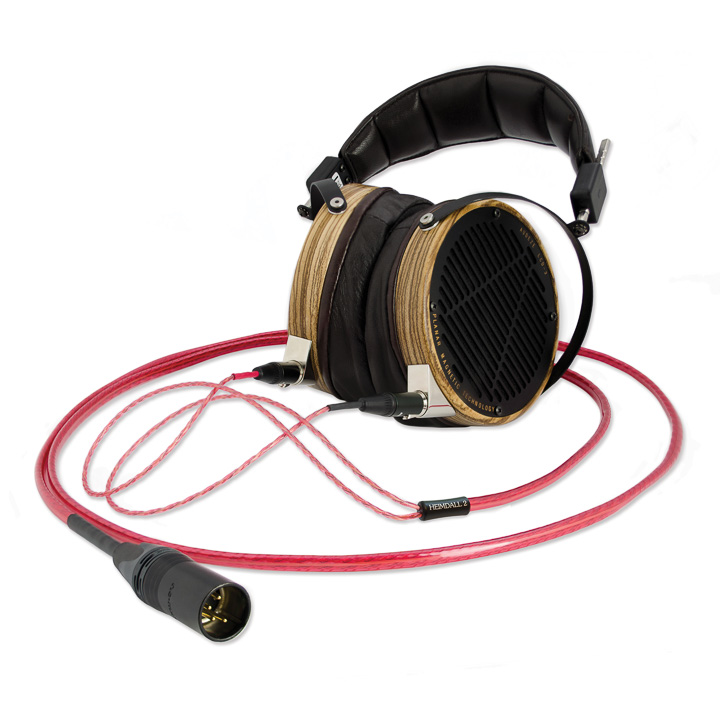
Like the Blue Heaven cables, the Heimdall 2 headphone cables feature a seven-strand Litz configuration. Two key differences, however, are that the Heimdall 2 headphone cable uses heavier gauge 32AWG 7/40 conductors and ones that are formed from an even purer (99.99999% pure) grade of oxygen free copper. Likewise, the Heimdall 2 cables use Nordost’s Micro Mono-Filament technology, with the company emphasising that the cables employ “mechanically tuned lengths, which reduce internal microphony and high-frequency impedance resonance.” The Heimdall 2 cables sport attractive translucent red outer jackets.

As I suggested above, Nordost’s Heimdall 2 headphone offering is a multi-part cable system that consists of a 2m-long main cable (terminated with a 4-pin male XLR connector on the amplifier end), plus two shorter adapter cables. One adapter cable is terminated with a 6.35mm stereo phono plug while the other is terminated with a 3.5mm stereo mini plug. In practice, this means the Heimdall 2 headphone cable system will work with virtually any single-ended or balanced output headphone amplifier on the market.


Like the Blue Heaven headphone cables, the Heimdall 2 headphone cables can be ordered with a very wide variety of headphone terminations to accommodate virtually any high-end headphone available today. However, the termination options offered for Blue Heaven are not as extensive as those for Heimdall 2, so it pays to consult Nordost’s online table of termination options to make sure the connectors you require are available.

I quickly discovered the defining characteristics of the Blue Heaven headphone cables are an open and airy-sounding midrange presentation with plenty of transient ‘snap’ and definition coupled with detailed and extended highs. The Blue Heaven’s bass is solid and taut with both good transient speed and pitch definition, but there is no added bass ‘lift’, weight, or warmth (meaning these probably are not cables you would choose in order to ‘warm up’ the sound of your headphones). Happily, though, the HiFiMAN Edition X v2 has thoroughly adequate low-end weight and warmth of its own. What the Edition X v2 headphones do need, however, turns out to be exactly the qualities the Blue Heaven cables have on offer: namely, an added touch of midrange transparency and definition, coupled with heightened high frequency detail and extension. As a result, when you put a set of Blue Heaven cables on the Edition X v2 headphones, their sound pulls noticeably closer to that of the very revealing flagship HE1000 v2.

The track ‘Nocturne’ from Medeski, Martin, and Wood’s Combustication [Blue Note, 16/44.1] neatly illustrates the beneficial effects of the Blue Heaven cable on the Edition X v2 headphones. The track opens with the funky, baritone voice of Chris Wood’s electric bass accompanied by eerie and at times heavily processed synth washes and other sounds from John Medeski’s keyboards. The Blue Heaven cables enhance the definition of Wood’s bass notes while making the off-kilter textures (and the sometimes deliberately inverted envelopes) of Medeski’s keyboard notes stand out in sharp relief. But once Wood and Medeski establish a fundamental and funky groove, Billy Martin joins the proceedings with a series of deliciously syncopated percussion notes sounded on peculiar-sounding cymbals, gongs, and other less common metallic instruments. With a little help from the Blue Heavens, the strangely beautiful clanks, boings, pings, and shimmering high harmonics of Martin’s percussion contributions take on lives of their own, not only managing to sound like real percussion instruments in play, but also clearly conveying a sense for the reverberant acoustics of the recording space. The net effect is that the entire presentation sounds more vivid, sharply focused, and clearly defined, yet without becoming edgy or overwrought.

Frankly, the Heimdall 2 cables had a tough act to follow, because the Blue Heaven/Edition X v2 combination was so beguiling. But in stepping up to the HiFiMAN HE1000 v2, the Heimdall 2 cables yielded several worthwhile sonic improvements, including more tautly defined but no less impactful bass, an across-the-board and evenly balanced increase in resolution, and a really impressive quality of top-to-bottom harmonic integrity. By ‘harmonic integrity’ I mean that the upper partials and harmonics of notes sounded pleasingly and satisfyingly consistent with the underlying fundamentals that produced them—a quality not all headphone cables can properly reproduce. The Heimdall 2 cables didn’t bowl me over with big, dramatic sonic changes, but they yielded a number of smaller (yet collectively important) incremental improvements that gave the already superb HE1000 v2 an undeniably more suave and sophisticated sound.

You can hear this newly unleashed sophistication on ‘The Mermaid’ from jazz vocalist Norma Winstone, reed specialist Klaus Gesing, and pianist Glauco Venier’s Distances [ECM, 16/44.1]. The track opens with the eerie sound of Venier’s piano, played as if it were a prepared piano, replete with various percussive taps on the frame and soundboard of the instrument and even moments where the strings are strummed autoharp-style. The Heimdall 2s make those opening moments simply riveting, because they reveal the multiplicity of harmonic signatures of which the piano is capable. Later, Winstone enters with her breathy yet also rich alto (contralto?) voice setting the song in motion. Again, the Heimdall 2 let the listener hear the smooth integration of the body of the voice with its own higher harmonics, creating an almost palpable sense of the singer performing before her microphone. Final, Gesing brings his reed instruments to the party and the Heimdall 2s help transmit both the sounds of the vibrating reed in the mouthpiece, but of the resonant column of air that is actuated within the instrument. The key, here, is that the Heimdall 2s deftly impart touches of heightened vividness, textural richness, and—above all—a sense of harmonic completeness, to everything they touch.


Nordost’s Blue Heaven and Heimdall 2 headphone cables are comparatively expensive, but that is to be expected when you are talking about elevating the performance of headphones that came with very good cables in the first place. All I can tell you is that the Blue Heaven and Heimdall 2 cable have taken up residence on my HiFiMAN Edition X v2 and HE1000 v2 headphones respectively, and both headphones sound all the better for it. Try these cables with your favourite headphones and see if you don’t get similar results. Highly recommended.

TECHNICAL SPECIFICATIONS

Nordost Blue Heaven headphone cable

  • Cable construction: Seven-strand Litz-type configuration, with each strand consisting of four 34AWG 7/42 conductors formed from 99.9999% pure OFC. The cable features proprietary Micro Mono-Filament technology and uses FEP dielectrics.
  • Headphone Connectors: Various
  • Amplifier side: Gold-plated 3.5mm stereo mini plug fitted with screw-on, gold-plated 6.35mm stereo headphone plug
  • Available lengths: 1.25m or 2m lengths.
  • Pricing: £334.99

Nordost Heimdall 2 headphone cable system

  • Cable construction: Seven-strand Litz-type configuration, with each strand consisting of four 32AWG 7/40 conductors formed from 99.99999% pure OFC. The cable features proprietary Micro Mono-Filament technology and uses FEP dielectrics. Interior materials feature “mechanically tuned lengths” to minimise microphony and resonance problems. One main cable is supplied along with two ancillary adapter cables.
  • Headphone Connectors: Various
  • Amplifier side, main cable: 4-pin male XLR connector. Gold-plated 3.5mm and 6.35mm adaptors supplied
  • Available lengths: 2m, main cable
  • Pricing: £649.99

Manufacturer Information: Nordost

URL: www.nordost.com

UK Distributor: Atacama

Tel.: +44 (0) 1455 283251

URL: www.nordost-cables.co.uk

Back to reviews

Read more Nordost reviews here

Hi-Fi+ Awards: Cables

Digital Audio Cable

Clearer Audio Silver-Line Optimus Reference 75

This pure 75 ohm digital interconnect cable (£975/1.5m as tested) is a coaxial design, featuring a central 6N (99.9999%) OCC silver central conductor, and micron-thick silver-plating over a 6N PC-OCC copper in two of the conducting braids (for the return path and the shield). It’s insulated by a foamed polyethylene dielectric, with an additional dual-layer active copper foil shield, and a passive silver-plated Nylon braid shield, Clearer Audio’s ‘Super Suppressor’ ferrite rings at both ends of the cable, and then terminated with WBT 0152 Ag Pure Silver nextgen RCA plugs. 

This impressive specification is backed up by equally impressive sound quality. Hi-Fi+ Editor Alan Sircom was especially taken by the way that, “everything really worked in harmony. Instead of that knife-edge between too flat and too edgy, the cable helped create more of a balanced platform of digital audio.” He concluded that “Silver-Line Optimus Reference 75 is more than up to the task and is certainly more than good enough to let any good digital audio shine.”

See: hifiplus.com/articles/clearer-audio-silver-line-optimus-reference-75-digital-cable/

Interconnect cable

Cardas Audio Clear Beyond

Building on the strengths of Clear interconnect cable, and the improvements brought about moving up from Clear to Clear Beyond loudspeaker cable, it was a logical choice for Cardas Audio to try to see what improvements could be made to Clear interconnects by giving them the Beyond treatment. Like Clear, Beyond is made of strands of Cardas’ own copper (Cardas has its own smelting furnace)… just more of it. These are wound into a quartet of 26.5 AWG copper conductors, individually insulated using an enamel coating, and then arranged in a star-quad geometry.

Hi-Fi+ Editor Alan Sircom felt Beyond “gives the listener all the things they like so much about Clear, and adds a little more separation, detail, microdynamics, and image depth, without any sacrifices in performance elsewhere.” He also felt it “manages to better combine the two goals of ‘sounding good’ and ‘sounding accurate’ even better than Clear. This is no mean feat, as Clear was one of the few that did this without falling into the ‘warmth’ trap.” Outstanding!

See: hifiplus.com/articles/cardas-audio-clear-beyond-interconnects/


Personal Audio Cable

Nordost Heimdall 2 headphone cable

Nordost’s Heimdall 2 headphone cables feature a seven-strand Litz configuration, with both 32AWG 7/40 conductors and ones that are formed from an even purer (99.99999% pure) grade of oxygen free copper. Heimdall 2 cables use Nordost’s Micro Mono-Filament technology, with the company emphasising that the cables employ “mechanically tuned lengths, which reduce internal microphony and high-frequency impedance resonance.” The Heimdall 2 cables sport attractive translucent red outer jackets. It can be supplied in a range of terminations. 

In our test, Hi-Fi+ Publisher Chris Martens felt “Heimdall 2 cables yielded several worthwhile sonic improvements, including more tautly defined but no less impactful bass, an across-the-board and evenly balanced increase in resolution, and a really impressive quality of top-to-bottom harmonic integrity,” and concluded that “The key, here, is that the Heimdall 2s deftly impart touches of heightened vividness, textural richness, and—above all—a sense of harmonic completeness, to everything they touch.”

Reviewed in Issue 145

Kimber Kable Axios

Kimber Kable’s Axios Axios headphone cables use a braided topology that harks back to the design of Kimber’s very first commercial products: namely, the braided 8-wire 4PR and 16-wire 8PR speaker cables. However, it also features a very flexible OFHC copper wire braid comprised of 16 FEP-insulated 24 gauge stranded conductors in a precision hand-braided process, and can be configured to fit myriad headphone terminations. 

It’s hard not to be impressed by the performance uptick Axios brings. Hi-Fi+ Publisher Chris Martens feels Axios offers the listener, “considerably finer resolution of low-level transient and textural details in the music, more focused and coherent rendition of layering within recordings (sometimes to the point of exposing low-level layers that had not been discernable through standard cables), superior bass control and pitch definition, and across-the-board improvements in soundstaging.” An award was almost mandatory!

See: hifiplus.com/articles/kimber-axios-headphone-cable/


Loudspeaker Cable

QED Supremus

QED was the company that gave us the ubiquitous 42-strand and 79-strand loudspeaker cables that were used almost universally in 1980s/1990s audio systems. Supremus aims for a more upmarket audience. At £1,160 for a 3m pair, Supremus hardly registers on the super-cable meter in price terms, but delivers a surprisingly cogent performance sonically. 

The Supremus design uses 16 silver-plated, 99.999% pure oxygen-free solid-core copper conductors, creating a 10AWG wire, with a cross-sectional area of 6.2mm2. The design of the cable itself uses QED’s AirCore technology to keep inductance low. In audition, the cable helped give the amplifier better control over the loudspeakers, with the sort of mid-band coherence, and glare-free treble that normally marks out more expensive speaker cable systems. But its overall sense of balance most impressed Hi-Fi+ Editor Alan Sircom, who said “QED’s Supremus gets tantalisingly close to being that One Cable To Rule Them All.”

See: hifiplus.com/articles/qed-supremus-loudspeaker-cable/

Power Cord

IsoTek EVO3 Ascension

IsoTek is perhaps best known for its power filters and conditioners, but in fact it has long made mains cables, often highly prized for their performance-to-value ratio. But, although it has long had the wherwithal to go for a more up-market design, it’s only now – with the launch of EVO3 Ascension – that the brand shifts into higher gear. This is not simply a ‘wingman’ mains cable, that one might buy because of the high performance of other devices, EVO3 Ascension is a fine power player in its own right. 

Ascension uses deep cryogenically treated silver-plated Ohno continuous cast copper conductors, wrapped in a dielectric of air, with partial FEP contact, with a secondary extruded FEP sleeve. Each conductor assembly is wrapped in Mylar with a further OFC shield before being given a slight rotational twist with FEP tubes of air. We were the one of the first outside of the IsoTek secret design bunker to have a chance to experiment with the EVO3 Ascension, and after 24 hours of running in, it can really deliver the musical goods. This £2,750 cable really lowers the noise floor and lets the soundstage breathe!

Review pending

Hi-Fi+ Awards: Accessories and Power Products

Accessory

Vicoustic Multifuser DC 2

The Portuguese firm Vicoustic aims to “provide the best products for acoustic treatment” with the goal of “enhancing rooms for great sound combined with the best possible design.” A fine example of this would be the firm’s simple but effective Multifuser DC 2 panels, which are sold in packages of six per box. The Multifuser DC 2 is described as a “bi-dimensional diffusion panel that is frequently applied to walls or ceilings, providing multi-reflection on both vertical and horizontal planes in sound critical spaces.”

Earlier this year Hi-Fi+ Publisher Chris Martens needed to set up of a new listening room — a room that initially exhibited some midrange and upper midrange problems. Seeking solutions, Martens installed two six-packs of Multifuser DC 2s on the rear and side walls of his room, then sat back to marvel at the sonic improvements the panels wrought. The DC 2 panels are sonic miracle workers, capable of resolving midrange and upper midrange response problems, while ushering in dramatic improvements in perceived soundstage spaciousness and image focus. Put simply, Vicoustic’s Multifuser DC 2 panels offer a musically satisfying go-to solution for almost any ‘difficult’ room.

Review Pending

iFi Audio IEMatch

The phrase ‘clever little gizmo’ is not one oft spoken in the field of good audio, primarily because many audio products fail to score in any of the three words that make up that term. The new IEMatch by iFi Audio is the perfect exception to that rule. It’s a deceptively simple, one-trick-pony that as soon as you see the need for it, you realise just how important it is in your life.

Many of us can log a lot of air-miles in the course of a typical year, and the joy of relaxing with some in-flight entertainment, coupled with the sonically isolating benefits of in-ear monitors sounds like a perfect way to while away the flight time… right up until you try to balance the output of that seat-back system with your hyper-sensitive IEMs. Anyone who has experienced the ear-piercing scream of cabin crew telling you about turbulence, on a system turned down to a whisper will appreciate the problem. The IEMatch is a tiny in-line gain and impedance matching device, designed to let you use normal volume controls with efficient or very sensitive in-ear monitors. The list of uses for the IEMatch extends beyond seat 24E, but one long-haul flight with IEMs plugged into the seat-back, and this award-winner becomes a must-have travel companion.

Review Pending

Power product

Nordost QKORE1, QKORE3, and QKORE6

The popularity, efficacy, and use of ground units appears to be a comparatively recent phenomenon, but in fact dates back to the earliest days of good audio. It was not uncommon for audio enthusiasts to run an additional star-earthing network, connecting devices to a common ground independent to the one used in the mains itself. The Nordost QKORE grounding units take and extend that notion to its logical limits. QKORE is built around three products, a QKORE1 with a single binding post designed to connect to the power before the electronics (ideally connecting to something like a Qbase), QKORE3 that includes three binding posts to connect to the electronics (plugging into a spare RCA socket), and QKORE6 that combines the QKORE1 and QKORE3, adding a supplementary set of mono ground connectors, for an all-in-one package or for users of mono power amps. 

In our test, Hi-Fi+ Editor Alan Sircom was impressed. “The main effect was in the bass,” He said, “which sounded significantly tighter, deeper, and more authoritative. More significantly, QKORE was like a quick lesson in ‘time coherence’.” He concluded that, “the benefits are immediate, easy to hear, and extremely consistent from system to system, even in systems that may never use another Nordost product.” It’s time to feel grounded!

See: hifiplus.com/articles/exclusive-munich-preview-nordost-qkore-grounding-system/

Hi-Fi+ Awards: Personal Audio electronics

Portable headphone amp/DAC

Chord Electronics Hugo2

The original Chord Hugo revolutionised the notion of what could be done with portable audio. Now the new £1,800 Hugo2 almost doubles the original’s already impressive number of filter taps (to 49,152), beefs up the performance of the headhone amplifier, and improves battery performance, in a fully root-and-branch change to the design.

Hi-Fi+ Publisher Chris Martens said simply, “I really can’t think of any other transportable headphone amp/DAC that can directly compete with Hugo2, or that even comes close.” It really is that good!

See: hifiplus.com/articles/chord-electronics-hugo2-transportable-headphone-ampdac/

Digital Audio Player

Questyle QP2R

Questyle’s QP1R DAP is almost universally liked by personal audio cognoscenti, but the new £1,299 QP2R raises the stakes a lot further. With its Class A current mode amplification, and high performance DAC, it sounds almost like a portable version of the firm’s top ‘Golden Stack’, but improvements the interface, battery life, on-board storage capacity, and balanced output, all make for a DAP that comes “enthusiastically recommended” in its listening test.

See: hifiplus.com/articles/questyle-audio-qp2r-highresolution-portable-digital-audio-player/