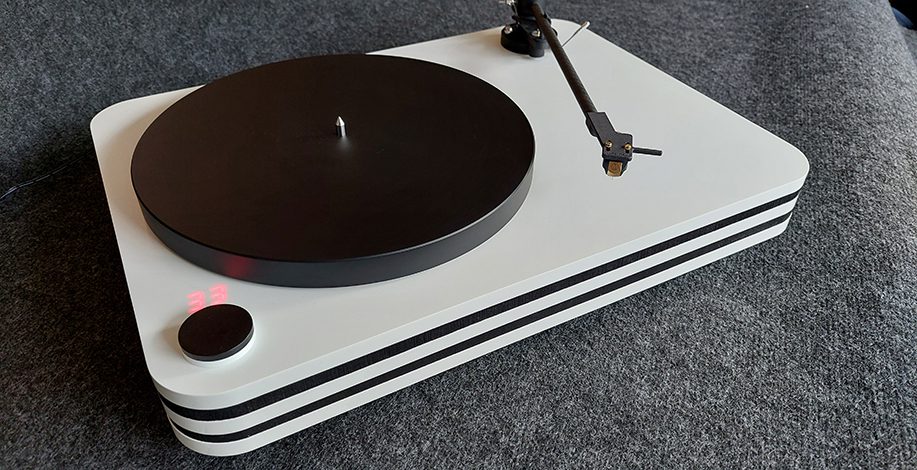
Luphonic didn’t have the most auspicious of startup experiences. The company was just a few weeks old when the COVID pandemic broke out. Still, Thomas Luh used this time well, going back to basics and experimenting with different materials and shapes for his distinctive, discreetly attractive, and immaculately finished turntables. The result of that experimentation was a recipe for the basic materials and structural elements of his designs. Oh, and a tonearm; having tried various OEM offerings, Thomas decided that he needed to make his own.
So the R3 follows the design principles and aesthetic of the other turntables in the range, from the H-shaped chassis of the H1 and H2 (reviewed by CF in issue 236), and the rectangular R2; the R3 continues with the rounded corners which soften the rectilinear shapes, and the layered Corian/elastomer sandwich of all but the entry-level H1.
Next level
The R3 takes this literally to the next level, being a five-layer sandwich: three Corian slices (the R2 has two), separated by two cellular rubber damping layers, with essential functions attached to different layers to isolate them from each other. So the bottom slice of Corian forms the base, with its adjustable feet, which is isolated from the middle slice, on which the motor and armboard assemblies mount, which in turn is isolated from the top slice, which houses the main bearing.
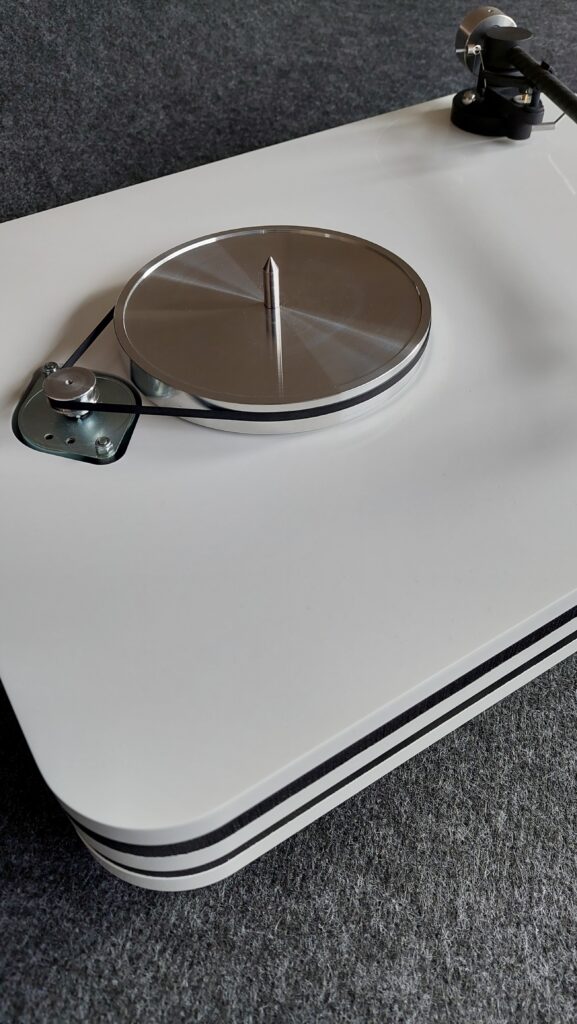
The armboard for the R3 is worth a mention in its own right. It’s a disc of Corian, onto which the arm mounts in an off-centre hole. The disc can be rotated, so arm geometries from 200-300mm can be accommodated by simply rotating the armboard until the desired pivot-to-spindle distance is achieved. Luphonic offers the R3 with either a 9” or 12” version of their K2 tonearm, a gimballed design with a low-resonance carbon armtube and a headshell of sintered polyamide with a filler of tiny glass beads. The armboard can be drilled for many alternative tonearms by arrangement, but you’d better be sure what you want to mount is an excellent arm and worth the trouble, because the K2 is no slouch. The review sample of the R3 came with the 12” version, onto which I mounted my regular Hana ML moving coil.
Cool control
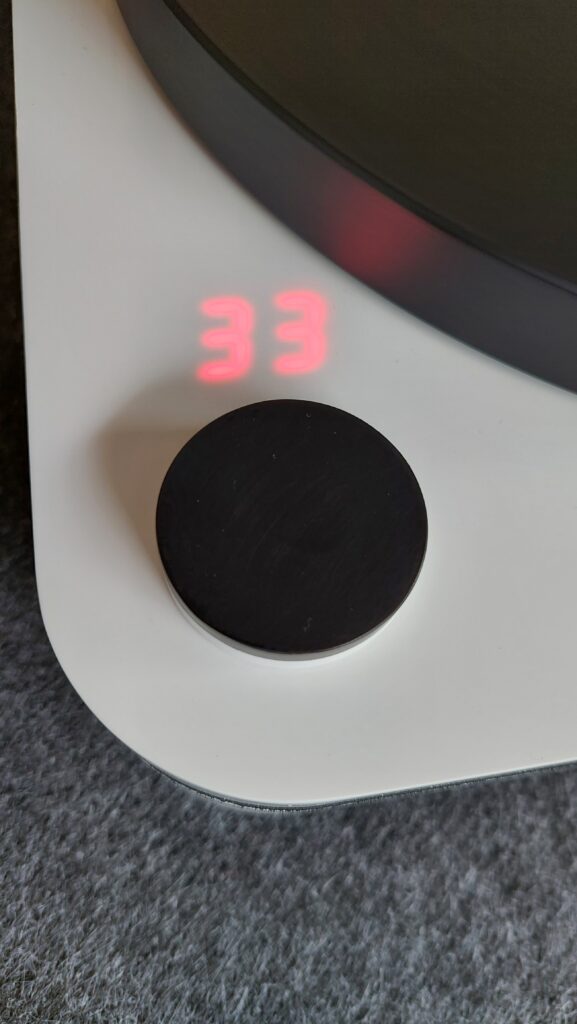
The R3 also retains the coolest control mechanism I’ve seen for a long time. A double-sided magnetic puck the size of a checkers piece, one side white, the other black, is placed over a backlit patch on the top plate. Black face uppermost gives 33.3 rpm; white face gives 45 rpm; the speed is displayed in numeric form just below the surface of the translucent Corian top plate once the platter rotation has stabilised. Take the puck off and put it to one side, and the motor stops. The pucks are £20 each, and it may be worth ordering a spare, because for sure, one is going to end up down the back of the sofa, or in the dog, or something…
The motor speed is electronically controlled, factory-calibrated for minimum vibration of the specific motor unit before shipping, and can be user-adjusted via a discreetly sited potentiometer.
Monochrome, not grey.
I think the monochrome colour palette is very pleasing, though it probably won’t suit everybody. If your domestic style is more Jane Austen than Austin Powers, the Luphonic’s ‘liquorice allsort’ aesthetic might jar slightly, but for anybody who has moved beyond the mid-20th century, and in particular anybody who has embraced the clean, simple lines of the Scandinavian or Bauhaus design schools, this is going to fit right in. But while black & white defines the look, the sound is very far from grey.
The R3 competes broadly on price with the VPI Prime Signature, which I used for a fair few years. Still, despite both being solid chassis designs, their engineering approaches are somewhat different, and thus they perform differently. The more ‘massy’ approach of the VPI is reflected in a substantial sound with gravitas, scale and stability; the Luphonic is arguably more about poise and responsiveness. So, the R3’s rendering of ‘Anitra’s dance’ from the Grieg Peer Gynt Suite (Marriner; EMI) has a graceful, balletic feel, with themes passing effortlessly through the orchestra, all underpinned by pizzicato strings tripping lightly. The VPI is perhaps bigger and bolder, majoring more on ‘orchestral suite’ rather than ‘dance’. Which you prefer may come down to personal preference or musical tastes, but it’s a testament to the rightness of the newcomer that it’s an entirely credible alternative. Me? I’m going with ‘dance’ here.
Happy years
So, having spent several happy years with the VPI, I’m finding myself increasingly won over to Team Luphonic, and it’s partly because of that poise I mentioned. It’s not a trivial thing, not merely prissy and elegant, it’s balance, subtlety, and unobtrusive control of basics like timing and energy. Take something large-scale and orchestral, like the Rimsky-Korsakov Scheherazade (Lorin Maazel/Cleveland Orch.; Decca), the R3 clearly lays out the structure of the orchestra, there are substantial forces at work here, and dynamics are vivid, but tight – the energy is used to excite the listener, not bludgeon them into submission.
Tonal colours are rich but not accentuated, instruments get to be themselves, and it’s intriguing to note how the composer puts these colours together to create his images. This was also very apparent in Saint-Saëns’s Piano Concerto No. 5 (Collard, Previn, Royal Philharmonic; EMI), where it was clear how the composer built the music in layers, using the sections of an orchestra like an artist applying paint. The sense of dialogue between soloist and orchestra, which makes this one of my favourite interpretations, was very well resolved. The turntable is clearly very adept at enabling the system to make sense of the music.
John Ogdon’s account of the Shostakovich Piano Concerto No 2 (EMI) takes a harder line than many others, which sometimes treat it as a relatively slight piece. I love the Ogdon version because his physicality is very apparent, both in the sheer muscularity of the fortissimo bits and in the way he brings out the subtle syncopation between piano and strings in the choppy first movement. And again, this elusive, but musically vital nuance is so easily overlooked.
Poise and responsiveness
Some of this poise and responsiveness may be down to the additional stability and tracking accuracy of the 12” tonearm compared to 9” alternatives, but that only comes to the fore if the turntable platform does its job correctly, too. I think you can be pretty confident that these attributes would be just as clear with the shorter tonearm; indeed, that responsiveness might even be better still.
Andy Sheppard, ‘Java Jive’ from his eponymous debut album (Island), starts intriguingly. Sometimes, people use ‘intriguing’ when what they really mean is ‘noodly and self-indulgent’, but here I do mean intriguing – there’s enough sense of purpose and communication in the less structured elements of the opening, to keep the listener interested and draw them in.
And then the groove settles in, and Sheppard’s sax is sinuous, agile, sensuous, all those things you want it to be. It’s not a track I’ve played much, so it’s not a particularly familiar one, and the R3’s ability to make sense out of unfamiliar music is winning me round to its way of thinking.
Not inexpensive
The Luphonic R3 is not an inexpensive turntable, so a fairly significant minimum level of performance is expected. And on this evidence, it delivers on the promises it makes. Perhaps more to the point, it’s not a ‘me, too’ design. You wouldn’t only buy this because of how it fits your décor, you’d buy it because it offers something different to many of its peers, something which, it turns out, is musically meaningful.
Being a turntable is one of those jobs that sounds superficially very simple but turns out to be very complex. The care that Luphonic has taken in its choice of materials, the layering and separation of the basic functions, and the attention to detail in things like tailoring the power supply to each motor have brought about a turntable that is different enough and better enough to warrant serious attention. Clearly, the time Thomas Luh spent during lockdown wasn’t wasted.
Technical specifications
Luphonic R3 turntable and K2 tonearm
- Type: belt drive, rigid chassis turntable with electronic motor control and K2 tonearm
- Rotational Speeds: 33 1/3 RPM; 45 RPM, fine adjustment by potentiometer
- Platter type: matt black finished, 24mm machined Corian, separate sub-platter with integral bearing spindle. Dedicated platter mat available as an option.
- Suspension: solid, with adjustable feet for isolation and levelling
- Tonearm: 9.5” or 12” low to medium mass, straight, gimballed tonearm with high precision ball bearing races;
- carbon armtube and sintered polyamide headshell;
- adjustable VTA, VTF, azimuth and anti-skate
- Tonearm Effective Length: 9.5”: 239.3mm; 12”: 304.8mm
- Overhang: 9.5”: 17.3mm; 12”: 12.8mm
- Cartridge weight: 4-14g
- Turntable Dimensions: (HxWxD) 150 x 510 x 370mm
- Weight: 15.2Kg
- Price: Turntable with 9.5” K2 tonearm: £5,550, €4,990, $8,490
Manufacturer
Luphonic Labs GmbH & Co
UK distributor
Auden Distribution
+44(0)7917 685759
Tags: LUPHONIC R3 TURNTABLE
Trending Articles
See all
By Steve Dickinson
More articles from this author

Read Next From Review
See all
Eversolo T8
- Oct 13, 2026
Acoustic Energy AE Active
- Oct 13, 2026
Reiki Audio SuperSwitch X/Pro X PSU
- Oct 06, 2026
Audiobyte SuperVOX
- Oct 06, 2026