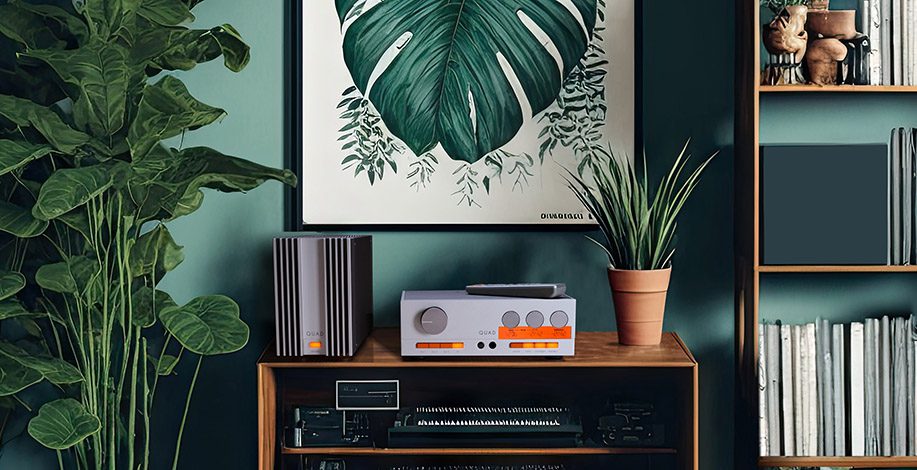
Nostalgia ain’t what it used to be.” This aphorism has been circulated for as long as I can remember. However, it is only thanks to the power of the internet that I can assert, with some degree of certainty, that it is formally attributed to the American writer Peter de Vries in his 1959 novel The Tents of Wickedness. Just eight years after that publication, another Peter, Peter Walker, founder of Quad Electroacoustics, released the company’s first solid-state technology amplification system in the form of the 33/303 combination. He referred to them as a control amplifier with a matching power amplifier.
Pictures used in advertising at the time show a couple sitting in front of a single Quad ESL electrostatic loudspeaker, which was launched in the same year as the amplification system. When I first saw pictures of the new Quad 33/303 combination in the late months of 2024, my first and overwhelming sensation was a wave of nostalgia, reminiscent of what it used to be. Although I was only a teenager when Quads appeared, I was already well aware that the Dansette player I was using might not be the last word in audio reproduction.
Burning a hole
In 1981, with money from a significant commission cheque burning a hole in my pocket, I ventured into a hi-fi shop close to where I worked in Tottenham Court Road, London. After several visits and long chats with the salesman, Lee, I purchased my first ‘proper’ audio system. A Quad 44. control amp, a Quad 405 MkII stereo power amplifier, a pair of Rogers Studio One loudspeakers, a Luxman direct drive turntable and a Luxman cassette player/recorder. That system served me for over a decade until I replaced the 405 with a later Quad design, the 606, while the Rogers gave way to another British design, the Castle Howards.
So why am I dwelling so much on the past? In the intervening decades, I spent tens of thousands of pounds on audio equipment without finding anything that served me better than that original system. Only when I stepped from in front of the counter to behind it in audio retail could I start building what I now consider my ultimate system, which combines terrific sound with domestic acceptability. As a reviewer, I am privileged to hear many different components, which I enjoy hugely. Still, I usually have them here for some time, learn their strengths and occasional weaknesses, write about them, and send them back. I rarely get excited about a forthcoming “guest” component, but when I read about the new Quad33/303 combination, I was bursting with enthusiasm.
Nostalgia was a factor, but so was curiosity and an enduring fondness for the Quad brand.
Enthusiasm justified?
Before we determine whether I was right or wrong to be so enthusiastic, let me describe these brand-new, twenty-first-century versions of the pre- and power amplifiers. They may strongly resemble their ancestors, but they are very much contemporary underneath. Starting with the 33, my first impression when I lifted it from the box was its solidity. It feels sturdy, and the toroidal transformer within it gives it a reassuring weight. Once on the rack and wired up, the LED illumination gives off a wonderful orange glow.
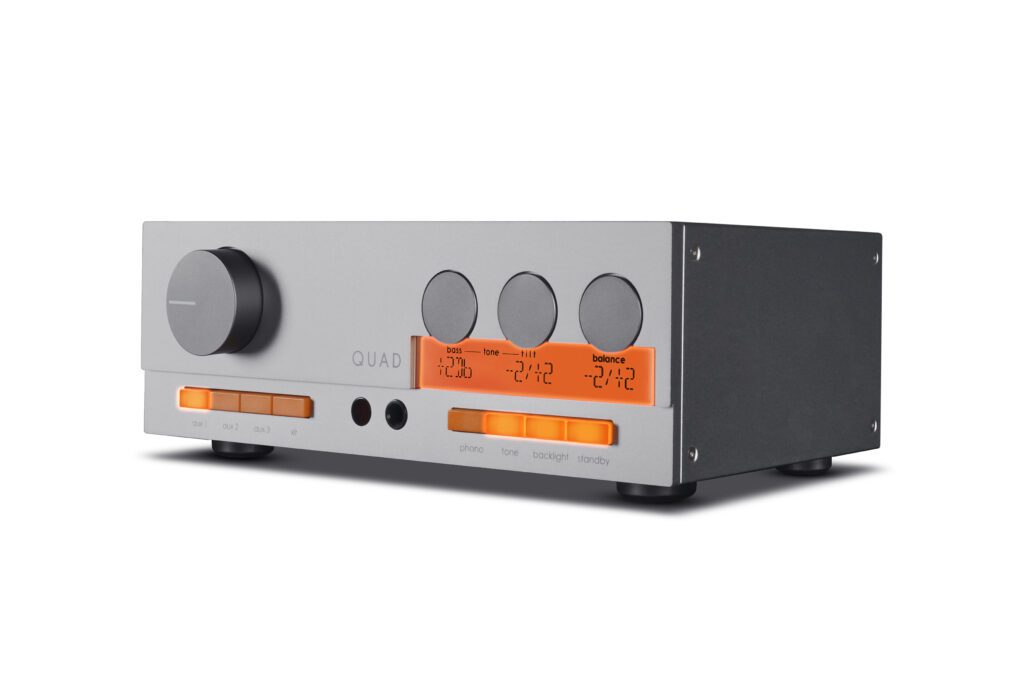
Looking at the front panel, on the left is a rotary control for volume, and below that are four rectangular buttons marked Aux 1, Aux 2, Aux 3, and XLR. To their right are two small black circles: one serves as the receiver for the remote control, and the other is a full-size headphone input. To the right are four rectangular buttons: Phono, Tone, Backlight, and Standby. Above that is the backlit LED screen, which displays the amount of bass adjustment applied, the amount of tilt dialled in, and whether the balance has been adjusted. These three functions are controlled via rotary controls above the LED screen.
Tilt?
So, what is Tilt? Peter Walker developed this idea because he felt that separate tone controls were inadequate and clumsy. Quad says, “The Tilt control differs in that it adjusts both ends of the frequency spectrum together, either attenuating the bass and lifting the treble or lifting the bass and attenuating the treble in 1dB steps.
“It rotates – or tilts – the audible frequency range on a 700Hz axis, thereby adjusting the overall sound balance with ‘warm’ or ‘cool’ hints without altering volume or adding colour to the sound. This feature is unique to QUAD and offers a subtle, precise, and consistent way to adjust your system’s performance and compensate for recordings or environments.” My old Quad 44 was equipped with a Tilt control, so this was not a new concept for me, but it may take some acclimatisation for someone new to Quad.
Switchgear
The rear panel features an IEC input socket for mains power, located at the bottom left. Above that is an on/off rocker switch. The next cluster of sockets relates to output. There are two pairs of XLRs and two pairs of RCAs, allowing the user to choose either. Additionally, a second pair of output RCAs is marked ‘Aux’ for connection, for example, to a subwoofer. The right-hand side is given over to inputs, comprising a pair of XLRs and two pairs of RCAs, with two additional pairs of RCAs positioned above them. The right-hand ones are specifically for access to the built-in phono stage.
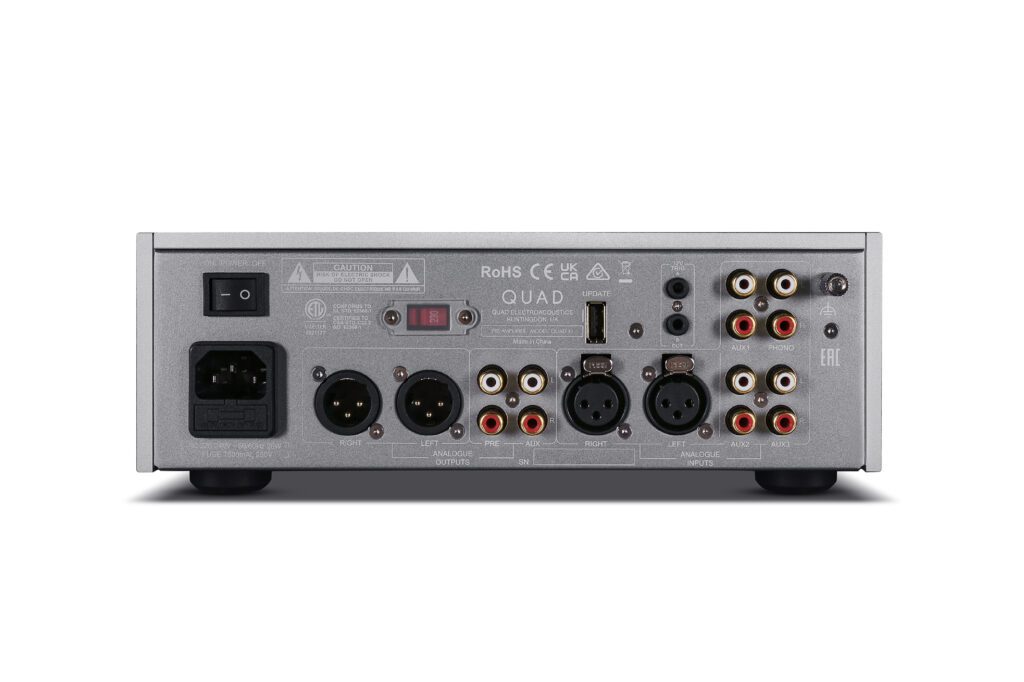
There is a grounding pin to the right of those. A small pair of sockets for the 12V trigger system is also available to power up the 33 and the matching 303 power amplifier simultaneously. The supplied remote control is excellent, allowing access to the tone controls and the inputs while giving precise level settings for the volume.
Faithful
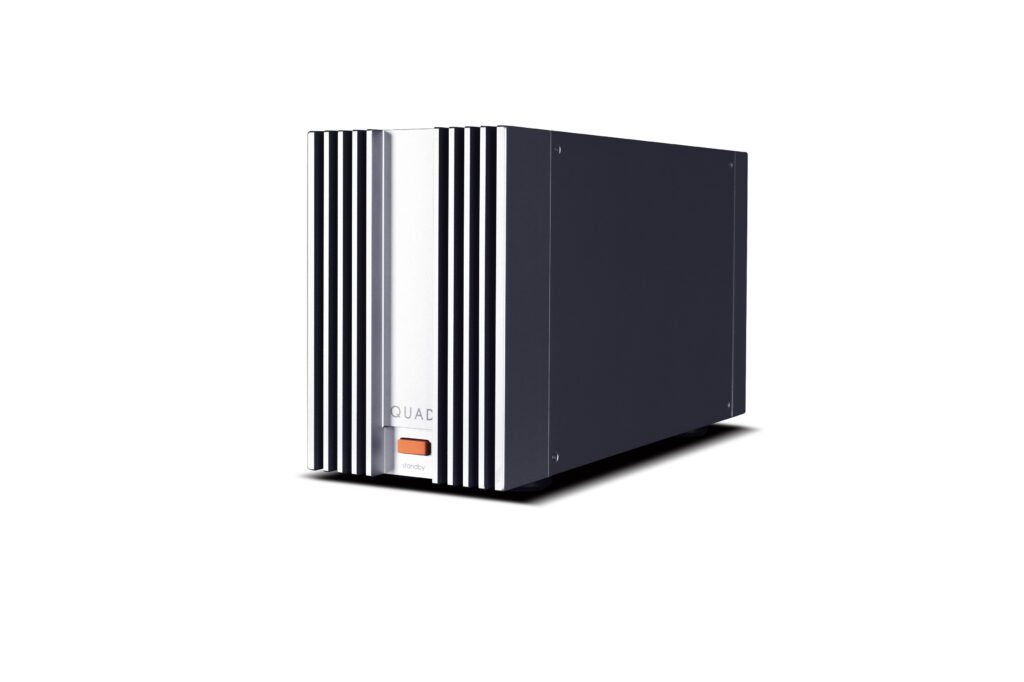
Turning to the 303 power amplifier, the designers at Quad have remained faithful to the original version in terms of size and shape but have again built a contemporary piece of engineering within the familiar exterior. At the flip of a switch on the rear panel, the 303 can be used as a standalone stereo amplifier, delivering 50W per channel into an eight-ohm load or 70W into a four-ohm load. It offers the user the choice of XLR or RCA connections to a pre-amplifier, two pairs of multi-way binding posts, and an IEC input socket with an on/off rocker switch above it. The front features a single orange rectangular switch in the lower centre, which activates the unit and is illuminated when the power is on.
I started the review using a single 303 in stereo mode. I connected the visiting Gold Note CD5 using Tellurium Q Ultra Silver II XLR cables, and the guest turntable, a Michell Orbe SE, fitted with Michell’s own Cusis M moving coil cartridge in the Michell TechnoArm A-II, was plugged into my own Gold Note PH10/PSU phono stage. This was connected with Vertere RedLine RCA cables to the 33. My pair of Harbeth Compact 7ES XD loudspeakers completed the system, connected to the 303 using Tellurium Q Ultra Silver II cables.
Listening To the 33/303
As I do not own a standalone DAC, and the 33 is strictly an analogue-only device, I used only CD and vinyl throughout the sojourn of the Quads at Kelly Towers. I let the units warm up for a day with a selection of compact discs before starting to do any serious listening, but even cold from the box, I was struck by the engaging nature of the sound being delivered.
The first CD to be loaded into the Gold Note’s drawer was an Audio Fidelity gold CD, issued in 2011, of Crosby, Stills, and Nash’s eponymous first album from 1969. As the opening notes of the first track, ‘Suite: Judy Blue Eyes’, poured into the room, I was drawn into the music. Stephen Stills and his bandmates had wandered into my room and were positioned just ahead of the loudspeakers. Their voices were clear, well-defined and, for me at least, as lovely as ever. I had intended to play just a few tracks, but could not tear myself from my chair until the last track ended.
Terrific
I played a couple more compact discs, then switched to vinyl, and was not surprised that from the outset, this sounded terrific. As I was on a Stephen Stills kick, the first album onto the Orbe SE’s platter was an original 1972 copy of Manassas on the Atlantic label. Although Stills’ name is prominent on the cover, this is truly a band effort, and all the better for it. The four sides each have a theme, and side one is titled ‘The Raven’, and starts with the rocking ‘Song Of Love’ and ends with the gorgeous ‘Both Of Us (Bound To Lose)’, on which Stills shares the writing credit with Chris Hillman, formerly of the Byrds, but a key member of this band. The music had real rhythmic drive, and with the volume advanced halfway through, it was an awe-inspiring performance.
Unable to resist, I reconfigured the system, adding the second 303 I had been sent and now running a pair of them, bridged to mono. The power output was increased to 140W into an eight-ohm load and 170W into a four-ohm load. I cued up Manassas again and lowered the stylus onto the black disc. Oh my goodness! The same music positively leapt from the Harbeths, transporting me to the studio with the band and encouraging me to listen to their contribution while immersed in the overall sound.
Keep playing
Record after record followed because this system made me want to keep playing music. From modern pop, à la George Ezra, through 1950s jazz, to rock, folk, classical, and electronica, the 33/303 trio delivered. Two final system changes were made to complete the review process. First, the Gold Note PH10 was disconnected from the 33, and Michell’s cables were attached to the phono input on the pre-amplifier. Setting up the Moving Coil was a straightforward process. I cued up the second side of my early 1970s pressing of Pink Floyd’s Meddle. I sat through the 20+ minutes of ‘Echoes’, absolutely absorbed in the complex music. This fine phono stage is quiet when not in use and will make a fine match with many mainstream cartridges.
Lastly, I removed the Harbeths from the system and replaced them with a pair of Wharfedale Super Lintons mounted on their dedicated stands. Again, I allowed the newcomers some time to warm up before sitting to listen more closely. What a team they make, the Quads and the Lintons. Yes, this turned the nostalgia to 11, as I had lived with a pair of original Lintons in the early 1970s. However, this modern version is a better-built and sounding device than its illustrious forebear. Modern drive units, a carefully designed crossover, and significantly higher-quality cabinetry and internal bracing make this new version impossible to ignore at its price point. That said, I found this whole system’s visually retro appeal irresistible.
Warmer
At the end of the review period, I reluctantly dismantled this system. I liked the way it looked at the other end of our lounge, and I also enjoyed the sound it created. If you have grown up with modern audio equipment, the Quads are slightly less analytical, perhaps a tad warmer tone than you are accustomed to. However, you will not want to hear details or musical communication.
If I were buying and had the budget, I would go for the 33 with a pair of 303s. You will own a first-class amplification system for under £4,000 here in the UK. If they were coming here, I would site each 303 close to the speaker, which would drive the use of XLR to carry the signal the width of the listening room for the 33, requiring much shorter runs of loudspeaker cable.
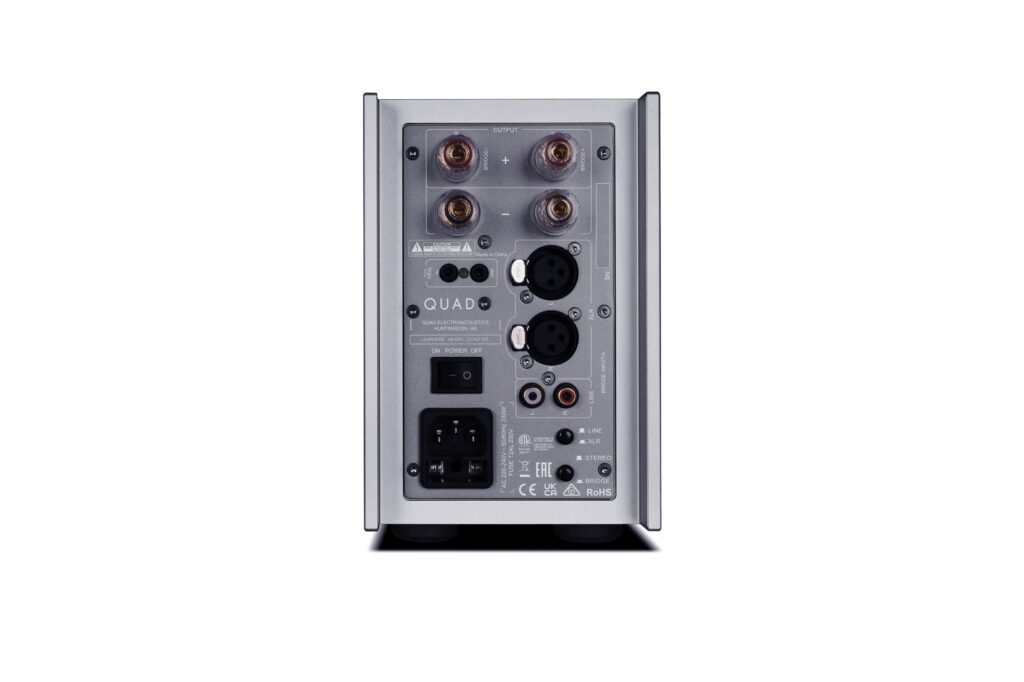
I would also set up the 12V trigger system so the 303s woke up when I took the 33 off standby. More than once during the first days of their stay, I took the 33 out of standby, cued up some music, and then was momentarily puzzled by the absence of music, having forgotten to wake up the power amplifiers. They turn themselves to standby mode if they detect no signal for a period. My feeble excuse is that my amplifier is integrated, so I never have to take that extra step.
Streaming?
If you prefer to stream your music, remember that the 33 will require you to connect an external DAC, as it is resolutely analogue only. I enjoyed the forced abandonment of my iPad and a full-time return to using physical media. One unexpected but welcome consequence was that I listened to whole albums, undistracted by fiddling with an app to find the next piece to play.
It came as no surprise that the Quad/Harbeth combination worked so well. I know that Alan Shaw, who designs Harbeth loudspeakers, uses a Quad 405 Mk II as one of the tools in his development laboratory. However, I am sure the amplifiers will work well with many modern loudspeakers. They have enough power to stir even the most challenging loads into musical action.
When the Quads arrived, I fell for their looks. By the time they left, I had fallen for their performance. These are a first-class, carefully conceived, and brilliantly executed homage to Quad’s illustrious history, but should appeal equally to those unfettered by the remembrance of times past and are highly recommended.
Technical specifications
Quad 33
- Type: Line and Phono Preamplifier with headphone amplifier
- Inputs: 3 x RCA, 1 x Balanced XLR (pair), 1 x Phono (MM/MC switchable)
- Outputs: 1 x RCA (AUX), 1 x XLR, 1 x RCA (Pre Out), 1 x Headphone, 2 x 12V Trigger Out
- Frequency Response: 20Hz – 20kHz (±0.2dB)
- THD: <0.0005% (1kHz, Line/XLR), <0.002% (1kHz, Phono MM / MC)
- Signal-to-Noise Ratio: > 108dB (A-weighted, Line/XLR), > 82dB (A-weighted, Phono MM), > 74dB (A-weighted, Phono MC)
- Output Impedance: 120Ω
- Headphone amplifier output impedance: 2.35Ω
- Headphone amplifier load impedance: 20-600Ω
- Dimensions (WxHxD): 25.8×8.3×16.5cm
- Weight: 4kg
- Price: £1,199, $1,599, €1,499
Quad 303
- Type: Class AB bridgeable stereo power amplifier
- Inputs: RCA stereo pair, XLR stereo pair, 12V trigger
- Outputs: Loudspeaker terminals, 12V trigger
- Rated power output: Stereo: 2 x 50W (8Ω, THD<1%), Bridged: 140W (8Ω, THD<1%)
- Frequency Response: 20Hz – 20kHz (±0.3dB)
- THD: <0.002% (1kHz)
- Signal-to-Noise Ratio: > 108dB (A-weighted)
- Input impedance: 15kΩ (Line), 22kΩ (XLR)
- Dimensions (WxHxD): 12×17.6×32.5cm
- Weight: 8.4kg
- Price: £1,199, $1,599, €1,499
Manufacturer
Quad Hi-Fi
+44(0)1480 452561
Trending Articles
See all
By Chris Kelly
More articles from this author

Read Next From Review
See all
Eversolo T8
- Oct 13, 2026
Acoustic Energy AE Active
- Oct 13, 2026
Reiki Audio SuperSwitch X/Pro X PSU
- Oct 06, 2026
Audiobyte SuperVOX
- Oct 06, 2026