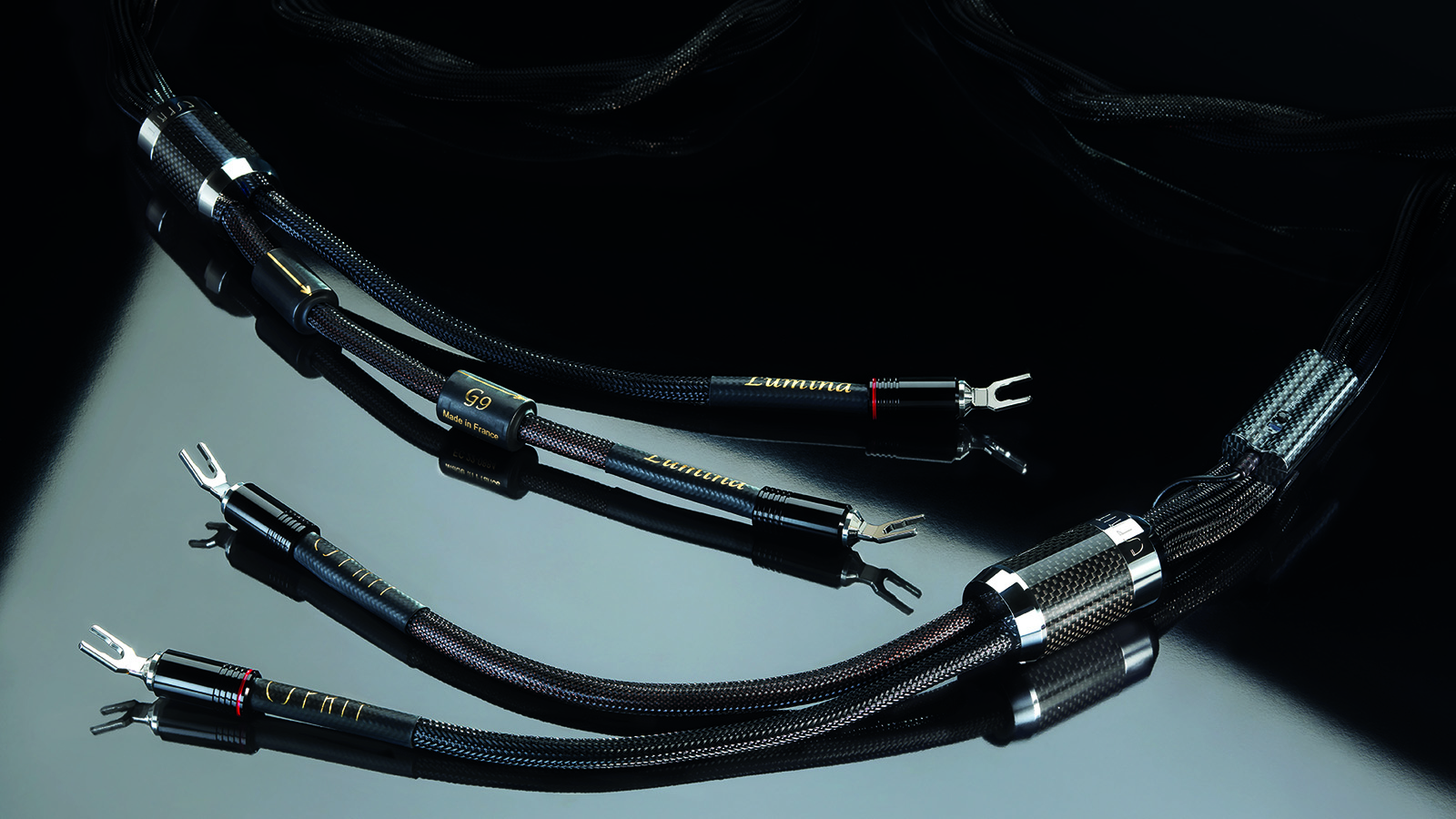
More people should know about Esprit Audio. Its cables are both consistent and consistently excellent. The close-to-the-top Esprit Audio Lumina range tested here can go up against some of the audio industry’s finest without fear. Esprit cables are well-built and use the right materials. If you seek to score high-end ‘cred’, they are ‘reassuringly expensive’. However, they are not so insanely expensive as to draw scorn from the masses. Better yet, the reasons behind their price are self-explanatory and far removed from the ‘more quantums per magic bean’ end of a somewhat crazy cable market. And yet, Esprit Audio routinely – and undeservedly – flies under the radar.
The brand is the brainchild of designer and electromagnetics engineer Richard Cesari. He founded Esprit Audio in 1996. This was primarily because he made some audio cables for himself that were so well received by audiophile friends. As a result, the next step was obvious. The ethos of using the best materials for the task and assembling the cables in the best possible way holds at Esprit to this day. So, Cesari still has oversight over the construction and design process. The hand-assembled cables are still made in Colofens, in South-West France.
Foodie cable
The French love their food, and perhaps unsurprisingly, Cesari likens the design of cables to cooking: “ If you don’t know how to combine the ingredients, you can have the best and still be wrong. On the other hand, if you know how to combine them, you can achieve exceptional results.” Like any good cook, the difference between throwing a few ingredients together and making something fantastic is a skill born out of decades of experimentation and testing. So, where all Esprit cables use fine, multi-strand, high-purity copper conductors throughout, the number of strands and the way those strands are laid out define the Esprit Audio sound. This applies from the most entry-level to the highest-end cables.
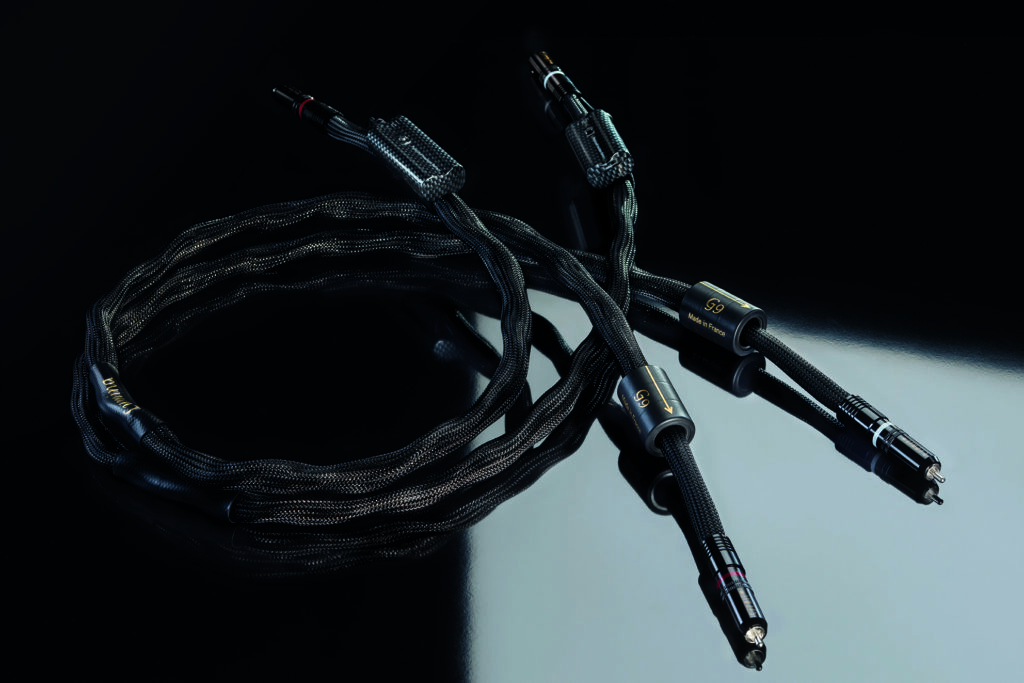
In Esprit Audio Lumina’s interconnects, this means using 6N purity OCC copper conductors with a 20-micrometre silver plating. These sit in a symmetrical star configuration. The cable uses two different dielectrics (PVC and silicone) for send and return conductors. The dielectric’s polarisation is a core element in the Lumina design. In the interconnects, this polarisation is activated using a battery pack. That sounds a little Star Trek, but it has precedent.
Conversely, the speaker cable employs an impressive 6,800 strands of 0.08mm 6N purity OCC copper, organised into ten bundles of 680 strands per conductor. Once more, the dielectric is asymmetrical, and the cable is semi-shielded to reduce capacitance. The independently jacketted conductors coil around one another.
Proper run-in
The Esprit Audio Lumina cables benefit from a proper running-in session. They greatly improve after a few dozen hours connected to a system. Whether this is due to the cable adapting to its environment or some form of electrical conditioning remains unclear and is largely irrelevant. Moreover, the performance improvement isn’t one of those ‘rollercoaster’ situations. In other words, it is not where one day it sounds good and the next it sounds dreadful. Luminar sounded quite good from the beginning. It only enhanced over the course of a few days.
The interconnects appear to take a bit longer to bed in than the loudspeaker cables. I also had digital and power cords in the mix, which also benefited from a few days of resting and playing. However, even straight out of the box, these cables sounded exceptionally good, and just a weekend of rest and relaxation adds a little extra to their performance.
I subscribe to the notion that all cables filter the sound to some extent, but the best cables filter the least. This is certainly true here; these cables do not alter the sound of the devices to which they are connected. They also add no blooms, peaks, or troughs to the audio. If there is any accent at all, it is very mild and resembles the presentation of the classic BBC LS3/5a. However, it’s not a comparison; the Lumina cables offer greater dynamic range and frequency extension than that petite mini-monitor.
Good character
What Lumina excels at is highlighting the character of the music rather than the sound of the system. In that sense, it’s the complete opposite of the ‘stark clarity’ type of sound. Instead, it offers a natural and perhaps even more appealing sound quality than the real thing. This is precisely why the LS3/5a came to mind.
That’s not to say Esprit Audio Lumina has a warmed-up sound; it simply puts you in a good frame of mind for listening to music. I found myself becalmed by the music I played through Lumina in my system. However, that sense of calm did not shape my musical tastes. You could play some rough-and-ready punk through these cables, and they would deliver a performance as energetic as a string quartet is cerebral. But that ‘aaaahh!’ quality that puts you in a good musical frame of mind was ever-present.
The soundstage size and precision are notable. Lumina produces a large image, slightly in front of the loudspeakers. If it’s in the recording and the system can reproduce it, Lumina will reveal it. Coupled with a lyrical sense of musical articulation and a dynamic range that is exceptional, Lumina is an ideal companion for fine piano music.
We often find cables that claim to be neutral, but such cables add a touch of zing to the sound. Therefore, it’s genuinely refreshing to encounter a set of cables that produces natural and captivating music. That captivating quality likely gives Esprit Audio Lumina an advantage across various genres. Finally, it’s now a system I will incorporate into my regular cable arsenal!
Prices and Contact Details
- Interconnect: RCA, $3,400, €3,810/0.6m; XLR, $3,700, €4,150/0.6m
- Loudspeaker cable: $6,100, €6,830/3m
Manufacturer
Esprit Audio
UK distributor
Midland Audio Xchange
+44(0)1562 731100
Tags: CABLES ESPRIT AUDIO LUMINA
Trending Articles
See all
By Alan Sircom
More articles from this author

Read Next From Review
See all
Reiki Audio SuperSwitch X/Pro X PSU
- Oct 06, 2026
Audiobyte SuperVOX
- Oct 06, 2026
Unitra WSH-805
- Sep 29, 2026
Wilson Audio Sabrina V
- Sep 29, 2026