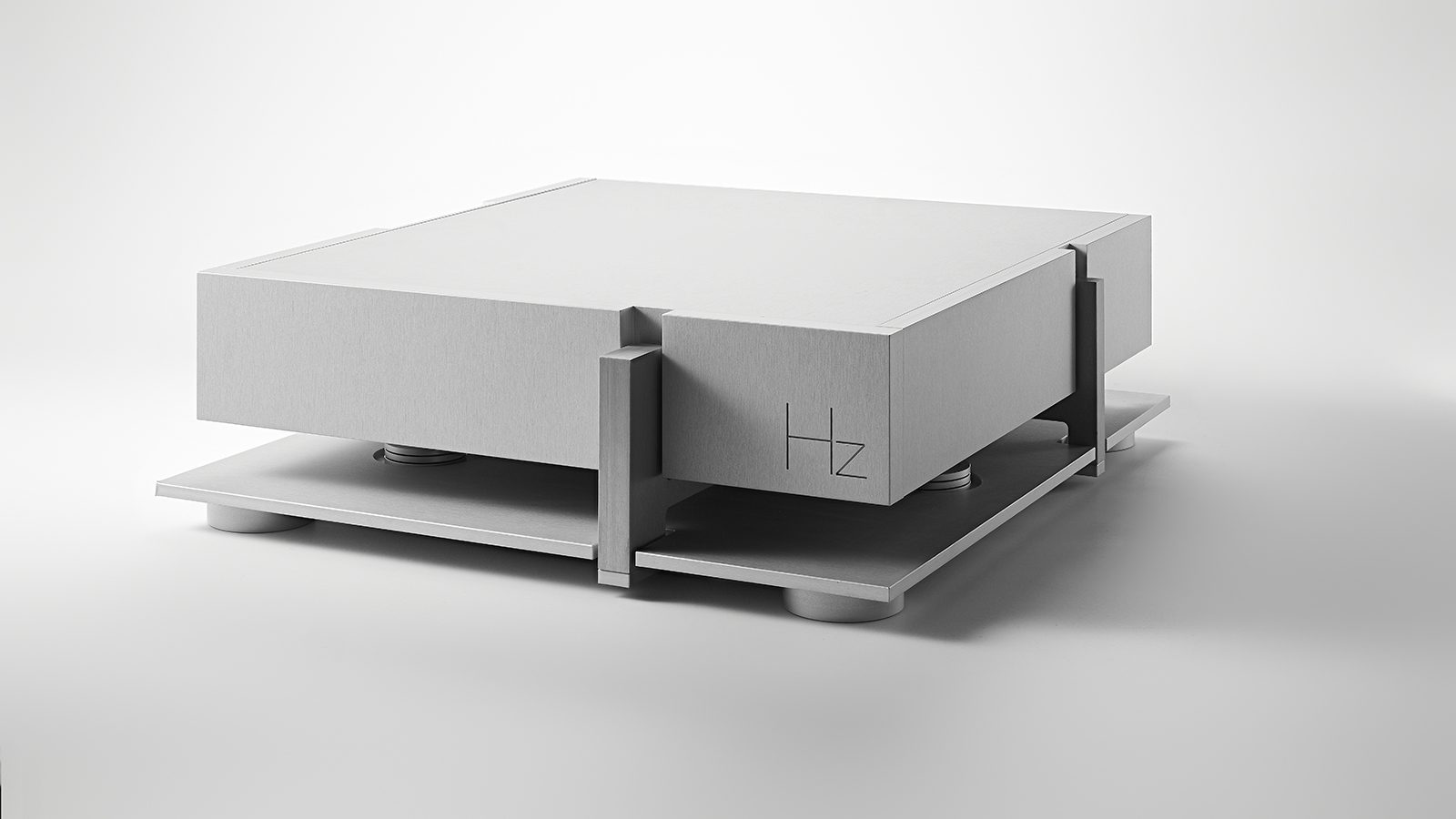
Network audio is a curious juncture between the audio industry wanting to do things on its terms and headbutting the broader applications of the equipment. Building products out of materials you usually reserve for things you’d shoot into space is unnecessary. One area where it seems possible to polish the cannonball reliably is with server solutions. The benefits of ensuring that the server doesn’t introduce unwanted noise (either over the network or USB) are generally repeatable and worth pursuing. And, taking cannonball polishing to the next level, the HzCORE Server from South Korean firm HzProject feels like a mirror-finished projectile.
HzCORE has an internal storage of SSD (1TB, 4TB or 8TB) to keep music files, but it primarily performs as a device to deliver music files via ethernet in Roon’s RAAT form to Roon Ready devices (from streaming directly or sending music files stored in an internal SSD) or via USB output to non-Roon Ready DAC. (an Audirvãna version is in the pipeline, too). It combines internal storage with enough processing hardware to run Roon with vigour. It’s a genuinely formidable piece of overengineering on all counts. HzProject is a new arrival in the market, and the specifications of the HzCORE make a very definite statement.
Physical storage
The physical storage is straightforward enough. The review sample arrived with a 4TB SSD in place, but the drive fitting is standard, and other capacities would be possible. The drive itself sits in a CNC-machined structure intended to shield it from unwanted interference from the rest of the HzCORE’s workings.
These workings are where things begin to get interesting. For starters, you’ll find more dedicated enclosures for different components, but they are not simply identical versions of the drive cover. The clock gains one made of aluminium and wood in a layered sandwich effect, while the power supplies are contained in enclosures made of aluminium and copper. Each has been designed for the job rather than a one-size-fits-all approach.
The components themselves are also notable. There are two separate PSUs, one 5v and one 12v. These supplies are separated further, so there are dedicated taps for each of the main components used on the board, and each is isolated from the other. Both power supplies are linear, and the termination on the back is an IEC socket rather than an external block.
Home of the clock
Inside its wood and metal home, the clock is a high-quality oven-controlled crystal oscillator with dual outputs for the motherboard and ethernet sections. The processing hardware is designed so there is no need for forced cooling. This ensures that the HzCORE is entirely silent in use, with not so much as a gentle buzz from the power supplies to break the silence.
Let me put it differently if the preceding paragraph has induced a slight ‘my eyes glaze over’ effect. The HzCORE is roughly twice as powerful as my resident Roon Nucleus, which I’ve never thought of as slow. In use, it’s run with assurance and overall slickness that suggests, regardless of what Roon might have planned, the HzCORE will handle it.
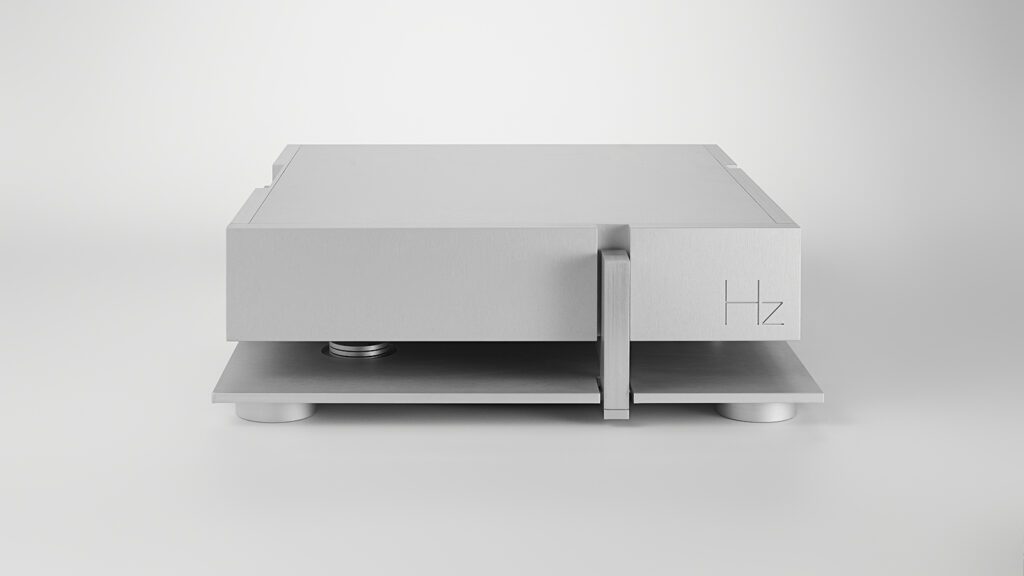
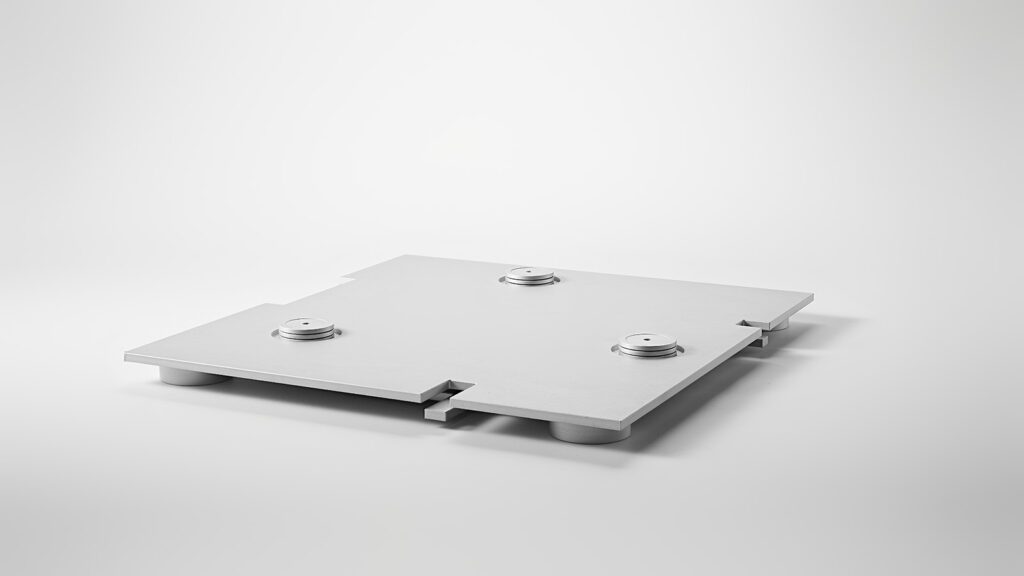
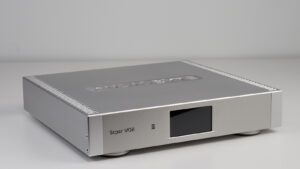
The HzCORE’s casework enhances that feeling of permanence. It’s made of 15mm thick aluminium and feels quite absurdly substantial. What is genuinely interesting is that HzProject’s efforts at isolation don’t simply end at ‘putting everything in a big metal box.’ The chassis has three partially decoupled feet, which sit proud of the main enclosure thanks to Stillpoints isolators. Then, an optional platform supports the HzCORE and the trio of feet slot into apertures, which supports the whole server on special isolation gears within the sub-chassis. This casework adds up to a lot of metal and a considerable amount of engineering, and the result takes up a fair bit of room, but you can see where the effort goes.
Striking
The HzProject HzCORE is a striking-looking bit of kit, too. Sat on the support platform, the HzCORE looks like an architectural scale model of an ambitious piece of brutalism; think Boston’s City Hall meets the National Theatre in London. However, it looks sensational because the HzCORE uses high-quality aluminium rather than weather-ravaged concrete. I had never really considered the idea of a server being a visually distinctive front end for a system, but this device is striking and sufficiently well-finished that it could legitimately be the focal point of a system.
Neither was the HzCORE finished there in terms of surprises. I volunteered for this review because I am somewhere between a Roon enthusiast and an evangelist, but I’m not blind to its absolute limitations. My personal Nucleus NUC does not act as the content library; that falls to a venerable Melco N1A. Not only does this allow me to test non-Roon devices, but I genuinely feel that files from the Melco sound better than the same file stored on the Nucleus, and I had some doubts about whether the HzCORE would be better doing both jobs than my split role duo.
It didn’t take much time for an 88.2kHz rip of Dead Can Dance’s Toward the Within [4AD] to have me revisit this belief. I’ve used the opening Rakim as a test piece for years because it’s a magnificent recording that stands up to repeated listening, and that’s particularly true here. The HzCORE doesn’t alter any of the basics feeding to my front end of a Chord Electronics trio comprising 2Go and 2Yu into a Hugo MScaler and TT2 DAC. Still, it does serve to refine what they are doing and often appreciably so.
Palpable improvement
From the opening applause, there is a palpable improvement to the already superb soundstage this live recording boasts. The HzCORE doesn’t interfere with the tonality or try to augment the sensational bass. The effect is more that every component that makes up the track is slotted together to make a more solid and cohesive whole. Picking up the tempo with Pale Green Ghosts by John Grant [Bella Union] sees the timing and cohesion of the title track sound a little faster and more together, while still framing Grant’s magnificent vocals as the main event. The result isn’t a change to the presentation of a set of electronics I’m fond of; it’s still my system, but better.
Extra horsepower
It has another party piece on offer, too. Where that extra processing horsepower starts to make itself felt is when you begin to make use of the extra bells and whistles of Roon. The upsampling, both PCM and with DSD transcoding, is audibly better than my Nucleus, and the headphone DSP options, tested via a pair of Focal Clear MGs connected to the TT2, are also bolstered considerably. Roon is good software, but even running as an OS, it’s reasonably hardware-intensive. The extra grunt of the HzCORE does make itself felt.
Interestingly, despite HzProject describing their handiwork as optimised for network rather than USB connection, I’ve found the performance with the TT2 connected directly via USB to be no less impressive, with the same comments on upsampling and headphone adjustments applying via this connection method, too. I’ve also found it interesting that content played directly from Qobuz – thus not benefitting from being stored on the HzCORE – sounds better than the same files stored on my Melco. The differences are minor but listening to the thunderous Nox Anima by Scratch Massive [Bordel] streamed on Qobuz still leaves me feeling that the HzCORE is achieving something that stored music on my Melco cannot. That feeling of cohesion and control permeating the Dead Can Dance recording is still perceivable here.
BC to AD?
No network hardware has ever made a sort of ‘BC/AD’ difference to my listening experience, but the HzCORE is probably the device that has got the closest. There is always – for me at least – an awkwardness in reconciling that hardware that successfully performs other heavy-duty tasks without breaking a sweat might have limitations around the notionally simple business of sending a music file from one location to another. Still, this striking-looking device demonstrates that there is a bit more to it. In an industry of incremental gains, the HzCORE is a concerted effort to make everything ‘just so.’ The result is a genuinely formidable Roon Core that can compete with anything else on the market.
Technical specifications
- Type: Music Server
- Network input/output: 1 × Gigabit Ethernet (1000BASE-T)
- Audio output: USB
- Memory: 64GB DDR4-3200 (2 × 32GB modules)
- System Storage: 256GB MLC SSD (for OS and system files)
- Music Library Storage: 1TB / 4TB / 8TB options (2.5” SATA SSD)
- Clock & Timing: Master Clock Accuracy: ±10ppb OCXO
- Number of Isolated Power Rails: 5
- Transformer Design: Dual toroidal
- Power Regulation: Ultra-low-noise linear regulators
- Noise Floor: <10μVrms (10Hz–100kHz)
- Thermal Cooling System: Fanless passive design
- Operating System: Audio-optimised Linux
- Primary Roles: Roon Core/Roon Streamer, Audirva‐na Core Player (expected soon)
- Dimensions (WxDxH): 36.6×38.9×10.5cm
- 36.6×38.9×12.8cm (with optional platform)
- Weight: 10.5kg, 14.5kg (with optional platform)
- Price: £6,900, $8,300, €8,400 (with 4TB SSD), optional platform £790, $870, €880
Manufacturer
HzProject
UK distributor
BOBUSIAN
+44(0)7922 277944
Tags: HZPROJECT HZCORE MUSIC SERVER
Trending Articles
See all
By Ed Selley
More articles from this author
Read Next From Review
See all
Eversolo T8
- Oct 13, 2026
Acoustic Energy AE Active
- Oct 13, 2026
Reiki Audio SuperSwitch X/Pro X PSU
- Oct 06, 2026
Audiobyte SuperVOX
- Oct 06, 2026