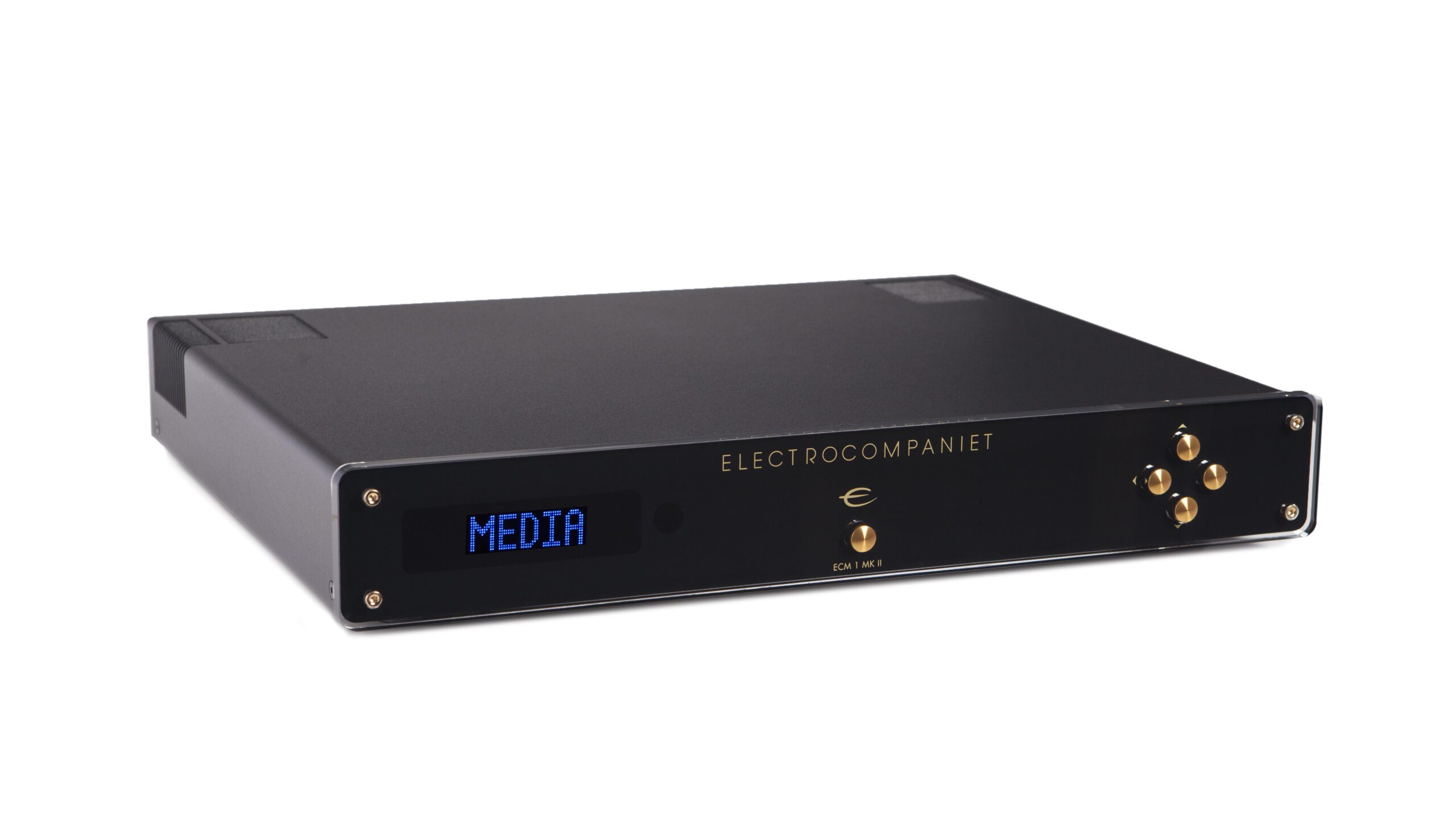
Electrocompaniet is not the only Norwegian audio electronics company, but it is the oldest and the only one that manufactures in Norway. It was part of the same wave that saw Linn and Rega enter the market in the early seventies and has a similar international reputation, especially for its amplifiers. The company achieved this by maintaining technological competitiveness and pushing boundaries. The ECM 1 MkII is described as a DAC and music streamer, and in the latter function, it truly excels.
I was encouraged to try the ECM 1 MkII by Rich Trussel at Network Acoustics, who is always searching for better streaming sources to test his filters and cables. He was particularly impressed with the sound of this Electrocompaniet and emphasised that it operates on proprietary control software. Few companies of this scale develop their own playback apps because it’s time-consuming and consequently costly. It’s much easier to base the software on an existing app, like mConnect. However, Electrocompaniet has a proven track record in streaming; they were the first to integrate Qobuz into their Linux-based software in 2015, and their team in Leeds has been advancing the technology ever since.
Don’t judge a book…
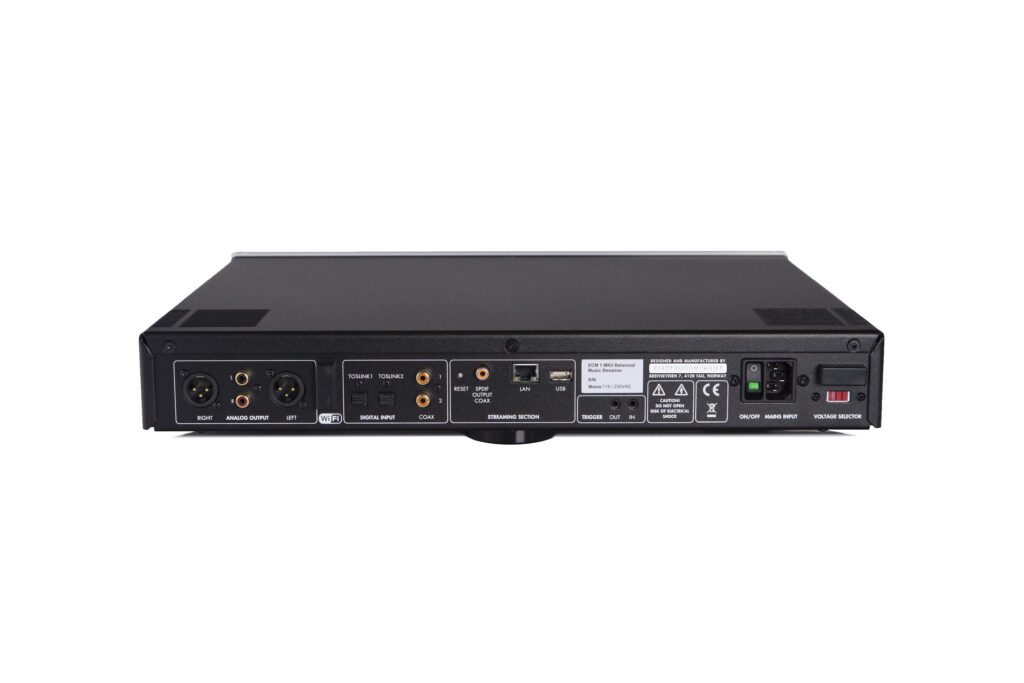
The ECM 1 MkII is a substantial piece of kit. At 470mm wide, it’s too big to fit into one of my racks, but fortunately, it’s not particularly tall. The front panel is straightforward, with just the standby button in the centre and scrolling controls on the right. In practise, you don’t need to use the latter because most of what needs to be done is on the app, and the rest is on the small remote handset. The rear panel isn’t much busier, featuring analogue outputs in the usual form, digital inputs limited to coaxial and optical varieties, and streaming connections that provide a USB port for a separate drive, RJ45 for networking, and a coaxial digital output. There are also trigger connections, should they be of use.
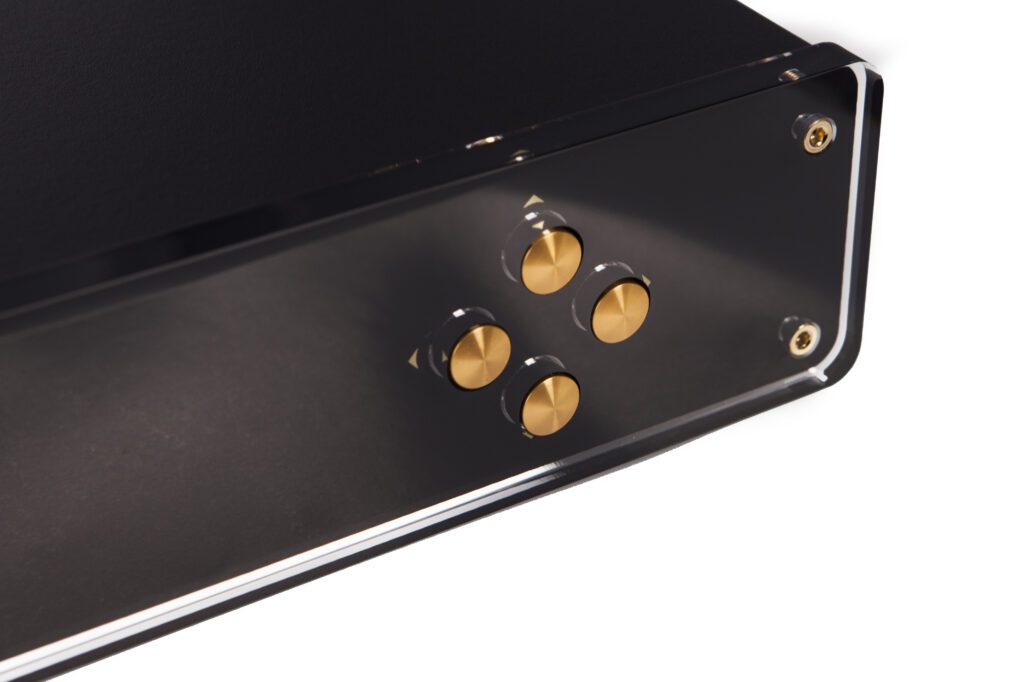
I was surprised not to find more digital inputs/outputs. An AES or USB digital output, for instance, would have been handy. However, this is designed to be a standalone unit that can upgrade sound from sources such as CD players, which generally only have coax or optical outputs. The ECM 1 MkII’s analogue outputs can be volume-controlled for direct connection to a power amp or active speakers.
The DAC onboard does not seem to have been chosen solely for its specifications, which is encouraging. Sample rates are limited to 24-bit/192kHz, adequate for all but a few audiophile releases, but below rates typically found elsewhere, which are often twice this on the sample front. Regarding streaming services, it is current with Spotify, Tidal Connect, Airplay 2, Roon Readiness, and Bluetooth receptivity. Less common is Audirvana readiness, should you prefer the French Roon competitor. Of course, my preferred music service, Qobuz, does not yet offer a Connect option.
The control effect
The EC Play control app may not be the sleekest available in terms of design or Qobuz integration, but it likely sacrifices features to enhance sound quality. It is becoming increasingly evident that control apps significantly influence performance, with some third-party examples improving the sound of streamers through their well-designed applications.
Dealers or end users can install an internal drive on the ECM 1 MkII. Since my sample was not equipped with one, I connected a Melco N10 music library and had EC Play scan its contents. Given that it’s a fairly well-stocked device, this process can take some time, but in this instance, it was particularly slow. Fortunately, this isn’t something you’ll need to do very often, and updating for added albums shouldn’t take too long.
The ECM 1 MkII didn’t respond very positively to the way metadata was stored in many of my music files, often listing the tracks without duration before correcting them. I didn’t investigate this further but suspect it might relate to the Metadatics software I use. Everything on Qobuz functioned as expected. I appreciate how it displays the bit rate of the files being played, regardless of their source. Most systems show the 16/44 bit sample rate but omit the kbps, which indicates the degree of compression or lack thereof for any given music file.
Listen to the music
This Electrocompaniet is an uncannily musical streamer. It hooks you in regardless of whether you are paying attention and makes the music more engaging and fun than most. By this, I mean that you can play relatively complex material while concentrating on something else, and it doesn’t grate. It makes clear what’s appealing about the music by delivering it in unusually coherent form, something that is surprisingly hard for streamers to do, especially with material streamed from the internet à la Qobuz.
The detail levels provided are impressive for the price point, though they don’t break any records. You can easily hear into each piece and separate the different elements in a band or orchestra; however, more expensive options can deliver a more refined rendition. The ECM 1 MkII also tracks dynamics well, suggesting that the perceived signal-to-noise ratio is wide. In musical terms, this means that when the band kicks in behind a quiet intro, you really notice it.
This is evident in Bill Frisell’s version of ‘Shenandoah’ (East/West), which showcases the fabulous effect of his solo guitar being expanded by bass and drums to create a substantial soundstage in all three dimensions. Scale is rendered quite well, as demonstrated by Stevie Ray Vaughan’s ‘Lenny, ‘ where the playing is beautiful and the sound is substantial due to its three-dimensionality and bass weight.
Timing is crucial to all of Electrocompaniet’s qualities; only when everything happens precisely as it should do you experience this level of scale, impact and engagement. It would be intriguing to compare the ECM 1 MkII with a Naim streamer at the same price; an NSC 222 would likely be the model to beat, as while it’s more expensive, it offers greater connectivity. I suspect it would be a close call, thanks to the ECM 1 MkII’s wide range of qualities.
This streamer doesn’t emphasise any particular aspect of the music but paints a substantial and detailed aural picture that you’ll want to keep experiencing. The focus and timing revealed in Keith Jarrett and co’s The Old Country (More from the Deer Head Inn) are inspiring; here, every piece draws the listener in and captivates them. ‘I Fall in Love too Easily’ resonated with me a little more than usual; it sounds absolutely beautiful. I doubt that even Bill Evans could do a better job.
No blur (or Oasis)
On the opening track, ‘Into You,’ from MYT’s eponymous debut, the speed at which this streamer delivers the drums is thrilling. It’s unusual to experience this sense of immediacy with digital sources because they tend to blur leading and trailing edges. The Electrocompaniet does a remarkable job of avoiding this, which helps give the music a more dynamic kick without sacrificing fluency or adding unnatural attack.
I noticed that the version of Ryley Walker’s Golden Sings That Have Been Sung was coming through at half the bit rate of the original CD, 755 kbps, but this didn’t stop the album from sounding particularly good. The way that guitar and piano interplay on ‘Funny Thing She Said’ is superb, if not quite as sweet as what I hear with the vinyl, and this might improve with a higher-quality file, though vinyl does have other advantages.
By developing the EC Play app, Electrocompaniet has given the ECM 1 MkII a clear advantage. However, it is also a well-thought-out and executed piece of hardware; you can’t make a streamer great with software alone. I suspect that with a drive installed onboard and filled with quality rips and downloads, this streamer will deliver a result that will charm the majority of those who hear it. It possesses the ability to engage both heart and mind, drawing the listener in and revealing what’s magical about the music, which is quite an achievement for any piece of equipment. Add to this the solid build quality and Electrocompaniet’s heritage, and you have a streamer that should be on anyone’s must-hear list.
Technical specifications
- Type: Solid-state network streamer, DAC, digital preamplifier.
- Analogue Inputs: none.
- Digital Inputs: Two coaxial S/PDIF (via RCA jacks), two TOSLink, RJ45 ethernet.
- DAC Resolution/Supported Digital Formats: FLAC/WAV/MP3, etc. Sampling rate for D/A conversion 192kHz/24 bit.
- Music services/Wi-Fi inputs: Spotify Connect, Bluetooth, Airplay 2, Qobuz, Audirvana, Tidal Connect, Roon Ready, Bluetooth, internet radio
- Analogue Outputs: One stereo balanced (via XLR connectors), one stereo unbalanced (via RCA jacks).
- Digital Outputs: One coaxial S/PDIF (via RCA jack).
- Frequency Response: 05 – 48kHz.
- Distortion (THD + Noise): 0.0005%.
- User Interface: Display (on main unit), EC Play application software for iOS, Android.
- Dimensions (HxWxD): 80 x 470 x 381mm
- Weight: 8.3kg
- Price: £5,249, $5,700, €5,249
Manufacturer
Electrocompaniet AS
+47 51 74 10 33
UK distributor
Elite Audio UK
0800 464 7274 (UK only)
Trending Articles
See all
Primare PRE60/ATC SCM150 ASL system
- Jul 06, 2016
Reiki Audio SuperSwitch Pro/Pro Statement
- Mar 27, 2024

Computer Audio Design CAT computer audio transport
- Oct 13, 2014


By Jason Kennedy
More articles from this author


Read Next From Review
See all
OePhi Kali
- Sep 08, 2026
Technics SC-CX700
- Sep 08, 2026
Ruark Audio R610
- Sep 08, 2026
Ultrafide Audio DIAS-U8
- Sep 07, 2026