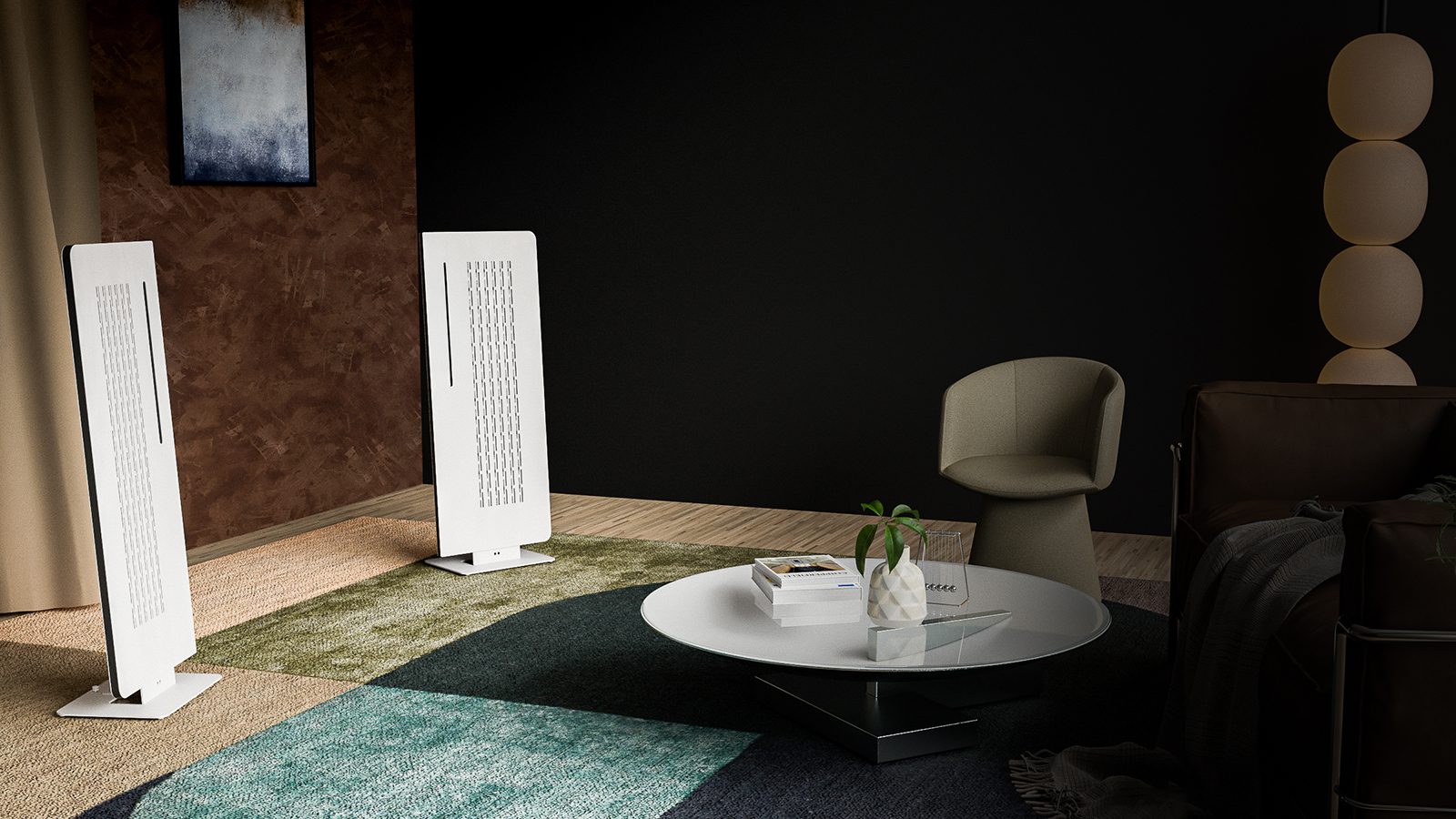
A friend visited and saw the speakers. “Hold on, what are those?” they asked. “They’re speakers,” I replied. “Really?” they said. “Yup,” I said. “Do you want to hear them?” “Yes, please,” they said. The music started, and within seconds, my friend looked at me with a big smile and then burst out laughing. “What?!” they exclaimed. “I know, they’re good,” I said. They looked at me. “Good? They’re incredible! The band is in the room!” That was not a singular experience. Welcome to Diptyque’s DP115 Planar Magnetic floorstanding loudspeakers.
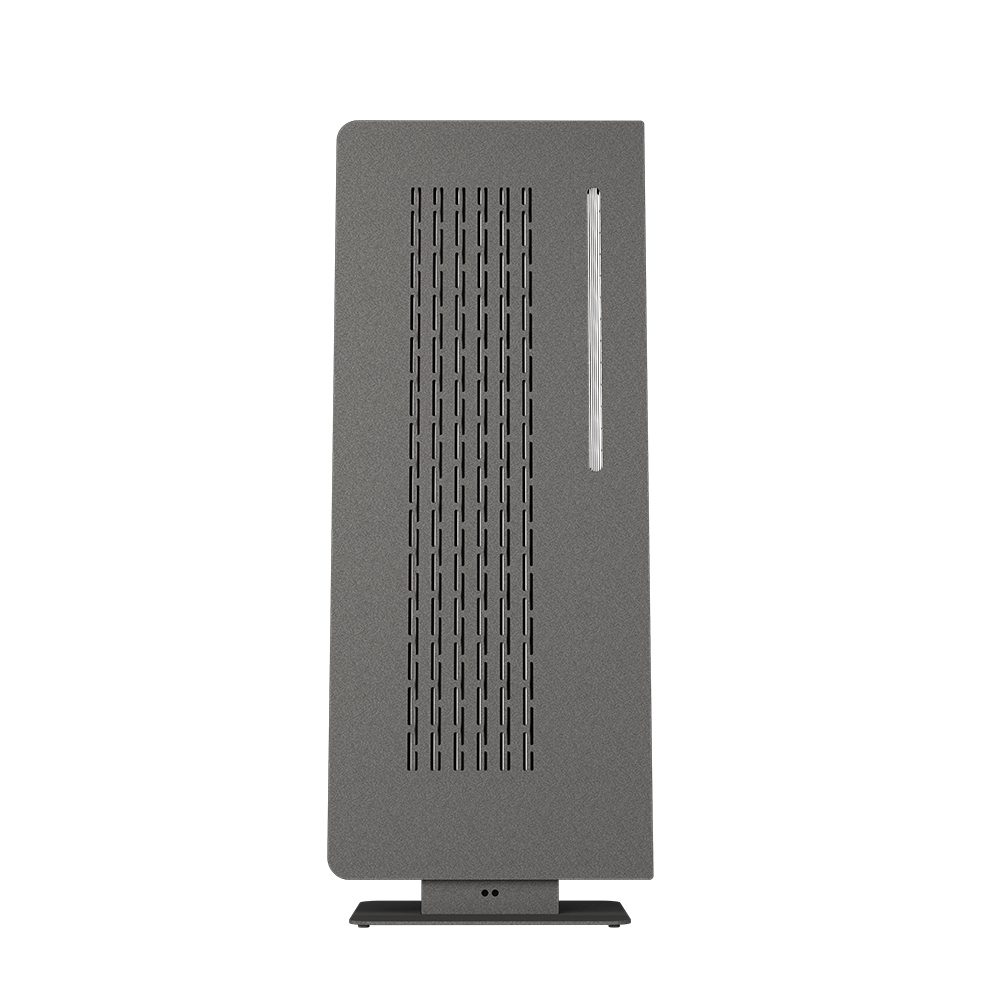
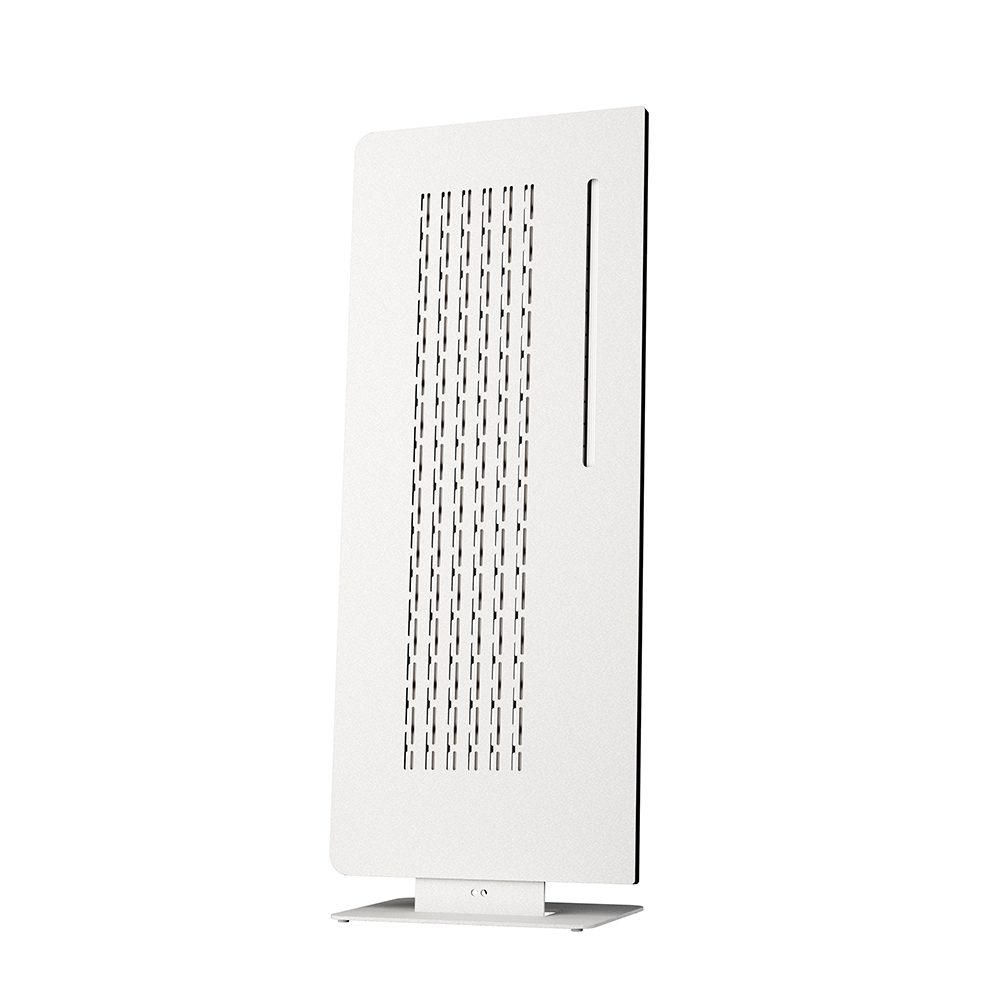
There is clearly something special about the Diptyque DP115 speakers – both in sound and appearance. The review pair was powder-coated in a charming copper colour with a black felt edge trim from ‘Laoureux’. It is one of 160 RAL colours available for an extra £600. Black and white are the free options. The size and shape are distinctive, especially in terms of depth, which measures just 3cm, and height, which is 120cm, with a width of 47.5cm. They stand on integrated stands that tilt the speaker back a few degrees, and this tilt can be adjusted using an optional rear-mounted thumb screw.
In-house
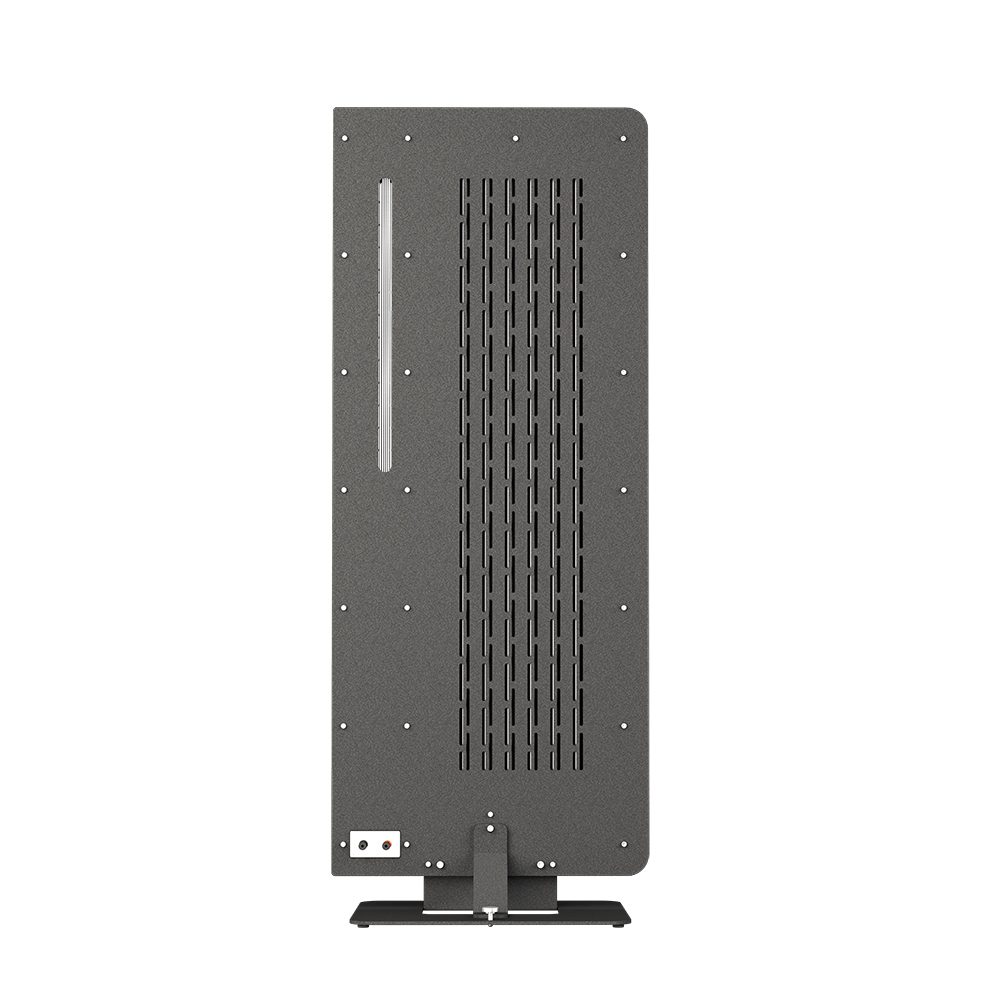
The Diptyque D115 is a floorstanding loudspeaker equipped with proprietary in-house planar-magnetic drive units. The bass/mid membrane measures 90cm by 19cm, while the tweeter is slender and elongated, measuring 45cm by 2cm. A knuckle-rap test indicates a non-resonant structure, likely due to the two-millimetre-thick full-sized steel plates at the front and back, which sandwich the MDF surround housing the drive units and crossover.
I had the pleasure of meeting Co-Director Gilles Douziech of Diptyque at the 2025 Munich High End show, where he handed me the bass/mid panel, made from a composite surround in which the Mylar membrane is precisely tensioned. Think of a rectangular transparent drum skin.
Vertical lines of aluminium tape are attached to one side of the mylar membrane. The tape, of course, is a single strip of aluminium, which I like to think of as a 2D voice coil. What I found fascinating is that once energised, the membrane experiences a displacement of up to 3mm, which is not a lot compared to a traditional bass/mid speaker unit, but over that surface area results in a large volume of air movement.
Push-pull bipolar
So, how did Diptyque achieve such a large displacement? Diptyque utilises Push-Pull Bipolar Magnets (PPBM). This means there is an array of powerful magnets on both sides of the membrane, allowing for a larger gap compared to traditional planar magnetic designs. Furthermore, the membrane is actively pushed forward and pulled back.
That substantial displacement of the bass/mid units explains the solid bass response below 50Hz in my room. The tweeter adopts a similar approach. It’s interesting to note that the tweeter membrane is the same as the bass/mid unit, which Diptyque states contributes to a significant phase relationship.
While I was with Gilles, I observed and listened to Diptyque’s Reference Isodynamic speakers. They feature an extra, perpendicular arrangement of aluminium tape and magnets, providing greater control of the membrane both vertically and horizontally. Ingenious.
Gilles’ dedication to quality is shown by the fact that all Diptyque speakers are handcrafted and made from sustainable materials from the start, and they are repairable for life. I love that their website states “…with the option of refurbishing them in our workshops at any time during their life. We design products that you can pass on to your children…”
Set-up is king
I kept the Diptyque DP115 at home for over two months. This turned out to be important. Had I reviewed them over a few days, this review would not have been as thorough. Why? Two reasons.
First, these are challenging speakers to position, not because of Diptyque, but due to my preconceptions about speaker placement. If you are used to traditional box speakers (that’s me!), everything you know is incorrect. The main difference is that the sound from the DP115 at the rear is identical to the front, just in anti-phase. The Diptyque DP115 ended up in a position where my Raidho D1.1’s would not work. It was placed much closer to the wall (50cm) and much wider apart.
Secondly, the running-in time. In the early days, I really struggled to control low bass and achieve good definition. I reached a point where I accepted that the Diptyque DP115 couldn’t reproduce deep synthesised bass from Björk or similar artists without droning. However, towards the end of my time with the speakers, I noticed the bass becoming tighter and much better defined. I then took a brave pill and played Björk’s ‘Hunter’ from the album Homogenic [Elektra]. The sound was breathtaking. I can only conclude that the DP115 needs hundreds of hours of break-in.
The key point is that if you face issues with the DP115s, make sure they are run-in, then check the room placement and system settings. As always, this is where your dealer provides value, so utilise and benefit from their expertise.
Other set-up essentials
Tweeters inside or outside? I preferred them on the inner face. This resulted in a slightly smaller soundstage, more focused on the listening position, with accurate placement of the midrange. I believe I have a bias towards that kind of presentation because I am accustomed to near-field listening.
As mentioned earlier, you will probably need to fine-tune other parts of the system to get the best performance from a new speaker. In my case, I changed the DAC Mapper on my dCS Rossini APEX from 3 to 1. Next, I adjusted the feedback (which controls the damping of the drive unit) on my David Berning QZ amplifiers from low to medium. These changes made a significant difference in opening up the sound. These are very revealing speakers.
Finally, I perform a ritual before any serious listening: I de-static the system using my trusty Orb Sakura Destat static charge eliminator. The Diptyque DP115 responded well. The sound stage improved in every aspect, including musical timing.
Low-level listening bliss
From my early listening experiences, what really impressed me was how astonishingly the Diptyque DP115 performed at low volumes. It surpassed any speaker I have ever heard. Neither dynamics nor soundstage are compromised. To give some context, the background noise in my room is just 27dB. I found myself truly enjoying music at as low as 45dB. This opened up a new listening opportunity for me: late-night sessions without worrying about disturbing anyone. It was a revelation.
Turning it up, even at a still low listening level of around 60dB, was obviously louder but offered a wonderful increased scale without sacrificing fine details. Of course, the Diptyque DP115 can become much more audible, but ultimately, they are not a speaker for party-level sound pressures (what true hi-fi speaker is?). Note, just because the DP115 performs exceptionally well at low volumes, this does not mean it is a very high-efficiency speaker.
Diptyque quotes an efficiency of 86dB/1 W at 1 m and recommends a minimum amplifier power of 60 W. Additionally, during installation, Gary Campbell (distributor) told me that the DP115 benefits from good current delivery. My David Berning QZs at 200 watts, as Gary observed, proved to be an excellent match.
Getting acquainted
To determine if this speaker is one you might want to audition, it can be helpful to understand their tonal palette. For comparison, a speaker I owned for many years was the Focal Diablo Utopias—a remarkably clear speaker but also bright with a ‘hot’ tweeter. My current speakers are the Raidho D1.1, and they are the complete opposite. At first, they sounded dreadfully dull to me. It took some time to recalibrate to a full frequency spectrum and appreciate that it’s a neutral speaker with high resolution and detail.
The Diptyque DP115 leans towards the bright side of neutral. However, importantly, once properly set up, it never becomes fatiguing. I am very sensitive to fatigue. Even the slightest hint of fatigue will cause me to grind my teeth and develop a headache. Initially, that was the case with the DP115, but it wasn’t the DP115. It was my setup, specifically the positioning of the speaker and tweeter. Once again, invest time in the setup because the results will be remarkable.
Now we can discuss the aspect of the speaker that impresses everyone—the sensational soundstage. Compared to my Raidho D1.1s, the soundstage is vast, the proverbial ‘wall of sound’. However, it doesn’t quite image with pinpoint accuracy. It offers a different presentation. But, as visitors have found, that’s not a problem because the astonishingly well-integrated soundstage will capture your attention, leaving nothing to be desired.
Deep listening
Listen to Shelby Lynn, ‘I Only Want To Be With You’ from the album Just A Little Lovin’ [Lost Highway] if you want to hear these speakers sound incredible. You might conclude you’ve never heard Shelby so well. In the past, when I had fewer systems, I felt this track could be more open, but I could forgive that for the brilliant rhythmic flow. With the Diptyque DP115, I forgot it was ever an issue. Without realising it, my reviewer hat fell off, and I was experiencing a phenomenal musical production right in front of me and nothing else.
A long-time favourite reference track is David Sylvian’s ‘Orpheus’ from the album Secrets of the Beehive [Virgin]. With the Diptyque DP115, David’s vocals are reproduced with breathtaking artistic sophistication that draws you into the Greek myth of Orpheus. I then found myself further drawn to the delicate microdynamics, coupled with a wide gamut of musical colours vividly reproduced in the presence of wonderfully judged, balanced bass. The vocals are not quite in the league of the Diapason Karis Wave (my last speaker review), but then again, I haven’t yet heard a speaker that is. However, the full frequency balance overall results in a more holistic performance.
New favourite
A new favourite is ‘Hey Laura’ by Gregory Porter from the album Liquid Spirit [Blue Note]. Once again, I was impressed by the balance. I found it difficult to find fault with the DP115 and felt especially sympathetic towards Mr Porter and his issues with Laura. The main point is that his feelings were conveyed with utter clarity, which meant timing, phase, and dynamics were reproduced accurately.
I mentioned this is not a speaker for the ultimate bass head, but listen to Jennifer Warnes’ ‘Bird On A Wire’, from the album Famous Blue Raincoat [Cypress Records]. Okay, this is not a bass-heavy track, but there is a tremendous kick drum thump that, as the track builds, hits lower, which the DP115 reproduces within its vast soundstage as if there is a wonderfully integrated, fast, tight subwoofer in the room. Clearly, the DP115 does not go down to subwoofer levels, but the illusion remains.
Engagement
The Diptyque DP115 makes music incredibly engaging. They make it effortless to explore the piece thoroughly, whether it’s the musical message, emotion, or the musician’s techniques.
This was highlighted while listening to Hilary Hahn’s interpretation of Edgar Meyer’s Violin Concerto Movement No. 2 from the album, Barber & Meyer Violin Concertos [Sony Classical]. I was struck by how sounds from opposite ends of the frequency spectrum simply coexist, in perfect harmony, without conflict. As with any great hi-fi, the sound from the DP115s is pleasing to your ears, vibrations resonate through your body, and together, create an all-encompassing musical experience. You don’t need to be a hi-fi enthusiast to recognise that what you’re experiencing is breathtaking.
You’re forgiven?
Unless you’re fortunate enough to hear a significantly more expensive speaker, you might be forgiven for thinking there’s nothing better than the Diptyque DP115. They can reproduce music with such realism and presence that it feels as though the performers are right in front of you.
My previous review was also from a speaker in Gary Campbell’s portfolio, which could be the perfect end-game choice for the right person or situation. Well… here’s another one!
Technical specifications
- Type: Two-way, planar-magnetic, diapole floorstanding loudspeakers
- Drivers: Custom planar magnetic drivers; 45x2cm tweeter, 90x19cm mid-woofer
- Frequency Response: 40Hz-22kHz
- Crossover frequency: 1.6kHz
- Sensitivity: 86dB/W/m
- Impedance: 6Ω
- Power Handling: 150W (>60W min)
- Finish: Black/White RAL colours as standard, 160 additional RAL colours and Laoureau black felt finish on request
- Dimensions (HxWxD): 1205x475x300mm
- Weight: 32kg
- Price: From £9,199, €9,200, $12,999 per pair
Manufacturer
Diptyque Audio
UK distributor
Reference Audio Distribution
+44(0)28 9557 5090
Trending Articles
See all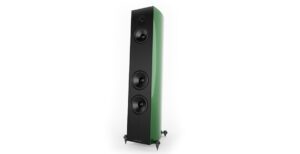
Acoustic Energy Corinium floorstanding loudspeaker
- Dec 23, 2024

Boenicke Audio W8 SE+ floorstanding loudspeaker
- Jan 06, 2022

By Paul Soor
More articles from this author

Read Next From Review
See all
Meze Audio 99 Classics (2nd Generation)
- Sep 22, 2026
MOON 371
- Sep 22, 2026

Nordost QNET 7
- Sep 22, 2026
HIFISTAY Sound Wings+
- Sep 16, 2026