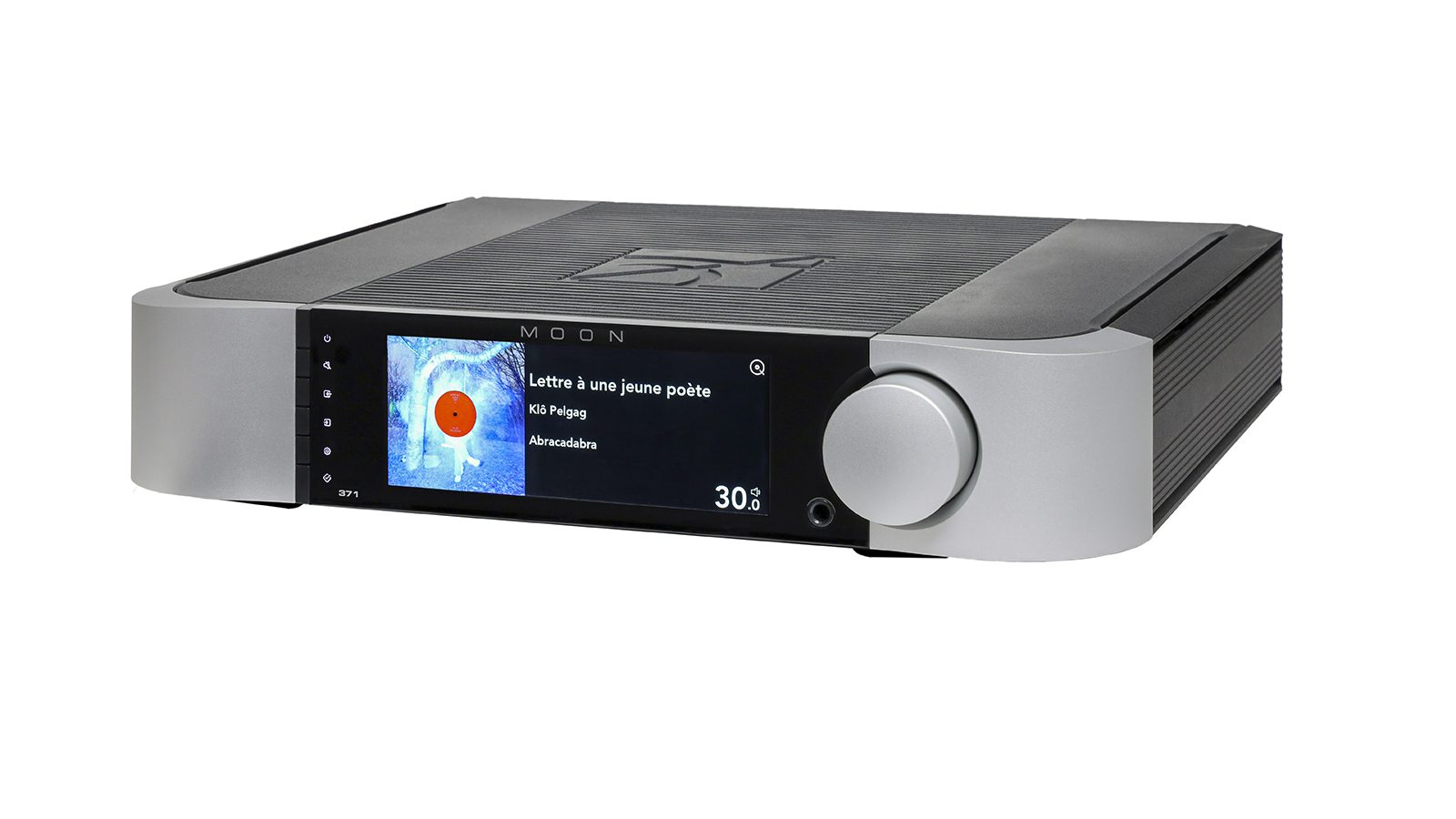
Recently, Simaudio has streamlined and modernised its high-end MOON range, now called the ‘North Collection’. The new MOON 371 Network Player/Amplifier is the first product in its modernised and streamlined mid-range Compass Collection. While the MOON 300 Series models are excellent, they also serve as gateways to the company’s 600 Series and beyond. That trend seems set to continue as a Compass… points North!
It’s hard to believe, but the MOON Ace Network Player/Amplifier that gained the company many friends is now nearly a decade old. We tested it in Issue 138. However, the Ace (also known as ‘Neo Ace’) was a less ambitious project than the 371. For those familiar with the MOON range, the Ace was more akin to a 240i integrated amplifier. Although it used a simplified, built-in MiND 2 network player. The Ace was a significant achievement for its time, but that was late 2016. Things have moved forward since then. Even just taken as a 300 Series model, the MOON 371 sets a higher bar.
Naming and Necessity
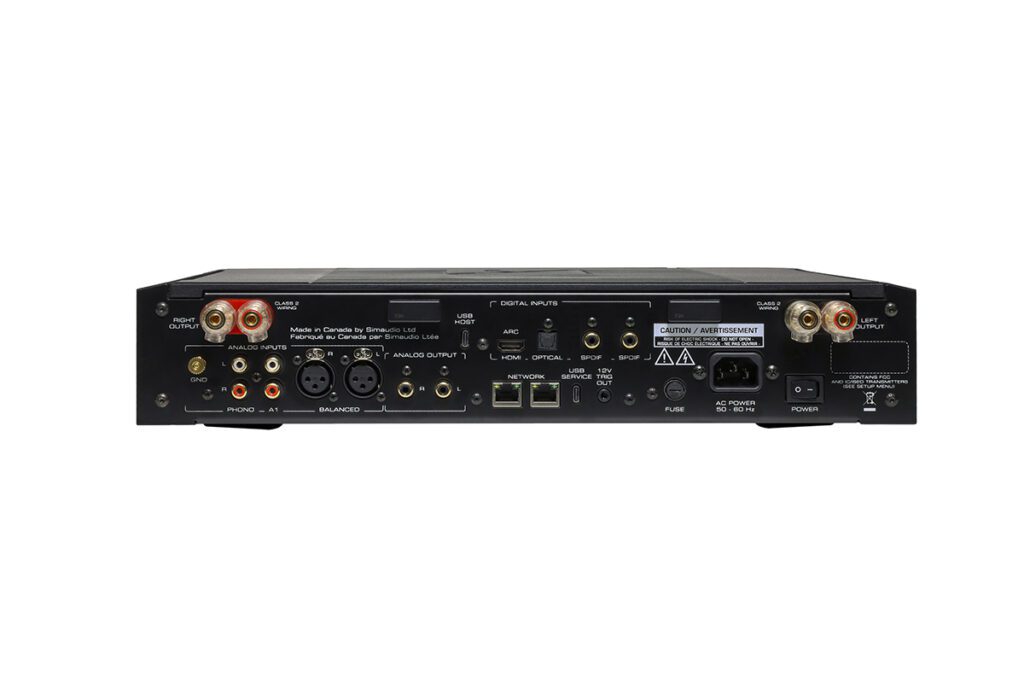
It’s necessary to clarify some nomenclature here. It’s easy – and entirely wrong – to miscategorise the MOON 371 as an ‘integrated amplifier’. The company prefers the term ‘Network Player/Amplifier’ for good reasons. First, it distinguishes the 371 from its 250i V2 and 641 integrated amplifiers. The latter of which is part of that North Collection, and we tested in Issue 227. These products are typical ‘integrated amplifiers’, where preamplifier and power amplifier stages (sometimes with a built-in phono stage) share the same chassis. Meanwhile, the ‘Network Player/Amplifier’ is exactly what it says: a lot of Network Player technology combined with an integrated amplifier.
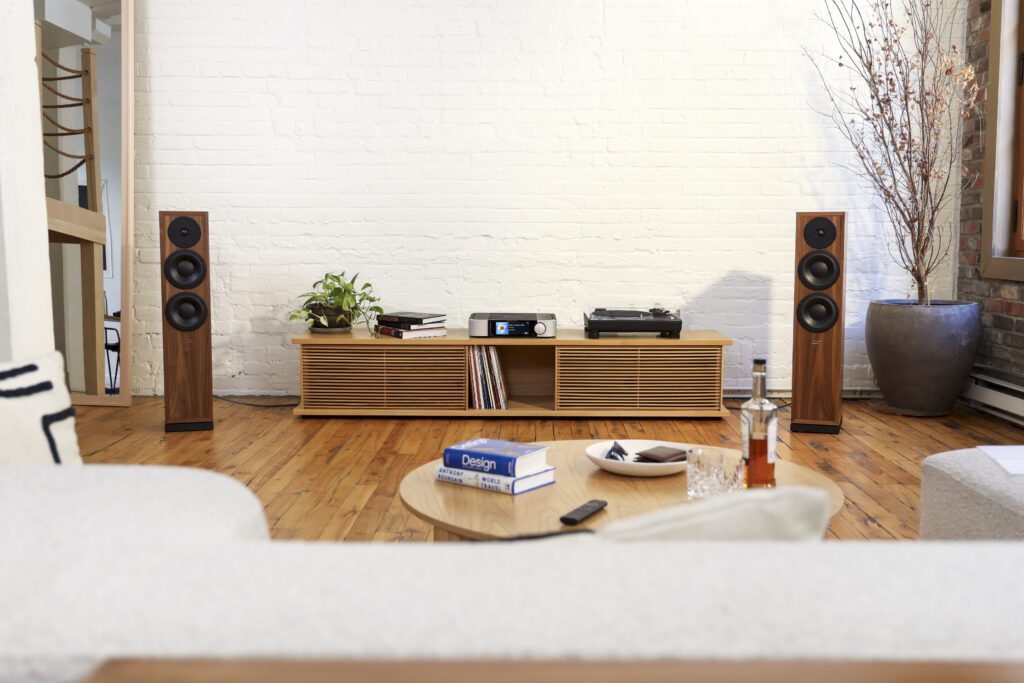
However, we humans have a pattern-recognition ability that is both a gift and a curse. The ‘curse’ arises when seeing the term ‘Network Player/Amplifier’ and assuming that the ‘amplifier’ aspect of the MOON 371 was merely an afterthought. A large colour screen displaying the album cover art doesn’t help change your mind. Yet, similar to calling the 371 an ‘integrated amplifier’, this is entirely incorrect. The word ‘afterthought’ does not exist in the 371’s vocabulary.
What you get
What you get with the MOON 371 is a MiND 2 Network Player, a MM/MC phono stage, and a preamplifier, coupled with a 100W Class A/B power amplifier. This features the MOON Distortion Cancelling Amplifier circuit. This ‘MDCA’ technology was first seen in the North Collection amplifiers, and its inclusion is both a welcome addition and a promising sign for subsequent products in the Compass line.
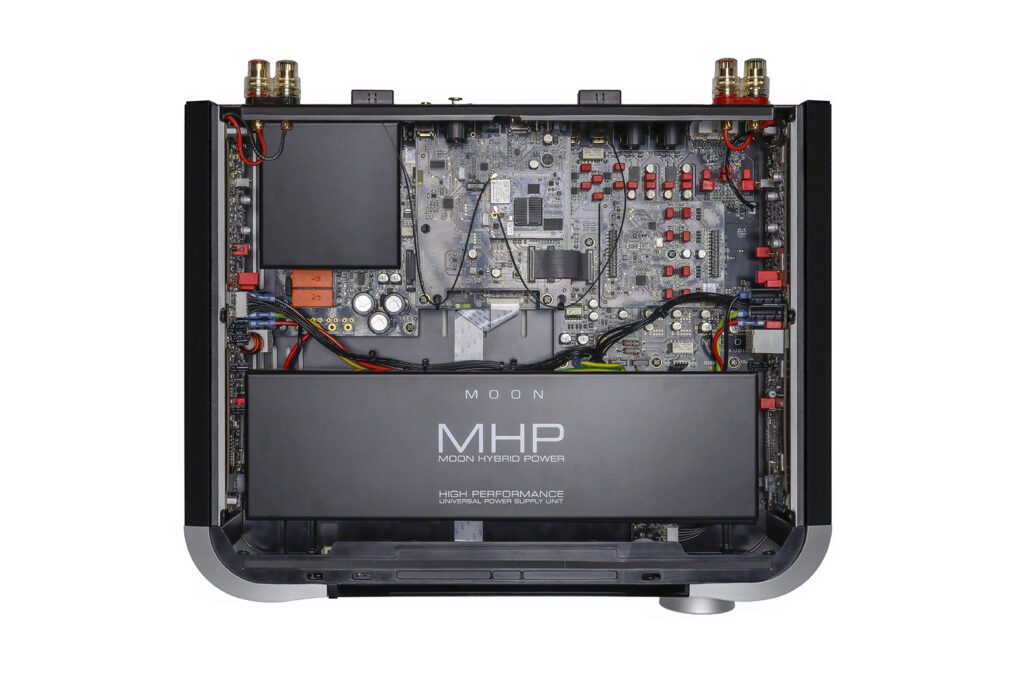
The amplifier also incorporates the MOON Hybrid Power (MHP) concept. Behind the scenes, a heated, ongoing debate continues within the audio electronics community about power supplies. Some argue that switch-mode power supplies provide efficiency and stability, while others believe linear supplies tend to produce a purer sound, especially in the midrange and high frequencies. The MOON approach… why not use both?
MHP uses a switch-mode power supply to transform AC into a relatively high DC voltage. This routes through an LLC (inductor-inductor-capacitor) ‘resonant tank’ circuit. The tank helps to minimise electromagnetic interference and ‘hard’ switching noise. Afterwards, the power passes to a linear regulation stage that provides clean, lower-voltage DC power to the amplifier circuit.
Back to volume
Looking at the review of the North models, it was clear there was an obsession with volume control. The same is happening in the MOON 371, but perhaps understandably not to the same degree. The volume implementation in the 371 is broadly similar to the M-VOL3 system used in the 641 and 791 models from the North line, but this Compass model does not have the same component roll-out or count. It still works effortlessly, however, and can use something funkier than the standard controller. The stylish BRM-1 remote handset used in the North Collection isn’t included with the MOON 371, but it can be purchased as an upgrade option. And don’t even blink; in most cases, the £890 for the BRM-1 is money well spent, in both looks and functionality. At the very least, consider it your 371’s first Christmas present!
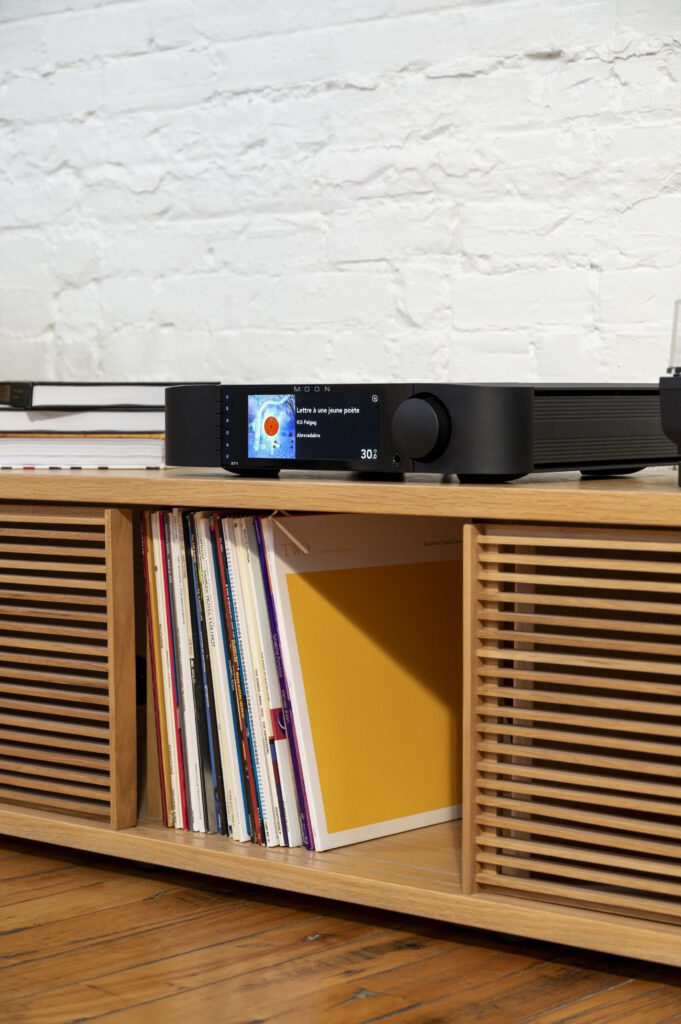
While not as acronym-led, the phono stage is not easily dismissed. It is switchable between moving-magnet and moving-coil cartridges. Simaudio is no stranger to making high-quality standalone phono stages and applies those engineering smarts here. Sure, the phono stage lacks the fine adjustment of a dedicated device (on the upside… no fiddly DIP switches!). For most people, however, that level of deep dive into cartridge setting is outside the purview of a one-box player.
Headphones
Headphone replay is equally adept but is a function of the 300 Series amplifier built into the 371. Low noise and distortion are particularly well-received in personal audio.
Setting the spec-sheet aside for a moment, it’s worth considering the whole MOON by Simaudio ethos in a broader context. Where most brands pull components from OEM suppliers, Simaudio is about as close as we get to a true ‘manufactory’ in audio. Sure, it buys in raw elements such as electronic components and PCB blanks, and it outsources anodising. That last is no surprise, as it’s a foul job. Otherwise, everything from board stuffing to screen printing is done in-house. And it does it in Quebec, where people are paid a decent working wage.
More than bragging
Where the MOON 371 is made is not simply about bragging rights. There have been many changes in the Network Amplifier market. When the Ace was launched in 2016, it was among a select group of network-enabled integrated amplifiers. Most of these were positioned in the broad middle to upper price range. The Ace competed directly with products like the Hegel H160 and the original Linn Majik DSM. Designs such as the Naim Audio Uniti Nova and Primare I35 Prisma emerged a year or more later. The MOON design didn’t have a segment to itself, but it wasn’t overwhelmed by a sea of competitors either.
Today, things look very different. Network-enabled (or, at least, ‘network-adjacent’) amplifiers can be found from most integrated amplifier brands and at all price points. Simaudio’s products need to compete with long-established brands and companies that have emerged since you started reading this sentence. And as we said earlier, Simaudio, building its products just outside Montreal. That offers a very different price proposition compared to companies that produce in a random factory half a world away.
Carves its place
Nevertheless, the 371 carves its place like the Ace before it. It does so by the simple expedient of sounding bloody good and ensuring the whole package is both reliable in build and straightforward to use.
There’s a sense of ‘just add speakers’ compatibility that dominates the MOON 371 sonic properties. It’s not the kind of product you use to tailor the sound of your loudspeakers; the 371 is way too honest for that. But neither is it so forthright as to lay bare every fault in recording or speaker design. Nor is the 371 one of those products that people ‘respect’ rather than ‘like’. Instead, it’s an éminence grise device; quietly pointing you to listen to more music and gently showing you what your loudspeakers are capable of. Great aesthetics, easily navigable control surfaces and sublime display aside, the 371 draws attention to itself by its total absence of fuss. It simply gets on with making music sound great.
Product defining
Its app and display define a networked product as much as its sound quality, but fortunately, MOON has nailed both. The MiND app is straightforward and intuitive to use, and the onboard hardware of the 371 makes handing over to Roon effortless. It also supports Apple AirPlay and all the Connects (Qobuz, Spotify, and Tidal) too. The app works at a pace that’s more than sedate; not blisteringly fast, but neither is it ‘laggy’.
If all of this sounds a bit ‘Goldilocks’, there’s a reason. The MOON 371 sits in the perfect sweet spot. Its interface is straightforward to follow; not so basic as to leave you wanting more, but not so complex that you need to refer to the manual to turn it on. Moreover, its soundstaging, detail, and dynamic range are all similarly in the sweet spot. It casts a wide image beyond the boxes and deep too. It doesn’t exaggerate the staging, even when using tracks like the 1957 Decca recording of The Pirates of Penzance, which can sound overblown in the wrong hands.
Pristine
As ever with MOON equipment, the sound is pristine. It handles an unalloyed mezzo-soprano like Joyce DiDonato with aplomb. Some systems highlight her voice’s power. That conveys exceptionally well here. However, you also notice the purity of her tone and how it soars. It also adjusts well; moving from DiDonato’s naturally large voice to the soft and breathy small voice of Taylor Swift is an exercise in proper balancing throughout. Here, the voice is not ‘shrunken’, it’s just not as forceful.
This sense of order and control could easily become too ‘well-behaved’. Many high-end amplifier systems fall into that trap, sacrificing dynamics and energy for authority and refinement. The 371 remains balanced, loosening up when playing ZZ Top or Orbital tracks through Tidal Connect. Nonetheless, the 371 performs with remarkable impartiality, handling Billy Gibbons’ graunchy guitar with the same confidence as Pablo Casals’ cello. The 371 isn’t ‘reserved’… it has reserves!
While reviewing my listening notes on the more upscale North amplifier series, I noticed that the two sounds are more similar than I anticipated. I find it difficult to describe its sound quality because, on one hand, the 371 is a chameleon and relies more on the music itself than on electronics to shape its sonic character. On the other hand, the subtle sonic signature it leaves on the music greatly appeals to my personal tastes; it delivers an effortless and naturally accurate presentation that stays just on the right side of smooth in all aspects. That lack of a strong imprint on the music is something I perceive as ‘correct’ in audio components, even if it’s hard to define precisely. But that makes the 371 either ‘correct’ or at least ‘right for me’.
Consistency is king
There’s one last and impressive feature of the 371: its consistency. It doesn’t matter whether you are using the network input, the phono stage, or the line inputs. And it doesn’t matter if you output to loudspeakers or headphones. The sound remains unchanged. It also stays true to that sound unless pushed well beyond ‘reasonable’, at which point the midrange and treble become increasingly strident. However, in most cases, this will be a ‘who blinks first’ moment; common sense and the need to protect hearing mean it’s most likely ‘the listener’.
No product is perfect, but the MOON 371 gets very close for its price. In fact, the only real ‘downside’ to the MOON 371 is a matter of perception. Since its on-board phono stage has no loading or gain adjustment, some might overlook it. With 40dB of gain for MM and 60dB for MC, it suffices for most users, and sonically, it performs exceptionally; I only wish there was some level of ‘granularity’ on that front screen for the phono setup. </span>
Years of maturity
It’s no surprise that MOON’s manufacturer, Simaudio, celebrated its 45th year in 2025. The company produces some of the most refined and thoughtfully designed products in the audio industry. The MOON 371 exemplifies this sophistication perfectly. It looks excellent, sounds superb, and enhances the loudspeakers’ innate character. The 371 is well-built, too. You won’t need a PhD in electronics or computing to operate it. At its price point, you might encounter ‘different’, but you won’t find ‘better’. In fact, you would need to spend serious, car-sized amounts of money to find ‘better’… and for many, that still includes a MOON logo as they look North.
If you see the MOON 371 as a ‘one-box solution’, you’re missing the point. This is a premium network player, phono stage, headphone amplifier, and integrated amplifier that just happens to live in a single case. In 2016, MOON had an ace up its sleeve; as the first of the Compass series, the 371 delivers impressive sound, in an awe-inspiring package.
Find out more about what went into the making of the 371 here.
Technical specifications
- Type: Network Player/Amplifier
- Digital inputs: 2x RJ45 network connections, HDMI ARC, TOSlink optical, 2x coaxial S/PDIF, USB Host (type 3), USB service port
- Analogue inputs: 1x MM/MC phono (+ground), 1x RCA stereo pair, 1x XLR balanced pair
- Analogue outputs: 1x RCA stereo pair, 1x ¼” headphone jack, 12V trigger
- Network connections: Access to Tidal, Qobuz, Deezer and Spotify. Compatible with Spotify Connect, Tidal Connect, Qobuz Connect, Apple AirPlay, Bluetooth, and is Roon Ready. Control is simple with the MOON MiND Controller app for iOS and Android.
- Max Sample Rate: PCM up to 24bit, 384kHz (MiND), DSD64-256 (only available on MiND)
- Output Power (Stereo 8 Ω): 100 W
- Output Power (Stereo 4 Ω): 200 W
- Input Sensitivity: 0.3 V – 4 V
- Input Impedance: 9.5 kΩ
- Gain: 40 dB
- Frequency Response: 5 Hz – 100 kHz (+0 / –3 dB)
- THD + Noise (@ 1 W): 0.009%
- THD + Noise (@ 100 W): 0.003%
- Intermodulation Distortion: 0.005%
- Signal-to-Noise Ratio: 108 dB
- Crosstalk: –108 dB
- Damping Factor: 425
- Dimensions (W x H x D): 42.9 x 8.7 x 38.5 cm
- Weight: 9 kg
- Price: £6,250, €6,800, $6,500
Manufacturer
Simaudio
UK distributor
Renaissance Audio
+44(0)131 555 3922
Tags: AMPLIFIER MOON 371 NETWORK PLAYER
Trending Articles
See all
Hegel H190v integrated amplifier
- Feb 06, 2025
Trending Articles

By Alan Sircom
More articles from this author

Read Next From Review
See all
Meze Audio 99 Classics (2nd Generation)
- Sep 22, 2026
Nordost QNET 7
- Sep 22, 2026
HIFISTAY Sound Wings+
- Sep 16, 2026
Marantz Model 10
- Sep 16, 2026