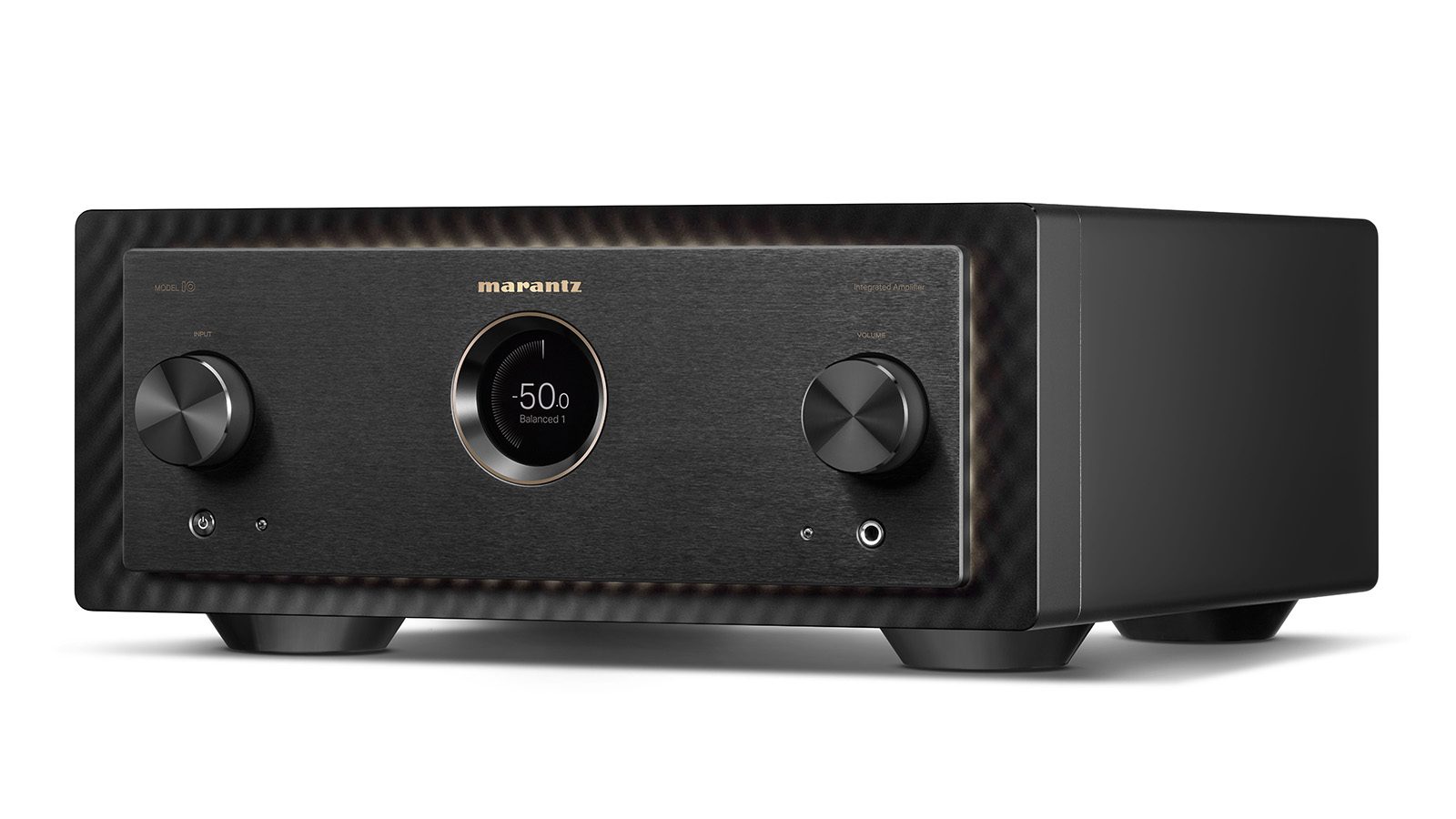
For a while there, I genuinely wondered how Marantz would ever be able to differentiate itself from its sister company, Denon. Well, I’m no longer wondering. The Model 10 integrated stereo amplifier from the brand’s Reference Series is so staunchly ‘A Marantz Machine’ that the idea of it overlapping with anything its siblings have to offer is fanciful in the extreme. If ever a product functioned as a statement of intent, as an uncompromising assertion of a company’s attitude and character, the Model 10 is it.
And as befits a statement product that sells for statement money, the Model 10 is an engineering tour de force. I’m sure that at some point, other departments will have had some input into the Model 10, but the way this device is specified and constructed gives every indication that engineers had the final say.
Inside No 10
On the inside, the Marantz features a triple-layer design with complete separation of all critical structures. On the bottom floor, sitting on a tri-layer copper-plated base, is the amplification itself: dual-mono Class D power amp modules (developed in conjunction with Purifi) in a symmetrical topology, featuring internal heatsinking and twin switched-mode power supplies. Go up a level and you’ll find entirely separate sections for input, preamplification, gain control circuitry, and the phono module, along with the linear PSU and transformer for the preamp. In addition to being separated from each other, each of these sections is also separated from the ground floor by a copper shielding plate. Another copper plate keeps the third level, which supports the control units and headphone amplification, isolated.
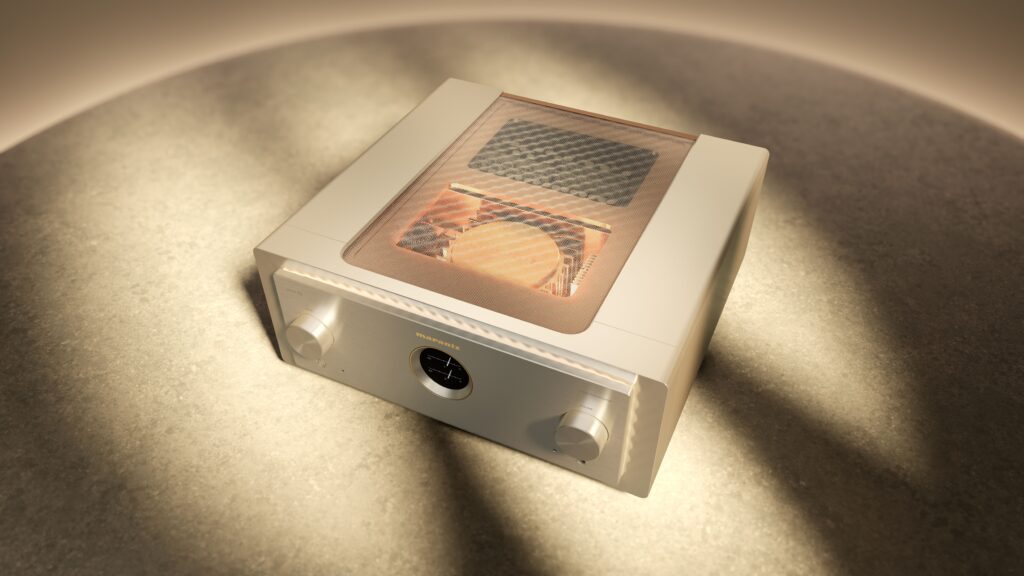
The Marantz Model 10 internals are all contained in a box built almost entirely from anodised machined aluminium. The front panel, which features the ‘floating’, backlit control panel that Marantz has been establishing as its design language for a little while now, is 4.5mm thick. The sides are a whopping 15.8mm thick, and the top plate (which affords, through a textured mesh grille, an illuminated glimpse of the chunky transformer and an array of Marantz’s latest SA-3 HDAM op-amp modules) is 6mm. It has a copper-plated base and rear. All of which makes the Model 10’s kerb weight of over 33kg easy to understand, if not all that easy to lift.
Strictly analogue
Model 10 is a strictly analogue device, and your options are numerous. The rear panel is where almost all the action is, of course: inputs run to four at line-level (two unbalanced via RCA, two balanced via XLR) and a phono input that’s switchable between MM and MC (with three impedance settings available when MC is selected). There’s an unbalanced output marked ‘Recorder’ that uses RCA connectivity too, and there are both RCA and XLR connections for use with external amplifiers – power amp and preamp connectivity is possible. There are two pairs of copper-plated SPKT-100+ speaker terminals, so the Model 10 can bi-wire a single pair or power two pairs of speakers. And the company’s ‘Floating Control Bus System’ allows the Model 10 to operate in multiples, in case you’re brave and wealthy enough to want to bi-amp some appropriate speakers.
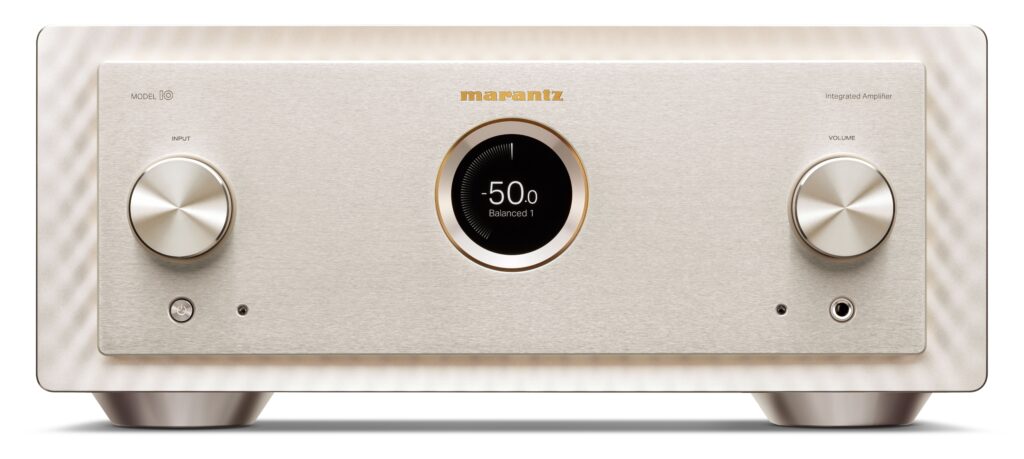
At the front, the Marantz manages the by no means easy trick of looking minimal yet interesting. There are three relatively large circles running across the fascia – two are solid aluminium knobs, one dealing with input selection and the other with volume. Between them is a ‘porthole’ display of the kind Marantz debuted way back when (or 1960, to be strictly accurate) – here it’s a high-definition OLED screen that offers input confirmation, phono input options, volume indication, along with bass/treble/balance options and the obligatory virtual VU meters. There’s also a 6.3mm headphone output.
Floating front
The front plate, above which the control panel appears to float, is slightly concave and textured – all the better for the defeatable illumination behind the control panel to showcase it. There’s also dimmable illumination of the top plate available, in case you want to highlight the engineering overkill that’s occurred inside. These two flourishes are really the only bit of ‘showbiz’ the Model 10 indulges in – in every other respect, it’s all business, no matter which of the available finishes (black or the traditional Marantz’ champagne’) you prefer.
As this is an all-analogue device, control is only available via appropriately old-school methods. The fascia controls operate with the well-damped precision appropriate for a product costing this much, and the electromechanical ticking that accompanies input changes is strangely gratifying too. The remote handset appears and feels less special than the product it controls – it lacks backlighting, features small buttons with correspondingly small labelling, and, as a system remote (capable of controlling the streamer and/or disc player in this flagship range), it also has a few redundant buttons.
Still, there’s no arguing with the ‘premium’ nature of the performance that’s on offer here. With the Model 10 powering a pair of Bowers & Wilkins 702 S3 Signature, and with sources including the Marantz SACD 10 disc player that’s part of the same range, a Naim Uniti Star functioning as a network streamer and a Technics SL-1300G turntable, the sound quality that’s on offer is never less than impressive and is periodically almost overwhelming. And one of the most remarkable parts of it is that it doesn’t really seem all that special when you first hear it.
Subtle and refined
That’s because the Model 10 is undemonstrative in the very best way. Five figures spent on amplification with some other brands will buy you sonic fireworks, a sense of shock and awe, a visceral impression of MUSIC HAPPENING! This Marantz, though, is an altogether subtler and more refined proposition. Oh, it can throw down as hard as is required when playing a DSD64 file of Do the Astral Plane by Flying Lotus [Warp Records] or a 180gm vinyl copy of Political Song for Michael Jackson to Sing by Minutemen [SST] – but the Model 10 is not about to bludgeon you into submission, 250 watts per channel into 8 ohms notwithstanding.
No, what the Model 10 majors in is a deft, clean, stunningly detailed and impeccably organised account of whatever it is you’re listening to. It creates a large and utterly plausible soundstage, keeps the spaces between elements of a recording completely dark, and unifies those elements into a compelling whole – the sensation of a group of musicians acting with common purpose in an effort to give the music lift during a 24bit/96kHz FLAC file of Kamasi Washington’s audacious take on ‘Clair de Lune’ [Brainfeeder] is tangible. As a result, the sound is direct, positive, immersive, and, above all, convincing.
Its tonality is entirely neutral – the Marantz has no opinion of its own in this regard and lets the recording dictate the terms. Frequency response, from the deep, martially controlled and gratifyingly rapid low frequencies to the shinily substantial top end, is as smooth as an architect’s straight line. And the Marantz communicates through the midrange most explicitly – detail retrieval and contextualisation is, at every point, brilliantly realised.
Surefooted
In every other meaningful respect, too, the Model 10 is surefooted and almost intimidating in its own confidence, lacking histrionics. It has more than enough dynamic headroom to track the shifts in a recording’s volume and intensity without making it sound in any way tricky. Model 10 can bring the most transient events in a recording into sharp focus without descending into the realms of analysis for its own sake. It expresses rhythms in the most naturalistic and hip-shaking manner and is zealous when it comes to the decay and, especially, the attack of individual notes or hits.
It’s hard not to suggest the Marantz Model 10 is everything you want in a stereo integrated amplifier – or, at least, an analogue stereo integrated amplifier. Of course, no one ever suggested that ‘everything you want’ is likely to come cheap – but it seems very much like Marantz has regained its identity, and it’s hard to put a price on that.
Technical specifications
- Type: Class D dual mono
- Analogue inputs: phono (switchable between MM and MC, with three selectable levels of MC impedance); 2 x unbalanced; 2 x balanced XLR
- Digital inputs: No
- Analogue outputs: to power amp (unbalanced and XLR); pre-out (unbalanced and XLR); 1 x unbalanced; 2 x speaker output; 6.3mm headphone
- DAC: No
- Power output: 250wpc (8ohms, THD 0.05%); 500wpc (4ohms, THD 0.05%)
- Frequency response: 5Hz – 60kHz (+0db/-3dB)
- Sensitivity: Phono (MM) 3.6mV; Phono (MC) 400 μV; balanced/unbalanced 350mV
- Distortion: 0.005% (125wpc, 8ohms)
- Signal to Noise Ratio: Phono (MM) 88dB; Phono (MC) 76dB; balanced/unbalanced 122dB
- Damping factor: 500 (8ohms)
- Dimensions (HxWxD): 192 x 440 x 473mm
- Weight: 33.7kg
- Price: £13,000, €14,500, $15,000
Manufacturer
Marantz
UK distributor
Marantz
+44(0)1903 953580
Trending Articles
See all
Krell Vanguard integrated amplifier
- Apr 07, 2015
Trending Articles

By Simon Lucas
More articles from this author
Read Next From Review
See all
HIFISTAY Sound Wings+
- Sep 16, 2026
DeVore Fidelity O/Bronze
- Sep 16, 2026
Network Acoustics Origin
- Sep 16, 2026

OePhi Kali
- Sep 08, 2026