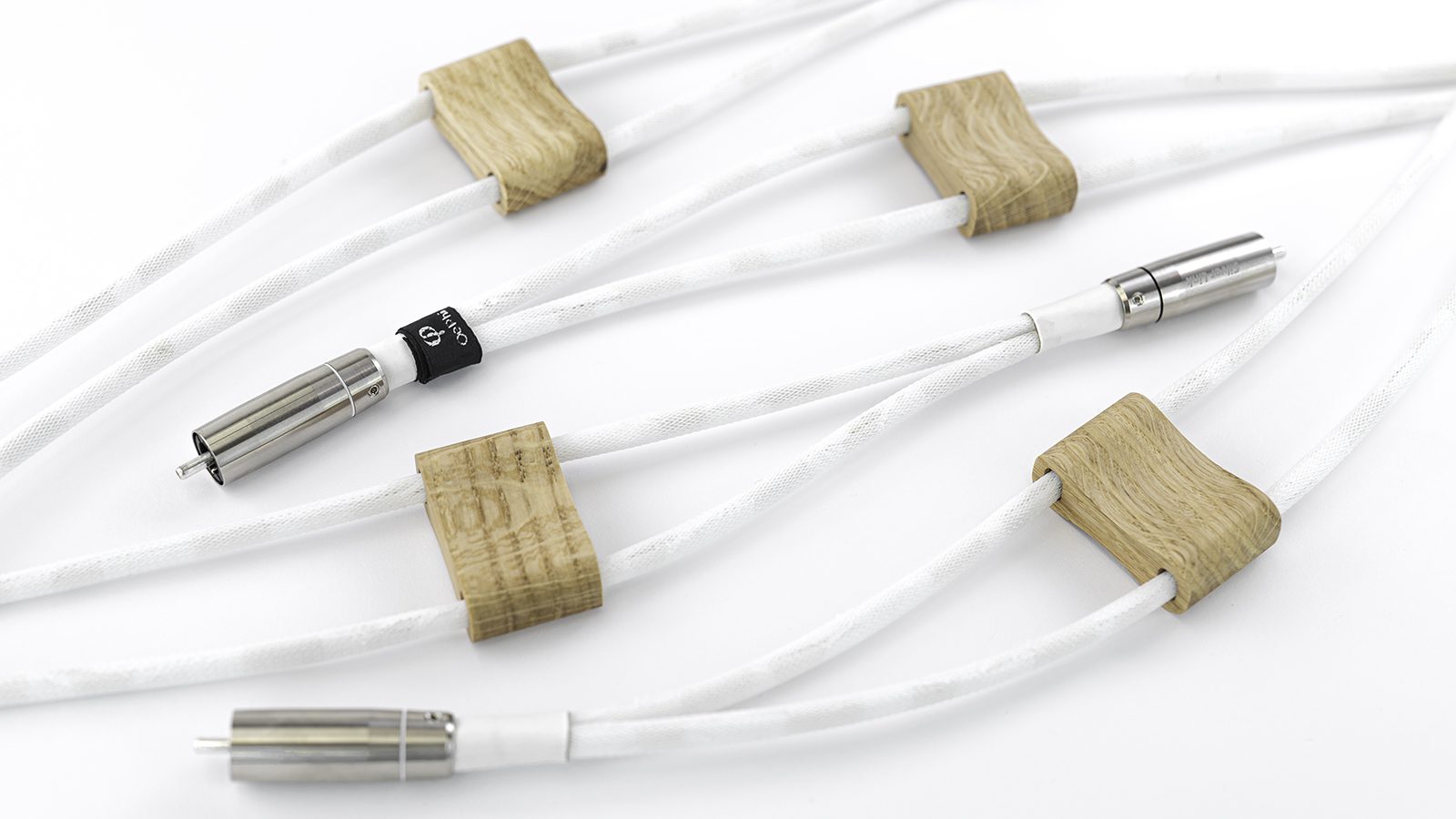
I rarely use ‘Editor Powers’, but this time I made an exception. We have a complete set of OePhi Kali cables for review, and – though I dislike the word – I could present this as a whole ‘loom’. However, that would mean I finish with them, and they go back. Instead, I get to write a few reviews and keep them longer. But there’s another crucial reason: the interconnect cable perfectly exemplifies why OePhi Reference is out and Kali is in.
We reviewed OePhi Reference interconnects, speaker cables, and power cords in Issue 218. I found them to be among the best cables I have ever tested. But that comes with a significant caveat: minimal strain relief. This meant the sound quality of each product was as unrestrained as possible by plugs, sockets, or terminals. Unfortunately, it also made them fragile. Too fragile for reviewers who frequently break the Geneva Convention whenever they unplug a system. Kali offers more conventional terminations without compromising sound. In fact, Kali surpasses Reference.
OePhi’s Joakim Juhl states that “The fundamental idea has been to keep all that made the Reference series so groundbreaking and further improve it without considering the associated cost increases. As such, the Kali range serves as a demonstrator for what our cable technology is capable of when we max out both geometries, materials and connectors.”
Similarities
OePhi’s Kali cables share many similarities with the Reference line, as both use a natural cotton dielectric and a large conductor spacing to achieve the electrical and mechanical properties needed to further minimise the cables’ impact on the signal and thus their ‘sound’. Conductor spacing increases by approximately 75%. This design change marks a further advance in conductor technology. Kali now uses the highest-quality unstressed silver. The interconnects now also feature pure silver connectors. Notably, the brand-new XLR connector is CNC-machined from solid silver billets for both pins and the female connector.
Kali’s conductor geometry minimises the impact of skin effect and thereby provide an almost frequency-independent distribution of the signal across the conductors’ cross-section. The geometry also improves signal transmission speed and phase coherence. Moreover, it extends the roll-off characteristics to much higher frequencies. This results in significantly lower impedance across the Kali line compared to the Reference line. Even the optimum length of cable is carefully chosen; no ‘per metre’ prices here.
What hasn’t changed between Reference and Kali is the time they need to ‘bed in’. When first taken out of the box, the sound is slightly muddy and lacks focus. It’s also a touch lean. This clears up after a day or two. The fuzzy sound returns if you move the cables too much (sorry, A-B demonstrations are not within Kali’s scope). There’s speculation about why Kali does this — possibly related to signals finding their optimal path through the cable —but it cannot be measured. Nonetheless, it’s clearly audible.
Blur falls away
What’s not audible is the Kali cable when fully bedded in. That blur falls away and you’re left with… nothing. If it were possible to directly couple the output of one device with the input of the next, that would be the ‘sound’ of Kali. Despite the Hindu name, Kali’s performance is closer to a Zen koan; what is the sound of no sound?
If this all sounds a bit naval-gazing and ‘crunchy yogic flying’, it’s not meant to. It’s just that the absence of sonic character is so striking here, any normal audio vocabulary is put on hold. You feel a closer connection to the music, with fewer devices between you and the musicians. Any deviations from that closer connection also seem more to do with the other components. It’s the ultimate in ‘blameless’ audio; it adds or subtracts practically nothing from the sound. And that is beguiling.
OK, I’ll temper that by adding it places high demands on both pieces of equipment that it connects. Kali is not brutal in exposing limitations in electronics, but neither does it shy away from telling the truth. But, if your system is up to the task, this is a truly ear-opening experience.
OePhi Reference was remarkable for its lack of sonic character. Can you get more ‘nothing’? With Kali, you begin to realise that ‘nothing’ from Reference was slightly – and I mean ‘slightly’ – foreshortened in the time domain compared to Kali. There was an absence of tonality or dynamic compromise and no spatial intrusion with Reference. Kali does all that, but it also extends that ‘un-presence’ of sound. This makes for an extremely coherent timing to music. You can probably tell by the clunkiness of that writing, I’m way outside my audio comfort zone here… and that’s a good thing.
Goddess of death
Naming your top cable after the Hindu goddess of death and destruction might sound like a bad idea. But Kali is also the egoless liberator of transcendental knowledge, and that’s a fine – if a bit pretentious – way of describing this cable. There’s no artifice to this cable, it just liberates the signal… and that absence of coloration, smear, tonal shifts, exaggerations or diminishments all makes for a truly transcendental musical experience. It’s almost enough to make you forget about Kali’s garland of skulls!
There was another reason I prioritised the interconnects. In Issue 218, I noted that the Reference interconnects had a slight edge over other cables. Kali interconnects outperforms the Reference ones. Job done. Well, not quite. You see, not only do the interconnects surpass the best of the Reference, but the ‘slight edge’ they had over loudspeaker cables and power cords has now disappeared. They are all outstanding and far superior to even the best Reference. OePhi Kali is also considerably better when used across the whole system, meaning this ‘best’ gets even better. But that’s a story for another day…
Price and contact details
- Interconnect: 1.635m RCA £15,000, €17,000, $20,000
- 1.635m XLR £19,000, €22,000, $25,500
- Add 25% for additional 54.5cm
Manufacturer
OePhi
UK distributor
Airt Audio
+44(0)1223 344053
Trending Articles
See all
hi-fi+ issue 250: the Awards
- Dec 02, 2025
Trending Articles

By Alan Sircom
More articles from this author
Read Next From Review
See all
Technics SC-CX700
- Sep 08, 2026
Ruark Audio R610
- Sep 08, 2026
Ultrafide Audio DIAS-U8
- Sep 07, 2026
Revival Audio Sprint 3
- Aug 31, 2026