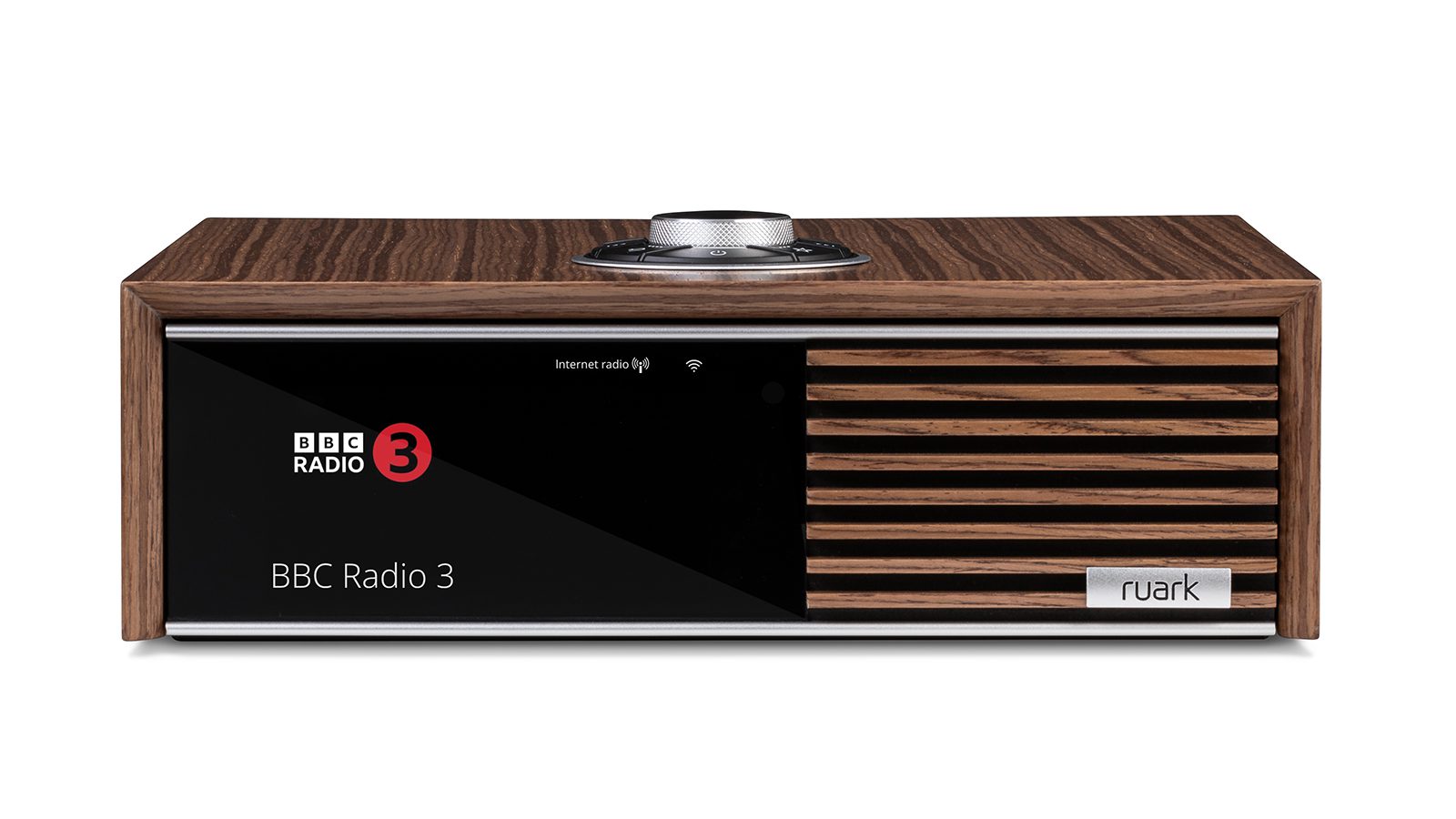
You can, I think it’s safe to say, rely on Ruark Audio. Even before ‘mid-century modern’ became completely ubiquitous in interior design vocabulary across the globe, the company had established a nice little niche for itself — and it’s managed to continue producing products that look somehow appropriate without seeming hackneyed, try-hard, or in any way a pastiche. When you look at a Ruark Audio product, you know exactly where it’s come from.
And increasingly, it’s obvious where the company is heading too. It may be enjoying prolonged success with its affectionately ‘throw-back’ designs, but the products it dresses this way are entirely forward-looking.
Ruark all over
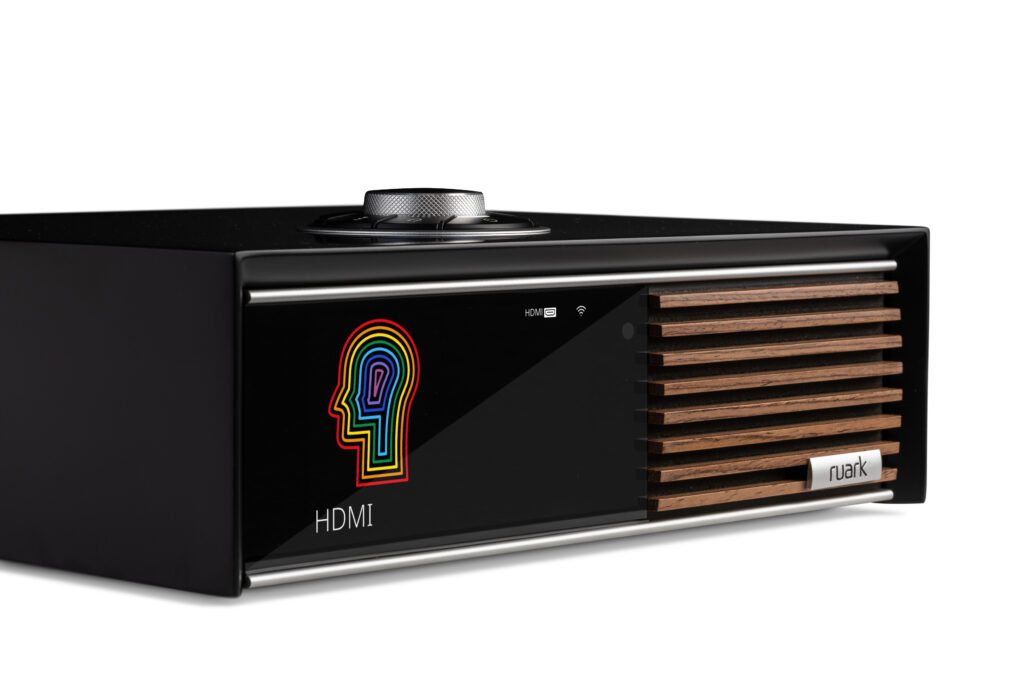
Take this R610 ‘integrated music system’, for example. In either of the available finishes (satin charcoal lacquer or fused bamboo veneer), it’s unmistakably branded with ‘Ruark Audio’ (figuratively speaking, that is — the small badge featuring the brand logo is discreetly placed). However, the design also incorporates some modern necessities. Most notably, it includes a bright, crisp, high-contrast, full-colour 5-inch TFT screen. Whether it’s displaying straightforward, logical, and practical set-up menus or providing a nice rendition of album artwork or similar content, it is exactly the kind of interface that a product of this type, available for sale today, requires.
The R610 also features a couple of Ruark Audio’s signature ‘RotoDial’ controls – they are as integral to the company’s design as the sleek, attractive cabinet work. One ‘RotoDial’ is embedded in the top surface of the R610 itself; the other functions as a conveniently palm-sized remote control. It operates via Bluetooth and can be recharged through USB. The puck-shaped remote looks and feels good, offering complete system control along with several user-defined presets.
Oh yes, the system. This is, after all, meant to be an ‘add speakers’ network streaming device with extra connectivity options – and it’s designed accordingly. Inside, the R610 has 75 watts of Class D amplification per channel, which should be more than enough for most environments, even if your preferred loudspeakers are somewhat tricky to drive. It’s equipped with a Burr-Brown DAC to handle digital audio, supporting resolutions up to 32-bit/384kHz PCM – which is about as high as most real-world users will need. Additionally, Ruark Audio has specified a switch-mode power supply to ensure the system receives optimised and efficient energy – a feature more commonly found in equipment costing much more than this.
Connectivity
Ruark Audio has equipped the R610 with numerous options. On the rear panel, alongside a kettle-lead mains power connection and a ‘power on/off’ switch, you’ll find a pair of extremely low-profile speaker cable terminals (designed to accept spade connectors or 4mm banana plugs) and an aerial binding post that supports the integrated DAB and DAB+ radio tuners. There’s an Ethernet socket, a digital optical Toslink input, a USB-C port, and an HDMI eARC socket that allows your TV to act as a sound source if desired.
Analogue options include a pair of line-level stereo RCA inputs and another pair dedicated to a moving-magnet phono stage, making turntable use straightforward. Additionally, a pair of RCA outputs can be configured as line- or pre-out levels, along with a single RCA pre-out for a subwoofer. The setup menus let you adjust the input levels for the line-in, phono-in, optical, and HDMI sockets.
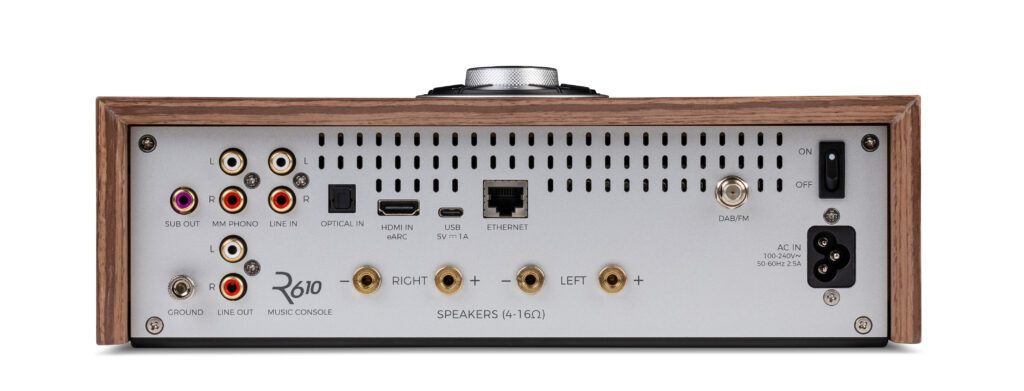
Bluetooth connectivity is available, quite naturally—it’s version 5.1 and supports SBC, AAC, and aptX HD codecs. It also includes dual-band Wi-Fi, which, like the Ethernet socket, means the R610 is DLNA-compliant and compatible with Amazon Music, Apple AirPlay 2, Deezer, Google Chromecast, and the ‘Connect’ versions of Qobuz, Spotify, and TIDAL. Additionally, it features an internet radio platform.
All the apps
There’s no control app, which is a bit of a shame – but Ruark Audio quickly points out that the native apps of Qobuz, Spotify, and TIDAL, along with services like BBC Sounds, provide familiar and intuitive control interfaces. And moreover, once you’ve set your 20 presets, using the ‘RotoDial’ control becomes a much more enjoyable experience.
Naturally, the company strongly recommends its Sabre R stand-mount speakers (£699 per pair) as the ideal match for the R610—it’s designed precisely for this purpose. During my time with the device, I used a range from DALI’s Kupid stand-mounters (£299 per pair) to the Bowers & Wilkins 705 S3 Signature (£3,500) at the front end, and the R610 never once felt out of place or overwhelmed.
Sources include a Technics SL-1300G turntable (fitted with a Goldring 1042 cartridge) connected to the phono input, a Rega Apollo CD player (connected via line-level analogue input and digital optical input to compare the R610’s digital-to-analogue conversion to that of the onboard Wolfson DAC on the disc player), a Philips 458OLED808 TV connected to the HDMI eARC input, and a FiiO M15S digital audio player linked via Bluetooth. An Apple iPhone 14 Pro loaded with the relevant app supports TIDAL Connect.
A lot to appreciate
There’s a lot to appreciate about audio equipment that values analysis, but it’s also common for such gear to sound a bit, well, dispassionate. The Ruark Audio R610 doesn’t obsess over analysis. Yet, it can easily delve into a mix and return with all sorts of relevant details – and it’s just as capable of placing even the smallest elements into convincing context. However, it does not sacrifice any vibrancy, engagement, or its ability to present music as entertainment in doing so.
A listen to Book of Sound by Hypnotic Brass Ensemble [Honest Jon’s] clearly demonstrates the point. The combined horns provide plenty of opportunity for the nuances of tone and texture to be uncovered – and the R610 has no difficulty doing so. But even when the sound is droning, blaring, or simply remaining still — as it often does during this recording — the Ruark Audio stays attentive and captivating, capable of delivering the energy and drive that turn the music into an event rather than just a moment.
Listening to this same recording on vinyl, CD, and TIDAL shows how consistent the R610 is. The differences in how the music sounds depending on its storage format are noticeable but not significant, and the Ruark Audio never alters its core character or attitude. It offers a smoothly refined frequency response and does not exaggerate or underplay any part of the range. It has enough control over the lowest frequencies to match their depth, substance, and variation — and this straightforward approach to bass attack means it can express rhythms with real energy. The soundstage it creates is larger than the size of the speakers it’s connected to, clearly defined and very easy to follow, even if every member of the ensemble is trying hard to dominate the others.
Consistent
The tonal balance is consistent in all situations. There’s probably a slight increase in warmth from the sound coming through the phono stage compared to the other inputs (both wired and wireless), but overall, the R610 remains a natural and fairly neutral performer. The device is also effective with dynamics – it easily handles fluctuations in intensity and volume during a recording of Magazine’s Shot By Both Sides [Virgin], adding vitality. Additionally, it is sensitive to harmonic variations in instruments and voices – so while it may seem, on the surface, like a loud, aggressive ‘everything louder than everything else’ setup, the Ruark Audio can discern and highlight the subtle nuances in the production that contribute to a richer listening experience.
Ultimately, the Ruark Audio R610 is a genuinely commendable device that covers all essential connectivity options and delivers excellent sound quality. Its distinctive appearance, in a market filled with generic alternatives, further enhances its appeal.
Technical specifications
- Amplification type: class D
- Power: 2 x 75 watts
- Analogue inputs: moving magnet phono; line-level (both on stereo RCA)
- Digital inputs: Ethernet; HDMI eARC, optical; USB-C
- Wireless inputs: Bluetooth 5.1 (with SBC, AAC, aptX HD compatibility); dual-band wi-fi
- Analogue outputs: selectable line-level or pre-out (on stereo RCA); subwoofer pre-out (on single RCA)
- Supported sample rates: up to 32-bit/384kHz
- Streaming features: Amazon Music; Apple AirPlay 2; BBC Sounds; Deezer; DLNA; Google Chromecast; internet radio; Qobuz Connect; Spotify Connect; TIDAL Connect
- Tuner: DAB; DAB+
- Dimensions (HxWxD): 95 x 300 x 280mm
- Weight: 4.1kg
- Finishes: 2 (satin charcoal lacquer; fused walnut veneer)
- Price: £1,199, €1,606, $1,599
Manufacturer
Ruark Audio
Trending Articles
See all
hi-fi+ issue 250: the Awards
- Dec 02, 2025
Fell Audio Amp
- Jul 27, 2026
Michi X3 Series 2
- Jan 08, 2025


By Simon Lucas
More articles from this author
Read Next From Review
See all
Ultrafide Audio DIAS-U8
- Sep 07, 2026
Revival Audio Sprint 3
- Aug 31, 2026
Transrotor Bellini TMD, TRA 9, Figaro
- Aug 31, 2026
Burmester 232
- Aug 31, 2026