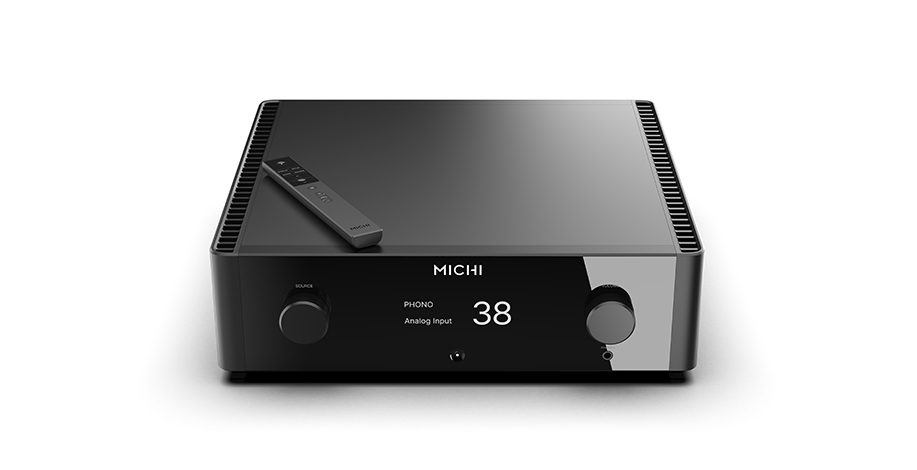
Rotel’s high-end Michi brand was revived from hibernation a few years back with the introduction of some substantial but stylish black boxes, which included the P5/S5 pre/power combo and what at the time was one of the most giant integrated amps from a mainstream brand, the X5. A marginally more manageable X3 joined that 600W beast with a mere 350W on tap from its stealthily black casework. Five years on, Michi has updated all but its flagship products to Series 2 status. They still combine a shiny acrylic front panel with very neatly integrated heatsinking, oodles of inputs and plenty of mass, but some 90 changes have been made under the hood.
These are in the way of refinements rather than revisions; the X3 S2 is integrated with both digital and analogue inputs, and plenty of them. However, most of the 90 changes are to the digital side, the fastest-moving area in electronics and, therefore, the most likely to warrant a change. So, the DAC is now an ESS Sabre ES9028PRO running four channels for fully balanced operation in current rather than voltage mode.
It also features new parts for the low pass filter on the DAC output, digital input switch, clock optimisation, and digital stabilisation. Now that Tidal no longer offers its higher resolution streams in MQA, the format’s fortunes are up in the air, but this tech was purchased by Lenbrook last year, so it may yet rise from the ashes. If it does the Series 2 Michi components will be ready with an XMOS USB receiver designed for the job.
We got tone!
The analogue side of the X3 S2 sees new volume and tone control circuits, a low voltage standby mode, a home theatre bypass with a trigger input and new coupling capacitors in the power amp stage. That power amp is suitable for a continuous 200 Watts into eight Ohms and nearly twice that into half the impedance. Those heatsinks are not just for show, but in practice, they don’t get that hot unless you have a working pair of two-ohm Apogee Scintillas and enjoy recreating Mogwai concerts in your room.
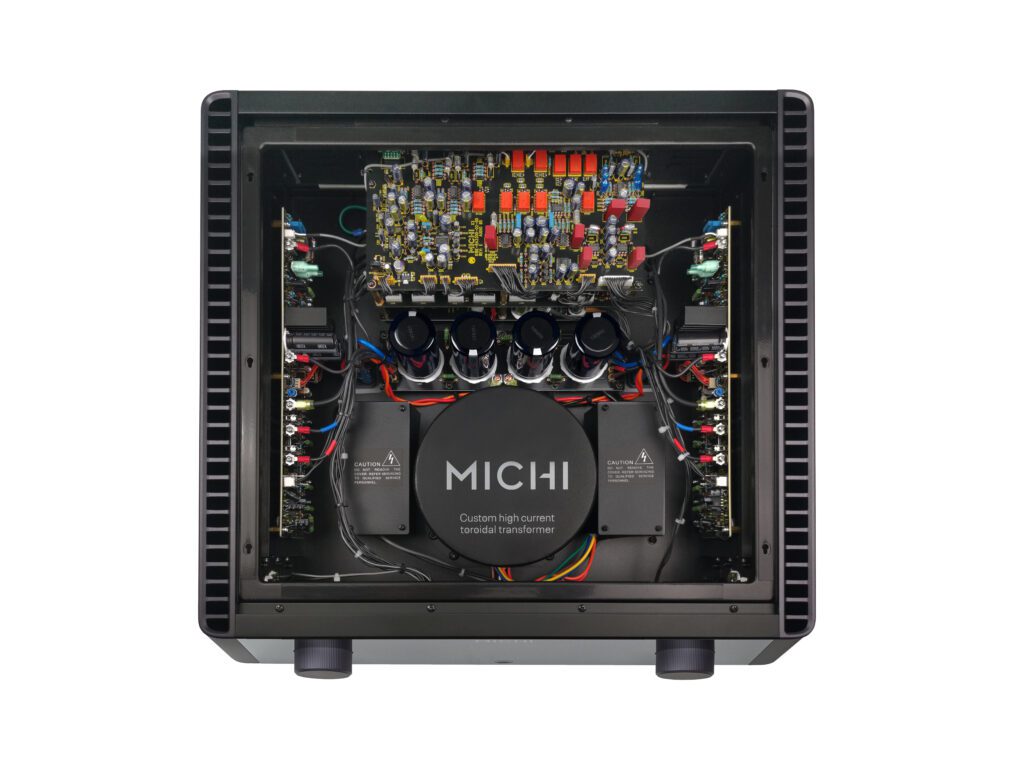
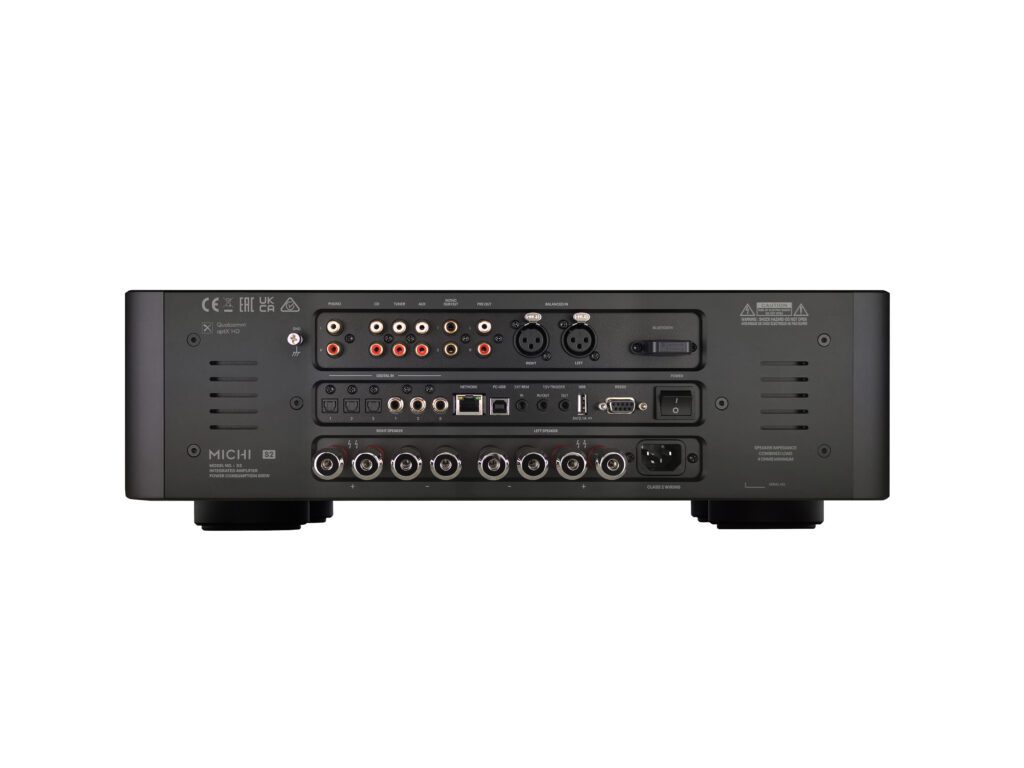
The back panel positively bristles with connections; it’s nearly in the AV amplifier league with two sets of chunky speaker terminals per channel arranged horizontally, but these are not for running two sets of speakers but for bi-wiring a single pair. Inputs include RCA and XLR for line sources and an MM phono input for suitably equipped record players. There is a compact antenna for aptX HD Bluetooth, three optical and as many coaxial S/PDIF inputs, USB and Ethernet on the digital side. However, that network connection is a bit of a red herring because the X3 S2 does not have a streamer onboard. That connection is for future firmware updates that a processor-driven amp like this may require.
Large display
I like the large, clear front panel display. The volume can be read at 40 paces, or at least it can so long as it’s not in direct sunlight. Like its stablemates, this Michi is a very nicely executed piece of industrial design, very different to its rosewood-cheeked 1990s ancestors and much more of the moment. Operationally, life is eased by the slim stick of a remote handset. This has a power button to match that on the amplifier, and if you press it long enough, it will power down and power up the X3 S2. Shutting down takes five seconds; it’s much keener to turn on.
More than a few set-up options are available from the left-hand screen; these include input naming and what appears to be up to plus or minus 10dB of gain adjustment per input (assuming the scale indicates dB). A whole section is dedicated to network management while another, ‘Audio’, covers power on volume, USB class and type of decoding: PCM only or everything, plus home theatre bypass. ‘Display’ allows you to dim the display after a chosen time and show up to four VU meters, horizontal rather than needle types, or the input and volume. Adding a child lock and checking the software versions for USB and LCD are also possible.
No streaming
It seems odd to build a multi-function amplifier like this and not include streaming, especially as Michi go to the expense of including a network connection. With Hegel, Naim and others making high-end streaming amps at this price point and appearing to do well, you must wonder what Michi is thinking. It could be that, despite the protestations of German synth-pop Alphaville 40 years ago, streaming is not ‘Big In Japan’, and companies tend to think of the home market’s needs in the first instance.
They have included a headphone output for that burgeoning market sector and the plethora of trigger connections plus its Roon-readiness would suggest more than half an eye on the US market. So maybe Michi is making the point that by applying their expertise where it counts and making most of the components in the X3 in-house, they are producing an amp worthy of its price without such fripperies.
Surprise factor
Connected to a Lumin U2 Mini streamer and the substantial yet easygoing DALI Epikore 11 speakers, the Michi revealed its capabilities in the power department almost from the off. This amp has a wide dynamic range and plenty of grip, which, with material that starts quietly and then hits hard, can catch you off guard. The inky black silence of backgrounds adds to this element of surprise, it’s handy that volume is displayed so clearly in this respect because not much else prepares you for the sort of dynamics on tap. I reviewed the larger Michi X5 when it was released and felt it was a little slow; it didn’t jump when the signal asked it to but worked up to it. The X3 S2 is nimbler in this respect, and while you wouldn’t call it fast, it knows a transient when one comes along.
The overall balance is smooth but not thick. You can hear its Japanese origins in the calmness of its delivery and that there has been some Western input into the voicing. Mids are clear, which helps to resolve the tempo of each piece, and the amp is not averse to throwing up a good-sized image when the right recording comes along; it doesn’t, however, add airiness where it’s not required.
The X3 S2 is slightly soft-edged for a relaxed speaker like the DALI, so I tried it with some PMC twenty5.26i floorstanders. This was a more successful pairing in terms of timing and tonal balance respects and was almost as good regarding dynamics. The slow burn of Evita Polidoro’s ‘Limerick’ (Nerovivo, Tuˇk Music) builds beautifully, the Michi producing the power and drive required to control the muscular bass line and spiky guitar.
Palpability
With the signal provided by a Merason Reuss DAC, the results are a little smoother through the mid and reveal more depth and shape to the soundstage; this and a pair of Vivid S12 speakers proved to be a most enjoyable combo with the X3 S2. The colossal reverb on Lady Blackbird’s signature tune went down well, with the powerful dynamics of her voice being particularly well served alongside the nature of the limiting applied in the studio. Laura Marling was in good fettle too, the bass reverb on ‘Soothing’ (Semper Femina) being clarified to a greater extent than usual, the sound radiating into the room with a palpability that it doesn’t usually exude.
I didn’t get to try the original X3, so it’s hard to say what the Series 2 changes have brought to the party, but if they have managed to give the X5 this sort of get-up-and-go, then it’s a worthy upgrade. The absence of streaming is compensated by a powerful and capable amplifier with a decent digital section; this and the wide variety of inputs and range of features add to its appeal, while the style and execution of the X3 S2 make it an amplifier that’s more than worthy of the Michi name. Those after a well-built and versatile integrated speaker that will drive any contemporary speaker should not overlook its solid, dark form.
Technical specifications
- Type Solid-state, two-channel integrated amplifier with built-in DAC, phono stage, and headphone amplifier.
- Analogue inputs: One MM phono input (via RCA jacks) , three single-ended line-level inputs (via RCA jacks), one balanced input (via XLR connectors).
- Digital inputs: Six S/PDIF (three coaxial, three optical), one USB port, Bluetooth aptX HD.
- Analogue outputs: One pre-out (via RCA jacks), IR, RS232 power control, two 12V trigger connections.
- Supported sample rates:
- Coaxial and optical S/PDIF: Up to 24-bit, 192kHk
- USB: Up to 32-bit, 384kHz
- Input impedance:
- High-level: 100kOhms
- Phono: 47kOhms
- Output impedance (preamp): 100 Ohms
- Headphone Loads: Not specified.
- Power Output: 200Wpc @ 8 Ohms, 350Wpc @ 4 Ohms
- Bandwidth: 10Hz – 100kHz
- Distortion: THD <0.008%
- Signal to Noise Ratio: 102dB
- Dimensions (HxWxD): 150 x 485 x 452mm
- Weight: 28.9kg
- Price: £5,999, $5,799
Manufacturer
The Rotel Co., Ltd.
UK distributor
Cadence Distribution
Trending Articles
See all
Krell Vanguard integrated amplifier
- Apr 07, 2015
Trending Articles

By Jason Kennedy
More articles from this author

Read Next From Review
See all
Eversolo T8
- Oct 13, 2026
Acoustic Energy AE Active
- Oct 13, 2026
Reiki Audio SuperSwitch X/Pro X PSU
- Oct 06, 2026
Audiobyte SuperVOX
- Oct 06, 2026