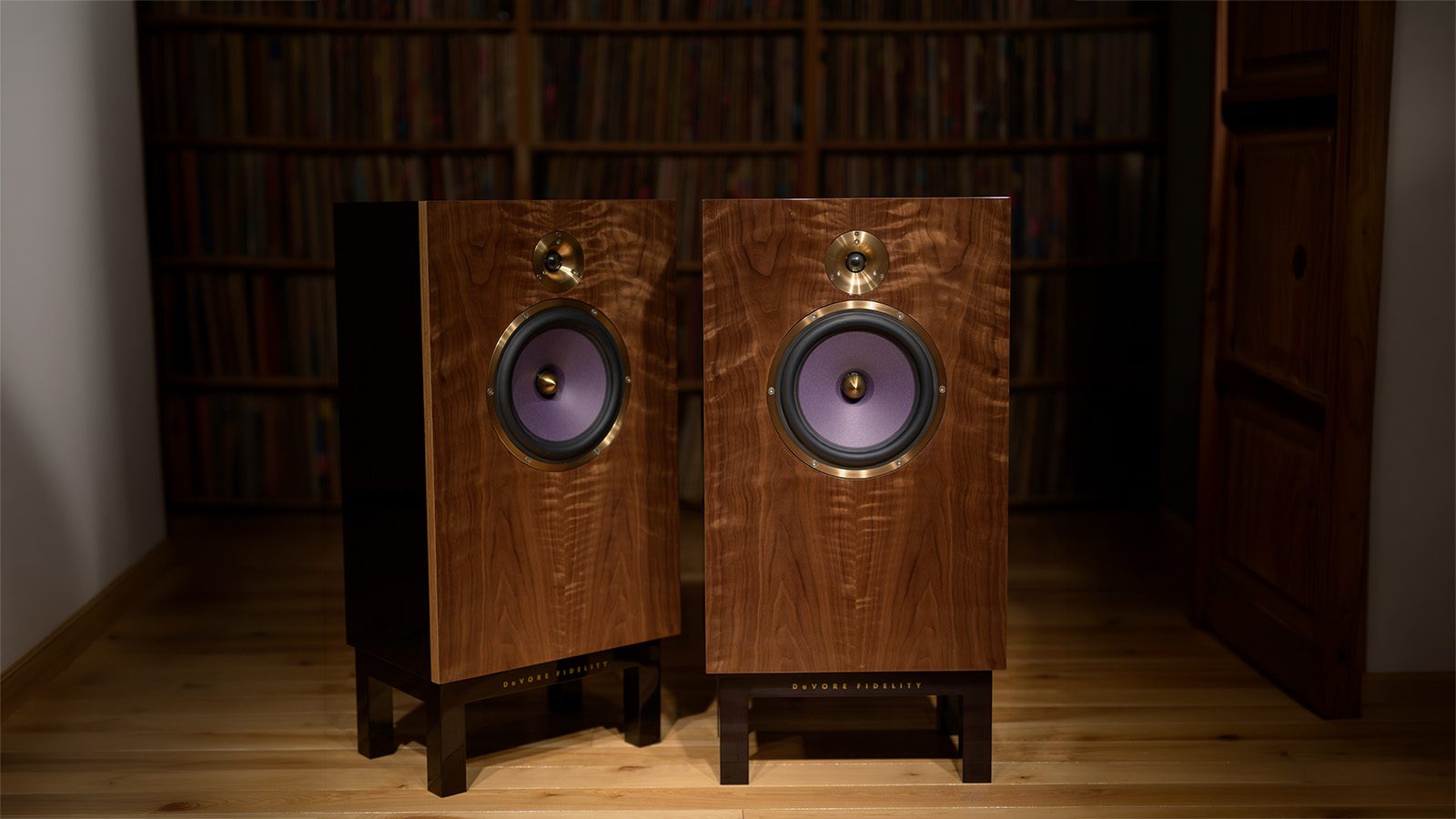
There are a few universal truths in life. Music was better when ugly people were allowed to make it. Triangular sandwiches taste better than square ones. And John DeVore does not know how to make a bad-sounding loudspeaker. The DeVore Fidelity O/Bronze is a perfect example.
The O/Bronze could so easily be one of those range-filler designs, because the original brief was to fill in a gap in DeVore’s Orangutan line. There’s a large physical, intellectual, and financial jump between the popular O/96 and the three/four cabinet O/Reference models. DeVore Fidelity’s O/Bronze draws heavily from elements of both loudspeakers. Everything about that shouts ‘bitza’ or ‘Frankenspeaker’ were it not for one thing: John DeVore does not know how to make a bad-sounding loudspeaker. Whether the O/Bronze is the result of mixing the right ingredients and a happy accident – a bit like the genesis of potato chips and Tarte Tatin – or a painstaking iterative process of test-tune-listen-repeat is immaterial (DeVore claims it’s a bit of both). The result is a loudspeaker that sings sweetly.
Motivation to sing
Like DeVore Fidelity’s other designs, it doesn’t need much motivation to sing. The stated sensitivity of 96dB/W/m and a nominal impedance of 12 ohms makes the O/Bronze an efficient and easy load for an amplifier. It’s perhaps not sensitive enough to be the perfect partner for the flea-powered single-ended triode designs from the turn of the century. Amps wielding a lone 300B and delivering barely enough power to drive a pair of headphones were all the rage in the early 2000s. While those days are behind us, the O/Bronze is probably one of the few loudspeakers (that isn’t a horn system from a 1930s cinema) that could extract a coherent sound from such an amplifier.
In 2025’s reality, that makes the DeVore Fidelity O/Bronze a uniquely flexible partner for amplifier systems of all shapes, sizes and types. Sure, hooking the O/Bronze to an amplifier that could be used to arc-weld a tanker is probably overkill and the speaker and the 20W output of an amplifier like the Trafomatic Audio Rhapsody integrated (reviewed in Issue 228) makes the two obvious besties.
Happy marriage
I’m also going to stick my neck out here and say the marriage between DeVore loudspeakers and tube amps is a much happier one than with most solid-state designs. However, I could easily be wrong and exceptions will abound. Regardless, unless you are determined to play a three-watt amplifier at PA levels in a huge room or like to see what happens when you put a kilowatt of square wave into a loudspeaker, the O/Bronze will work with almost any system you care to use.
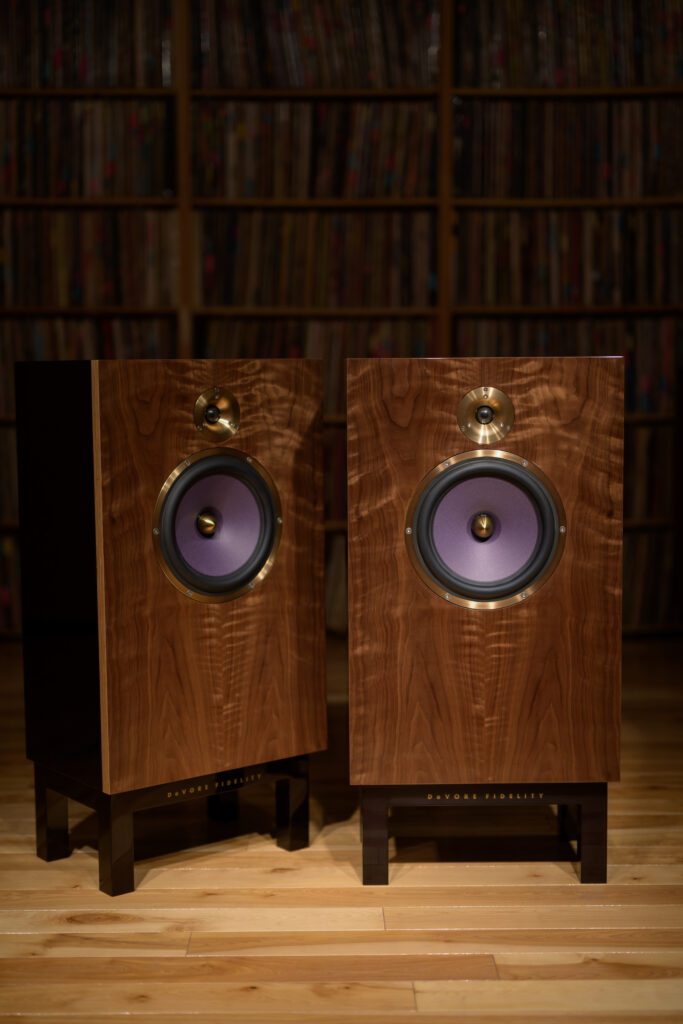
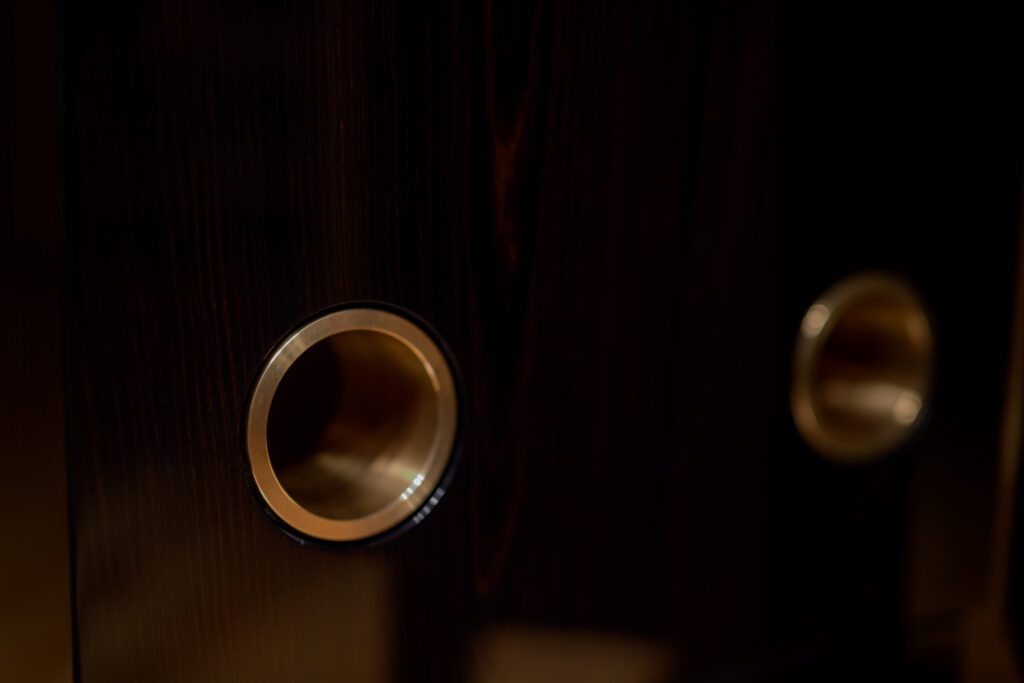
In its most basic terms, the O/Bronze takes the soft-dome tweeter from the O/Reference and mates it to a new 10” paper cone woofer. The O/Reference tweeter has a cast and machined bronze alloy chassis, and DeVore applies the same to that woofer, and its twin rear port tubes to the bottom of the cabinet. These are further isolated from the chassis to minimise any vibration effect from the port itself.
Sturdy, yet stocky
The loudspeaker sits on small, stubby feet that give the DeVore Fidelity O/Bronze a sturdy, stocky appearance. We’re in two minds as to whether this is a floorstander or stand-mount. The nature of the design makes the feet so integral to the O/Bronze that it’s more like a floorstander sitting on very tall feet.
The wide front baffle finish contrasts well with the darker wood of the top, rear and sides. Also, the contrast of blueish paper cone, bronze surround and waveguide and the highly polished, book-matched American Black or Lace Walnut veneer front baffle looks even better in the flesh. Yes, it does give a sort of ‘classic’ hi-fi look, as if you had unearthed some beautiful new old stock loudspeakers from the early 1960s, but this is not retro for retro’s sake; it’s a timeless take on how a loudspeaker should be made from the inside out.
A lot of people look at a DeVore Fidelity loudspeaker and draw parallels with Audio Note. There’s no direct link, but there’s something distinctly Darwinian about this; the two loudspeakers ‘species’ share common ancestry. This ancestry harks back to Harry Olsen’s experiments with diffraction in the 1930s and 1940s, but especially in the work done by Peter Snell in the 1970s and until his untimely death in 1984. Snell designed loudspeakers that achieved low levels of coloration by control of the on and off-axis response. His low-diffusion cabinet design permeates a lot of modern loudspeaker design, and the last 40 years of high-end speaker history is littered with models directly or indirectly influenced by Snell. Nevertheless, the designs diverge significantly, and DeVore’s O/Bronze has more in common with the smaller O/96 and larger O/Reference than it shares with designs from other brands.
Unfounded reputations
DeVore designs have a mostly unfounded reputation for being hard to install. I think this comes about from the designs not conforming to the ‘six feet apart, and toe them in’ convention that surrounds modern floorstanders. Granted, installation is a painstaking process but is made a little easier if first you remember to give those twin ports some breathing space. The manual gives good advice on installation, but I found they work best installed slightly wider than most designs, but with relatively little toe-in. A good rule of thumb is if you sit at the listening position, you should only be able to see the front baffle, or at most see the merest hint of the outer side walls of the cabinet.
DeVore loudspeakers are not insensitive to their surroundings, but neither are they over-reliant on them. They are loudspeakers designed to work in living spaces rather than studio environments, but they tend to like a well-damped room. Not too ‘dead’, but more ‘library’ than ‘bathroom’.
Good room
While I maintain audiophiles massively understate the importance of good room treatment, the O/Bronze is not the kind of loudspeaker that only works well in a treated room. You do need to be somewhat careful in the choice of listening chair as the tweeter routinely sits below ear height. While vertical dispersion is extremely good, too tall or (especially) too low a listening position won’t give ideal results. Most sofas and armchairs are fine, however.
Uniquely, the speaker terminals – a set of Cardas binding posts – sit at the base of the loudspeaker. These preclude the use of 4mm banana plugs; if nothing else, 4mm plugs mounted at the base of a loudspeaker are more likely to fall out than tightly sealed spade lugs. The cones need several hours of solid thrashing to get into their groove, but even from the outset, the DeVore magic shines through.
The magic touch
That magic is all about the musical realism. Not simply those subtle inner details like string noises, the full visceral, musical event. Live in your living room. It’s not that super-clean, super detailed, forward presentation that’s popular with many loudspeaker designers today. That can sound exhilarating, but some will add an “…at first.” And it’s those people, the ones who don’t want music thrown at them in a bright and stark manner, who will love what the O/Bronze does, and does so well.
We in audio are so used to breaking music down into its component parts that when we get something that just ‘hangs together’ perfectly, we’re a bit stumped. Yes, it can fall into terms like ‘coherence’ and ‘articulation’ and even ‘dynamics’ but they don’t paint the full picture. And the O/Bronze is all about painting the full picture.
I found myself reaching for pieces of music that don’t make it into print in audio titles that often. Pablo Casals and Segovia rediscovering Bach for the cello and guitar in the 1950s and 1960s, for example. Or Cymande playing a very 1970s British funk-pop. Or even playing early jazz from Louis Armstrong and 1950s big band from Count Basie. All these records just made you want to play more records, not in an orgy of discovery but an ‘ahhh’ moment of just enjoying the music.
Sit anywhere
Sure, the O/Bronze has excellent dispersion and great imaging, so you can sit almost anywhere in the room and get a good sound and fine stereo. And, if you look to audio characteristics like coherence and dynamics, it ticks all the boxes too. But that isn’t what the O/Bronze is all about. Those arid parameters don’t tell the whole story. The O/Bronze, and it’s uncanny ability to lock into what makes that piece of music an event rather than a collection of organised frequencies, tells the whole story. And it’s a joy to sit in front of.
If I have to pick out specifics, the bass performance of the O/Bronze is excellent, delivering deep, tuneful and – as Jason Kennedy so aptly describes it – ‘chewy’ low end. It’s powerful and dynamic, too. The ports pass the ‘Trentemøller’ test; if you play fast, deep synth bass – such as on Trentmøller’s ‘Chameleon’ [The Last Resort, Poker Flat] – some ports ‘choke up’ and blur the leading and trailing edges of those synth bass tones. Here, they are deep enough and free from resonance and influence that the bass never blurs together.
Lower blood pressure
Outside of electronica, this precision to bass depth gives the left hand of a piano piece a sense of drama and force that makes it sound more like the real thing. It doesn’t matter if you are subjecting it to some showy Chopin, some Jerry Lee Lewis-level keyboard mutilation or even some more reflective, blood-pressure-lowering work like Bill Evans’ ‘Peace Piece’ [Everybody Digs Bill Evans, Riverside], the sound moves into musical realism in a way many more notionally ‘accurate’ loudspeakers never attain.
Finally, there’s an obvious internal set of comparisons, between the O/96 and O/Reference. In a way, we can discount the reference model, as its bass modules make it both a more upscale proposition and one that demands a much larger room than the O/Bronze. The O/96 comparison is interesting, however. They are notionally very similar loudspeakers, with similar sized cabinets and drivers and an almost identical on-paper specification sheet.
The difference, however, is striking. You can tell that they are from the same family and the O/96 is a great loudspeaker… right up until you hear what additional bronze brings to the party. The O/Bronze is faster, tighter, has both better control and seemingly deeper bass. It adds refinement and clarity without being in the least bit pretentious. Let’s put it this way; if you have a pair of O/96, this is your next loudspeaker. If you are wavering between O/96 and O/Bronze, you’ll go for the O/Bronze. Even if that step is a bit of a reach, you’ll make it.
Observations
At this level, downsides are simply ‘observations’. As suggested, those wanting a more forward and tightly detailed presentation will skip over all things DeVore. The O/Bronze is no exception. However, if you listen to most modern loudspeakers and words like ‘etched’, ‘bright’ spring to your mind – or you find that modern forward sound too ‘up front’ then DeVore Fidelity’s O/Bronze is right in your wheelhouse. Also, regardless of sound quality, there will be those who want something more ‘sculptural’ than a rectangular box, no matter how well finished. Finally, an absence of grille is probably no big deal, unless you have two- or four-legged family members who see a tweeter as a button to press.
I end as I started this; John DeVore doesn’t know how to make a bad loudspeaker. This leads to a philosophical aside; although the term has lost its way of late, we still think of audio products as ‘high-fidelity’. The DeVore Fidelity O/Bronze asks, ‘fidelity to what?’
Maybe, being uniquely faithful to a set of dry objective metrics isn’t the complete picture, after all. Perhaps, argues the O/Bronze with every note it plays, the benchmark should be how a system performs with music? After all, being more faithful to the music is what a product should be doing. At least, when it comes to, y’know, making music!
Technical specifications
- Type: Two-way, bass reflex loudspeaker
- Drive units: 1x 25mm soft-dome tweeter with bronze horn and chassis, 1x 250mm paper cone mid-bass unit with bronze chassis and phase plug
- Frequency Response: 26Hz-23kHz
- Sensitivity: 96 dB/W/M
- Impedance: 12 ohms
- Finish Options: American Black Walnut, Lace Walnut, or Custom
- Dimensions (DxWxH): 30.5 x 46 x 90cm including stands
- Weight: 20.5kg
- Price: £29,998
Manufacturer
DeVore Fidelity
UK distributor
Absolute Sounds
+44(0)20 8971 3909
Trending Articles
See all
Xavian Unica
- Apr 07, 2026
Online Exclusive: OepPhi Lounge 2
- Jan 20, 2026
Trending Articles

By Alan Sircom
More articles from this author
Read Next From Review
See all
HIFISTAY Sound Wings+
- Sep 16, 2026
Marantz Model 10
- Sep 16, 2026
Network Acoustics Origin
- Sep 16, 2026
OePhi Kali
- Sep 08, 2026