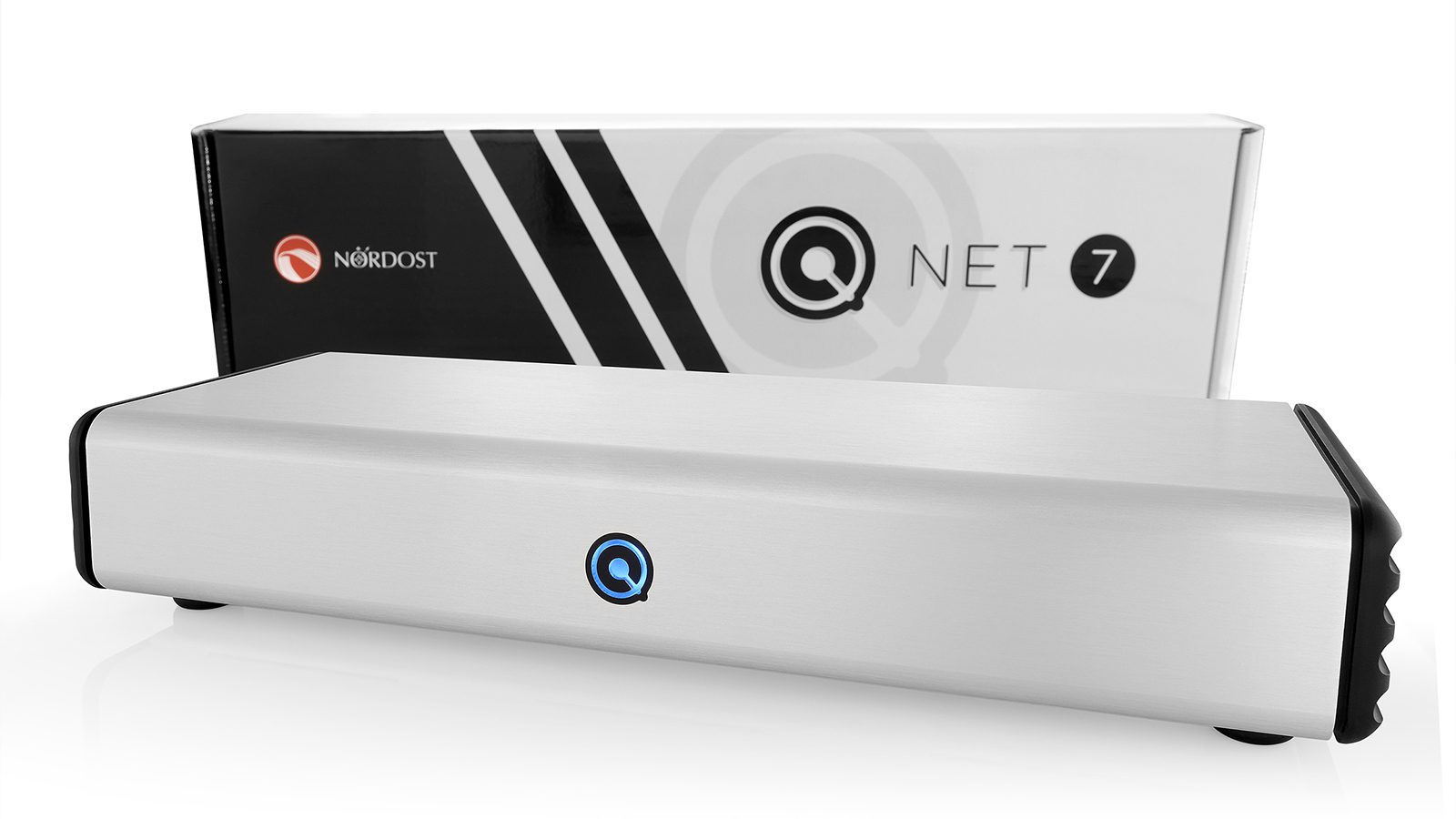
Nordost’s QNET 7 is derived from – and improves upon – the QNET audiophile network switch we reviewed in Issue 209. It sits above the QNET and does not replace it. However, many existing QNET owners will replace it with the QNET 7 for two reasons. First, it does what the QNET does, but better. And secondly, its shelf appeal compared to the large hockey puck-shaped original.
However, before focusing on the specifics of QNET and why the QNET 7 improves on its performance, it’s worth asking why there should be a need for an audiophile network switch in the first place? Ethernet devices send data in packetised form. Unlike a datastream, the chances of corrupting data in transmission is effectively zero. However, beyond the signal itself, there is a lot of noise that is inherent to the transmission process. This noise isn’t ‘data intrusive’ but can undermine sensitive audio and video equipment reading that data.
The body in the library
It’s like reading a book in a library and doing the same on a busy street; the book, the words, your eyes and the cognitive process required to translate those squiggles into meaningful text are unchanged, but your enjoyment of the reading process will be very different. Most switches are not built to reduce that extraneous noise, because it’s irrelevant for most kinds of file handling. On the other hand, the best audiophile switches (such as the Nordost QNET models) specifically address ‘audio intrusive’ interference. In particular, they target electromagnetic interference and noise in the radio frequency bands. While galvanic isolation helps keep some of this interference in check, broadly speaking, the better the network audio devices, the more sensitive they get to this kind of interference.
QNET 7 takes this interference and noise control and runs with it. Curiously, where most audiophile switches – including the QNET – rely on 100Mbps (100BASE-TX) ports, ports one to five of Nordost’s QNET 7 features faster, Gigabit Ethernet (1000BASE-T) ports. In contrast, just the sixth port uses a 100BASE-TX. Apparently, in listening tests, Nordost found the Gigabit ports are quieter when used with network attached storage (NAS) or routers. Moreover, the 100Mbps port adds additional noise control making it ideal for streamers or network DACs. The final port is compatible with both 1000BASE-T and fibre-optic SFP transceiver modules.
Seven ports
Seven ports for a network audio system might seem a little excessive at first glance (most systems today will use one port each for router, server, NAS box and streamer/DAC), but an active Linn system could fill almost every port on the QNET 7. If the direction of travel in audio continues on its present trajectory, the number of network attached audio devices will only continue to expand. Therefore, the five ports of the QNET might be a little ‘belt-tighty’ soon.
Like the first QNET, the Nordost QNET 7 is a layer 2 switch, meaning it doesn’t just repeat physical signals (as layer 1 switches do) to all connected devices, but instead intelligently forwards data to the appropriate address on a local network. And, also like the original QNET, you can upgrade with a Nordost’s QSOURCE linear power supply.
Shelf assured
The novel QNET layout might have been a good way to reduce socket-to-socket interference, but it wasn’t the most aesthetically pleasing layout. Five equally spaced RJ45 sockets and a power connector at the rear of a disc-shaped device meant at least one and possibly two cables would always be visible. By putting QNET 7 in a more conventionally shaped box, it can sit on a standard shelf of an audio rack. Consequently, no Gordian knot of Ethernet cables is on show. To a reviewer, who likely always has cables strewn around the room, this seems like no big deal. However, to many having those neatly dressed cables out of sight lines makes a lot of sense. Also, in looking more like conventional audio and less like either a giant hockey puck or a commercial network switch, there’s something reassuring for audio enthusiasts.
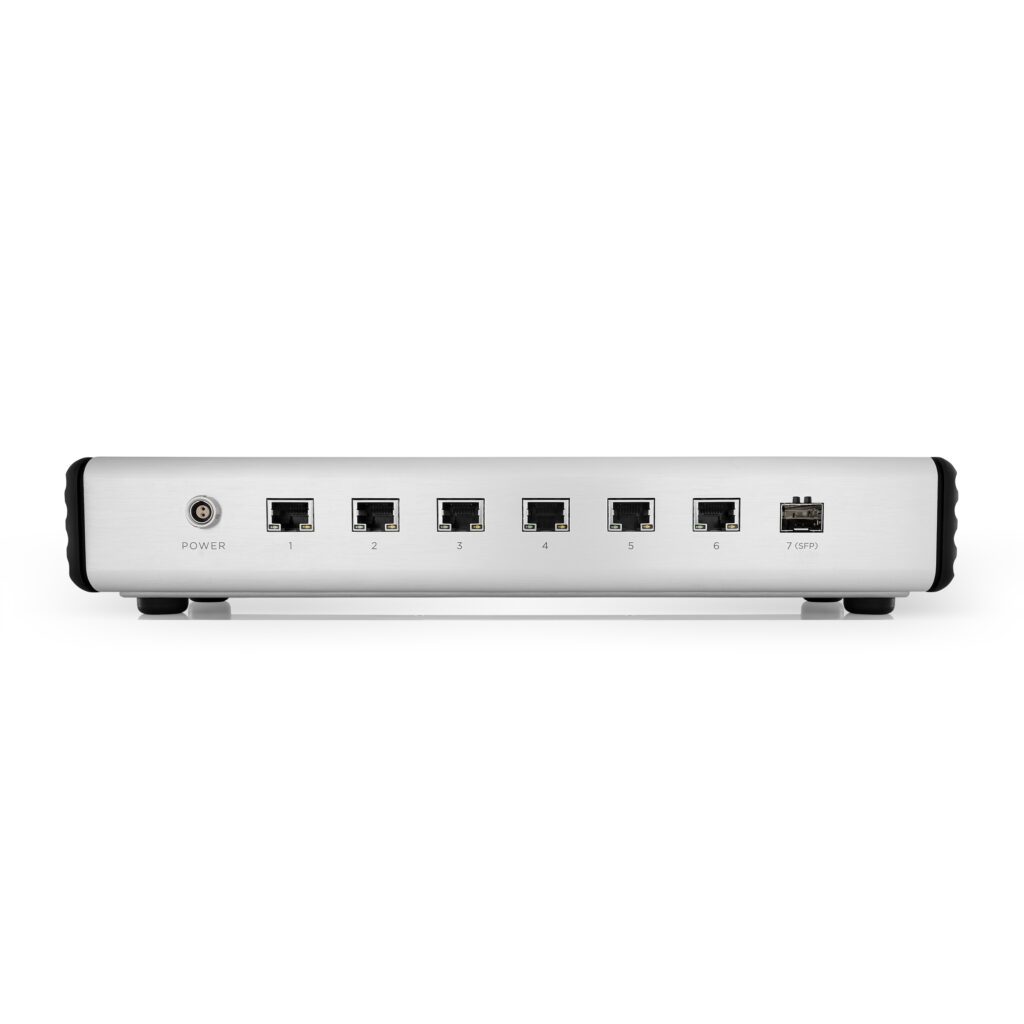
The QNET 7 retains the physical separation and equidistance between ports seen in the QNET. This minimises crosstalk between adjacent ports. Couple that with the QNET 7’s eight-layer boards (compared to the six-layer PCBs in the QNET) and nine power supplies, and you have a switch that introduces as little as possible internal angst to glom onto that packetised data.
QNET 7’s more conventional shape does have an additional benefit. There is an option for two Stand Mount outriggers for four Sort Kones. You can, and should, do the same with the QNET and a trio of Sort Kones. However, that’s more of a balancing act.
More excellent-er?
As a user of Nordost’s original QNET, I approached this with interest and a little bit of apprehension. QNET was already excellent, will QNET 7 be more excellent-er? If there’s no change, what then? Does it mean we’ve overhyped the whole network switch debate? Or is there a performance ceiling in networking? However, after a few minutes, I realised I was asking the wrong questions. The right question was “where did I put that QNET box, now that I have to upgrade?”
The original QNET lets the music be smooth sounding, with quieter backgrounds. It helps bring out detail and dynamic range that are held in check by the system itself. Additionally, there’s a lot of expansiveness and depth to the soundstage. This is demonstrably lost when moving back to something more prosaic. And, yes, that gets a lot better when a QSOURCE replaces the wall-wart supply.
QNET 7 does all that and more. Or is that ‘less’? It gets you further into the music and pushes that interference further into the shadows. What was smooth sounding through the QNET sounds realistic and natural through the QNET 7. Detail – already a QNET strong point – is brought into even sharper focus and clarity. If the QNET was like having your window on the music wiped clean, QNET 7 is like putting that window in an ultrasonic bath.
Universally
And that happens universally, irrespective of whether that now cleaned music comes from an online or local source. It applies regardless of musical genres, and without favouring one kind of audio component over another. It’s probably the closest I’ve heard to a ‘universal good’ in some time. In fairness, I stopped short of playing ‘Baby Shark’ through the QNET 7, but everything from Albinoni to Zappa benefitted from its inclusion in the system. So, even this addictive kids song from a few years ago will probably sound even more addictive through the Nordost box.
Beyond the ‘it did X better’ comparisons, there is an important musical consideration the QNET 7 brings to network audio; a sense of order and calm to the music. It’s as if the musicians practiced a little more before they went into the studio. Consequently, music hangs together better here. Once again, this is more peeling away layers between the listener and the music, rather than adding or changing the sound.
Getting that noise out of the way means there are unlikely to be any tonal or temporal changes to the music… but it just sounds more like music on the Nordost QNET 7. For once, ‘you pay more and get less’ is a positive thing!
What about QNET?
There’s an interesting test that pops out of this upgrade path. Is the QNET+QSOURCE better or worse than QNET 7 with a basic power supply? I’d say they are about even, with maybe the original QNET+QSOURCE having the edge on dynamic range. Just. However, QSOURCE has enough power feeds to drive both at the same time. Therefore, when you compare QNET and QNET 7 with QSOURCE feeding both of them (for comparison purposes only… it gets warm if you leave them both perma-connected), QNET is simply outclassed. It’s by no means a bad device but the additional levels of noise-busting in the QNET 7 make it hard to go back.
Aside from a Freudian desire to say ‘QNET’ and think ‘Q*bert’ (I didn’t even like that game, I was always more of a Pac-Man guy), it’s hard to find flaw with the Nordost QNET 7. Those with existing Nordost QNET and QSOURCE are going to upgrade to a QNET 7, the difference is that marked. Furthermore, those new to top-end network streaming would be well advised to give the QNET 7 a listen. This is true even if they have no other Nordost products in their system. Just don’t be surprised if you end up adding a QSOURCE, the Stand Mount and four Sort Kones too. QNET 7 is so good, it might be the gateway to a whole host of Nordost products.
Technical specifications
- Type: Layer 2 unmanaged network switch
- Number of ports: 7
- Port capability: Ports 1-5: 1000BASE-T/100BASE-TX capable with auto-negotiation and auto-MDI/MDI-X support. Port 6: 100BASE-TX capable with auto-negotiation and auto-MDI/MDI-X support. Port 7: 1000BASE-T and 1000BASE-X (LX/SX) capable.
- Port connectors: 6x 8P8C (RJ45), 1x SFP
- DC power input: 5V/1A (via LEMO connector)
- Dimensions (WxDxH): 32×12.2×59.6cm (including feet)
- Weight: 1.65kg
- Price: £5,200, €6.049, $5,500
Manufacturer
Nordost
UK distributor
Renaissance Audio
+44(0)131 555 3922
Tags: NETWORK SWITCH NORDOST QNET 7
Trending Articles
See all



By Alan Sircom
More articles from this author

Read Next From Review
See all
Meze Audio 99 Classics (2nd Generation)
- Sep 22, 2026
MOON 371
- Sep 22, 2026
HIFISTAY Sound Wings+
- Sep 16, 2026
Marantz Model 10
- Sep 16, 2026