The last piece of kit I reviewed from Bulgarian high-end digital specialist APL Hi-Fi was a streamer. It was based on an AURALiC engine. With the recent passing of that brand, this streamer is no longer in the APL catalogue. Instead, there is a range of significantly more impressive-looking digital components. These sit alongside some amplifiers and even a loudspeaker. For the most part, these are ‘coming soon’. From the analogue product offerings, only the PRE-GR tube preamplifier is in production thus far.
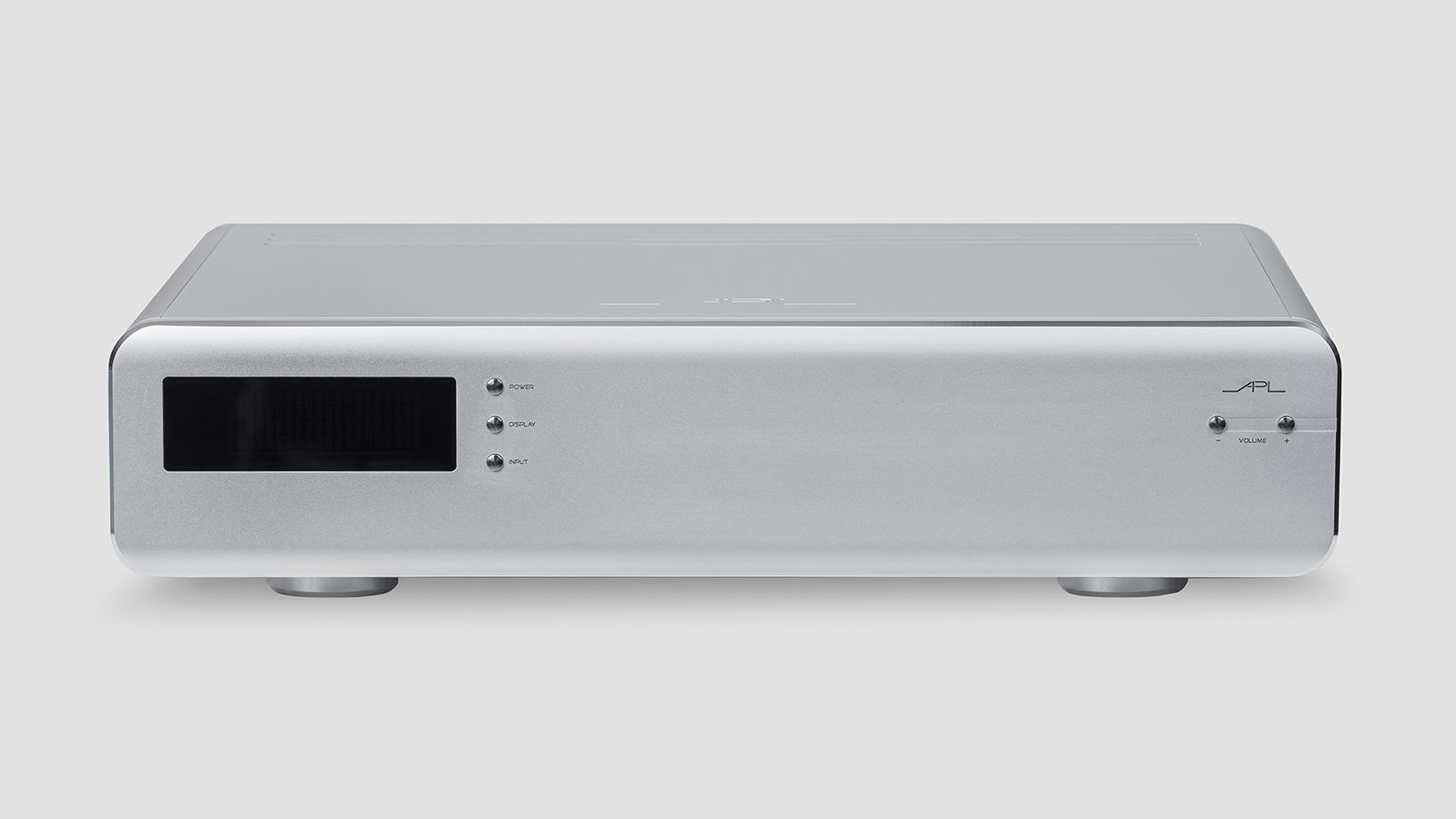
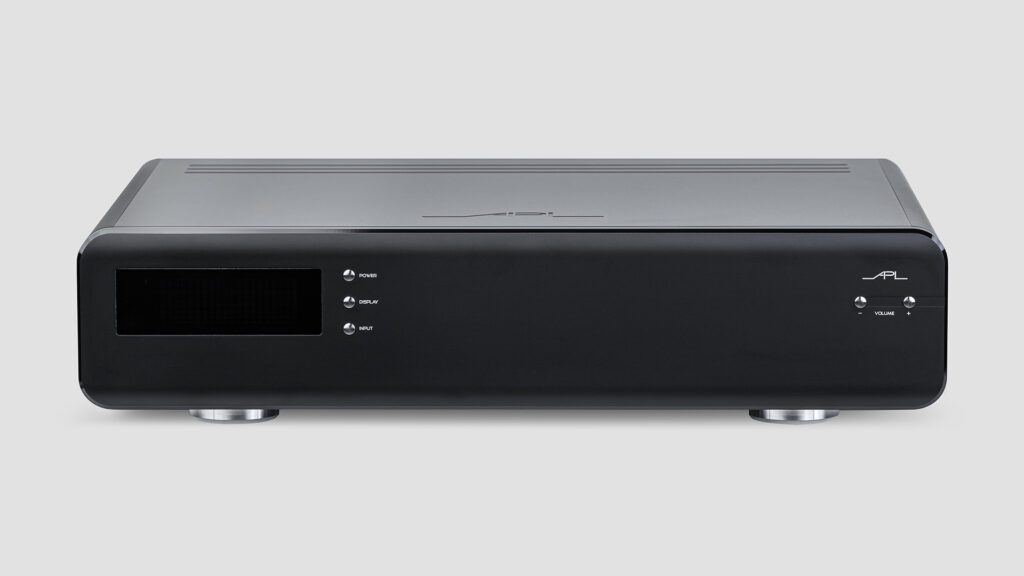
The APL DSD-WR (World Reference, great name) is the company’s reference all-solid-state digital-to-analogue converter. APL also makes an even more ambitious DAC in the DSD-GR (Galactic Reference, even greater name). This is a transformer-coupled tube output stage, at around three times the £19,000 asking price of the DSD-WR. Both inhabit the same superbly finished casework and sit on three decoupled non-magnetic stainless-steel feet. At 12 kilos, this feels like a serious bit of kit.
The presence of DSD in the name gives a strong clue to its operational inclinations. The DSD-WR converts PCM signals to a one-bit format using a 64-bit PCM-to-DSD converter module. The final DAC can receive files as DSD128 or DSD256 files. That means two- or four-times upsampled. APL’s Alex Peychev is clearly a DSD devotee, as there are no other types of DAC in the range. Peychev says it’s “inspired by vinyl sound quality. It provides a comparable natural, rich and spacious sonic character.”
No stone unturned
The USB input module accepts PCM at up to 384kHz/32-bit and native DSD256, and converts the DSD signal to analogue. It uses parallel DAC chips operating in DSD-only mode. This features two DACs per channel in balanced mode, in a proprietary Class A configuration. The DSD-WR employs ultra-low-noise femto master clocks and offers variable output with 0.5dB steps, via non-decimating attenuation. The output stage is Class A, transformer-coupled, using Lundahl transformers with amorphous cores and OFC windings. This is naturally a negative-feedback-free stage, created discretely without op-amps or mechanical relays/switches, and the wiring is oxygen-free copper throughout.
The linear power supply features a custom R-core balanced transformer, also wound with OFC wire. With specially selected components and solid OFC copper wiring throughout, Alex appears to have left no stone unturned in his quest to build a reference-grade DAC. The display is an FLD type, available in red, blue or green. However, as is usually the case, sound quality is likely to benefit if the display is turned off when the DAC is in use.
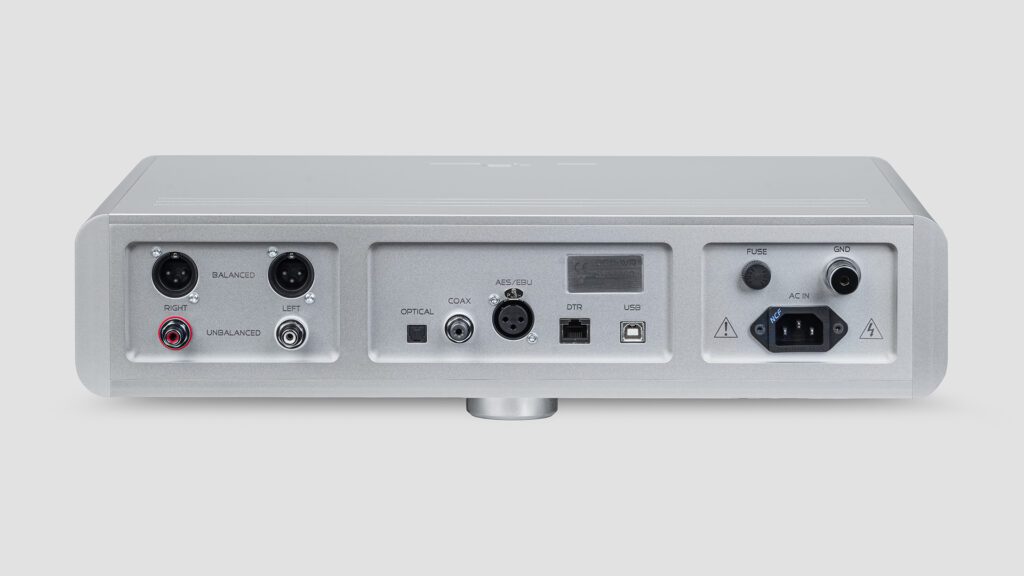
At the back of the precision-machined enclosure, the DSD-WR offers high-quality sockets for the usual array of in- and outputs, alongside an RJ45 connection for APL’s proprietary DTR connection. This allows I2S signals to be received from the company’s digital sources. That should say source, as at present there is only the NSP-GR server/streamer available. The only other unusual connection is a grounding point, an increasingly popular feature on components whose makers appreciate the benefits of connecting it to an appropriate device. I hooked it up to a CAD GC1.1 Ground Control box.
300 hours
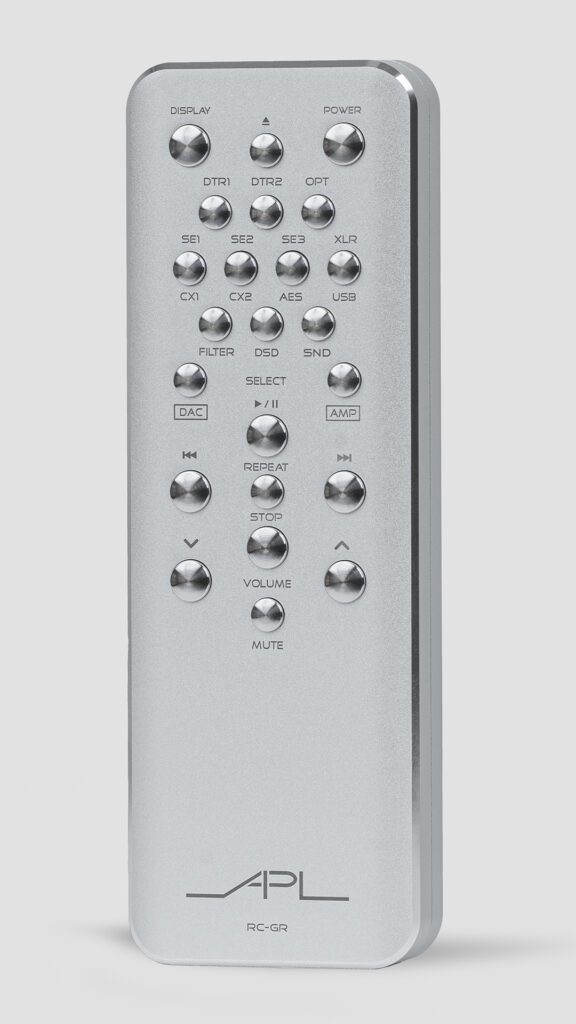
Most of the controls you require are on the front panel, but the button-festooned remote is much easier to use and lets you control volume from your seat. This handset is just as nicely made and finished as the machine itself and allows changes to filter settings for PCM signals, with three options: non-oversampling, slow roll-off and sharp roll-off. These are detailed in the manual, alongside a note that the DSD-WR requires 200-300 hours of break-in to fully settle, which is a lot. Fortunately, distributor Definitive Audio had been using this sample for a while and put in the necessary hours.
I am not the biggest DSD fan in the audio omniverse. To me, the format has always sounded tremendously clear and revealing, but lacking in timing. I much preferred the short-lived DVD-Audio format to DSD-based SACD. But it is a very popular digital carrier among many enthusiasts, and this APL made the best case for it that I have yet heard. In fact, it pretty well swung my opinion.
Before I started listening in earnest, I asked Rob Osbourn of Network Acoustics, who uses a DSD-WR, and Kevin Scott of Definitive Audio what their preferred filter settings were. Rob recommended the Zero option (no oversampling), and Kevin said he liked the Normal setting, which provides a sharp roll-off. So I listened to both and was blown away by the incredible transparency and high-frequency extension. This enabled large-scale, precise imaging with three-dimensional depth that was off the scale of decent recordings. It also meant loads of detail. You need more information to present this level of imaging, and this APL has it in spades.
Higher highs
Voices and instruments really shine, too. Again, it’s down to data. APL has clearly managed to extract more fine detail from digital files than most in the DSD-WR, and this is clearly related to the one-bit nature of DSD. The benefits are most obvious in the high frequencies, which seem to extend that much higher and in a more solid, clean way than is usual for digital sources. The highs are where digital generally falls down. They never have the depth or presence that a good analogue can achieve and are prone to graininess, which makes the treble sound unnatural. This is clearly not the case here. This APL is the most open and transparent-sounding DAC I have used in a long, long time.
I used it mostly with PCM music files and some of my small collection of DSD albums too. Of these, only a very few are original DSD recordings, and these did sound excellent, not so much as to convert me to the format, but they did reveal why so many love it. Eric Bibb’s ‘Where the Green Grass Grows’, from an Opus3 compilation, proved more emotionally powerful than expected, thanks to the depth with which his and the gospel backing singers’ voices were resolved. Another Opus3 release of Zappa covers by the Omnibus Wind Ensemble produced an extremely natural, effortless result that seemed a bit out of keeping with the originally filthy-sounding ‘Peaches en Regalia’, but it sounded very realistic.
In truth, the result with PCM files was very similar. I wasn’t able to compare the same music in both formats, but I got the same massive resolution, incredibly low noise and a wide dynamic range. Clearly, the conversion from one format to the other is done with minimal losses.
Body and mind
But does it time well? Does it engage the body and the mind? Not with the Zero and Normal filters. However, the Slow roll-off filter I tried last (of course!) can do this. It trades a little transparency for significantly better coherence, and once I had found it, my leg rarely sat still when any rhythmic music was played. Here was proof that DSD can ‘time’ really well when appropriately filtered. By this point, I was connecting the balanced outputs directly to the power amp and using the onboard level control and its tiny half-decibel increments. Preamps, eh? Who needs ‘em?
Now, romps like Salika, Molika (Erland Apneseth Trio and Frode Halti) became living, breathing balls of sonic energy, with dynamics that kept on building. The volume had to be reined in more than once. Bugge Wesseltoft’s solo piano sounded more beautiful and touching than I have previously encountered. In the past, his It’s Still Snowing on My Piano Live has seemed worthy and genuine. Now, it had emotional heft thanks to the feeling in its playing.
It’s safe to say that, for me, the APL DSD-WR has removed any reservations I had about DSD. Now, it’s no longer a format for those more interested in beautiful tonal balance than in musical engagement. Filtering clearly plays a part, as it always has, in a format that extends significantly further than PCM. Regardless, APL DSD-WR manages to combine immense detail resolution with superb timing and a huge dynamic range. It allows the musical message to flow in a way that approaches the best that analogue can offer.
Technical specifications
- Type: Solid-state high-resolution PCM, DXD, and DSD-capable digital-to-analogue converter
- Digital Inputs: One AES/EBU, two Coaxial, one USB, one DTR proprietary I2S
- Analogue Outputs: One stereo single-ended (via RCA jacks), one balanced (via XLR connectors). Both outputs have variable level operation
- DAC Resolution/Supported Digital Formats: All PCM from 44.1KS/s to 384KS/s with word lengths up to 32-bit, Native DSD from DSD64 to DSD256
- Frequency Response: 20Hz to 20kHz at ±0.5dB
- Distortion (THD + Noise): Not specified
- Output Voltage: 2.1Vrms at RCA and 2.1+2.1Vrms at XLR
- User Interface: Remote handset, FLD display
- Dimensions (HxWxD): 8 x 45 x 28cm
- Weight: 12kg
- Price: £19,000, €22,950, $25,500
Manufacturer
APL Hi-Fi
Homepage – aplhifi.com
Product – aplhifi.com/products/dsd-wr/
Distributors – aplhifi.com/distributors/
UK distributor
Definitive Audio
+44(0)115 9733222
Tags: APL DSD-WR DIGITAL CONVERTER
Trending Articles
See all
By Jason Kennedy
More articles from this author
Read Next From Review
See all
Reiki Audio SuperSwitch X/Pro X PSU
- Oct 06, 2026
Audiobyte SuperVOX
- Oct 06, 2026
Unitra WSH-805
- Sep 29, 2026
Wilson Audio Sabrina V
- Sep 29, 2026