Marcin Ostapowicz developed a passion for computer audio early on and has been immersed in it for over 20 years. His dedication to building a file streaming system that meets the standards of ears attuned to live music and authentic instruments has resulted in numerous achievements. These include the release of the JCAT software player for Windows in 2009 through JPLAY. This was followed by its commercial version a year later. He introduced his first USB audio card in 2013 and launched the JPLAY iOS app in 2022.
I had been following his progress from the early days, but JPLAY truly captivated me; it was a control app that provided near-Roon levels of metadata and significantly outperformed native apps on various network streamers. I have been using JPLAY for a year now, and nothing I have encountered makes me want to switch.
Server/streamer or switch
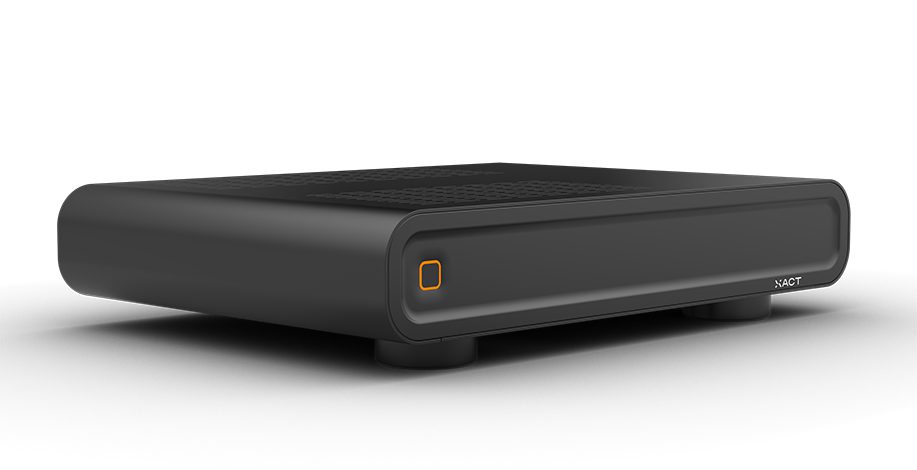
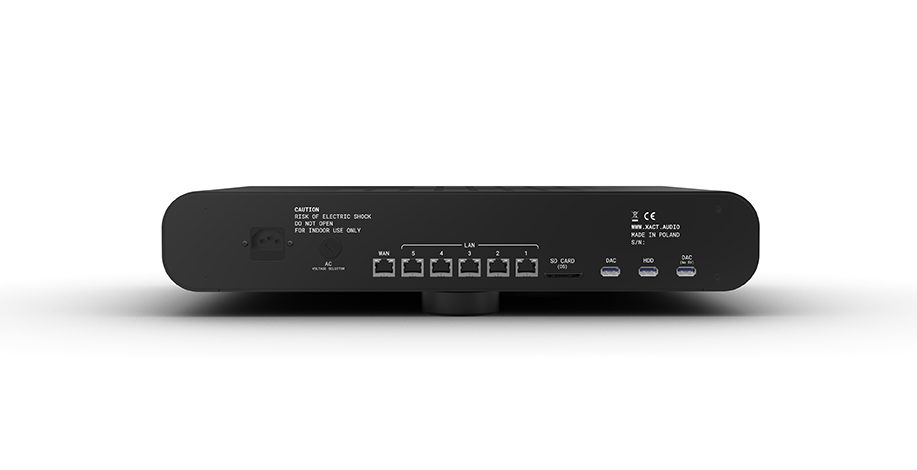
In 2023, Marcin launched his most ambitious product yet, the XACT S1 server. This is a comprehensive digital source developed over six years, offering file storage, network switching, and streaming output. At least, that’s what I initially thought when I examined the array of RJ45 Ethernet sockets on the back panel. It turns out that this switching element functions in an either/or capacity. The XACT S1 can operate as a server/streamer or a network switch. Given its exceptional performance in the former role, this must be its trump card.
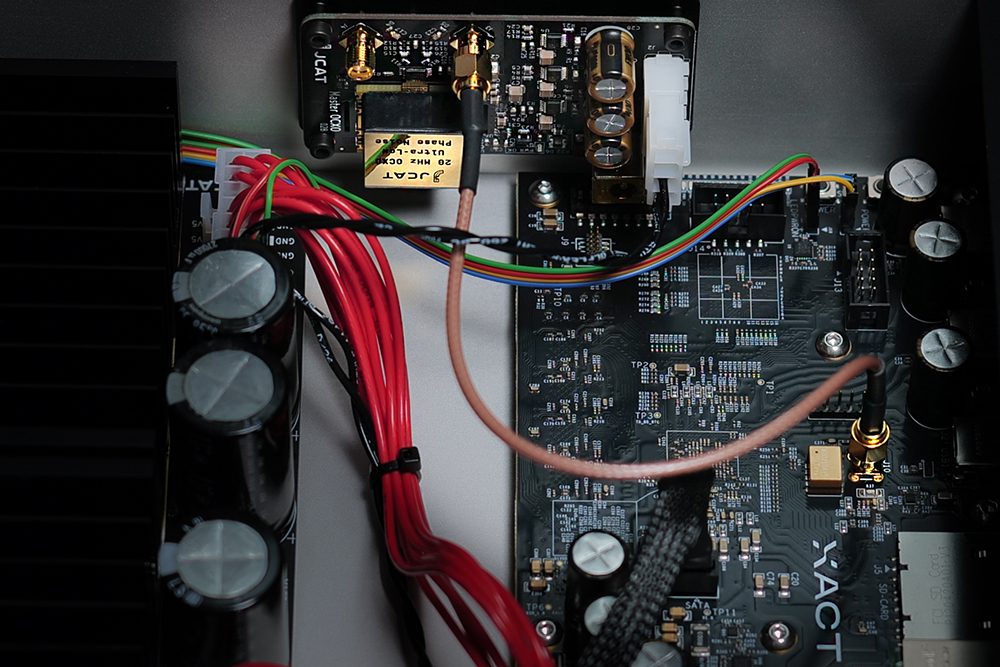
The XACT is available in two forms: the standard S1 and the S1 Evo, with the latter priced at £4,000 more than the former. Both models are based on a custom motherboard developed exclusively for audio playback, featuring a linear power supply and a high-stability OCXO (oven-controlled oscillator) clock. They offer USB outputs both with and without a 5V power bus. Allegedly, some DACs function without this ‘handshake’ voltage. Music files are stored on a selected 4TB solid-state drive (8TB available on request). This connects to the motherboard using XACT’s dedicated SSD drive cable.
Operating system
The operating system for the XACT S1 is stored on an SD card that slots into the back of the unit. This is an unusual approach. It has been adopted to allow for server updates without running software that is constantly alert to updates, which generates noise in the process. Updates must be flashed onto the SD card using a computer and a card reader. I found a reader originally purchased for a camera card. I was able to update the software on the review sample, so it’s not exactly rocket science.
Marcin is keen to point out that this is not just any SD card; it’s a single-level cell (SLC) type, which stores only one bit of information per cell. This means faster write/read speeds and significantly greater longevity. The spec indicates that it’s good for 100,000 program/erase cycles.
The Evo upgrade adds Immotus CL isolation feet to the S1. These aluminium feet have a ceramic ball-bearing interface that is said to enhance sound focus and dynamics. Xact recently launched two versions of Immotus footers, with prices starting at €1,000 for three. You will not be surprised to hear that the Xact S1 Evo also features three feet.
Furthermore, the OCXO clock is “significantly upgraded” from the standard version. As one would expect, it was developed in-house with an emphasis on precision and stability. The third benefit of the Evo is a Phantom music drive cable. Xact produces USB and LAN cables under this name, so they are likely to be of good quality.
The JPLAY way
Purchasers of the Xact S1 in either form receive a lifetime licence for the JPLAY app (worth £199). The app was launched prior to the Xact, but both were developed in tandem, and their combination must significantly contribute to the results it delivers. Marcin tells me that it sounds better than other control apps because the traffic between the streaming engine and the controller is kept to a minimum. In other words, they are not constantly communicating with one another. This creates low-level electronic noise in the process.
This means that playback cannot be rewound from pause, and the play cursor will move even if the signal is not reaching the DAC due to an issue in the signal chain. This is a concern for those of us who need to change cables and components for a living. However, in other respects, it’s a highly informative and user-friendly app. Once you are familiar with these quirks, it is easier to use than many others. It provides native access to all the usual streaming services and displays plenty of metadata where available. Sonically, it is far ahead of the competition, somewhat like the Xact S1 Evo.
Immediately gratifying
I utilised this server/streamer with a Bricasti M11 Classic DAC, connecting it to the 5V USB output with a Network Acoustics muon2 USB cable. The result was immediately gratifying, thanks to a distinctly calm, low-noise presentation. This made even a Tim Hecker ambient track (Sunset Key Melt via Qobuz) sound remarkably rich. It featured low yet clean synth bass and heavily distorted mids. The sound was both clear and gritty. The gritty aspect is clearly part of the original signal.
With a more familiar track from the onboard drive, things became even more interesting. There seemed to be so much occurring, showcasing extraordinary dimensionality. Once again, the word “clean” appeared in the notes. The noise floor on the Xact S1 Evo is incredibly low, allowing one to hear significantly more. This reduction in electronic noise eliminates any trace of harshness from the sound and permits higher playback levels. The perception of loudness is considerably diminished. It resembles analogue with a flat response, which is a very rare occurrence.
The thrill is back
In recent months, I’ve relied on an AES/EBU connection between my streamer and DAC due to its superior musical fluency and detailed sound. Consequently, switching back to USB may have produced a sound that is usually detailed but somewhat less engaging and slightly harsh. The Xact S1 Evo shows that this connection isn’t a limitation. Instead, many implementations struggle to use it effectively. This might highlight the importance of the custom motherboard.
With the Keith Jarrett Trio’s “The Old Country – More from the Deer Head Inn” live performance, the Xact effectively eliminated distracting glare from the sound. It uncovered the speed and immediacy of the performance, offering a very natural-sounding perspective with genuine room acoustics. When Jarrett, Peacock, and Motian get into the swing of ‘Everything I Love,’ the result is absolutely thrilling. The way the pianist merges intensity with joy and fluency is remarkable. You simply have to turn it up to ‘be there’; it’s not difficult. I adore how it discovers melodies where none were previously evident. I also love how it enhances the dynamic range, allowing you to follow the finest nuances of playing while others play with gusto.
Very revealing
The Xact is very revealing of what it’s connected to, by which I mean power and switching. Changes in both departments are obvious. You will only get the best results when both are sorted. At one point, I had to put the switch on a lesser mains source, and the change in perceived distortion was shocking. Switches shouldn’t make this much difference. When you open the window as wide as the S1 Evo does, everything shows.
I had a very well-regarded server/streamer at my disposal during Xact’s too brief tenure. It wasn’t quite as expensive, but it was in the same ballpark. Yet the comparative benefits that the S1 Evo brought to the table were significant. It offers a sense of presence that is as close to magic as I have heard from a digital source. The backgrounds are darker, and the dynamic and tonal contrasts are more pronounced. Vocals are extraordinarily real and solid in the room— the Dali Epikore 9 speakers certainly assisted in this—but nonetheless, I have rarely heard such purity and untarnished truth as that produced by Tamara Lindeman on ‘Free’ (The Weather Station). Her high voice often sounds thin on digital systems that leave some trace of their processing. However, here it was pure and natural. We vinyl junkies rarely get this kind of thrill from digital.
No hesitation
Marcin and his team deserve the highest praise for what they have achieved with the Xact S1 Evo. It delivers everything that is good about digital audio, apparently without any of the problems that afflict the format. If I could afford one, there would be no hesitation in placing an order. As it stands, I will have to love and lose and save up for that day when streaming can sound as good as this again.
Technical specifications
- Type: Solid-state music streamer and server with SSD storage.
- Storage: 4TB SSD hard drive (optional 8TB).
- Network connection: RJ45 ethernet.
- Digital Outputs: One USB, one USB without 5V power bus.
- Back up connection: USB.
- Formats supported: DSD: DSF, DFF, PCM: FLAC, Apple Lossless (ALAC), WAV, AIFF; MQA (pass-through)
- Streaming services supported: Qobuz, Tidal, HQPlayer.
- User Interface: JPlay control app for iOS, Mac.
- Other Features: Includes lifetime JPlay licence.
- Dimensions (HxWxD): 100 x 439 x 315mm
- Weight: 10kg
- Price: £16,000, $18,600, €16,000
Manufacturer
JPlay
UK distributor
Elite Audio UK
0800 464 7274 (UK only)
Tags: MUSIC STREAMER SERVER XACT S1 EVO
Trending Articles
See all
By Editor
More articles from this author


Read Next From Review
See all
Eversolo T8
- Oct 13, 2026
Acoustic Energy AE Active
- Oct 13, 2026
Reiki Audio SuperSwitch X/Pro X PSU
- Oct 06, 2026
Audiobyte SuperVOX
- Oct 06, 2026