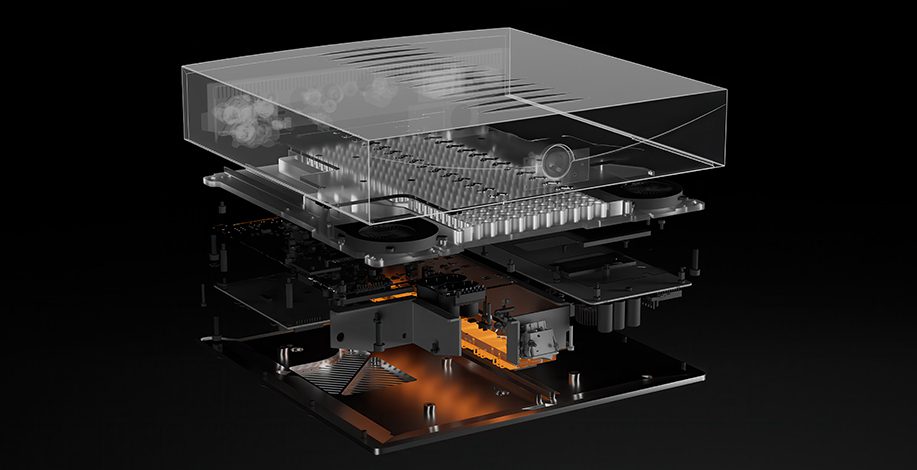
The Linn Klimax Solo 500 ranks among Linn’s most ambitious projects so far. It integrates much of the engineering from the larger Klimax Solo 800, but in a more compact, shelf-friendly design. It also succeeds one of Linn’s most celebrated products, the Klimax Solo, which had been in production for twenty-five years. That’s quite an achievement.
We spoke to Alastair Bennett, Senior Mechanical Design Engineer at Linn, and Dan Wareing, one of the company’s electronics engineers tasked with the Klimax Solo 500 circuit architecture, about the development of this revolutionary amplifier.
AB: The Klimax Solo 500 is a complete redesign based on the fundamentals of our most successful amplifier ever – the Klimax Solo. We have maximised the use of every available space within its machined-from-solid enclosure to create a product that surpasses its legendary predecessor in every aspect, while still maintaining a compact form factor.
We have leveraged our flagship amplifier and power supply technologies to develop designs that fit within a sleek, minimalist casing, ensuring that Solo 500 is a significant upgrade. It serves as an ideal drop-in replacement for existing systems that include either the original Solo or third-party amplifiers, and its compact size makes it especially suitable for active setups and environments with limited space.
Solo 500 performs optimally from the moment it is powered on and continues to do so throughout its lifetime, thanks to our Adaptive Bias Control system. It has immense available power, an extraordinarily low noise floor, and 85 times lower distortion measurements than its predecessor.
Adaptive Bias Control
Linn’s Klimax Solo 500 follows the Klimax Solo 800 and 360 loudspeakers in using Linn’s Adaptive Bias Control technology to adjust the biasing of the amplifier’s output stage optimally.
DW: The output stage of a Class AB amplifier is responsible for providing the necessary power to the loudspeakers. It consists of two sets of high-power transistors—one managing the positive side of the signal and the other handling the opposing side.
The smooth transition from one device to the next as the signal crosses zero is essential for the performance of a class AB amplifier. To ensure a seamless switch, a bias voltage is applied to the output transistors, causing a small bias current to flow through them. This current must be optimised at a specific level to minimise distortion.
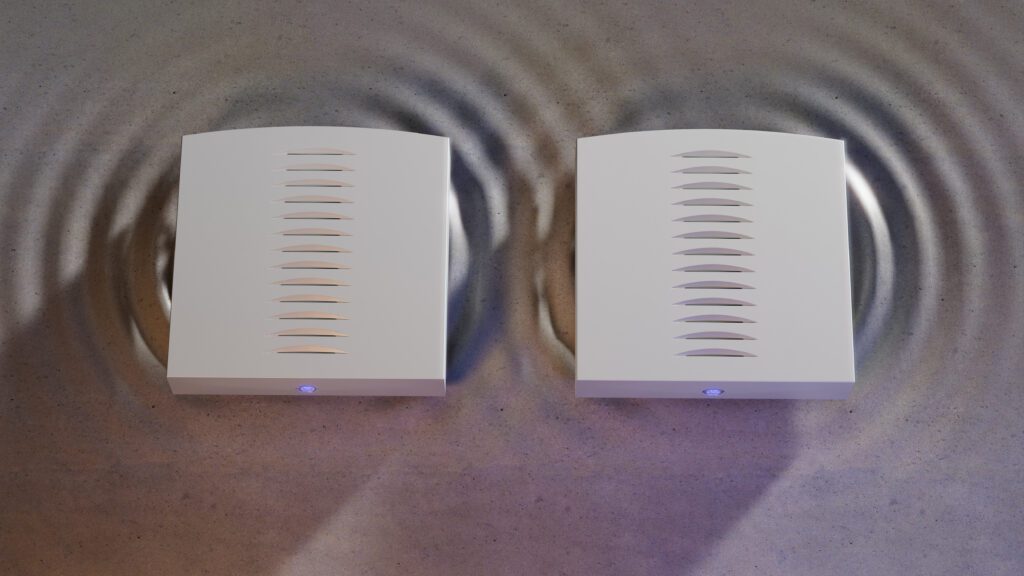
However, the relationship between the applied bias voltage and the resulting bias current isn’t constant – it varies significantly with the temperature of the output transistors and over their lifetime.
Conventional class AB amplifiers employ techniques to compensate for some variations, such as slow temperature changes. However, these methods are ineffective against rapid temperature shifts caused by large transients in music, as well as changes in transistor properties over time and differences between individual transistors. The accuracy of such correction also tends to drift over time. Consequently, an amplifier’s performance may decline throughout its lifespan and differ between units in a single setup.
With our Adaptive Bias Control, we continuously monitor the amplifier’s output current, digitise it, and then apply digital signal processing to extract the instantaneous bias current. We can then compare this to the ideal level we are targeting and correct any errors in real-time.
This method overcomes the issues associated with more traditional techniques. Both slow and rapid temperature variations can be measured and corrected, and changes in the device’s characteristics over the amplifier’s lifetime are managed through the digital correction method. Additionally, any other potential sources of error and long-term variations are addressed by calibration routines performed during startup.
Overall, this ensures an amplifier that will always perform optimally throughout its entire lifetime, from the moment it is switched on. And each Solo 500 in your system must perform identically to the others.
Hybrid Cooling Matrix
AB: As with any class AB amplifier, we must dissipate the heat generated during use to enable it to perform at its best, and managing this within a compact form factor is a challenge.
In Solo 500, we have employed a hybrid cooling system designed to be equally effective at passively cooling the system at lower temperatures and actively cooling it at higher temperatures when the amplifier is pushed hard.
When cooling passively, heat is transferred and spread through our machined thermal plate into a series of fins that radiate the heat away into the air. However, when the active part of the cooling system begins, air is pressurised and evenly distributed through the channels between those fins. As the air moves along each of the channels, it removes the heat from the fins and exits through the top and rear of the amplifier.

The cooling fins, with their zig-zag shape and limited openings, are designed to maximise the amount of heat the air removes as it flows through each channel. The openings in each channel help to equalise the pressure and airflow across the cooling plate, while the zig-zag profile of the fins promotes turbulence and enhances the interaction between the moving air and the fins.
The design of this thermal plate was optimised through computer simulation to achieve the best combination of uniform heat distribution, pressure equalisation, airflow, and maximising the passive and active cooling provided by the fin matrix.
For Solo 500, we introduced a new intelligent fan control system to regulate the amplifier’s cooling. Besides monitoring the product’s temperature, the control system also measures the real-time signal level entering the amplifier. These readings are then combined to adjust the speed of the low-profile fans, which are mounted deep within the chassis to minimise noise. During quieter sections of music, when the input signal drops below a set level, the fans are turned off entirely and remain inactive until the signal level rises above the threshold for a specified period.
Extensive thermal testing was conducted to develop a control system that delivers the necessary cooling for the product at any given moment, using the minimum active cooling required.
When everything aligns, it creates a cooling system that enables the amplifier to perform optimally while occupying minimal space.
Utopik
DW: Another critical aspect of the amplifier’s thermal performance is the new Utopik power supply, which has been specially designed for this model. It is like the supply in Solo 800, but is scaled down to meet the power requirements of Solo 500.
As well as having extremely impressive efficiency across all conditions, another key feature of the Utopik supply that contributes to the thermal performance of the amplifier is its ability to vary its output voltage.
These ‘auto-voltage rails’ enable us to adjust the Utopik’s output voltage to match the audio signal, ensuring it only delivers the necessary power based on the content and volume. This prevents excess power from being generated and wasted as heat – thereby improving overall amplifier efficiency and resulting in a much cooler-running amplifier.
This feature is only possible because Utopik is a switched-mode power supply, which could not be achieved with the traditional linear power supplies found in many other amplifiers.
Linear power supplies also require massive transformers, which significantly increase their overall size. Because Utopik is a switched-mode power supply, we avoid the need for a large transformer. As a result, the size of the power supply and the amplifier overall is much smaller – this is one of the main reasons that allows Solo 500 to be so compact.
Industrial design
AB: Solo 500’s overall aspect is one of minimalist and sophisticated beauty, with a seamless construction of precision-machined pieces, which gives the impression of a single aluminium mass. Upon closer inspection, you see the machined-from-solid casework, with its combination of clean lines and elegant curves, is punctuated by finely designed and characterful details:
• Vents: The vents on the top surface, with their crisp outline and smooth catchlight surface, disguise the openings for air to exit the cooling system.
• Front face: The front face of Solo 500 features a beautiful, smooth swept surface, which meets with the lower section through an elegant fillet, which evolves and varies depending on lighting conditions. The lines of these faces lead your eye to the centrepiece, the roundel.
• Roundel: The roundel at the centre of the front face revolves when viewed from different angles. Its steel body and glass front surround the beautiful radial chrome detail behind, with the Linn logo illuminated during operation. Framing the roundel, the recessed groove illuminates during operation, and adds playful character when powering up, entering and exiting sleep mode.
Manufacturer
Linn
+44(0)141 307 7777
Trending Articles
See all
Acoustic Energy Corinium floorstanding loudspeaker
- Dec 23, 2024
Xavian Unica
- Apr 07, 2026


By hi-fi+ Staff
More articles from this author
Read Next From Blog
See all
Quinton Barnes: Black Noise
- Sep 16, 2026
Tech Talk: Ben Lilly and Richard Newman of ATC
- Aug 18, 2026

High-End Vienna 2026: Part Two
- Jun 16, 2026

Meet Your Maker: Atlas Cables
- Jun 16, 2026