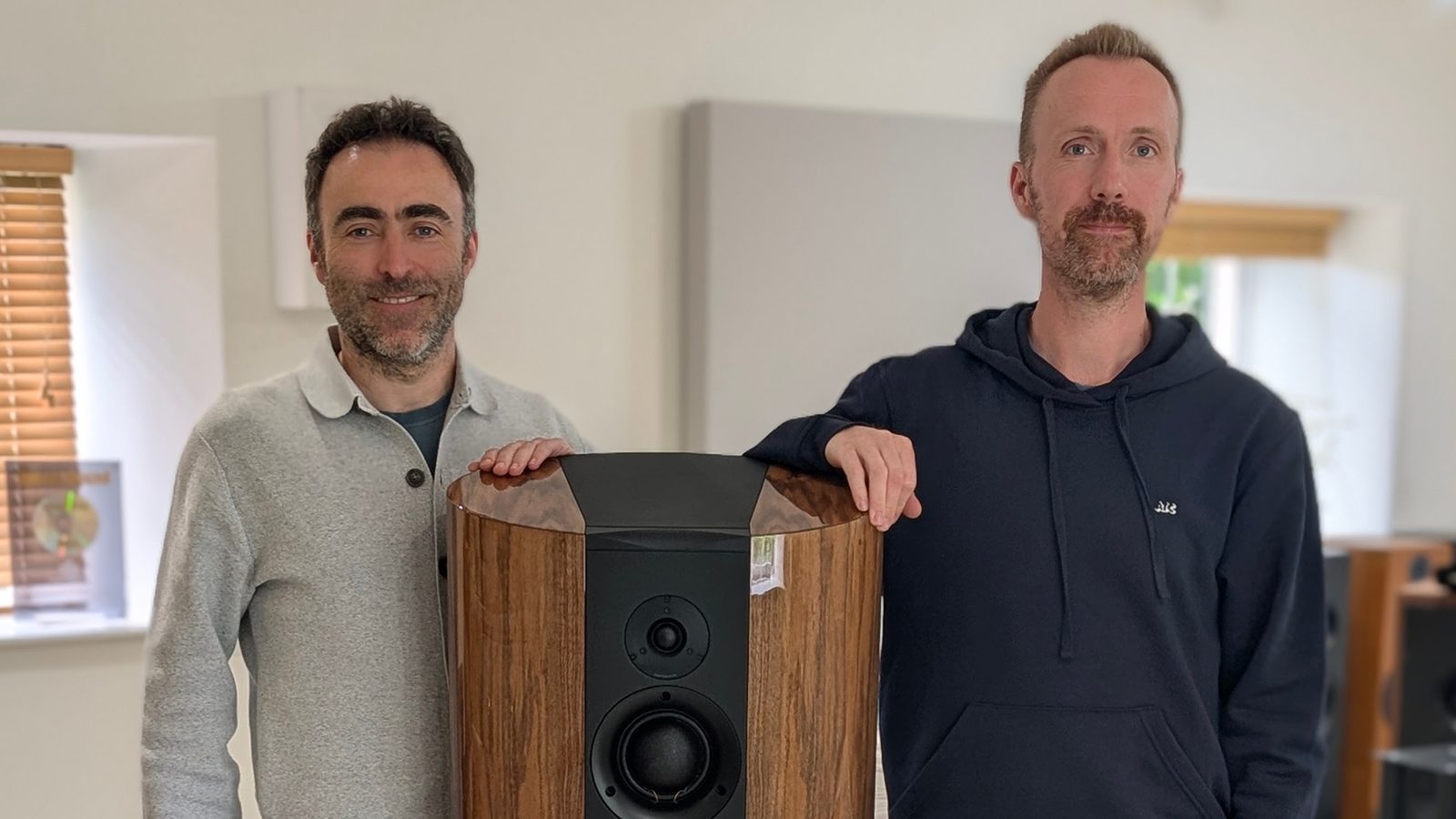
Ben Lilly is the Technical Sales Manager at ATC and has been with the company since 2003. Before working for the company, he had worked with Genelec and Arup Acoustics. Richard Newman, meanwhile, is ATC’s Head of Engineering and has worked at ATC since 2011. Both are Salford University alumni, with Lilly studying Audio technology and Newman graduating in Acoustics.
We spoke to them about the genesis of the EL50 Anniversary and its inspiration in a product made 20 years ago.
What was the catalyst for the EL50 Anniversary project.
BL: It was the desire to introduce a new ‘flagship’ model to celebrate our 50th Anniversary. The project started in March 2023, and we presented a working prototype to a handful of our distributors at our 50th Anniversary party in June 2024. As is often the case, taking the product from prototype to full production took longer than anticipated, and we had to manage the move of our cabinet factory from Evesham to Stonehouse in October 2024, which, as you can imagine, was very disruptive!
RN: Cabinet design is always a collaborative process between engineering and production and, for this product, also included a third-party five-axis CNC subcontractor. This added to the project’s complexity but was vital to the quality and integrity of the finished product.
In parallel, the electronics design team were working on the amplifier development, guided by the cabinet’s physical properties and the performance targets set in the design brief. The EL50 amplifier is discretely integrated into the cabinet, so it’s easy to overlook, but it included a full redesign of the previous-generation Anniversary amplifier, including a move to surface-mount technology for most of the line-level and control circuits. ATC has recently installed an SMT production line at our Aston Down location, so we are steadily transitioning our active amp-packs and standalone electronics to surface-mount.
Tell us more about the new site
RN: ATC is split across two sites near Stroud, Gloucestershire; a relatively new site in Stonehouse for cabinet development and production, and our long-standing main facility near Aston Down for all other work (drive unit production, electronics, final assembly, R&D and sales). All physical cabinet development took place at the Stonehouse site, overseen by Alistair Black and Jeremy Higson (our Cabinet Factory Production Manager and Cabinet Development/Process Engineer, respectively).
Which existing ATC products inspired the EL50 Anniversary?
BL: Visually, the EL50 design was inspired by a previous model, the EL150, designed by the late Billy Woodman and released in 2006. This was the first product to use the elliptical cabinet shape, so we had prior experience manufacturing the complex shape.
However, sonically, the goal was to elevate the performance of the hugely successful SCM50 to a new level whilst also presenting a striking new visual design. The elliptical cabinet shape improves the on- and off-axis frequency response across the mid and high-frequency bands, resulting in a more balanced timbre and a larger soundstage with more precise stereo imaging. Due to the relatively large cabinet curvature, these benefits are realised at a lower frequency than is often achieved via simple chamfering of cabinet edges.
RN: The next step was to produce a model so we could observe the physical size and proportions first hand before refining the 3D model in SolidWorks. The design progressed to first prototypes fairly quickly, aided by our in-house design and manufacturing for our cabinets, drive units and electronics. That said, refining the details takes a lot of time.
BL: The three-channel amp pack was the other major element of the EL50 project. Based on the previous-generation Anniversary amp pack (as used in the SE Series) but required a move to surface-mount technology, a new discrete op-amp, and a major change to the power amplifiers’ power supply configuration. It features three major improvements over the previous generation: Firstly, a new balanced instrumentation input that combines very low noise with high CMRR and increased input impedance.
Secondly, fourth-order active crossover filters. The move to surface-mount technology and the development of a new discrete op-amp with a far smaller footprint allowed us to double up the filter blocks to achieve 4th-order filter shapes. The steeper filters reduce distortion and reduce power compression in the mid and HF bands. They also result in improved vertical directivity due to reduced overlap between the drivers.
Finally, it uses multiple isolated power transformers for the bass, mid and high-frequency power amplifiers, plus increased current capability for the bass transformer. The use of multiple transformers results in reduced inter-modulation distortion between overlapping bands, delivering improved clarity for the listener, whilst the increase in current on the bass supply results in improved bass control when the system is being driven hard and/or with very dynamic recordings.
Bringing the product from concept to production is never easy. What challenges did you face?
BL: Once the pre-production product was complete, we were a step closer to the project completion, but the work involved in making a product ready for mass production is huge.
The cabinet’s exterior comprises five major parts: left-hand curved form, right-hand curved form, front panel, rear panel and top panel. The most challenging aspects of manufacturing this cabinet consistently are the joints between the two curved sides and the rear panel. The compound top panel joint is also challenging, and we use five-axis CNC to simplify the process, but it’s still tough to get just right.
RN: Bonding the joint and inlay is relatively straightforward, but we then need to cut it back to finish perfectly flush, without damage or ‘sand-through’ to the European walnut veneer (which is only 1.6mm thick). This is all done by hand, so it requires a great deal of patience and skill. The design of the individual elements of the amplifier went smoothly, but the challenges came from the final ‘packaging’ of the amplifier and the multiple power supplies it utilises.
Even the fabric-wrapped metal grilles for the EL50 were interesting – in fact, grilles are often challenging when you demand something that looks good, offers a suitable level of protection and has minimal impact on the loudspeaker’s performance. Many grilles satisfy only two of the three.
Where does the EL50 Anniversary sit in the ATC line-up?
BL: The EL50 Anniversary sits at the top of the 50-sized product family and near the top of our overall range. We make larger loudspeakers such as the SCM150, SCM200, and SCM300, which are capable of greater dynamic range and with an extended low-frequency response, but they don’t have the benefit of the elliptical cabinet shape or the highly refined amplifier.
Read the review of the ATC EL50 Anniversary here.
Contact details
Manufacturer
ATC
+44(0)1285 760561
Trending Articles
See all
Krell Vanguard integrated amplifier
- Apr 07, 2015


Xavian Unica
- Apr 07, 2026


By Rafael Todes
More articles from this author


Read Next From Blog
See all
Tech Talk: Wiktor Schulfer of Unitra
- Sep 29, 2026

Tech Talk: Daryl Wilson of Wilson Audio
- Sep 29, 2026

Tech Talk: Antonio Meze of Meze Audio
- Sep 22, 2026

Tech Talk: Dominique Poupart of MOON
- Sep 22, 2026