ATC (The Acoustic Transducer Company) was founded in 1974 by Billy Woodman, an engineer who, as a student, had written a thesis on drive-unit engineering. The company recently celebrated its 50th anniversary and is located near one of the most scenic parts of the Cotswolds, outside Stroud. Billy died in 2022, and the company passed to his son, Will Woodman. It is one of those rare companies to straddle the hi-fi and pro audio camps. Indeed, ATC’s client list includes the Walt Disney Concert Hall in LA, The Royal Opera House, the BBC, and a very long and impressive list of other users, including a crop of studios for which many manufacturers would commit murder!
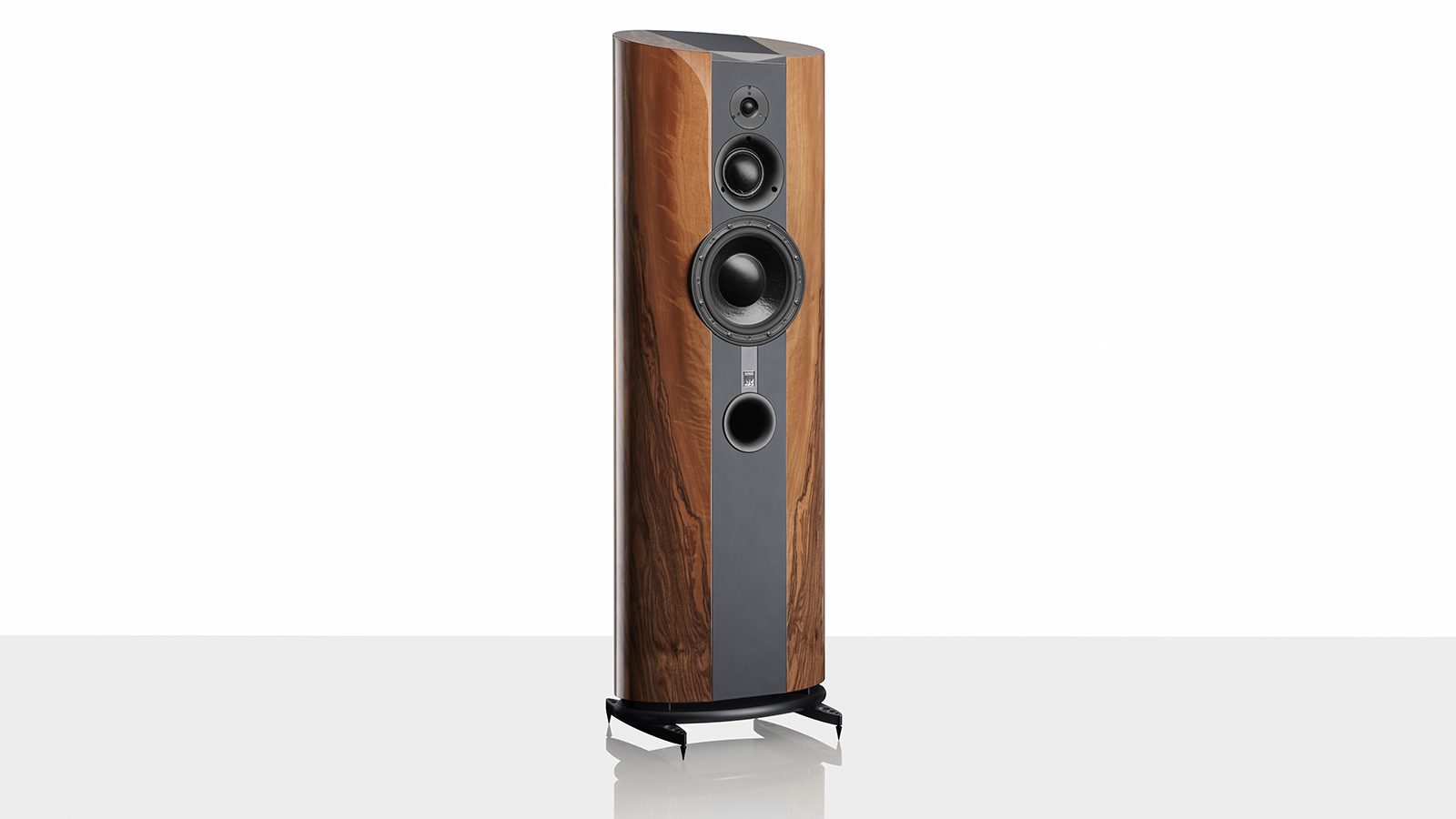
The EL50 Anniversary speakers are a three-way active tower design with an elliptical enclosure, first used by the speaker’s forebear, the EL150, in 2006. Each drive unit has its own dedicated amplification. ATC is well-versed in the art of amplification. It has a long list of pre- and power amplifiers in its catalogue, past and present, and believes that the active solution gives the speaker designer ultimate control over how and when the drive units function and is the pathway to superior sound.
Amp Pack
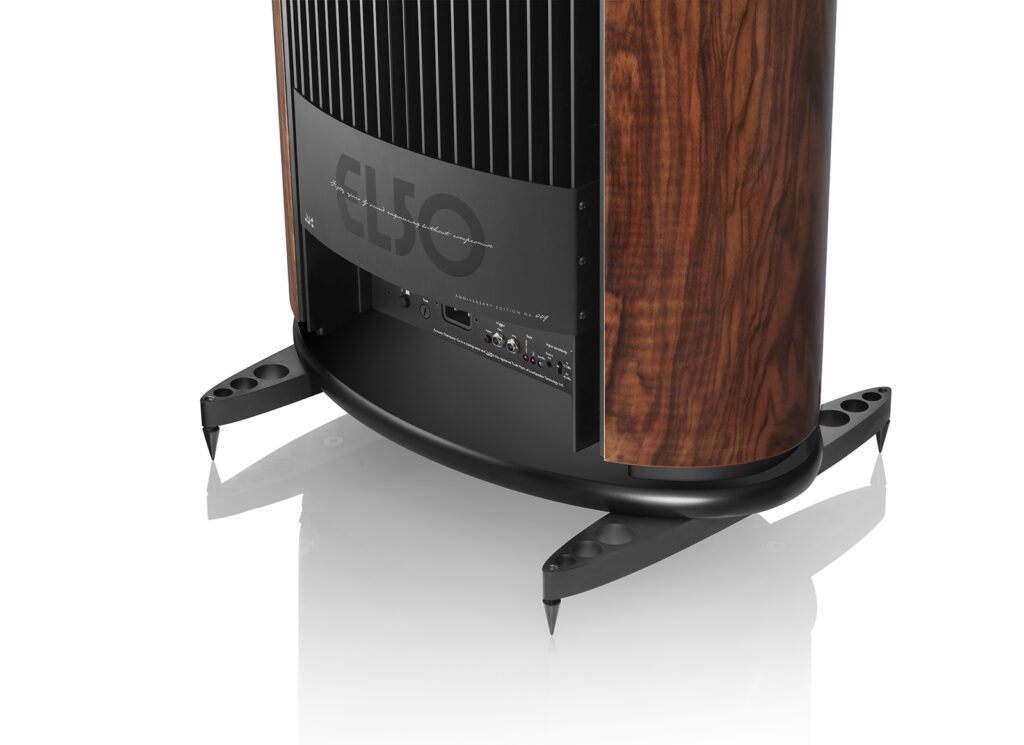
The three-channel MOSFET Class A/B ‘Amp Pack’ delivers 200W to the bass driver, 100W to the midrange, and 50W to the tweeter, with a fourth-order active crossover. The power supply has a separate toroidal transformer for each drive unit, plus an additional one for the low-voltage supply. The absence of intermodulation distortion is readily apparent on listening. On the rear of the speaker, there are input sensitivity settings, a power-on/off trigger, continuous thermal status monitoring, and DC offset. Given Billy Woodman’s background, it is no surprise that ATC’s drive units are nearly all made in-house and are probably the greatest torchbearers of ATC’s “house sound”.
The tweeter is soft-domed, with a compact neodymium motor and a dual suspension system designed to precisely control the voice coil. The midrange is also soft-domed, first introduced in the 1970s, and is similarly built and wound in-house. Finally, the bass unit uses a proprietary material said to reduce third-order distortion by 15 dB.
Feet in both worlds
With its feet firmly planted in both the professional and domestic audio worlds, ATC has – at least notionally – long been familiar with active loudspeakers. However, the EL50 Anniversary is an excellent proof of concept for the importance of active loudspeakers in the home. While active loudspeakers are more commonplace than ever in domestic settings, ATC was something of a flag-bearer for active operation for many years, as other brands all but dismissed the concept.
ATC continues to produce both active and passive loudspeakers, but the EL50 Anniversary makes a bold statement for active loudspeaker technology. Pair these loudspeakers with a product such as the company’s CDA2 Mk 2 CD/DAC/Preamp, and you have a complete reference-grade audio system in an extremely simple layout. While there will always be space for the man-cave-full-of-devices approach to audio systems, minimalist systems with a comparatively low ‘box count’ are becoming more commonplace. The ATC EL50 Anniversary shows that – with an intelligent approach to active power – it’s possible to achieve that minimalist elegance without sonic compromise.
Beautifully crafted
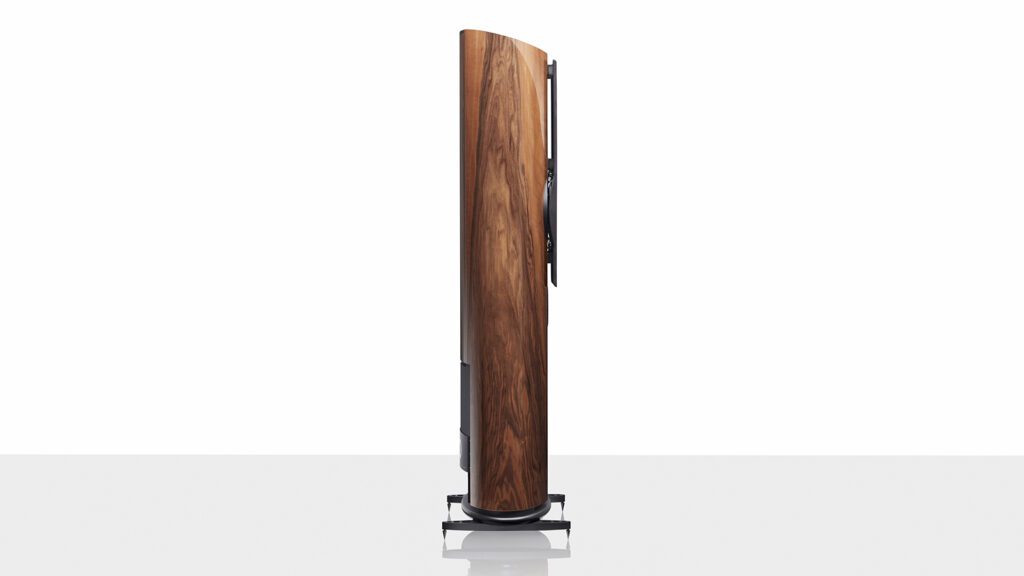
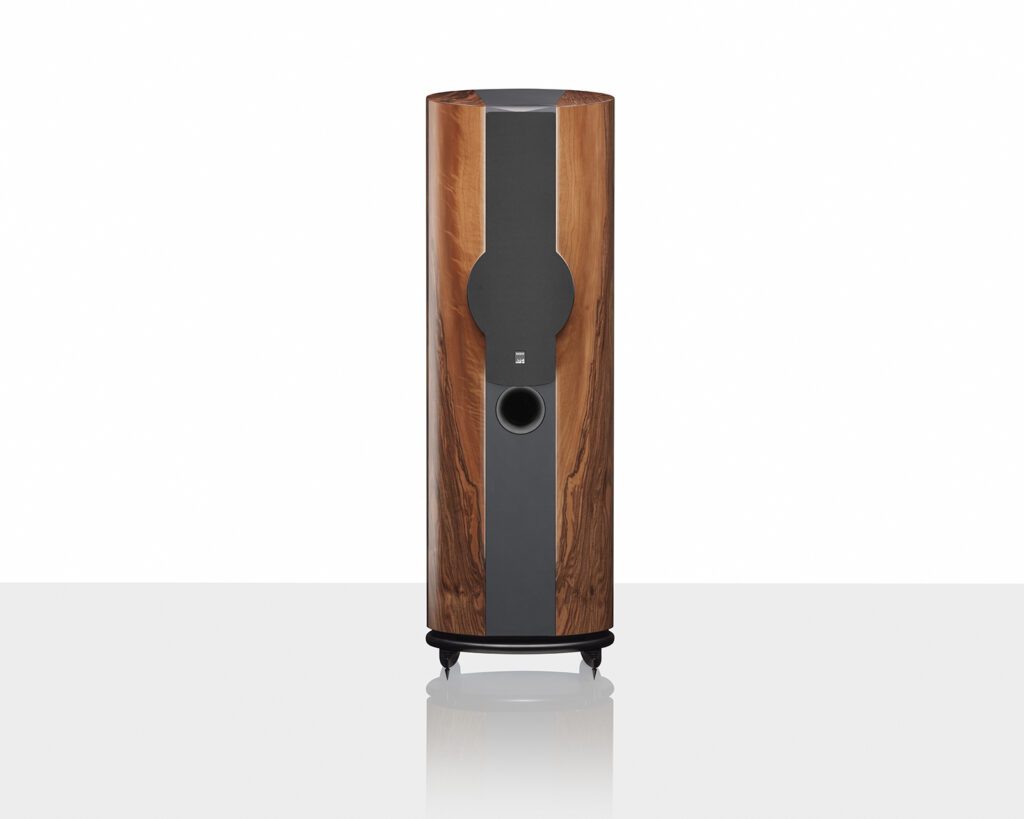
The cabinet is a beautifully crafted ellipse, with a slanting top and a bold Napa leather strip running from top to bottom, surrounding the drive units. The structure is MDF, precision-cut on a CNC machine, then veneered with European Walnut and finished with a high-gloss polyester lacquer. It is then polished to give a deep shine. Ebony inlays on the rear panel show just how much thought and care have gone into the construction of this loudspeaker. A set of spikes is supplied, which I didn’t use as I had the speakers on a solid tiled basement floor.
One of the more obvious points about active speakers is that they combine the functions of a power amplifier and a speaker, and, as a reviewer’s tool, they don’t allow swapping power amplifiers. This is perhaps one reason they rarely appear on the list of components a reviewer uses regularly. Having said that, they are cheaper than buying a separate amplifier, and this should be factored in when choosing such a speaker.
Listening
I started my listening with a dCS Bartók APEX as the source, driven by a dCS Lina clock. I used my Townshend Allegri Reference passive preamplifier, which is one of the most neutral preamplifiers I know, together with a PS Audio PS10 power regenerator, to drive the speakers, which seemed to enhance the accuracy of the imagery once connected.
Listening to Andris Nelsons’ recording of Strauss’ Rosenkavalier Suite with the Leipzig Gewandhaus Orchestra produced a dynamic, full-bodied sound with plenty of air. Both in the massive orchestral tuttis and in the smaller, more intimate moments, the speakers handled both scenarios with aplomb. The ATCs could generate real weight and the gravitas of this piece, with seemingly effortless power and grip.
The bass control was outstanding, tight and massive at the same time. The oboe solos were as sweet as I’ve ever heard them, and the speakers confidently reproduced this large and extraordinary orchestra. Trying the speakers on some Townshend Podiums on my tile floor tightened the presentation, improved imagery, and gave a slight improvement to the already excellent bass timing, but a more strident treble.
More precision
There is an interesting moment in the recording of Shostakovich’s First Symphony, conducted again by Andris Nelsons, when, at the end of a phrase in the first movement, the bass drum has a solo of a couple of notes. There is just a little more precision in the attack. It must be one of the lowest orchestral notes available, and the ATC’s broadcast this place like no other speaker I’ve had here for review!
The EL50’s also come with spikes, but they were not left with me when the speakers were being set up. I can’t comment on their efficacy next to the Townshend Podiums, but I’d hazard a guess they do vaguely similar things. The sound I’m getting on this piece is gutsy and live-sounding, with a really fast attack, precision, and a full-range delivery. There is a lack of distortion and a clarity to the sound which makes things sparkle.
I notice that in one of my reference recordings of Bach’s 4th Brandenburg Concerto, Raymond Leppard with the ECO (a Philips analogue recording), one of the recorders is very brightly lit in the top register, particularly on a single note, a top C around 1kHz. This could be a node in my room, but it’s not something I’ve noticed in my many years of listening to this recording. It’s possible the speaker has been voiced with a preamp that is more reticent than the Allegri, which has a ruler-flat frequency response. Being a passive auto-transformer preamp, it is down 0.1dB at 80k. It is also possible that when Philips mastered the recording in 1975, they were monitoring on Quad electrostatics, which are rolled off at the top, and they wouldn’t necessarily have noticed it.
Glorious
In a recent recording of Mozart’s Concert Aria “Ch’io mi scordindinte?” with Anna Prohaska, the Haffner-Akademie under Riccardo Minasi, the soprano sounds absolutely glorious. Her voice is full-bodied, and the rather eccentric scoring, which Mozart uses for a singer, a fortepiano and an orchestra, comes across beautifully, both tonally and spatially. You can really feel the different musicians collaborating to produce this sublime sound. It feels like being in the recording box during a session.
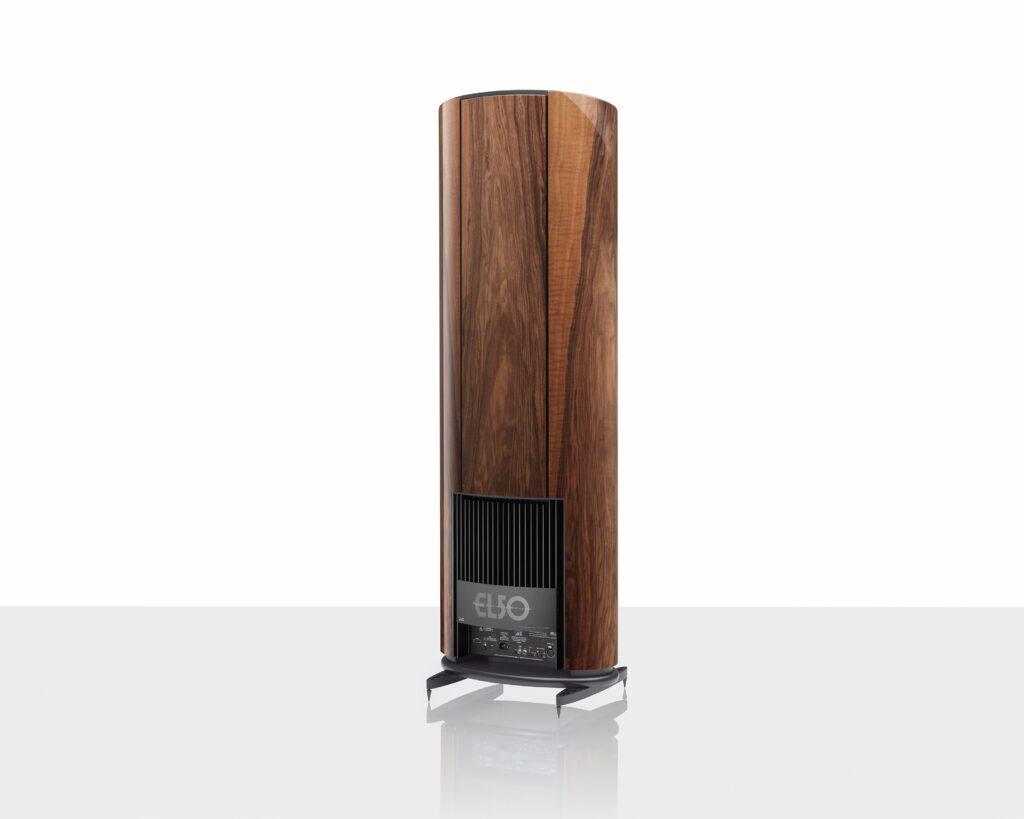
I recently recorded the Trout Quintet with my family playing, a guest pianist, and a double bassist, using a couple of vintage Neumann 84s feeding a Sounddevices 702 at 96 kHz, 24-bit. I have replayed the recording on a number of systems, and what is fascinating to me is how an unmastered recording always sounds best on a hyper-detailed system. This is absolutely true of this recording.
Sheer realism
The sheer realism and the levels of detail I hear are really like being in the room – which I was. The micro-differences in the timing of what the Neumann microphones are receiving are extremely well reproduced by the EL50s, creating a fine stereo image of the room, and the timbre of my violin is also faithfully reproduced.
Listening to Caro Emerald’s “Deleted Scenes From The Cutting Room Floor”, particularly “That Man”, this vintage swing album really shines with the ATC’s. The precision of the drum kit, the rhythmic pumping, and the exact scoring, which comes across with greater transparency than I have heard to date, are all there, and Caro Emerald’s voice is present in all its colours. It sounds like a dazzling audio spectacle. I can really see into the mix, and I am more aware than usual of the production choices the producer has made and the effects that have been used. The compression on some instruments and not others. Very revealing, but is it too much information, as my wife sometimes says to me?
Speaker or monitor?
A question that always niggles me is what the difference is between a speaker and a monitor. Obviously, they both exist to turn electrical signals into sound accurately. The principal difference is that the role of the monitor is to produce the warts-and-all, to show the record producer exactly what’s on the recording, whereas the role of a hi-fi speaker is to reproduce music, albeit accurately, but principally to create an enjoyable and emotionally relatable experience for the listener. Thus, if something is wrong on a recording that needs adjustment, a hi-fi speaker may make this less obvious than a monitor. Perhaps it’s the glass being half full as opposed to half empty!
The ATC EL50 Anniversary treads the balancing act carefully between monitor and hi-fi speaker; a true hybrid. It is lovingly designed and built without compromise and is a beautiful piece of furniture to boot. Yes, it is expensive, weighing in at a shade under £50,000, but when you consider it contains say £20,000 worth of power amp, it starts to look like something of a bargain in disguise. It may not suit everybody’s taste in listening; it may be too detailed and analytical for some wanting an easier life. But for someone looking for a highly honest and detailed listening experience with huge insight, where no pills are sugar-coated, this is a must-hear speaker.
Find out more about what went into making the ATC EL50 Anniversary here.
Technical specifications
- Type: Active ported floorstanding loudspeaker
- Driver complement: 25mm soft dome tweeter, a 75mm soft dome midrange, 234mm bass driver
- Amplifier type: Grounded Source MOSFET, class A/B, convection cooled (fan-less)
- Output Power:
- Bass: 200W (8Ω, continuous average, 0.1%THD)
- Mid: 100W (16Ω, continuous average, 0.1%THD)
- HF: 50W (8Ω, continuous average, 0.1%THD)
- Balanced Input: Rear panel mounted female XLR, pin 2 +ve
- Input Impedance: 20kΩ
- Input CMRR: >80dB (20Hz- 10kHz)
- Input Sensitivity: 2.2dBu/1V or 8.2dBu/2V (switched, ref. full output)
- Crossover Filters: 4th Order Linkwitz Riley
- THD+N: 0.0015% / -96dB (1kHz, 1dB below rated power, 90kHz BW)
- Frequency Response: 8Hz-190kHz
- MaxSPL: 112dB (per pair, IEC Weighted Pink Noise, 1m, anechoic)
- Sensitivity: -17.5dBu (85dBC, @1m, pink noise, per speaker, anechoic)
- Dimensions (HxWxD): 142.1×45.9×35.2cm
- Weight: 63kg
- Price: £49,500, €68,700, $99,999 per pair
Manufacturer
ATC
+44(0)1285 760561
Trending Articles
See all
By Rafael Todes
More articles from this author
Read Next From Review
See all
Unitra WSH-805
- Sep 29, 2026
Wilson Audio Sabrina V
- Sep 29, 2026

Meze Audio 99 Classics (2nd Generation)
- Sep 22, 2026
MOON 371
- Sep 22, 2026