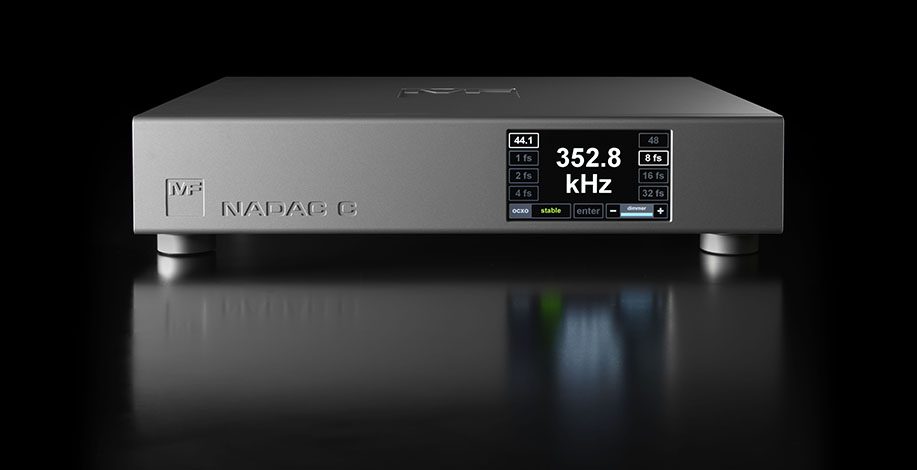
It’s not every day that a DAC is launched built around an actual one-bit application-specific integrated circuit (ASIC). Design lead at Master Fidelity’s Vancouver facility, Weishen Xu, believes his team’s proprietary DAC chip is actually the first since the TDA 1547 by Philips in 1988. To own one of Master Fidelity’s chips, we need to buy Master Fidelity’s newly-launched DAC, the NADAC D. Together with its accompanying master clock, the NADAC C, they come in at a cool £50,000.
A long-time Canadian citizen, Xu was a recording engineer before diving deep into the world of DAC and clock design. He says that the Philips chip was ‘an incredible accomplishment’. Still, he suggests that one of the reasons it has remained a one-off for so long is that the theoretical benefits of single-bit conversion – its linearity, low noise floor, wide dynamic range, and comparative absence of artefacts – proved impossible to realise due to the then limitations of surrounding technology. Designers were put off the scent, and they went in different directions to provide us with resistor ladders, the now ubiquitous multi-bit DAC chip, and, more recently, DACs implemented on field-programmable gate arrays and complex programmable logic devices.
Extreme timing
Xu’s verdict on using generic programmable devices to run one-bit D-to-A code? Close, but no cigar. He says true one-bit DACs require extreme timing precision to deliver on their sonic promise. His application-specific integrated circuit DAC allows ultra-precise circuit matching, enabling those strict timing demands to be met more easily. Optimised for audio use, a one-bit ASIC also allows a more idealised conversion to analogue than do generic programmable devices.
It might be easier to dismiss these points as mere marketing spin if it were not the case that being the first in more than three decades to develop a fully custom one-bit ASIC has cost Master Fidelity a simply eye-watering sum. Xu reveals that designing a chip from initial development to receiving test samples takes at least 10 months, and Master Fidelity went through several iterations over four years before settling on a final design.
Then there’s the production barrier. Wafer fabrication facilities don’t accept small orders, so Master Fidelity had to partner with established chip companies to reduce the unit cost to something semi-reasonable. Even so, the price per chip – he declines to put a number on it – is ‘very substantial’, so much that due to the low sales volumes that typify the high-end, Master Fidelity may offer the chip as an OEM component to other audio manufacturers to speed up its return on investment. Xu says Master Fidelity won’t quite be selling off the crown jewels since the performance of the one-bit chip is heavily reliant on the quality of thought and execution that goes into the circuitry surrounding it.
How low can you go?
As Xu notes, true one-bit DSD technology needs precise clocking. In particular, digital wander below 10Hz can affect high-frequency jitter. The NADAC D’s internal clock for USB has a claimed jitter of less than 800 femtoseconds over the 10 Hz to 100 kHz bandwidth. In contrast, the intrinsic clock recovery jitter (for S/PDIF over coax input) is claimed to be less than one picosecond over the same bandwidth. Students of jitter mitigation will recognise those as strong figures, but connecting the DAC to the 10 MHz clock signal from partnering NADAC C clock reduces jitter even further to 66 femtoseconds, with phase noise of -140 dBc at 10 Hz and -160 dBc at 100 kHz. While that’s not quite industry-leading, it’s not far off.
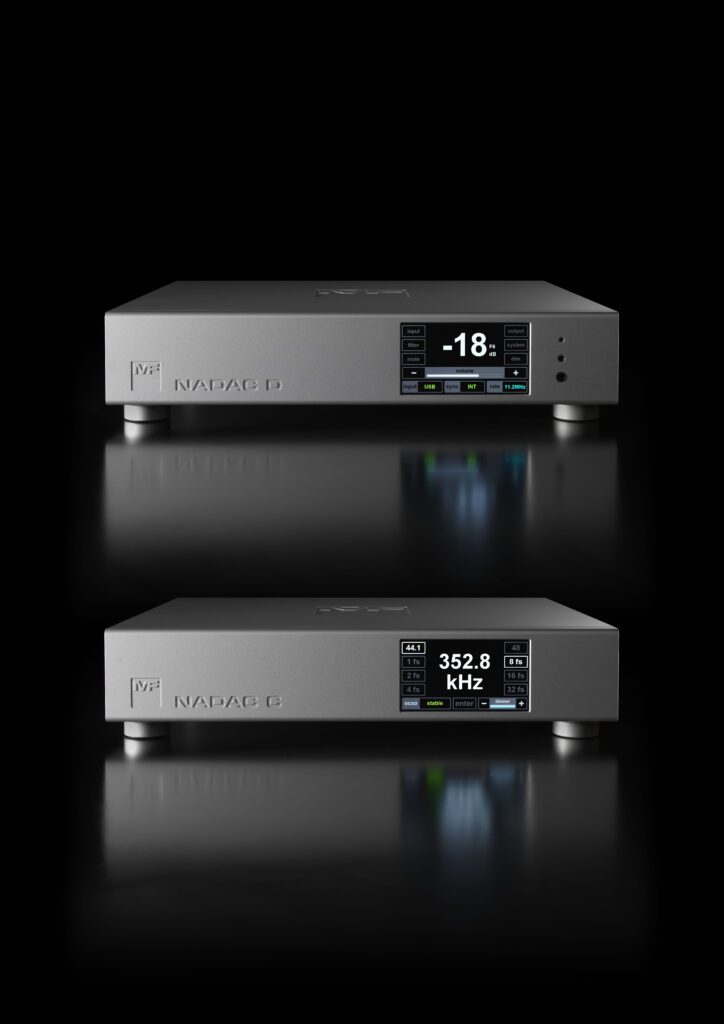
The name NADAC was first applied to a high-end consumer DAC and clock combination sold by the professional studio brand Merging Technologies of Puidoux, Switzerland, starting in 2015. It had been co-developed for Merging Technologies by the Merging Fidelity team at its Vancouver facility. Acquired by the Sennheiser Group in 2022, Merging Technologies was refocused by its new owner solely on the professional market. However, by then, Merging Fidelity’s development team had already made significant progress on a next-generation NADAC. Rather than writing off the investment, Merging Fidelity rebranded its Canadian operation as Master Fidelity, assigning it the task of completing the project and bringing the result to the consumer market.
Similar visuals
The new NADAC D and C have a similar visual aesthetic to the old Merging Technologies’ NADAC product line. They remain full-width, matt, natural aluminium components, but now feature 11x6cm full-colour touch screens. Aside from the different displays, it’s on the inside that things get really interesting. Lift the lid of the NADAC D and it’s evident the lengths to which Master Fidelity’s design team have gone to provide the one-bit chips with that optimum supportive environment.
Apart from the customised Amanero USB interface software and USB hardware specially optimised by Master Fidelity, the DAC is entirely proprietary. It features five independent power supplies: one linear and three switching supplies, plus an oven-controlled power supply dedicated to the one-bit ASICs. The clock recovery stage processes incoming S/PDIF signals
before being passed to an up-sampling module running Master Fidelity’s proprietary code. This module converts PCM signals up to 96kHz into DSD 128, and PCM from 176.4kHz to 384kHz into DSD 256. DoP signals remain unprocessed.
After the DSD is converted to analogue by the one-bit chips (one per channel), a Master Fidelity fully balanced, digitally controlled, lossless analogue attenuator provides 3dB step adjustments or can be bypassed for use with an external controller. The 4V balanced (2V single-ended) analogue output stage is implemented with discrete components.
We will rock you
The review sample NADAC D was connected via USB to an i3 NUC running Roon, then fed PCM and DSD files of mixed resolution from Qobuz and local storage. A Jay’s Audio CDT3MK3 CD transport was used as a second source, connected to the DAC via S/PDIF. The NADAC D and CD transport were both fed 10 MHz clock signals from the NADAC C via 50 Ohm coax. A Life-Changer Audio icOn 5 Balanced line controller fed the analogue signal to Quiescent T100MPA monoblocks driving PMC MB2se speakers.
If we consider the DAC and clock as one product – they are, after all, intended to be bought together – then the NADAC turned out to be the third new product in the last 12 months that has truly rocked my world. What made the experience all the more special was that all were in residence at the same time.
The icOn 5 Balanced line controller and Quiescent’s T100MPA monoblocks are the most transparent and tonally and dynamically faithful attenuation and gain combination that I have heard to date, and that’s why the bought-and-paid-for review samples are now the core of the household audio system.
New reference
Through them, the NADAC combination set a new reference for transparency and musical engagement, certainly at its price, and quite possibly beyond.
I cannot remember which writer for Stereophile coined the observation in the early 2000s that …’ there’s more ‘there’ there.’ It might be a slight torturing of the English language (three ‘there’ in one sentence!) and it wasn’t in this context, of course, but it just as well fits the NADAC and the way it allows us to discern more thereness than I’ve heard from any DAC to date.
The NADAC’s performance is so detailed, so dense, yet at the same time so vital and so natural, that on many occasions it caused household listeners to fall into stunned silence, not just at the degree of technical competence in evidence, but at the ease with which the performance pressed emotional buttons as well.
Essential quality
The NADAC demonstrated that there’s more to benchmark digital reproduction than just impressively strong detail recovery. We only need to listen to it for a minute or so to hear and latch on to the quality that Xu’s team evidently clearly understands very well: the essence of thereness. Thereness certainly requires that we are being told about even the tiniest of musical details, but, as the NADAC shows, it is not only about how detail is recovered from the recording but at what time it is forwarded; in other words, to what degree jitter is allowed to corrupt the spacing between the pieces of detail.
We might expect exceptionally low jitter to result in, among other qualities, strong imaging, and so it does; the NADAC revealed spatial information in recordings that I had previously thought were seriously impoverished.
Separation
Marked front-to-back separation between instrumentalists became apparent. Also, the precision, in terms of the position and apparent size of each musical event, was to a standard I’ve frankly not heard before from any DAC. Combined with the NADAC’s ability to transcribe rich tonal density and texture, that notable spatial acuity stood up sonic images with simply arresting presence.
The cherry on top was hearing from NADAC that the most natural, most life-like transcription of recorded dynamic energy that any DAC of my acquaintance has delivered. Master Fidelity’s DAC is simply a beast when it comes to producing dynamic expression, able to reveal previously hidden contrasts even in the most horribly compressed audio files. On material mastered at a more sympathetic -16 or so LUFS (loudness units relative to the full scale), the NADAC allows musical energy to bloom in the greater headroom fully. The highly textured gut-punches and keyed bass rumbles that the NADAC transcribed made the ‘Pirates’ sequence from Hans Zimmer’s Live In Prague album highly addictive. So too the track ‘A Little Rice and Beans’ on Trypnotyx by Wooten, Chambers and Franceschini, where nuanced finger-on-bass string texture and power were bookended by subterranean sonic explosions from Chambers’ floor toms.
Fluidity
Out of curiosity, I played the same track in three ways: remotely streamed, locally stored on an SSD, and on a silver disc from Jay’s CD transport. Removing and then replacing the clock connection to the DAC and the CD transport (hot swapping is allowed) brought about a change in delivery that, at the point of disconnection, seemed inconsequential, but after a minute or so, revealed just what the NADAC clock makes a profound contribution to sonic quality. The previously noted, deeply dimensional spatial perspective had flattened; dynamic expression and low-end definition were dialled back, tonal density diminished, and playback no longer sounded as fluid and natural.
The NADAC combination does an impressive job of portraying the layers in complex material, whether in the case of a symphony orchestra at full throttle or a big band hitting its stride, with thoroughly convincing weight. In complete musical contrast, Roon earlier this year turned me on to the Canadian finger-style guitarist Antoine Dufour’s 2020 album Reflect. One player, one guitar, no overdubs; on the face of it, things could hardly be simpler, yet the NADAC revealed that actually there’s an awful lot more going on sonically than we might assume.
Household reference
Through the household’s reference DAC, a Mola Mola Tambaqui, the album is a fine demonstration of Dufour’s extreme technical chops wrapped around some quite beautiful compositions. Through the NADAC, it felt like the first listen all over again. Dufour taps and slaps on the guitar body, blends strumming, picking, tapping and harmonics, sometimes all at once. Master Fidelity’s DAC took the 16/44.1 album file and gave a reading so sonically dense, expressively powerful and tonally vivid that it felt only a nat’s wing away from a live recital.
I have but two gripes to make about the pre-production review samples I was loaned. The twenty 3dB steps provided by the lossless volume control are barely adequate; however, I imagine most potential buyers will use multiple sources, so they need a device to handle switching duties anyway. In the review system, setting the NADAC D to its full 4V output and running it through the iCon 5 allowed for properly granular attenuation, plus impedance matching, for even greater energy transfer at low volumes—second gripe: the NADAC display screens are dimmable but cannot be turned off. Master Fidelity must surely rectify both issues on the full production runs.
Thousand-dollar question
There’s a question that nags at the open-minded audiophile brain almost as insistently as a dripping tap: when will digital finally deliver on its theoretical promise of superiority over vinyl? Most studios operate in the digital domain, so if we listen to vinyl, we are opting to insert an unnecessary stage between ourselves and the original recorded event. Simpler – as in recording digitally and listening digitally – should be superior.
After more than six weeks of digital via the NADAC D and C, I realised that not once had I touched the household record collection. Digital was delivering on its long-promised technical superiority. Quietly, and just like that, it had become the preferred medium.
Technical specifications
NADAC D
- Type: Digital to Analogue converter
- Inputs: USB Type C, AES3 (XLR), S/PDIF RCAx1, TosLink optical x1 (RAVENNA RJ45 to follow), Clock BNCx1
- Outputs: Analogue balanced line 2x XLR, single-ended, 2x RCA, 4.4mm balanced mini headphone jack, 6.35mm single-ended headphone jack
- Formats supported 44.1-384kHz, 16bit-true 32-bit. Native DSD64-DSD512 true 1bit (USB) 44.1-192kHz, 16-96bit, DoP64 (AES and S/PDIF), 44.1-384kHz, 16-32-bit. Native DSD64-DSD256, true 1bit (RAVENNA to follow).
- Analogue volume control: 3dB/step attenuation,
total 20 steps - Dimensions (WxHxD): 43.5×9.5x39cm
- Weight: 9.2kg
- Price: £25,000, $27,500, €25,000
NADAC C
- Type: Master Clock
- Crystal type: Selected high-stability pre-aged, SC-cut crystal
- Clock output options: 10MHz, 625Hz, Word Clock
- Word Clock output frequencies (in kHz): 44.1, 48, 88.2, 96, 176.4, 192, 352.8, 384, 705.6, 768,1141.2, 1536.
- Frequency accuracy: <10ppb
- Nominal Impedance: 50Ω (10MHz clock, 75Ω supported), 75Ω (Word Clock, 625Hz)
- Dimensions (WxHxD): 43.5×9.5x39cm
- Weight: 9.2kg
- Price: £25,000, $27,500, €25,000
Manufacturer
Master Fidelity
+1 604 266-5067
UK distributor
Swiss Sound
Trending Articles
See all
By Kevin Fiske
More articles from this author
Read Next From Review
See all
Eversolo T8
- Oct 13, 2026
Acoustic Energy AE Active
- Oct 13, 2026
Reiki Audio SuperSwitch X/Pro X PSU
- Oct 06, 2026
Audiobyte SuperVOX
- Oct 06, 2026