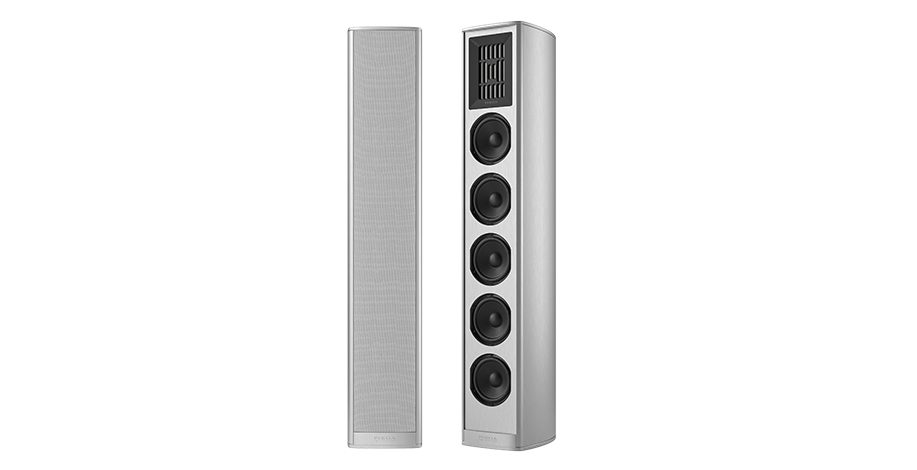
Alongside one of the most fabulous record shops on the planet (Bongo Joe’s), Geneva was once home to Piega loudspeakers, makers of the Coax 611. The Swiss company has an affinity for lakes. It relocated from the Lake Geneva shoreline nearly 200 miles northeast to the municipality of Horgen. This is situated on the shores of Lake Zürich. However, regardless of which lake it chooses to build beside, the company has been producing distinctive loudspeakers designed for housing for 35 years. Founded by engineers Kurt Scheuch and Leo Greiner, it’s now operated by Manuel Scheuch and Alexander Greiner. The brand remains a family affair.
The Piega trademarks are extruded aluminium cabinets, along with that rare thing: a coaxial ribbon mid and treble driver, a design unique to the brand and necessarily made in-house. I reviewed a Piega floorstander of similar dimensions to the latest Coax 611 about 15 years ago. It was highly detailed and revealing, but not to my taste. I was trepidatious about trying this new Gen2 Coax model. It turns out that I needn’t have been; the developments at Piega and within my own system over that time have resulted in a pairing that proved highly engaging and entertaining.
The Coax Gen2 series comprises two floorstanding speakers, the sturdy 811 and the stylish 611, as well as a 411 bookshelf speaker. There is also a matching 211 centre channel. The updates for Gen2 are significant, featuring additional cross-bracing, more neodymium magnets above the tweeter, and a newly developed coating on the ribbon foil.
Push pull
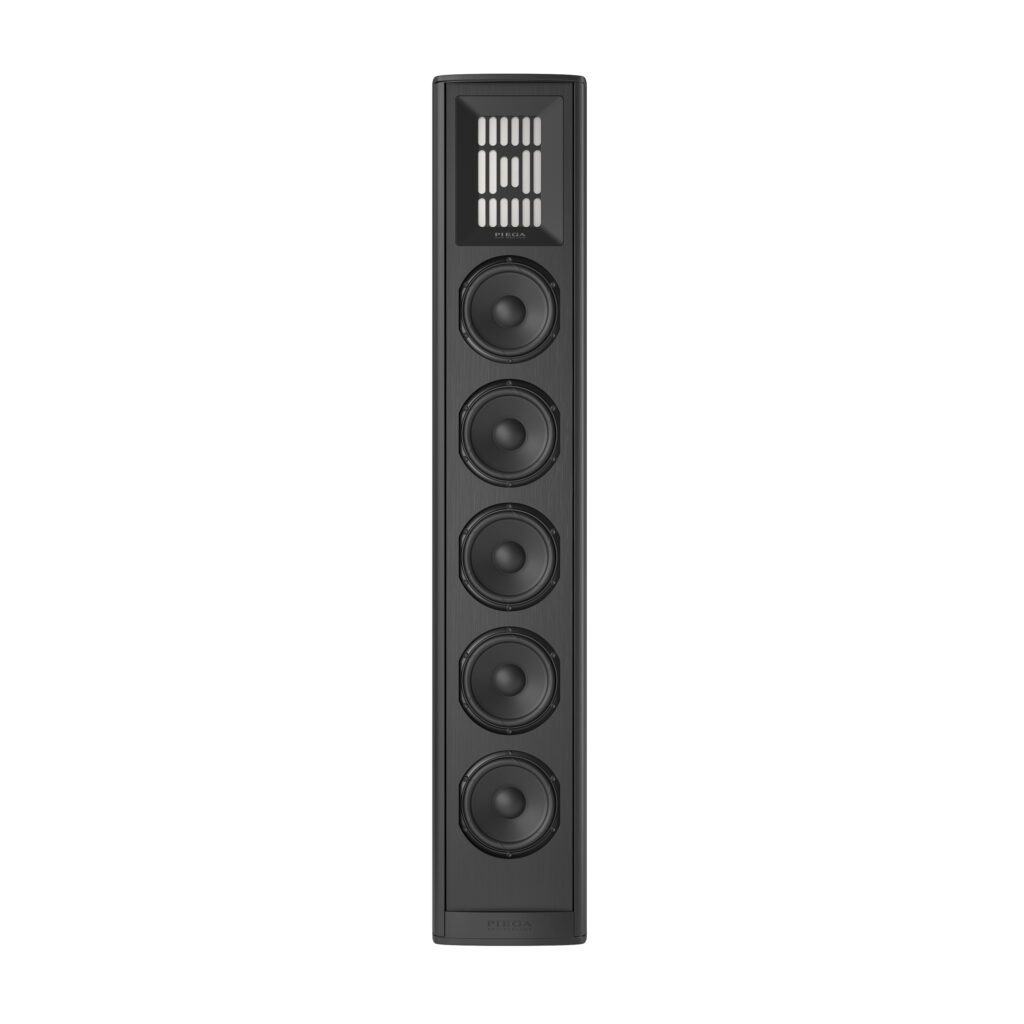
Being essentially a large aluminium tube, the 611 would be prone to bell-like resonances if the metalwork were not adequately controlled. As a result, Piega employs substantial aluminium braces between each of the drivers, creating a central web within the cabinet using tensile stress. The earlier system pushed the casework outward, but this new approach has been judged superior. A slim loudspeaker made from a material generally considered lightweight turns out to be somewhat different due to its internal support structure. The Coax 611 weighs 45 kilos, which isn’t excessive for a 117cm (about four feet with spikes) loudspeaker, but it is a lot for something so slender.
This speaker lacks a reflex port but uses three passive radiators to balance the compression from two bass drivers. All these cones have the same 160mm diameter, so it’s hard to tell which ones are doing the heavy lifting; however, it’s an impressive driver array, considering the most crucial part of the design. That is the coaxial ribbon, whose name, C112, relates to its width; however, this doesn’t indicate its frequency range of 450Hz to 50kHz. Piega states that the ‘magnetic rods’ inside are now mechanically decoupled.
Magnetic attraction
Presumably, this means the bar magnets controlling the diaphragms of the two drivers are no longer rigidly attached to the chassis. They are therefore less likely to vibrate when in-cabinet energy levels reach specific frequencies. Some manufacturers try to decouple the entire driver from the chassis, but as mentioned, this is a unique case.
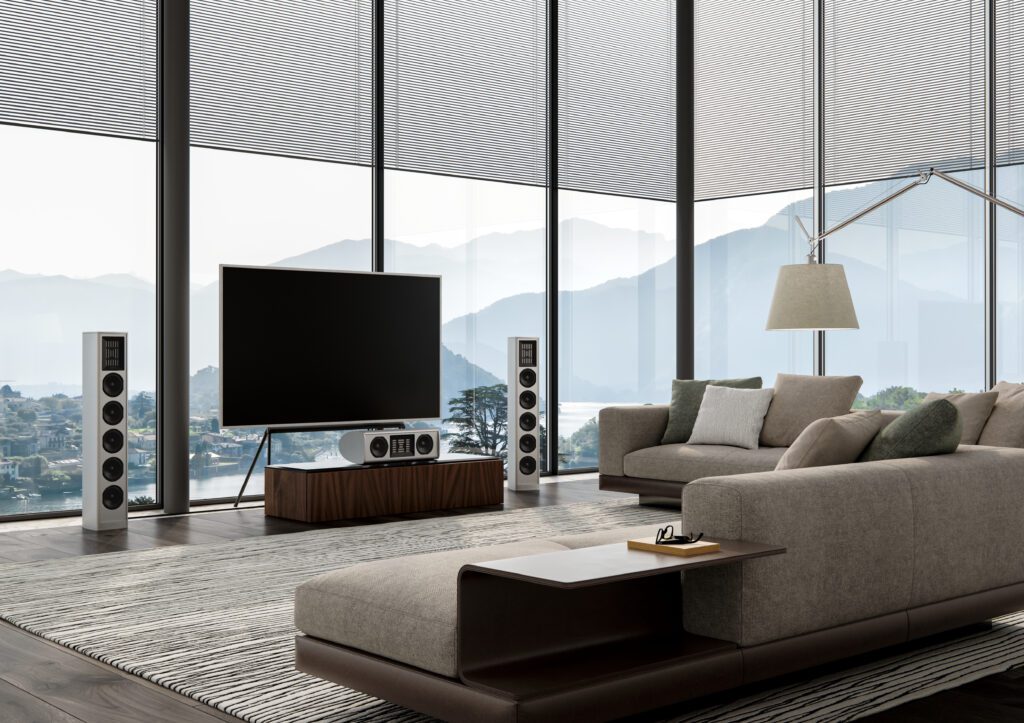
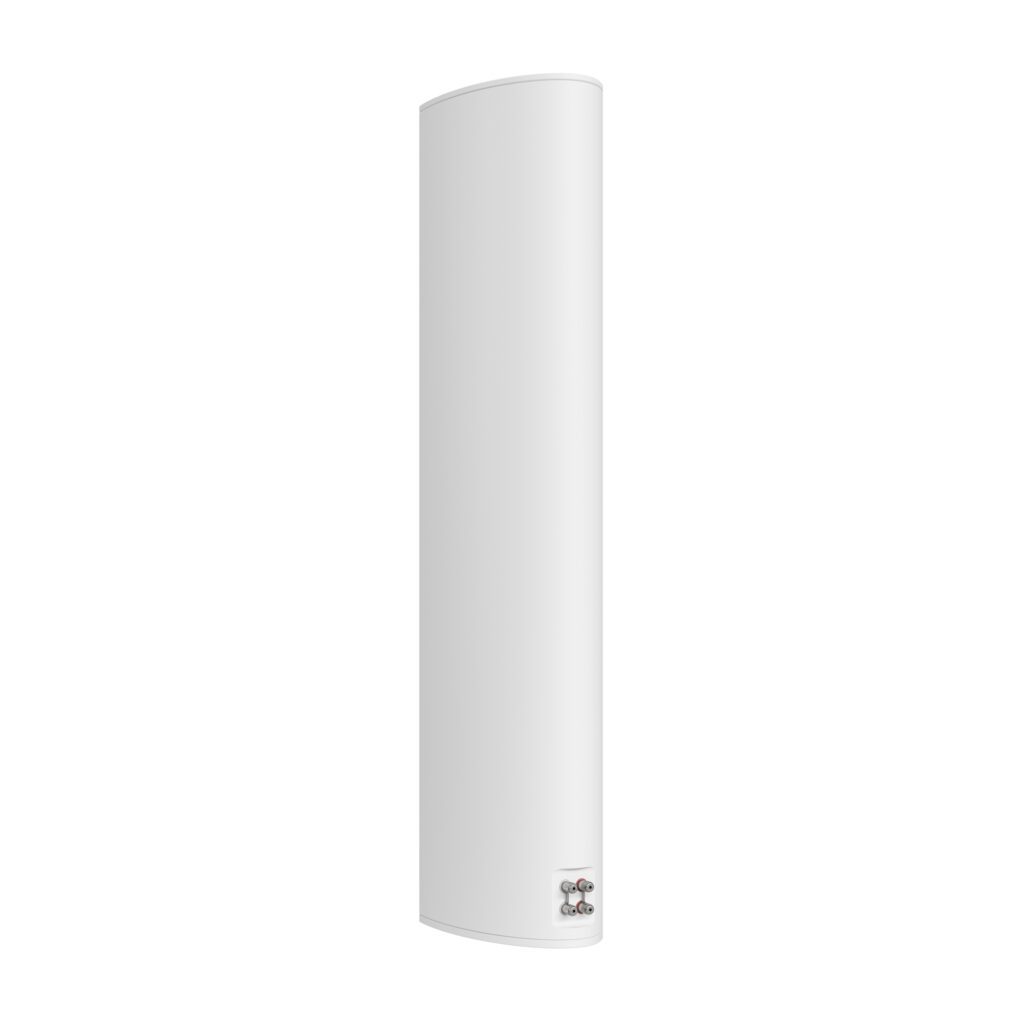
There is also an optional Coax Bottom Plate available for an additional £900. This is a beautifully machined, broadly X-shaped plinth that bolts to the base of the speaker to provide a more secure footing on carpets. All I needed to do was manoeuvre the speaker into a position reasonably close to the rear boundary, as my room is bass-light. Since this speaker has no ports, I had to toe them in to achieve the desired balance, with the speakers on axis, pointing straight at me. I also noticed that the bi-wire terminals are connected by very short pieces of copper wire instead of the usual flat jumpers. This is a nice detail because, although the plate solution looks great, it rarely sounds as good as proper cables.
Not so cool
With its sleek silver design and all-metal drivers, I expected the Coax 611 to sound cool and sophisticated but lacking warmth. I am pleased to say that the cover of this book does not reveal its true character. In fact, pinning down any single character is quite difficult as the sound varies with the music played and the equipment used to play it. Generally, this is a very neutral and sensitive speaker that does not seem to have any tonal tendencies or other obvious flaws. It appreciates a great recording, who wouldn’t, but does not amplify the limitations of a lesser one—ditto for ancillary equipment, where characteristics are seen but not exaggerated.
The best results were achieved with my Rega Naia turntable, fitted with an Aphelion 2 cartridge and a Rega Aura phono stage that was under review. This setup is naturally highly synergistic and, in Piega’s hands, pulls out the finest details and the most spectacular timing in a self-effacing way. I played a fancy pressing of Joe Walsh’s masterpiece The Smoker You Drink, the Player You Get, and by the third track ‘Wolf’, things became interesting.
Then ‘Midnight Moodies’, whose unusual rhythm line has rarely been so well expressed, and you can hear how the piece evolves into a jam that has to be faded out to make room for the final track on the side. ‘Happy Ways’ starts with a glorious bass tone—fat and juicy, with a hint of burr on the edge—but the entire piece is delightful with its fantastic sound. How a side that begins with the raucous ‘Rocky Mountain Way’ can end so sublimely remains a mystery, but it certainly works.
Absolute Delight
The Piegas have excellent liquidity and ease in the mid and treble ranges, which is an absolute delight. The ribbon drivers are smoother than their domed competitors and capable of revealing the finest nuances. For optimal results, I prefer sources with a bit of leading-edge bite, but some will enjoy the finesse combined with the clarity on offer. With the double bass of Kham Meslien, the Coax 611s deliver the rhythm line with metronomic precision, suggesting that the cabinets are well out of the audible picture. This, and many other examples, show very low coloration from the box and its drivers, with no blurring of leading or trailing edges.
With more expansive productions like Symbolico’s ‘I’m Free,’ the sound escapes the confines of the box in all directions and fills the room engagingly. However, here the choice of DAC proved crucial to the result. The slightly more affordable converter I tested produced a crisp, clear soundscape, while the more expensive option created a more uniform outcome with better timing and greater engagement. This is a slow-burning track, and it’s easy to lose interest in the first half with a lesser converter; the Piegas made this more apparent than usual.
With the more intricate rhythms of Keith Jarrett, Gary Peacock, and Paul Motian on the recently released The Old Country (ECM), I was impressed by how these musicians opened up the performance without stumbling over the less accessible passages. Many speakers never reach this level, and I wanted to understand why this 1992 recording had been issued. The Piegas showed me the way and placed the musicians in the room.
Being there
Most of the listening was done with my usual Moor Amps Angel 6, a 150W transistor power amplifier, and an iCon Five passive preamplifier. Still, when an enormous Viva Solista Mk2 integrated arrived with its parallel single-ended 845 tubes, it was worth a try. This proved to be a slightly edge-of-the-seat experience. Yet, with a sound recording and some William Eikos Litz cables, it brought a degree of vivacity and live energy to the party that energised the atmosphere. I have rarely heard such dynamics, and I spent an evening seeking out live recordings to capture that authentic being-there feeling.
The Piega Coax 611 is a very aesthetically pleasing loudspeaker. Don’t let that fool you into thinking it’s not a serious option. It is as revealing as it is elegant and can deliver highly engaging sounds across a wide range of musical styles and hardware types. This Piega proves that if you develop technology correctly, it can evolve into a tremendously capable device. The fact that it looks great should not work against it.
Technical specifications
- Type: Three-way, seven-driver, floorstanding speaker with aluminium enclosure.
- Driver complement: One C112+ coaxial ribbon tweeter/midrange driver; two 160mm UHQD woofers; three 160mm UHQD passive radiators.
- Crossover frequencies: not specified
- Frequency response: 32Hz – 50kHz
- Impedance: 4 Ohms
- Sensitivity: 90dB/W/m
- Dimensions (HxWxD): 1170 × 210 × 310mm
- Weight: 45kg/each
- Finishes:
- Aluminium cabinet brushed, silver/speaker grille cloth silver
- Aluminium cabinet brushed, black anodised / speaker grille cloth black
- Aluminium cabinet, white-lacquered finish/speaker grille
cloth white
- Price per pair: £14,900, $19,995, €15,900
Manufacturer
Piega SA
+41 44 725 90 42
UK distributor
Henley Audio
+44(0)1235 511 166
Trending Articles
See all
Acoustic Energy Corinium floorstanding loudspeaker
- Dec 23, 2024
Trending Articles

By Jason Kennedy
More articles from this author

Read Next From Review
See all
Reiki Audio SuperSwitch X/Pro X PSU
- Oct 06, 2026
Audiobyte SuperVOX
- Oct 06, 2026
Unitra WSH-805
- Sep 29, 2026
Wilson Audio Sabrina V
- Sep 29, 2026