Up to 37% in savings when you subscribe to hi-fi+
hifi-logo-footer

Begin typing your search above and press return to search. Press Esc to cancel.

How to find a good stereo system: Audio Basics Episode 5

How does one go about finding a good stereo system?

Audio Basics is a series intended for audiophiles who may be at the beginning of their journeys, as well as the experienced audiophile who may just want a refresher.

In this week’s episode, Nextscreen Executive Publisher Tom Martin describes the steps you should take to find a good stereo system.

Tom has already told Lance the 10 elements of a great stereo, including frequency response, sound staging, and distortion.

Jumping into the high-end audio world can be daunting for those new to the field. Audio Basics aims to make the early part of that journey easier for beginning audiophiles.

Tom tells Lance about the steps you should take to be able to identify a good stereo system.

Finding a good stereo system is more than just going to the store or online and buying something. First, you have to train your ear to be able to know what you’re listening for.

Audio Basics is a weekly series that you can see on the hi-fi+ YouTube channel. If you’ve missed the first few episodes, learn more about what makes a great stereo.

Be sure to subscribe to the YouTube channel so you don’t miss another episode!


Audio Basics: How to judge stereo sound quality

Audio Basics is a series intended for audiophiles who may be at the beginning of their journeys, as well as the experienced audiophile who may just want a refresher.

In this week’s episode, Nextscreen Executive Publisher Tom Martin continues telling Lance, who is playing the role of a beginning audiophile, the last four elements that make up a great stereo.

Tom has already told Lance the first six elements of a great stereo, including frequency response and soundstaging, among others. Now he’s talking about dynamic capability, resolution and noise floor, timing, and distortion.

Audio Basics is a weekly series that you can see on the hi-fi+ YouTube channel. If you’ve missed the first few episodes, you can find them here.

Click here to subscribe so you don’t miss another episode!

Thales TTT-Slim II, Simplicity II, X-quisite CA turntable, arm and cartridge

Switzerland is home to more than watchmakers, cocoa-wranglers and discreet bankers; it’s also a hotbed of high-end audio manufacturers whose wares have been making their way to our shores for some time. Those with long memories will recall brands like Revox and its pro arm Studer, Goldmund and no doubt a few more. Another legend is EMT, which largely operated in the pro arena but now makes generators for MC cartridges. EMT might be the best known of the trio, but is actually now a sister brand to Thales and X-quisite owned by engineer/entrepreneur Micha Huber.

Thales started out making tonearms with the distinction of tangential headshells, that is the angle of the headshell changes as the cartridge traverses the vinyl. This is a clever way of getting around the fact that traditional pivoted arms are perfectly aligned at only two points on the vinyl, the rest of the time the stylus is not parallel to the groove and therefore tracking is compromised. Tangential headshells are not a new thing, I recall hearing a wooden one fitted to a Garrard 301 with a Decca MkII cartridge from the 1950s once, it was more than thrilling but probably less than accurate. However, it’s uncommon to see them among today’s high-end offerings. The intrinsic problem is maintaining rigidity whilst allowing the correct degree of movement.

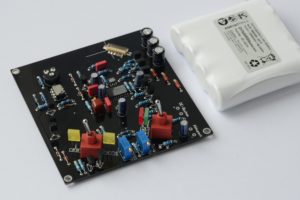
Battery Power Supply

The name Simplicity II does not indicate that it was easy to design, manufacture and build but rather that set-up is relatively straightforward, as long as you ‘RTFM’. Thales has come up with an arrangement of two arm tubes that are joined at the bearing and headshell and share a split counterweight. The headshell such as it is fixed by two precisely tensioned bolts that allow it to change angle but remain as rigid as possible. Fitting a cartridge is a two-stage process, first you fix the cartridge to a shoe and then you slide that shoe sideways onto the plate at the end of the arm, fixing it in place with a very small grub screw. Thales supply all the tools required to set up the turntable and arm in this package but in practice, I only needed to use two, and of these the 0.9mm Allen key got the most use.

Installing and setting up expensive cartridges is nearly always a nerve-racking process, so it’s good to see that Thales does its best to reduce the stress. In order to align a cartridge in the Simplicity II once it has been bolted to a shoe, there is a rather nicely finished and substantial jig that you slide the shoe into and align using a grid on its Perspex cover.

The TTT-Slim lives up to its name with an aluminium plinth that’s only 27mm thick but thanks to some clever machining looks even thinner. It’s suitably weighty, however, especially when the platter is in place. The drive system is neatly hidden beneath this aluminium platter and consists of a large Delrin hub driven by a motor that’s decoupled to some extent by spring-like fixings on either side. Drive is from a DC motor via a thin, round section belt. The bearing is a hardened steel shaft in a bronze bushing set into a cast-iron case. The power for the motor is provided by rechargeable batteries within the plinth, which allow this turntable to run for up to 20 hours according to the manual. A charger is supplied and can be left plugged in at all times but equally, it can be removed during playback to achieve electrical isolation. I encountered hum problems with the Thales in my system and found that removing this connection cured them by breaking a ground loop.

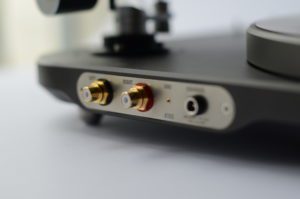
The TTT-Slim and Simplicity II combo can be had with full arm wiring or with plinth mounted RCA outputs, I reviewed the latter and used Townshend Fractal interconnects. Thales supplied an X-squisite CA, this is a moving coil cartridge with a micro ridge stylus on the end of a single piece or monobloc cantilever and coil body. The main cartridge body is made of wood and aluminium and the coils themselves are pure copper.

Setting up the Simplicity II arm is eased by the provision of a counterweight that’s designed for this cartridge but what’s unusual about Thales twin arm arrangement is that it doesn’t inherently provide the same tracking weight at all points across the record. You need to check both inner and outer downforces and rotate the rearmost part of the counterweight to compensate; it was necessary to turn it such that the mass was entirely on the inside to offset higher downforce at the centre of the record. I also used the azimuth adjustment to make the cartridge vertical above the platter. The platter itself is covered with a smooth rubber-like material and this combined with the optional non-threaded clamp ensures that the vinyl is well damped.

The sound reflects this to some extent with a darker balance than average but one that has plenty of scope for delivering energy and solidity of sound. It has an appealingly unflappable quality that suggests it will cope with whatever is thrown at it, what you get is no more intense or aggressive than the recording requires and that is not something that all turntables can achieve. It also gives a sense of inky black backgrounds that allow the tonal character of instruments and voices to stand out.

Live recordings are delivered with a strong sense of scale and image depth and the better studio productions can sound superb. Joni Mitchell’s Mingus [Asylum] being one clear example where everything sounded spot on, the voice stood out with beautiful tone and nuance and it felt as if you could hear right into the studio. Making it particularly easy to appreciate the efforts of the various top-notch musicians Mitchell gathered for this project; Jaco Pastorius, Herbie Hancock, Wayne Shorter, Peter Erskine being the best known but even the percussion playing is in the top flight. All of this is revealed by the way that this Thales record player shows you not only what and how each note is created but, equally important, ensures that those notes stop and start precisely and allow what artists call the negative space, the quiet between notes to be clarified as well. I forgot to put the clamp on initially with this album so got to hear the way it solidifies the bass and adds definition to leading edges when it’s added. On some turntables clamps are not always beneficial but here it brings obvious increases in resolution.

Bass is a strong point on the Thales. The low-end is both solid and particularly articulate. I often play a hi-res digital version of ‘The Drycleaner from Des Moines’ on a streamer and digital usually has advantage in the bass but this record player made it clear that vinyl can compete in this arena where there is fine detail to be extracted from an analogue recording. Tonal character is usually an area where good turntables excel and that’s certainly the case here, on Conjure’s ‘Skydiving’ [Music For The Texts Of Ishmael Reed, American Clavé] instruments like congas really pop out of the speakers and there is strong contrast between the various horns, guitars and sounds in this rich mix with all elements getting to occupy a space in the soundstage. This is relatively easy with smaller ensembles but the Thales can do it with larger bands too.

With really big bands like the National Symphony Orchestra [España, Chasing the Dragon] you get a really inky black background that allows the solo voice of Rosie Middleton to project a powerful image, the backing delivering real dynamics thanks to the solid low end of the turntable. With the contemporary folk rock vibe of Ryley Walker’s Golden Sings That Have Been Sung [Dead Oceans] it feels like the Thales is opening up the recording and giving a sense of expanded time, the relaxed nature of the songs and the depth of tone being particularly enthralling.

This Thales package combines technologies like battery power and a tangential headshell that few other record players offer. Build quality is in the premier league and finish superb, so there’s a lot to like. But ultimately it’s the way it makes all manner of music engaging and accessible that’s important; these technologies have been harnessed in the service of the music, which is the way it should always be.

TECHNICAL SPECIFICATIONS

TTT-Slim II

  • Type: Battery-powered, DC-drive turntable.
  • Rotational Speeds: 33 1/3 RPM, 45 RPM.
  • Drive Mechanism: Belt driven via brushless DC motor
  • Speed Control: Closed loop controller with ultra-precise reference voltage
  • Platter Type: 12-inch aluminium platter with high density rubber mat
  • Platter Weight: 4kg
  • Bearing Type: hardened carbon tool steel in sintered bronze bushing in graphite cast iron housing
  • Plinth Configuration: Rigid, on optional damped base
  • Dimensions (HxWxD): 100 x 423 x 305mm
  • Weight: 12kg
  • Simplicity II tonearm
  • Type: Five axis micro bearing-equipped tonearm.
  • Tonearm Length: 9 inches
  • Effective mass: 18g
  • Offset Angle: variable.
  • Signal Cable Length: Various options available.
  • Weight: 650g
  • Price: £11,250 including Simplicity II arm

X-quisite CA

  • Type: Low output moving coil phono cartridge.
  • Stylus/Cantilever: Micro-ridge diamond tip on monobloc ceramic cantilever.
  • Tracking Force: 1.9 – 2.1g
  • Load: 400 – 800 Ohms
  • Compliance: 12µm/mN.
  • Output (at 5cm/s): 0.3 mv
  • Weight: 14.8g
  • Load: 400–800 Ohms
  • Compliance: 12µm/mN
  • Output (at 5cm/s): 0.3 mv
  • Weight: 14.8g
  • Price: £7,500

Manufacturer: HiFiction AG

URL: tonarm.ch

UK Distributor: Fi Audio

Tel: +44 (0)1563 574 185

URL: fiaudio.co.uk

Back to Reviews

PrimaLuna Evo 400 integrated amplifier

At first glance, you could be forgiven for thinking that PrimaLuna is an Italian brand, after all, it means “first moon” in Italian. In fact, the brand hails from the Netherlands, launched in 2003, its founder and Director being Herman van den Dungen. This integrated amplifier is actually built in China like so many brands these days, and occupies the “my first valve amplifier” segment of the thermionic market. Chinese manufacture enables audio companies to offer more for less, and in this case quite a bit more.

The Evo 400 amplifier sports something called ‘Adaptive Auto-bias’; this simply means that the amplifier biases itself virtually instantly, which avoids the hassle of a monthly tube check that can be easily forgotten, and is kinder to the valves in the early stages of warm up, after the amplifier is switched on. The biasing system (Bad Tube Indicator) will also spot a defective tube before it can take the amplifier with it, and anyone who has made frequent visits to a repairer for this reason will no doubt appreciate this hugely. I have on more than one occasion had to spend hours driving across London to repair a valve amplifier taken down by a failed tube, and this type of protection takes the hassle out of valves. There are also protection mechanisms to safeguard the output transformer should the temperature rise too high or from high-voltage transients. It is the top of the range of integrated amplifiers, with Evos 100, 200, and 300 sitting below in the offering.

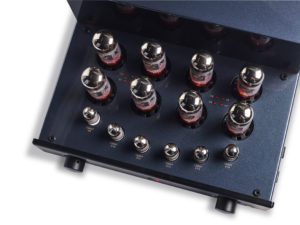
The amplifier comes furnished with eight EL34 valves, and six 12AU7’s as driver/preamp valves, it will put out 70 Wpc in Ultra-Linear mode and 38 Wpc in the purer sounding Triode mode, achievable by handset control.

There is a switch on the right hand side of the amp which enables the user to change over KT88’s, or indeed KT120’s. On the rear panel there are six RCA inputs, one for a fixed level tape output, three line-level inputs, two XLR inputs as well as a home theatre bypass which avoids the preamp section altogether, with a choice of both 4 and 8ohm speaker taps. On the front panel, there are two rotary switches, one for choice of input, the other a high-quality motorised Alps pot for volume. The amplifier is denser to pick up than the sort of amp of this size I’ve picked up in the past, it weighs in at just under 24Kg, which whilst being shocking, is also an indicator of quality. The output transformers on a valve amplifier are always the thing that foretell quality, these transformers are made in-house, custom-wound toroidal, and together with DuRoch tinfoil capacitors, Takman resistors from Japan, this is an amplifier which cuts no corners!

A solid aluminium remote-control unit is included. There’s also a removable cage for protection against children and dogs supplied, which probably doesn’t do much for the sonics of the amplifier. So, for the purposes of listening, I removed it… and no dogs or children were harmed.

I began by listening to Sir Simon Rattle conducting the Berlin Philharmonic in Haydn’s 88th Symphony, on my B&W 802d3’s, with a PS10 power regenerator and Townshend F1 Fractal speaker cables, I’m fascinated by the triode/ultralinear switch, and the ability to make virtually instantaneous comparisons. I have had amplifiers which do both, but rarely so effortlessly. It is really enlightening to be able to see two totally different musical personalities existing in the same space. Listening initially to the ultralinear configuration, I am impressed by the quality of the overall sound, and in particular how the amplifier is producing bass. It reminds me of a more expensive Audio Research amplifier of the last decade, or even a good transistor amplifier. There is a grippiness to the sound, fast, immediate and immaculately timed. The sound stage isn’t as cavernous as I normally hear on my (considerably more expensive) VAC Phi’s, but it sounds more impressive than the equivalently priced transistor amplifier I’ve recently come into contact with. The orchestra sounds dynamic, weighty and the musical intention of the phrasing in this Haydn Symphony is crystal clear. The midrange isn’t the sweetest I’ve heard: my VAC’s are much more liquid in the midrange, but it falls somewhere liquidity-wise between a good transistor amplifier and my VAC reference amps.

To change from ultralinear to triode can only be done with the help of the handset, and once the transformation is done, the red light (default when powering up and representing ultralinear) changes to green to show it’s in triode mode. The changes range from subtle to pronounced, depending on the music you’re listening to. On the same Haydn Symphony, the bass is slightly looser, but more generous in this case. The soundstage is deeper and more extensive, and the violins sound quite a bit sweeter. The sound is less grippy, less transistor and more the way of traditional valve sound, but the amp is capturing all the detail of this wittily written work, the interplay between instruments, the micro phrasing, and the emotion of the performance. The manual says the maximum power is roughly half as much in triode mode, though this isn’t really that obvious.

Onto the “Rite of Spring”, Stravinsky’s shockingly modernist ballet score, Gergiev conducting the Kirov Opera orchestra  [Philips] really illustrates the two different modes of operation. The ultralinear does the fireworks brilliantly, a dazzling display of rhythms and textures, the triode the more lyrical as well as spacial elements of the score. In the famous second track, (Dances of the young girls) I’m happy to sacrifice (no pun intended) the velvety sweetness of triode for the greater blast and rhythmic tightness of ultra linear. They are both excellent, but it gives the user more choice and control.

Moving on to some jazz, Kenny Burrell and ‘Chitlins Con Carne’ [Midnight Blue, Blue Note], I’m loving the percussion in ultralinear mode; the palpably real sense of being in the room when a drum skin is whacked, really dynamic punchy playing, the tail of percussion and Saxophone notes organically trailing off. Moving over to triode mode, a little of that bass thwack that is there in ultralinear is lost. The sound is a little more organic, a wider soundstage, but I find myself missing that rhythmic immediacy that was there with ultra linear. Not night and day, but once the ear is tuned to it… it’s very noticeable.

As an inveterate tweaker and an audiophile who is just plain curious, I relish the opportunity to swap the valves over to KT88’s. It again is rare to have an amplifier that can do EL34’s as well as KT88’s. I’ve always appreciated the differences, but never have been able to see them in the same place, as it were!

So armed with a set of Gold Lion KT88’s I made the swap, which thanks to the auto bias on the amplifier took less than three minutes.

Surprisingly, the differences weren’t quite as great as I’d have thought. There was a slight loss of the airiness that the EL34’s have, the pentode with KT88’s sounded a little closer to the ultralinear setting with EL34’s, more muscular but some of the spacial extravaganza curtailed. On ultralinear (KT88), the sound was big, but I was slightly bothered by a touch of nasality to the midrange, definitely the most ‘transistor’ of the four combinations. So for my money, an interesting and rather revelatory experiment, but give me the supplied EL34’s for the sweetness and depth, at a small cost of power.

Also of interest is the headphone socket, which I believe utilises the output section of the power amplifier. So with my Sennheiser HD 800’s in hand, and listening to the same tracks as before, I notice a very high quality headphone amplifier, with the all the liquidity of the best tube headphone amplifiers, spacial control and sweetness, almost as a throw-in. I’ve heard headphone amplifiers selling for the price of this integrated fail to reach this quality of sound. Very impressive for someone who takes headphone listening seriously.

Like other PrimaLuna models, the Evo 400 integrated amplifier is an extraordinary mixture of being low maintenance, and a great first valve amplifier, combined with a spot of tube-rolling audio nervosa paradise. The ability to change between ultralinear and triode at the flick of a remote control button, combined with the ability to use different valve types means that this amplifier can indeed be all things to all people, or ‘cakeism’ as the modern turn of phrase goes. But not only is this the ultimate ‘cakeist’ amplifier, it actually does the various options extremely well. It is not only an educational experience, it is also extremely satisfying to listen to. Well thought out, well executed, and creates a high bar for those few competitors at this price.

TECHNICAL SPECIFICATIONS

  • Type: Integrated stereo valve amplifier
  • Analogue inputs: 5× RCA, 1× HT bypass RCA
  • Phono input: optional moving magnet
  • Digital inputs: N/A
  • Analogue outputs: tape out RCA, sub‑out RCA
  • Bluetooth: N/A
  • Headphone output: 6.3mm jack
  • Speaker outputs: 5-way binding posts, 4 & 8 Ohm taps
  • Power output (EL34 valves): 70W Ultra‑Linear; 38W triode with
  • Dimensions (H×W×D): 205 × 405 × 385mm
  • Weight: 31kg
  • Warranty: 2 years (valves 90 days)
  • Price: £4,598
  • PhonoLogue MM phono stage: £155

Manufacturer details: Durob Audio BV

Tel: +31 73 5112555

URL: primaluna.nl

Distributor details: Absolute Sounds

Tel: +44 (0)20 89713909

URL: absolutesounds.com

Back to Reviews

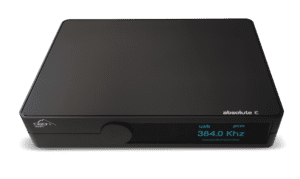
Ideon Absolute ε digital converter

If you have a long memory for YouTube videos, you might recall the graduation documentary from a Goldsmiths College student that was all about the Athens Audiophile Society. While that documentary was more mocking than the society might have liked, anyone who thought Greece doesn’t take its audio seriously was effectively silenced by that video. Greece also has a small, but vibrant and growing, group of audiophile manufacturers, including Athens-based Ideon. The company was founded in 2016 by CEO George Ligerakis and chief engineer Vasilis Tounas who, together with two like-minded professionals, concentrated on making the best in digital audio regardless of cost.

Ideon’s range is therefore small, but beautifully formed; two DACs, two clocks, two streamers, a USB reclocker and a made to order linear power supply for the more affordable devices in the Ideon catalogue. We didn’t go with the affordable, though. We went right to the motherlode; the Ideon Absolute ε DAC. This is the latest revision of Ideon’s Absolute DAC; well, not so much a revision, more taking the already highly regarded Absolute and running with it, like an absolute (pun intended) boss. Cleverly, Ideon didn’t simply throw out all that was good in the Absolute, it instead looked at what could be improved upon and spent three years enhancing it!

Even before its epsilonisation, Ideon’s Absolute flagship DAC was itself the product of a three-year-long research project, which resulted in selecting ESS Technology’s Sabre ES9038PRO DAC, taking advantage of the chip’s 32-bit processing and 140dB dynamic range. The ESS chip has extremely well-designed digital filters that took a whole team many man-years to develop. However, Ideon wrote more than 4,000 lines of code to fully exploit the firm foundations created by ESS and didn’t just go with ESS’s pre-configured set of commands and parameters. Ideon’s own application of the ESS chip alone would make it the Absolute ε force a to be reckoned with, but we’re just getting started!

Three is the magic number in many sections of the Absolute. It features a trio of top-of-the-line femto clocks (each with its own discrete power line) to help produce an ultra-low-noise and ultra-low-jitter signal path. Staying with the power of three, Ideon uses what it calls its ‘Triple Distillation’ input section; a proprietary three-stage noise-reducing circuit. Ideon claims that “Figuratively speaking, we have declared war on linear and non-linear distortion and noise!” Given the last time I had anything triple distilled, it was an Irish whiskey, and the unconsciousness it produced certainly reduced my noise levels. So maybe Ideon has a point.

In addition, and new to the Absolute ε, Ideon has included three zero-noise active bridges of its own design, built to eliminate the possibility of noise coming from the current rectification on the bridge. The usual way for digital designers to reduce this noise is either to go for a switching power supply, or to pretend it doesn’t happen, but compromise is not something that translates into Ideon’s core value system.

The numbers game steps up a bit as you move through the DAC’s features; the balanced output stage has four output channels (again each with its own dedicated power supply) with no capacitors in the signal path. This again is one of the key areas that has seen upgrades in the move from Absolute to Absolute ε; Ideon has redesigned these symmetrical circuits to feature equally symmetrical, low noise, independent power supplies.

This brings the power supply count to 17 individually regulated stages throughout the converter, all fed from a high-grade, ultra-low-noise power supply that features two custom-made transformers designed to handle three times the current draw of the Absolute ε. Each regulator is built to incredibly high tolerances, and the power supply bristles with 80 high-grade Elna capacitors. All of which makes the DAC a top-class design, and not easy or cheap to make. Ideon claims the Absolute ε is future-proofed for the next 10 years, but as my TARDIS needs recharging, I’m unable to verify that statement.

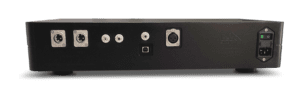
 The DAC’s connections are extremely simple by today’s standards, with no Ethernet, HDMI or anything apart from S/PDIF, AES/EBU and USB. However, the USB receiver is a state-of-the-art combination of the ESS USB input chip and Thessycon’s drivers made for Ideon to offer the best possible sound and support also up to 8x DSD. This is no off-the-shelf receiver; ESS has produced custom code and configured it specifically for Ideon. The DAC outputs to both balanced and single ended amplifiers. However, instead of sparking comments that include the word ‘rudimentary’ connectivity, the Absolute ε invites interesting philosophical asides about what else is needed on a DAC. Of course, it’s not as if Greece has anything to do with philosophy…

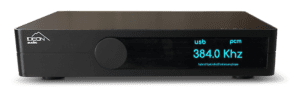
The front panel is surprisingly user-friendly for a DAC with a nice big dial to switch inputs and an equally large display showing input and sampling frequency. It does display ‘kHz’ as ‘Khz’ (although this will change soon). The display also switches to dB (this time displayed correctly) when the large central dial is used to access the digital volume control, and the display is useful when setting up the DAC, because there’s a choice of seven filter settings, settings for an IIR filter (47.44kHz is the default), lock speed (the number of audio samples the DAC ‘sees’ before deploying its digital phase-locked loop; which is useful in working with the Sabre chip’s jitter-reduction algorithm, as well as dithering, jitter elimination, and de-emphasis, all of which can be enabled or defeated.

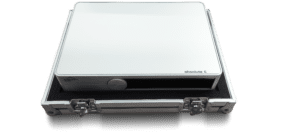
There are two big and obvious issues with the Ideon Absolute ε. The first is it is bloody heavy! It comes supplied in a flight case, which adds to its shipped mass (but also makes it highly unlikely to be damaged in transit), but a solid billet of aluminium machined out to make a full-size clamshell case is never going to be light. Add in the transformers and you are looking at a DAC that weighs in at a healthy 28kg, which is more than many power amplifiers.

The other issue is burn in. While the DAC sounds good straight out of the box, it does go through one of those ‘good, then bad, then good again’ warm-up curves, and the whole process takes hundreds of hours to finish. To make matters worse, that warm-up requires a little more than just having power running through it and it seems to condition faster if you actively feed it digits from different sources. I’m not altogether sure whether this was simply hasty listening on different sources, but I had the distinct impression that if you gave the USB 100 hours and the S/PDIF input 300 hours of running in, you could hear the difference in performance between the two inputs. This sounds odd because once you get past the input stage, the datastream is passing through the same circuit, but it might be because that USB port has its additional noise-filtering circuit.

I used the Ideon DAC in balanced mode (if you use it in single-ended, it’s essentially a down-shifted balanced mode rather than single-ended operating in pseudo-balanced) into my Burmester 088/911 Mk 3 pre-power amp and from there into Wilson Audio Duette 2 loudspeakers, using Nordost cable throughout. I fed it a diet of USB from my Melco N10 music server as well as S/PDIF from both a Naim Uniti Core and a Hegel Mohican CD player.

This is a DAC of rare subtlety and finesse, like a synthesis of all the good things of all the best DACs with none of the idiosyncrasies. It demands you take it seriously and approach its settings with careful consideration, ideally performed over weeks of listening. None of which makes it good for the quick-fire movements of a review sample, where such a device is in constant short supply. The same likely holds in demonstrations, where no matter how much run-in, that finesse of combining the DAC with your tastes and your system takes weeks, all of which cannot be performed in a single listening test no matter how involved. That isn’t meant to excuse the Ideon DAC – because no such excuses are needed or demanded – but suggests that no matter how good that listening experience in the demonstration room or in a home audition, there’s still a lot more to be had from the Ideon Absolute ε.

Saying how much more can be had from a DAC is one thing, but when a DAC gets so far under the skin of music even when in ‘out of the box’ mode, you know you are onto something really, really good. The adjustment of filters, dither, de-emphasis and jitter are not simply window dressing, but make that link between DAC and music get ever closer. This is where reviewers begin to run out of terminology fast, which is, in this case, a very good thing. The Ideon gives music true ‘presence’ as it gets past the ephemera normally associated with audiophilia and gives the music the stature and energy it should demand. Given that it bestows that stature to ‘Toxic’ by Britney Spears [In The Zone, Jive] as much as it does to Schoenberg’s Verklärte Nacht [von Karajan, Vienna Philharmonic, DG] shows just how much there is buried in digital audio and just how much the Ideon manages to extract.

A perfect example, relevant to both recordings, is the audio definition of ‘dynamic range’. We consider this in terms of the difference between ‘silent’ and ‘the loudest a system can muster without distortion’. While true, dynamic range in music is more nuanced; not just ‘microdynamics’ and a system’s ability to parse relatively small aspects of a performance within the sonic whole. Here, however, ‘dynamic range’ refers to the way the music just flows from the loudspeakers thanks to the Ideon DAC.

My first reaction to this was to think the Ideon was trying to smooth everything over, making the rookie error of trying to make a DAC sound soft and ‘vinyl-like’, but in fact the rookie error was all mine. This isn’t music declawed and sanitised; the energy and vibrant power of recordings is not held in check. It just doesn’t have that steeliness or the bright, forward nature of many top-end DACs. This isn’t a rolled off sound; my go-to Joyce DiDonato recording [Stella Di Napoli, Erato] showed her singing in fine form, to the point where you could hear her diaphragm opening as she drew breath; none of which is possible to hear from a system that softens the impact of music.

This recording perhaps best encapsulated what the Ideon does so right. Her voice is one that raises goosebumps on even the humblest audio equipment, but here you are stilled and silenced by her voice, and to switch to another track while the music is playing seems like an act of musical sacrilege when it’s played on the Ideon, so direct the link between you and the music.

There was no musical passage or genre that troubled the Ideon, and neither was there anything in audio that caused it to stumble. In short, the Absolute ε sets a new standard for reference DAC’s for me as the very best in almost every performance aspect, and close to the best in all others. There are a lot of paths up this digital mountain and those prepared to sacrifice key parts of the musical whole for a more immediate presentation will always find different avenues, but for someone seeking the musical whole will struggle to find anything that comes remotely close to the Ideon Absolute ε.

Lengthy run in and backache aside, the only real downside to the Ideon Absolute ε is the lack of remote control. This isn’t so big an issue if you are using the DAC just as a DAC, but if you are using its volume control into a power amplifier, that absence of handset can be a bit of a bind. Its omission is done for sonic reasons, and that itself speaks to the level of obssessiveness that went into the design of this converter, but as a practical consideration, a remote would be nice sometimes (good news… a remote is on the way!).

The Ideon Absolute ε came as a bit of a surprise. I admit that I came to it with little background knowledge of the company and even less about the product itself. I didn’t even ask about the price until the test was over. But in the listening, it was clear this was a world-class device capable of doing what so many high-end DACs claim to do, but often fail to achieve in reality; make music sound like music. Real living, breathing musicians playing in your living room. There are lots of different interpretations of how digital audio is supposed to sound but Ideon makes it sound like real music. This really is one of the best DACs in the world right now.


TECHNICAL SPECIFICATIONS

  • Inputs: USB, AES/EBU, coaxial
  • Formats supported: 44.1kHz to 384kHz PCM up to 32 bits, Native DSD (up to 8x DSD)
  • Digital Inputs: 4x advanced isolated input slots
  • XLR Output: 9Vrms at 0dB
  • RCA Output: 4.5Vrms at 0dB
  • THD (A-weighted, 20Hz–20kHz): <-120db on all outputs
  • Channel Separation: >130dB on all outputs
  • Signal to noise ratio (A-weighted, 20Hz–20kHz): >130dB on all outputs
  • Dynamic Range (20Hz–20kHz): 147dB FS, 145dB AFS
  •  Dimensions (W×D×H): 49 × 35 × 12cm
  • Weight: 28kg
  • Price: £31,440


Manufactuer: Ideon Audio

URL: ideonaudio.com

Back to Reviews

Munich High-End 2022: The Highlights Part One

After a two-year absence, Munich High-End has finally returned, complete with a new brand ambassador in studio legend Alan Parsons. What has become the largest and most important show on the audio enthusiast calendar is back at last, at the MOC exhibition centre to the north of the Bavarian city. Before the enforced break, Munich High-End was the largest show of its kind, with hundreds of exhibitors taking all four halls, two atria, and the dozens of glass-fronted demonstration rooms on the two upper flights of Atrium 4. Despite soaring temperatures in those glass-fronted rooms (with outside temperatures reaching 34°C/93.4°F at times, sitting in a room filled with hot-running audio electronics and sweltering audio enthusiasts was often ‘challenging’), the weekend public days were packed, and people are clearly keen to be back!

In total, the show organisers registered 19,767 visitors across the four days, comprising 9,472 trade visitors from 80 countries, 9,878 consumers from 69 countries, and 417 media representatives from 36 countries. These visitors encountered 450 manufacturers with 800 brands from 40 countries. These figures compare favourably with the numbers from 2019.

However, the 2022 world is different and the show reflected that change. recent and significant supply chain issues meant many products expected to be ‘on demonstration’ at Munich were ‘on show’ or even ‘coming soon’, with either an empty box prototype or even little more than a computer graphic. A handful of companies even decided not to exhibit despite booking an expensive booth because they were beset by shipping problems, supply chain problems, and manufacturing problems due to COVID-19 putting members of their workforce out of action in the run-up to the show.

In addition, while the COVID-19 pandemic is decreasing in force worldwide, many Asia-Pacific countries are still imposing lengthy quarantines on travellers, and it seems few are willing to spend weeks in self-imposed isolation for a couple of days in Germany. Factor in the absence of visitors, manufacturers, distributors and press unable to attend due to the Ukrainian conflict, and many Americans chose AXPONA 22 as their lone Spring 22 expo, and the show felt quieter during its two trade days.

To make the show more actively ‘business’ the two trade days included the new IPS (International Parts + Supply) event, which allowed OEM trade manufacturers to ply their wares to audio companies. This is a good idea because few members of the public are particularly interested in talking about PCB stand-offs or having conversations with the manufacturer of feet for amplifiers, but such conversations are a gift to audio makers. The show also featured a ‘start-ups’ section and the lower halls were, as ever, broadly divided into zones (headphones, vinyl, etc).

This year, perhaps understandably, the usual moments of wild excess were few and far between, there were a few cars on display at the show (perhaps most notably, Dynaudio’s own display… of a pristine condition DeLorean), but none had been crane-lifted onto one of the atriums. This was also not a show to spot trends in audio, although in very broad terms this was the show where wireless loudspeaker streaming became more accepted even in audiophile circles. But new products were still abundant.

Here’s our list of some of the best new products we saw at Munich High-End 2022. Such a list is never going to be exhaustive, as even a top 200 would be cutting a lot away:

Aavik Acoustics

The latest integrated amp from the already distinctly high-end Aavik brand goes for the stratospheric. It features 200W of surprisingly cool-running Class A power, thanks to an innovative high current driver stage. The industrial design of audio legend Flemming Rasmussen to bring some gravitas to the look and feel of amp, too. Alongside the I-880, the group presented Børresen’s new M1 loudspeaker that takes the iron-free magnet technology to new levels, and new Gold Signature cables from Ansuz. This all represents a new high point for the brands… with anticipated prices to match!

Ambitious Audio Design


Shown in several forms across the years at Munich, Ambitious’ A1.1 two-way stand-mount more than lives up to the name, with every aspect of loudspeaker technology – from the construction of a cabinet to the Linear Lossless Suspension drive units are all designed like no other, using extensive amounts of aluminium and carbon fibre in unique, cabinet-eliminating designs. The two way is designed to work with a subwoofer (an Ambitious Audio Design sub in early prototype form was also on show). The A-Series loudspeaker is in its last phases of pre-release development. The price is Ambitious too… at €95,000 per pair.

Audiobyte 


Still in early prototype form, Audiobyte’s excellent trio of streaming transport, DAC, and power supply are proving popular among headphone enthusiasts and audiophiles alike, but the Romanian brand showed its work-in-progress Super trio, that improve on each aspect of the existing trio, including better DAC, improved firmware and the addition of balanced headphone output. These products will likely make it to market sometime in 2023, but you heard it here first!

AudioQuest

One of the most poised-sounding high-end systems at the show, the combination of dCS Rossini Apex digital front-end, Einstein Audio The Preamp and Integrated amplifiers, Wilson Audio Sasha DAW loudspeakers and AudioQuest’s Niagara 7000 power conditioner and the company’s excellent new Mythical Creatures cable line. Where some systems emphasised a forward or bright sound and others overcompensated with too dark or laid-back a presentation, this one really hit the Goldilocks spot.

Audio Research

The new flagship power amplifier from Minnesota’s amp experts is scheduled to arrive later this year and its price is still to be confirmed, but the 320W balanced and single-ended input KT150-powered mono power amp is expected to be a real superstar, especially as it takes advantage of Audio Research’s new in-house finishing. This allows a greater range of colours first seen in the company’s I/50 integrated amplifier.

Audiovector

At 40kg a piece, and with a pair 200mm in the bass and an AMT driver in the treble, the new QR7 from Audiovector looked and sounded like one of those fine tower loudspeakers in the €10,000-€20,000 price range. Except it costs €5,700/£4,995. This was one of the stars of the show, delivering a sound with punch and refinement in equal measure and really filling a room, both with music and listeners, despite being in one of the pressure cookers of the baking hot top floor of the Munich MOC.

Boulder

The latest design from the Colorado-based high-enders, the $8,850 Boulder 812 DAC Preamplifier is a high-performance headphone amplifier, but one that can its balanced and single-ended personal audio connections behind a magnetic plate for those who simply want a digital converter or digital preamp. Styled to match the 880 integrated amplifier, this is a perfect stand-alone device for high-end headphone users.

Burmester

Unlike many companies in the audio business, Burmester doesn’t change its products too often. This means the company saying a fond farewell to one of its range is a big thing – especially when the farewell is to the evergreen 911 power amplifier, now in Mk 3 form but still based on the circuit from 1991. The replacement isn’t one power amplifier, but two, the 216 for the company’s Top Line and 218 from the Reference Line; both based on a new circuit design drawn from the current Signature Line 159 flagship mono amps. Both can be used in stereo and mono form with the 218 (shown) selling for €35,000. These are said to deliver 909 or 159-grade performance but in a chassis closer to the 911 Mk 3.

Chord Electronics

At the last Munich Show, Chord Electronics surprised everyone by announcing its first wholly new range of power amplifiers in years… the Ultima series. This year, the new £6,000 Ultima Pre 3 analogue preamplifier joins the line. The five balanced/three single-ended design has individually buffered and selectively filtered inputs and a brightly-lit central sphere aesthetic that matches well with the company’s digital designs and the Ultima range of power amps.

Dan D’Agostino Master Audio Systems

If Dan D’Agostino’s Relentless mono power amps weren’t beefy enough for you, the new Relentless Epic update delivers an input stage with devices that deliver a 300% increase in current and a new bias stability circuit that produces almost 50% increase in operating bias. The Epic costs $349,500 per pair and existing owners can upgrade to Epic status for $49,500 per pair. Meanwhile, those wanting Relentless performance but don’t need its 1.5kW power can opt for the new Relentless Epic 800. Housed in the same chassis and using the same basic circuit (but with fewer output transformers), the 800W per channel Epic 800 is priced at $194,500 per pair.

dCS

Arguably, dCS invented the Schrödinger’s Product Launch… in all the right ways. Technically, there was nothing new at the show in terms of outright product (in fact, the company introduced Lina, a wholly new headphone amplifier system… but did so a day after Munich). However, Munich was one of the first public outings of the company’s new APEX upgrades to the Vivaldi and Rossini product lines, which is the biggest change to dCS technology in years, as it fundamentally reworks the Ring DAC at the core of dCS digital platforms. So significant, in fact, that dCS revived the strictly limited four-into-one box Vivaldi One APEX player for the launch.


DeVore Fidelity

It seems that John DeVore doesn’t know how to make a bad loudspeaker. His high-efficiency, wide-baffle two-way stand-mount Orangutan line of loudspeakers are commonly considered to be some of the nicest sounding models around, but many companies struggle when making a bigger or smaller version of their biggest hit. However, in producing the new O/baby – essentially a smaller version of the popular O/96 with a horn-loaded 1.9cm dome tweeter and 178mm paper cone – DeVore made a loudspeaker that retains that O/96 magic but at $5,750 per pair comes in at less than half the cost.

Dynaudio

OK, so much of the ‘focus’ on Dynaudio was on the pristine Dynaudio-equipped DeLorean parked in the foyer of the show, but in the real world, Dynaudio launched its new high-end wireless Focus trio of products. The €5,000 Focus 10 two-way stand-mount, €7,500 Focus 20 and €10,000 Focus 30 floorstanders all feature extensive wireless audio capabilities alongside their active powered performance.

This was the first press launch of the event and the expectation was that many other companies might follow where Dynaudio (and KEF with its new LS60) are leading. But so far, these two are the trailblazers.

EAT

In German, the name means ‘C Major’ and is pronounced ‘Seder’ (like the Passover ritual). However, EAT’s new C-Dur sits midway between the existing C-Major and C-Sharp turntables, and retains the record clamp and gimballed C-Note arm of the other products in the C range. Priced at $3,595 in satin black and $4,295 in high-gloss plum the integrated player can be supplied with the Jo No5 cartridge. EAT also launched two versions of the 12” F-Note tonearm (now in Mk 2 guise); the Variable Tube and Variable Headshell versions, in both black (for $3,295) or polished aluminium (for $4,395).

Ensemble Audio

Stepping away from the main show for a while, Ensemble Audio of Switzerland holds a one-man-band event at the Pullman Hotel near the off-site Hi-Fi Deluxe Show. While the products ostensibly remain the same, internally they are subject to a series of listening-test derived revisions over the years. So, the Massimo Fuoco, Massimo Fonobrio and Ondiva loudspeakers (now in Gold form) produce an extremely elegant and musical sound, that is especially capable with extremely complex classical music.

Epos Acoustics

Recently, the classic Epos brand changed hands once more, moving from being under the auspices of Creek Audio to being owned by Karl-Heinz Fink of Fink Team. The first model from the reborn brand harks back to the company’s original roots; the ES14N is named after the popular ES14 of the late 1980s. The two-way, rear-ported stand-mount carries little more than the name over from the past, however, and this double-layered asymmetric cabinet stand-mount is every inch a Fink model and is expected to cost around €4,500 when launched later in the year.

Fyne Audio

Having built a commanding reputation (and a major back-order list) for its five current ranges of products in the hi-fi world, Fyne Audio announced its Vintage and Vintage Classic lines. These use a distinctly retro styling coupled with some very up-to-date technology used in Fyne’s most popular designs. The curved Vintage line uses real wood throughout with cryo-treated crossovers and a unique Presence control dial to tune the sound to the room, while the more squared off Vintage Classic wraps MDF in real-wood veneers, but still allows some modification of the crossover limits. The range was expanding faster than the company could produce its literature, but the Vintage Twelve playing sounded lovely. Prices are still to be confirmed but are expected to start at around £4,000 and reach up to £30,000.

Funk Firm

Having shown off a monumental and innovative deck-meets-stand at the last Munich show, Funk Firm’s static display this year was a little less outré, but no less innovative. The company’s Kepler turntable uses a vacuum hold-down platter, gives the listener the option of switching between belt and direct drive, and has provision for three rotating arms in orbit around the deck (hence the Kepler name). The Raptor-Z arm gets the ‘z’ suffix because the company claims it has zero tracking error, resonance and feedback. Both products fit into Funk Firm’s ‘isolation bubble’ concept. The price of deck with three arms is expected to be around £75,000.

GiK Acoustics

The new £115 Sound Blocks are a clever idea in room treatment. Each 23”x23”x10.5” block is a broadband bass trap that works to well below 60Hz in room and a neat optional MDF rail system allows blocks to stack and interlock. Each one can be fitted with diffusion plates and other options for midrange or treble response. The block array is designed to be free-standing to make either a false wall environment or to allow listeners in shared living spaces to move the treatment in and out of the room as the listener feels fit.

Graham Audio LS5/5F

Using the damped thin-wall construction common to BBC and post-BBC designs, Graham Audio’s LS5/5F floorstander is the latest design from the company. This reflex-loaded three way weighs in at a healthy 42kg and stands 111cm high and features a 300mm long-throw bass driver that is claimed to reach 40Hz in room, 200mm midrange and a 25mm soft-dome tweeter. As with many products at Munich 2022, the price was still to be confirmed.

Gryphon Audio

Gryphon Audio had two new products and one upcoming product on display. The mighty £57,500 Commander preamplifier and £87,000 Apex power amplifier had been launched earlier this year and set a new high bar in an already distinctly high-end brand, whether it’s the radar detection for the two-box Commander (that changes its display relative to how close you are standing to its front panel) to the sheer scale of the 210W per channel Class A Apex and even bigger Apex Mono, these are paragons of audio performance.

However, at the other end of the scale, Gryphon showed its upcoming EOS 2 floorstanding loudspeaker. A radically clever feature of this design is a port that can be set to fire to the rear (for larger rooms) or front-firing for close-to-the-wall integration in smaller rooms. With a tweeter that extends to 34kHz and a bass that is said to approach 25Hz in small rooms, this makes the EOS 2 the perfect high-end metropolitan design, if the still-to-be-confirmed price is right.

Back to Hi-Fi+

Enjoy the Music.com Sponsors T.H.E. Show 2022 Media & Exhibitor Celebration 

From the EnjoyTheMusic.com press release

(May 24, 2022) Enjoy the Music.com, high-end audio’s celebrated site for over 26 years and a leader in providing premium audio and music industry news, hardware reviews, and show reports, is pleased to announce that we’re sponsoring T.H.E. Show’s Thursday night media and exhibitor celebration! To be held from Friday, June 10th through Sunday, June 12th at the Hilton Long Beach in Southern California, both show exhibitors and members of the press are invited to join us for drinks, music, and good times. For decades, T.H.E. Show has been the must-attend event for Southern California music lovers, audiophiles, and hi-fi enthusiasts alike. When first launched, T.H.E. Show was primarily a Las Vegas event an alternative to a non-industry operated CES.

Featuring finely-crafted luxury audio products, T.H.E. Show is an upscale event for those who truly value music within their homes and on the go too. Operated in part by award-earning musicians and those who are enthusiasts, T.H.E. Show 2022 is the place to experience the very best high-end premium audio / video products. With many leading brands exhibited, plus educational seminars and special features planned, this show is not to be missed!


“T.H.E. Show is always delighted to include Enjoy the Music.com in all of our endeavors, especially T.H.E. Show in Long Beach,” said Emiko Carlin, Senior Vice President of T.H.E. Show. “We’re excited to have over 100 Exhibitor brands and dealers this June, showcasing some of the best hi-fi and audio in the world, serving California and the entire Western United States of America. We are grateful for Enjoy the Music.com‘s continued support – not just of T.H.E. Show but of our entire industry and beloved community.”


Enjoy the Music.com is overjoyed to be working alongside T.H.E. Show 2022 for their Long Beach California event,” says Steven R. Rochlin, Enjoy the Music.com‘s Creative Director. “With many exhibitors showcasing the very best in premium audio and video gear from around the world, our support shows the strength of this luxurious and vibrant industry filled with passionate music lovers. As the music industry has greatly grown over the recent years, in turn many music enthusiasts have sought out the finest of home and personal portable consumer electronics gear. Our ongoing support T.H.E. Show includes sponsoring their Denver Colorado and Nashville Tennessee events.”


Vinyl & Booze
Why just talk only about vinyl when you can talk about vinyl and booze from a leading expert who has written multiple books about it! André Darlington, author of Booze & Vinyl and Booze & Vinyl Vol. 2 will be appearing at T.H.E. Show Long Beach for two very special Happy Hour sessions of mixology, listening, and discussion, on June 10 and 11.

T.H.E. Show Launches Their 2022-2023 Ambassador Program
T.H.E. Show welcomes Jiles McCoy of Home Theater Fanatics and Scott Lylander of Audio Acoustic Engineering as Ambassadors for T.H.E. Show’s 2022-2023 programming. Between them, McCoy and Lylander bring over 30 years of experience in hi-fi, audio, and home theater. With their knowledge and passion, they will be an integral part of T.H.E. Show’s front-facing personality, bringing T.H.E. Show’s mission of an elevated listening experience for all very much to life through the content they create and their respective global reach on social media.

T.H.E. Headphonium
The launch of their brand new initiative, T.H.E. Headphonium, a dedicated space within T.H.E. Show featuring headphones and personal / portable audio. The inaugural Headphonium, presented by audio and home theater publication eCoustics. The brand new T.H.E. Headphonium will offer show attendees a more engaging and unique experience including the opportunity to listen to a wide cross-section of the world’s best headphones and portable audio equipment. Attendees will have access to a lifestyle lounge, bespoke professional photo shoots, live social media events, and more.

Live T.H.E. Life.  |  T.H.E. Hi-Fi Life.  |  T.H.E. Group Life
An exclusive membership program, where all who love music are welcome. Members get a three-day pass to T.H.E. Show’s annual June event and access to exciting VIP events such as studio tours (our legendary “X Marks the Spot” at Capitol Studios for example), live artist recordings, artist performances, networking events, our brand new Audio University program, and local Ambassador Program Events in cities around the world! They also have wine-tasting events, boat and yacht events, racing and driving events, and gaming events.

You can see our T.H.E. Show 2022 event coverage at this link.


About T.H.E. Show
Founded in 1998, T.H.E. Show (The Home Entertainment Show) has the honor of being the longest-running high-end audio and luxury hi-fi show open to the public in the United States of America. T.H.E. Show’s mission, to encourage and educate the community through elevated listening experiences, can be seen and heard first hand with its 100+ exhibitors, award winning documentary film, T.H.E. Human Side, membership lifestyle ecosystem, T.H.E. Group, and VIP curated events. T.H.E. Show’s team lives by the values that hi-fi and music are for everyone, no matter where they are in their journey of audio discovery, thus curating T.H.E. Show to reflect this and have exhibits and experiences for all music lovers.

T.H.E. Show recently announced their expansion into the Denver, CO and Nashville, TN markets for the autumn of 2022 and beyond, with each location exhibiting two-channel audio as well as having additional areas of focus in home theater, technology, gaming, and music creation/production. All who love music are welcome at T.H.E. Show and we look forward to seeing you at T.H.E. Show in Long Beach, California from June 10th through 12th, 2022!


For Event Tickets: Eventbrite.com

More Information About T.H.E. Show: TheHomeEntertainmentShow.com

More Information About T.H.E. Group: TheGroup.life


About Enjoy the Music.com
Enjoy the Music.com is one of the Internet’s leading information sites for high-end audio and music news, equipment reviews, plus show reports of both home and portable gear since 1995. We have received critical acclaim from our worldwide readership, like-minded audio publications, and notables such as the President of the Consumer Electronics Association (now CTA). Being associated with nine print publications and four web-based magazines, Enjoy the Music.com is part of a robust grouping of magazines and journalists which features the best minds within the high-end audio industry.

Enjoy the Music.com also offers its Review Magazine, the industry’s most extensive daily industry news, plus over 260 show reports online. Enjoy the Music.com proudly sponsors all industry-operated luxury audio major events within the USA and Canada including the AudioCon Los Angeles, Capital Audiofest, Florida Audio Expo, Montreal Audiofest, Pacific Audio Fest, T.H.E. Show, and the Toronto Audiofest. Readers can connect with Enjoy the Music.com on leading social media sites Instagram and Facebook.

Enjoy the Music.com is internet partners with print magazines audioXpress,  Australian Hi-FiHi-Fi+, HIFICRITIC, Hi-Fi MediaHi-Fi World, The Absolute Sound, plus vintage magazines Sound Practices and VALVE. We also collaborate with online publications eCoustics, Headphone.Guru, Positive Feedback, and STEREO.

Audiovector QR7 floorstanding loudspeaker

From the Audiovector/Renaissance Audio press release:


Audiovector unveiled its new QR 7 loudspeaker at the High End Show in Munich. The QR 7 is the flagship of the QR series and is designed to put the fun back into playing music. Its big and vibrant sound will transport you to the concert hall or night club of your dreams! Pick the right track and you’ll want to get up and dance!


Whilst the QR 7 has a huge, room-filling sound, it is also an extremely refined loudspeaker that has been developed, engineered and handmade in Denmark. It has a dynamic musical ability and features the latest in speaker technologies to deliver that powerful performance.


The QR 7’s imposing cabinet houses two massive, air-shifting 8-inch drivers and a newly developed crossover that combine to create a hyper-dynamic, yet neutral-sounding speaker with a big, open soundstage. It is a full 3-way system and has double Pure Piston bass units with sandwich membranes, a 6-inch midrange and the Audiovector fast and agile Air Motion Transformer tweeter. Due to its easy impedance load and high efficiency of 90.5dB, it is easily driven – a perfect match for both solid state and tube amplifiers. This is a speaker designed for inspiring and invigorating listening sessions.

One of Audiovector’s distinguishing features is that instead of selecting ‘off the shelf’ drive units, it engineers its own drivers in-house and then asks the best suppliers to build them. This way it ensures that it co-engineers its drive units in combination with its crossovers. The combination of low-hysteresis voice coil technology, large powerful magnets, rigid turbulence-suppressing baskets and sandwich membranes made from two layers of aluminium, allows Audiovector to create a richer, clearer and more vibrant sound.

The QR 7’s enclosure is generously braced and made from high-density hardwood HDF for the perfect combination of superior strength, low resonance and elegant aesthetics. The tweeter’s fascia plates are machined from a single piece of aerospace grade aluminium. They are precision machined, glass blasted, brushed and then anodised in a beautiful tungsten titanium grey colour. The rose gold-plated dispersion mesh works as an S-Stop filter and improves driver Integration.

The QR 7 perfectly matches its siblings. With the addition of the powerful QR Sub, the detailed QR Centre and the easily placed QR Wall, Audiovector is proud to be able to offer a potent and powerful home cinema system.

MD of Renaissance, John Carroll, said: ‘This is a fantastic new loudspeaker and the perfect way to herald Renaissance’s exclusive UK distribution of Audiovector products. I love its powerful performance and the striking cabinet design. Our customers are fun folk, and they are really going to enjoy getting down to the QR 7 sound.’

The QR 7 is available in a choice of three finishes: White Silk, Dark Walnut and Black Piano.

RRP £4,950 per pair.


www.renaissanceaudio.co.uk

www.audiovector.com

Back to News


Innuos debuts STATEMENT Next-Gen Power Supply Upgrade

Innuos debuted at AXPONA in the US a Next-Gen Power Supply Upgrade for their flagship STATEMENT Music Server and Streamer.

The STATEMENT Next-Gen Power Supply Upgrade is the result of Innuos ongoing Research and Development efforts in close collaboration with the long-term partner Dr. Sean Jacobs. The impressive improvement in sound quality is achieved by an innovative Powers Supply design and significant component upgrades:

The Power section uses two custom-designed ARC6 AC/DC modules – each containing a new high-precision Active Rectifier board, a massive 10mH DC Choke and almost 4 times more capacitance provided by six Mundorf caps. The ARC6 modules are mounted on the new Adaptive Vibration Control (AVC) platform, a combination of Panzerholz wood with a specific density gel layer, which is highly effective at dampening high-frequency vibration coming from the chassis.

In the Server section, the Regulator modules include a dedicated CPU Booster module, providing up to 15A of current to the CPU for faster transients. All rails are further smoothed by new Audio Note KAISEI capacitors benefitting all the main components: Motherboard, USB Reclocker, Ethernet Clock module and SSD.

The results are crystal clear: Increased realism with even more detailed textures, expansive soundstage and improved dynamics.

Following Innuous’ philosophy of supporting existing customers in taking their systems to the next level through upgrades, when possible, the STATEMENT PSU Upgrade will be available as an option for both new or existing units. The recommended price for a new unit with the Next-Gen Power Supply Upgrade will be the following:

RRP/MSRP

Innuous will start shipping new units and receiving existing units from customers for upgrade in June.

More details on the Next-Gen Power Supply Upgrade can be found on the Innuous STATEMENT product page here.


Click here to subscribe to the Hi-Fi+ YouTube channel!

Goldring’s new Eroica HX

From the Goldring press release

World renowned analogue audio specialists Goldring, introduces the latest member of its moving coil (MC) cartridge family, the Eroica HX. Joining the award-winning LX model in the Eroica range (‘Eroica’ translates as ‘Heroic’ in Italian), this high output, high-performance cartridge makes upgrading from a moving magnet cartridge to a moving-coil model straightforward.

The demanding nature of moving coil designs often prevents a clear upgrade path for vinyl enthusiasts. With the Eroica HX, turntable owners can enjoy the greatest gains in performance of an MC cartridge without the hassle of a system-wide upheaval – this cartridge delivers a stunning moving coil performance from a moving magnet input.

Arriving at a price comparable to that of a good moving magnet cartridge, Eroica HX is designed to work straight from the box, and to slot into your existing system with no fuss whatsoever. Simply install it in place of your old moving magnet cartridge, and enjoy improved dynamics, enhanced stereo imaging and controlled, distortion-free high frequencies immediately, with no additional equipment or any system adjustments required.

Key features at a glance:

  • New, pure-iron cross-armature design for low crosstalk and reduced effective mass
  • Ultra-fine, enamelled-copper windings for higher output and correct impedance matching
  • Equipped with Gyger II diamond stylus that traces frequencies as high as 50kHz without distortion
  • Housing made from lightweight Pocan® composite material, chosen for its anti-colouration properties

Eroica HX manages to combine thrillingly accomplished performance with unheard-of ease of use thanks to Goldring’s engineering know-how. By using numerous ultra-fine enamelled-copper windings – so fine they literally float – Eroica HX has output sufficient to work with moving magnet phono inputs without compromising the low crosstalk that moving coil designs are prized for.

Goldring Eroica HX

And by deploying a new pure-iron cross-armature, the copper windings have a permeable path for the parallel magnetic field in which to operate, resulting in greater output and correct impedance matching. In addition, the cross-shape design can separate left and right stereo channels far more effectively than the moving magnet alternative. Eroica HX’s Gyger II diamond stylus has a tiny five micron playing radius, which means it can trace frequencies as high as 50kHz without distortion, and thanks to the cross-armature’s low mass it can react to musical transients with absolute precision.

This is, unsurprisingly, a delicate mechanism. So Goldring has ensured it’s fully protected by enclosing it in a light, rigid and attractive housing formed from Pocan®. As well as the benefits of its light weight and stiffness, Pocan® has no input into the sound the cartridge makes.

Eroica HX is compatible with virtually all tonearms, no matter if they’re straight, S-shaped or J-shaped, and no matter if they’re made from aluminium or carbon-fibre. Its standard size fitment means it can be mounted using standard fixings, from above or below the headshell. And it’s among the most obvious and cost-effective upgrades you can make to your vinyl audio system.

The Goldring Eroica HX moving coil cartridge is available in June priced £549 / €699 / $899.

To buy the Goldring Eroica HX moving coil cartridge and discover other Goldring products please visit www.goldring.co.uk / www.goldringusa.com

Specifications

Frequency Response: 20 Hz – 20 kHz ± 3 dB

Frequency Range: 10 Hz – 50 kHz

Channel Balance: within 1 dB @ 1 kHz

Channel Separation: Better than 25 dB @ 1 kHz

Sensitivity: 2.5 mV ± 1 dB, 1 kHz @ 5 cm/sec

Static Compliance: 25 mm/N

Trackability: 85 um (@ 315 Hz)

Equivalent tip mass: 0.4 mg

Vertical Tracking Angle: 22 °

Stylus Radius: Gyger II

Stylus Type: Non-Replaceable (re-tip service available see website)

Load Resistance: 47 kΩ

Load Capacitance: 100 – 500 pF

Internal Inductance: 0.13 mH

Internal Resistance: 35 Ω

Cartridge Mass: 5.2 g

Cartridge Mass (inc. fixings): 6.6 g

Fixing Centre: 0.5 ” (12.7 mm)

Playing Weight: 1.5 – 2.0 g (1.75 g nom.)


Click here to subscribe to our YouTube channel!

KEF LS60 Wireless

We had heard something about this new project on the grapevine very recently. KEF’s new LS60 Wireless is a very different design to the LSX or LS50 Wireless, as it is a completely new design in its own right and a striking statement of how modern high-performance audio happens in the 2020s. By creating an active design that incorporates all kinds of streaming options for the listener, but by making it effectively like an active Baby-Bluetooth-Blade, this suddenly pushes the streaming concept front and centre.

We think this has the potential to be a new form of high-end audio, one without some of the baggage of what’s gone before. Watch this space…

From the KEF press release:

Maidstone, Kent, 12th May 2022

Celebrating 60 years of innovation in technology, performance and design, LS60 Wireless is KEF’s vision of high-fidelity for the future.

Over 60 years KEF has worked tirelessly to hone their craft and revolutionise the landscape of audio speakers. To mark this momentous milestone KEF has combined all their key technologies to deliver superlative acoustic performance in a distinctive, stylish and modern floorstanding speaker.

The LS60 Wireless is as powerful as it is attractive and its slim design makes room placement adaptable for everyone. The LS60 Wireless produces an impressively powerful, rich and full-bodied sound that evenly fills any space with high-fidelity audio.

60 years of acoustic innovation
LS60 Wireless is the world’s first Single Apparent Source wireless system. The unique technology is adapted from KEF’s flagship Blade speaker in which it aims to achieve the acoustic ideal of a point source where low, mid and high frequencies radiate from one point. This unique technology is only possible with KEF’s iconic Uni-Q driver array. Perfectly calibrated drivers that cover the entire bandwidth of the speaker are configured so that all frequencies appear to radiate from one single point. The result is noticeably more precise imaging and highly accurate sound across a wider listening area.

At the heart of LS60 Wireless’ Single Apparent Source configuration sits the remarkable 12th Generation Uni-Q with Metamaterial Absorption Technology (MAT™) driver array. Specially designed to perform at its best in the LS60 Wireless, this cutting-edge Uni-Q boasts a host of refinements including a tweeter gap damper and new Z-Flex surround that ensure a near-perfect transition of sound from the speaker into the room. With the MAT that acts as an acoustic black hole, 99% of the unwanted sound that comes from the rear of the tweeter is absorbed, eliminating the resulting distortion and providing a purer, more natural acoustic performance. Together, these innovations and refinements deliver a super-wide sweet spot, uncannily natural sound with vanishingly low distortion.

The slim profile of the speakers and close positioning of the drivers in the Single Apparent Source configuration call for a novel approach to bass driver design. As a result, LS60 Wireless features two pairs of Uni-Core driver arrays, first found on the KC62 subwoofer, maximising bass performance while minimising space. KEF’s P-Flex and Smart Distortion Control Technology also play their parts, ensuring that the low frequency performance is as balanced and detailed as the audio derived from the Uni-Q driver array. In addition, the bass drivers are mounted back-to-back in a force-cancelling arrangement, cabinet vibration is practically eliminated.

Smart and powerful
The LS60 Wireless delivers elevated sound with impact. This is because the Music Integrity Engine brings together the Single Apparent Source configuration and other KEF acoustic technologies, allowing them to work closely. The brain behind most of KEF’s wireless speakers, the Music Integrity Engine offers a suite of bespoke Digital Signal Processing algorithms (DSPs), enabling it to deliver a perfectly timed audio performance with better imaging and a tighter sound. The Music Integrity Engine for LS60 Wireless features low-frequency phase correction. This new feature does more than ensuring perfect timed performance, it delivers pinpoint timing exactly as if you were listening to the original sound.

The LS60 Wireless also has power in abundance, with a highly optimised mixture of bespoke amplification delivering a combined 1400 Watts of audiophile-grade power, with amplifiers dedicated to high, medium and low frequencies within each speaker. This smartly managed power means LS60 Wireless is capable of a beautifully balanced performance at any volume level.

LS60 Wireless also offers you the choice of wired or wireless interspeaker connectivity. You can choose a wired connection (24bit/192kHz) or use KEF’s low-latency intelligent wireless interspeaker connection, which provides exceptionally reliable cable-free listening up to 24bit/96kHz.

Intuitive connectivity. Play anything. Hear everything.
LS60 Wireless delivers robust, high-quality streaming using any format you can imagine. The platform provides the choice, connectivity and control that is the bedrock of unrivalled user experience.

No matter how you stream your music, LS60 Wireless has you covered with out-of-the-box wireless compatibility with Wi-Fi, Apple AirPlay 2, Google Chromecast and Bluetooth. Using the KEF Connect app you can stream Amazon Music, Qobuz, and Deezer or tune in to internet radio and podcasts. You can use native apps to stream directly from Spotify Connect, Tidal and QPlay, and it will be Roon Ready (expect release of Roon Ready to be in Autumn 2022).

The connection options don’t stop there, LS60 Wireless also supports all your wired sources whether you love to listen to vinyl records on your turntable or want to get the best possible sound from your CD player and games console. There’s also an HDMI (eARC) connection for a high-quality link up with your TV, and a dedicated output on each of the two speakers for the addition of one or two KEF subwoofers.

LS60 Wireless supports the streaming of PCM files up to 24bit/384kHz, as well as DSD and MQA decoding which are beloved by audiophiles. MQA enables music lovers to enjoy the original master recording without compromise. In partnership with MQA, Tidal – one of KEF’s compatible streaming platforms – delivers master quality authenticated recordings directly from the source.

Effortless control
The KEF Connect app walks you through the set-up and features intuitive sound settings so you can fine-tune LS60 Wireless to best suit your room; there are normal and expert modes so you can get the best performance regardless of your knowledge of acoustics. The app first lets you effortlessly connect the LS60 Wireless to your home network, before providing control over every aspect of the performance.

Impossibly slim. Made possible.
The LS60 Wireless’ extremely slim design is only possible because of the advanced technologies contained within the sleek cabinet. The product of a joint design by renowned designer Michael Young and the KEF product design team, LS60 Wireless is an exceptionally elegant loudspeaker that can fit effortlessly into a wider range of living spaces, both because of its looks and thanks to a broader range of placement possibilities.

Finally, LS60 Wireless is available in three elegant matte finishes: Titanium Grey, Mineral White and Royal Blue. This colour scheme is designed to fulfil two types of approach to interior design. Titanium Grey and Mineral white are made to be integrated and blended into various spaces while Royal Blue, a more striking finish, is perfect for people who are determined to make a statement. All of the finishes feature tone-matched drive units and detailing to round off a truly exceptional loudspeaker.

Summary of features
• Plays all major music services and supports all major audio formats
• Wireless both from source and between the speakers
• Comprehensive connectivity including WiFi, Bluetooth, HDMI eARC, optical, coaxial, RCA
• Works with Apple Airplay and Google Chromecast
• Multi-room support
• Personalised listening experience via KEF Connect app
• Single Apparent Source technology for coherent, immersive sound
• 12th Generation Uni-Q with Metamaterial Absorption Technology (MAT™) for exceptional acoustic accuracy
• 4 x 5.25″ Uni-Core force-cancelling drivers to maximise bass performance
• Music Integrity Engine for rich, full-bodied sound
• PCM up to 24bit/384kHz, DSD and MQA
• System power of 1400W with dedicated amplifiers for HF, MF and LF
• Design by renowned designer Michael Young and KEF product design team
• Available in 3 finishes: Titanium Grey, Mineral White and Royal Blue

Price: £6,000 per pair (SRP)

Availability: June 2022

kef.com

Click here to subscribe to the Hi-Fi+ YouTube channel!

Music Interview: Super Furry Animals

It’s been 20 years since psychedelic Welsh wizards Super Furry Animals released their masterpiece – the lavish and wildly eclectic Rings Around The World, their fifth studio album, which was nominated for the 2001 Mercury Prize.

In September of last year, it was re-released to celebrate its 20th anniversary – the original album has been remastered, with extensive bonus tracks, and is available as a deluxe double 180g gatefold vinyl LP, a single CD, a 3-CD set and a digital version.

The band’s first record for a major label, Sony/Epic, Rings Around The World was also the world’s first simultaneous CD /5.1 surround sound DVD release.

Recorded in Monnow Valley, in Rockfield, Wales, and Bearsville Studio, New York State, in Woodstock, it’s a hugely ambitious collection of songs, taking in diverse influences like techno, West Coast psych, plastic soul, A Guy Called Gerald, John Barry, Aphex Twin and Gene Clark. Guest musicians include Paul McCartney and John Cale. ‘(Drawing) Rings Around The World’ sounds like The Beach Boys doing Status Quo, ‘It’s Not The End of the World?’ and ‘Juxtapozed with U’ are gloriously wonky summer pop songs, ‘Presidential Suite’ has lush Easy Listening strings and Burt Bacharach horns, ‘Receptacle For The Respectable’ is a complex, four-part epic – Pet Sounds-meets-electronica, Beatles rock ‘n’ roll and pantomime death metal – and ‘Run!Christian,Run!’ manages to mix trippy dub with Byrds-style, cosmic country-rock.

To find out some of the stories behind the making of Rings Around The World, I got keyboard player, Cian Ciaran, and bassist, Guto Pryce, on the phone.

SH: Does it feel like 20 years since Rings Around The World?

CC: It feels like another life. Our last studio album came out in 2009 – after that, we didn’t do anything for six or seven years, and then we did two years of touring and then nothing for five years. Once you have a break from that Groundhog Day routine of going into the studio, doing an album, going on the road and then having a break, it feels like a different life.

GP: It’s a weird one – it does feel like a lifetime ago. A lot’s changed.

Have you listened to it since it came out?

CC: I don’t listen to my own music once it’s been released. I rarely go back. I always think I would’ve done stuff differently. If people put one of your tunes on, it’s embarrassing. I say, ‘switch it off!’

GP: I listened to it on Spotify in my car recently. We made a high-concept, high-fidelity record thinking that was going to be the future and it turns out that the future’s possibly the opposite of that.

Were you involved with the remastering process?

GP: No – I think we’re better off not getting involved, as it would go a lot smoother if we stepped back from it. Making Super Furry Animals records was very democratic and quite a painstaking process to get something that we were all happy with.

What are your memories of writing and recording Rings Around The World?

CC: Pretty hazy. I don’t remember much of the pre-recording, but I’d just bought a new MPC [Music Production Centre – drum machine, sampler and sequencer], so I think a couple of the tracks were written on that, as I learnt how to work the thing. I was playing with loops.

GP: I have happy memories – I feel very privileged to have had the chances that were given to us. We used wonderful studios and to go on tour was a wonderful way to spend your twenties and thirties. When we made the album, it was quite an overwhelming time, because mobile phones were coming – it was right on the cusp between analogue and the digital revolution – pre-broadband. It was all dial-up.

We were still using tape in the studio, but we were also using Pro Tools – I think the computer cost ten grand. It was ridiculous, but we embraced the possibilities of it, because we were already into sampling, cutting things up and manipulating sounds. We had a love of cinema and soundtracks – we had a filmic concept for the record.

[To Cian]: You wrote the instrumental track, ‘[A] Touch Sensitive’, didn’t you?

CC: That came from pissing about – we sampled The Stooges and sped it up, so it wasn’t as smacked-out, but felt more hip-hop-based. We also sampled Ennio Morricone, but we didn’t get clearance to use it, so we recreated it.

It was the first album we did on a hard disc – we’d record it on tape first and then dump it onto Pro Tools and do overdubs on a computer. We did a simultaneous CD and 5.1 DVD release. When were in the studio we’d consider the fact that it would be playing on five speakers, so we did five-part harmonies instead of three, or we’d put a voice in a speaker – that kind of shit.

GP: We were very aware that we didn’t want to make a record that was too long, so the DVD enabled us to fill it with content, like remixes. We really wanted to push what you could do with the DVD format, so we kept on coming up with stuff. We even got silly with the menu system – it was probably far too complex.

What was it like recording in Bearsville, Woodstock?

CC: That was off the back of a two-week tour [of the US]. We didn’t get on with the bus driver, so at the end of the tour, in Woodstock, he dumped us on the side of the road early one morning and we had no idea where we were. I don’t know what happened, but we made it – we’re still here. Bearsville was like you’d expect in upstate New York. We did see a bear. It was a baby one.

GP: They’re the most dangerous kind of bear, because the mother’s close by, but we never saw her.

CC: We were in The Band’s studio – [producer] Chris Shaw reckoned it was the best sounding drum room he’d ever worked in. We stayed in houses a few hundred yards down the road and we had to walk through the woods every morning and every night. I think we had three weeks there – it was a great experience and we did five or six songs. ‘Receptacle for the Respectable’ was made in three countries and two continents – it started in Cardiff, was recorded in Bearsville and mixed in London. The song’s in four parts – there was a fifth part, but we had to say stop, as it was too OTT.

GP: Bearsville was nuts. We thought Woodstock was going to be flowers in your hair, but in reality it was full of New York accountants on shiny Harley-Davidsons, with clean bandanas. Everything was gentrified, apart from the studio – it felt like being in a time warp. It was a beautiful room in the middle of some woods. There were fireflies at night, which was something we’d only seen in films.


The arrangements on the record are lush and rich, with strings and brass. It’s arguably your most ambitious album, isn’t it?

GP: It’s an ostentatious record. I was surprised listening back to it how many of the songs had strings and how many guest musicians we had on it.

CC: We’ve never gone into the studio with a formula, but we’re a band that always embraced technology and where that journey takes you. We weren’t purists in that sense – the ambition was always there in previous records, but it might not sound like it, comparatively.

In terms of our approach, we’ve always been an ambitious band with what we wanted to achieve musically. We also wanted to travel the world and make a living out of it. You’d always throw everything at it because you’d think ‘maybe this is the last album we’ll get a chance to do’. We’d never go into it blasé. It wasn’t an unlimited cheque book, but it felt like it – when you’ve got that, it’s hard to stop. When four French horn players turned up in the studio, you’d say ‘who booked these?’

It was your first album on a major label – Sony / Epic – after the indie label you were on, Creation Records, went pear-shaped in 1999. Sony threw a lot of money at the record. Was being on a major label a good move for you?

CC: Yes – I think that’s what we’d always wanted. We embraced it. Creation was also a big step for us, as they had shitloads of money to spend off the back of Oasis – we went to Real World Studios for eight weeks to do the last Creation album [Guerilla].

GP: Fair play to Sony, but they said yes to anything we asked for.

The reviews of Rings Around The World at the time were polarised – some said it was your best album ever, while NME called it your worst. What do you feel about the record now? Is it one of your favourites?

CC: I’ve always looked at all our nine albums as a whole body of work, so I can pick out songs rather than albums. A lot of people didn’t like it because it was too polished – it wasn’t raw enough for some. There’s a lot of traditional songwriting on it, but also some more groove-oriented stuff. I think it’s reflective of the eclectic tastes we have.

The Beach Boys were a big influence on the album, weren’t they? There are lots of harmonies and also some Easy Listening, Burt Bacharach-style arrangements. ‘It’s Not The End of the World?’ and ‘Juxtapozed with U’ are summery pop songs, while ‘(Drawing) Rings Around The World’ is a bluesy surf-boogie – it has a Status Quo feel…

CC [laughs]: I think it’s like Hawkwind – ‘Silver Machine.’

There are some great pop songs on the album, but you screw ‘em up at times with some weird stuff, don’t you, which I really like…

CC [laughs].

GP: That’s where our heads were at – we always had a broad musical palette. We were fans of The Beatles and Aphex Twin. Gruff [Rhys – lead vocals and guitar] wrote a lot of the songs on acoustic guitar and then we’d arrange them in the studio and give them all the textures and production. It’s such a varied record.

Paul McCartney is credited with playing ‘celery and carrot’ on ‘Receptacle for the Respectable.’ How did you get him on the album?

CC: We met him at the NME Awards, exchanged phone numbers and forgot about it. It was a late night. I didn’t forget that I’d met him, but I forgot we’d swapped numbers. A few weeks later, there was a message from him on my answering machine – it was pre-mobile phone days. I was like ‘it’s Paul McCartney on my answering machine!’ We did a remix for him and then we ended up working with him on the album – we asked him if he’d do it, and he said yes. He was going to come into the studio for a laugh, but he ended up sending it on a DAT. He also sent us a really dodgy impression of him doing a Welsh accent.

At the time, Gruff said Rings Around The World was written about “about Earth, and the pollution of space,” but it’s not a concept album, is it?

CC: In its tone, the album was about the state of the world and observations on that. I think Gruff was listening to Marvin Gaye’s What’s Going On and he cited Frankie Goes To Hollywood.

The album was nominated for the Mercury Prize in 2001, but it didn’t win – PJ Harvey got it. Did you go to the ceremony?

CC: Yes – we turned up and there were loads of cops everywhere. We thought, ‘what’s going on here?’ When we got to the hotel, we put the news on and saw that one of the Twin Towers had gone down. We were like, ‘what the f***’s going on?’ And then when we were watching it, we saw the plane go into the second one.

GP: It was horrible. That’s typical Super Furries luck – things just go tits up.

Rings Around The World (20th Anniversary Deluxe Edition) by Super Furry Animals is out now on BMG.

Back to Hi-Fi+