Up to 37% in savings when you subscribe to hi-fi+
hifi-logo-footer

Begin typing your search above and press return to search. Press Esc to cancel.

2026 Awards – Server Under £15k

Welcome to a very special hi-fi+ Awards. Fate (and producing a dozen issues a year) has colluded to make this issue a combination of our 250th edition and our annual Awards special edition. We have scoured the last 12 months of issues to find the best products we’ve seen across a range of categories.

In the past, we had very fixed categories for our annual awards, but that doesn’t fully reflect the current shape of the audio industry. While some categories remain constant, others change and branch out into new avenues. For example, a few years ago, there were so few streaming integrated amplifiers that the category did not need to exist. Now, we have enough to make them distinctly different from integrated amplifiers, without the need for a streamer or DAC. It’s not that one has eclipsed the other; it’s not that one is obsolete and the other state-of-the-art. These are now two divergent lines of ‘integrated amplifier’ that demand their own Awards. To lump them all together as ‘integrated amplifiers’ does the reader no favours, as it adds to confusion rather than pointing out the best we’ve tested.

Similarly, we have sometimes found categories where new products were commonplace a few years ago have reached a zenith. Thus, the category hasn’t received as many new products this year. Portable Audio DACs are a fine example. There are doubtless new models coming soon, but there aren’t enough yet for us to choose an example this year.

Each year we say this, but it’s worth repeating. The best in each category may or may not combine to build the best systems. There have been many cases over the years of people buying an Award-winning source, amplifier, and loudspeakers only to find the pairing a sonic mismatch. Our view of our awards is that they are a finger pointing the way. That finger often points to a good dealer who can assemble a system around that component, blending it with other devices like a master cocktail mixologist.

This is also why we include Highly Commended products. Not everyone likes the same things, and not every component works beautifully with every other. Our Highly Commended products are the result of the audio world being so good at its job, picking the very best from the already excellent is sometimes a very nuanced decision. By including Highly Commended products, we introduce a wider selection of outstanding devices to your next shortlist.

Awards and celebrations

Combining this Awards issue with our 250th also means we get to think about past masters in audio. There’s an interesting question surrounding the best of the past with today’s finest products. How do they compare? I think in many respects, the outstanding products this year are as good as we can get at the moment. They hold no comparison with even the finest past glories of 26 years ago; things have moved so far forward.

Sonically speaking, the very best in digital audio today leaves everything from even five years ago in the dust, so looking back to the last century is almost not worth it. And while things might seem less clear-cut in other aspects of audio design, I still maintain that today’s audio outperforms nearly everything from the 1990s, and today’s best is the best you’ll ever hear. Hopefully, that trend continues, and the sound of good audio in five or ten years keeps getting better.

We’re still a long way from achieving sonic realism in the home, and even the best audio systems cannot fully replicate the whole live experience. But they get ever closer; the top-end has the drama, scale, detail and dynamics to take your breath away, but even the most affordable audio gets closer than ever now!

One thing is sure: your next hi-fi product is on the following pages of this magazine! I hope you enjoy the search for the best as much as we did.

Chord Electronics to UK-debut the revolutionary Quartet upscaler and ULTIMA PHONOSTAGE at the Bristol Hi-Fi Show

2 February 2026, Kent, England: British amplification and digital audio expert, Chord Electronics, is set to host the UK premieres of two highly anticipated flagship products: the Quartet digital upscaler and the ULTIMA PHONOSTAGE. The newcomers will be joined by the acclaimed ULTIMA PRE 3 and ULTIMA 3 (monoblocks) in a unique playback system. 

Both new products will be showcased in the Kent company’s premium ground floor demonstration space, the SS Great Britain 1 Suite, offering attendees the chance to hear the latest generation of Chord Electronics’ proprietary digital and analogue engineering. 

Quartet: a new benchmark in digital audio  

Eight years in development, the Quartet is Chord Electronics’ most ambitious digital audio project to date. A highly advanced two-box FPGA-based upscaler, the Quartet boasts an incredible five times the computing power of the partnering DAVE DAC. 

The Quartet’s unrivalled processing power centres around 5x 200T FPGAs with over two million lines of bespoke code; the Quartet redefines what is possible with transient timing reconstruction for unparalleled transparency, realism and fidelity.  

A dedicated external power supply features the Kent company’s most sophisticated RF filtering so far, ensuring total isolation from mains noise and partnering electronics. 

True lossless EQ customisation is offered from the device’s bespoke 108-bit, 705.6/768kHz lossless EQ technology which provides a 10-band shelf adjustment, delivering tonal flexibility across genre, format and recording quality, without the phase distortion typical of conventional equalisers.  

(Full details and images will follow when the device is formally launched later in 2026.) 

ULTIMA PHONOSTAGE: Chord Electronics’ most advanced phono stage in almost 40 years 

On the analogue side, the ULTIMA PHONOSTAGE distils decades of know-how from Chord Electronics’ founder and chief designer John Franks. It adapts the company’s acclaimed ULTIMA amplifier topology for vinyl replay, creating a new reference point for owners of high-performance turntables. 

The dual-mono design supports up to three tonearms or turntables simultaneously. Each input is independently configurable, with settings retained in memory after power-down. 

An innovative automatic gain reduction system protects speakers and prevents clipping by detecting signal spikes, such as accidental arm drops, adjusting gain instantly. 

Two locations at the Bristol Hi-Fi Show 

In addition to the main demonstration room, Chord Electronics will also occupy a further space in the Bristol Suite (Ground Floor) where visitors can experience the latest mobile and desktop solutions, including the latest-version Mojo 2, featuring the new 4.4 mm output and USB-C charging, the Hugo TT 2 desktop DAC/preamp and headphone amplifier, plus models from the highly versatile Qutest range.  

The playback system in the SS Great Britain 1 Suite will also feature Wilson Audio Sabrina loudspeakers, the latest Michell Gyro turntable, cables by fellow Brits Chord Company, plus a packed Innous music server. 

There will also be special show-only offers on the Mojo 2 (v1), Qutest and Hugo 2 DACs.

SDD INTROS THE OSSETRA MONO POWER AMP

28 January 2026: High-end audio distributor Sound Design Distribution is delighted to be introducing the Ossetra mono power amp to UK audiophiles. Marking a significant upgrade in Mola Mola’s proprietary Trajectum class D amplifier technology, the Ossetra is a 350W/8 Ohm fully-bridged mono power amplifier in the brand’s signature wave-shaped half-size chassis. 

Its design, which is fully balanced from input to output, features a newly engineered power supply, a new discrete class A input stage and all new discrete class A gain stages.  

The uprated power supply has allowed Mola Mola’s engineers to realise a significant reduction in noise while improving both dynamic and continuous output power, together with vastly increased current capabilities in a fully-bridged output stage, creating an amplifier which is able to drive practically any load. 

The new discrete class A, DC coupled input stage, similar to that deployed by the Mola Mola Makua preamplifier, delivers a high impedance input for the source or preamp, addsgain and ensures that no DC or other signal unrelated noise enters the power stage. In addition, shunt regulators draw from the power supply the current required to dynamically meet load demands across the entire audio band while achieving superior levels of noise rejection.  

Input stage distortion at approximately -150dB (~0,000003%) provides for an exemplary power stage performance involving new discrete class “A” gain stages, which generate the gain needed for the Ossetra’s high feedback amplifier design but with significantly reduced noise and distortion. An amplifier bandwidth of over 100kHz keeps the frequency response ruler flat within the audio band.  


Brief specifications: 

Output power: 350W @ 8Ω, 700W @ 4Ω, 900W @ 2Ω 

Gain: 22dB or 28dB (switchable) 

Unweighted Signal/Noise Ratio: 130dB 

Distortion (THD, IMD): <0.003 % (all frequencies and power levels) 

Input Impedance: 200kΩ 

Output Impedance: <0.002Ω (DF>4000), all frequencies 

Bandwidth: >100kHz 

I/O: Balanced and unbalanced input, selectable by a switch; 2 pairs of Furutech binding posts biwired directly to the amplifier PCB using Kubala-Sosna cable; Trigger input (3.5mm jack) 

Dimensions: 200mm (W) x 110mm (H) x 355mm (D including speaker terminals); Weight: 7 kg 


Mola Mola Ossetra Mono Amplifier typical UK retail price (inc VAT): £7,999.00 

Availability: January 2026 

Introducing the Børresen Bass Module 3 (BM3)

27 Jan 2026: Audio Group Denmark proudly introduces the Børresen Bass Module 3 (BM3) — a breakthrough in low-frequency performance. Designed and handcrafted in Denmark, the BM3 delivers deep, dynamic, and naturally detailed bass that integrates effortlessly with any high-end audio system.

Developed by Michael Børresen and Flemming Erik Rasmussen, the BM3 fuses advanced acoustic engineering with refined industrial design. Its very rare folded dipole architecture eliminates room pressurization, producing fast, controlled, and distortion-free bass that brings every musical performance to life. The opposing polarities of the folded dipole principle create the desirable in-room cancellation that effectively allows the BM3 to integrate far more easily with the listening environment than a conventional subwoofer.

Superior Bass Performance

Driven by a 2 × 300W Aavik UMAC amplifier and four custom 8” DCC8 Neo drivers arranged in a boxer engine configuration, the BM3 delivers extraordinary precision and depth. Its counteractive design eliminates self-generated vibrations, producing a sound that is both powerful and impeccably balanced—infusing every loudspeaker system with lifelike realism and emotional presence.

Børresen Technology Foundations

  • Folded Dipole Architecture
    for superior room integration

  • Fully Analog Crossover
    with an adjustable low-pass filter (30–80 Hz)

  • Ansuz Tesla Coil & Analog Dither Technologies
    for ultra-low noise

  • Advanced Cabinet Construction
    for optimal mechanical stability and performance

KEY TECHNOLOGIES

LIGHT, FAST, POWERFUL: THE BM3 BASS DRIVERS

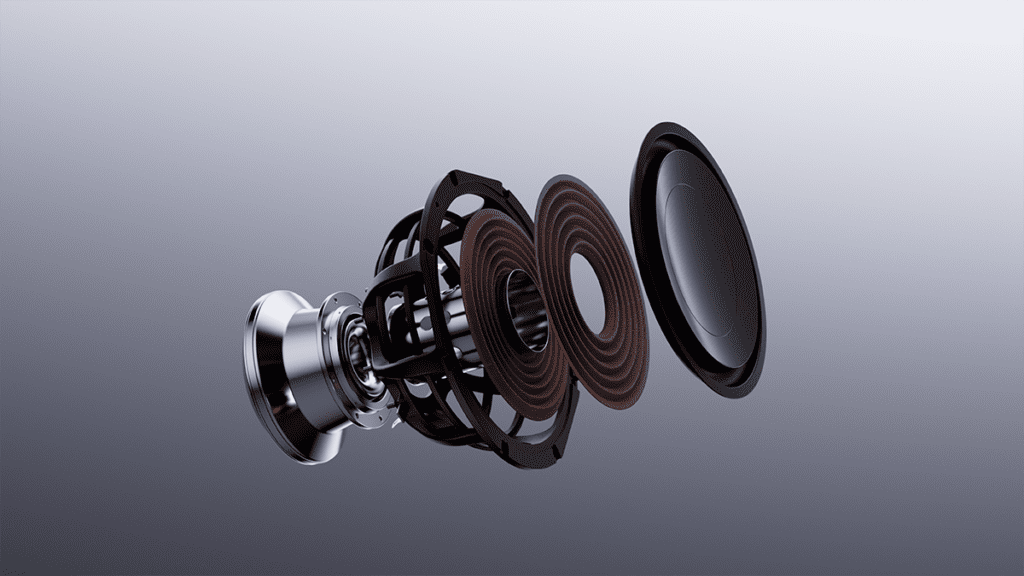
The Børresen BM3 features four 8-inch Børresen DCC8 Neo drivers with spread-tow carbon fiber diaphragms reinforced by an extremely light aramid honeycomb core. This advanced composite delivers exceptional stiffness-to-weight ratio for ultra-fast transient response and minimal distortion. Paired with high-performance neodymium motors and double copper caps, the drivers produce deep, articulate bass with remarkable clarity, speed, and authority.

A HEART THAT SETS THE PACE

The BM3’s integrated amplifiers use the latest Pascal technology with high-speed UMAC switching modulation. With lower noise, reduced filtering requirements, and minimal output impedance, it delivers precise control over the four drivers, ensuring dynamic, accurate, and high-resolution bass performance across the full frequency range.

CROSSOVER TECHNOLOGY THAT REDEFINES BASS CONTROL

The BM3 incorporates an adjustable, fully analog low-pass crossover that integrates with virtually any loudspeaker, introducing no signal delay for perfect time alignment. It precisely filters higher frequencies so the BM3 reproduces only the intended bass range, shaping the roll-off to manage transitions, reduce overlap and distortion, and deliver tight, accurate, and seamlessly controlled low-end performance with enhanced overall clarity.

MSRP (Prices may vary by market):
Børresen BM3 € 18.000

Specifications

Børresen BM3

LINE INPUT
Maximum input 9V RMS (mono) or 4.5V RMS (stereo)
Input impedance 10kohm

VOLUME CONTROL
56 0.5dB steps

NOISE REDUCTION
Active Tesla Coils: 36
Active Square Tesla Coils: 72
Dither circuitry: 3
Anti Areal Resonance Coils: 3

POWER CONSUMPTION
Standby: <1W
Idle: <30W

INPUT VOLTAGE
100–240 V
Max current 10 A

ENCLOSURE IP RATING
IP20

DIMENSIONS
Height: 585 mm | Width: 399 mm | Depth: 429 mm
Height: 23.03 in | Width: 15.71 in | Depth: 16.89 in

WEIGHT
46,4 kg / 102.3 lbs

FREQUENCY RESPONSE
20 Hz – 120 Hz

INPUT IMPEDANCE
10kΩ

DRIVERS
4 × Børresen DCC8 Neo

FINISH
High gloss black w. carbon details

For more information, please contact:
[email protected]
audiogroupdenmark.com

2026 Awards – Phono Stage Under £5k

Welcome to a very special hi-fi+ Awards. Fate (and producing a dozen issues a year) has colluded to make this issue a combination of our 250th edition and our annual Awards special edition. We have scoured the last 12 months of issues to find the best products we’ve seen across a range of categories.

In the past, we had very fixed categories for our annual awards, but that doesn’t fully reflect the current shape of the audio industry. While some categories remain constant, others change and branch out into new avenues. For example, a few years ago, there were so few streaming integrated amplifiers that the category did not need to exist. Now, we have enough to make them distinctly different from integrated amplifiers, without the need for a streamer or DAC. It’s not that one has eclipsed the other; it’s not that one is obsolete and the other state-of-the-art. These are now two divergent lines of ‘integrated amplifier’ that demand their own Awards. To lump them all together as ‘integrated amplifiers’ does the reader no favours, as it adds to confusion rather than pointing out the best we’ve tested.

Similarly, we have sometimes found categories where new products were commonplace a few years ago have reached a zenith. Thus, the category hasn’t received as many new products this year. Portable Audio DACs are a fine example. There are doubtless new models coming soon, but there aren’t enough yet for us to choose an example this year.

Each year we say this, but it’s worth repeating. The best in each category may or may not combine to build the best systems. There have been many cases over the years of people buying an Award-winning source, amplifier, and loudspeakers only to find the pairing a sonic mismatch. Our view of our awards is that they are a finger pointing the way. That finger often points to a good dealer who can assemble a system around that component, blending it with other devices like a master cocktail mixologist.

This is also why we include Highly Commended products. Not everyone likes the same things, and not every component works beautifully with every other. Our Highly Commended products are the result of the audio world being so good at its job, picking the very best from the already excellent is sometimes a very nuanced decision. By including Highly Commended products, we introduce a wider selection of outstanding devices to your next shortlist.

Awards and celebrations

Combining this Awards issue with our 250th also means we get to think about past masters in audio. There’s an interesting question surrounding the best of the past with today’s finest products. How do they compare? I think in many respects, the outstanding products this year are as good as we can get at the moment. They hold no comparison with even the finest past glories of 26 years ago; things have moved so far forward.

Sonically speaking, the very best in digital audio today leaves everything from even five years ago in the dust, so looking back to the last century is almost not worth it. And while things might seem less clear-cut in other aspects of audio design, I still maintain that today’s audio outperforms nearly everything from the 1990s, and today’s best is the best you’ll ever hear. Hopefully, that trend continues, and the sound of good audio in five or ten years keeps getting better.

We’re still a long way from achieving sonic realism in the home, and even the best audio systems cannot fully replicate the whole live experience. But they get ever closer; the top-end has the drama, scale, detail and dynamics to take your breath away, but even the most affordable audio gets closer than ever now!

One thing is sure: your next hi-fi product is on the following pages of this magazine! I hope you enjoy the search for the best as much as we did.

2026 Awards – DACs over £10k

Welcome to a very special hi-fi+ Awards. Fate (and producing a dozen issues a year) has colluded to make this issue a combination of our 250th edition and our annual Awards special edition. We have scoured the last 12 months of issues to find the best products we’ve seen across a range of categories.

In the past, we had very fixed categories for our annual awards, but that doesn’t fully reflect the current shape of the audio industry. While some categories remain constant, others change and branch out into new avenues. For example, a few years ago, there were so few streaming integrated amplifiers that the category did not need to exist. Now, we have enough to make them distinctly different from integrated amplifiers, without the need for a streamer or DAC. It’s not that one has eclipsed the other; it’s not that one is obsolete and the other state-of-the-art. These are now two divergent lines of ‘integrated amplifier’ that demand their own Awards. To lump them all together as ‘integrated amplifiers’ does the reader no favours, as it adds to confusion rather than pointing out the best we’ve tested.

Similarly, we have sometimes found categories where new products were commonplace a few years ago have reached a zenith. Thus, the category hasn’t received as many new products this year. Portable Audio DACs are a fine example. There are doubtless new models coming soon, but there aren’t enough yet for us to choose an example this year.

Each year we say this, but it’s worth repeating. The best in each category may or may not combine to build the best systems. There have been many cases over the years of people buying an Award-winning source, amplifier, and loudspeakers only to find the pairing a sonic mismatch. Our view of our awards is that they are a finger pointing the way. That finger often points to a good dealer who can assemble a system around that component, blending it with other devices like a master cocktail mixologist.

This is also why we include Highly Commended products. Not everyone likes the same things, and not every component works beautifully with every other. Our Highly Commended products are the result of the audio world being so good at its job, picking the very best from the already excellent is sometimes a very nuanced decision. By including Highly Commended products, we introduce a wider selection of outstanding devices to your next shortlist.

Awards and celebrations

Combining this Awards issue with our 250th also means we get to think about past masters in audio. There’s an interesting question surrounding the best of the past with today’s finest products. How do they compare? I think in many respects, the outstanding products this year are as good as we can get at the moment. They hold no comparison with even the finest past glories of 26 years ago; things have moved so far forward.

Sonically speaking, the very best in digital audio today leaves everything from even five years ago in the dust, so looking back to the last century is almost not worth it. And while things might seem less clear-cut in other aspects of audio design, I still maintain that today’s audio outperforms nearly everything from the 1990s, and today’s best is the best you’ll ever hear. Hopefully, that trend continues, and the sound of good audio in five or ten years keeps getting better.

We’re still a long way from achieving sonic realism in the home, and even the best audio systems cannot fully replicate the whole live experience. But they get ever closer; the top-end has the drama, scale, detail and dynamics to take your breath away, but even the most affordable audio gets closer than ever now!

One thing is sure: your next hi-fi product is on the following pages of this magazine! I hope you enjoy the search for the best as much as we did.

Tech Talk: Stephen Cosh of Audio Origami

Audio Origami is one of the UK’s hidden audio gems. Stephen Cosh is an expert engineer in his own right and has been quietly making a range of vinyl-centric audio products for decades. The company is best known for its tonearms, a modern derivation of the evergreen Sphinx arm. Its sister brand, J7 Rewires, is famous for its ability to repair, rewire and refurbish all makes of tonearm.

We caught up with Stephen recently and asked him about his company, what goes into making a high-performance tonearm, and more…

Tell us a little about yourself!

We’re a 20-year-old tonearm manufacturer, also producing tonearm cables, bespoke turntable isolation systems, and custom hi-fi racks.

How did the PU8 come about?

The PU8 Reference tonearm resulted from two years of dedicated research into armtube damping, initially aimed at enhancing our PU7. Most tonearms utilise bare aluminium, titanium, or carbon-fibre tubes, all of which transmit ground, airborne, and groove-induced vibrations. After thoroughly studying these behaviours, we devised a repeatable, high-precision method for manufacturing a constrained-layer armtube: an outer carbon-fibre tube bonded to an inner aluminium tube with a specialised damping resin. This construction is considerably more resistant to vibration.

We then re-engineered our Meta Material Arm Damping System (M.M.A.D.S.) to function within this new tube. It provides additional damping and supports the internal wiring to reduce resonance and RF interference.

Because the armtube marked a significant advancement, we designed a completely new baseplate and gimbal to complement it. Both parts are machined from stainless steel and polished to a mirror finish.

When did development for PU8 begin?

Development started in late 2023 and finished with the PU8’s launch in 2025. The longer timeline shows our dedication to making every part (except the Japanese-made bearings) entirely in Scotland.

What challenges did you face in producing the PU8?

The most challenging aspect of production is achieving consistent quality in the constrained-layer armtube. Each one is handcrafted and takes about four hours if everything goes smoothly. Polishing the stainless-steel parts is equally labour-intensive, but the flawless finish is one of the first things customers comment on; photographs never quite capture it.

What are the tonearm’s strengths?

The PU8 Reference is our flagship tonearm. It provides exceptional stability, very low noise, and excellent tracking performance. Designed to safeguard the cartridge’s signal from groove to cable, it easily surpasses many tonearms priced two to three times higher. 

Manufacturer

Audio Origami

audio-origami.co.uk

+44(0)7894 945 787

Read more Audio Origami reviews here

Back to Reviews

Audio Origami PU8

Turntables are the last remnant of how hi-fi used to be. Speakers were once a combination of drivers you selected. These were placed in a cabinet you either specified or built. Even further back, your amplifier came as a set of parts in a box that you assembled yourself. And you did this with specific components of your choosing. Over time, this has evolved to the point where most components arrive as finished products, complete with warranties and better packaging. Now, turntables are starting to shift in this direction, too. But… well… if you prefer, you can still select your deck, arm, and cartridge individually as a nod to the old ways.

For those who adopt this approach, Audio Origami has been delivering compelling solutions for the arm section for over a decade. The PU7 has been a great success and has become a highly regarded option. This prompted the company to develop the basic design into the PU8, while also upgrading the PU7 to ‘GTS’ standard. Like the PU7, the PU8 traces its roots back to the Syrinx PU2 tonearm from the late seventies. However, just as disassembling a new Porsche 911 Turbo S won’t reveal many VW Beetle parts, the PU8 should be considered ‘inspired by’ rather than ‘based on’ the Syrinx arm.

Two arms, both alike in gimbal

The PU8 is a gimbal tonearm available in effective lengths ranging from 9” to 14”. Most choose 9” and 12” arms. The first major modification involves the metal bearing surround. High-grade stainless steel is used in the gimbal, pillars and mount. This increases mass in areas that do not alter the effective arm mass. However, they significantly improve resonance damping. The bearing housing, situated between the armtube and the metal structure, is made of Delrin for better resonance control. This is also where an azimuth adjustment is fitted, allowing the armtube to be gently rotated. 

The armtube itself is made of a composite of carbon and aluminium, with an aluminium tube encased in a carbon fibre outer layer. This design is both stiff and lightweight, while reducing resonances that could affect an armtube made from a single material.

M.M.A.D.S. world

Inside the tube, Audio Origami has used the latest version of their M.M.A.D.S (Meta Material Armtube Damping System). M.M.A.D.S isolates internal vibrations by floating the internal wiring and decreasing any remaining armtube resonance. The headshell is aluminium and includes an integrated Cartridge Enhancer, which the company also sells separately. The internal wiring comprises Cardas Clear cables that terminate in a five-pin mini-DIN connector, allowing the use of balanced cables if desired. 

Also new for the PU8 is a revised anti-skate system. A bar on the left-hand side of the bearing housing acts against a rotating bar and weight assembly. The weight can be moved relative to the rotating point to adjust the resistance. This is an admirable improvement over line and weight systems because there is little mechanical contact at work and the system can’t snag or do anything else untoward. I also like that the PU8 ships with two different counterweights (one for heavier carts), which can be adjusted very accurately on a threaded stub.

Meticulous concern

In fact, everything about the PU8 reflects a high level of meticulousness and concern for its appearance and feel. It can be used with either Rega or Linn fittings, and the Rega sleeve supplied, which was designed to fit the GyroDec armboard, fits perfectly and allows for very precise VTA adjustment within the sleeve itself. The headshell is spacious and easy to handle, and I appreciate that Audio Origami has joined the growing list of companies that supply thumb bolts for cartridge attachment, recognising that very few people are born with three arms. You also receive some useful tools in the box along with documentation written by humans for humans. No tonearm is ever going to be entirely easy to fit, but Audio Origami comes closer than most.

And once it’s fitted, you can enjoy a truly beautiful piece of engineering. The PU8 is elegant and visually appealing, mainly because it lacks any fiddly protrusions or anything that seems poorly done. In fact, the whole device feels more polished and better finished than you might expect from a relatively small company’s product. 

Having installed the PU8 on the resident Michell GyroDec, I used the same Van den Hul DDTII cartridge that normally resides at the end of an SME309 on the Michell. The relatively light tracking force and high compliance design of these cartridges can pose a challenge for some arms, and Audio Origami themselves describe the PU8 as being intended for medium and low compliance designs, so I was unsure how this would turn out.

Rising silence

I needn’t have worried. The opening of Kessoncoda’s Outerstate [Gondwana] rises from silence to a fairly lively level in about a minute, demonstrating that the PU8 has not affected the Gyro’s very low noise floor. It also shows there’s no problem for the DDTII to handle the dynamic moments smoothly. More than that, the PU8 acts just like an extension of Van den Hul’s qualities. It provides a tonal realism and musical fluency that keep you utterly focused on the music. And not the hardware producing it.

Request the livelier IV by Black Mountain [Jagjaguwar], and the PU8 offers an impressive balance, capturing the grit and impact of this seventies homage without losing that effortless sense of smoothness. At my most critical, I don’t believe the deep bass extension from this setup is as profound as what the SME can achieve in similar conditions, but I never feel there’s a lack of bass, and the clarity and precision it provides are superior. The SME also cannot match the airiness and palpable three-dimensionality that the PU8 delivers, even on this relatively dense, congested track.  

I’ve also discovered that the articulation and agility provided ensure that even very fast-paced material is delivered in a way that imparts a sense of order and coherence to the music without compromising speed or the raw impact. Listen to Frontier by Dead Can Dance [4AD]. The effect is swirling and relentless as Perry and Gerrard intended. However, there is a clear sense of order and cohesion to the music that highlights Gerrard’s soaring vocals over the tribal drumming. At no point does it feel like the music is being deconstructed. Rather, it is delivered in a way that significantly delays—and sometimes completely eliminates—any feeling of congestion.

Into the Mystic

Tests using a Vertere Mystic moving coil cartridge, which has tracking force and compliance more consistent with most commercial models, show that the PU8 maintains its qualities just as with the Van den Hul. Listening to the eponymous album by The Olympians [Daptone] reveals that the Audio Origami effortlessly adopts Vertere’s behavioural traits. While some of the lushness of the DDTII is reduced, there is a regain in bass depth. The ongoing impression is that no mechanical processes influence the sound becomes even stronger. Furthermore, since both cartridges balanced easily with the smaller counterweight, it suggests that quite substantial weights can be used with the larger one attached.

Of course, with an asking price two rounds of drinks below six grand, you would expect the PU8 to be good. And there are unquestionably some very talented options currently vying for your attention. What has won me over about the PU8 is its simple operation. There’s also a strong sense of quality that arises from interacting with it. At a time when the market sees the return of extremely complex solutions to questions of geometry and tracking errors, the PU8 reminds us of the effectiveness of the ‘basics’ when executed to a high standard. For those looking to build a turntable that precisely meets their needs, this effortlessly capable design will be a very strong contender. 

Learn more about Audio Origami

Technical specifications

  • Tonearm Type: Modern Gimbal
  • Effective Length: 9 inches (as tested)
  • Effective Mass: 15g
  • Mount: Rega / Linn
  • Base: Stainless Steel
  • Armtube: Composite Carbon Alloy
  • Headshell: Aluminium
  • Gimbal Housing: Delrin
  • VTA: Adjustable
  • Azimuth: Adjustable
  • Anti-Skate: Adjustable
  • Damping: Meta Material
  • Internal Wiring: Cardas Clear
  • External Wiring: Zavfino 5-Pin DIN
  • Counterweight: Threaded Steel
  • Colour: Silver and Black
  • Price: £5,950, €7,590, $6,900 (9 inch) £6,350, €8,090, $7,495 (12 inch)

Manufacturer

Audio Origami 

audio-origami.co.uk

+44(0)7894 945 787

Read more Audio Origami reviews here

Back to Reviews

Bowers & Wilkins introduces the exquisite 707 Prestige Edition loudspeaker

Worthing, UK, 21st January, 2026: Empowered with many of the same technologies found in the 800 Series Diamond loudspeaker range – trusted by many of the world’s most famous recording studios – the Bowers & Wilkins 700 Series brings studio sound home, offering a range of elegant, high-performance models that will suit every décor and preference.

Building on this successful range, the new 707 Prestige Edition debuts as the ultimate Bowers & Wilkins bookshelf loudspeaker. Exclusively available in Santos Gloss, its gloriously luxurious finish – created using no less than 12 layers of paint and lacquer – is inspired by the Santos Rosewood chosen for the 805 D3 Prestige Edition, one of the most desirable loudspeakers Bowers & Wilkins has made. A unique rear logo plate further celebrates the elevated status of the new model, while FS-700 S3 floorstands in black or silver finishes are also available should buyers prefer to mount their new loudspeakers on a stand.

The 707 Prestige Edition’s design builds on the proven acoustic platform of the 707 S3, which includes such key technologies as the Carbon Dome tweeter, Continuum cone mid-bass drive unit and curved baffle. To deliver an even more refined and spacious sound than the standard model, the 707 Prestige Edition adds the carefully optimised high-frequency tweeter grille mesh and upgraded, low-loss speaker terminals used in the multi-award-winning 705 S3 Signature. The result is an elegant, compact loudspeaker that is inspiring to both look at and listen to.

The new 707 Prestige Edition is available from 21st January from selected retailers for €1750 | £1550.

2026 Awards – Integrated Amplifier under £5k

Welcome to a very special hi-fi+ Awards. Fate (and producing a dozen issues a year) has colluded to make this issue a combination of our 250th edition and our annual Awards special edition. We have scoured the last 12 months of issues to find the best products we’ve seen across a range of categories.

In the past, we had very fixed categories for our annual awards, but that doesn’t fully reflect the current shape of the audio industry. While some categories remain constant, others change and branch out into new avenues. For example, a few years ago, there were so few streaming integrated amplifiers that the category did not need to exist. Now, we have enough to make them distinctly different from integrated amplifiers, without the need for a streamer or DAC. It’s not that one has eclipsed the other; it’s not that one is obsolete and the other state-of-the-art. These are now two divergent lines of ‘integrated amplifier’ that demand their own Awards. To lump them all together as ‘integrated amplifiers’ does the reader no favours, as it adds to confusion rather than pointing out the best we’ve tested.

Similarly, we have sometimes found categories where new products were commonplace a few years ago have reached a zenith. Thus, the category hasn’t received as many new products this year. Portable Audio DACs are a fine example. There are doubtless new models coming soon, but there aren’t enough yet for us to choose an example this year.

Each year we say this, but it’s worth repeating. The best in each category may or may not combine to build the best systems. There have been many cases over the years of people buying an Award-winning source, amplifier, and loudspeakers only to find the pairing a sonic mismatch. Our view of our awards is that they are a finger pointing the way. That finger often points to a good dealer who can assemble a system around that component, blending it with other devices like a master cocktail mixologist.

This is also why we include Highly Commended products. Not everyone likes the same things, and not every component works beautifully with every other. Our Highly Commended products are the result of the audio world being so good at its job, picking the very best from the already excellent is sometimes a very nuanced decision. By including Highly Commended products, we introduce a wider selection of outstanding devices to your next shortlist.

Awards and celebrations

Combining this Awards issue with our 250th also means we get to think about past masters in audio. There’s an interesting question surrounding the best of the past with today’s finest products. How do they compare? I think in many respects, the outstanding products this year are as good as we can get at the moment. They hold no comparison with even the finest past glories of 26 years ago; things have moved so far forward.

Sonically speaking, the very best in digital audio today leaves everything from even five years ago in the dust, so looking back to the last century is almost not worth it. And while things might seem less clear-cut in other aspects of audio design, I still maintain that today’s audio outperforms nearly everything from the 1990s, and today’s best is the best you’ll ever hear. Hopefully, that trend continues, and the sound of good audio in five or ten years keeps getting better.

We’re still a long way from achieving sonic realism in the home, and even the best audio systems cannot fully replicate the whole live experience. But they get ever closer; the top-end has the drama, scale, detail and dynamics to take your breath away, but even the most affordable audio gets closer than ever now!

One thing is sure: your next hi-fi product is on the following pages of this magazine! I hope you enjoy the search for the best as much as we did.

2026 Awards: Server over £25k

Welcome to a very special hi-fi+ Awards. Fate (and producing a dozen issues a year) has colluded to make this issue a combination of our 250th edition and our annual Awards special edition. We have scoured the last 12 months of issues to find the best products we’ve seen across a range of categories.

In the past, we had very fixed categories for our annual awards, but that doesn’t fully reflect the current shape of the audio industry. While some categories remain constant, others change and branch out into new avenues. For example, a few years ago, there were so few streaming integrated amplifiers that the category did not need to exist. Now, we have enough to make them distinctly different from integrated amplifiers, without the need for a streamer or DAC. It’s not that one has eclipsed the other; it’s not that one is obsolete and the other state-of-the-art. These are now two divergent lines of ‘integrated amplifier’ that demand their own Awards. To lump them all together as ‘integrated amplifiers’ does the reader no favours, as it adds to confusion rather than pointing out the best we’ve tested.

Similarly, we have sometimes found categories where new products were commonplace a few years ago have reached a zenith. Thus, the category hasn’t received as many new products this year. Portable Audio DACs are a fine example. There are doubtless new models coming soon, but there aren’t enough yet for us to choose an example this year.

Each year we say this, but it’s worth repeating. The best in each category may or may not combine to build the best systems. There have been many cases over the years of people buying an Award-winning source, amplifier, and loudspeakers only to find the pairing a sonic mismatch. Our view of our awards is that they are a finger pointing the way. That finger often points to a good dealer who can assemble a system around that component, blending it with other devices like a master cocktail mixologist.

This is also why we include Highly Commended products. Not everyone likes the same things, and not every component works beautifully with every other. Our Highly Commended products are the result of the audio world being so good at its job, picking the very best from the already excellent is sometimes a very nuanced decision. By including Highly Commended products, we introduce a wider selection of outstanding devices to your next shortlist.

Awards and celebrations

Combining this Awards issue with our 250th also means we get to think about past masters in audio. There’s an interesting question surrounding the best of the past with today’s finest products. How do they compare? I think in many respects, the outstanding products this year are as good as we can get at the moment. They hold no comparison with even the finest past glories of 26 years ago; things have moved so far forward.

Sonically speaking, the very best in digital audio today leaves everything from even five years ago in the dust, so looking back to the last century is almost not worth it. And while things might seem less clear-cut in other aspects of audio design, I still maintain that today’s audio outperforms nearly everything from the 1990s, and today’s best is the best you’ll ever hear. Hopefully, that trend continues, and the sound of good audio in five or ten years keeps getting better.

We’re still a long way from achieving sonic realism in the home, and even the best audio systems cannot fully replicate the whole live experience. But they get ever closer; the top-end has the drama, scale, detail and dynamics to take your breath away, but even the most affordable audio gets closer than ever now!

One thing is sure: your next hi-fi product is on the following pages of this magazine! I hope you enjoy the search for the best as much as we did.

Electrocompaniet ECM 1 MkII

Electrocompaniet is not the only Norwegian audio electronics company, but it is the oldest and the only one that manufactures in Norway. It was part of the same wave that saw Linn and Rega enter the market in the early seventies and has a similar international reputation, especially for its amplifiers. The company achieved this by maintaining technological competitiveness and pushing boundaries. The ECM 1 MkII is described as a DAC and music streamer, and in the latter function, it truly excels.

I was encouraged to try the ECM 1 MkII by Rich Trussel at Network Acoustics, who is always searching for better streaming sources to test his filters and cables. He was particularly impressed with the sound of this Electrocompaniet and emphasised that it operates on proprietary control software. Few companies of this scale develop their own playback apps because it’s time-consuming and consequently costly. It’s much easier to base the software on an existing app, like mConnect. However, Electrocompaniet has a proven track record in streaming; they were the first to integrate Qobuz into their Linux-based software in 2015, and their team in Leeds has been advancing the technology ever since.

Don’t judge a book…

The ECM 1 MkII is a substantial piece of kit. At 470mm wide, it’s too big to fit into one of my racks, but fortunately, it’s not particularly tall. The front panel is straightforward, with just the standby button in the centre and scrolling controls on the right. In practise, you don’t need to use the latter because most of what needs to be done is on the app, and the rest is on the small remote handset. The rear panel isn’t much busier, featuring analogue outputs in the usual form, digital inputs limited to coaxial and optical varieties, and streaming connections that provide a USB port for a separate drive, RJ45 for networking, and a coaxial digital output. There are also trigger connections, should they be of use.

I was surprised not to find more digital inputs/outputs. An AES or USB digital output, for instance, would have been handy. However, this is designed to be a standalone unit that can upgrade sound from sources such as CD players, which generally only have coax or optical outputs. The ECM 1 MkII’s analogue outputs can be volume-controlled for direct connection to a power amp or active speakers.

The DAC onboard does not seem to have been chosen solely for its specifications, which is encouraging. Sample rates are limited to 24-bit/192kHz, adequate for all but a few audiophile releases, but below rates typically found elsewhere, which are often twice this on the sample front. Regarding streaming services, it is current with Spotify, Tidal Connect, Airplay 2, Roon Readiness, and Bluetooth receptivity. Less common is Audirvana readiness, should you prefer the French Roon competitor. Of course, my preferred music service, Qobuz, does not yet offer a Connect option.

The control effect

The EC Play control app may not be the sleekest available in terms of design or Qobuz integration, but it likely sacrifices features to enhance sound quality. It is becoming increasingly evident that control apps significantly influence performance, with some third-party examples improving the sound of streamers through their well-designed applications. 

Dealers or end users can install an internal drive on the ECM 1 MkII. Since my sample was not equipped with one, I connected a Melco N10 music library and had EC Play scan its contents. Given that it’s a fairly well-stocked device, this process can take some time, but in this instance, it was particularly slow. Fortunately, this isn’t something you’ll need to do very often, and updating for added albums shouldn’t take too long.

The ECM 1 MkII didn’t respond very positively to the way metadata was stored in many of my music files, often listing the tracks without duration before correcting them. I didn’t investigate this further but suspect it might relate to the Metadatics software I use. Everything on Qobuz functioned as expected. I appreciate how it displays the bit rate of the files being played, regardless of their source. Most systems show the 16/44 bit sample rate but omit the kbps, which indicates the degree of compression or lack thereof for any given music file.

Listen to the music

This Electrocompaniet is an uncannily musical streamer. It hooks you in regardless of whether you are paying attention and makes the music more engaging and fun than most. By this, I mean that you can play relatively complex material while concentrating on something else, and it doesn’t grate. It makes clear what’s appealing about the music by delivering it in unusually coherent form, something that is surprisingly hard for streamers to do, especially with material streamed from the internet à la Qobuz. 

The detail levels provided are impressive for the price point, though they don’t break any records. You can easily hear into each piece and separate the different elements in a band or orchestra; however, more expensive options can deliver a more refined rendition. The ECM 1 MkII also tracks dynamics well, suggesting that the perceived signal-to-noise ratio is wide. In musical terms, this means that when the band kicks in behind a quiet intro, you really notice it. 

This is evident in Bill Frisell’s version of ‘Shenandoah’ (East/West), which showcases the fabulous effect of his solo guitar being expanded by bass and drums to create a substantial soundstage in all three dimensions. Scale is rendered quite well, as demonstrated by Stevie Ray Vaughan’s ‘Lenny, ‘ where the playing is beautiful and the sound is substantial due to its three-dimensionality and bass weight.

Timing is crucial to all of Electrocompaniet’s qualities; only when everything happens precisely as it should do you experience this level of scale, impact and engagement. It would be intriguing to compare the ECM 1 MkII with a Naim streamer at the same price; an NSC 222 would likely be the model to beat, as while it’s more expensive, it offers greater connectivity. I suspect it would be a close call, thanks to the ECM 1 MkII’s wide range of qualities. 

This streamer doesn’t emphasise any particular aspect of the music but paints a substantial and detailed aural picture that you’ll want to keep experiencing. The focus and timing revealed in Keith Jarrett and co’s The Old Country (More from the Deer Head Inn) are inspiring; here, every piece draws the listener in and captivates them. ‘I Fall in Love too Easily’ resonated with me a little more than usual; it sounds absolutely beautiful. I doubt that even Bill Evans could do a better job.

No blur (or Oasis)

On the opening track, ‘Into You,’ from MYT’s eponymous debut, the speed at which this streamer delivers the drums is thrilling. It’s unusual to experience this sense of immediacy with digital sources because they tend to blur leading and trailing edges. The Electrocompaniet does a remarkable job of avoiding this, which helps give the music a more dynamic kick without sacrificing fluency or adding unnatural attack. 

I noticed that the version of Ryley Walker’s Golden Sings That Have Been Sung was coming through at half the bit rate of the original CD, 755 kbps, but this didn’t stop the album from sounding particularly good. The way that guitar and piano interplay on ‘Funny Thing She Said’ is superb, if not quite as sweet as what I hear with the vinyl, and this might improve with a higher-quality file, though vinyl does have other advantages.

By developing the EC Play app, Electrocompaniet has given the ECM 1 MkII a clear advantage. However, it is also a well-thought-out and executed piece of hardware; you can’t make a streamer great with software alone. I suspect that with a drive installed onboard and filled with quality rips and downloads, this streamer will deliver a result that will charm the majority of those who hear it. It possesses the ability to engage both heart and mind, drawing the listener in and revealing what’s magical about the music, which is quite an achievement for any piece of equipment. Add to this the solid build quality and Electrocompaniet’s heritage, and you have a streamer that should be on anyone’s must-hear list. 

Technical specifications

  • Type: Solid-state network streamer, DAC, digital preamplifier.
  • Analogue Inputs: none.
  • Digital Inputs: Two coaxial S/PDIF (via RCA jacks), two TOSLink, RJ45 ethernet.
  • DAC Resolution/Supported Digital Formats: FLAC/WAV/MP3, etc. Sampling rate for D/A conversion 192kHz/24 bit.
  • Music services/Wi-Fi inputs: Spotify Connect, Bluetooth, Airplay 2, Qobuz, Audirvana, Tidal Connect, Roon Ready, Bluetooth, internet radio
  • Analogue Outputs: One stereo balanced (via XLR connectors), one stereo unbalanced (via RCA jacks).
  • Digital Outputs: One coaxial S/PDIF (via RCA jack).
  • Frequency Response: 05 – 48kHz.
  • Distortion (THD + Noise): 0.0005%.
  • User Interface: Display (on main unit), EC Play application software for iOS, Android.
  • Dimensions (HxWxD): 80 x 470 x 381mm
  • Weight: 8.3kg
  • Price: £5,249, $5,700, €5,249

Manufacturer

Electrocompaniet AS

electrocompaniet.com

+47 51 74 10 33

UK distributor

Elite Audio UK

eliteaudiouk.com

0800 464 7274 (UK only)

More from Electrocompaniet

Back to Reviews