Not so long ago, the notion of isolating loudspeakers by decoupling them from the floor was anathema to the hi-fi fraternity. In the 1980s, we were told in very clear terms that the only way to get the best out of our loudspeakers was to fit them with spikes and push those spikes well into the floor, often through a carpet. This was also referred to as isolation. It’s to our shame that we accepted it as such for so long.
Nothing about nailing the speaker to the floor is isolating. Instead, it does the exact opposite, making a strong connection between the floor and the speaker. This changes the sound for sure. It allows energy to travel from the speaker to the floor and back. In fact, energy produced by one speaker travels to the other and back again. Depending on the floor’s material and rigidity, the energy’s frequency varies. Still, even the hardest floors transmit vibration.
Three parts
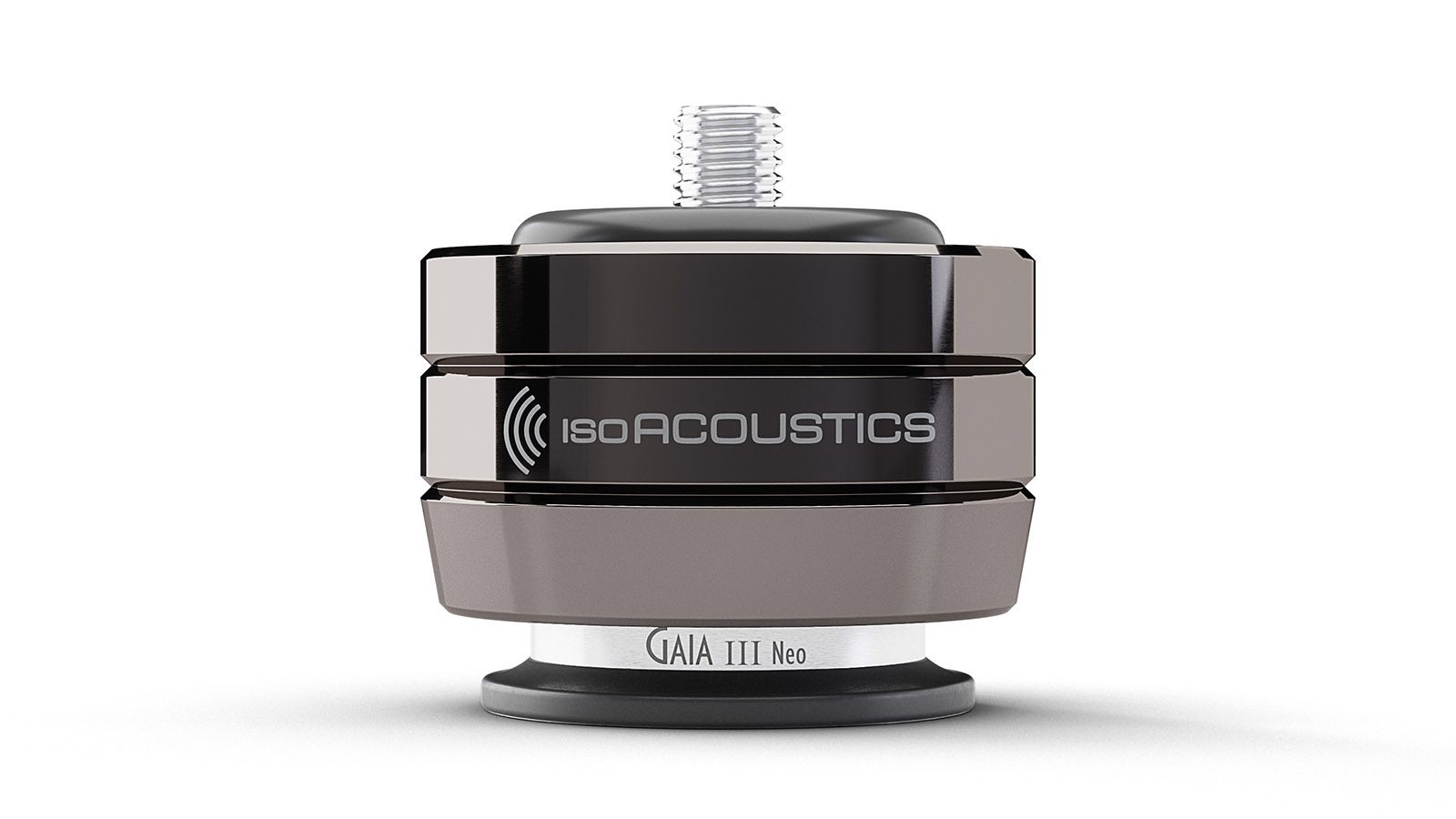
IsoAcoustics Gaia III isolators consist of three parts: a top isolator, a bottom isolator, and a connector. Their performance stems from how these components work together, as well as the shape and characteristics of the materials used. Important factors include: durometer (hardness), viscoelastic properties, material thickness, and geometry.
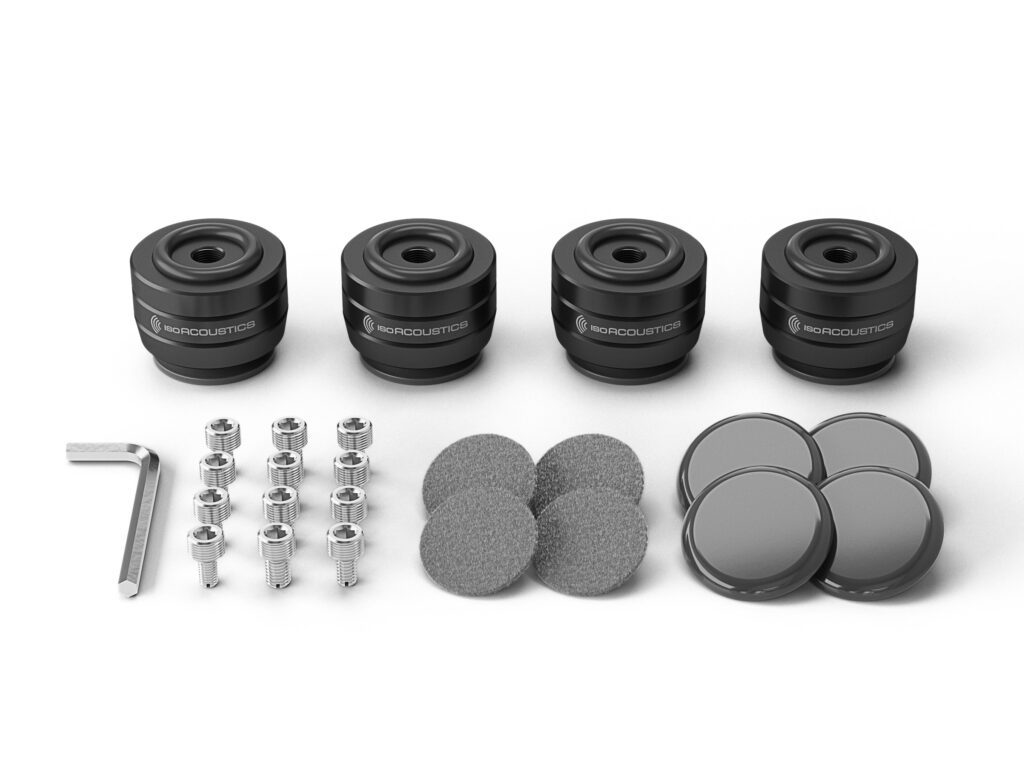
The top isolator attaches to the bottom of the speaker using threaded adapters, while the bottom isolator connects to the supporting surface. A slight concave shape on the bottom creates a gentle suction effect on smooth surfaces. As a result, there is a secure and stable connection. The isolators are made from a resilient elastomer that leaves no residue and maintains consistent performance over time. These isolators are finished in a choice of ‘Dark Chrome’ (pictured at the top of the page) or semi-matt ‘ElectroBlack’ (below).
IsoAcoustics isolators are tuned with a bias in the on-axis direction and stiffened laterally to maintain focus. Unlike uniform materials or springs that allow movement in multiple directions, the Gaia isolators control energy flow to remain on-axis.
Universal appeal
The benefits of speaker isolation are easy to hear, and many enlightened enthusiasts have ditched spikes in favour of it. Even though the systems that provide real isolation are often unattractive and can be expensive, IsoAcoustics has been tackling these issues for some time now with their Gaia feet. Now, they have a new or Neo version that looks very smart in dark chrome or black. It also aims to provide better isolation. The clever thing about the IsoAcoustics feet is that they can be screwed into any loudspeaker and only raise it slightly more than the spikes they usually replace. Furthermore, they look good and don’t cost a fortune.
IsoAcoustics Gaia feet are sold for specific weight ranges, as isolation is possible only when the spring is balanced against the weight it is trying to isolate. If the spring is too stiff for the weight, it will transmit energy. The number in the name Gaia III Neo indicates that it suits speakers weighing 32kg or less. This is the lightest range available. Performance only drops off when the weight level is exceeded. So using the Gaia III with lighter loudspeakers doesn’t undermine performance. The Gaia II Neo is for speakers up to 55kg. Lastly, the I Neo takes this up to 100kg.
Alignment
The Neo feet allow height adjustment of up to 8.5mm to cope with uneven floors. You align the feet so the branding is at the front to ensure the lateral resistance is most effective. They are supplied with cups that allow a speaker to be easily moved around on either hard or soft floors.
Fitting the Neo feet is a fairly straightforward process. You fix a stud to the base of the speaker or stand, then screw the foot onto it. This allows IsoAcoustics to provide several insert thread sizes in each set of four feet. It is a bit like including mains plug alternatives with wall-wart supplies. It took me about ten minutes to fit them to a pair of PMC prophecy9 speakers, making it fairly easy to do an A/B comparison of the Neo feet. I don’t use spikes for the reasons mentioned earlier. However, I have conical plastic feet on threaded studs that allow easy movement and raise the speakers by 20mm. The Gaia Neo III raises them twice as high. This will have a small bearing on the bass response. However, as many rooms have problems with excess bass, that is unlikely to be an issue for most users.
Not subtle
The effect these feet had on the prophecies was not subtle. The sound became more relaxed, and there was clearly more detail coming through, with aspects of reverb and harmonic clues that didn’t seem to be there with the regular feet. The Gaia III Neos provide enough isolation for the drive units to deliver finer detail, as cabinet vibration is reduced, if that’s the right term. A firmer foot will allow energy to travel into and out of the box. So isolation means that any vibration the drivers induce in the cabinet is less able to escape through the floor. But the benefit in overall resolution suggests that what the isolation is keeping out is more significant in the scheme of things. Therefore, it is worth avoiding if possible.
I found that these feet made the sound easier and perhaps slightly softer. This could be because the tweeter was raised by another 20mm. However, I am inclined to think that it’s the removal of energy around the driver itself that allows it to operate in a more linear fashion. As a result, it sounds less hard-edged. Overall, the smoother presentation does not undermine timing nor perceived bass power, which can only be a good thing.
As a firm advocate of component isolation, I can only laud what IsoAcoustics have done with the Gaia III Neo feet. They let you hear more of what’s going on in the recording, yet don’t undermine impulse response. That is, the timing remains as good as it was. Add to this the high quality and finish of these feet, for a very good price. I’d say we have a winner.
Technical specifications
- Type: Loudspeaker isolation feet
- Material: Metal alloy with chrome-plated finish plus proprietary materials
- Thread options: ¼”-20, M6-1.0, M8-1.25
- Speaker weight range: up to 32kg.
- Includes: felt pads, floor sliders, compression washers, Allen key
- Height adjustment: 8.5mm
- Dimensions (Height x Diameter): 4.5 x 5.6cm
- Price: £299, €299, $299.99 set of four
Manufacturer
IsoAcoustics Inc
Home Page: isoacoustics.com
Gaia Neo: isoacoustics.com/home-audio-isolation-products/gaia-series/
Where to buy: isoacoustics.com/where-to-buy-international-home-audio
UK distributor
Sound Service U.K. Limited
+44(0)3301 222500
Trending Articles
See all
By Jason Kennedy
More articles from this author

Read Next From Review
See all
Eversolo T8
- Oct 13, 2026
Acoustic Energy AE Active
- Oct 13, 2026
Reiki Audio SuperSwitch X/Pro X PSU
- Oct 06, 2026
Audiobyte SuperVOX
- Oct 06, 2026