Up to 37% in savings when you subscribe to hi-fi+
hifi-logo-footer

Begin typing your search above and press return to search. Press Esc to cancel.

CanJam at RMAF 2016 – Part 4 of 4

Part 4 of our report covers:  Onkyo, Oppo Digital, Pioneer, Questyle, RHA Audio, Rupert Neve Design, Schiit Audio, Sennheiser, Sonoma, Sony, Stereo Pravda, Ultrasone, Unison, Wells Audio. Westone Laboratories, and ZMF.


Find Part 1 of our CanJam report here: https://hifiplus.com/articles/canjam-at-rmaf-2016-part-1-of-4/

Find Part 2 of our CanJam report here: https://hifiplus.com/articles/canjam-at-rmaf-2016-part-2-of-4/

Find Part 3 of our CanJam report here: https://hifiplus.com/articles/canjam-at-rmaf-2016-part-3-of-4/


Onkyo
Over the past year or so Onkyo’s highly capable, Android-based DP-X1 high-res digital audio player ($799) has been winning friends and influencing people through its combination of flexibility, performance, and advanced features.  Specifically, the DP-X1 supports virtually any PCM or DSD format you’d care to name, provides 32GB of built-in memory, and provides two Micro SD card slots (each slot supporting Micro SD cards of up to 200GB capacity). Moreover, the DP-X1 provides MQA decoding and incorporates dual DACs in support of the DAP’s balanced preamp/headphone outputs. The Onkyo’s user interface is remarkably flexible, aesthetically pleasing, and straightforward to use, too.

www.onkyo.com

Oppo Digital

Oppo Digital showed a range of products that took different approaches to the notion of personal audio.

First up was the Oppo HA2-SE high-res portable headphone amp/DAC ($299) which provides PCM decoding at sampling rates up to 384kHz and that also decodes DSD files at resolutions up to DSD256. The HA2SE is Apple/Android/PC/Mac compatible, incorporates an ESS Sabre32 Reference ES9028-Q2M DAC device, and can even be used to charge mobile devices on the go.
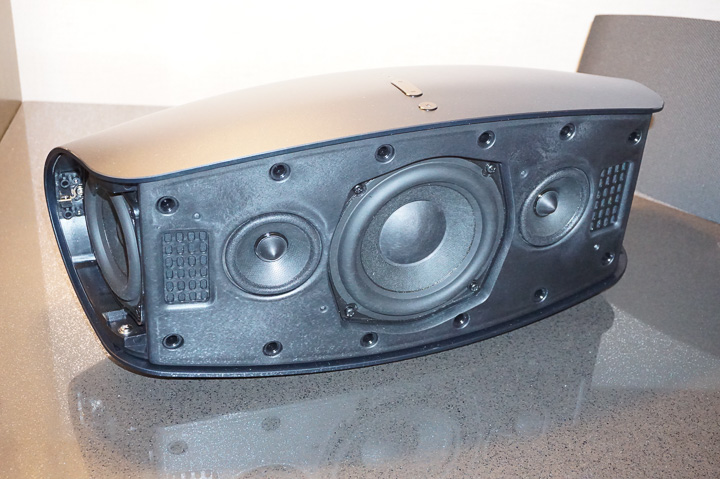
Next, Oppo showed its cool new Sonica Wi-Fi/Bluetooth speaker system ($299), which features one 3.5-inch long displacement bass driver, two 3-inch balanced bass radiators, and two 2.5-inch wideband drivers with Neodymium magnets. The Sonica is compatible with AirPlay, Bluetooth, DLNA, Tidal, and other music playback sources. The unit can be used as a standalone 2.1-channel single-chassis speaker, or it can be configured for multi-room use, or use in setting where two Sonicas will serve as a stereo pair. Oppo promises that the Sonica can deliver “amazingly strong bass” and that it can be optimised to several different placement scenarios (for example, open room placement, or placement near walls or corners). Oppo also previewed an upcoming new larger Sonica model to be called the Sonica Grand, which will sell for about $699.

Finally, Oppo also previewed its upcoming Sonica high-res DAC/streamer (projected price, $799), which is said to offer even better audio performance than Oppo’s critically acclaimed HA-1 headphone amplifier and BDP-105 universal disc player. The Sonica DAC will be based on an ESS ES9038PRO SABRE DAC and will provide decoding for PCM files up to 32-bit/768kHz and for DSD files up to DSD256. The DAC will provide both single-ended and balanced outputs and is set up so that it can serve as both a high-res player via attached USB driver or can serve as a high-res streamer. We cant’ wait to hear it in action.

www.oppodigital.com

www.oppodigital.co.uk

Pioneer

As many Hi-Fi+ readers may already know, Pioneer and Onkyo are sister brands that from time-to-time share product concepts and topologies. So it is that Pioneer’s original XDP-100R digital audio player borrowed many—but not all—of the technical features of Onkyo’s DP-X1 player. Specifically, the XDP-100R was a single-ended only DAP that did not incorporate the Onkyo’s desirable dual DAC, dual amp, balanced output features.
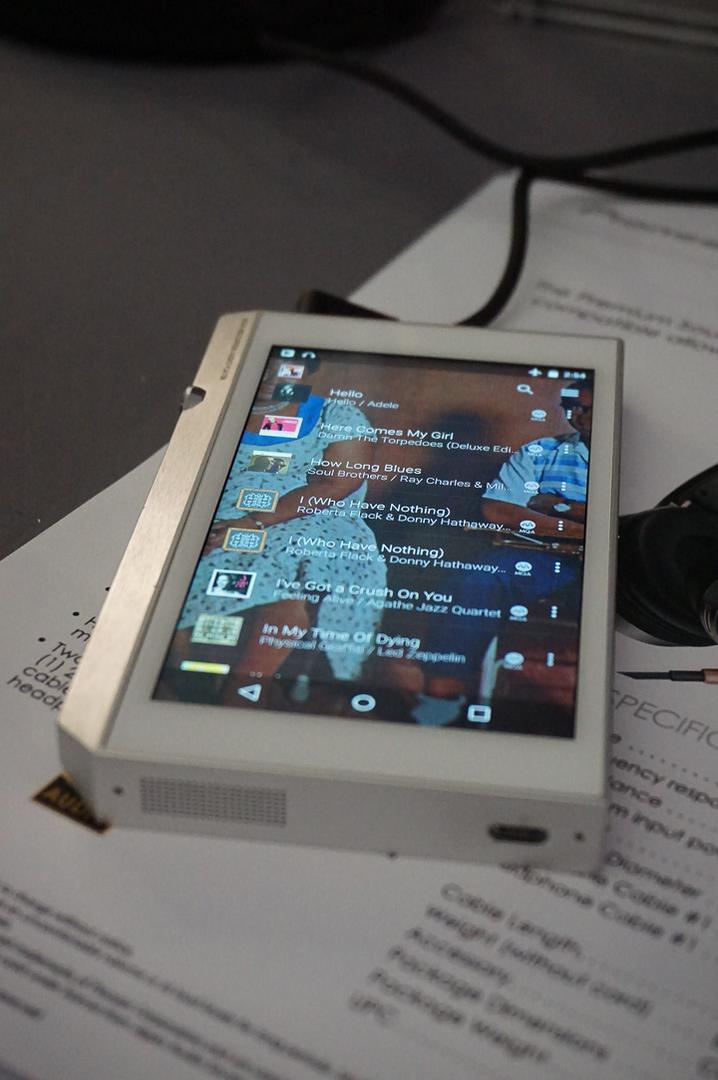
All of this is about to change with the arrival of Pioneer’s new Android-based XDP-300R DAP, which—like its Onkyo sibling—now sports dual ESS DACs and balanced outputs. The XDP-300R actually debuted at the recent Indulgence Show in London, with a promised price of £599. The DAP should sell for about $799 in the US. Visually, the XDP-300R is quite different to Onkyo’s DP-X1, so which you prefer may well be a matter of personal taste.

A tantalising offering demonstrated at the show was Pioneer’s full-size, UO-5 headphone amp/DAC—a model that is available in the UK at a recommended retail price of £699, but that is not offered in the US at all! (The reason: Pioneer did not feel it could justify the considerable expense of having the unit tested to achieve a UL-listed rating, which is an expectation of most mass-marketed consumer electronics products sold in the US.) Based on a too brief listen, I felt the versatile UO-5 offered excellent value for money, so I hope Pioneer will re-think its choice not offer the model in the US.


Finally, I got a chance to try out a very serious high-end headphone from Pioneer and one not commonly encountered apart from trade show environments: namely the SE-Master 1 ($2,500). The SE-Master 1 features a distinctive 50mm dynamic driver consisting of a 25μ-thick aluminium diaphragm with a Parker Ceramic Coating as supported by a PEEK (poly-ether-ether-ketone) film surround with ribbed edges said to help eliminate distortion. The driver was modelled extensively through computer aided engineering techniques and is said to afford superior high-resolution reproduction of low-level details in the music. This is a model that I think will definitely bear further listening in the future.

www.pioneerelectronics.com

Questyle Audio Engineering

Questyle’s two main points of emphasis for CanJam RMAF 2016 were to demonstrate the firm’s cost-no-object ‘Golden Stack’ headphone electronics suite ($12,500) as reviewed in Hi-Fi+ issue 137 and to continue the roll-out of the firm’s new CMA600i fully-balanced headphone amp/DAC ($1299). As many of our readers already know, the ‘Golden Stack’ consists of the performance-enhance Gold-edition CMA800P preamp, the CAS192D DAC, and a pair of CMA800R amplifiers used in a left/right monoblock configuration.  In turn, the CMA600i provides a high-res PCM and so-called True DSD-capable DAC, plus a fully balanced headphone amp/preamp based on Questyle’s signature CMA (current mode amplification) circuit topology. The result, says Questyle, is the finest-sounding single-chassis amp/DAC the firm presently makes. Look out  for an upcoming Hi-Fi+ review of the CMA600i, coming soon. In fact, I’ve been listening through our review sample of the CMA600i as I am writing this report and can vouch for the fact that it is a very special unit indeed.

www.questyleaudio.com


RHA Audio

The Scottish firm RHA Audio used CanJam RMAF 2016 as a springboard from which to launch three new products: the long-awaited DACAmp L1 ($550 or £399), the new CL750 universal-fit earphone ($139.95 or £99.95), and the firm’s new flagship CL1 Ceramic universal-fit earphone ($499.95 or £349.95).

The DACAmp L1 is iOS, Android, Mac, and Windows compatible and looks like a sure-fire winner. Featuring one dedicated DSC device per channel, the DACAmp L1 supports PCM decoding at up to 32-bit/384kHz resolutions as well as DSD decoding for up to 11.2MHz Quad DSD files. It is also respectably powerful  (300 mW at 16 Ohms), provides line-in, USB A, USB micro-B, and Mini-TOSLINK digital inputs, while also offering both single-ended and balanced headphone outputs. Powering it all is a 4,000mAh lithium ion battery. One of the most appealing aspects of the DACAmp L1 is its gorgeous industrial design, featuring gentle organic curves and satin finishes that make the new amp/DAC a joy to hold in your hand and to use.

The CL750 earphone could in many respects be viewed as an update on design themes established in RHA’s popular MA750 earphone, but re-cast as an earphone optimised specifically for use with amplifiers. The CL750 incorporates what RHA terms an “ultra-wideband CL Dynamic transducer” and ships with high purity OFC signal cables. One caveat, however, is that the CL750 is a very low sensitivity device as earphones go, with a sensitivity rating of just 86dB.  This is fine if you plan on using the CL750 with a DACAmp L1, but don’t even think of driving it from a smartphone (we tried and, well, let’s just not go there…).

The CL1 Ceramic is the most ambitious earphone RHA has ever created and it is a compact, dual-driver model that incorporates both RHA’s new CL Dynamic transducer coupled with a distinctive “ceramic plate transducer said to yield “high-resolution, precise audio reproductions.” Like the CL750 the CL1 Ceramic ships with OFC signal cables, but as a welcome touch the CL1 cables are fitted with detachable sMMCX cable connectors and are equipped with mouldable over-ear hooks for a more secure fit. Like the CL750, the CL1 Ceramic is a low sensitivity earphone (87dB) that is meant for use with amplifiers—not driven directly from smartphones or tablets.

www.rha.co.uk

Rupert Neve Design

The legendary British recording studio electronics designer Rupert Neve is widely thought to have created some of the most technically sophisticated and musically satisfying recording consoles ever made. Now, in response to requests from his studio clients and many others, Neve has created a very simple but simply superb sounding headphone amplifier call the RNHP, priced at $499. The rather modest-looking RNHP rejects all the usual trappings and conventions of audio bling, preferring instead to make its mark in the only way that really matters: that is, through exceptional sound quality that—in keeping with Neve tradition—offers an even-handed blend of technical excellence and musicality that just won’t quit.
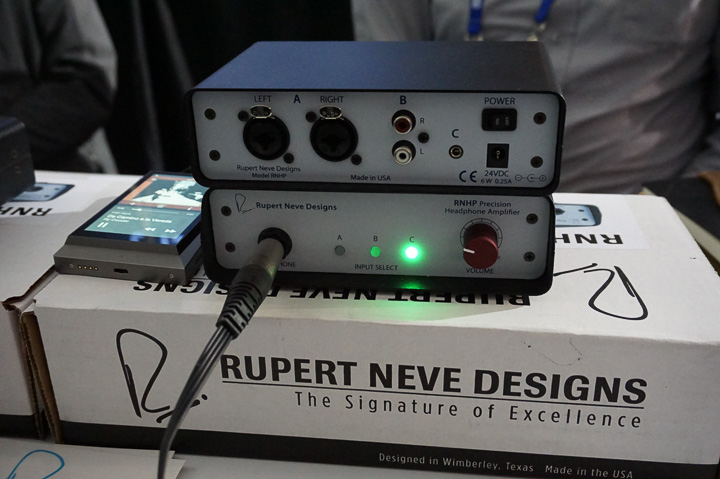
http://rupertneve.com/products/rnhp-headphone-amplifier/

Schiit Audio

For CanJam RMAF the iconoclastic California-based company Schiit Audio gave the public the US debut of the firm’s impressive new fully balanced, high-powered, low-noise Jotunheim headphone amplifier/preamp, priced at $399. But don’t let the low-ish price fool you: on a technical level the Jotunheim is as advanced as they come thanks to its distinctive Schiit Pivot Point circuit topology. Schiit bills the Jotunheim as a “configurable” headphone amp, in that it provides an internal space that can accommodate one of two optional I/O modules: a fully-balanced AK4490-based USB DAC module or a high-precision moving magnet phono stage with passive RIAA equalisation. Either module adds a modest $100 to the price of the Jotunheim so that even when fully loaded the amp still sells for a tick under $500. Watch for a review in the next issue of Hi-Fi+.

Apart from the Jotunheim, Schiit also debuted three fascinating new full-size traditional audio components that are sure to attract attention for all the right reasons (namely, high performance at sensible prices). These new products were the Saga remote passive/active preamp ($349); the Freya balanced, remote passive/active preamp ($699) with user selectable passive, JFET buffer, or valve gain operation; and the Vidar “intelligent stereo/mono power amp” ($699) with current-feedback gain stages, dual mono topology, and no capacitors or DC servos in the signal path. The Vidar puts out 2 x 100 watts RMS per channel into 8 Ohms in stereo mode, or 400 watts RMA into 8 Ohms in mono mode. Needless to say, these new models will soon do their part to help take the high cost out of high-end audio.

www.schiit.com

Sennheiser
Often Sennheiser’s trade show displays emphasize the firm’s top-tier, performance-über-alles designs, but for CanJam RMAF 2016 the firm focused attention on its newest and best wireless noise-cancelling headphone: the PXC 550 Wireless ($399.95). The PXC 550 Wireless offers sound reminiscent in some respect to Sennheiser’s own Momentum model, but is equipped with the firm’s NoiseGard hybrid adaptive noise cancellation system, plus a new ear cup-mounted touch control panel and voice prompt control system. Best of all, the PXC 550 offers up to 30 hours of battery life, meaning the headphone could conceivably offer high-quality sound for an around-the-world journey on a single charge.

en-us.sennheiser.com

en-de.sennheiser.com


Sonoma Acoustics

The northern California-based firm Sonoma Acoustics was until recently best known for its state-of-the-art DSD recording and editing system, commonly known as the Sonoma Workstation. Now, however, Sonoma has expanded in a new direction by teaming with British firm Warwick Audio Technologies Ltd. to create the spectacular new Sonoma M1 electrostatic headphone system, which will sell for $4,995 in the US and for £4,595 in the UK.

The M1 system leverages the High-Precision Electrostatic Laminate (HPEL) transducer developed by Warwick Audio Technologies, but expands upon the capabilities of the driver through a jointly developed class A electrostatic “Energizing Amplifier” that incorporates a custom 64-bit double-precision fixed-point DSP engine that manages certain aspects of the headphone’s voicing. Further, the amp also incorporates a USB DAC based on dual 32-bit ESS SABRE Reference DACs, plus an ultra high-performance, multi-channel, 32/384-capable AKM premium ADC system that is conceptually positioned upstream of the amp’s DSP system. In this way, incoming analogue signals are digitised before DSP processing and before amplified signals are finally passed on to the M1 headphones.

The M1 headphone is special too, using HPEL drivers mounted in injection-moulded magnesium ear cups that are extremely light, comfortable and fitted with Cabretta hair sheep leather ear pads and headband pads. The system ships with ultra-low capacitance signal cables and a very high-performance USB cable developed in conjunction with the cable specialist Straight Wire Inc. 

In a too brief listen, I felt Sonoma’s M1 system sounded very promising indeed, so that it is a system I look forward to exploring in more depth in the future.

www.sonomaacoustics.com

Sony

Sony’s CanJam RMAF 2016 display and demonstrations centred primarily on three Signature-series high-end offerings: the firm’s flagship NW-WM1Z high-res digital audio player ($3,199), the TA-ZH1ES balanced output desktop headphone amplifier/DAC(price?), and the top-of-the-range MDR-Z1R headphone ($2,299).

Words can scarcely begin to express the sheer beefiness and build quality of the Signature-series Walkman NW-WM1Z digital audio player, whose overall construction reminds me of a bank vault writ small. And that bank vault metaphor will come to mind again whenever you pick up the NW-WM1Z, which is a bit of chunk to hold in one’s hand. This 32/384-capable player also provides native DSD support and offers storage capacity up to 256 GB. The sound of the unit struck me as being almost microscopically detailed and exceedingly pure-sounding—very much cut from similar sonic cloth to Astell & Kern’s flagship AK380 DAP. It would very interesting, I think, to compare the two units side-by-side.

The TA-ZH1ES features a hybrid digital/analogue amplifier section offering both balanced and single-ended outputs. The sophisticated DAC section of the TA-ZH1ES is not one most listeners will soon outgrow as it can decode PCM files at resolutions up to 32-bit/768kHz and DSD files at up to 22.4MHz. And, did we mention the unit sports the sort of elegantly simple, no-nonsense good looks that we find most appealing?

The MDR-Z1R is a closed-back, dynamic driver-equipped circumaural headphone. The key to the headphone’s transparent and wide-open sound, I think, is its unusually large 70mm dome-type driver, which features, says Sony, a “responsive magnesium dome with liquid crystal polymer-edge diaphragm for clarity.” Interestingly, Sony—a firm not typically given to gratuitous specification inflation, claims the frequency response of this driver to be a stupendous 4Hz – 120kHz. Further listening is indicated.

www.sony.com


Stereo Pravda

The Russian firm Stereo Pravda (meaning “solid truth” in Russian) showed its highly unorthodox SPearphone SB-7 passive universal-fit earphone ($2,000) and the similar SPearphone SB-7A ($2,500), which is intended for use with the firm’s DACCA dedicated portable module that provides DAC, crossover network, tone control, and dual differential amplifier functions.

The SPearphone SB-7 and SB-7A both feature seven balanced armature-type drivers per earpiece, with the drivers arranged so that their sound outputs are all aligned on the same axis—a design touch said to foster superior sonic transparency, clarity, and cohesiveness. The earpiece enclosures are quite unusual, too, in that they are made of wood and are slender, relatively long, and look something like Scandinavian sculptural interpretations of a gnarled section of tree branch. The sound, however is not gnarly at all; as advertised, it’s wonderfully clear and transparent-sounding.

The DACCA module is nominally portable, but it’s certainly not a pocket-sized portable; rather, the complicated multi-function DACCA is more the sort of device you would carry in a fairly good-sized over-the-shoulder pouch. The size may be a bit cumbersome, but there’s no arguing with the fact that the DACCA really helps the SPearphone SB-7A’s to ‘sing’.

www.stereopravda.com

Ultrasone

The German firm Ultrasone had two new models of interest at the show, one in the mid-tier price range and the other solidly positioned in the cost-no-object class.

The new mid-tier model is the Performance 880, which is a closed-back, dynamic driver-equipped headphone featuring the firm’s patented S-Logic Plus technology and ULE shielding system. The Performance 880 sells for $499 and ships with a neoprene carry case, velour ear pads, and two detachable signal cables (one 3m long and the other 1.2m long).

The new over-the-top model is the Jubilee 25 limited edition headphone, designed to commemorate Ultrasone’s 25th anniversary, and of which only 250 sets will be made for worldwide distribution. The Jubilee 25 is a closed back headphone featuring Macassar ebony ear cup covers, a 40mm Mylar/Titanium driver with neodymium magnet assemblies, and that incorporates the firm’s patented S-Logic EX technology and special ULE shielding. The Jubilee 25 ships with a very high-quality aluminium travel case, a micro fibre cleaning cloth, various gold-plated adapters, and a premium 3m four-core signal cable fitted with LEMO headphone connectors.

(We apologise for using a stock photo of the Jubilee 25, but the fact is that the headphone was on site for only part of the show, so that it had been sent on before we arrived at the Ultrasone display.)
 
www.ultrasone.audio/en/

Unison Research

Many audiophiles think of the Italian firm Unison Research as a maker of amplification components (and loudspeakers) for full-sized home hi-fi systems, but at CanJam RMAF 2016 we learned that the firm also makes a lovely valve-powered integrated headphone amp/DAC called simply the SH ($1,795).

The SH uses pure class A circuitry throughout, with an input stage based on 12AX7 valves, an output stage based on dual EL84 triodes, and a power supply that features valve rectification. But for even greater flexibility, the SH also incorporates two user selectable gain settings, plus an built-in USB DAC based on the popular ESS SABRE DAC device.

www.unisonresearch.com/en/

Wells Audio

For CanJam RMAF 2016 Wells Audio showed the latest and most refined version of its flagship headphone amplifier: the Headtrip ($7,000). The Headtrip, as you might expect, is extremely powerful (50Wpc @ 8 Ohms), very quiet (SNR -103dB at full power), and essentially leaves no stone(s) unturned in its quest for unbridled performance. This amp enjoys an almost magical musical synergy when used with the Abyss AB-1266 planar magnetic headphones.

However, the even bigger news from Wells is that the firm’s new dramatically cost-reduced Milo headphone amplifier ($1,699) is now in production. In essence, the Milo represents an attempt to capture much of the magic of the firm’s Enigma and even Headtrip amplifiers and to do so without giving up too much in the way of performance specifications, but at a far more accessible price point. Besides, the Milo just plain looks cool!
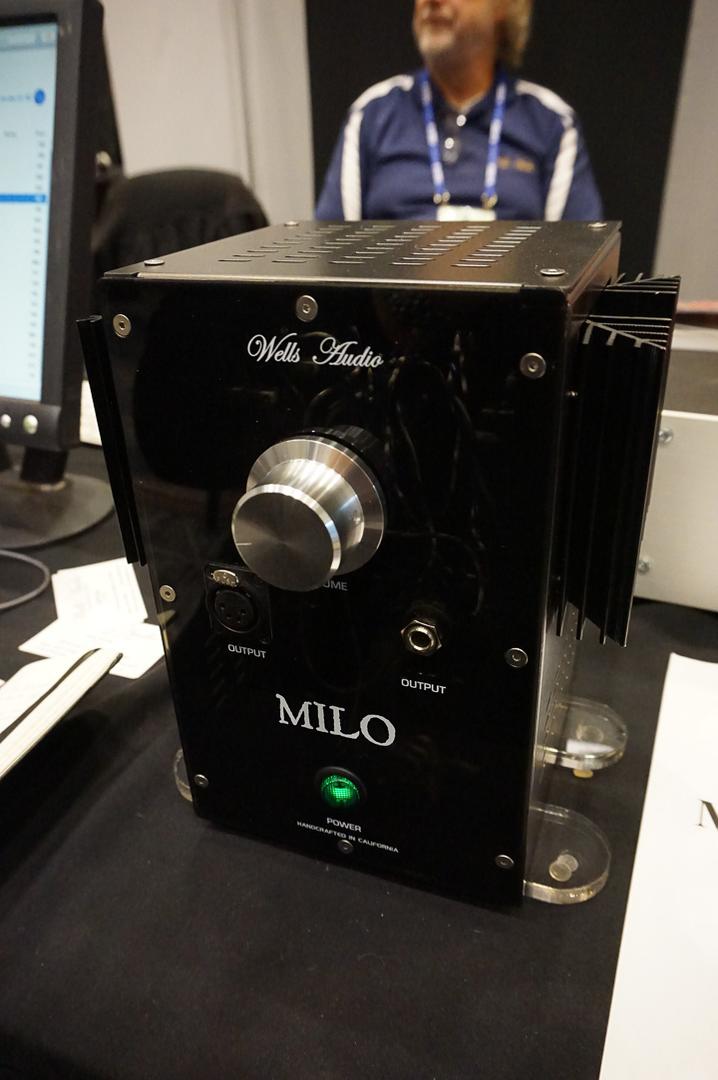
www.wellsaudio.com

Westone Laboratories

Colorado Springs, Colorado-based Westone Laboratories used CanJam RMAF 2016 as the big stage upon which it debuted its spectacular new flagship universal-fit earphone: the new W80 ($1,500). At present, the W80 is the most sophisticated in-ear transducer it knows how to make, whether universal-fit earphone or CIEM. The W80 features an array of eight balanced armature drivers arranged in the three-way configuration and fitted into a remarkably compact, ergonomically sized and shaped earpiece enclosure.

Lead engineer Karl Cartwright spent an extraordinary amount of time working on and revising the voicing of the W80 in an effort to give it neutral tonal balance coupled with the elusive qualities of top-end openness, airiness, and purity in reproduction of upper-midrange and high frequency harmonic. The result is one of the most effortlessly spacious and three-dimensional-sounding earphones we’ve yet heard. As you might expect, the flagship W80 comes with a carefully chosen set of premium accessories including a set of detachable ALO Audio Reference 8 signal cables that feature eight braided, silver-plated copper and OCC copper conductors. Watch for a full Hi-Fi+ review of the Westone W80 in an upcoming issue.

www.westoneaudio.com

ZMF

ZMF started out by building a headphone called the Omni ($899 – $999) that was in essence an extensively modified Fostex T50RP. This model is still in the ZMF range, but in some respects two new, entirely ZMF-manufactured models as shown at CanJam RMAF 2016 have superseded it.

The new models, which are very similar in design, are called the Atticus, featuring a TPE/PET driver ($999 – $1,099) and the new flagship Eikon, featuring a biocellulose driver ($1,299 – $1,399). All ZMF models feature lovely hardwood ear cup shells, so the price ranges shown above reflect market pricing for the various hardwoods on offer. Of the two new models, I thought the Eikon particularly showed promise (that new biocellulose driver seems to have a lot going for it).


www.zmfheadphones.com

Coffee and Stethoscopes

If you want to encapsulate all that Magico represents, ask the company’s founder Alon Wolf about coffee. Or photography. Or guitar playing. Or practically anything in which Alon Wolf expresses an interest. But try it with coffee first.

“Would you like a coffee?” is a relatively straightforward question you might be asked in the reception of any firm you visit. But with Magico, those five words lead to a forty-five minute discourse on the ideal bean, the perfect location on the perfect mountain for that bean to grow (practically down to a Google Earth fly-by of that region), the best importers, the perfect roast, storage technique, grinder, grind, coffee machine, the right kind of water, optimum boiler capacity, material used for the tamper, the best environmental conditions for the best draw, how long the cups need to be heated, whether its best to raise the milk to the optimum temperature for a flat white quickly or slowly, and whether it’s best before, during, or after the drawing of the espresso. Then, two or three otherwise-perfect coffee attempts later, you are handed a cup of coffee. And yes, it’s the best damn cup of coffee you’ll ever drink in the history of everywhere, ever.

That’s the Alon Wolf way. That’s the Magico way. What happens at the espresso machine in the corner of the staff canteen in that business park in Hayward in California is an almost perfect reflection of the uncompromising attention to detail that Magico treats everything.

Magico has been going for a little over 10 years now, originally in a smaller factory in nearby Berkeley, and I can’t think of another audio brand just into its second decade that has anything close to this impressive production plant. Whether it’s the state-of-the-art Klippel measurement system, the outstanding dedicated listening room, or the machine shop, the 30,000 sq ft factory facilities all point to a company far longer established than Magico.

The company engineers its loudspeakers with cabinets of aluminium, and builds using materials made in the US. Quality control for most companies wouldn’t be a problem here – the US has a commanding reputation for producing high-grade aluminium – but high-grade is just a starting place for Magico. To this end, while the larger panels are supplied by fabricators to Magico’s exacting specifications, many of the components that make up the internal spaceframe of the Q series or the top-plates and footers of the S-range are made in house on one of the five multi-axis CNC milling machines in the machine shop. That is the kind of detail that might not register on the significant-o-meter, but it’s more than simply a substantial investment in expensive manufacturing toys, it is the sort of machining capacity found in a company that makes bits for Boeing, not the kind of scale found in a high-end speaker building factory. It’s not overkill, though; it’s the sort of correct engineering that should be going on inside every reasonably sized high-end loudspeaker brand, but is hardly ever seen today. If that perfectionist slant wasn’t running so strongly through the company, Magico’s facilities are the kind that could scale up to make excellent £500 loudspeakers by the tens of thousands. Instead, the perfectionist goes for quality over quantity, every time.

As you might expect from so intricate a build, every Magico loudspeaker is built by hand in a clean, bright assembly area reminiscent of Formula 1 workshops. Like F1, this is not a large team assembling products on a production line, but instead two or three people who build a speaker from parts to packaging, with painstaking assembly sometimes taking days to finalise. Again, we can’t stress the attention to detail strongly enough. Not only does the firm soak test every finished loudspeaker for 24 hours, but Magico also uses a full Klippel testing suite to final test the designs (Klippel’s measurement system is more commonly found in R&D sections of huge speaker brands, and batch testing tens of thousands of speakers per year), but just before final crating up, one of Magico’s more sensitive listeners dons a special stethoscope and listens to every joint, corner, and angle of a loudspeaker to listen out for stray wisps of air or sound escaping through the seals of a sealed box. In a rare moment of near-compromise, the same soak-Klippel testing procedure is used to prototype Magico’s next designs.

Thinking it through a moment, the most important consideration in the manufacturer of a sealed box loudspeaker is the quality of those seals, so trying to hear fractures in the construction of the cabinet by listening with a stethoscope is an obvious way to build a loudspeaker as uncompromising as the S or Q series. And to Magico, it’s the proper way to test the speakers before shipping them. It’s just that, no one else (to my knowledge) does this kind of testing at all.


Away from the actual manufacture of Magico speakers, the office and meeting space is typically large and bright and open. One of the highlights of the office complex part is Magico’s combined museum and trophy haul. Samples of every loudspeaker from the original Magico Mini standmount to the latest versions of the Q1 SII (then just rolling off the production line) were on show and even ready for demonstration. There is even a Magico Ultimate on show, but the factory can’t keep those seven-figure, computer optimised horn loudspeakers on display because it can’t build enough of them.

These speakers can all be used in Magico’s listening room. This purpose built, soundproofed ‘floating’ room measure an impressive 10m × 6.7 × 3.96m (which makes it larger than most rooms, but smaller than most concert venues, and about the size of a tracking suite in a large studio). The room, a useful semi ‘LEDE’ (live end/dead end) design, allows the speakers and the listener to sit in free space in the optimum positions for listening tests. The room is one of the flattest and most neutral I’ve ever heard. Or is that not heard? The room has an impressive range of high-end royalty electronics on offer to define the performance of the loudspeakers on test. During my visit, much of that set-up was a combination of CH Precision, Constellation Audio, and Soulution equipment. The room was super-accurate and extremely revealing, but not to the extent of undermining the enjoyment of the music played in the room. It was also a room that took a lot of energy to drive loud, allowing the speakers to be played at ‘exercise’ levels without profoundly deafening the listeners. Whether solely for fine testing a product, or for showing potential clients precisely what Magico is capable of, this room was extremely impressive.

More than anything, though, it’s not about one aspect of the Magico experience that makes the difference. It’s all of them pulling together. It’s the outstanding engineering and the precision of parts made in house. It’s the attention to detail in final assembly, in testing after a 24 hour soak, and in using a stethoscope to check for leaks. And it’s the test and especially the in house listening facilities.

So, perhaps it’s not wholly about the coffee, after all. Even so, it’s damn good coffee, and well worth travelling across one ocean and a whole continent to taste. Of course, the speakers are pretty good, too… 

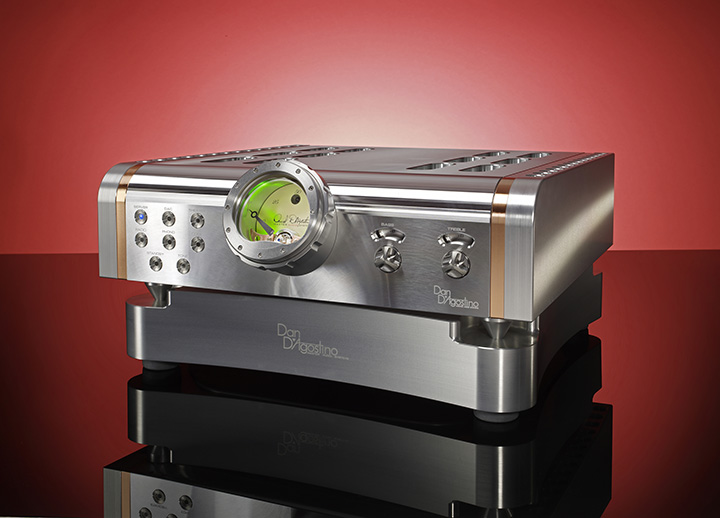
Dan D’Agostino Master Audio Systems Momentum Integrated amplifier

The Dan D’Agostino Master Audio Systems Momentum Integrated amplifier is effectively two boxes in one. The lower, base chassis doubles up as the power supply, and a short, green, braided, four-pin connector cable connects this to the main amplifier stage. The amplifier itself sits on this baseboard supply using four sharp screw-in spikes. And the reason for the bluff introduction instead of some florid prose is because the amplifier is so powerfully built it needs no such flummery. It’s a ‘get on with it’ amplifier. So we will!

There are six colour-coded inputs (both as push-buttons on the front panel, and replicated on the unique round remote control handset) and these are all balanced inputs, fed by a central sextet of XLRs inset into the centre of the rear panel. It also features fully defeatable bass and treble controls. There is also a rear mounted headphone jack alongside the solid multi-way speaker terminals (not WBTs, as anything plastic-jacketed is just not ‘deep time’ enough for the D’Agostino). There’s even an RS232 port and a mini-jack for the well-machined IR extender supplied in the box. Although ‘box’ actually means ‘velvet-lined aluminium flight case complete with rolling luggage wheels and handle’ – it’s that kind of product.

We’re dancing round the subject here. It’s the look and the build quality that makes the biggest impression. In silver or black (as per the review sample) with those contrasting copper heatsink bands, this product is machined to look the part. It’s fearsomely heavy for a relatively small box (54.4kg for the two boxes) and runs very warm, but you won’t care. This is one of the most distinctive and powerfully designed amplifiers out there. The green glowing central volume display (inspired by watchmaker Breuget) is a talking point, as is the volume control wheel that flanks this display. This dial supposedly took an age for D’Agostino to get right, but it immediately pays off in ‘engineered quality’ the first time you use it.

Beneath the elegant casework, the amplifier is a discreet, fully balanced very wide bandwidth Class AB design delivering a healthy 200W into eight ohms that perfectly doubles its load to 400W into four ohms and again, delivering 800W into two ohms. This is a useful indicator of the amplifier’s power supply design, as a less ‘stiff’ power supply will never be able to double its power into the lower impedance load. This also helps it to drive tougher loudspeaker loads without effort. Our sample arrived with many miles on the clock, so any questions about running in began and ended long before we took delivery. As a consequence, the Momentum Integrated sounded excellent as soon as we recovered from lifting it out of the case, although a true running in phase may be required.


We had at first intended to review the M-Life – the variant of the Momentum that includes a streamer in place of the tone controls – but events conspired against us (D’Agostino can’t make them fast enough, apparently). But the Momentum Integrated also opens up a new line of ‘system curation’ in the wake of distributor Absolute Sounds taking on UK digital experts dCS because the combination of D’Agostino amplification and dCS sources is an internationally popular mix. This is also a good choice because the balanced output of any of the three current dCS digital sources makes a lot more sense than trying to turn a single-ended source pseudo-balanced. Factor in a pair of Wilson Audio loudspeakers and runs of Transparent Audio (plus some Stillpoints equipment supports and a few Tube Traps) and you have a turn-key high-end system that will take on anything the rest of the high-end world can throw at it.

The ‘take on everything’ factor is perhaps the most obvious and immediate fix on the Momentum integrated’s performance: absolute authority. The amplifier’s other sonic benefits (and there are many) resolve out over the first few hours spent in its company, but that first impression is of an amplifier in complete control of its environment. It combines the fast-twitch reading of the audio terrain like a fighter pilot and the ‘the skies are mine’ confidence of the admiral of an aircraft carrier fleet. The result is an amplifier that has no challengers, except for more of the same from D’Agostino’s own preamp and power amplifiers. Even if ultimately you take a different audio direction, you cannot help be a little in awe of that confidence and sheer control over the proceedings the Momentum integrated displays.

This confidence is most notable in the bass, where the D’Agostino has the perfect combination of power, precision, and performance. You could add ‘punch’ there too, because that almost visceral gut-punching force really hits home in the bass making your loudspeakers sound deeper and more powerful than you expected. This isn’t just for dub bass lines or thundering cannons (although it certainly helps make bass-oriented elements take on an authenticity and energy that is refreshing). In fact, it’s the more surprising bass textures, like the way Sam Jones’ upright bass just hangs in the room like the real deal on ‘Love For Sale’ on the classic Cannonball Adderley album Somethin’ Else [Blue Note]. Every pluck of the strings, every finger squeal as he moves around the neck, the precision of his playing is brought perfectly to the fore. This is an album I know backwards, and have used it as a test recording for listening for years. I know the shape and texture of that walking bass line extremely well, and I know how it sounds through tightly controlled amplifiers and amps. Regardless, the D’Agostino Momentum shows new insights.

For all the Momentum’s power, control, and deep bass, D’Agostino also gave this amplifier the kind of temporal precision one might expect of a small, fast British amplifier. Viewing this with a kind of mid-Atlantic balance, the American’s Fear of Timing meets the Englishman’s Fear of the Watt, and often the criticism levelled at more powerful amplifiers is they don’t have the quicksilver temporal precision of a fast-paced sub-100 watter. When you hear what the Momentum Integrated can do with a beat, you realise this temporal precision has nothing to do with power output, but a lot to do with good amplifier design. One of the best recordings to highlight this is one of the worst recordings I have: ‘Addis Black Widow’ by Mulatu Astatke & the Heliocentrics from their Inspiration Information Vol 3 album [Strut]. This Ethopian-based slice of ethno-jazz funk is all about the drumming, featuring some of the most out the pocket and off the wall rhythms you will hear. Think that rhythmically lazy but actually ‘inside the song’ drumming of a young Ringo Star, but seemingly with six arms and four feet. On an amplifier that plays music simply for the size of the soundstage or the precision of the detail, this track sounds like someone is throwing a drum kit down a very long flight of stairs. On the D’Agostino, however, you get a sense of rhythm just kept together to give the track a malevolent undercurrent: precisely what it should be doing.

Couple this ability to tease out the most complex rhythms well with the sheer amount of detail, the precision of the dynamic range (both in resolving small changes within a passage of music, and dealing with those more broad dynamic brushstrokes you get with Bruckner or Mahler), the functionally perfect sense of coherence that makes a string quartet seem almost psychic, and the ‘wide, high, and deep as the record permits’ soundstaging properties, and the D’Agostino is something really special.


We mentioned the M-Life earlier, but having used the Momentum Integrated for some time, I’d actually find it hard to lose the tone controls, because they are possibly more useful than ever. They help tailor the sound of modern recordings, taking some of the edge off bright recordings and a bit of bass boost can help flesh out some of those ‘Mastered for iTunes’ bass-light albums.

The D’Agostino Momentum Integrated is one of those rare products that stands out even among highly-respected rivals. It’s one of those designs where the only thing better than the Momentum is more Momentum; a move to separate preamp and mono amps – even the pre and stereo amp might be a bit of a sideways move rather than a leap forward. If you are looking for what is quite simply the best integrated amplifier out there – and have the shelves to take it – the Momentum Integrated is the heavyweight champion. Very highly recommended!

TECHNICAL SPECIFICATIONS

Type: Integrated balanced operation amplifier

Inputs: six XLR only, RS232 port, 3.5mm jack for IR extender (supplied)

Outputs: five-way loudspeaker terminals, rear-mounted ¼” TRS headphone jack

Power Output: 200W per channel into 8Ω, 400W per channel into 4Ω, 800W per channel into 2Ω

Frequency Response: 0.1Hz-1MHz, -1dB, 20Hz-20kHz ±0dB

Distortion (full output): < 0.1%, 20Hz-20kHz

Signal to Noise ratio: -95dB, unweighted

Power consumption at standby: 20W

Finishes: Silver and black

Dimensions (H×W×D): 10.9×45.7×40.6cm (amplifier), 10.2×45.7×40.6cm (PSU, base)

Weight: 54.4kg

Price: £45,000

Manufactured by: D’Agostino LLC

URL: www.dandagostino.com

Distributed in the UK by: Absolute Sounds

URL: www.absolutesounds.com

Tel: +44(0)20 8971 3909

Back to reviews

Read more Dan D’Agostino reviews here

Vivid B1 Decade standmount loudspeakers

It’s anniversary time again, this time for Vivid Audio, which celebrated its 10th birthday recently. To mark the occasion, designer Laurence ‘Dic’ Dickie went back to the first speaker he created for the company: the B1. He thought it was apt that after ten years in production this model should be given the anniversary treatment. It was also an opportunity to incorporate some of the things that he had learnt in the intervening decade, a period that saw the birth of the mighty Giya G1 in its curvaceous composite cabinet and the subsequent scaled-down offspring that it produced. When Dic first sat down to design the oval B1, he was relatively new to computer aided design; this hadn’t stopped him from creating the original and distinctive Nautilus for Bowers & Wilkins, but it turns out that he was originally hired as an electronics engineer to build amplifiers and active crossovers for the brand. The Vivid B1 was, in fact, his first passive loudspeaker design. It was an impressive first effort – not only did he come up with the carbon-fibre loaded polyester compound material it was built with, but also designed the catenary domes used in the mid and treble drivers, and the centre of the mid/bass cone, the latter being mounted in reaction-cancelling formation on front and back of the cabinet. In fact, these speakers are chock-full of innovation, with only the tapered tube driver loading and choice of driver material being retained from the Nautilus project.

The experience that Dic has gained since the first B1 means that the Decade version looks a bit more curvy than its forebear. Vivid is very keen on curves, citing the change in pressure wave radiation that occurs at the edges of square cabinets as a major cause of coloration in loudspeakers. This is an idea that you see in many high-end loudspeakers today: it’s why the KEF Blade and many others have avoid sharp-edged cabinets. But when Vivid introduced the B1, it was one of only a handful such designs.

Another idea that has been picked up by other designers is reaction-cancelling (or force-cancelling) driver arrangements, where the magnet systems of mid/bass drivers are on opposing sides of a cabinet, and braced against one another to keep them under control. Not many speakers have cancelling, opposing drivers in this manner as yet, although the design is gaining momentum in speaker design (KEF’s Blade again), and is used in a number of subwoofers because of the larger forces involved.

Many of the other ideas introduced in the original  Vivid B1 remain unique to the brand, and one of the most revolutionary is the catenary dome driver. This is a variation on the hemispherical dome used by the rest of the audio world that, when combined with a carbon fibre reinforcement ring around the perimeter, pushes the first break up almost an octave higher than a conventional dome. A catenary shape looks more like the pointy end of an oval and can be seen in chains suspended between pillars. As a result, the dome in the centre of the mid/bass driver is not a dust cap, but an integral part of the driver in order to achieve a stiffer drive unit overall, with ventilation for the voice coil provided by a perforated coil former.

When Vivid’s team sat down to think about what they were going to do with the B1 to make it worthy of the company’s first decade (Vivid’s 10th anniversary was in 2014, so ‘a sense of urgency’ was probably not in the B1 Decade’s design criteria), the initial idea was to build the cabinet using the vacuum-infused composite sandwich technique employed in the Giya models. Dic put curves around the drive units for purely aesthetic reasons, and the Decade looks sexier than its flat-fronted brother, but he couldn’t leave it at that.


The mid/bass drivers on the B1 are both the same size, but the rear facing unit is only used to produce bass, while the front one goes all the way up to 880Hz, which makes this a three-and-a-half-way configuration. The second biggest change found in the Decade version is to this bass driver: the magnet system was created for the bass unit on the Giya G4 and has a longer linear magnetic field than the standard motor on the Vivid C125 driver. It’s only an extra 5mm and the movement of the cone is restricted by the surround, but it lowers inductance and this in turn improves mid-range performance. this means Vivid can roll off the rear driver a little earlier to give a flat power response and, this is where it gets technical, increase the ratio between the front and rear output by 12dB through the lower midrange. It gives the driver being used for bass a true first-order roll-off and this results in a flatter response overall. Dic still isn’t entirely sure why so much subjective improvement has been achieved with this relatively minor change in design, but he’s not complaining!

The rest of the B1 Decade’s armoury consists of two aluminium catenary domes, a 50mm midrange and a 26mm tweeter, which sit at the top of a cabinet that stands just over a metre tall on its integral stand. Another unique feature of Vivid designs that is literally obvious on this model is the use of reflex ports on opposite sides of the cabinet. These mean you can see straight through the speaker itself. This is another example of reaction cancellation through symmetry, air movement through a port causes a reaction from the cabinet, but if two ports are opposed they balance one another out without moving the box. There are more remarkable ideas in this speaker than there is space to describe them here, but suffice it to say that this is about as far from a ‘me too’ product as you will find anywhere in audio.

Cable connection is made via WBT bi-wire terminals at the back of the base, and there are five high quality stainless steel spikes for each speaker. However, these were left in the box and the speakers sat on carpet in the first instance. The mid and treble domes now have injected moulded protection grilles with a hole pattern based on the mineral skeletons of radiolaria (look them up on Wikipedia!), which makes a change from the “we tried all sorts of designs and listened till our ears bled” explanations for tweeter grilles found elsewhere! The B1 Decade also comes with metal grilles that magnetically attach to front and rear and arguably add to the speaker’s appeal.

The Vivid had to follow Bowers & Wilkins remarkable 803 D3 speakers in my system and I was deeply concerned that there would be no way that they could take their place without leaving a lot to be desired. The Vivid is 50% more expensive than the B&W so it should be better, but price is no indication of quality. Therefore, I was pleasantly surprised that after a few tracks I didn’t feel that I was missing out, and that the Vivid even brought qualities to the performance that had been less obvious before; qualities that make the B1 Decade an instantly engaging loudspeaker. Its key attribute is the one that I hold in highest esteem: timing. It sounds so right in this respect that I was bowled over and had to listen to all of Kurt Vile’s ‘Pretty Pimpin’ [b’lieve I’m goin down… Matador] – in fact, just writing this makes me want to repeat the experience, it was that compelling. You can make a speaker that ‘times’ well with a single driver in a simple wooden box, but it won’t be as effortlessly revealing, as low in perceived distortion, and not nearly as evenly balanced in tonal terms as this. Several more tracks later, I was reminded that you can normally hear what a speaker is made of; cone and dome materials in particular have distinct characteristics as do many cabinet materials. Here… nada! Absolutely no hint of metal, no emphasis on cymbals or electric guitars, and no sign of cabinet resonance. Instead you hear huge differences in recordings because the tonal character of each voice and instrument is presented without the ‘little and often’ harmonious colorations that most speakers add. And, as mentioned, timing is spot on, and this applies right down to the lowest notes.

In balance terms, the B1 Decade has a warmer upper bass than the 803 D3, yet within that warmth you hear bass lines and reverberations that just didn’t make themselves apparent with the bigger speaker. It is also very smooth through the mid and top: presumably this is down to the various engineering breakthroughs involved with the dome drivers, but in all honesty you could be listening to a silk dome and a paper cone, so effortless is the end result. However, those drivers rarely give this degree of resolution, as their own colorations usually get in the way and mask the quietest notes. Not forgetting that the wooden cabinets they usually inhabit join in the fun by vibrating and adding to the overall presentation. Wood does this in a pleasant way of course, which is why it’s such a popular material, but ultimately you have to be making a lot of effort to get a wooden box of any size to be ‘quiet’ when it has a vibrating drive unit attached to it.

Back to the music: I picked up a Nina Simone Sings Ellington CD at a bootfair recently. Although this no-name recording drips with poorly-recorded syrupy strings, nothing undermine the power of her singing on ‘A Little Sugar In My Bowl’. Initially what you notice is the style of the recording that sounds ancient, the piano is positively distorted yet the voice breaks through the narrow band, distinctly ‘flavoured’ balance of the recording technology used at the time. This Vivid tells you all this and more, while putting the performance front and centre. It is very much a music-first product because it has been successfully engineered to have as little character as possible without the designer forgetting the point of the exercise. It’s surprising how often the science takes over, leaving the art as an afterthought in this game; but not here.

I have an admission to make which is that the majority of speakers I review end up on Townshend Podium isolation bases: once you start using these things it doesn’t sound right unless you carry on. The B1 Decade is the first speaker in over a year that has bucked that trend, and its timing in particular is better without the isolation. The midrange gets more revealing and image scale increases with Podiums, but that crucial factor is weakened. I’m not sure if this is because the speaker is so good at cancelling its own vibrations or if the material is particularly inert, but it’s quite an achievement either way.


In working on an upcoming review project I tried a Beyond Frontiers Audio Tulip amplifier with the B1 Decade and got unusually good results. The amp’s speed, delicacy, and openness suites the Vivid to a tee – the depth of image, the subtlety of the bass, and the fine detail that this combo exposed was addictively good. Bass notes in particular reveal harmonic shades alongside the fundamentals, and modern pieces like Laurie Anderson’s ‘My Right Eye’ [Homeland, Nonesuch] are absolutely beautiful – captivating in fact – and a good example of how recording technology has progressed over time. You can enjoy the tonal luxury of Decca SXLs with this speaker, but it won’t gloss over the character of such classics… it will let you hear them exactly as they are.

I have yet to hear a Vivid loudspeaker that I didn’t like, but the B1 Decade is special. It lets more of the music through by virtue of its balance and its spectacular timing. The fact that you can hear so much through it is rather good, too. But if you want a pair don’t procrastinate; the Decade is a limited edition model with only 200 being made in each shade, rosso, and piano black.

TECHNICAL SPECIFICATIONS

Type: 3.5-way, four-driver, integral stand speaker with reflex loaded enclosure.

Driver complement: One 26mm aluminium dome with tapered tube loading; one 50mm aluminium dome with tapered tube loading; two 158mm metal coned mid/bass drivers with reaction cancelling bracing.

Crossover frequencies: 100Hz, 900 Hz, 4kHz

Frequency response: 39Hz – 33kHz +/- 2dB on reference axis

Impedance: 4 Ohms

Sensitivity: 89dB/W/m

Dimensions (H×W×D): 1095 × 265 × 375mm (420mm base)

Weight: 36kg/each

Finishes: rosso red, piano black.

Price: £18,500 per pair

Manufacturer: Vivid Audio

Distributor: Vivid Audio UK

Tel: +44 (0)1403 71 3125

URL: www.vividaudio.com

Back to reviews

Read more Vivid Audio reviews here

Rocky Mountain Audio Fest – Part Two

If there is one term that describes the audio industry, it’s that we collectively ‘put on a good face!’ Rocky Mountain Audio Fest is a perfect example of this. As discussed previously, the hotel was running late on its rebuild and as a consequence exhibitors were given rooms of different sizes or dimensions to the ones they anticipated, and some were moved into temporary spaces. Also, many of the international representatives and travelling demonstrators were exhibiting signs of show overload as a result of a constant stream of departure lounges and hotel lobbies, seeing the world through the window of a taxi, and living out of a suitcase for months at a time.

RMAF is a fixture on a now very contended international audio events circuit. It vies for its place amid a travelling circus that moves from Hong Kong to Guangzhou, then Tokyo, Silverstone, Denver, London, Toronto, Copenhagen, Old Windsor, New York, Warsaw, and so on in a matter of a few short weeks in the Autumn of each year. It would be easy for major brands to skip at least one of these events, and – being considered more of a local than a national event – RMAF could be the one in the cross-hairs. And yet, the friendliness and laid-back approach of RMAF wins out year upon year. Long may it continue!

Of course, that seemingly endless stream of audio shows in the latter half of the year does pose some ennui problems for readers too, which is why we’ve focused primarily on new products in these round ups. Please note, however, as RMAF is effectively the last major show in the headphone However, there are a few good rooms that deserve praise irrespective of whether or not they featured new products.

3Beez is not a brand commonly seen outside of the US, which is a shame because its top Wax Box 4SE music server seems a very impressive piece of digital electronics. The latest iteration includes a new ‘BitScrubber’ noise elimination board, the company’s own Wax music management software (PC driven, but also on an intranet web-page for tablet users), and more. This $6,000 digital front end showed a lot of promise.

The TechDAS turntables are proving to be some of the most popular designs at the top-end of the high-end. At $27,000, the Air Force III is the brand’s  ‘entry level’ model. It has been shown at several events since its launch earlier this year, but this was its first sonic outing, and really rather spectacular it is too!

BelCanto’s impressive Black Series was the darling of 2015’s show circuit. The line is joined this year by the $25,000 ACI 600 integrated amplifier, a full-spec 300W design complete with phono stage, DAC, Ethernet streaming, MQA support, an impressive headphone amp. Again seen but not heard earlier this year, this sounded very tasty coupled to a pair of Verity Parsifal Anniversary loudspeakers and WyWires Diamond cabling.

Bricasti Design recently added the M12 source controller to the (gold and black) M1 DAC and M28 mono power amplifiers. However, at RMAF, Bricasti completed the line up with the new $18,000 M15 stereo amplifier, essentially taking all the benefits of the M28s in a single stereo chassis. This system (sporting ZenSati cables and Tidal loudspeakers) was extremely precise and detailed.

Burwell and Sons is a maker of very fine horn loudspeakers, based around the classic Altec Voice of the Theater designs. The company trawls modernising movie theatres in search of classic Altec and Western Electric loudspeaker units, that are lovingly restored, and implanted into some of the nicest looking cabinets this side of Living Voice Vox Olympians. This particular set – the deliciously named $80,000 Mother of Burl – came complete with a pair of subwoofers to handle the bass, and the room was driven effortlessly by these reborn classics.


Crystal Cable has been showing prototypes of its Cube System for some time, but it’s now in its ready to roll form. The 200W $16,995 system in a box that draws heavily from sister brand Siltech’s unique SAGA amplifier system. It’s a perfect partner for the company’s Arabesque Minissimo loudspeakers and Dreamline Plus cables, also shown at the show. In many respects, this is the ideal small-but-perfectly-formed audio system.

MartinLogan was playing its new additional lines in its Masterpiece series. The company had set up the $14,999/pr Expression ESL 13A floorstanding hybrid electrostatic loudspeaker using the optional Anthem Room Correction system, which makes a lot of sense in the home, and an awful lot of sense in a hotel room! The Expression ESL 13 A, the second of four models in the new range (not including the mighty Neolith), sounded great as a result.

French brand Métronome Technologie requires a little bit of explaining now. Both are subsets of the same company, but the Métronome name is now reserved for its standard sized digital devices, while the name Kalista appears on the top end three-footed reference models from the company. So the old top-end DAC – the Métronome Kalista – has been replaced by the new Kalista, an elegant tripod arrangement with two separate DACs and two different output stages to suit the needs of the digital signal it receives. A matching touch-screen Kalista CD transport was shown at Warsaw apparently. The Métronome Music Center 1 music server was also on hand.

Yes, RMAF is a high-end show, but not all things on show are that high-end. Take NAD for example. The brand’s new C 368 Hybrid Digital DAC amplifier from its classic series is a full streaming design (and even includes a phono stage) in very much the NAD tradition minted with the legendary 3020 amplifier of more than 30 years ago. With a pair of PSB Imagine XB loudspeakers, this $899 system in a box sounded extremely easy on the ear.

The new $799 Oppo Sonica DAC/headphone amp is designed to be the company’s core desktop product, but also fits well into a decent audio system. Combining an ability to play virtually every file format (apart from MQA), stream from a network, computer, USB stick or connected drive as well as traditional digital audio sources. Sonica is built around the new top ESS ES9038PRO Sabre DAC.


Peachtree and Zu Audio work well together sonically and philosophically. Both are trying to upturn the ideals and ideas of high-end audio by making high performance products at good value. The demonstration in a large room switched between two Peachtree integrated amps and several large and small speakers. The star of the show was the Zu Soul Supreme (in vivid blue at $4,500 per pair) playing through the excellent and upcoming Peachtree Decco125. This smart amp-meets-headphone-DAC made a thrilling large-room filling sound, and is expected to cost $999 without WiFi and $1,199 with. This has to be one of the true value stars of the show!

Synergistic Research had one of the most packed rooms at the show. Even during the slow-down Sunday, Ted Denney’s room was constantly packed out, as he showcased the performance of the brand’s latest UEF treatment to every aspect of an audio system. The system itself set a high bar in a low room, featuring Berkeley digital and VAC analogue electronics, and a pair of Magico S3 loudspeakers in a room too small for such a system. Regardless, Synergistic’s systematic treatment brought out the quality of the sound impressively. The latest component in the system is the new PowerCell 12 UEF ($5,995 in its full glass-topped glory) line conditioner, which uses graphene in its EM cell system, and reclocks the AC with the Earth’s Schumann resonance!

Peter McGrath of Wilson Audio Specialities talks us through the finer points of the new $25,500 Yvette. Wilson Audio seems pathologically incapable of making a bad loudspeaker, but the Yvette (which replaces the Sophia 3) is exceptional, even by the standards of category-defining speakers like the Sabrina and Alexia. Yet another Daryl Wilson design, the new three-way, easy driving, 175lb single box loudspeaker – played through a fine Brinkmann/dCS/VTL/HRS/Nordost system – was one of the high-points of the show, even if the total cost came to more than half a million dollars. 

Wyred 4 Sound was showing two new products at the show. It’s new SX-1000R mono power amp is a real power house, delivering 625W into eight ohms, and yet costs just $1,499 per unit. It’s joined by the $499 PS-1 modular linear power supply, that takes the place of up to four wall-wart PSUs and delivers high-grade DC juice without switch mode supply noise!


Zesto Audio’s new $12,000 all-tube Téssera phono stage looked fabulous in the flesh; and not too shabby on screen, too. With the exception of sharing the same case and power cord, the Téssera is completely dual-mono (even down to doubling up the controls on the front panel) and made a great sound via a Merrill Williams REAL 101.2 turntable, Zesto’s Andros amplification, and Marten Django loudspeakers.

While most of our round-up of new products discusses those devices that were ‘in play’ rather than ‘on show’, we were rather taken with the $9,900 VAC linestage preamp. Matching the Phi range of continuous auto bias power amps, this new preamp (with optional phono stage) uses circuitry and components from VAC’s high-end and super-high-end ranges.

Like many of the best US products, brands like Vinni Rossi often miss the credit they deserve outside of the country. In fairness, the exposed tubes of the company’s LIO integrated amplifier might prove difficult to get past the CE-marking police in mainland Europe, but this $11,000 modular amplifier and optional power supply, driven by a pair of Harbeth Super HL5 Plus speakers, was one of the most effortless sounding systems of the event.

VPI’s $21,000 Avenger Reference turntable has been shown at a number of shows, but never quite like this! Possessed of multiple arms sitting on multiple outriggers for stereo and mono performance, the Avenger aced it all. In single arm-guise, VPI’s Prime and Avenger turntables were some of the most popular choices at the show, and Mat Weisfeld was one of the most exhausted men at the show, having to deliver decks to almost every floor!

Finally, there were three rooms that deserve to be singled out for making an exceptional sound. The first was the Luxman/Eclipse room, because once a day Philip O’Hanlon of distributor On a Higher Note played an hour’s worth of classic mono recordings on a giant Luxman reference turntable from the 1970s. The newest LP played was 50 years old, and many were well into their mid-60s. Say what you want about stereo, but one channel of effortless, dynamic, and vivid sound is hard to beat.

Next up, Sanders Sound Systems. This $26,000 preamplifier, ESL stereo power amplification, and Model 10e electrostatic loudspeaker package from the brand might not have been exactly new, and firing-across-the-room, three chairs in a row layout was not particularly interior-design friendly, but the even-handedness and sheer ability for music to breathe made this one of the true stars of the show. Sanders consistently wins ‘best in show’ plaudits for good reason.

Finally, one of the more satisfying and uniformly best loved systems at RMAF featured a Kronos turntable, arm, and EMT cartridge, Nagra Classic amplification and Avalon Acoustics Indra Diamond loudspeakers, with al the equipment resting on Modulum racks and using top Kubala Sosna cables and power conditioning. This was one of those high-end systems that looks great and sounds even better. A true star system worthy of wrapping up any show report!

CanJam at RMAF 2016 – Part 3 of 4

Part 3 of our report covers:  HiFiMAN, Holo Audio, iFi Audio, Jays, JDS Labs, JH Audio, Koss, Labkable, Little Dot, Lotoo, Meze, MrSpeakers, Noble Audio, and oBravo.


Find Part 1 our CanJam report here: https://hifiplus.com/articles/canjam-at-rmaf-2016-part-1-of-4/

Find Part 2 our CanJam report here: https://hifiplus.com/articles/canjam-at-rmaf-2016-part-2-of-4/

HiFiMAN

Over the course of a number of recent audio shows, HiFiMAN has shown successive prototype versions of its upcoming Shangri-La electrostatic headphone system, comprising both a cost-no-object electrostatic headphone and matching electrostatic headphone amplifier.

For CanJam RMAF 2016, however, HiFiMAN rolled out the finished, production-ready Shangri-La system for the very first time, with a dramatically re-worked version of the valve-powered Shangri-La electrostatic amp and an also significantly re-worked version of the Shangri-La electrostatic headphone. The amp now sports an all-new, angular, cantilevered and wonderfully eye-catching new industrial design created for HiFiMAN by Catalano Designs. The circuit is based on quad 300B valves and quad 6SN7 valves.

The headphone, in turn, also showed some industrial design changes (many of them in keeping with changes applied in HiFiMAN’s v2-series planar magnetic headphones). In keeping with past HiFiMAN practice for top-tier headphones, the Shangri-La electrostat features a sub-micro-meter thickness diaphragm and uses a proprietary process to distribute conductive nanoparticles evenly over the diaphragm surface—leading, we presume, to more even response over entire playing surface of the diaphragm.

HiFiMAN founder Dr Fang Bian has been quite forthright in stating that his aim with the Shangri-La system has been to exceed the performance of Sennheiser’s ultra-expensive HE1 electrostatic headphone system and accordingly the Shangri-La system will be priced at a breath taking $50,000; HiFiMAN will begin taking advance orders shortly with a three-month production wait for each build-to-order system.

Two questions of course come to mind. First, is the Shangri-La system really better than Sennheiser’s HE1 system? The answer to that one will have to wait until the Shangri-La system can be heard at some length in a much quieter setting than that afforded by the extremely noisy big tent at CanJam. The open-back Shangri-La headphone is particularly susceptible to background noise as there is only a minimalist driver frame and also minimalist protective grille on the rear side of the driver. The good news is that these design features help give the headphone astonishing transparency and the ability to resolve ultra-low-level sonic details, but the downside is that the headphones also allow background noise to pass right through, almost unimpeded.

The second question, which many are bound to ask, is whether the world really needs or wants a $50,000 headphone system, no matter how good it might be. The answer to that question will be market driven, of course, but my gut instinct is that there will be more takers than we might think. Sennheiser, for example, has indicated that when it begins production on its comparably expensive HE1 system, there is a very real likelihood that the system will be back ordered for the better part of year—if not more. Stay tuned. Given the rare and exotic nature of this system, we can’t guarantee that it will be possible to arrange a Hi-Fi+ review, but we’ll do our best…

www.hifiman.com
 

Holo Audio

One of my favourite new products from CanJam RMAF 2016 was/is the Holo Audio Spring DAC – Level 3 Kitsuné-tuned edition, with silver O-type transformer upgrade and Jensen capacitor upgrades, priced at $2,399. According to the manufacturer the Spring DAC uses “patented R2R (ladder DAC) technology”, where there are two ladders per each +/- channel.  Holo Audio adds that, “this is the first discrete DAC that has linear compensation and this allows for ultimate music reproduction accuracy. (There is a) Dual R2R network for PCM and Dual RSR network for DSD.”

In a brief listening session, I felt the Holo Audio Spring DAC with Kitsuné upgrades sounded very promising.  For those who appreciate the general concept of the Holo Audio Spring DAC, but aren’t so sure about the Kitsuné upgrades, a standard version of the DAC sells for $1,699.

www.kitsunehifi.com/product/springdacgreen/

iFi Audio

The British firm iFi Audio focused on revealing the three new products that together will comprise the firm’s new Pro-series product family—the most ambitious offerings from iFi Audio to date. As the centrepiece of the family we have the Pro iCAN headphone amplifier/preamp ($1,999), which is a high-powered, low-noise, fully balanced amplifier that offers three user selectable front-end circuitry options: solid-state, valve, or valve + (much like the valve setting, but with reduced loop gain and lower negative feedback). Additionally, the Pro iCAN offers its own versions of the firm’s signature 3D Holographic sound circuit (one version optimised for headphones, the other for loudspeakers) as well a version of the firm XBass low frequency correction system.

Expanding the range will be the upcoming Pro iDSD DAC, which in a sense can be viewed as a descendant of both the firm’s Micro iDSD and Micro iDAC2, but on ‘steroids’ ~$1,999).  The Pro iDSD is a fully balanced DAC based on quad Burr-Brown native DSD chipsets that is capable of decoding virtually every high-res PCM and DSD format yet conceived (including even the really high-res, hypothetical ones like ‘octo-DSD’, etc.). The DAC incorporates, says iFi, “passive CLC filtering for better suppression of noise”. The Pro iDSD will reprise the Pro iCAN’s solid-state, valve, and valve + front end circuitry options. The Pro iDSD can accept outboard 10MHz, Atomic Clock, or DARS (Digital Audio Reference Signal – AES11) clock inputs, or it can serve as its own clock master for 10MHz or DARS clocking signals.

Last but not least will come the new Pro iEnergiser (~$1,999), which can be used as an add-on companion product to the Pro iCAN or as a standalone product in its own right. Either way, think of the Pro iEnergiser as a bolt-on electrostatic headphone amplifier that can work either in conjunction with a Pro iCAN (via a dedicated, single-cable link between the Pro iCAN and the Pro iEnergiser, which was how the pair was shown at CanJam RMAF 2016) or for use with a standard speaker-orientated amplifier (via a set of speaker tap input/outputs on the rear panel of the Pro iEnergiser).  The Pro iEnergiser can deliver 100dB @ 100V (as required by many Stax headphone models) and provides a range of electrostatic headphone bias voltage options including: 230V bias for 6-pin plug connected Stax headphones, 580V bias for 5-pin plug connected Stax Pro headphones, plus variable 500V – 640V bias options to accommodate other makes of electrostatic headphones that also use the Stax-type 5-pin Pro connections. A good example would be the spectacular new MrSpeakers ETHER ES electrostatic headphones with which the Pro iEnergiser was being demonstrated, nicely showing off the exceptional sound quality of which the Pro iEnergiser is capable.

www.ifi-audio.com


Jays

Like many volume-orientated headphone and earphone manufacturers, the Swedish firm Jays is responding to Apple’s new headphone jack-less iPhone 7 (what were they thinking?) with the firm’s first-ever Bluetooth headphone—the u-Jays Wireless headphone ($179.95), which is based on the popular u-Jays passive headphone.

Like the passive-Jays model, the u-Jays Wireless headphone features purpose-built dynamic drivers that deliberately treat the headphone ear cups and ear pads as a complete acoustic system, and that feature Japanese-silk driver diaphragms said to yield “crystal clear details” and “deep bass response.” Moreover, the headphone features “soft viscoelastic ear pads claimed to provide “superior sound isolation” and wearer comfort.

The u-Jays Wireless features full-featured touch control and wireless system offering 25+ hours of playback time per charge. A welcome touch is a control lock that “secures the controls to avoid unintentional interruption.”

www.jaysheadphones.com/u-jays

JDS Labs

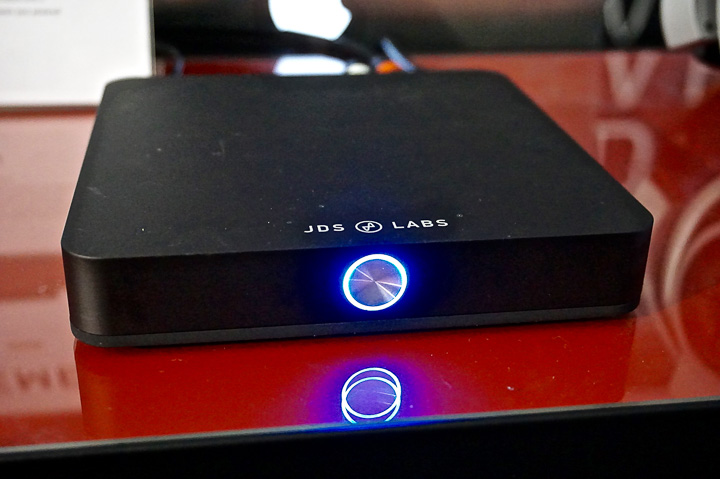
Up to this point, the Collinsville, Illinois-based firm JDS Labs has perhaps been best known for its modestly-priced but very good-sounding Element headphone amp/DAC ($349), but that may be about to change thanks to the introduction of two upcoming products.

First, JDS Labs will launch the new Element DAC (~$299). To be clear, the Element DAC is not merely the DAC section of the original Element amp/DAC broken out into a separate chassis, but rather is an all-new, AK-4490-based DAC designed to take the firm’s digital audio performance capabilities up to a whole new level. Then, JDS plans to  follow the Element DAC with the dedicated, amplifier-only Element Amp (~$200).

The concept, clearly, is that the next performance step up from the present day Element amp/DAC, which is the product responsible for putting JDS Labs on the personal audio map, would be to order up the combo of an Element DAC and matching Element Amp (presumably for a tick under $500).

www.jdslabs.com

JH Audio
The Orlando, Florida-based firm JH Audio is one of the most widely recognised makers of custom-fit in-ear monitors (CIEMs) on the planet, so when the firm announces major revisions to its product line that’s invariable big news in the personal audio community.

For CanJam RMAF 2016 the firm’s demonstration were focussed heavily on two new CIEM models that happen to fall at nearly opposite ends of the pricing spectrum. Up near the top, we have the firm’s new Performance Series JH16V2 PRO model (starting at $1,499), which incorporates JH Audio’s proprietary soundriVe balanced armature-type driver arrays—in this case quad low-frequency driver array, a dual midrange driver array, and a quad high frequency driver array. The driver arrays load into triple bores using the firm’s signature Freqphase steel tube waveguides, which co-optimise both frequency and phase response. Finally, lifting a design touch from some of JH Audio’s top-tier Siren-series CIEMs, the new JH16V2 PRO incorporates the firm’s patented variable bass features through which a user control embedded in the CIEM’s signal cables allows a ± 10dB adjustment in low-frequency output, to suit the user’s tastes.

At the other end of the price spectrum, JH Audio rolled out what I believe might be its most affordable CIEM to date: namely, the new JH3X PRO, starting at just $599. The JH3X PRO is a two-way, dual-bore, triple balanced armature-type driver-equipped CIEM said to offer “low end punch and upper mid detail that’s unparalleled by it’s rivals.” Like other JH Audio CIEMs, the JH3X PRO uses bore tubes leveraging Freqphase technology.

www.jhaudio.com

Koss

The venerable Milwaukee, Wisconsin-based headphone manufacturer Koss sometimes goes overlooked in discussions of top-tier headphones, which is a shame. The fact of the matter is that Koss may have ‘painted its masterpiece’ in terms of headphone design so long ago that the product in question has by now all but fallen off of the radar screens of some high-end headphonistas.

What product am I referencing? I’m thinking of none other than Koss’ rather remarkable ESP/950 electrostatic headphone system, which sells for a comparatively modest $1,000—for the headphone with electrostatic energiser included.  At CanJam RMAF 2016 I took the opportunity to give the ESP/950 a careful listen with fresh ears and came away favourably impressed.

Honestly, it occurred to me that the ESP/950 was developed so long ago that it was probably far better than many of the source components then used to feed it. Now, with much more modern source components on tap, it’s much easier to grasp the performance benefits of the design, among which are transparency, lightning-quick transient response, and reasonably neutral frequency response. In short, this design is a classic example of an oldie but goodie that arguably arrived on the market before its time. I think it’s well worth a second look.

www.koss.com/headphones


Labkable

Labkable is a Hong Kong-based manufacturer of exotic and highly specialised high-performance signal cable sets for many of today’s top-tier earphones, CIEMs, and headphones.


Coming into CanJam RMAF 2016, I knew relatively little about the firm, so I took the opportunity to try a set of Labkable Samurai III signal cables ($870) with my reference pair of Westone’s flagship W80 universal-fit earphones.  The Samurai III cables feature—get this—platinum alloy conductors.


Those of you who know Westone’s W80 will be aware that the earphone ships with an excellent set of relatively expensive aftermarket signal cables worth approximately $300. Given this, I really wasn’t sure how much, if any, difference the Labkable Samurai III cables would or could make. To my surprise, though, the Samurai III cables made a substantial difference, lifting the already superb performance of the W80s to a noticeably higher and more musically satisfying level.


What can I say? It was sad moment when I had to unplug the Samurai III demo samples and revert back to the W80’s original cables. (I suppose this can be chalked up to the old adage, which holds that, “The great is the enemy of the very good…” ) close brackets Great job Labkable.

www.labkable.com   

Little Dot

The Little Dot brand, whose products are built by the Chinese firm Shenzhen Audio, specialises in making high value, valve-powered headphone amplifiers. A great example would be the Little Dot Mk9 amplifier shown here as demonstrated at the Dana Cable display booth at CanJam RMAF 2016. The Little Dot Mk9 uses a complement of one 6NN9P valve and two 6080 valves in a single-ended push-pull, OCL, direct coupled headphone amplifier that is available through Amazon.com for $559.99.

Also shown in this image are Dana Cables signal cable sets, available for many top-end headphones, which sell for $549 – $1,399.

www.shenzhenaudio.com/little-dot-mk9-6n9p-6080×2-tube-ocl-tube-headphone-amplifier.html


Lotoo

The Chinese firm Lotoo is known for its powerful and robustly built high-res digital audio players and for CanJam RMAF 2016 the firm was showing a proposed new product bundle (price TBD) consisting of Lotoo’s flagship Lotoo PAW Gold DAP as reviewed in Hi-Fi+ issue 129 and the ENIGMAcoustics hybrid electrostatic/dynamic headphone as reviewed in Hi-FI+ issue 138.

In the Abyss booth adjacent to the Lotoo exhibit space, the firm was also showing a new Diana Edition version of the PAW Gold—a version with higher gain than the standard model and that is offered in anticipation of Abyss’ upcoming Diana planar magnetic headphone. Abyss president Joe Skubinski observed that he had found very few DAPs that could drive his firm’s admittedly power-hungry headphones, but that Lotoo’s PAW Gold (and specifically the PAW Gold Diana-edition) fitted the bill quite nicely. The Diana Edition model is expected to sell for about $2,379 (or roughly $179 more than the standard PAW Gold).

www.lotoo.cn

Meze

Thus far, Meze Headphones is perhaps best known for its full-size 99 Classics headphones as reviewed in Hi-Fi+ issue 134, but at CanJam RMAF 2016 (as at some of the other headphone shows leading up to CanJam RMAF) Meze focused on showing a cost-reduced version of the 99 Classics called the 99 Neo (priced at $250, versus the $309 price of the Classics).  Where the Classics feature gorgeous oiled-finish walnut or maple ear cups, the 99 Neo instead offers less costly but functionally identical all matt black ear cups—a trade-off I suspect many buyers might willingly embrace.

Further, Meze continues in its launches for two similar but not identical ranges of universal-fit earphones: the 12 Classics that—you guessed it—sport hardwood walnut earpiece sleeves surrounding aluminium enclosures (priced at $79) and the 11 Neo that features a full aluminium earpiece enclosure offered in Gun Metal or Iridium finishes (priced at $59). Both models offer a lot of value for money, so that the primary question may be whether you prefer the look of wood or metal.

www.mezeheadphones.com

MrSpeakers

MrSpeaker’s display at CanJam RMAF featured the firm’s recently released ETHER Flow and ETHER C Flow planar magnetic headphones (priced between $1,799 and $1849 depending on signal cable options chosen). Both ETHER Flow models could be observed throughout the show and on demonstration in various manufacturers’ booths, where the Flows were rightly treated as ‘reference-grade’ planar magnetic headphones. The ETHER Flow, by the way, is reviewed in Hi-Fi+ issue 141.

But perhaps an even more significant part of the MrSpeakers display involved the now finalised ETHER ES electrostatic headphone, which is expected to sell for “under $3,000”, but is intended to compete with any high-end headphones on the planet, regardless of the price. Based on impressions from the show, I expect the ETHER ES will be a sonic force to be reckoned with, to say the least. MrSpeakers president Dan Clark told Hi-Fi+ that the ETHER ES design is finished from a sonic perspective, but that there are a few production-related items remaining to be fine-tuned and finalised. Have we finally got a headphone that can meet or beat the performance of the legendary Stax SR-009? Only time will tell, but indications thus far are positive indeed.

www.mrspeakers.com


Noble Audio

 The Santa Barbara, California-based firm Noble Audio used CanJam RMAF 2016 as its opportunity to reveal the firm’s new Katana universal-fit earphones and CIEMs to the US audience (the model had its world debut at CanJam London a few months back).

To review, the Katana is the latest Noble design and one that features nine balanced-armature-type drivers per earpiece. Perhaps of greater importance than the sheer number of drivers used is the fact that, for the first time in its history, Noble collaborated directly with the balanced armature driver specialist Knowles to create drive units purpose built to Noble’s specifications specifically for use in the Katana. The Katana thus takes its place as, in essence, a ‘separate but equal’ co-flagship model alongside the firm’s famous Kaiser 10 model. The Katana universal-fit earphones sell for $1,850. Katana CIEMs are offered in three formats: the Katana SLA ($1,650) with 3D-printed earpieces, the Katana C (starting at $1,850) with custom-moulded acrylic earpieces, and the Katana Prestige (starting at $2,850) and available with custom-machined earpieces offered in a variety of exotic solid materials.

https://nobleaudio.co.uk/en/

oBravo Audio

The Asian firm oBravo Audio is perhaps best known for its full-size HAMT hybrid dynamic/AMT-driver equipped headphones and HRIB hybrid dynamic/ribbon-driver equipped headphones. In particular, oBravo’s HAMT-1 was very favourably reviewed in Hi-Fi+ issues 120 (main review) and 121 (an even more positive follow-up review).

But at the same time, oBravo has quietly but steadily been working to apply these same hybrid concepts to a range of what may well be some of the finest universal-fit earphones ever made. Having heard several models in the range in the past, I can only say that their performance benefits are so significant that, in a way, they force listeners to toss out most if not all of their preconceived notions as to what universal-fit earphones can be and do. Continuing this theme, oBravo took the opportunity at CanJam RMAF 2016 to show a preproduction prototype of its latest universal-fit effort: the EAMT-0 Zeus, which uses a 16mm dynamic driver and a miniature second-generation oBravo Heil AMT (Air Motion Transformer)-type driver. The sound is impressive indeed, but pricing—as of the show—was yet to be determined. Stay tuned for more information later on.

www.obravoaudio.com

Analog Domain The Isis M75D integrated amplifier

I have to admit that I was surprised when I discovered the £18,650 asking price for Analog Domain’s Isis M75D integrated amplifier. Granted, it’s a lovely piece of engineering and the black surface has a rubbery coating that gives it a pleasing tactility, but nonetheless on size and looks alone I would have put it at around a third of the actual asking price. However, in audio, performance trumps all, and in that respect, the M75D has got it where it counts!

At seven years old, the German-based Analog Domain is a relative newcomer to the business. Until recently, the company almost exclusively concentrated on power amplifiers with outputs ranging from 550 Watts up to 4,000 Watts, with outputs that double into a four Ohm load. So, Analog Domain is no stranger to amplifiers, as it has made some of the most powerful designs an audiophile can buy. The Isis, with its 250 Watt into eight Ohm specified output, is relatively restrained in comparison, and at 25 kilos it’s fairly manageable, too.

The Isis M75D is a perfect reflection of company founder Angel Despotov’s uncompromising stance on amplifier design, which naturally extends to the choice of component quality and the level of build employed. Take the casework for example; it’s clearly custom machined, but what’s not obvious is that the top and bottom plates are internally machined in a latticework to give excellent rigidity without excess mass, lowering resonance in the process. The black parts are not painted or anodised but latex coated. This produces a deep matte finish, that is both ergonomically and aesthetically pleasing, and long lasting: Despotov make the point that his products are designed to last “at least 25 years”.

The actual component count under the lid is not apparently very different from other high-end integrateds at or beyond this level, but great claims are made for the amplifier itself. For a start, it is a fully balanced circuit with “exceptional current output capability” and output impedance that is “essentially zero” giving the Isis what Angel describes as an “insane damping factor”. The power supply is a class G type with separate voltage rails for high and low power outputs. This is an approach used with some considerable succes by Arcam, in its current range of larger amplifiers. According to Angel “the key here is to do it in such a way as to have minimal artefacts in the output signal.” He uses this topology because it keeps the amp’s temperature down, and yes, this is the coolest high power analogue amp I have used. The idea is that the lower the operating temperature, the longer the components inside survive in situ – apparently, every 10 degree Celsius drop in temperature doubles the life of “the most vulnerable components” in an amplifier. This gradual failure of components is essentially why older audio components tend to sound warmer and softer than they once did – it might often appear nice and benign, but this is the sound of your amplifier going out of specification, and ultimately beginning to die.

The price is related to the use of high-spec components, but Analog Domain admits that half of the Isis’s price tag comes down to the chassis, which is something one presumes about high-end components but it is nice to have it confirmed. And it is a superbly detailed chassis at that; the way that the heat sinks are concealed from the side but vent top and bottom gives it a clean appearance that doesn’t threaten to lacerate its owner, and the styling is reminiscent of Revox at its aesthetic peak, or Mark Levinson at its best. The back panel is also unusually well endowed on the switches front: chrome levers let you choose between bridged or stereo operation; separate pre-out/power in or internally connected on that rare connector the five pin DIN; and gain can be increased by 8dB on either of the two RCA phono socket equipped line inputs. The other two inputs are balanced giving the Isis just four line inputs in total, which doesn’t seem overly generous but probably enough for most situations.

Operation is mildly confused by the auto dimming of the input and level displays. This can be changed and you soon realise that a white indicator means it’s on, so even reviewers get to grips with it quite quickly. I was surprised to find a One4All remote handset in the box for the Analog Domain but am told that a suitably substantial matching handset is on its way and will be supplied to all purchasers of this amp. As the Isis is the first amp that requires control in AD’s range, this is understandable. On the amp itself, there are individual input buttons, power, mute and phase, plus a headphone jack with a limiter light above it. The latter is for the amp as a whole and indicates that you have maxed out the available unclipped volume. This indicator glows white if the limiter is active and red if protection has been activated, such as if the output has been shorted. Limiters are a rarity in high-end audio because they usually compromise sound quality but this amp doesn’t seem to be too compromised and a bit of protection is useful with this much power on hand.


The volume control consists of a discrete resistor matrix driven by solid-state opto-coupled MOSFET switches, in an arrangement that results in a constant output impedance at all attenuation levels. I was initially concerned that the level was approaching the nineties without the volume being that great, but discovered with some quieter recordings that it carries on past 100. It turns out that for some unstated reason, ‘127’ equates to 0dB, and every step represents 0.75dB. This, combined with good sensitivity to the remote, means you can make very small steps if required, or keep your finger down for bigger changes.

Perceived volume is quite different, too. The level rises but the distortion that usually accompanies it seems to be absent. This amp clearly has very low distortion of the usual variety and this results in outstanding transparency allied to total control. There is no sense of overhang or time smear in the usual sense because notes just start and stop without any trace of ringing. It’s quite uncanny to have this without the sense of grip usually associated with powerful transistor amplifiers. Such things generally have a subtle electric character, a water mark almost that lets you know that you are dealing with a high power amplifier. The Isis does not seem to have this. One example of the transparency of power on offer is that the sense of timing did not change noticeably when moving from the relatively difficult load of a Bowers & Wilkins 803D to the lower sensitivity but easier load of a PMC fact.8. With most amps, timing is superior with the latter speaker. Here, the same precision could be heard with both. And ‘precision’ is the word; this is not the ‘Pace, Rhythm & Timing’ of a Naim or the zest of a Rega, it’s a complete control of tempo with such a light touch that one’s attention is not particularly drawn to it.

The Isis is a very clean amplifier indeed, and you hear extraordinary levels of detail in everything that’s played. This can make it sound a bit cool with a speaker like the 803D and I found it beneficial to seek out a warmer, highly refined source in the armoury to balance this out. I don’t think the AD has a particular tonal character – it seems extremely even handed, in fact – but the absence of overhang means you need to carefully consider the right balance of components in the system, rather than trust your luck. I found that the CAD CAT server and CAD 1543 MkII DAC fitted the bill better than my usual sources, perhaps because it’s the most expensive but also because it produces more resolution than the digital alternatives. My usual digital reference is a Melco server, Cyrus X-Stream network streamer, and Primare DAC 30, which as a rule delivers a strong sense of timing and plenty of detail in what seems an even-handed way when played through most systems. In the AD’s hands, however, it sounded a bit cool because it ultimately is a bit cool, although this rarely makes itself known when played through less revealing amplification. When you open the window wider, it’s inevitable that you hear both the good and the less good in a source.

That said, it was striking just how close this combination got to the recordings. The moment Gregory Porter’s ‘No Love Dying’ [Liquid Spirit, Blue Note] came on, the compression used was obvious, albeit in the context of good scale, maximum crispness, and dynamics. The percussion on Patricia Barber’s ‘A Touch of Trash’ [Modern Cool, Premonition] has never sounded so real and the timing never so taut. The double bass had power and extension, but was never allowed to get overblown. Barber’s voice was pretty special too, as was Melanie De Biasio’s on the song ‘With All My Love’ [No Deal, PIAS], where the subtlety of reverb, ‘inky black’ background, and virtual realism of the performance combined with eerie low frequency notes to tremendous effect. Did I mention that this amplifier is quiet? Because it’s very quiet indeed. It makes other serious amplifiers sound grainy, even decent, high-end examples that taken alone seem to have very low noise floors. But this isn’t a noise floor thing; it’s an absence of the usual sense of electrical power that is so hard to avoid in solid state amplification, and part of the appeal of valves. But valves have other characteristics and cannot deliver anything close to the sort of control on offer from this Analog Domain integrated.

I also used an analogue source in the form of a Rega RP8 turntable, Rega Apheta 2 cartridge, and Rothwell Signature One phono stage. This also sounded unusually taut and devoid of thickener, and it revealed an odd sound between tracks on a familiar album. This must be a sign of wear, but highlights the Isis’ clear cut, even-handed soundstage that appeared to have nothing added nor taken away. The dynamics of the drums on another Patricia Barber track, ‘Company’, were remarkably real and the voice was clearly recorded in a completely different fashion to the band. This sounds obvious yet is not always easy to define, and such image separation on this amplifier is in the premier league. The trumpet was bright and clear and the double bass remained as per the digital experience: taut and powerful. The only thing it lacked was a sense of presence; imaging is precise, reflecting both the depth, width, and height of the recording, but you don’t feel like the musicians are in the room in the way that other amplifiers present them. As both styles of presentation are very convincing it’s a case of figuring out which is the most accurate, but ultimately if it’s acoustic music then there shouldn’t be any grain evident, and that suggests Analog Domain is doing it right!


The majority of listening was done with the 803 Diamonds but I also used my usual reference the PMC Fact.8 and the results were equally as persuasive. The bass was superbly controlled and transparency remained in a class of its own. George Duke’s dulcet tones on the ‘smooth’ version of ‘Inca Roads’ as featured on the recently released Roxy by Proxy album [Frank Zappa, Zappa Records], have rarely sounded more real and intimate. Also, the low synth on the Hadouk Trio’s Live à FIP [Mélodie] was frankly gorgeous, dark, chewy, and full of texture.

In truth, everything I played offered up new insights into the performance and production: from Radiohead to St Matthew’s Passion it all had oodles of character and depth. The Analog Domain Isis 75D is a remarkable feat of engineering: it reveals the potential of doing things differently and opens the sonic window so wide that it’s hard to believe that this is an integrated amplifier. The presentation is so transparent that you need sources that are equally even-handed, resolute, and low in distortion to get a result that matches this amplifier’s capabilities. But it’s worth the effort in carefully selecting those components. There’s no doubt that Analog Domain is a force to be reckoned with, and that the price is well justified under the circumstances.

TECHNICAL SPECIFICATIONS

Type: Solid-state, 2-channel integrated amplifier with headphone amplifier

Analogue inputs: Two single-ended line-level inputs (via RCA jacks), two balanced inputs (via XLR connectors)

Digital inputs: N/A

Analogue outputs: One pre-power loop (via 5 pin DIN)

Input impedance (high-level): 20kOhms balanced, 10kOhms on RCA
Input impedance (power amp): 10kOhms [differential]

Output impedance (preamp): 10 Ohms

Headphone Loads: Any!

Power Output: 400Wpc @ 4 Ohms, 250Wpc @ 8 Ohms

Bandwidth: 2 Ohm, THD < 0.1% 5Hz – 50kHz

Distortion (THD+N):  20kHz BW, 8 Ohm nom. power < 0.002%

Signal to Noise Ratio: >120dB referenced to full power

Dimensions (H×W×D) inc. feet: 135 × 440 × 440mm

Weight: 25kg

Price: £18,650

Manufacturer: Analog Domain

Tel: +49(0) 1608 173 193

URL: www.analogdomain.eu

UK Dealer: Choice Hi-Fi

Tel: +44(0) 20 8392 1959

URL: www.choice-hifi.com

UK Dealer: Concerto Audio

Tel: +44(0) 7751518404

URL: www.concertoaudio.co.uk

Back to reviews

Read more Analog Domain reviews here

Hegel Music Systems Mohican CD player

Even if it weren’t a star player, the Hegel Mohican would get credit for having a delicious name. With a touch of wry Scandinavian humour, Hegel’s ultimate CD player is named after that final leader of that part-fictional native American tribe in the title of James Fennimore Cooper’s classic 19th Century novel, The Last of the Mohicans. Meaning this is the last – and best – CD player Hegel will ever make.

This is something of an about face for Hegel. The company has long been involved with digital audio and its CDP2A Mk 2 and CDP4A disc players are both highly respected and have been unchanged in the Hegel catalogue for many years. And that’s part of the problem, or rather ‘parts’ of the problem. You see, a lot of the traditional high-performance components used in the best CD players of a few years ago are becoming very hard to find. Any product, for example, that relies on the near-legendary Philips CDM Pro series transport mechanisms is relying on a disc-spinning device that has not been in production for several years, and supplies are dwindling. The Mohican is Hegel’s response, building a player from first principles, leveraging much of the technology and development that has gone into its current line of DACs and sourcing those last, best CD components.

This is resolutely CD in approach, though. The transport mechanism isn’t a computer blu-ray writer press-ganged into CD use. It’s not even a computer-based CD device or a CD/SACD player, it’s a dedicated audio CD transport mechanism. This is coupled to Hegel’s own servo control logic circuits, and a converter, filter, and output stage that bear a striking resemblance to Hegel’s top HD30 converter with 32bit AKM DAC chips. But where the HD30 can process everything to DSD, the Mohican cruises in a low gear by playing 16-bit, 44.1kHz files as 16-bit, 44.1kHz files, so where the HD30 had low noise, the Mohican has extremely low phase noise, and even uses Hegel’s patented SoundEngine output stage (which successfully attempts to move the crossover distortion of Class AB out of band without the attendant inefficiency and heat generation of Class A) to drive the transistors that manage the clock crystal, thereby reducing the potential for error in that stage still further. It’s also, by 2016 standards, minimalist in the extreme. No upsampling, no digital inputs, no frills, no crazy overclocking, not even magic filters to alter the sound of the player’s output. You have the choice of XLR or RCA stereo outputs and a solid 75-ohm BNC connector for digital output, should you be disturbed enough to want to try the Mohican with an off-board DAC.

The layout of the player is classic Hegel; a central mounted transport mechanism atop a medium sized blue LED read-out. Flanking this are two large dials, although in reality they are both three-way control buttons for opening and closing the CD drawer, play, and stop (to the right of the transport/display block) and track forward, track back, and power on (to the left). Play, track navigation (including FF and REW within a track) and a two-step repeat function are included on the supplied handset (which also controls the volume, source, and mute functions of a Hegel amplifier). Pause is actioned by pressing play while the track is playing. If you access ‘repeat’, the Mohican shifts from its regular track number and time display to ‘RE P tr’ (single track repeat) or ‘RE P cd’ (whole CD repeat) on the front panel LED screen every 10 seconds. As display dimming is a martyr to the cause of minimalism, this blinked away in my peripheral vision for a week or so of running in.


As ever with Hegel equipment, the casework is extremely solid, although the Mohican is not a heavyweight. It sits on three round feet with small hard rubber balls inset into them, and the power connector is set into the middle of the rear panel. The only possible concession to bling is the accessory box that comes with the Mohican, which houses the remote, its batteries, and the power cord. This is about the same size and looks similar to the box for an iPad mini. Factor in  a friendly manual that really doesn’t do deep ‘informative’ because there isn’t much on the Mohican that requires ‘information’, and you have a player that does the right thing; it relies on its sound quality rather than peripheral aspects like a shiny front panel or a bewildering array of functions.

There is a depth and projection to the sound of CD through the Hegel Mohican that struggles to make it past the output stages of most players. ‘Leave My Head Alone Brain’ from the Wessletoft and Schwarz album Duo [Jazzland] is difficult to get right because the combination of piano and electronica sit in a ‘treated’ acoustic; the piano in a sometimes reverberant space, while the dry backbeat and basslines have never left the confines of the computer. This can sound like bad jazz meets bad house music, but the Mohican instead ties these disparate sounds together to bring out the interplay between instrument sounds perfectly. This is what jazz evolved into and it’s exciting!

The Mohican also treads that thin line between being controlled and controlling, giving music played through the CD a natural sense of order, not imposed order. It has that distinctive slightly forward presentation common to Hegel electronics, but not in an imposing way. In fact, if anything, the Mohican’s biggest strength is its ability to keep out of the way of the music and let the recording be its own strength or weakness. Bad recordings aren’t given a free pass through the Mohican, but really good recordings on CD are truly sensational.

In fact, the interesting part of the Mohican’s performance is just how much it challenges the need for high-resolution audio. That is fast becoming almost heresy among audiophiles, to the point where people even consider CD a low-fi format. Hegel’s Mohican begs to differ, and can demonstrate just how good CD really can sound. There’s a sense of cohesiveness and coherence to the sound of CD played through the Mohican, something that all too often gets lost in all the impressive detail and soundstaging properties of high-res. The Mohican has impressive detail and soundstaging, too, but it’s not the kind of product that accents these (or any) parts of the performance. It’s just a fundamentally honest sounding player.

There seems to be something of a Scandinavian theme emerging here, with like-minded brands making damn good, minimalist products that don’t make you reach for the off-switch. In a financially unbalanced way, I found this source component sang along with the Aavic amplifier elsewhere in this issue far more than it has any right to. In a more sensible way, it’s perfect for one of Hegel’s integrated designs. In fact, the Mohican, the H160, a pair of Audiovector SR1 Avantgarde Arete standmount loudspeakers (and some Nordost cables) is one of those magic synergy systems that you can comfortably sit in front of for hours of extremely contented listening.

Lack of display control aside, the only downside to the Mohican I can see is I promised those shelves given over to CDs were going to be cleared and most of those discs put in the attic, and the Mohican is the kind of product that would make me renege on the deal. This will result in a high-frequency whine eminating from the wife’s upper regions.

It would be in Hegel’s interests to gently push those still playing CD to a file-based solution and point them in the direction of DACs like the HD30. Instead, the company has been both brutally honest with itself and shown just how much more can be squeezed out of the shiny polycarbonate disc. I guess there will be those who point to the Mohican’s lack of SACD replay as a blot in its copybook, but I’ve only heard a handful of SACD players that really do a good job playing Red Book CD, and of those that are still in production, all of them cost considerably more than the Mohican. It seems, if you want to hear the best in CD, then only a dedicated CD-only player will do!


What I like about the Hegel Mohican CD player above all else is it doesn’t care about its place in the audio chain of command; it just gets on with playing music. If it cared about its place, this would be a £15,000 player. OK, it would be a £15,000 player with a means whereby the display could be turned off, but if that’s the sacrifices you need to make to get CD replay this good at this price, then so be it. To twist and paraphrase the last paragraph of The Last of the Mohicans, ‘the time of the Red Book has come again!’ Very highly recommended.

TECHNICAL SPECIFICATIONS

Type: Red Book CD player

Analogue outputs: 1× unbalanced fixed RCA, 1× unbalanced fixed XLR (in pseudo-balanced output)

Digital output: 1× BNC 75ohm connection (S/PDIF)

Frequency Response: 0Hz-50kHz

Distortion: Less than 0.0015%

Available in: Black or Silver

Dimensions (H×W×D): 8×43×29cm

Weight: 10kg (shipping weight)

Price: £3,900

Manufactured by: Hegel Music Systems

URL: www.hegel.com

Tel: +47 22 60 56 60

Back to reviews

Read more Hegel Music Systems reviews here

WIN! One of 10 Pairs of 1MORE C1002 Dual-Driver earphones worth £89.99

We have teamed up with those clever people from 1MORE UK to bring you our latest superb competition. No fewer than 10 lucky winners will each receive a pair of the excellent C1002 Dual-Driver earphones.

The 1MORE C1002 Dual-Driver earphones are the perfect example of high-performance at outstanding value, and were reviewed by Chris Martens in issue 140 of Hi-Fi+. He wrote, “The C1002 sports a hybrid dual-driver array consisting of an innovative dynamic-type woofer and a single balanced armature-type tweeter/midrange driver. The C1002 provides signal cables partially clad in fabric but whose upper ends are sheathed in rubber, presumably to reduce contact noise should the cables rub against the wearer’s face or garments.” He summed up his review by saying that these “represent a credible effort to give music lovers serious mid-to upper-level performance at breathtakingly down-to-earth prices.”

Normally, a pair of these outstanding earphones would set you back £89.99, but we are giving away 10 pairs to our lucky winners!

Competition Question

What does the C1002 hybrid dual-driver array consist of?

A.              A dynamic-type woofer with a single balanced armature-type tweeter/midrange driver

B.              A dual balanced armature-type driver

C.              Two midrange drivers and three high frequency drivers

To answer, please email your answer, including your name and address to: [email protected]. Remember to mark the subject line ‘1MORE Competition’.

Alternatively, send your answer on a postcard (including your name, address, and contact details) to 1More Competition, Hi-Fi+ magazine, Unit 3, Sandleheath Industrial Estate, Sandleheath, Hampshire SP6 1PA, UK. Competition closes on January 8th, 2017.

Competition Rules

The competition will run from November 3rd, 2016 until January 8th, 2017. The competition is open to everyone, but multiple, automated, or bulk entries will be disqualified. The winner will be chosen at random from all valid entries, will be contacted via email (where possible), and their name will be published in the magazine. The Editor’s decision is final and no correspondence will be entered into. Absolute Multimedia (UK) Ltd. is compliant with the Data Protection Act and UK laws apply. Our policy is such that we will not pass on your details to any third party without your prior consent.

The audiophile clubland scene

The clubland scene in London has taken a turn for the better and the worse lately. While superclubs like Fabric are finding their licenses revoked for myriad reasons (often citing noise and drug-taking, and equally often based on tissue-paper-thin evidence), smaller, more cerebral events are taking place with a distinctly audiophile intent.

The mainstream media in the UK and US has recently picked up on the Spiritland club in the heart of London (http://www.nytimes.com/2016/10/31/arts/music/london-listening-clubs-spiritland.html?hpw&rref=arts&action=click&pgtype=Homepage&module=well-region&region=bottom-well&WT.nav=bottom-well, https://www.theguardian.com/music/2016/jan/07/spiritland-brilliant-corners-london-audiophile-bars ). The ultralounge in the new Kings Cross development is built around a unique combination venue, radio studio, café bar and listening space. Perhaps most importantly for the audiophile is its sound system, comprising a Kuzma turntable and a dCS Vivaldi digital player, a handbuilt Isonoe mixer/preamplifier, a set of Atelier du Triode amplifiers and custom made Living Voice horn loudspeakers. This kind of system would set you back close to half a million in the home.

Spiritland is not the first audiophile-directed musical event space in London, but it is the first one to put down roots in a regular space. Perhaps the best known of these events is Classic Album Sundays, which has been running in several places around the world (starting in 2010 in the Hanbury Arms pub in North London), and venues such as Brilliant Corners in London’s East End, the Hidden Rooms in Cambridge, and the Songbyrd Music and Record Café in Washington DC. These events are more likely to use equipment brought in from the pool of audiophile DJs renting the space than have a high-performance audio system installed, and to this end Spiritland is unique in this sense. Moreover, while I am fairly convinced that few will take things to Spiritland’s extreme, there will be those who follow its lead and deliver high performance audiophile sound in a live space. This might be a way of losing some of the demonization of the term ‘audiophile’ along the way.

The new quality-driven experience is largely predicted by the vinyl revival, in part because that revival is equated to quality, but also because of the way people tend to react (on a seemingly unconscious level) to listening to vinyl. From experience and for reasons that remain seemingly mysterious, when playing back music, listeners are typically more enrapt and applaud at the end of a focused listening session to an LP, where they simply stand up after listening to digital files under the same circumstances. So, it’s perhaps unsurprising that the audiophile club movement features turntables, often with valve amplifiers, and large horn loudspeakers.

In fact, this is not ‘new’ at all, and it dates back to the very start of clubbing, because these audiophile listening events continue to expand on the club foundations laid down by David Manusco in the Loft parties in the New York of the early 1970s. These were events where soul, funk, and afro-funk rhythms could be heard, but played through domestic audio equipment like Klipschorns rather than the then still nascent PA systems. This trend continues to this day in the shape of the Lucky Cloud Sound System

What’s surprising about this increased interest in all things audiophile in a shared space is the term ‘shared’. While the traditional view of the audiophile is a lone enthusiast holed up in his (it’s usually a male hobby) ‘Man Cave’, these events are all about the shared experience. People sit and listen intensely to an album from beginning to end quietly and as a group, then often start discussing it among themselves. The equipment is, as it should be, more a means to an end than an end in itself, but that is not to denigrate the performance of the equipment, or undermine the experience those who listen to such systems are getting. Merely that it’s a way for people to enjoy music in a way few others can today.

A handful of switched-on hi-fi retailers are wise to this movement. The Classic Album Sundays movement has had close ties with DJs who either use good audio at home, or who spend their working life during the day in high-end audio stores. Some of the really switched-on retailers even use their own premises as a night-time audiophile event space. Whether this generates any tangible business for these retailers remains to be seen, but I reckon people who spend a few days a month listening to good music through great systems in ultralounges, clubs, pubs, and converted audio stores are very likely to buy their own systems.

It’s early days. This may be a fad and burn out over time. Or it might continue to grow from strength to strength. It needs to move out from under the trendy North London hipster elite umbrella, and I’m not sure a bar in the middle of nowhere would be able or willing to justify spending tens of thousands on audio equipment. But, let’s not shoot this down in flames… I’m off to check out Spiritland soon!

http://spiritland.com

http://classicalbumsundays.com

Oppo Digital PM-3 closed-back planar magnetic headphones

Roughly two years ago Oppo Digital entered the high-performance headphone market in a powerful way. First came the firm’s flagship PM-1 planar magnetic headphone (favourably reviewed in Hi-Fi+ Issue 115 and Issue 116), which was followed by the cost-reduced PM-2 planar magnetic model (a model patterned directly after the PM-1), and finally there came the very affordable PM-3 closed-back planar magnetic model that is the subject of this review.

While there is an unmistakable family resemblance between these three headphones, the PM-3 distinguishes itself from its higher-end brethren in several important ways. First, it is the only compact, lightweight, closed-back model of the group and the only model explicitly developed with smartphone/tablet compatibility and portable applications in mind. Second, unlike Oppo’s PM-1 and PM-2 models, the PM-3 uses a circular planar magnetic driver (55mm in diameter) rather than the oblong (85mm x 65mm) driver featured in the upper end models. Finally, the PM-3 is priced at just £349, making it by far the least expensive model in Oppo’s headphone range and one of the most affordable planar magnetic headphones on today’s market.

Like all Oppo headphones, the PM-3 is the brainchild of designer Igor Levitsky (of BG Radia fame), whose credentials as a designer of planar magnetic drivers are impeccable. In a 2015 interview with Hi-Fi+, Levitsky spoke at some length about his headphone design priorities, stating, “Without a doubt, for a top-level headphone, sound quality is the most important. If we talk about a real life headphone, not just a lab device for short term comparative sessions, then the second top objective for me is to make sure it is enjoyable to use in real life conditions for prolonged periods of time. This is mostly related to comfort (weight, construction), ergonomics, and, to some extent, to industrial design, feel, and appearance.”

Levitsky also acknowledged that the PM-3 was at once one of his most challenging but also most satisfying design projects, observing that,

“We wanted PM-3 to be truly portable and affordable for a wide range of customers that would appreciate higher resolution quality sound… This was a very tough call. How were we to retain superior sound quality at a much lower cost while also providing high sensitivity combined with small weight? I hope you realise that all those factors are contradictory, especially for planar magnetic headphones.”


A brief technical overview of the PM-3 will help explain some of the steps taken by Levitsky in an effort to meet these design objectives.

The PM-3 is an elegant and deceptively compact headphone with a beautifully made, size-adjustable metal frame fitted with articulated (swivelling) metal yokes that hold the ear cup assemblies. By design, the yokes allow the ear cups to be turned sideways to fold flat, thus enabling the headphone to fit within a relatively compact travel case (included). At first glance, the PM-3s seem to be roughly the same size and shape as the upper-end PM-1 and PM-2 models, but in reality the PM-3 is significantly smaller and lighter (just 320g) than its bigger brothers.

The PM-3’s closed-back ear cups are made of a moulded thermoplastic material trimmed with brushed metal cover plates finished to match the chosen colour of the headphone (black, in the case of our review samples). Both the padded headband pad and ear cup pads are covered in protein leather, which looks luxurious and feels sumptuous to the touch. Apparent build quality is extremely high, especially in light of the PM-3’s moderate price. Unlike Oppo’s larger models, the PM-3 features just one signal cable connection jack, located on the bottom of the left ear cup. The PM-3 ships with a fairly heavily built 3m audio-only signal cable and with a much shorter and lighter 1.2m, smartphone cable supplied in the buyer’s choice of an Apple or Android-compatible version.

The PM-3 ear cups are fairly compact, but nevertheless will provide a comfortable though cosy over-the-ear fit for many listeners (myself included). However, listeners with larger ears might conceivably find the PM-3 to be more of a quasi-on-ear than an over-the-ear design.

Internally, the PM-3 planar magnetic drivers follow the same general design concepts applied in Oppo’s flagship models, but with various necessary adaptations appropriate to the PM-3’s role as a portable, closed-back headphone. Like the larger Oppos, the PM-3 planar magnetic driver features a seven-layer diaphragm with double-sided aluminium film conductors, plus a Neodymium magnet array developed through FEM (Finite Element Method) design. As mentioned above, though, the PM-3 driver is smaller than the PM-1 and PM-2 drivers and is circular rather than oblong in shape. The general idea was to have a driver smaller and lighter than the ones used in the flagship models, but that maintained the high sensitivity and nuanced sound quality for which Oppo headphones are known.

In our 2015 interview, Levitsky told Hi-Fi+ that the PM-3 had been voiced with bass levels, “elevated by about 5-6 dB from measured flat response to overcome the masking effect of noise when the listener is on the move or outdoors.” This voicing choice, said Levitsky, also addressed the fact that closed back headphones tend to have “higher acoustic output impedance” and are, “more prone to bass loss due to realistically imperfect fit.” Apart from judicious bass lift, the designer also, “carefully balanced the (PM-3’s) response to avoid excessive HF energy in the 3-to-5 kHz range that could easily lead to annoying sibilants and hardness on average pop music.” The point is that every aspect of the PM-3 sound was carefully weighed and judged in advanced, always with an eye toward creating an easy to drive portable headphone that preserved a serious measure of high-end sound quality and that offered what Levitsky terms, “realistic dynamic impact”.

I decided to test the PM-3 with the sorts of electronics for which it was designed. Accordingly, I did much of the listening for this review through a Samsung Android smartphone, an Apple iPad Air tablet, and through two very high-quality, high-res digital audio player; the Lotoo PAW Gold and the Questyle QP1r.

How did the PM-3s sound when put to the test? Several qualities stood out for me. First, the headphone delivered wonderfully extended, tightly focused, and decidedly impactful bass. A perfect example would be the recurrent low percussion and subterranean synth bass passages heard in Lorde’s “Royals” from Pure Heroine [Lava Music, CD]. On that track the PM-3s showed exemplary low frequency power, depth, and control—especially when reproducing the loud, low, and envelope-modulated sounds of the synth bass. Was the PM-3s somewhat elevated bass response noticeable? It was to a degree, at least in very quiet listening environments, though the PM-3’s superb bass control consistently kept the headphone from sounding loose, billowy, or overblown. More importantly, the PM-3s bass response curve enabled the headphone to pass the ‘listening in a noisy coffee shop’ test with flying colours, gracefully overcoming the distracting sounds of whirring coffee grinders, customer conversations, foot traffic, and so on.


Next, I was impressed by the PM-3’s agile, expressive, and for the most part neutrally voiced midrange. These qualities are readily apparent on “Touch of Trash” from Patricia Barber’s live album Companion [Premonition, CD], where the PM-3 did a lovely job of capturing Barber’s lilting and breathy-sounding voice, not to mention the rich and downright exotic-sound mix of accompanying keyboard and percussion instruments. Yet if this track serves to show one of the PM-3’s greatest strengths (namely, its gorgeous and highly articulate midrange), it also shows where certain sonic compromises have been made. Specifically, “Touch of Trash” shows how the PM-3’s upper midrange and lower treble response deliberately have been pulled back a bit—a design choice that makes the headphone more forgiving of mediocre records (and source components), but that also makes it sound slightly less open, airy, and spacious than would be ideal on good recordings. Personally, I thought the PM-3’s voicing choices made good sense, especially when listening through smartphones or tablets, which can otherwise impart an annoyingly bright or brittle sound.

Overall, I thought the PM-3 sounded more like Oppo’s flagship PM-1 than not: remarkable when you consider how much less expensive the PM-3 is relative to the top model. The PM-1 undeniably offers higher levels of resolution and serves up a more open, transparent, and neutrally balanced resentation, though the more compact and affordable PM-3 is not slouch in any of these areas. In fact, as you interact with the PM-3 and use it in a variety of listening contexts, you will inevitably come to appreciate its sheer versatility and the well-judged mixed of sonic and ergonomic virtues it offers—virtues that together make Oppo’s PM-3 a true ‘high-performance headphone for all seasons’.

TECHNICAL SPECIFICATIONS

  • Type: Closed back, circumaural planar magnetic headphones
  • Driver complement: Circular 55mm planar magnetic drivers with seven-layer diaphragms with spiral‑shaped conductor arrays on both sides of the diaphragm, and a ‘symmetric push-pull’ Neodymium magnet system
  • Frequency response (in Free-Field): 10Hz – 50kHz
  • Impedance: 26 Ohms
  • Sensitivity: 102dB/mW
  • Accessories: Selvedge denim carry case, 6.35mm stereo headphone adapter plug, and two sets of detachable signal cables: One 3m fabric-jacketed main cable terminated with a 3.5mm stereo mini-plug, and  Buyer’s choice of one of three available 1.2m portable cables: Cable with in-line Apple remote/mic module,
    Cable with in-line Android call answer button/mic module, or Cable without a mic module.
  • Weight: 320 grams (without cables)
  • Colour options: Black or white.
    (Note: Some international markets also offer options for blue and red versions.)
  • Price: £349

Manufacturer: Oppo Digital

URL: www.oppodigital.com

UK Distributor: Oppo Digital UK, Ltd.
42 Hellesdon Park Road,
Norwich, Norfolk
United Kingdom NR6 5DR

URL: www.oppodigital.co.uk

Tel. (UK): 0345 060 9395

Tel. (Europe): 0044 345 060 9359 or 0044 1603 402240

Back to reviews

Read more Oppo reviews here

CanJam at RMAF 2016 – Part 2 of 4

Part 2 of our report covers:  Cavalli Audio, Cayin, Clear Tune Monitors, Echobox Audio, E-Mu Systems, Empire, ENIGMAcoustics, Etymotic Research, Fender, FiiO, Final, FLC, Focal, and Fostex.

Find Part 1 our CanJam report here: https://hifiplus.com/articles/canjam-at-rmaf-2016-part-1-of-4/

Cavalli Audio

The Austin, TX-based firm Cavalli Audio is in the midst of a ‘sea change’, where many of the firm’s legendary, hand-built, full-size headphone amplifiers are now in final production and a new family of models is just beginning to appear.

Leading the way is the new Spark portable headphone amplifier (USD $499), which represents a concerted effort to bring the vaunted ‘Cavalli sound’ to a smaller, more convenient, and lower-priced format than the firm has ever before offered. The angular, futuristically styled, chrome-finished Spark is nothing if not eye catching; indeed, it would not look out of place if it appeared on the set of the latest Star Trek film. But the Spark’s sound is good, old-fashioned Cavalli—meaning that it is taut, transparent, muscular, and well defined. The Spark features fully discrete circuitry, offers two gain settings (1x or 3x), has very low output impedance, and produces an honest 350mW @ 50 Ohms. As a welcome touch, the battery circuit is set up to allow simultaneous charging and music playback—something not all portable units support.

At the other end of the price/performance spectrum, Cavalli again showed working prototypes of its upcoming, valve-powered Liquid Tungsten desktop headphone amplifier. Many who have heard this statement-class amplifier feel it is among the best of the best, so that the only questions remaining are A) what will the final production version of the amplifier look like?, B) when will it go into production?, and C) how much will it cost? The answer to the latter question is, says Cavalli, “about $6,000”, but on the industrial design question the firm is much more close-mouthed, saying only that, “we have some design concepts in mind, but we aren’t ready to show them to you yet.” My best guess, then, is that the Liquid Tungsten will appear on the market early in 2017. Stay tuned.

http://www.cavalliaudio.com/

Cayin
 

The Chinese firm Cayin is well known in many audiophile circles for its full-size source component and both valve and solid-state powered amplifiers and preamplifiers. At the same time, however, the firm’s range of personal audio-orientated electronics continues to grow by leaps and bounds, with the firm’s cool new i5 Android-based digital audio player ($499) particularly capturing our attention at CanJam/RMAF. The i5 is an uncommonly versatile and beautifully made DAP that incorporates an AKM AK4490 DAC (the same device seen in DAPs carrying four-figure price tags), a PGA2311 volume control IC, dual crystal-controlled clocks, and a headphone amplifier that puts out a healthy 2 x 190mW @ 32 ohms. The DAC section of the i5 supports PCM/DXD decoding at up to 32/384 resolutions and also support native decoding for DSD64 and DSD128 files.

But that is only the beginning, as the i5 also provides WiFi, Bluetooth, and USB 3.0 connectivity, and supports apps such as Google Play, Tidal, and Spotify, while also offering playback from Cloud servers, LANs, DLNA sources, and from Dropbox. Further, the i5 provides 32GB of internal storage with support for up to 200GB of external microSD storage. Last but not least, the i5 provides a beautiful and highly intuitive graphical user interface that leverages the embedded  HiBy Music Player app. We hope to spend a lot more quality time with this high-sophistication/high-value DAP in the year to come.

en.cayin.cn

Clear Tune Monitors

A new, or at least new to us, firm we encountered at CanJam/RMAF is the Orlando, Florida-based CIEM and universal-fit earphone maker Clear Tune Monitors. In broad strokes, the firm offers an extensive range of nine models of CIEMs, a smaller three-model range of Vintage-series universal-fit earphones, custom moulded earplugs, complete onstage monitoring systems, and accessories.

Perhaps of greatest interest to us and to Hi-Fi+ readers were the firm’s CT-series CIEMs, which promise all the performance of premium-priced competitors, but at roughly half the price.  For example, CTM’s entry-level CT-100 model features a single-balanced armature driver and custom moulded acrylic earpieces, yet is priced starting at just $300 (which is a very low price for any CIEM).

At the other end of the pricing spectrum is the CT-6E Elite CIEM, which has six balanced armature drivers, features custom moulded acrylic earpieces, and is priced from $1000 on up (depending upon finish options chosen). In terms of design and sound quality the CT-6?E is the most sophisticated model that Clear Tune Monitors knows how to build, and on the basis of a brief listen we found its sonic performance impressive indeed. The CT-6E is priced starting at $1,000, which is not bad at all when you consider that many top-tier CIEMs are priced anywhere from 1.5 to 2.5 times higher.  

I did not have time to investigate the firm’s Vintage-series universal-fit models, but their marketing materials seek to evoke a retro vibe, while their tagline read, “The SOUL of the past; the SOUND of the future”. The Vintage range comprises the dual balanced armature driver VS-2 ($399), the triple balanced armature driver VS-3 ($499), and the quad balanced armature driver VS-4 ($599). Best of all the VS models are offered in cool colours reminiscent of those used on late 1950’s US automobiles. (UK and European readers might wish to note that, in the time period referenced, US automakers often went in for some rather daring hues, such as salmon pink, vivid aquamarine blue/green, etc.).

www.cleartunemonitors.com

Echobox Audio

Echobox Audio edges ever closer to the long awaited release of its Explorer streaming DAP, which as many of you already know looks very much like a hip flask (only this one is full of fine music, not fine single malt whiskey). In keeping with this visual theme, the undeniably sexy Explorer is offered in a range of hardwood case options: mahogany, ebony, maple, or zebra (complete with optional, matching wood finish docking stations). Depending on finish and other options chosen, the Explorer sells for between $550 – $599.

The versatile Explorer is based on an Android 4.2 platform and uses a Rockchip RK3188 Quad Core processor, provides 2 GB of DDR3 RAM, 64GB of internal storages, and supports a microSD card slot for storage expansion. However, almost any discussion of the Explorer with the Echobox team reveals the firm’s hope that users will use the DAP as intended: namely, as a true Wi-Fi, Bluetooth, and DLNA-enabled streaming player that comes complete with a trial Tidal subscription.

The Explorer is based on a TI PCM1892 DAC device with support for up to 24/192 PCM files and for DSD, while the Explorer’s amp section uses a TI TPA6120AS amp chip, delivering 30mW peak power output.   

Complement developments on the Explorer front, Echobox’s range of Finder X1-series titanium earphones is also expanding, so that in addition to the original Finder X1 (as reviewed in Hi-Fi+ issue 139) there are now Finder X1i (Apple iDevice compatible) and Finder X1a (Android compatible variation. Finder X1 models range from $200 – $229.

www.echobox-audio.com

Empire
 

A new-to-me CIEM and earphone-maker I discovered at CanJam/RMAF 2016 was the Buford, Georgia-based firm Empire Audio, which has recently teamed up with Asius Technologies—a firm that promotes use of the ADEL (Ambrose Diaphonic Ear Lens) technology developed by Asius founder Stephen Ambrose.

Empire, itself, is an aspiring manufacturer of no-compromise, exclusively USA-made CIEMs and universal-fit earphones, but the relationship with Asius adds an interesting new dimension. I say this because ADEL technology, which will soon be available as an option on many Empire offerings, promises to relieve the pneumatic overpressure conditions to which most CIEMs and earphones are prone. In the process, ADEL technology is said to promote better hearing health (and safety) while also enhancing sound quality.

Until recently, Empire’s CIEM ranges comprised nine models ranging from the entry-level dual balanced armature-type driver equipped Supra II ($429) on up to a pair of flagship, 14 balanced armature-type driver-equipped models known as the Zeus XIV and the Zeus R (both priced at $2,099). The Zeus R (for ‘Reference’) features scrupulously neutral voicing, while the Zeus XIV deliberately offers slightly mid-centric voicing with noticeably more lush and full-bodied mids. Now, Empire has seen fit to offer a new flagship, called the Zeus XR, with  both the sound signatures of both the Zeus R and Zeus XIV models. In other words, the Zeus XR is intended as a true, best-of-two-world’s design.

Empire’s universal-fit model range exactly parallels its CIEM range with models that are identically priced.

In a brief listen to the Zeus R, I came away thoroughly impressed by both the earphone’s admirably neutral tonal balance and remarkable top-to-bottom transparency and coherency. Clearly (no pun intended), further listening is indicated.  

www.empireears.com


E-Mu Systems

E-Mu Systems is perhaps best known for its Pro Sound-orientated studio-centric digital audio components, USB/MIDI interfaces and controllers, software packages, and keyboard instruments, and are  now offering a range of full-size high performance headphones, whose ear cups are—distinctively—made of wood.

There are two models in the range: the Audiophile Reference Headphones, which I gather sell for between $450 and $475, and the smaller Lightweight Audiophile Headphone, whose price I was not able to learn.

I could be wrong about this, but it appears to me that the Audiophile Reference Headphones are—in terms of look, feel, and overall specifications—patterned directly after the new Fostex TH610 model, but with a few significant differences. Specifically, the E-Mu Audiophile Reference feature gloss rather than matte-finished wood ear cups that are offered either in walnut (like the Fostex) or in teak wood. The yokes or frames of the E-Mu Audiophile Reference are finished in satin silver, where the Fostex TH610 features a satin black frame. Both headphones use 50mm dynamic drivers fitted with bio-cellulose diaphragms (Fostex calls its versions “bio-dyna” diaphragms), but the E-Mu model claims substantially higher sensitivity (106dB, in fact) vs. the TH610, whose rated sensitivity is 98dB. These sensitivity differences lead me to think there are likely voicing differences as well. It would be interesting, I think, to do a side-by-side comparison of the E-Mu Audiophile Reference with the Fostex TH610 upon which it appears to be based.
 

One interesting side note is that E-Mu can offer an extensive range of optional exotic wood ear cups to allow a degree of personalisation with the Audiophile Reference headphones.

http://www.emu.com/images/headers/topbanner/Woodseries.pdf

ENIGMAcoustics

ENIGMAcoustics teamed with the DAP-maker Lotoo to show, among other things, an interesting product bundle that incorporated ENIGMAcoustics’ now iconic Dharma D1000 hybrid dynamic/electrostatic headphones (as reviewed in Hi-Fi+ issue 138) being driven by Lotoo’s powerful and refined PAW Gold digital audio player (as reviewed in Hi-Fi+ issue 129). The combination sounded very nice indeed.

In a brief conversation with ENIGMAcoustics founder Wei Chang, we also learned that the firm’s long awaited hybrid valve/solid-state Athena A1 headphone amplifier (long planned as the companion amp for the Dharma D1000 headphone) should be entering production very soon.

www.enigmacoustics.com

Etymotic Research

The Elk Grove Village, Illinois-based firm Etymotic Research enjoys a well-deserved reputation as one the first firms—if not the first firm—to offer an accurate, neutrally voiced, high-precision audiophile-grade universal-fit earphone. The models that put Etymotic’s name on the audiophile map so many year ago were the original ER4 microPro-series earphones (priced at $299), which are still being made and selling well to this day.

But at CanJam London and now at CanJam/RMAF, I have learned that there is now an enhanced series of ER4 earphones, comprising the ER4SR (for Studio Reference) earphones and the similar but very slightly bass-boosted ER4XR (for eXtended Response)—both priced at $349. What’s changed? The new ER4SR and ER4XR feature rigid anodised metal bodies where the original ER4’s had plastic bodies, the new models feature detachable and user-replaceable signal cables where the originals did not, the new models feature different and purpose built balanced armature drivers, and the new models offer, says Etymotic, “increased sensitivity for a more dynamic sound.”

Speaking as a long-term ER4 user, I can state unequivocally that the new models both seem more responsive and nuanced than their predecessors—especially in terms of retrieval of low-level sonic details. And what of the differences between the SR and XR models? In keeping with longstanding Etymotic practice, one of the models—the ER4SR—features textbook-perfect neutral frequency response (which can be a blessing, or perhaps a slight drawback, depending upon your listening tastes and preference).

The other model—the ER4XR—offers almost identical response to the ER4SR above about 200Hz, but below that frequency the XR applies a slow, gentle degree of bass lift that eventually reaches a high point of about +5dB at 25Hz. This rise bass output is very gradual so that, in the listening, there is no sense of a bass ‘bump’ at all. Rather, there is the subtle sense that the ER4XR offers just a touch more foundational mid- and low-bass weight and gravitas. Strict neutrality mavens will likely favour the ER4SR (though some might find it potentially  a bit too neutral for its own good), while those who believe earphones need a bit of bass lift (to better match the response characteristics of monitor-type loudspeakers influenced by room gain) will likely prefer the ER4XR. Both are worthy successors to the original ER4 models.
 

http://www.etymotic.com/consumer/earphones/er4-new.html

Fender

The famous musical instrument manufacturer Fender acquired Aurisonic some time ago and has leveraged that firm’s resources to create a new range of Fender-branded universal-fit earphones. The range comprises five models:

·      The entry-level DXA1 ($99) featuring a custom 8.5mm titanium dynamic driver and offering somewhat bass-enriched voicing,

·      The FXA2 ($199) featuring a 9.25mm micro dynamic rare earth driver and a “Groove-tuned” port for comparatively taut bass for a sound said to appeal especially to bassists and drummers,

·      The FXA5 ($299) featuring a dual balanced armature driver and fitted with a “Groove-tuned” port for a design which is said to offer flat frequency response,

·      The FXA6 ($399) featuring a hybrid driver array combining an HDBA balanced armature tweeter and a custom 9.25mm rare earth dynamic driver, a “Groove-tuned” bass port, and a zero-crossover design said to offer a powerful sound with pristine clarity, and

·      The flagship FXA7 ($499) featuring a hybrid driver array combing dual HDBA balanced armature tweeters and a custom 9.25mm rare-earth dynamic driver, the ubiquitous Fender “Groove-tuned” bass port, and a zero crossover design that is said to offer a highly revealing and linear sound.
 

Interestingly, all of Fender’s new earphones come with patent-pending secure-fit, ambient noise-reducing ear tips. A Fender spokesman explained that the tips are made of a special temperature-reactive elastomer that become more pliable as it comes up to temperature, yielding a more secure, consistent, and comfortable seal within the ear canal.

http://shop.fender.com/en-US/audio/in-ear-monitors/


FiiO

FiiO had many of its well-priced compact digital audio players on hand at CanJam/RMAF, but two that caught our eyes and ears were the new entry-level X1 Gen2 model ($99) and the flagship X7 (ranging from $550 – $650 in price, depending on configuration).

The X1 Gen2 is a lovely little digital audio player that is equipped with a colour screen, with a touch-wheel for scroll and control functions, that incorporates a 32/192 capable DAC with built-in amp, is Bluetooth 4.0 compatible, and that provides a microSD slot for digital audio file storage up to 120GB (or possibly higher, capacities as the model evolves). Specifically, the X1 Gen2 is based on TI’s CM5242 DAC chip and uses TI’s OPA232 op amp chip, says FiiO, to “improve sound quality of the all-new X1, making better low-frequency quality and depth.” The X1 Gen2 strikes us as offering uncommonly good value for money.

The X7, in turn, is an ultra full-featured, all signing, all dancing, Android-based digital audio player that offers a staggering array of features functions, and options.  Specifically, the X7 is based on a Rockchip RK3188 SoC processor with four Cortex-A9 cores, uses the eight-channel ESS ES9018S DAC device (allowing 135dB of dynamic range), incorporates 32GB of ROM storage, 1 GB of RAM, support for 128GB of microSD storage, and sports a 3500mAh battery. For maximum flexibility, the X7 is offered in five versions that are fitted with interchangeable amplifier modules to suit various listener requirements:

·      AM0 supplied with no headphone amplifier module,

·      AM1 with IEM amp module,

·      AM2 with a medium power headphone amp,

·      AM3 with a balanced-type headphone amp, and

·      AM5 with a high-power headphone amp.

·      (There is no AM4 model as the number 4 is thought to be extremely unlucky in Chinese culture.)

The X7 decodes PCM files at resolutions up to 32/384, DXD files, and DSD 64/DSD128 files. Better still the X7 has its own FiiO-designed music app that supports Bluetooth playback and will soon support advanced features such as play from NAS, play from/to DLNA, play from Dropbox, and play from cloud. There really wasn’t enough time at CanJam to explore all that the X7 could do, but we hope to spend more time with the unit in the coming year.

www.fiio.net/fiio

Final

The Japanese firm Final enticed show attended with ‘unobtanium-class’ products past and present, plus three new universal-fit earphones that fall much more within the range of accessibility for normal mortals.

Representing the ‘unobtainium’ class was the firm’s spectacular new Lab II dynamic driver-equipped, open canal-type earphone ($4000), of which only 200 pairs will be offered for the worldwide market. The Lab II features a purpose-built 15mm dynamic driver, an incredibly elaborate and beautiful open-mesh-type 3D printed titanium enclosure, and an extremely complex, internal, and also 3D printed mechanical equalizer. The result is one of the most open, transparent, and alive-sounding earphones I’ve ever heard.

Also representing the ‘unobtainium’ class was a sample of the firm’s now out-of-production Lab I dual-balanced armature-equipped earphone, which when last available sold for $1,600/pair. The Lab I could be viewed as the absolute pinnacle of the firm’s Heaven-series universal-fit earphones and it certainly sounds the part.

Stepping back to the world of down-to-earth budgets, though, Final showed three recently released and closely related new ultra-compact universal-fit earphones: the F7200 ($479), the F4100 ($279), and the F3100 ($189).  All three models use a single-balanced armature-type driver per earpiece, where the earpiece enclosures are almost unimaginably short and slender (picture slim cylindrical earpiece enclosures not much larger in diameter than the sound outlet tubes of most earphones and you’ve got the general idea). Final says that this design brings the driver closer than ever before to the wearer’s ear drums and that, “bringing the driver unit closer to the ear drum achieves and even more realistic, vivid sound quality.”  Expect to see a review of the F7200 (and possibly the other models in the group) in an upcoming issue of Hi-Fi+.
 

www.finalaudiousa.com

www.final-audio-design.com/en


FLC Technology

As had been the case at CanJam London, the Chinese firm FLC technology used CanJam/RMAF to show its universal-fit FLC8s universal-fit earphone ($355) and especially to preview its upcoming flagship Celeste universal-fit earphone (price TBD).

Both the FLC8s (and its CIEM-version sibling, the FLC8c, $596) use a patented FLC system to provide 36 user-selectable sound signature combinations. Plainly the firm’s view is that, with so many divergent opinions as to how in-ear transducers can or should be voiced, the most desirable option of all is to give users a very, very high degree of tuning flexibility to allow users to adjust the sonic character of their earphones over time.

Following along this same train of thought, the flagship Celeste model is intended to provide no less than 108 (!) possible sound signature combinations, complete with an externally adjustable gear-driven tuning system. The Celeste prototype on hand at the show were “locked” into sound signature settings that have proven popular with listeners thus far and I thought they showed great promise. I suspect, however, that perhaps the greatest single obstacle to the release of the Celeste involves its necessarily complex gear-driven sound tuning control system. In discussions with the FLC team, I learned that it has been difficult to create a miniature gear train that is at once sturdy, relatively friction free, and well damped, yet also free of undue ‘play’ or ‘gear lash’. So the good news is that the multi-voice tuning system works well in principle, but the not-so-good news is that we may have to wait a while longer for miniature gear-drive mechanism to catch up with otherwise sonically sophisticated Celeste. Watch this space for further developments.

www.flctechnology.com

Focal

The French loudspeaker specialists at Focal have, in the past several months, got high-end headphone ‘religion’ in a major way. Focal’s earlier headphone efforts were thoroughly respectable, workman-like mid-fi efforts, but they were certainly nothing to challenge the state-of-the-art in world-class headphones. With the advent of the firms new Elear ($999) and Utopia ($3999) headphones, however, everything has changed—in large part because Focal’s formidable engineering team was charged with researching the exact technical requirements of top-class headphones and then with pulling out all the stops to build the finest headphones they possibly could.

The results are, in a word, spectacular—so much so that Focal claims its new headphone drivers are among the most sophisticated drive units it has ever created for any class of product (loudspeakers included, which is saying a mouthful). The Elear is so good, so nuanced, and so inherently musical that, if heard in isolation, it would surely and rightly strike most listeners as one of the finest dynamic driver-equipped headphones they had ever encountered. However, one then encounters the even more upscale Utopia model and finds that everything one liked in the Elear has more or less been ‘turned up to 11’, and then some. ­Hi-Fi+ is in the process of doing a full-length review of the Utopia, which will be coming soon

Some key differentiators between the Elear and the Utopia are the Elear features a driver diaphragm made of an aluminium/magnesium alloy?and uses a motor with a ring-shaped Neodymium magnet, whereas the Utopia features a driver diaphragm made of exotic beryllium and a motor fitted with a powerful and distinctive 6-segment Neodymium magnet array. Other more visible differences include the fact the Elear features an aluminium yoke/frame, where the Utopia features a carbon fibre yoke/frame.

www.focal.com

Fostex

For CanJam/RMAF Fostex showed a wonderfully updated version  of its classic headphone models, introducing North American audiophiles to its new TH610 model, which is the successor to the firm’s original TH600. The new TH610 is priced at a sensible $599, yet features matte-finished black walnut ear cups (trust us, they’re gorgeous), and 50mm dynamic drivers featuring motor assemblies with 1 tesla (1,000 gauss) magnetic circuits and that use so-called ‘bio-dyna’ diaphragms said to offer “rich lows, natural mid range, and smooth highs”. Finally, the TH610 offer new detachable signal cable connectors that are shared with the firm’s flagship TH900mk2 model. Based on a brief listen, we felt the TH610 offered the elusive combination of an uncommonly accessible and inherently musical sound, with fit and finish almost certain to inspire pride of ownership.

Alongside the TH610, Fostex also showed its keenly priced new HP-A4BL balanced output headphone amp/DAC, which sells for $399. The HP-A4BL DAC section is based one the BurrBrown PCM1792A DAC device and supports decoding for PCM files at resolutions up to 24/194 or DSD material up to DSD128. The amp, in turn, features user-selectable Hi/Lo gain settings, user selectable digital filer settings to control both roll-off characteristics and cut-off frequencies, and that provides both balanced and single-ended outputs. Our sense is that the HP-A4BL represents a lot of amp/DAC for the money.

www.fostex.com/usa/

www.fostexinternational.com