Up to 37% in savings when you subscribe to hi-fi+
hifi-logo-footer

Begin typing your search above and press return to search. Press Esc to cancel.

Meet Your Dealer: Criterion Audio

A good audio dealer is hard to find. A good new audio dealer is almost impossible to find. But Criterion Audio, based in a village just outside of Cambridge, UK, is just that. Having opened in the last couple of years, the company has already gained a reputation for a friendly and professional atmosphere, a well-stocked portfolio of brands across almost all audio sectors, expert demonstrations and installation services, and a willingness to think beyond normal audio dealer confines. Most of all, however, a dealer is only as good as the people who work there, and Criterion has chosen wisely: their staff are not simply salespeople, but also keen enthusiasts and music lovers. We spoke with Criterion Director Mike Cunningham, Senior Sales Consultant Bill Darby, and Sales Consultant James Williams about how they got to where they are.


What brands/products do you stock?

MC Linn, Naim, Cyrus, PMC, Clearaudio, Moon, Devialet, Pro‑ac, KEF, Focal, QUAD, Spendor, YG, Boulder, Raidho, Vitus Audio, ATC, Sonus Faber, Stillpoints, Chord, The Chord Co, TQ, Nordost, Grace Designs, Audeze, Abyss, Sennheiser, Grado, Beyer, Burson Audio, Graham Slee, and Isotek.

What inspired you to get into the industry?

BD I have been interested in hi-fi and the quest for better sound since I was at school back in the early 1980’s. The Linn LP12 was something I aspired to and not long after school, I got a job working in a local hi-fi shop and then a year later I worked for a higher end showroom who were Linn and Naim dealers.

MC A fascination with electronics and ‘how stuff works’ combined with an enjoyment of music and dealing with (most) members of the public.

JW A passion for sound, and my father’s influence.

What music do you listen to when doing a demo?

BD Mostly rock, pop, and Jazz from the 1960’s onwards. I’m not a classical music listener myself.

MC My personal taste is rock/electronic biased, but I’m open to listening to anything good. I have a selection of go-to tracks, but it’s the customer’s preference.

JW Whatever the customer likes, but personally, Heavy Metal, Electronic, anything congested/challenging.


What is the best piece of advice you can give to someone looking to improve/upgrade their system?

BD Do your research but most important is to visit a dealer who has good demonstration facilities and can guide you properly to making the right purchase. Always listen before you buy, use reviews as a guide only, and trust your ears!

MC Consider where you’re heading with your system before making any upgrades to prevent heading into a hi-fi culde-sac, and in these times of upgradeable electronics, don’t forget the loudspeakers can usually only be changed, so digging a little deeper here can often help financially in the long run.

JW The Source is the source. Your speakers will do as they’re told!

Where do you see the industry going?

BD At the moment we are seeing it go in various directions, streaming is becoming ever more popular, and we are seeing new people looking at hi-fi because of the vinyl revival. One thing is for certain: the sounds that you can achieve now with good hi-fi is outstanding.

MC Honestly, I think it’s contracting, meaning dealers need to react to their audience more than try to steer them ‘their way’. Streaming and premium online music services seem to be convincing the listener back towards good sound quality now that storage and broadband speeds are cheaper/more available.

JW More deeply down the digital route.

Who has been your biggest influence?

BD I think my days back in the 1980’s with Linn and Naim. They paved the way for higher quality sounds and a certain way of achieving them.

MC Ummm, I really don’t know!

JW My Father.

Stereo or home theatre, or both?

BD Home theatre is fun and I really love a movie played on a good theatre system, but I aways had a love more for two-channel stereo.

MC As a business, it was a conscious decision to begin as exclusively two channel, and set the showroom up accordingly. We’ve since found that our customers like the fact that we focus on hi-fi. Never say never though, and I enjoy home cinema, but good performance can be had for a relatively modest cost these days and is well catered for by online retailers and high street stores, which we’d struggle to compete with.

JW I appreciate both, but it’s two-channel for me.

CD, DAC, or streaming, or all three?

BD All three!

MC Streaming (with emphasis on the DAC).

JW Streaming.

Have you been a part of the vinyl revival? How?

BD I started way back when vinyl was king. I have always said you cannot beat a good vinyl system, and I’m so pleased I’m introducing new people to good sounds again – those who are buying vinyl for the first time, and those that have had it are returning to it again.

JW Yes! I bought a collection of vinyl with the intention to build a high spec turntable around it.

Meet Your Dealer – brianandtrevors

One of Manchester’s best loved audio dealers, brianandtrevors was one of the first dealers to abandon the store-front in favour of replicating a domestic home environment. Taking over a whole house in Greater Manchester, first as House of Linn and more recently as brianandtrevors (named after the two ex-Linn team members and owners of the company, Brian Morris and Trevor Liddle), the company has grown from being an exclusive Linn consultancy to a complete audiophile must-visit centre.

Fast approaching the company’s tenth year, we asked Brian and Trevor (more accurately, we asked ‘brianandtrevor’) about the company, how they got into audio, and advice they have for music lovers and audiophiles.

What brands/products do you stock?

It is almost ten years since we established House of Linn, the expert Linn consultancy. As brianandtrevors, we do a number of things; our main interest is configuring system solutions and upgrades from the brands we offer, from power to performance, including furniture and other products that maximise information retrieval and musical output of individual system components to realise their true potential. Linn is our “house brand system solution” and the most advanced source-to-speaker, single-brand upgradeable system solution that we offer. We know, because we used to work for them! We are Linn and Linn EXAKT specialists. We upgrade Linn systems to EXAKT specification and upgrade Exakt-compatible loudspeakers from the Linn range past and present as well as loudspeakers from other manufacturers, ready to perform in a Linn EXAKT System. In addition to our House of Linn range, our brands include ATC, Audio Technica, Dynaudio, Booplinth, Entreq, Graham Audio, Keith Monks, Melco, Musical Fidelity Nu Vista, PS Audio, REL, Stamford Audio, Chord Cable Company, Vitus Audio, Quadraspire, and Trinnov Audio. A new brianandtrevors website is underway and will be live as soon as we finish it.

What inspired you to get into the industry?

(Brian) My first hi-fi job was, as a teenager with a part time holiday job at a Co-op in Manchester City Centre, alternating between selling ‘hi-fi systems’ in the electrical department and menswear! Then many years later, I ended up working for Linn for fifteen years!

(Trevor) Before joining Linn, I worked in audio and hi‑fi retailing, selling Linn and other quality brands. I also played drums in a number of local bands in and around my Oxford hometown. Like Brian, I also worked for Linn for many years!

We always remember our first experiences as hi-fi enthusiasts – comparing different audio components and systems and listening to our favourite recordings through hi-fi systems that promised to deliver alive, realistic, and truly moving performances. Installing a proper music system takes time and often the traditional shop dem rooms are simply not good enough to evaluate a substantial investment in hi-fi. To us, it was vital to provide the best demonstration environment for any system to deliver its potential so we set up our consultancy in a large Victorian house where we offer the complete client service from advice and personalised demonstrations by appointment to complete installation and aftercare. We advise, demonstrate, install, and aftercare sources, amplification, loudspeakers, and systems for owners of hi-end systems who want a dramatic improvement in system performance. Our many years of experience give us an excellent understanding of brands that we do not sell, which has proved useful in many instances. We offer realistic trade-in terms to make upgrading easier.

What music do you listen to when doing a demo?

To begin with, we use acoustic music, simple recordings to show reproduction of musical notes, harmonics, texture and timbre of instruments, and how musical reproduction and information retrieval improves as we demonstrate better sources for example. Often, clients bring their own recordings, vinyl and digital, but we always use a benchmark to begin with to establish a system’s musical integrity. Ultimately, we want a system to reveal the full benefit of a recording, including a convincing sense of space where the recording occurred. Of course, we never know how much information is actually captured in any piece of recorded music. No one does, not even the recording studios know! We have spent a lot of time recently demonstrating stereo music with the addition of sub-bass reinforcement (sub on left and right channels and behind the listener). Adding a sub or two (or even three) to a stereo system reignites a personal passion, as this achieves better tonal balance and greater scale when correctly implemented, making the listening room walls sonically disappear as the soundstage widens and deepens.

What is the best piece of advice you can give to someone who is looking to improve/upgrade their system?

Come and see us! We examine the weaknesses in the current system starting with the source, then amplification, loudspeakers, and cabling. We run comparative demonstrations starting with the source(s). We offer bespoke system solutions and upgrades focussing always on a source-first approach to system building, making sure our clients always receive the best value for money from demonstration to purchase to aftercare. From single systems for music and movies to network music throughout the home for whole home audio. Demonstrations can last for hours – and we are happy that they do!


Where do you see the industry going?

We are always keen to audition new innovative system components we find interesting and adopt if they deliver better performance – from storage to speakers. Since the start of our business in 2007, high performance audio technology has developed very quickly, almost continuously, and many new audio products now offer even better performance from single, rather than multiple components.

There is a place for every technology in our industry, especially now with even better product design producing integrated amplification products for example, with better performance than some multiple box systems we can name!

Vinyl, CD, or streaming… and why?

We love vinyl above all other formats. We have a large library of around 3000 albums available to dem. Original recordings that go back to the golden age of music; pure analogue recordings, and to the present day of course. We are forever buying vinyl, new and used. Some of the newer digital recordings pressed on vinyl sound superb; others can sound compressed, where more care could have been taken in the recording process. Pure analogue recordings, of course, sound best.

Streaming CD quality and 24bit streaming will replace download as more people adopt and subscribe to streaming services like Tidal and Qubuz, etc., for accessing digitally available music. The downside to great digital sound via streaming, is never owning a music collection, only owning playlists. CDs will probably always be available just as vinyl never disappeared. There is room for all physical music media – owning vinyl and CD collections is an important aspect of engaging with artists, their music, and performance.

What advice would you give someone buying today?

Go see your specialist! There will always be a polarisation of products from the cheapest to the best, from single brands packages to bespoke, multi-brand solutions. The specialist is in the middle of all of this, listening and understanding what works best within their range of experience and knowledge. You can’t get this advice on eBay or reliably from the forums. The only way to know is to just listen and judge for yourself. This way, customers receive better value and avoid expensive mistakes!

What has been your biggest influence?

The Linn LP12 Turntable, for which we now do a great deal of servicing and upgrades for our clients. We like the LP12 so much we developed the Booplinth upgrade for an even greater and more revealing LP12 performance!

What questions are you often asked?

How much?

Can you give me another receipt to show the wife?

Should I buy an LP12 off eBay?

What is Exakt?

Do you do Home Demonstrations?

Will new loudspeakers improve my hi-fi system?

Do you install outside of the UK? 

www.brianandtrevors.com

+44(0)161 766 4837

[email protected]

First Listen: YG Acoustics’ flagship Sonja XV four-tower loudspeaker system

This past weekend I had the privilege of representing Hi-Fi+ at a very special private demonstration of YG Acoustics’ new flagship Sonja XV (XV stands for ‘eXtreme Version’) four-tower loudspeaker system, which was held in the largest of five demonstration rooms at the facilities of GTT Audio & Video in Long Valley, New Jersey, USA. YG Acoustics and GTT Audio & Video had set aside about a week dedicated to private showings of the Sonja XV for a small handful of audio journalists from publications across the globe. I arrived at GTT around mid-afternoon on Friday, September 9, 2016 and my listening time extended from then until a bit after midnight! The midnight/wee-small-hours cut-off point wasn’t so much by plan, but rather had to do with the fact that I along with my hosts Bill Parish (the owner of GTT Audio & Video) and Dick Diamond (Director of Sales and Marketing for YG Acoustics) simply got caught up in the sonic/musical ‘tractor beam’ that is the new Sonja XV. And what a musical magic carpet ride that turned out to be.

Up to this point, YG Acoustics’ loudspeaker range, which is the brainchild of company founder and president Yoav Geva, has consisted of four basic models: the two-way/two-driver floorstanding Carmel 2 (named for Geva’s son), the three-way/three-driver and two-enclosure Hailey floorstander (named for Geva’s daughter), and the three-way/five-driver and three-enclosure Sonja floorstander (named for Geva’s wife). It’s an impressive range and one I’ve spent considerable time listening to in that I use the Carmel 2 as a reference, have heard the Hailey at some length, and have had multiple experiences in hearing the Sonja in various demonstration systems. In the case of each of these speakers I would say that YG Acoustics’ hallmark qualities of tonal neutrality, wide-range frequency response, high resolution, excellent transient speed, and dramatic dynamic agility and clout are present and accounted for, so that the differences between the models are largely a matter of degree. As the size, complexity, and prices of the models increase, so too does low frequency extension, the absolute level of resolution, and the sheer size of the dynamic envelope on offer.

Given all this, one might expect the Sonja XV to represent yet another evolutionary step along the path, and in one sense it is, but in an overarching sense it is also much more than that: namely, a step up in performance so dramatic that it simply stops listeners in their tracks and gently but insistently compels their rapt attention. The funny part is that the speaker seems to have this effect not only on first-time Sonja XV listeners, like me, but also on veteran Sonja XV listeners like Dick Diamond, Bill Parish, and Joe Kubala, co-founder of Kubala-Sosna Research (the firm whose cables were used exclusively in the demonstration system).


Some common reactions to the speaker might be, for example, eyes growing wide as the Sonja XV explicates familiar musical passages in an exceptionally lucid way, or deep chortles as the Sonja XV exposes unexpected moments of vivid realism in well-recorded tracks, or—at the very best three-dimensional moments—blurted expressions such as, “How is that even possible?” When I say the Sonja XV offers an extremely compelling listen, I am—believe it or not—exercising my very best American imitation of traditional British reserve and understatement. The tricky part is that the Sonja XV is pulling just as hard in the opposite direction—evoking almost shameless, gushing expressions of musical awe, wonder, and delight. It’s just that kind of loudspeaker.

The Sonja XV consists of two large towers per channel. The main tower features a two-way, three-driver tweeter/midrange module at the top, a three-driver mid-bass module in the middle, and a single-driver bass module down at floor level. Then, standing slightly behind and to the side of the main XV tower is a second tower that is focused purely on low bass and that consists of three more bass modules that are different in shape, but equal in enclosed volume, to the bass module used in the main tower. Starting at the bottom of the frequency range and working upward, the crossover points used in the Sonja XV are placed at 65 Hz, 337 Hz, and 1.75 kHz.

Most of the technologies used in the speakers have, with two key exceptions, been seen in past YG Acoustics designs. Thus, the six modules that comprise each Sonja XV feature cabinets whose panels are precision machined from solid slabs of aircraft-grade aluminium, then treated to an exquisite black anodised finish. Cabinet panels are joined using aircraft-style ‘pressurised assembly’, which is a subtle technique that deliberately pre-stresses panel-to-panel joints in a way that eliminates both vibration and air leaks and that makes for a cabinet that is exceptionally rigid and stays that way over time. On the cabinet interiors, YG uses its proprietary ‘FocusedElimination™‘ technology to reduce resonance while at the same time minimising mechanical or friction losses (the design is said to provide the critical damping advantages of a sealed enclosure with the freedom-of-driver motion benefits of a vented enclosure).

Crossover boards are of ultra heavy-duty construction, so that the board’s circuit traces are not ‘printed’, but rather machined into the ultra-thick pure copper layers on the face sides of each board. Many components used in the crossovers are top-shelf units from manufacturers such as Mundorf, but in certain critical areas—most notably large, in-the-signal path inductors—YG chooses to make its own components. Thus, the firm builds ‘ToroAir™’ CNC-wound toroidal air-core inductors for its mid-range and high-frequency crossover, and—in a first for the Sonja XV—uses its own all-new ‘ViseCoil™’ CNC-wound low-frequency inductors, which are encased in beefy, vise-like milled enclosures said to “eliminate vibration and tighten tolerances.” YG provide a brief video showing how its ViseCoil inductors dramatically outperform even the most costly of available third-party inductors.


The Sonja XV’s bass, mid-bass, and midrange drivers feature the firm’s signature ‘BilletCore™’ driver technology, where each driver diaphragm is precision machined from a thick, blank billet of aircraft-grade aluminium. According to YG’s Yoav Geva, this construction technique, which at first blush seems almost gratuitously extreme, actually yields diaphragms whose dimensions are more tightly controlled and whose molecular structure is more relaxed and free from incipient microscopic stress cracks or ‘crazing’ structures than diaphragms made from metal stampings or from composite materials. Thus, there’s real, serious method to the BilletCore ‘madness’, with the benefit that the drivers performs better when first manufactured and maintain as-new performance indefinitely over time (other diaphragm construction methods, says YG, are prone to gradual performance degradation over).

The tweeter user in the Sonja XV is entirely new and might be the single greatest contributor to the speaker’s overall performance. YG calls its new driver a ‘BilletDome™’ tweeter, which is perhaps a bit misleading in that the tweeter is actually a hybrid creation using a resonance-free fabric dome diaphragm reinforced from the back side by a minimalist, precision machined, ultra lightweight (30 milligram) aluminium support frame—or ‘airframe’, as YG would have it. The intent is that the BilletDome tweeter will have the smooth, non-ringing character for which fabric soft-dome tweeters are known, yet will also have the stiffness and strength to survive ultra high-G-force acceleration. (YG points out that real-world high frequency musical material sometimes requires acceleration of well over 1000+ Gs.) YG claims that its new tweeter thus resolves the “age-old debate of hard versus soft (domes), by combining the best of both.”  Like other YG tweeters, the BilletDome tweeter uses a motor magnet system created through the firm’s ‘ForgeCore™’ system—an approach where the magnet assembly is CNC machined to include what YG calls “sophisticated 3D geometries” said to reduce distortion and foster a sonic sense of smoothness and ease.

Finally, like all YG speakers, the Sonja XV was designed through use of proprietary Yoav Geva-designed CAD software, which YG calls ‘DualCoherent™’ technology, whose defining characteristic is that it allows simultaneous optimisation of both the loudspeaker’s frequency and phase response.  Accordingly, YG specifies that the Sonja XV offers frequency response from below 20 Hz to above 40 kHz, with frequency response deviations of  ± 1dB “in the audible band” and ± 5° relative phase “throughout the entire overlap”.


No matter how impressive this technical description might sound, replete as it is with its many trademarked names for the various technologies incorporated in the design, nothing can fully prepare the listener for actually hearing the Sonja XV in play.

Several qualities stand out. First, as expected, the speaker offers exceptionally even and neutral tonal balance with extremely wide-range frequency response. Second, given the 10 drivers sharing the workload per channel, the Sonja XV exhibits a quality of relaxed dynamic ease, no matter how demanding the musical material at hand may be and no matter how loudly (within reason and the natural desire to avoid volume-induced hearing damage) you might choose to play the speaker. Third, the speaker offer better main tower-to-woofer tower integration than any competing multi-tower design I have ever heard. Even when listening intently for any tower-to-tower discrepancies or discontinuities, I found there simply weren’t any. In fact, if anything the bass response of the Sonja XV sounded noticeably quicker, deeper, and better defined than in even the finest single-tower speakers I’ve heard in the past.

But finally we come to the three qualities that set the Sonja XV apart from other YG models (and from many if not most competitors, as well): extreme resolution, extreme effortlessness and smoothness (especially treble smoothness), and uncanny three-dimensionality. As I mentioned earlier, you can hear a gradual evolutionary increase in resolution as you work your way upward through YG’s model range, but with the Sonja XV resolution has taken a more than merely incremental step upward. I think this may well have to do with spreading the workload evenly across a larger number of drivers—most notably in the bass and mid-bass region—so no individual driver has to work as hard as in YG’s smaller models. The result is that extremely low level textural and transient details in music are suddenly resolved with disarming ease. It’s almost become trite to say, “Speaker XYZ reveals details I never heard before in my favourite recordings,” though this is exactly what the Sonja XV does. But what’s profoundly significant is that the Sonja XV offers these new sonic revelations across the entire audio spectrum and at such a high level that recordings seem—this is no exaggeration—quite literally transformed, essentially becoming markedly better versions of their previous selves.

Now normally declarations that a given speaker dramatically improves resolution might be followed by a consumer warning of sorts, to the effect that, “with all this newfound resolution comes a certain unforgiving amount of edginess, stridency, and pain.” This emphatically is not the case with the Sonja XV; one of its most impressive qualities, and one that is terrifically beneficial in terms of musical enjoyment, is that its impressive gains in terms of resolution are matched step-for-step with equally impressive gains in overall smoothness—especially treble smoothness. This is quite extraordinary, because it means that through the Sonja XV high frequency details simply happen—with no histrionics, no hey-look-at-me spotlighting, no edginess, and no glare. You enjoy all the high frequency information you might ever want, with no heightened stress levels or pain factor whatsoever. Well done, YG!

Put all these qualities together and the Sonja XV stands as a very big speaker that offers—quite surprisingly—better than state-of-the-art mini-monitor-grade imaging and three dimensionality, but with the ability to scale upward and downward in its presentation to match the scope of the musical material at hand. Put on something big and powerful (e.g., O’Connor’s Fanfare for the Volunteer) and the Sonja XV will transport you a to very large acoustic space filled with a dramatic orchestral performance. But put on something smaller in scale (e.g., Jen Chapin’s rendition of Stevie Wonder’s ‘Big Brother’ from ReVisions), and the Sonja XV ‘zooms in’, sonically speaking, to give an intimate, up-close-and-personal view of the vocalist and her highly simpatico trio at work.

Unlike many physically imposing speaker systems, then, the Sonja XV can play big, or small, or anything in between. All things considered, the performance of the Sonja XV is not just different in degree from the other models in YG’s range; it is different in kind because it steps up its ability to reproduce recorded music not just by a click or two, but by many clicks and all at once. The sonic and emotional effect is as deeply moving as it is enchanting.

The reality is that, absent an unexpected winning lottery ticket, I will never be able to own the Sonja XV, yet I am very glad to have heard it. In retrospect, my listening session with the Sonja XV at GT Audio & Video has come to represent a benchmark experience for me—a high water mark in terms of experiencing what’s possible when everything comes together to create moment of musical magic. It’s an experience I hope many Hi-Fi+ reader might also be able to enjoy. If you have a chance to audition YG Acoustics’ Sonja XV, by all means take it.


About the System:

The demonstration system for the Sonja XV consisted of a suite of Audionet monoblock amplifiers and front end-components, analogue audio via a Kronos Pro/Black Beauty turntable tonearm system fitted with an Airtight Opus 1 phono cartridge, digital audio (at CD and higher resolution levels) fed from a Roon server, with Kubala-Sosna Elation cables throughout. My understanding is that Bill Parish, Dick Diamond, and Joe Kubala joined forces to set up and dial-in the system, prompting Kubala to exclaim, “C’est magnifique, n’est ce pas?” Indeed it was and is. 

For more information visit:

Sonus faber Venere S floorstanding loudspeaker

Sonus faber’s reputation is predicated on elegant loudspeakers made in Italy. The brand’s recent Venere models were its first loudspeakers not built in its northern Italian factory. They still look good, represent great value, use clever, state-of-the-art drive units, and sound great, but they don’t have just that same beautiful, almost organic finish so beloved in Sonus faber loudspeakers, and that sets them apart from other speaker brands.

Faced with adding a top model in that successful Venere range, Sonus faber decided to go for a ‘best of both worlds’ option; build a loudspeaker that incorporated the benefits and technologies of the Venere design, but build it by hand in Vicenza. The result is the Venere Signature, more commonly referred to as the Venere S.

Of course, simply assembling a product in the hometown has been done before; a surprising number of ‘made in…’ products are actually ‘final assembly in…’, with the bulk of the actual making and assembly performed offshore. This is different – the Venere S utilises the hundreds of man-years spent making high-grade Sonus faber cabinets, assembling a custom cabinet with Venere parts with care, precision, and the kind of fine-tuning and fine-finish that is impossible to find elsewhere.

Of course, simply making a hot-rodded version of one of the existing Venere loudspeaker models might look good, and would be an interesting academic exercise to see how much more can be extracted from a loudspeaker due to that fine-tuning process, but instead Sonus faber went back to basics and designed a loudspeaker from scratch that exploited the Venere technology, but brought its own brand of skills to the table, too.

The three-way, five driver Venere S effectively starts where the Venere 3.0 floorstander left off, adding an extra bass driver to the mix. This means there are now three 180mm aluminium-cone bass units, a single 150mm ‘Curv’ (a heat-formed polypropylene and textile mix) midrange unit with a phase plug (or a ‘coaxial anti-compressor’ in Sonus faber parliance), and a visco-elastically decoupled 29mm soft-dome tweeter. The mid and bass units feature technology trickled down from the Olympica range, in the use of die-cast ‘free compression’ baskets, but the tweeter is unique to the Venere range, eschewing the ‘Arrow Point’ damped apex dome design common to the more up-scale ranges. Given the Venere S is priced to fit between the Venere and Olympica ranges, having aspects of design common to both lines seems appropriate and fitting.

The crossover is Sonos faber’s own ‘progressive slope’ design, which is suggested to optimise phase response, and features the brand’s ‘paracross topology’ (a nanotech deposit on the PCB lines) and is housed to minimise resonance. The Venere S crosses over at 250Hz and 2.5kHz.


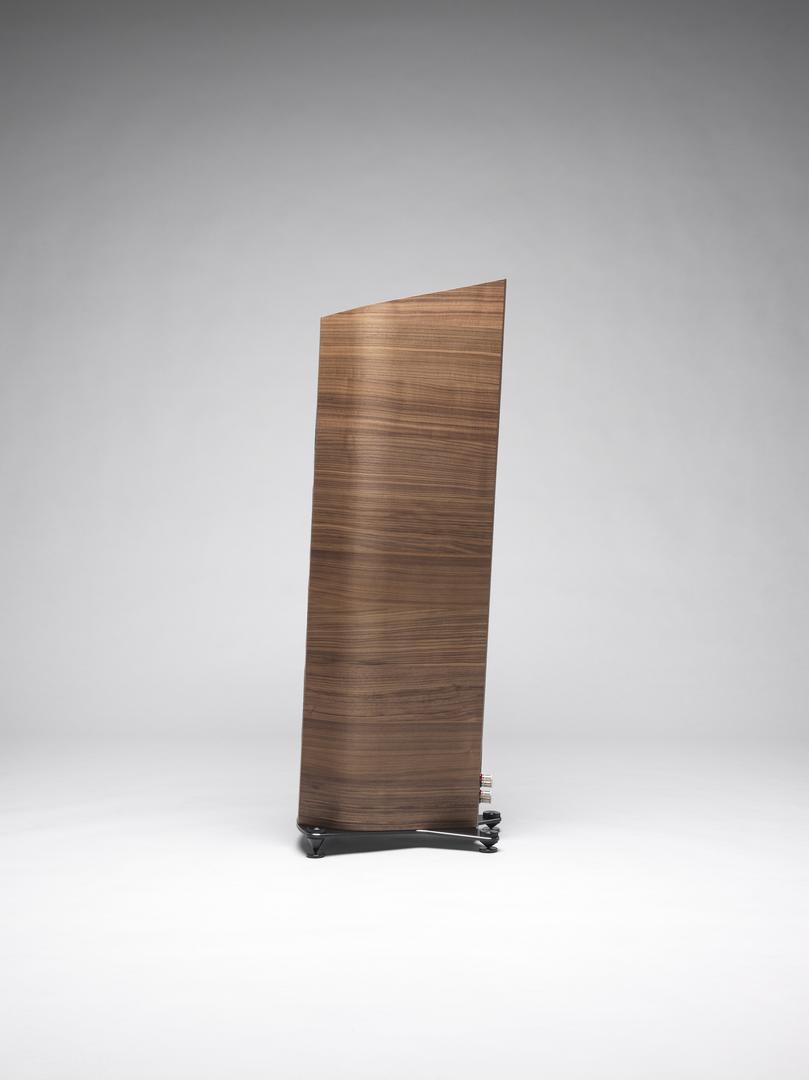
It’s the cabinet that really reflects the benefits of the Venere S’ Italian roots. The cabinet seems to pull together the clean lines of the Venere models (no ‘string’ grilles,  but drivers with their mounting points hidden behind brushed metal rings), elements common to all modern Sonus faber designs (a cabinet that is back-swept, boat-tailed, and features curved sides, with a rear-rising top plate), and factored in a level of richness of finish and attention to detail that has long marked out Sonus faber’s designs. In the process, Sonus faber has moved from a front-firing narrow port used in the other Venere models, to a downward firing port. This is proving to be a popular choice among designers now, as the engineering used in modern speaker cabinets makes this a near ideal position. Down-firing ports effectively maximise speaker placement without introducing port chuffing sounds; rear-firing ports require greater real estate behind the loudspeaker, while front-firing ports are more flexible and often more audible. This makes the out-rigger metal baseplate mandatory, it means the bottom-firing port must be unobstructed, and the baseplate must be parallel with the floor. In modern houses, this is generally not a problem (unless you are fond of deep shag-pile carpet or rugs, in which case ‘modern’ to you is about 1968 and you still use the word ‘groovy’), but can make installation more challenging in older properties where the floor can be somewhat uneven. In really ‘olde worlde’ properties, this could mean using a tape measure and getting all four corners of the Venere S level with the floor, rather than using a spirit level placed along the front of the baseplate.

This can make for a slow installation process as the loudspeaker also has a ‘magic’ point in the room where the degree of toe-in brings the soundstage to life, and the accuracy of plinth-floor installation transforms the bass. My recommendation is to anchor the toe-in to the optimum soundstage point, then fine-tune the plinth-to-floor distance. I’m normally a ‘pragmatism rules’ type who is happy with a compromise in installation, but while the Venere S sounds good in that compromise, it is capable of so much more if you really make these two aspects of the installation work for you.

Installation otherwise is straight forward (at least a metre from the rear and side walls) and the 90dB efficient, four-ohm load is untroubling to the kind of amplifiers (valve or solid-state) this speaker is likely to be used with. Yes, the natural partners here are other McIntosh Group electronics (Audio Research, McIntosh, Wadia), but realistically you could use this speaker with almost anything, and it sounded exceptionally good on the end of the Moon ACE tested in this issue. The speaker is supplied with provision for bi-wiring, but doesn’t seem to be too unhappy used in a single-wired context (you may want to replace the metal jumpers with something more in line with your choice of speaker cables, however). Our review sample arrived ‘well-travelled’ so any concerns about running in were long since passed and the speaker sounded great right out of the boxes. They are big boxes, too!

The sound of the Venere S is just as much a synthesis of Sonus faber sound as the technology is a synthesis of the company’s technology. The speaker combines the warmth and richness that remain typical Sonus faber characteristics from the Olympica and Homage lines, with the sense of directness and accuracy found in the Venere. It drips with what could best be described as ‘passion’ for the music played, or more accurately it invokes that passion in the listener, as you find yourself increasingly carried away with the music you are playing. The sign that the Venere S is doing the right things is you get carried away with almost any musical genre, too.

I started the session off with the overture to Gilbert & Sullivan’s The Pirates of Penzance [Decca Eloquence] – not fashionable, but entertaining, fun, and a perfect rendition of how good Decca engineers were in the late 1950s. The sense of ambience and the sheer musicianship of the orchestra were apparent from the outset, and you can’t help but develop that wry smile that accompanies 19th Century comic opera. The speakers really drew me into the album, and where I normally stop at the overture for reviewing purposes, the presentation was so alive and so much fun, I just listened to the whole thing. This highlighted another aspect of the Venere S’ performance – it’s vocal articulation. The patter song ‘Modern Major-General’ (sung here by Peter Pratt) requires both impressive diction on the part of the singer and absolute accuracy on the part of the loudspeaker. Any overhang or coloration and the rapid-fire singing ends up hard to follow, especially the lines “When I have learnt what progress has been made in modern gunnery/When I know more of tactics than a novice in a nunnery,” which can sound like the Muppets ‘Mahna Mahna’ song if not handled properly. Here, the detail, dynamics, resolution, and just plain deft handling of the articulation of the singer is excellent.


It’s not just wry comic opera that works with the Venere S. Short of black metal played loud (where things, perhaps unsurprisingly, get a little too shouty), the Sonus faber Venere S simply draws you closer to the music and helps you re-engage with the passion for sound that started you along this audiophile quest. As someone who churns through a lot of audio equipment in the course of the average month, it’s easy to get somewhat jaded, and the Venere S’ resparking of my musical passion is worth its weight in gold.

A £4,000 loudspeaker might seem a little ‘ambitious’ in an issue devoted to affordable audio excellence, but in fact it hits all those spots perfectly. The Sonus faber Venere S is materially good value in high-end circles (nromally you don’t get a box this big and this nicely finished in the high-end world without spending a lot more), it sounds excellent, and the only things that separate it from the best of the best are the extremes of frequency, and a lot more weight. As an introduction to what Sonus faber can do, the Venere models are hard to beat, but as an introduction to what Sonus faber can do when production is brought back to Italy, the Venere S is outstanding and comes highly recommended.

TECHNICAL SPECIFICATIONS

Type: Three-way floorstanding loudspeaker.

Drive units: 29mm fabric dome tweeter, 1×150mm polypropylene textile cone midrange driver. 3×180mm aluminium cone bass drivers. All drive units are custom Sonus faber designs.

Crossover points: 250Hz, 2.5kHz

Frequency response: 40 Hz -25.000 Hz

Sensitivity (2.83V/1m): 90db SPL

Nominal impedance: 4 ohm

Suggested amplifier output: 40W – 300W without clipping

Finish: Black, White, and Walnut

Dimensions (W×H×D): 39×124×48cm

Weight: 28.8kg

Price per pair: £3,998 (std), £4,198 (walnut)

Manufactured by: Sonus faber

URL: www.sonusfaber.com

Distributed by: Absolute Sounds

URL: www.absolutesounds.com

Tel: +44(0)208 971 3909

Back to reviews here

Read more Sonus faber reviews here

The EC Living concept by Electrocompaniet

Unless you have been living under a rock for the last few years, the fact the audio world has changed almost unrecognisably recently can’t have passed you by. CD and even download sales are in steep, and some say even terminal, decline, eclipsed by the new world of audio streaming. Our audio products are beginning to reflect this, but slowly. Electrocompaniet’s bold EC Living project is more than just grudging acceptance that times have changed; it’s a bold and powerful welcome to the future of audio.

EC Living is a simple yet deceptively clever, extendable, and extremely flexible set of products totally designed and built in Norway to grow with your musical requirements if needed, or remain just a single, network-connected box of tricks. The first two products out of the starting gates are the TANA SL-1, which combines loudspeaker, amplifier, and streamer in a cabinet about the size of a conventional two-way standmount design, and the TANA L-1, which is the wireless add-on speaker to turn a single SL-1 into a stereo pair. The SL-1 can be set up as a specific zone in a house, can run wired or wirelessly as a UPnP renderer, can support a USB stick, or local coaxial and Toslink digital connections. On the cloud, it can connect to Tidal (or sister channel WiMP in some regions), Qobuz, Spotify, and play internet radio. It will support practically any file, even up to 24bit, 192kHz PCM and DSD128. The TANA SL-1 can even support Apple AirPlay, although Electrocompaniet recommends not using this pathway when playing from Spotify or Tidal, preferring instead to use its own EC Remote App, or control direct from a computer.

Extendable means other products will become available in time. And this is related to what people need and where the music industry takes us over the next few years, rather than shoe-horning people into a fixed solution that no longer fits the world around us. The next product is intended to be the RENA S-1, a dedicated EC-Living streamer designed specifically to connect TANA L-1 speakers to make an alternate stereo system from the SL-1/L-1 package. Planned additional devices included multichannel surround systems, video streamers, or devices that allow EC Living to access an existing audio system, but these options remain truly open. Nevertheless, there are some pathways not open to the TANA SL-1 as it stands, such as Bluetooth. However, it runs along 802.11ac wireless protocols using Multiple Input Multiple Output (MIMO) channels, making the EC Living system about as robust as it gets in the widest number of homes without demanding ‘enterprise’ grade Wi-Fi.

Alongside the digital electronics side, the loudspeaker itself (whether SL-1 or L1) is a two-way bass-reflex standmount using custom specified drivers and an aluminium enclosure, coupled with a 150W Class AB (as opposed to Class D) power amplifier and some subtle DSP correction. The top panel is a neat glass effect and the speaker comes in a choice of black, silver, or shiny copper bases.


The top panel of the TANA SL-1 is the whole status indicator of the unit. The central Electrocompaniet ‘E’ glows as a power indicator, there are touch buttons for volume up, down, and standby. There are also three little indicators on the right hand side that give a surprising amount of status indication, from start-up to signal clipping.

How it works is as follows. You initially plug the TANA SL-1 into your Wi-Fi router using an Ethernet cable. This is more to establish a handshake between router and TANA SL-1 without having to manually enter the Wi-Fi password (as the TANA SL-1 only has three little display lights and no means of entering a password directly). Once you establish communications between your TANA SL-1, your iOS or Google Android device using the EC Remote App and run through the start-up and configuration procedure, the system will automatically do the rest. You will need to name your unit, set it for mono use or stereo with the L-1, test the audio output and network robustness, login, add your music files and services, and you are done. You can then go back in and reconfigure the TANA SL1 to be a wireless zone of the App itself, thereby allowing you to disconnect the unit from the network and use it wirelessly.

As with any computer-side process, describing it is usually more complicated than actually doing it. Here the system behaves so intuitively and logically it’s hard to think of using another system once you have acclimated yourself to it. And in many respects, the acclimation process is more about unlearning the idiosyncrasies of other systems, than it is learning how to use the EC Remote App. In essence, the way to think of it is simple (although it took me almost a week to unlearn other schemes to get to this point): The EC Remote app is the heart of the EC Living system, it follows you around, and you access the specific zone wherever you are. This runs in completely the opposite direction to something like the Naim system, which treats the app as a controller that connects to specific devices within their own zone. This might sound like a nuanced difference, but the older systems are more like client terminals in a traditional client-server network, where EC Living is more about network attached devices being accessed in an Internet of Things (IoT) space.

Other systems had the advantage of being first out the starting gates, but EC Living has the benefit of working in the way products are now working in the second decade of the 21st Century. This is why the EC Living was first shown to the audio press more than two years ago at Munich 2014 and is only now coming to market. It’s not that Electrocompaniet was dragging its heels; even by 2014, it was clear changes were happening to the way people acquire audio and those changes needed to be more robust and in place before EC Living could launch.

This getting it right for tomorrow is more important than it might first seem. Many ‘next-gen’ systems – even the really good ones – end up being compared to Sonos, and while sonically they are often superior, products that compete with Sonos tend to fall down on app control. And, the concern here was that EC Living would be yet another SuperSonos. That time spent understanding the market and learning how to create a true IoT device almost immediately breaks the connection with Sonos and makes it something subtly, but completely, different.

With one TANA SL-1 and one TANA L-1, our options for testing were a trifle limited; single zone single speaker, or single zone stereo speaker. Checking how well the system works with multiple zones remains untested, but the rest of the app is solid, and I suspect this aspect of the system would be just as untouched by performance problems as the rest of the system.

What I like about the EC Living system is it needs no apologies to be made about its performance. The loudspeaker behaves like a conventional ported two-way loudspeaker, and actually a pretty good one at that. It’s driven by a clean and organic sounding amplifier and the whole package sounds as good as many amp and speaker systems you could get for the money. In particular, it’s clean, fast, tidy, ordered, surprisingly deep, and keeps good time. It can go relatively loud, too, but this probably isn’t the first choice in home PA party speakers, even if its wireless capability means it can go practically anywhere there is a plug socket in a Wi-Fi connected home.

A system like this needs to be all things to all people, and the EC Living concept understands that on a cellular level. This is a system that’s made for Tidal; it comes alive when discovering new CD-quality streamed music files and both music discovery and on or off line listening with high-grade recordings is a pleasure. But, if you are out of luck and your next musical peccadillo is not in your own network connection or on Tidal or Qobuz, you don’t sacrifice too much by listening to Spotify. You can tell the difference in performance, but the difference in performance is not screamed at you with a thinner or grainier sound. And EC Living is even relatively forgiving of signal compression. It’s certainly more forgiving than I am; that Californication album by the Red Hot Chili Peppers [Warner Brothers] has some good tracks on it, if you can get past the fact that even the silences are too damn loud. For me, that is almost out the running for that reason, but the EC Living’s more diplomatic approach to music making helps make tracks like ‘Around The World’ seem almost listenable. Yet it manages to do this without sacrificing dynamic range and resolution when it’s called for.

Ultimately, the speaker compares well to bigger boxes thanks to that DSP tailoring, but if you compare it directly to a similarly-priced pair of standmounts, you’ll hear more naturally rich bass lines. The DSP is not heavy handed and means in most cases you’ll only notice this by direct comparison to a conventional system. But, as many of those prospective EC Living buyers will either already have a system and view this as an extension, or see conventional audio systems as ‘legacy’ or even ‘history’, I don’t think a little bit of subtle signal processing is much to bark about.

The really clever thing about this system – and I mean really clever – is there is no latency when adding a second loudspeaker to the system. Latency is acceptable (just) in mono, but in two channels it ends up making the sound more like reverberation than stereo. It’s the potential killer for any wireless networked audio system, but here it works perfectly. I suspect this harks back to placing the app as effectively more than just a controller. I did encounter one network drop-out moment where the whole system seemed to judder and there was a tiny degree of latency between left and right channels, but this was temporary and short-lived. I suspect the RENA S-1 and two TANA L-1 package will do the same.


Almost more important than the sound quality, it’s that app that really ties the system together. The seamless integration of your own music, Tidal, Qobuz, Spotify, and more shouldn’t be downplayed. It means the EC Living app really does hold the whole canon of music under your fingers in the same place. Other systems do this, but rarely to the same degree of integration or intuitive ease of use. I couldn’t give this to my granny because she’s been dead for decades, but it is the kind of system I can hand to a drunk cousin at a party and have them play their awful taste in music in seconds. And the robustness of the wireless network meant the same drunk cousin at a party could blare that sound out from the patio to the surrounding neighbourhood, all of whom now think I am a big fan of Billy Ray Cyrus and The Scorpions. Damn you Electrocompaniet. Damn you for making this system so easy to use.

Electrocompaniet took time to bring the EC Living concept to market, and for good reason. It actually wins out in the real world, making the system more ‘nowproof’ than many existing systems and that shows in the company it keeps. It is ideal for use with Tidal/WiMP and sings with high-quality streaming. The system in mono works perfectly, but the lack of latency when adding a second loudspeaker makes it one of the best in breed. More than just an up-market Sonos, EC Living paves the way for a more robust future audio system that doesn’t have to rely on shelves of electronics. And it sounds great, too. What’s not to like? Highly recommended for tomorrow’s sounds today!

TECHNICAL SPECIFICATIONS

  • Type: Network enabled active loudspeaker and speaker streamer
  • Supported protocols: Tidal/WiMP, Spotify, Qobuz, Internet Radio, SMB, NFS, USB storage, UPnP rendering
  • Supported audio formats: All popular formats including WAV/WAVE, MP3, AAAC+, Ogg Vorbis, ALAC, FLAC, APE, WMA, up to 24bit, 192kHz. DSD up to DSD 128 (5.6Mhz)
  • Connections: (SL-1) USB port, Toslink, coaxial S/PDIF, ECLiving link port, RJ45 ethernet, power socket
  • Wireless connectivity: 802.11ac with MIMO
  • Amplifier: 150 Watt Class AB
  • Loudspeaker: Two-way bass reflex loudspeaker with custom drivers
  • Enclosure: Aluminium
  • Finish: black grille, black, silver or copper base plate
  • Dimensions (W×D×H): 18×18×24cm
  • Weight: 6kg
  • Price: €768 SL-1, €659 L-1

Manufactured by: Electrocompaniet

URL: http://ecliving.electrocompaniet.no/?lang=en

Back to reviews

Read more Electrocompaniet reviews here

WIN! A fantastic Chord Hugo worth £1,400!!!

We have teamed up with those clever guys at Chord Electronics to give one lucky reader the chance to win a fabulous Chord Hugo Portable DAC/ headphone amplifier. The outstanding Hugo was reviewed by Chris Martens in issue 111 of Hi-Fi+.

Chris wrote, “All it takes is a few minutes of listening to the Hugo to recognise that it possesses that elusive ‘X’ factor, which marks the difference between very good products and truly special ones that touch on greatness. No one sonic characteristic steps to the foreground to define this product. “Hugo’s FPGA DAC supports 26k tap-length digital filters, whereas Chord says conventional DACs are limited to about 150 tap-length filters and claims even the largest commercial DAC chips offer ‘only about 250 taps’.”

This is currently the must-have high-performance portable DAC for the discerning audiophile on the go. A Hugo should set you back £1,400, but here’s how you can win one!

Competition Question

How many tap-length digital filters can the Chord Hugo support?

A. 150

B. 250

C. 26,000

To answer, please visit Chord’s dedicated competition page at www.chordelectronics.co.uk/news-info.asp?id=215

Alternatively, send your answer on a postcard (including your name, address, and contact details) to:

Chord Hugo Competition,

The Pumphouse,

Farleigh Bridge,

Farleigh Lane,

East Farleigh,

Kent,

ME16 9NB.

Competition Rules

The competition will run from September, 8th 2016 until November, 3rd 2016. The competition is open to everyone, but multiple, automated or bulk entries will be disqualified. The winner will be chosen at random from all valid entries, will be contacted via email (where possible) and their name will be published in the magazine. The Editor’s decision is final and no correspondence will be entered into. Absolute Multimedia (UK) Ltd. is compliant with the Data Protection Act and UK laws apply. Our policy is such that we will not pass on your details to any third party without your prior consent.

Sennheiser HD 630 VB headphones

The top HD range from Sennheiser is the brand’s home audiophile range, but the pivotal word is ‘home’. Open backed designs that need good upstream amps and DACs to drive them, the HD 500, HD 600, and HD 800 series are not really models for travelling and commuting: I do know someone who travels with a Chord Hugo powering a pair of HD 800, but he uses that rig in the hotel room rather than in transit. The HD 630VB is the exception – it’s every bit a part of the HD range, but folds away, comes in a travel case, and even includes an in‑line microphone.

The rounded, closed-back, over ear HD 630VBs are neatly finished in (mostly brushed) silver and dark blue-grey, with red contrasting cloth inside the ear-cups. The cups and headband are high-grade ‘pleather’, which is both hard-wearing and not aromatic. The overall look is one of sophistication and elegance, aided by the single gimbal headphone band connector. It’s not a heavy headphone either to carry or wear, although the large black cake-tin carry case does add bulk to the package. The HD 630VB has a captive lead (with in-line microphone) and a stereo 3.5mm TRS jack plug (a mini-jack to 6.3mm jack plug adaptor is supplied in the case).

The business end is all on the right ear cup. There is a little switch marked ‘I/G’ by the cable strain-relief, to switch between Apple iDevice and Google Android use. The centre of the right-hand ear-cup is given over to track and phone-handling options normally assigned to an in-line pod. This means volume adjustment, track handling, and call handling can be assigned bigger and more easy to use buttons than the tiny ones on a cable pod. It also allows listeners to access Siri and Assistant voice commands. The captive cable is mostly very good at eliminating conduction noise, although the cable around the microphone is itself slightly microphonic.

The HD 630VB is based around a single transducer said to be able to deliver sounds from 10Hz to 42kHz. The headphone is rated at an impedance of 23Ω, which – coupled with a suggested 114dB sound pressure rating (measured at 1kHz and at 1Vrms) – means the Android/Apple implementation isn’t just for show and the headphones will comfortably work straight from a phone. The 50Hz bass end of the frequency response features a +5dB boost or a –5dB cut, thanks to the variable bass controller, on the rim of the right hand ear-cup. This is infinitely adjustable, although there are marks on the side of the ear-cup denoting 12 steps above or below ‘flat’.


I have to admit starting out with some puritanical bias against the Sennheiser HD 630VB, simply due to that suffix. “It can’t be as good as the fixed bass versions,” ran the prejudice, “simply because it doesn’t have fixed bass”. In fact, all that comes down to bias without any real-world basis. In outright performance terms, the HD 630VB sits somewhere closer to the HD 600 than it does the Momentum series. It really does live up to the ‘HD on the move’ concept.

There are three ways of looking at the VB suffix of the HD 630VB, all good and all relevant. You can think of it as the perfect way of tailoring bass to suit the listener, the bass to suit the environment, or as a systematic desensitisation program for Beats users. The bass of the HD 600 series Sennheiser sometimes get criticism from both sides; some find it a little too ‘audiophile’ and bass light, yet paradoxically some audiophiles find it too bold and strong in the bass. The variable bass system allows listeners to adjust the bottom end to suit and, unless turned to the maximum setting, it never impacts further up the frequency range. This also helps tame some more bass-wayward recordings, although thinking of the VB system as a tone control isn’t that smart. I’ve found that in noisy environments (the London Underground, for example) bass is slightly more likely to be swamped than midrange or treble, because of the degree of isolation offered by the HD 630VB is so good. The VB system offers some compensation, allowing the listener to retain the good bass of the headphone in less than accommodating environments.

Then there is the bass-heavy deprogramming option. Despite performance to the contrary, bass-oriented headphones remain popular with many listeners, but they are regularly sold more on looks than on sound, and some people who like good sound end up going down this big-bass sideline. The VB can be used to wean people off overpowering bass; start with the bass control at ‘Max’, then gradually reduce the setting to more accurate levels. After some slow, methodical bass reduction, try your older headphones, and discover just how awful they always sounded.

The great thing here though is the headphone’s bass is mostly subtle and well controlled. It is slightly more bass-oriented than its stay-at-home siblings, but bass is more of an accent than a feature, and best of all this bass system never impinges on the midrange and top, even at its most bass-heavy setting. As such, adjustment is more about balancing bass ‘texture’ to suit the surroundings and the listener. In fact, it’s more about bringing genuine HD 600 series performance to the open road, train carriage, or aircraft cabin. It’s not a closed back design that sounds like an open-backed headphone, but it gets surprisingly close.


There’s not a lot with which to find fault here. The use of a captive headphone lead seems a bit odd in today’s market. I’d prefer something more immediately replaceable, if only to prevent breakage. But that’s splitting hairs – when you think not only what the HD 630VB does, but also how effortlessly it does it, you can’t help but be impressed.

The HD 630VB is a welcome addition to the Sennheiser line. The sound quality is somewhere between good Momentum and HD models, retaining the closed-back isolation of the former with much of the transparency of the latter, together with a (for the most part) limited and sophisticated bass tailoring, and the ease of driving that puts it on the end of iPhones, Androids, and DAPs. That makes it a high-end Sennheiser headphone that goes with you everywhere, and that is an easy headphone to recommend.

Technical Specifications

  • Type: Circumaural, dynamic, closed back headphones with variable bass control
  • Ear coupling: Circumaural
  • Transducer principle: Dynamic, closed
  • Frequency Response: 10–42,000 Hz
  • Impedance: 23Ω
  • Sound Pressure Level: 114dB (1 kHz / 1Vrm)
  • Total harmonic distortion: < 0.08% (1kHz, 100dB)
  • Bass Boost: +/– 5dB at 50 Hz
  • Contact pressure: 5.5 ~ 6.8N
  • Weight (headphones excluding cable): 400g
  • Accessories include: carry bag and 3.5mm to 6.3mm adapter
  • Price: £399.95

Manufactured by: Sennheiser

URL: www.sennheiser.com

Tel (UK only): 0333 240 8185

Back to reviews

Read more Sennheiser reviews here

ENIGMAcoustics Dharma D1000 hybrid dynamic/electrostatic headphone

Most audiophiles first learned of ENIGMAcoustics through the firm’s Sopranino self-biased electrostatic supertweeter (reviewed in Hi-Fi+ Issue 99), which was developed as an add-on enhancement for use with high-end loudspeakers. Later, applying Sopranino technology in a loudspeaker of its own, ENIGMAcoustics brought forth its versatile and accomplished Mythology M1 hybrid dynamic/electrostatic standmount monitor (reviewed in Hi-Fi+ Issue 125). Now, the firm has applied the design concepts behind the Mythology M1 loudspeaker in a personal audio context and the result is the Dharma D1000 hybrid dynamic/electrostatic headphone that is the focal point of this review.

Before delving into the thick of the review, though, it occurs to me that some of you must surely be asking, “What exactly are self-biasing electrostatic supertweeters and why are they ostensibly things audiophiles might want?” Both are fair questions. Most electrostatic drivers use thin-film driver diaphragms to which very high bias voltages must be applied, with the bias voltage typically being supplied from an onboard power source (as is the case with virtually all electrostatic loudspeakers) or—in the case of most electrostatic headphones—from a purpose-built electrostatic amplifier that delivers the appropriate bias voltage to the headphone.

ENIGMAcoustics has taken an entirely different approach by creating a proprietary self-biasing system where the electrostatic driver in essence becomes its own bias voltage source. As you can imagine, this is a hugely significant advancement, in particular for headphones, since it means users can enjoy electrostatic headphones that emphatically do not require dedicated electrostatic amplifiers. You read that last line correctly; the Dharma D1000 can be driven by most any conventional headphone amplifier, or even by small portable amps, digital audio players, smartphones, or tablets.

But next, there is the second part of our hypothetical question. Why are electrostatic supertweeters desirable to use for music playback? In the Dharma D1000 owner’s manual ENIGMAcoustics offer the following succinct justification for its design choices.

“Music passages contain overtones and transient information beyond the range of human hearing. Why, then, try to retrieve it? The answer is simple. Those tones we do hear sound more natural when they are reproduced in the company of their harmonics. Listeners will in fact hear more midrange articulation—not just the air and sparkle associated with extended high frequency response.”


The Dharma arrives in a handsome matte black case trimmed with tasteful silver lettering and the company’s logo. Within, one finds the headphone along with a high-quality, fabric-jacketed 3m signal cable, a 6.35mm to 3.5mm adapter plug, and the aforementioned owner’s manual. First impressions are that the D1000 is a refined design that visually conveys a sense of quiet, understated elegance, with an emphasis on functionality and straightforward ergonomics.

The Dharma D1000 is a full-size, open-back, over-the-ear headphone. The D1000’s frame is an arch-shaped structure, padded on top, to which are fitted semi-circular support arms and articulated circular yokes that enable the headphone’s ear cups to swivel in both the vertical and horizontal axes. Suspended below the arch-shaped frame is an elastically supported headband pad covered in an open-weave, breathable mesh-type fabric. This flexible pad offers a generous amount of surface area, and can stretch to provide a comfortable fit for wearers of varying head sizes.

The ear cups of the D1000 are fairly large in diameter, meaning the Dharma should offer a spacious fit for virtually all listeners—even those with large ears. Within each ear cup is a 52mm dynamic driver with a Washi paper diaphragm. The dynamic driver covers low and middle range frequencies over the range of 5Hz to 5kHz; above that frequency, ENIGMAcoustics’ signature SBESL (self-biased electrostatic) driver takes over.

For those not familiar with Washi paper, the material is a thin, light, yet deceptively strong type of paper first created in Japan. Normally we think of paper as being very fragile or lacking in durability, but once treated for moisture resistance Washi paper has more in common with high-tech textile materials than it does with traditional paper goods. In short, it’s a versatile and desirable material from which to make responsive, low-mass driver diaphragms.

Interestingly, the D1000’s dynamic drivers are not centred in their respective ear cup frames, but rather are positioned forward of the ear cup centre-line, with the drivers angled slightly rearward toward the wearer’s ears. Similarly, the SBESL driver assembly is mounted on an angled flange adjacent to the dynamic driver. Both drivers are covered by a protective mesh grille cloth, which ENIGMAcoustics advises users not to remove.


The rear sides of the Dharma’s ear cups are fitted with perforated metal mesh covers pressed into gently flared shapes reminiscent of the bells of horns (albeit somewhat flatter in profile). The rear sides of the cups are then finished off with screen-like metal endcaps with black and silver trim rings, with the headphone’s serial number on the ring on the right side ear cup. Finally, on the lower rear quadrant of each ear cup ENIGMAcoustics provides recessed signal cable connection sockets that incorporate keyed slots corresponding to metal alignment tabs found on the Dharma’s signal cable plugs.

Although the D1000 nominally weighs 450g, it subjectively feels lighter than that, offering a fit that is as comfortable at the end of long listening sessions as it was at the beginning. For my tests, I ran the Dharma’s in conjunction with a Windows/jRiver Media Center-based music server and the superb Chord Electronics Hugo TT desktop headphone amplifier/DAC. While the headphone is sensitive enough to be driven by smartphones or tablets, it is so revealing and nuanced in its sonic presentation that I suspect most users will want to use it with the highest quality DACs and amps they have available.

What did my listening tests reveal? First, they showed a design that goes far beyond the usual tropes about ‘seamless blending of disparate driver types’. Sonically speaking, what the Dharma does is more akin to the creation of a new alloy, where two materials with different but complementary qualities merge to form a new, third material that combines the best of both. In the case of the Dharma, the Washi paper dynamic driver offers excellent dynamic agility, powerful (but not overpowering) low-frequency extension, and a wonderfully natural and almost organic quality of tonal purity. In turn, the SBESL tweeter, whose output is kept strictly in phase with that of the dynamic driver, offers smooth and profoundly extended reproduction of high frequencies, coupled with extraordinary transient speed (and thus the effortless ability to render high-frequency overtones, transient events, and the elusive sense of ‘air’ surrounding instruments and vocalists). But fuse these qualities together in one headphone and you’ve got something that, in my view, offers serious musical magic.

To give you a handful of musical examples that illustrate the Dharma’s ability to serve up ‘magic on demand’, let me begin with the track ‘Purple Haze’ from bassist Michael Manring’s Drastic Measures [Windham Hill, CD]. Manring performs his homage to Hendrix on a Zon fretless electric bass that, when slapped or tapped, can produce thunderclap-like low bass transients, but that also is—in Manring’s hands—capable of brilliant, shimmering high frequency overtones. The Dharma deftly tackles the track with an unexpected (and frankly, rarely heard) combination of dynamic gusto, wide-range frequency response, and a quality of almost ethereal delicacy.

Or to supply a quite different illustration, try any of the tracks from classical guitarist Philip Hii’s interpretations of Frederic Chopin’s Nocturnes for piano [GSP, CD]. Throughout the recording the D1000 manages to capture perfectly the lithe, fleet-footed quality of the classical guitar, along with its naturally warm and woody tonality. But no less important, the Dharma’s ability to render subtle overtones and high frequency air in records not only enables the guitar to sound reach-out-and-touch-it real, but also captures the acoustics of the recording venue, thus providing a believable context in which the performance can unfold.


Finally, consider the Dharma’s handling of the final few minutes of Mahler’s Symphony No. 8 as performed by the San Francisco Symphony with Michael Tilson Thomas conducting [SFS Media, 96/24]. Arguably the most dramatic moments in Mahler’s most dramatic composition, these symphonic passages weave their way back and forth between almost whisper quiet vocal and instrumental sections on through to the most powerful and complex moments of which world-class orchestras and choirs are capable. The Dharma D1000 navigated its way to the finale with a truly impressive combination of power, subtlety, grace, and sheer bravado. Listening to the conclusion of Mahler’s Eighth through a headphone this good reminds me why high-end hi-fi is worth the effort.

ENIGMAcoustics’ Dharma D1000 is a delightful, highly capable, world-class headphone that is reasonably priced for the very high levels of quality on offer. Give it a listen, but beware: to hear it is to want it!

TECHNICAL SPECIFICATIONS

  •  Type: Circumaural, open-back, hybrid dynamic/electrostatic headphone
  • Driver Complement: One 52mm dynamic driver with Washi paper diaphragm and one proprietary SBESL (self-biased electrostatic) driver per ear cup.
  • Frequency Response: 5Hz – 40 kHz
  • Impedance: 26 Ohms
  • Sensitivity: 103dB@1Vrms
  • Distortion: <0.3% (1 kHz @ 1mW)
  • Accessories: 3m fabric-jacket signal cable, 6.35mm – 3.5mm adapter plug, user manual
  • Weight: 450g
  • Price: £1,195, $1,190

Manufacturer: ENIGMAcoustics, Irvine, CA USA

Tel: +001  (949) 340-7590

URL: www.enigmacoustics.com

UK Distributor: Select Audio

Tel: +44 (0)1900 601954

URL: www.selectaudio.co.uk

Back to reviews

Read more ENIGMAcoustics reviews here


Dynaudio Emit M20 standmount loudspeaker

Dynaudio is in its 40th year, with a product range that includes speakers for cars and pro audio alongside all manner of domestic designs. The Danish company also expanded into wireless technology back in 2012, with its Xeo range; the only decent sounding wireless speaker I have heard thus far. The brand first made an impression on me in the mid 1990s, when B&W organised a visit to the Whitfield Street studio in Soho to meet Airto Moreira who was recording for their label at the time. The sheer volume level that the Dynaudio monitors were pumping into the well-damped control room only became apparent when a pair of B&W Silver Signatures were substituted and struggled to maintain the level. This was an active to passive transition, but nonetheless it illustrated how much power a pro monitor can deliver while maintaining an even keel.

Dynaudio’s Emit series is their latest entrant into the hotly contested affordable end of the market. The range is made in Denmark, so it’s not beer budget, but the three stereo models and a centre channel in the range are the most affordable that the company makes. The Emit M20 is the larger of two stand mounts and has a 17cm (near 7inch) main driver combined with a soft dome tweeter in a matte black (or white) box that is largely devoid of styling save for a chamfer around the front baffle. It’s a conservative piece of industrial design that should ensure it remains timeless. The back panel is a little plain for the price with basic single wire terminals, but the flared reflex port looks solid enough. The driver side of the cabinet has grille fixing sockets, so the Emit M20 looks better fully clothed in its grille cloth and doesn’t seem to suffer sonically as a result. A Bowers & Wilkins 685 S2 at £100 less has shiny bi-wire terminals, but that feature is not necessarily a great sonic benefit; one run of £100 speaker cable beats two runs of £50 cable every time.

Dynaudio continues to use magnesium silicate polypropylene (MSP) for its driver cones, a material that the company developed for its earliest products and maintains to have the best combination of stiffness and self-damping that it has found. Some credence is given to this claim by the amount of other speaker companies around the world that have incorporated Dynaudio drive units into their designs. The UK arm of the company suggests it gets a steady stream of demand for replacement drive units that the brands concerned can no longer supply but which Dynaudio can build from scratch because it still has all the original tooling.

At £599, the M20 is only £100 more expensive than its brother the M10 which seems an odd approach in marketing terms at least, as the M10 has a 14cm main driver and a slightly easier 6 Ohm impedance than the 4 Ohm nominal impedance of the M20. All of this makes the smaller speaker an easier load that does not require a big amplifier, but the M20 is claimed to have an even impedance load that, allied to its 86dB sensitivity, means you shouldn’t need more power than an integrated amp at the same price can deliver. The question is how does Dynaudio manage to keep the price of the M20 so close to the M10? Clearly not in the construction;  the closest to cost saving on the inside is the use of a steel rather than cast aluminium basket on the mid/bass driver. This driver still has a large (75mm) aluminium voice coil and a double symmetrical magnet with the aforementioned MSP cone, so no (other) corners have been cut in driver quality. Similarly, the tweeter has an aluminium voice coil and uses ferrofluid to keep things cool at high SPLs. The crossover incorporates air core inductors, low loss dielectric capacitors, and zero compression resistors, all of which bode well for sound and longevity. While some similarly priced alternatives have more luxurious finishes and terminals, Dynaudio spends the money on the bits that matter to the sound – a brave move in an era when so many listen with their eyes.


In the listening room sitting atop Dynaudio’s attractive stands with their sandwich construction top and bottom plates, the Emit M20 is a remarkably effusive and bold sounding speaker. It delivers bass, dynamics, and energy that are not expected at the price. And I wasn’t using a high end, high power amplifier to achieve this result; rather I used a Rega Elex-R (72W/8 Ohms), which is my go-to affordable integrated amp. Speaker set-up (courtesy of Dynaudio UK) was with the Emits toed in such that the axes crossed in front of the listening position; I also tried pointing them straight at the listener but this proved to be a little bright, so they were returned to the original orientation. The rear port did what such things sometimes do in my room, and caused certain bass notes to be amplified to the point of discomfort. This happened even with the speaker well out from the wall (front baffle at 90cm), making the M20 a try before you buy speaker or one that will suit drier sounding rooms at least. I tried blocking the ports with the supplied foam bungs and that did cure the excess, but as ever with bungs it also restricted dynamics and the sense of openness that are among this speaker’s strong points.

And there are many of many of those strong points. The M20 is remarkably good at reproducing drums, for a start, with the playing by two drummers on ‘Bermuda Blues’ by the Henry Threadgill Sextett [You Know The Number, Novus] reveals just how much dynamic range and bandwidth this speaker has to offer by sounding very convincing. This is achieved while delivering the swing that this very able band delivers in the context of a muscular performance. The quality of timing on offer is likewise better than you might expect of something so large for the price. It illustrates the advantage that standmounts have over their more elegant floorstanding brethren; the smaller the box the less it colours the sound and the faster the speaker can stop and start. The M20’s cabinet is not totally inert, but it’s quiet enough to get the job done quick smart.

Jan Lisiecki’s Chopin Études [DG] illustrated how well it deals with dynamics as well; the piano has real body and power, but it keeps the distance between quiet and loud notes as wide as they should be, doing so whilst revealing the shine of the instrument’s tone and the fluency of the playing. Keith Jarrett’s piano on ‘Part VII, London’ [Paris/London – Testament, ECM]is bold and strong, the thump of his foot on the stage is convincingly low, and the timing that is the key to his appeal is right on the money. A smaller speaker might give you a cleaner, tighter result, but it’s the bandwidth that makes live recordings like this sound so real. There is always a balance to be struck with loudspeakers and the more affordable they are the tougher it is to get it right, but Dynaudio has done just that with the M20.


With more subtle pieces like Arvo Pärt’s sublime Tabula Rasa [ECM] this speaker’s dynamic range allows the music to build and build without losing composure. This is not an easy album to reproduce well, as the string tone is quite harsh in places and the power it requires when things get to a crescendo is pretty demanding, so you need a speaker that is tonally even handed and that does not start screaming when the going gets tough. I don’t usually play this music on relatively affordable speakers for this reason so I was pleasantly surprised at how well the M20s coped. The icing on the cake was how good Astral Weeks sounded [Van Morrison, Warner Bros]; there is a lot going on in ‘The Way Young Lovers Do’ but it’s a brilliant piece of music if the system is up to the job. This proved to be the case so comprehensively that I had no choice but to listen to the rest of the album, and would happily have done so again.

Dynaudio has done a fine job of combining low colouration, wide bandwidth, good timing, and dynamic range in such a competitively priced loudspeaker. The rear porting might be an issue in some rooms, and bigger spaces will be best, but that aside it’s hard not to like this loudspeaker. It may not look particularly fancy, but it sounds better than much of the competition at £600 and several hundred pounds more. Combine this with the company’s reputation and you have a speaker that will keep any music lover away from the TV forever more.

TECHNICAL SPECIFICATIONS

  • Type: 2-way, two-driver stand-mount monitor with rear‑ported bass reflex enclosure
  • Driver complement: One 28mm soft dome tweeter, one 170mm MSP mid-bass driver
  • Frequency response: 50Hz – 23kHz
  • Crossover frequency: 2.6kHz
  • Impedance: 4 Ohms
  • Sensitivity: 86dB/W/m
  • Dimensions (H×W×D): 355 × 214 × 265mm
  • Weight: 7.5kg/each
  • Finishes: Matte white, matte black
  • Price: £599

Manufacturer: Dynaudio

Distributor: Dynaudio UK

URL: www.dynaudio.com

Tel: +44(0)1638 742 427

Back to reviews

Read more Dynaudio reviews here

Cro Audio Turntable Stone Weight and Record Mat

The audio accessories world has gone a little bit loopy of late. The fact you can spend more money adding the right cables and equipment supports to hook up an £80,000 dCS Vivaldi four-box stack than you might spend on the dCS Vivaldi itself points to a world out of balance. But it needn’t be this way. Cro Audio’s new turntable mat and record clamp have all the right high-end credentials and sound quality, just not the price tag.

The ‘Cro’ in Cro Audio is short for Croatia, and the most obvious sign of the brand’s Slavic roots is the company’s Turntable Stone Weight. This is a machined and polished puck of Dalmatian Brac limestone, with a rubberised cork particulate surface facing the record, and a little black rubber o-ring set into the pale stone surface to make handling the polished weight a little easier. The weight notionally weighs 450g, but being made of natural stone, there is slight variance in the weight, and our sample came in at 446g. It’s supplied in a nice little cardboard gift box, about the size of a small tube of Pringles.

Of course, adding a half-kilo weight on the spindle of an LP means this weight isn’t designed for use with most suspended turntables (although some of the more heroic suspension systems – like the SME Model 20 and 30 – could accommodate the Cro Audio turntable weight), but it works well on many rigid decks. There is no screw thread on the weight, just pop it on the spindle and play.

Currently, the other product in the Cro Audio range is an LP mat. Like the base of the weight, this is made of a proprietary mix of cork and rubber particles. The mat is available in two different thicknesses; 2mm, for those with existing felt mats and no means of adjusting the arm’s vertical tracking angle (Rega springs to mind here), or 3mm for those who want the maximum Cro Audioness and can adjust VTA accordingly.


Cork is a surprisingly good material to use with some platter designs as the interface between LP and everything else because it has good antistatic and antimicrobial properties, and it’s a natural sound absorber. Rubber is also good because it limits any slip that might occur on a felt mat, and will reduce some of the potential for ringing on a polished aluminium platter. The two combined seem to bring the best of both worlds to the slip-mat, in the process maximising the number of places a replacement mat might work best – rubber is a good replacement for felt on metal platters, cork is better for glass platters, and rubberised cork seems to have a more even-handed nature.

Of the two though, I think the influence of the weight is the greater. The mat is good, and it’s a great leveller in that it works across a wide variety of platter types, but the weight has the greater overall effect on the sound quality itself. On my VPI Prime, replacing the screw-in clamp with the half-kilo weight did give the sound better high frequencies, especially with fast-transient instruments like cymbals. Cro Audio itself claims the weight acts to reduce vibration, and that certainly seems to be the case in the listening.

The other big improvement in using the Cro Audio Turntable Stone Weight is in the stability and size of the soundstage. For this, out came an old recording of the RPO and the D’Oyly Carte company performing the overture to The Pirates of Penzance [Decca SXL], a recording that is both outstanding in terms of presenting a (literal) stage in front of the listener, and in terms of placement of musicians within the image. It’s also notable for a distinct tape ‘wobble’ that made it both to LP and subsequent CD. The Cro Audio weight helped make that orchestra pit have the correct dimensions, and gave every instrument a solid place within that soundstage, which even stayed true during that tape problem.

How big or small a difference I think is turntable dependant. The Prime is relatively self-sustaining in this respect, and the difference between its supplied clamp and some of the more ornate models out there are somewhat lessened and what improves seems to be in the areas of high-frequency transients and tonality, and soundstage openness. Aspects like bass depth and dynamic range are already well defined on the Prime, and the Cro Audio weight helps, but not substantially.

The differences aren’t massive between the Turntable Stone Weight and the standard clamp, and there is a level of improvement wrought by the really expensive clamps that Cro Audio doesn’t quite achieve. But, you could buy several Cro Audio weights for the cost of one of these ultra record clamps, and the operative word is ‘quite’; this gets you 90% of the way there, and that last 10% costs a lot of money.

Cro Audio’s two products combined do make for a better performance than the sum of the parts. The mat and weight do seem to bring out superior dynamics, tighter bass, and just snap the sound more in focus than the two taken separately. The oft played Mo-Fi version of Beck’s Sea Change is a perfect example of how this works, because his voice is locked optimally between the speakers instead of wavering slightly in the standard Prime guise.

In an audio world where expensive is par for the course, it’s a refreshing change to find products that improve the performance of a turntable without costing a small fortune. The Cro Audio Turntable Stone Weight and matching rubber/cork mat fit that bill perfectly. While it’s true that if you spend more you get better, you actually need to spend a lot more to get a little better. As a result, the new Cro Audio turntable accessories are an obvious recommendation.

Prices

Cro Audio Turntable Stone Weight: £89

Cro Audio Record Mat: £39 (2mm), £45 (3mm)

Manufactured by: Cro Audio

Distributed by: Audiofreaks UK

URL: www.audiofreaks.co.uk

Tel: +44(0)208 948 4153

Back to reviews

Read more Cro Audio reviews here

AudioQuest DragonFly Red and DragonFly Black DACs

AudioQuest has been making the DragonFly portable DAC since 2012. The DAC’s appearance hasn’t changed much, but it’s been through two iterations, and now there are two new models vying for your readies. Up until now it has not been possible to use a DragonFly with most tablets or mobile phones because the USB controllers in these devices limit the amount of power that they let a device draw  (for example, when iOS 7 came out the Apple devices that ran it restricted power output to 100mA). The previous generation of DragonFly, v1.2, could be used with some Android phones, but it would not have had a positive effect on battery life.

Given that the smartphone sector has the potential to outstrip the computer audio market by a huge margin AudioQuest has understandably been very keen to find a solution to this USB power puzzle. The company made the breakthrough two and a half years ago when Gordon Rankin and Steve Silberman found a semiconductor company called Microchip that makes low-noise micro-controllers for all kinds of applications, including linear measurement. Microchip has a low power range of micro controllers that draw considerably less power from a USB host and allow use with all smartphones on the market. It took this long to get to the new DragonFlys to market because AQ needed to write control code and develop protocols to use the new chips.

The new DragonFly Black (v1.5) uses Streamlength software and a 32-bit ESS 9010 DAC developed fro mobile applications and that runs PCM and DSD, but AudioQuest’s choice of micro controller limits sample rate to 96kHz. None of AudioQuest’s portable DACs cover higher sample rates or DSD because of the radiated noise created by the current crop of high-speed USB micro controllers. In the confined space of a portable DAC like a DragonFly, which is only 63.5mm long, this noise undermines the sound quality so significantly that it renders higher sample rates pointless.

The new DragonFly Black is £40 cheaper than the previous version at £89 – an achievement AudioQuest puts down to higher production runs and because the new DAC uses the clock in the converter chip itself instead of having a separate crystal clock.


The £179 DragonFly Red uses the same receiver chip as the Black, but has an ESS 9016 DAC, a strong contender in the best mobile chip that company makes. It has an excellent signal-to-noise ratio, multiple power supply taps, and an ESS headphone amplifier with a 2.1-volt output that can drive more demanding phones. The other significant factor is a 64-bit digital volume control rather than the analogue one in the Black. Both DragonFlys are upgradeable via firmware so that they can adapt to future requirements: MQA was mentioned as being on the cards, if the format proves to have legs.

Both DACs can be used with iOS devices if you buy Apple’s ‘camera kit’ that converts any USB input to Apple’s Lightning connector. For Android users, AudioQuest makes a dedicated OTG (on the go) connector for phones with a micro USB connection called the ‘DragonTail for Android’. Being an open source system, not all Android phones are compatible with USB DACs because the phone manufacturer needs to enable USB audio support. However, I’m reliably informed that most Android smartphines and tablets designed for use with Lollipop (or later) OS are fine. You can check out compatiblity using an app called USB Host Check that’s linked from the DragonFly FAQ page.

It’s naturally a lot easier to use either DragonFly with a computer and a good piece of audio replay software, as you just need to remember that the PC’s volume control acts as a proxy for the volume in the DAC. So, if you are using iTunes, for instance, then push the iTunes volume to max and use the PC’s volume buttons. With my preferred player, Audirvana Plus, you use the volume knob on its graphic, unless you are integrating Audirvana with iTunes of course. In a domestic situation where you are connecting the DragonFly’s 3.5mm jack to an amplifier or preamp, set the volume to maximum in the software/computer and use your amp’s controller. AQ says that volume should automatically be maxed by the DAC in this situation too, but that seems to be software dependent.

As I have a v1.2 DragonFly, I contrasted it with the new Black v1.5 and was surprised to find that the original has a higher output (I had not looked at the spec at that point), but once that was accounted for, it became obvious that the new Black is superior. It reveals more ‘air’ – that is, the acoustic of the recording venue, which is essentially its reverberant character–and has better timing thanks to stronger leading-edge definition. The slightly soft nature of the earlier DAC made it more accommodating for lesser quality sources, but also denied the fine detail that is the purpose of adding a DAC to a device like a computer (that already has one). This result was achieved with a Macbook Air, which is not the greatest of computer audio sources, but the DragonFly proved that it can produce decent immediacy and impressive low-level resolution with a good recording such as John Eliot Gardiner’s Beethoven The Symphonies [Orchestre Revolutionnair et Romantique, Archiv], which made for a performance with lovely restraint. This gives the music something akin to torque, a sense that there is an immense amount of power being held in reserve.

‘Ful Stop’ from Radiohead’s rather more contemporary A Moon Shaped Pool [XL] is a little edgy but powerful and has plenty of drive and even if the bass is not quite as well articulated as it can be, it’s pretty close. Leading edges are well-defined on ‘Don’t Let Your Right Hand Know’ by Sonny Boy Williamson [Keep It To Ourselves, Analogue Productions], where the finger clicks are precise and clear while remaining as natural as the horny fingers of an old bluesman can sound! This is a great recording with lots of background sounds and decent reverb, and the Black does a pretty decent job with it. With a considerably more refined blues recording, like ‘Too Many Misses’ by Doug MacLeod [Exactly Like This, Reference Recordings], the bass drum has plenty of body, dynamics are good, and the voice projects well. This track does have more depth than the Black reveals, and that becomes apparent when switching to the DragonFly Red, which adds tension, drive, and vitality to the mix. It has a notably higher output than the Black (useful for driving more difficult headphones), but even when you compensate for this there is a lot more detail and air in the soundstage. It also sounds better when attenuating the two outputs with the onboard volume control. The Black loses dynamics and leading-edge definition, and while the Red performs in a similar manner, it does so to a lesser degree. There is still a benefit to keeping the DAC’s volume at maximum if you can, however; subtlety and depth of image both increase quite markedly with it set this way.

With the volume all the way up, the aforementioned Radiohead track sounded massively expansive and the guitar was really well rendered. Bass power is still not up with powered DACs, but it extends well enough.

I compared the Red DragonFly with a battery powered portable DAC at over twice the price and was pleasantly surprised with the results. The AQ is a little bass light but ‘times’ extremely well. It took a length of Vertere D-Fi interconnect and Van Morrison’s ‘The Way Young Lovers Do’ [Astral Weeks, Warner Bros] to prove as much, but it handled this tricky track with its dense horns, strings, double bass, and all round genius with aplomb. In fact, I got quite carried away, which is not something that happens too often to me when playing music through a laptop source.


Both the new DragonFlys have a lot to offer for the money. The Black brings quality D/A conversion to portable devices in a well thought out and easy to use package, while the Red ups the sonic ante to the point where it gives pricier competition something to worry about. The Red is a rather good DAC qua DAC, and anyone that uses a computer as a source will find a lot to like in its remarkably coherent and transparent presentation. The 96kHz limit is a restriction if you have a penchant for higher sample rates, but its downsampled sound is more than respectable. Those looking for better sound on the move will be the real winners here, though; all they have to do is find headphones that are up to the job.

TECHNICAL SPECIFICATIONS

  • Type: Compact USB powered PCM digital-to-analogue converter/headphone amplifiers
  • Digital Inputs: One USB 2.0
  • Analogue Outputs: One volume controllable stereo single-ended (via 3.5mm mini jack)
  • DAC Resolution/Supported Digital Formats: All PCM up to 96KS/s with word lengths up to 24-bit
  • Output Voltage: Black 1.2Vrms at maximum, Red 2.1Vrms at maximum
  • User Interface: None.
  • Dimensions (H×W×D): 12 × 19 × 62mm
  • Weight: 24g
  • Price: Black £89, Red £169

Manufacturer: AudioQuest

Tel: +31 165 54 1404

URL: www.AudioQuest.com 

Back to reviews

Read more AudioQuest reviews here

First Listen – Schiit Audio’s new Jotunheim

The past weekend I had the privilege of attending an event called ‘Schiit Show II’, which was sponsored, of course, by Schiit Audio and held at the Marina del Rey Hotel in Los Angeles, CA. Following in the pattern of last year’s inaugural Schiit Show, this year’s event involved a Friday evening gathering for members of the audio press to learn about and audition new Schiit products, followed by an extended Saturday event open to enthusiasts who had acquired tickets to the show. And, from the moment you were met by Cowboy, the Schiit mascot dog, you knew this wasn’t going to be just another manufacturer event.

Where the 2015 show featured a number of then new Schiit products, this year’s even focussed on just one: the brilliant new Jotunheim configurable, fully balanced headphone amplifier/preamp. (Jotunheim, in Norse mythology, is the Land of the Giants.)

At first glance, the beautifully made but modestly sized and conservatively styled Jotunheim might seem a bit unprepossessing—until you learn what it is really like on the inside. In a nutshell, the Jotunheim is headphone amplifier/preamp that is:

·      Very powerful (5 Wpc at 32 Ohms in balanced mode),

·      Very low in distortion (0.0015% IMD),

·      Very low in noise (SNR >109dB),

·      Very wide bandwidth (20Hz – 20KHz, -0.1dB; 2Hz – 700kHz, -3dB)

·      Fully balanced (meaning the circuit operates in balanced mode from end to end), and offers,

·      User-selectable gain (users can choose gain settings of 2 or 8 via a front panel toggle, plus

·      Balanced and single-ended analogue inputs and both balanced and single-ended analogue preamplifier (rear panel) and headphone (front panel) outputs.
 

What is more, Jotunheim uses an all-new, proprietary balanced amplifier circuit topology that, according to Schiit Audio founder and Jotunheim designer Jason Stoddard, is a completely original design that could, were Schiit Audio so inclined, be the subject of a patent application (though for now Schiit has decided not to pursue a patent application for the circuit). Schiit calls this proprietary gain stage its “Schiit Pivot Point™ fully discrete differential current-feedback topology.”

In a brief presentation for the press, Stoddard explained that when he first showed the Jotunheim’s Pivot Point circuit to other analogue engineers on the Schiit Audio team, the almost universal initial reaction was, “Oh, that could never work…” However, Stoddard pointed out, once he explained that the circuit not only could work, but was in fact operating beautifully in his first three lab-bench prototypes, the team took a closer look and discovered the new circuit offered a host of benefits, some expected and others not. First, the topology is inherently balanced from end to end. Second, the circuit uses neither circlotron nor supersymmetric topologies. Third, one interesting property of the circuit is that one leg of the circuit can be used as a single-ended output (meaning no additional summing circuits are required). Fourth, the circuit is inherently simply and lends itself to high-output/wide bandwidth applications, yet generates very little noise. In short, the circuit offers what may well be a best-of-all-worlds approach to balanced audio amplification.

In a one-on-one conversation with Hi-Fi+, Stoddard mentioned that, as he initially worked on developing the Pivot Point circuit, he did not at first grasp how the circuit actually worked. “At first, I included a number of extra parts that, at the time, I was convinced were necessary,” said Stoddard, “but I later discovered many of those parts were superfluous and had nothing to do with how the circuit actually works.” Thus, as Stoddard gained familiarity with and a deeper understanding of his new creation, the parts count went down, as did expected production costs, while performance continued to increase.

Now here’s the amazing part: Apart from sheer power output specifications (where Schiit’s mighty Ragnarok headphone/integrated amplifier undeniably rules the roost), the little Jotunheim offers the best measurable performance of any Schiit Audio amplifier yet designed, though it is far from the most costly. In fact, the Jotunheim will sell for—wait for it—just US$399 (!), which must be considered a bargain basement price for what promises to be a more or less world-class, fully balanced headphone amplifier/preamp.


But wait, since—as they say in late-night television infomercials, “There’s more.”
 

The Jotunheim is, please remember, a configurable headphone amp/preamp that sports two analogue inputs (one balanced, one single-ended), plus something more: namely, an internal card connector with matching card-mounting points that can accommodate either an available high performance hardware balanced DAC card or a moving magnet phono stage card with passive RIAA equalisation, both cards priced at just $100. The one small catch is that you can only order one card or the other, but not both at once (since there’s only so much room inside the Jotunheim chassis). The only other small catch is that the cards must be factory installed and are not set-up for user installation in the field. As Stoddard puts it, “We really mean it when we say there are no user-serviceable parts inside.”

The optional Jotunheim DAC module is by no means an afterthought. It features dual AK4490 DAC devices set up in a fully differential configuration, with passive summing and passive filtering. Note, please, that these are the very same DAC devices used in Astell & Kern’s über-expensive flagship AK380 digital audio player. Schiit Audio aficionados will be quick to observe that this is a Delta Sigma-type DAC coming from a company whose reputation has been built, in part, on stepping away from Delta Sigma-type DACs to offer instead DACs based on closed-form, multibit architectures. While this is certainly true, Schiit’s feeling is that the optional Jotunheim DAC module is an extremely good and highly sophisticated Delta Sigma implementation that offers a fully differential DAC architecture at an almost shockingly low price.

Still, Schiit Audio devotees may wonder, as I did, if there will ever be a multibit DAC module for the Jotunheim. I posed this question to Schiit Audio’s resident digital audio guru Mike Moffat, who said, “We’ll have to wait and see. As you know, I’m a firm believer in the benefits of multibit DAC technology, but you have to understand that multibit architectures are processing intensive and draw a lot of power.” Given this, Moffat explained, he wasn’t sure whether it would be feasible to build a multibit DAC module that could fit within the Jotunheim’s space and power constraints. In the meantime, Moffat conceded, the Jotunheim’s DAC module is “a pretty good one, as Delta Sigma DACs go.”


The Jotunheim phono module is well done, too. It offers 42 dB of gain (which is ideal for moving magnet cartridges), low noise (with a SNR >80DB), and exemplary RIAA tracking (with accuracy of  ± 0.25dB from 20Hz – 20kHz). To demonstrate the versatility and sound quality of the phono module, Schiit had set up two Jotenheim listening stations for vinyl playback, which Schiit Show attendees seemed to appreciate, judging by those eagerly waiting their turn to try the vinyl-through-headphones listening experience.

How does the Jotunheim sound? I won’t try to give that question the in-depth answer it deserves, given that Hi-Fi+ plans to do a full-length review of the Jotunheim in the future. However, I can offer at least a handful of initial impressions based on having tried the Jotunheim over a series of roughly 20-minute long listening sessions using a selection of top-shelf headphones (and earphones) including the Audeze LCD-3F, Focal Utopia, MrSpeaker Ether Flow and Ether C Flow, and the Sennheiser HD 800 and HD800S headphones. I also tried the amp, with its low gain setting engaged, with my Noble Audio Katana custom-fit in-ear monitors and found it more than quiet enough for use with such high-sensitivity transducers. In fact, in all cases the Jotunheim struck me as sounding consistently clean, pure, quick, quiet, and well-controlled—with all of these qualities delivered at a such a high level and with such sophistication that the Jotunheim appears to have re-written the rule books for what we can expect of $399 headphone amplifiers.

This isn’t to suggest that the Jotunheim’s sound quality can never be topped, because that would be untrue, but it is to suggest that this amp takes listener’s so far up the performance curve for such reasonable sums of money that they may find they have little need or desire to climb even higher. And that, I think, is the true beauty of Schiit Audio’s newest creation; it potentially gives its owners near-endgame levels of performance at a near-everyman price. Who could object to a value proposition like that?

I encourage readers to go hear the Jotunheim, and then to form their own opinions. If you hear what I heard, I think you’ll be favourably impressed and you may also feel an almost uncontrollable urge to whip out your credit card to acquire a Jotunheim of your very own.

For more information, visit:

www.schiit.com  (US)

www.electromod.co.uk  (UK)

schiit.eu.com (Europe)