Up to 37% in savings when you subscribe to hi-fi+
hifi-logo-footer

Begin typing your search above and press return to search. Press Esc to cancel.

Hi-Fi+ Awards 2016: Headphones

Value-Priced Headphone of the Year

Meze 99 Classics

The first product out of Antonio Meze’s Romanian headphone lab, the Model 99 Classics are a closed-back design featuring a 40mm full-range Mylar transducer with a Neodymium magnet system, a V-shaped metal head band with a single flexible inner band of comfy pleather, two sets of Kevlar-wrapped OFC cables (one with and one without an in-line microphone/media controller), and walnut ear-cups. These last are solid blocks of walnut, CNC milled, then hand finished and polished to an artisan matt finish.

In our test, Alan Sircom said, “The Meze 99 is an unexpected joy. It has a sensational musical performance, even when played with very humble audio equipment, and is comfortable enough (both in wear and in listening) to allow the listener to spend many hours at a stretch in the company of the Meze 99 without a care.” 

Reviewed in Hi-Fi+ Issue 134

Closed-Back Headphone of the Year

Final SONOROUS III

Drawing heavily from some really big hitters in the Final range, this headphone has a lot in common with the SONOROUS X and SONOROUS VIII, despite the more than ten-fold price differential. Based around a 50mm dynamic driver that features a polycarbonate/glass resin molded front plate, Final’s unique Balanced Air Movement mechanism, and synthetic leather ear pads, the SONOROUS III looks and sounds more upmarket than many of its peers. In listening, Chris Martens felt that “it offered deeply extended and powerful, (albeit somewhat elevated) bass, with plenty of pitch definition and transient impact,” with a vibrant midrange, an extended treble response, “effortless transient speed”, and “a satisfying quality of coherence.”

Reviewed in Hi-Fi+ Issue 137


Open-Backed Headphone of the Year

MrSpeakers ETHER Flow

In our last Awards, MrSpeakers ETHER C won Closed-Back Headphone of the Year. This time round, it’s the turn of its Open-Backed big brother – the ETHER Flow. This planar magnetic design, using the company’s patented V-Planar technology, also incorporates the TrueFlow U-shaped metal channels with bar magnets with circular relief air holes. This forms the core of the ‘Flow’ upgrades, and helps rid the design of unwanted turbulence.

In his listening test, Chirs Martens felt that, “the ETHER Flow is at once a headphone that is endlessly engaging and always invigorating to hear, yet that is so smooth sounding, comfortable, and relaxing that it makes us want to listen for hours on end. It is everything that a great transducer should be.”

Reviewed in Hi-Fi+ Issue 141

Cost-no-object Headphone of the Year

Focal Utopia

Although Focal has made its Spirit headphones for several years, the new Focal Utopia flagship model is the product of four years of fundamental research and development. The Utopia features a lightweight 40mm pure Beryllium driver set in an M-shaped dome arrangement, with custom designed frame and motor systems, and an ear cup frame that optimises driver positioning for the best stereo imaging. With thin, carbon-fibre yokes, pure lambskin ear and head pads, and high performance OFC cables, no part of the headphone design was subject to corner cutting. As to the sound quality, it more than matches the design, and Focal has created a headphone of rare quality, more than worthy of the Utopia name.

Reviewed in Hi-Fi+ Issue 142

Hi-Fi+ Awards 2016: Loudspeakers

Digital Loudspeaker of the Year

Devialet Gold Phantom

A wholly new category for this year, so why not pick the leader of the pack? The rise in wired or wirelessly connected, active loudspeakers has been hard to miss in recent years, but many of the models in this category tend to be at the lower end of the spectrum. They remain a great way of getting music into and around the home, connecting as they do with both Bluetooth on phones and tablets, and to the home network for on- and off-line streamed musical content, and more.

Devialet’s original Phantom was, to our ears, more an interesting project than a potential audiophile system, but in the latest Gold variant – with its completely new tweeter, revised DAC, and beefed up hybrid Class A/Class D amplifier design delivering 4.5kW peaks – it is a very different proposition. In his enthuiastic review, Alan Sircom concluded that, “the Gold Phantom should be considered one of the best ‘bridge’ products in audio. It is the product that brings 21st Century audio levels of ease of use to audiophiles, and it is also the product that raises the bar for those more used to those convenient 21st Century audio products”.

Reviewed in Hi-Fi+ Issue 140

Value Loudspeaker of the Year

ELAC Debut B5

In his years working with KEF and more recently TAD, loudspeaker expert Andrew Jones has a long, glittering career of designing some of the best-loved loudspeakers ever made. But traditionally, his designs don’t come cheap. So when Jones moved to ELAC, it would have been logical to expect his first designs to be ultimate expressions of his design skills. And in the Debut B5, they were… just not in the way anyone might have imagined.

The Debut series was a chance to see what a truly great designer can do when working to a limited budget. The two-way, rear-ported standmount that resulted features a 25mm cloth dome tweeter coupled to a 135mm Aramid mid-bass driver, in medite cabinets with no internal bracing or damping. In our test, Chris Thomas noted that, “over the course of my time with them I continually forgot that they were so incredibly cheap. In fact nobody who heard them could believe it either. There’s a lot to be said for an audio system that just gets on with it and this was certainly it.”

Reviewed in Hi-Fi+ Issue 134

Standmount Loudspeaker of the Year

Vivid Audio B1 Decade

To celebrate the company’s tenth anniversary, Vivid Audio designer Laurence ‘Dic’ Dickie went back to the first speaker he created for the company: the B1. He thought it was apt that after ten years in production this model should be given the anniversary treatment. It was also an opportunity to incorporate some of the things that he had learned in the intervening decade in designs such as the distinctive Giya line, as well as looking to the designs of other brands for inspiration. The curvy B1 Decade that resulted expands upon the benefits in pressure changes such a design delivers, as well as reaction (or force) cancelling driver arrangements, where the magnet systems of mid/bass drivers are on opposing sides of a cabinet, and braced against one another to keep them under control. Many of the other ideas introduced in the original Vivid B1 remain unchanged, including the tapered tube loading for both the 26mm aluminium dome tweeter and the 50mm aluminium dome midrange. These are joined by two 158mm metal coned mid/bass drivers (one firing forward, one back) with reaction-cancelling bracing. The magnet system was created for the bass unit on the Giya G4 and has a longer linear magnetic field than the standard motor on the Vivid C125 driver. The B1 Decade also B1 Decade also uses reflex ports positioned on opposite sides of the cabinet. These mean you can see straight through the speaker itself, and is another example of reaction-cancellation through symmetry. In our test, Jason Kennedy concluded that “the B1 Decade is special. It lets more of the music through by virtue of its balance and its spectacular timing. The fact that you can hear so much through it is rather good, too.” Just 200 will be made.

Reviewed in Hi-Fi+ Issue 137


Floorstanding Loudspeaker of the Year

Wilson Audio Specialties Sabrina

In the past, one new Wilson Audio loudspeaker would be launched few years, but Such is the rate of change at today that the Sabrina came hot on the heels of the Sasha W/P Series 2 and the Duette Series 2, then to be followed by the ALEXX, the Yvette, and soon the mighty WAMM – effectively one new product per year, every year. As we went to press, Wilson Audio’s hand-over from father to son was completed, with Daryl Wilson taking over the role of CEO as his father David stands down. In the audio world, however, few people retire, they just spend more time designing products! The Sabrina, however, remains something truly special; it’s the least expensive floorstander Wilson Audio has ever made and – judging by the number of electronics and turntable manufacturers fighting over being able to use a pair in their demonstrations, it’s clearly one of those loudspeakers everyone wants. It’s not hard to see why; the three way, rear ported design offers much found in larger Wilson designs, without the need for an absolutely micrometer-precise installation and equipment matching. Comfortable with electronics capable of delivering more than 50 watts per channel, the Sabrina deeply impressed Alan Sircom in test: “It’s the sense of seamlessness across the frequency range. Try hard to listen out for crossover points – I mean really try hard, like you are pretending at being an audio analyser – and you’ll struggle to hear points of inflexion, and in the real world of playing music – forget it!” He also felt the Sabrina, “has the large-scale sound that has made Wilson loudspeakers so successful, so much so in fact that if you close your eyes you’d swear there’s a bigger speaker in the room.”

Reviewed in Hi-Fi+ Issue 134

Cost-No-Object Loudspeaker of the Year

YG Acoustics Sonja XV

To celebrate 15 years of YG Acoustics, the company will release its new four-tower flagship, the Sonja XV, both as a standalone project, and as a substantial upgrade for present Sonja owners. The XV is formally launched in 2017, but we’ve had exclusive access to the loudspeaker in time for a review at time of launch, and the overall performance is as impressive as its physical size would suggest. YG Acoustics really pulled the stops out on this one, introducing a wholly new ‘BilletDome™’ tweeter and a new CNC-milled ‘ViceCore™’ inductor system for the bass crossover network. With each tower standing as tall as the average American man, and the whole package weighing about the same as a Honda Civic, everything about the Sonja XV is designed for cost-no-object performance. In listening, we were surprised by the effortless, unforced treble performance, perfectly matched by a midrange, bass, and sub bass that redefine what is possible to be heard in an audio system.

Reviewed in Hi-Fi+ Issue 145

Subwoofer of the Year

REL T/9i

To some, the only thing better than a subwoofer is two subwoofers, and that was certainly the case when we tested the REL T/9i. While a single T9/i delivers the speed and depth we have come to expect from REL designs, the true strength of the argument comes when you use a pair of subwoofers, but not in the way you might expect. You see, carefully and cleverly used, two of these 300 watt powered subwoofers with a front-firing long-throw 254mm powered bass driver, and a similar downward-firing model used in passive mode, add up to more than the sum of their parts. Not only do they deliver all the bass and drive needed by sub-bass aficionados, but the two act more like active room treatment in the sub-200Hz region. In test, Alan Sircom said, “the T/9i – put simply – is your loudspeakers, but more so. Everything you like about your speakers is heightened; typically opening out the midrange detail, and adding a heightened sense of presence in the upper registers.”

Reviewed in Hi-Fi+ Issue 135

Hi-Fi+ Awards: Innovation of the Year

Magico M3 floorstanding loudspeaker

It might seem strange giving any first-of-its-kind of ‘innovation’ award to a loudspeaker, as they are typically some of the most resistant to change products in any audio system, but the Magico M3 is an exception on two counts. First, the company is pushing the envelope in terms of materials science and technology, and second, the lowered distortion of this sealed box loudspeaker sets a standard that shows we can still extract more and better performance out of our loudspeakers. The innovative materials science comes in the use of graphene in the midrange and bass units – this new, molecule-thick form of carbon has the advantage of being stiffer than virtually any other material at a given weight, and can also be made extremely light. The company has also managed to combine diamond and beryllium coatings in its tweeter design. However, by designing a loudspeaker that uses ‘wings’ of aluminium and carbon fibre along its side panels, and a tripod of effectively low-pass filters derived from the company’s Q-Pods, and utilising a ‘no quarter given’ approach to industrial design, Magico has also made one of the most inert cabinets in audio history. As a result, the new M3 offers lower distortion than any other box loudspeaker to date, and this throws down a challenge to other designers to produce better loudspeakers… at all prices!

Reviewed in Hi-Fi+ Issue 142

Headroom Show 2017

Metropolis Studios in West London is one of the last great recording studios in the British capital, and in the early months of the year it is home for a weekend to the Headroom Show, in association with headphone retailer, Audio Sanctuary. More than 50 brands rocked up again this year – 45 for the headphone world – to fill the four of the five studios and the bar section of the four-floor studio complex.

We recognise that there are a lot of shows crammed into the first few months of every year, and many of the products on show at Headroom have been seen several times in many different events across the globe, so rather than cover all the products at the event, we are going to focus largely on newcomers, or products that are new to the UK or Europe, as well as discuss some of the trends in this fast moving world.

ACS

UK makers of custom in-ear monitors for pro musicians, ACS has recently branched out with a trio of universal fit models, initially designed pragmatically as demonstration models for the custom designs. The single driver Evoke, three driver Evolve, and five driver Emotion are based heavily on the pro range and all feature detachable Danish cables. Prices range from £199-£749, with the custom in-ear versions costing around £50 more.

Audio Technica

We’ve been selectively focusing on Audio Technica’s output both at CES and Bristol, in part because the company had so much to show. This time at Headroom, Audio Technica concentrated on its Pure Digital Drive technology in its Digital Wireless headphone range. The two models – the £299 ATR-DSR7BT and £499 ATR-DSR9BT – both feature an innovative 45mm ‘True Motion D/A diaphragm that couples with a Trigence Dnote chipset. This feeds a digital datastream direct to a multi-layer voice coil on the carbon-composite drive unit, via a modulated power supply voltage. This is akin to taking Wadia’s concept of the ‘power DAC’ even further, right to the drive unit itself.

The aptX, NFC compatible Bluetooth headsets support AAC and SBC codecs to 24-bit, 96kHz, and include a USB combination charger and signal cable for wired connections to Macs and PCs. The difference between the two models include improved materials and finish, but more importantly more layers to the voice coil on the higher-end model.

The Chord Company

The Chord Company launched its ShawCan headphone cable from the company’s Shawline collection. This cable uses silver-plated copper conductors, with a PTFE dielectric, a carbon-composite shield, and a braided outer jacket. The design uses a variation of the company’s Super ARAY conductor geometry so successfully used in its top lines of interconnect cables. Currently available with connectors for mono or stereo jacks, mini jacks, 2-pin IEM, mini XLR, LEMO, and more, we got to hear these on a pair of Audeze through a Chord Electronics DAC and the difference was marked. Prices start from £275 for a 1.5m cable.

It’s worth repeating periodically that despite The Chord Company using a Chord Electronics DAC, and despite The Chord Company and Chord Electronics frequently turning up at the same shows (including this one), the two brands are entirely unrelated and based on different sides of the country. OK, so it’s a small country…


Cyrus

The new £99 soundKey from Cyrus is a bold departure for the Cambridge-based company. The small digital converter/headphone amplifier is designed to run from portable and desktop audio alike (and is compatible with iOS device power output limitations). Made in the UK and not much larger than a couple of SD cards, this powerful little device was Kickstarter funded (raising £50,000 in its first day).

Once the initial Kickstarter angels have been supplied with their soundKeys, we look forward to investigating this UK-built, elegant little portable audio DAC, and see how it shapes up against stiff competition from the likes of AudioQuest’s DragonFly models. First impressions are very positive!

Even

Even currently makes a pair of wired headphones and a pair of wired earphones, with a pair of wireless headphones expected soon. Prices are very competitive, with the in-ears retailing at £129, the H1 headphones priced at £199, and the Bluetooth headphones (expected in May) will cost £299. If you are at the ‘so what?’ stage, the Even EarPrint concept takes this headphone to new levels.

Press a button on the headset and you run through eight, low level pieces of music in the left ear, followed by eight in the right ear. Your job is to press the button when each piece of music is audible. Once the process is complete, the Even H1’s have taken a basic audiological profile of your hearing and applies it to music played through the headphones. This is a fascinating experience, and is especially useful for those who have hearing loss or damage. We hope to be looking at a pair of these clever headphones in a forthcoming issue of Hi-Fi+

Goldmund

A name perhaps best known among high-end audiophiles, the Swiss firm Goldmund has a commanding reputation for top-grade audio and its £9,500 Telos Headphone Amplifier 2 looks set to extend that reputation to the headphone space. This cost-no-object DAC/amplifier is capable of 32-bit, 384kHz or DSD playback through its USB input, high resolution through its optical or coaxial digital inputs, and includes a line input for analogue sources, which are digitised at input.

The main difference between the original and latest version of the Telos is the inclusion of a Binaural encoding option. With Chasing the Dragon actively releasing binaural recordings (among the first in a generation) and the original binaural discs now highly prized, this all-digital amplifier could prove a popular choice among the well-heeled cognoscenti.

On the same stand, Goldmund distributor and Simaudio dealer Sonata Hi-Fi was showing the first European outing for the £1,700 Moon NEO MiND network streamer, allowing the THA2 to gain full streaming services via the NEO MiND’s array of digital outputs.


HiFiMAN

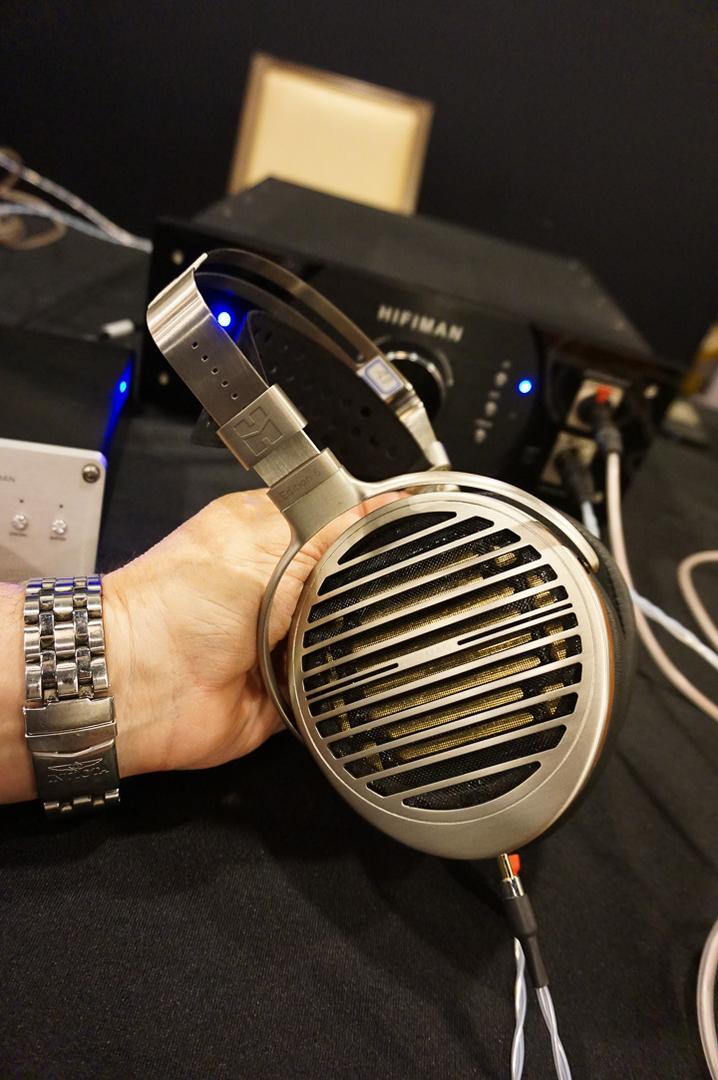
HiFiMAN had a busy few months (when did HiFiMAN have a few ‘quiet’ months? it seems to launch a new product every couple of weeks), but Headroom gave the company a chance to showcase products new to Europe rather than ‘brand new’. The show was the first public outing across the continent for the finalised version of the £50,000+ Shangri-La electrostatic headphone system (playing vinyl through a Michell Orbe turntable), as well as first public outings for the £2,000 RE2000 and £690 RE800 in-ear monitors. The company was also comparing the current and previous versions of its £2,199 HE1000 planar magnetic headphones, which made for fascinating demonstrations!

Jays

As the name suggests, the u-Jays Wireless headphones are a £140 Bluetooth wireless headset with a unique touchpanel on the right ear cup that allows swipe controls of the Android or iOS device to which it is connected. The all-black, and black with gold trim versions were on show. Jays expected to have the new white version available, but the first versions proved too popular and none were left to put on show!

Meze

The 99 Classics by Meze have gained lots of attention since their launch a couple of years ago. The latest variant is the £260 Meze 99 Neo, which has been seen in near-complete form before. The new models are an affordable, none-more-black version of the walnut Classics with the same stamped manganese spring arrangement for the headband.  

oBravo

Innovative Taiwanese brand oBravo has a somewhat bewildering range of in-ear monitors and headphones, including a new $6,000 flagship version of its Air Motion Transformer (AMT) HAMT-1 headphone. More significantly, however, it also had samples of the most expensive earphones currently in production, the hybrid EAMT-0  (codename Zeus) in different finishes. The ‘standard’ model features aluminium enclosures and costs £6,000, with copper and titanium, and each one sounds very different. The supplied Comply tips weren’t an ideal fit for me and there was a lot of ambient noise in the room, but the midrange and bass were extremely exciting, and the treble was effortless too.

Onkyo/Pioneer

Sister brands Onkyo and Pioneer simul-announced their latest DAP designs, the £399.99 Rubato DP-S1 from Onkyo and the £xxx.xx XDP-30R from Pioneer. The two share a lot of common technology, including the dual ESS 9018 SABRE DACs, a 2.4” touchscreen, twin MicroSD slots, and 16GB of internal memory.

The similarities don’t end there. The two also use the same milled-from-solid-billet aluminium chassis (different finishes separate the two), the same basic ergonomics, the ability to run balanced headphone cables, and a custom-based Linux platform. Both also share a dual-band Wi-Fi networking capacity in order to stream TuneIn radio stations and TIDAL services. And both are expected to add MQA to the current line-up of DSD, FLAC, ALAC, AIFF, AAC, WAV, and MP3 file support not long after their launch in May this year. Finally, both include Bluetooth connectivity, and a DAPcontroller App, so your phone in your hand can control the DAP in your pocket.

The main difference is in the voicing and tailoring of the sound of the two devices, with the Onkyo featuring selected components – including thin-film resistors – to make it the more ‘audiophile’ of the two. To this end, the Onkyo will appear in more audiophile settings, while the Pioneer is intended for more mass market appeal. The Android-based Pioneer XDP-100R and Onkyo DP-X1 models will be phased out as a result of the new models.

Sennheiser

Alongside its normal coverage – including the outstanding £54,000 HE 1 electrostatic system – Sennheiser was heavily promoting its wireless designs, to reflect significant change in the portable audio market. The company is convinced that wireless headphones and earphones will come to represent around half the total market by the end of 2017, so its main thrust this year has been to promote higher end wireless designs, such as the Momentum over-ear, on-ear, or even in-ear wireless models, as well as the £329.99 PXC 550 wireless noise-cancelling, touch-panel controlled models. Most of these have been seen in previous shows – most notably Bristol Sound & Vision – but Sennheiser’s commitment to wireless is as strong as ever, even in a dedicated headphone show where wires still dominate.

Tron

Tron’s new Antares (£3,000, Standard model, £5,000 Deluxe pictured here) is a Class A headphone amplifier featuring just one transistor in the output stage. It features a massively overrated power supply (in the good way, not ‘overrated’ in the Mark Wahlberg’s acting ability way), a dual mono linear power supply and is not only powerful enough to drive two sets of headphones at once, but can even drive two sets of desktop loudspeakers! We like the Original Star Trek font, too!

Hi-Fi+ Awards 2016: Cables, Power, and Accessories

Analogue Audio Cable of the Year

Chord Sarum Super ARAY

Until the recent launch of ChordMusic, Sarum in all its guises was Chord’s top cable. The latest version – Super ARAY – uses a tuned length of cable to help improve the already outstanding performance of Sarum. Super ARAY includes new PTFE plugs in place of the acrylic versions in the older design. All of these innovations are upgradable for any present Sarum or Sarum TA owner.

We tested Chord’s Sarum Super ARAY cables in the context of a Naim and Focal system and our reviewer observed, “If this system’s sense of easy musical expression, expansive dynamics, and rhythmic flow set it apart, then that is due in no small part to the cables connecting the components getting out of the way and letting them do their job, something which Sarum Super ARAY achieves so effortlessly that you barely notice its contribution – until you remove it from the system and the music simply closes down!”

Reviewed in Hi-Fi+ Issue 135

Digital Audio Cable of the Year

Purist Audio Design 30th Anniversary USB

In celebrating thirty years at the forefront of cable development, Purist Audio Design went right back to basics to determine what was needed to get the best from USB audio. Taking its Ultimate USB design as a template, the new top cable improves isolation between the power and data lines in the cable itself, and adds a large tuned ferrite ring mid-way along the cable to provide passive filtering that is useful for the +5V and 0V conductors. In test, Nicholas Ripley noted, “The overall sound with this cable is just the right side of ‘dark’ to be full of musical gravitas rather than ‘moody’, and is also powerful, weighty, and monumental when it needs to be.”

Reviewed in Hi-Fi+ Issue 139

Power Cable of the Year

IsoTek EVO3 Initium

It is easy to get somewhat carried away by cable costs, especially power cable costs. Which is why the lean, green, power machine that is Initium came as such a refreshing change. EVO3 Initium uses a PE dielectric, 40 strands of OFC to form the three 2mm diameter conductors, an RFI-busting rotational twist in the construction, a cotton filter, nickel plated terminations, and a vivid green PVC jacket. Steering clear of either flattening dynamics or accenting the top end at the expense of the bottom, Alan Sircom felt Intitum, “plays a longer game, with an absence of sonic signature and a good sense of dynamic freedom on integrated and smaller power amps. Initium also shows up just how inconsistent give-away power cords can be.” Which is important at this price point.

Reviewed in Hi-Fi+ Issue 135

Loudspeaker Cable of the Year

Tellurium Q Silver Diamond

What makes Tellurium Q so difficult to review is not what makes it perfect for an award. The TQ team play their cards close to their chest, and categorically refuse to discuss almost anything about the cables in terms of design, metallurgy (although we know the incidence of both silver and diamonds in this cable is relatively limited), or construction – not out of secrecy, but rather that it’s looking at a cable in the wholly wrong way. Instead, they focus on Silver Diamond’s ability to act as less of a filter than most cables, and that this performance is particularly well suited toward high-end systems. When th cables are used in that context, asserts Alan Sircom, “Silver Diamond is extraordinarly transparent, satisfyingly open, full-bodied, with an awesome bass, and extremely sweet and smooth across the midrange.”

Reviewed in Hi-Fi+ Issue 141


Power Conditioner of the Year

Torus Power TOT AVR

The Torus Power TOT AVR power conditioner is a very well engineered huge toroidal transformer built into a solid chassis. It can power up to three 4A devices and has three sets of three-pin 13A sockets for UK users. It can be controlled by a RS232 link, and looks and sounds more than good enough to be used as a standalone power conditioner for small-to-medium sized audio systems. In listening, Alan Sircom said, “You’ll hear the improvement in the first few bars of music played with the TOT AVR in place, and you’ll hear it taken away when it’s removed. A ten minute demonstration would seal the deal and the majority of people would buy one at the end of it.” It’s that simple, and that good!

Reviewed in Hi-Fi+ Issue 141

Accessories of the Year

Nordost Sort Kone, Füt, and Lift

A few years ago, Nordost branched out from making an extensive range of cables, to apply a systematic and like-minded approach to equipment, loudspeaker, and now even cable support systems. We have already looked at the Sort Kone several years ago, and the four-strong range of tuned resonance control supports benefit many audio components. Soon after, the Sort Füt applied the same mechanically tuned resonance control to the base of your loudspeakers or equipment tables. Now, the Sort Lift extends that concept to your loudspeaker cables. Best of all, the three systems work in harmony! 

Reviewed in Hi-Fi+ Issue 143

Hi-Fi+ Awards 2016: Amplification

Integrated Amplifier of the Year

Ayre Acoustics AX-5 Twenty

In making the AX-5 Twenty, Ayre Acoustics pulled together many important elements of design from existing higher-end Ayre amps into what has become the company’s only integrated amplifier, following the recent end of the brand’s entry-level 7 Series. The 125 watt per channel AX-5 Twenty uses Ayre’s VGT (variable gain transconductance) approach in its preamplifier stage, a design first seen in the company’s top KX-R preamplifier. This uses a pair of double-pole silver-contact rotary switches, connected to an array of precision, hand-selected resistors. This is not a stepped attenuator, however: these resistors alter the transconductance of two pairs of complementary JFETs in the power amp’s input gain stage. The all-balanced signal is then fed into a form of gateable bridge network of bipolar transistors; Richard Baker’s ‘diamond circuit’ that Charles Hansen of Ayre discovered languishing in an electronics book dating back to the birth of transistors. The ‘Twenty’ modifications add better thermal control and AyreLock output voltage regulation. 

In our test, Alan Sircom suggested what the AX-5 Twenty delivers is “absolutely stunning amounts of detail retrieval, always staying the right side of ‘forward’, but with a fine sense of musical order and a good deal of enjoyment thrown in for good measure.” However, it isn’t overly bright or detailed. “A lot of this”, says Sircom, “comes down to that fluid naturalness normally associated with valve amps, but this time without the associated softness in the bass or a laid-back treble, and with a lot of power in reserve.”

Reviewed in Hi-Fi+ Issue 132

Integrated DAC/Amp of the Year

Aavik U-300 Unity

This is a category that simply couldn’t have existed a few years ago. Such is the change in the industry from one-box-per-activity systems to all-in-ones that this category has grown faster than expected. So much so, in fact, that more integrated amplifiers are now shipping with built-in DACs, streaming systems, and increasingly fully-functioning digital hubs alongside the regular line-up of line level and phono inputs. This is a hotly contended sector at all levels, and deservedly so… such designs are increasingly taking the lion’s share of audio electronics sales, and the trend looks set to continue.

This year, however, we stuck our flag firmly in the high-end of this market, because it’s perhaps here that we have seen the biggest changes, both in product and perception. The Aavik U-300 Unity is at the forefront of that change, not just because it sports an incredibly good DAC, but because it also features an incredibly good phono stage and exceptionally good line inputs, all feeding into a powerful 300 watt per channel Class D amplifier that sounds truly world class. A few years ago, recommending such a device would have brought forth an angry audiophile mob demanding heretics be burned. But now, thanks in no small part to products like the Aavik U-300 Unity being demonstrated around the world, the scene is set for a truly open-minded investigation of what makes a one-box audio system in the future, at all levels. “Every input has the same exciting, yet even-handed sound,” said Alan Sircom in his test, and the U-300 Unity delivers “a fine sense of rhythm, a good ‘bounce’ to that rhythm, plenty of detail, and easy, unforced dynamics.”

Reviewed in Hi-Fi+ Issue 139


Preamplifier of the Year

conrad-johnson GAT Series II

With its gold-effect front panels, and its black crackle top, rear, and side plates, the conrad-johnson GAT doesn’t cut an impressive visage. It’s fairly rudimentary, single-ended-only line input make for a features list that is not, on paper at least, that impressive, and all this makes the revised version of the GAT line preamplifier perplexing. Why? Because its sonic performance leaves you in no doubt that this – let’s face it – expensive preamplifier is worth every single penny, whatever its appearance and base spec say to the contrary. Isn’t that, at its heart, what good high-end audio is supposed to be about?

The revisions between the original GAT and its Mk II version are far-reaching, with more than 100 changes to the circuit design and component roll-out, necessitating a completely new circuit board. Fortunately, conrad-johnson has offered a full upgrade path for present GAT owners to move to the latest model, and the upgrade is well worth the taking. In testing, Roy Gregory opined that, “I’ve not heard anything that matches the GAT Series II. This is among the most genuinely natural and is definitely the most neutral pre-amp I’ve ever used – with none of the pinched, lean, or mean associations that term normally evokes.” He concluded that, “truly great preamps are few and far between, confined to those that genuinely manage to put the music first – and this is definitely, unequivocally a great preamp.” Summing up, Gregory said, “if you are well-healed enough – or committed enough – to consider a pre-amp at this level, c-j’s GAT remains at the top of the audition list.”

Reviewed in Hi-Fi+ Issue 137

Power Amplifier of the Year

Naim Audio NAP 300 DR

A key fixture in Naim Audio’s Classic Series of electronics, the two-box, top-of-the-line NAP 300 has long stood between the more affordable, lower power designs in the Naim range and the top-flight 500 Series and Statement amplifiers. As befits Naim’s inconoclastic approach, the 90 watt per channel amplifier is configured slightly differently from most two-chassis amplifiers, in that it’s divided between ‘brain’ (its power supply) and ‘brawn’ (the stereo power amplifier), rather than a more conventional mono design. Recently, alongside many of Naim’s range of power supplies and amplifiers, the NAP 300 has been upgraded to ‘DR’ status, replacing the chip-based regulator circuit with a discrete component board, as well as using the custom-designed NA009 output devices, which form such an important element in the outstanding performance of Naim’s Statement power amps. This is a fine example of ‘trickle-down’ in action.

Tested in the context of a complete system, comprising Naim streaming preamplifier, Focal loudspeakers, and a complete run of Chord Company cables, the NAP 300 DR shines out as a perfect expression of what Naim does so fundamentally right in all its products. In our test, Roy Gregory was deeply impressed by its, “presence and dynamic authority of its mid-bass, so vital to the feeling of instrumental identity, scale, and power, the intimacy it brings to vocals, its agility and poise, its easy sense of tempo, be that relaxed or hesitant, measured, or urgent.”

Reviewed in Hi-Fi+ Issue 135

Hi-Fi+ Awards 2016: Digital Audio

DAC of the Year

Chord Electronics DAVE

Some awards categories were difficult to choose, and notionally that could have applied to the fast-moving and extremely competitive DAC market. In fact, there’s really only one DAC we could give this award to this year: Chord Electronics’ DAVE. Short for Digital Audio Verite in Extremis, DAVE pushes the envelope of just what is thought possible in digital audio in the home, and in the process delivers a product that sounds so good, it makes you wonder whether we have reached the pinnacle of what’s possible. For now…

Chord’s genius in the DAVE is to be not one, but two DACs stored in firmware ready to upload to the DAVE’s vast on-board FPGA at a moment’s notice, using the same circuitry throughout. So, when you want to play a high-resolution PCM file, the DSD converter remains hidden, and when you decide to play DSD, the PCM-friendly DAC goes back to its firmware storage. Despite this, the DAVE is extremely simple to operate, whether as a standalone DAC or an excellent combined DAC/headphone amplifier. Alan Sircom said, “The DAVE is that rare beast; a device that performs equally well in all these aspects of performance, and by ‘equally well’ we mean it does an outstanding, class‑leading job.”

Reviewed in Hi-Fi+ Issue 141

Streamer of the Year

Linn Klimax DS/3 and DSM/3

Linn Products’ goal of continous improvement coupled with a desire to never leave one of its customers stranded makes for some potential clashes of ethos. Fortunately in the third iteration of Linn’s top streamers – the standard Klimax DS and preamplifier-equipped Klimax DSM – both sides of the equation are expertly resolved. Linn’s new Katalyst DAC architecture represents a major step change in sonic performance of the Klimax platform, while it is also designed to be wholly upgradable for existing Klimax DS and DSM owners, who can also get their old Klimax DS back in a ‘Renew’ case. Both Klimax variants are also ‘Exakt’ ready should you decide to go the full ‘source is in the speaker’ active line that Linn has been developing in recent years. In short, Everybody wins!

Katalyst carefully optimises every pathway to the DAC chip itself, allowing unparalleled access to power requirements right down to a subsystem level. The easiest – and briefest – way of considering this is it is like Linn built a bespoke suit for the DAC and it wears it well in its hewn from solid billet aluminium chambered chassis.

Normally, when listening to a change in digital architecture, the difference in sound quality is comparatively small. With the Linn Klimax DS/3, that wasn’t the case. In test, Alan Sircom commented “out came ‘Son of a Preacher Man’ from Dusty Springfield’s justly famous Dusty In Memphis album [Phillips], which sounded extremely good on the DS/2. Two bars into the same track on the DS/3 and it sounded like she was singing with a band, where the DS/2 now sounded like she was singing to a backing track.  It was as if a group of better and better-rehearsed musicians had turned up.” He concluded by saying, “even at the super-lofty end of high-end digital, the Klimax DS/3 stands with the best of them.”

Reviewed in Hi-Fi+ Issue 140


Network Player of the Year

dCS Vivaldi ‘Version 2.0’

We are no strangers to the dCS Vivaldi four-box system, comprising CD/SACD transport, upsampler/streamer, clock, and DAC. We’ve been impressed by it since it first arrived in 2012. But recently, the upgradable architecture received its first main face-lift in its ‘Version 2’ firmware (and a streaming board replacement for the upsampler). With TIDAL and Roon end-point upgrades and more enhanced app control, Version 2 makes controlling the system better than ever, but the real changes are in the sound quality. Compared to the original Vivaldi, Chris Thomas felt the upgraded system, “offers greater instrumental separation, more dynamic independence, and a much more attractive picture of the music in the sense that the soundstage itself seems to have grown; in scale and three dimensional space, plus tauter bass, and a more extended and comfortable high frequency performance.”

Reviewed in Hi-Fi+ Issue 141

Server of the Year

Innuos ZENith MkII

Innuos has made a name for itself in a surprisingly short time, with the range of ripping music servers first appearing in 2014. Originally intended for the custom install market, the Zen range of music servers quickly found their way into the homes of people wanting high performance music servers without having to compromise and build something from off-the-shelf parts. The ZENith Mk II is the top model in Innuos’ three-strong server range, and features a linear power supply (rare in computer-side products, but good for sound quality), built-in ripping capabilities, and an architecture built around the robust, much lamented, and still widely supported Squeezebox platform. In listening, Jason Kennedy was deeply impressed, stating that, “This revealed that the ZENith delivers a highly coherent, vibrant, and engaging sound that hangs together very well indeed. It delivers instrument timbre, reverb, and more importantly does so in such a fashion that it sounds like musicians playing together. This is not something that streaming systems do as a matter of course.”

Reviewed in Hi-Fi+ Issue 139

Disc Player of the Year

Hegel Mohican CD player

Of all the product categories in audio, one might be forgiven for assuming that the good old-fashioned 16-bit, 44.1kHz CD player had all but disappeared. After all, who is going to be interested in a player that has no capacity for processing 24-bit, 192kHz or DSD128 files, has no digital inputs, and steadfastly eschews upsampling or any other concession to post-1980s digital audio technology? They’d have to be mad, right?

Well, Hegel clearly embraces audio’s mad side with its Mohican CD player. Faced with ‘end-of-life’ cancellations of key components in its existing CD players, Hegel chose not to simply walk away from the spinning disc, instead choosing to make the best CD-only player it’s possible to build at this time, using the last, best hope in CD mechanisms coupled to a digital circuit derived from Hegel’s own top-notch HD30 DAC, the Mohican might just be the last CD player the company ever makes, but it’s also by far its best.

In our test, Alan Sircom felt that “There is a depth and projection to the sound of CD through the Hegel Mohican that struggles to make it past the output stages of most players.” He added that, “The Mohican also treads that thin line between being controlled and controlling, giving music played through the CD a natural sense of order, not imposed order,” and showing, “just how much it challenges the need for high-resolution audio.”

For those still convinced there is lots more entertainment to be extracted out of the spinning silver disc, Hegel’s last of the Mohicans is the best thing that happened in 2016. Is this the start of the Compact Disc revival?

Reviewed in Hi-Fi+ Issue 139

Meet Your Maker: Marc Gomez of SAT

The Swedish Analog Technologies tonearm caused quite a stir when first seen a couple of years ago. Primarily that stir came about because of the arm’s very high price (it is one of just two arms – both launched in recent years – to cost as much as a new car); however, a few who looked beyond the big ticket saw a tonearm design that was a genuine step-change in vinyl replay, something that is all too rare in the 21st Century.

SAT (the tonearm, and the company itself) isn’t the result of unearthing decades-old development projects, or falling back on received wisdom and second-hand engineering skills. Marc Gomez, chief engineer behind the SAT arm, is an extremely highly qualified engineer and materials scientist in his own right, and has worked on everything from water-jet engines for Rolls Royce to the rocket engines for the Ariadne programme. Born in Barcelona, but based in Gothenburg in Sweden since 1999 (hence the name of the tonearm), we caught up with Marc during a recent stop-over in London and asked him just what it takes to design and build a tonearm in the 21st Century.

AS: How did the SAT arm come about?

MG: I have spent all my working life in engineering, and have worked on many projects for many companies over the years. This is the first time the project is one of my own!

Everything started when I realised that the arm was playing a major role in the performance of a vinyl playback system. When I realised that, and that I could back that idea up with numbers and physics, I started looking at what had been done before, what was available in the market, and I realised serious improvements could be made.

I understood that even if there was a very limited market for such an arm, I started work on a design that is built the way it always should have been built, with no prejudices or limitations. I made a requirements list, and from there I derived specifications, and then converted them into physical systems.

AS: How long did the SAT arm take to develop?

MG: It’s difficult to say how long the development of the product took because it wasn’t a continuous timeline and I had to interrupt the project for one to two years. However, I would say a matter of two or three years in total.

AS: Is it true that the SAT arm was developed without a prototype?

MG: Yes. I didn’t want to base the development on trial and error, but on theory, physics, and engineering practices. I went as far as I could without having to build prototypes, partly because of the time and money involved. You can explore a lot doing simulations using computers for example.

When we built the first sample, we then made a heavier and a lighter version, but the physics was correct.

AS: Many feel tonearm development reached its acme in the 1980s. Do you agree?

MG: In the late 1970s and early 1980s (especially in Japan), tonearm design and development was considered an engineering undertaking. That time was a big inspiration for my work: not in terms of design, but in how they were conceived and built. If you look at those arms, they were engineering work. Today, you see a lot of fancy-looking high-end equipment, which are not built by engineers who understand the mechanisms that dictate how such a component should be built. I think that’s the reason why the quality of many arms available today is not as good as they can be.

AS: What was the main design criterion in making the SAT stand out from its peers?

MG: It was about understanding what matters to make the arm perform as it was supposed to perform when playing a record. One of the main design specifications is it has to be as rigid as possible. Any deviation from this in the headshell or armtube, for example, results in a form of distortion. It removes some of the information the cartridge is reading. So I put a lot of effort into making the arm really rigid while still not being high mass, to accommodate the warps and eccentricities in a record. I address this in the armtube, headshell, yoke, and the rest of the static parts. I also put a lot of emphasis on the bearings, but it’s mainly rigidity.

AS: How about fine-tuning the arm?

MG: I haven’t tuned or even thought about tuning the arm. It is designed to be rigid and deform as little as possible, and I knew that would translate into better sound. Because what’s really converting the groove into sound is the cartridge, and what a tonearm should be doing is allowing the cartridge to sit in the groove and nothing else. Tuning an arm, or allowing inherent distortions from the arm itself to reduce the cartridge’s ability to do its job, are distortions that undermine the performance of the overall vinyl replay system.

AS: Is the SAT arm readily compatible with many turntables?

MG: The two kilogramme weight of the arm assembly can pose a problem for light, suspended turntables, but most other designs work well. We have used it to great success with turntables like the Air Force One, Two, and Three, the Kronos turntable, and the SME Model 30.

AS: What have been the most challenging parts of making the SAT tonearm?

MG: The most complicated part is the production side. Development wasn’t that complicated compared to putting them into production. It’s relatively easy to make one, but to make more and make them reliably and with consistency is a lot harder. Even getting the finish right is difficult, time-consuming, and costly to get consistent as a small manufacturer!

To this end, there is one small aspect of the design that I plan to improve. It is not an improvement that changes the performance or even the design of the arm, it is a more efficient way of construction, which becomes more important as demand increases. It’s not a cost-cutting exercise, it’s all about time!

AS: What impressed and what surprised you in making the SAT?

MG: I think I was impressed by how stable it is. Not simply in use – we engineered it to be a stable platform for a cartridge at the outset – but how stable it makes the cartridge sound in comparison to other arms. That aside, its performance and manufacturing processes are all in line with the mathematics. And I think the whole package worked out really well.

What surprised me was the case! It’s custom made for the arm, and it’s not easy to make. The cable, too, was a little unexpected, in that I didn’t expect it to be so time-consuming.

AS: Presently, there is only one product in the SAT line. Will that change?

MG: There will be more products. The current arm is very costly, both to make and to buy, so it’s possible we will be able to make a less-expensive version. But a lot of this comes down to the manufacturing processes involved, and also the volumes.

We were also fortunate to hear the SAT, on an Air Force Two turntable and sporting a Koetsu Jade cartridge. What becomes clear on listening to the SAT is just how much of what we consider ‘vinyl’ sound really does come down to the arm itself, and how much of that becomes apparent when the arm is not getting in the way of the music. A more thorough investigation is required in a later review, but even in relatively brief exposure, it seems to combine the best of unipivot arms with the best of gimbal arms, and reminds you of your favourite tonearm, only better! It may be extremely expensive, but looks like the application of good, modern science and good, modern engineering to the late 19th Century concept of a tonearm makes a lot of sense.

Origin Live Sovereign turntable with Enterprise-C tonearm

The British have two very galling character flaws. We are not good self-promoters, and we love a bit self-deprecation. So, when it comes to a turntable brand like Origin Live and it’s flagship tonearm and one-from-the-top turntable, we should be all over it like a nasty rash, praising the brand and stamping our respective feet about how the plucky little British brand takes on the big guys… and wins. But we don’t do that. Instead, we go all British and get embarrassed at the success of another.

Origin Live is one of those old-school engineering-based companies that were supposed to have disappeared in the 1980s. In a small factory on England’s South Coast, Mark Baker and the small team run one a cramped, swarf-filled factory in the best tradition of the great British engineer, and the results speak for themselves.

Until the recent introduction of the cost-no-object Voyager, the Sovereign was the top of Origin Live’s turntable line-up. It’s also arguably the pinnacle of the ‘attainable’ decks in the line, because the best of the best Voyager S will set you back £25,000: that equates to four Sovereigns, and enough change for a tonearm and cartridge.

From the Aurora and up to the Sovereign, the basic turntable layout remains the same; a belt-driven design with an outboard motor to the back right, the deck on three adjustable towers. Effectively, the further up the Origin Live product line you go, so the greater the mass of each component in the turntable. Or so a surface reading of the turntables would suggest. In fact, this is an oversimplification in the extreme. Simply looking at the intricate milling of the underside of the Sovereign’s alloy top platter highlights exactly how much more careful design and engineering goes into the better turntables. The platter is a composite of the aforementioned machined aluminium top with an acrylic lower section, and a felt mat, and this effectively decouples the record surface from the bearing. It’s a non-suspended design, although there is a significant amount of damping built into those three adjustable feet. Origin Live uses a very high tolerance bearing, but the usual slow insertion of bearing into housing is not so prevalent, because Mark Baker doesn’t think going for almost interference fit is the best way to make a bearing noiseless. The deck is supplied with a little vial of oil to lubricate that bearing, and expect a little bit of overspill when oiling the bearing, but think a couple of extra drops, not Deepwater Horizon!

The motor sits in a separate, high-mass housing with a separate power supply block that sits away from the deck itself. The overall look of the turntable is extremely elegant and (gloss black acrylic aside) less ornate than many of its turntable peers. There are no spinning discs, pendulums, exoskeletons, or air pumps. There’s not even a record clamp. It’s just a damn good turntable, engineered well.

The original Sovereign was designed for a 9.5” arm, but the outriggers were redesigned and extended to accommodate a 12” arm on the skeletal armboard, which adds a £390 premium over the base £5,700 turntable price. It’s also possible to have two arms fitted when building the turntable, and this adds £490 to that base price. The armboard is pre-cut to suit Linn or original Rega arm bases, because the geometry of these arms suits the turntable itself. Other arm bases can be accommodated but, warns Origin Live, the cost of changing back to a Rega arm base (for one of its own arms) is considerable.

Origin Live’s arms fit the original Rega geometry (not the new three-point Rega mounting), and that is recomputed for the 12” arm. Although Origin Live’s first arms were based around Rega components, everything today is 100% Origin Live. It’s worth re-iterating that fact periodically, because people still seem to think of the company as ‘those people who hot-rod Rega arms’.


The Enterprise (actually the Enterprise-C, which as every Trekker will tell you was captained by Rachel Garrett and destroyed in 2344 at the battle of Narendra III) is a hybrid design, using six different materials in the armtube itself, a dual pivot bearing (that mimics the stability of a gimballed bearing with the freedom of a unipivot), which is both extremely low friction and fully decoupled from the yoke assembly. It has both VTA and azimuth adjustment, and features silver wiring throughout. The arm is the top model in the Origin Live range, and the only one that can be supplied in the 12” form we tested.

My go-to turntable is a VPI Prime, with its 3D printed version of the JMW tonearm. I was so impressed, I bought the review sample. It’s currently featuring a Lyra Dorian moving coil cartridge and this combination just sings. However, the Origin Live turntable and arm combination improve on that VPI performance markedly, and also work beautifully with a Lyra design.

The Sovereign is one of the most speed stable turntables I’ve heard at or near the price. Solo female voice and records with tape wobbles cut to disc are perfect indicators of this at work. Listen to ‘Mining for Gold’ by the Cowboy Junkies on the legendary Trinity Sessions LP [RCA]; Margo Timmins almost fragile voice requires complete pitch stability to keep it in the moment and keep the lyrics powerful. Doubly so, if you listen to this first through digital replay, where you get the pitch precision and none of the ambience. Here, you get both, and perfectly so.

It’s easy to point out highlights on the Sovereign’s performance, because they are pretty much all highlights. But, speed stability aside, the big highlight has to be the sense of scale it brings to the bass. Bass notes are textured, deep, powerful, and dynamic. This is the sort of turntable Lyra should use to quiet the ‘it’s sounds a bit lean’ arguments set against the firm’s cartridges. The Origin Live combination shows it isn’t lean, just others decks and arms aren’t this resolving in the bass to show what Lyra can do. I pulled out the classic ‘Two Tribes (Annihilation Mix)’ 12” single by Frankie Goes To Hollywood [ZTT]  to show just what this table and arm can do. The Lyras track beautifully, but the amount of modulation in those grooves is intense and any limitations in the replay system are brutally exposed. Instead, I was sent back to the early 1980s, with all the nuclear paranoia and heavy-handed production values that go with it. In most cases, this is an impressive recording, but occasionally, when the turntable is outstanding, the sound takes on a kind of enveloping energy that makes it impossible to turn off until the very end. It also has the kind of complexity and depth of soundstage that only someone like Trevor Horn could pull out of the faders.

It’s pointless to break up the band here. The deck is excellent, the arm is excellent, and the combination of the two seems to be greater than the sum of the parts. I was a little concerned that a 12” arm ends up adding instability, mass and wayward geometry to an excellent 9.5” design (as is often the case), but in the case of the Enterprise-C what notional sacrifices made in extending the arm are more than balanced by the added accuracy across the whole album side. There is a ‘just cut’ fluidity and openness to the sound that makes it seem like albums you know through repeated plays are fresh from the stamper. The sign of a good turntable and arm combination is one where the idea of splitting the two up into their component parts seems alien and wrong. The aforementioned VPI Prime (along with Kuzma and Brinkmann) has that integrated approach to design. So does Origin Live.


I’ve tested Origin Live decks before. I know how good they can sound, but that foreknowledge left me unprepared for just how good the Sovereign with the 12” Enterprise arm can sound. A reviewer is only as good as their last criticism, but I’m struggling to find anything other than praise to heap on the Origin Live duo here. It’s one of those rare turntables that doubles as a time machine; you don’t just play an album, you are transported to where you were when you first heard that album. Records you know well suddenly sound like this is the first time you’ve heard them, and you can give the Sovereign/Enterprise duo any vinyl-related test you can think of and it will come up trumps. Origin Live’s turntable and arm combination an outstanding and natural paring, and come highly recommended!

TECHNICAL SPECIFICATIONS

  • Sovereign Mk3-1 turntable
  • Type: belt-driven, non-suspended turntable
  • Platter: high mass alloy/acrylic sandwich
  • Dimensions (WxHxD): 45x38x16cm
  • Weight: 34kg
  • Price: from £5,700
  • Enterprise-C tonearm
  • Type: dual pivot tonearm available in 9.5” and 12” versions
  • Price: from £4,995 (12” model)

Manufactured by: Origin Live

URL: www.originlive.com

Tel: +44(0)2380 578877

Back to reviews

Read more Origin Live reviews here

Hi-Fi+ Awards 2016: Analogue Audio

Turntable of the Year

Origin Live Sovereign

The Origin Live Sovereign is a belt-driven turntable design featuring a high tolerance bearing, and a non-suspended chassis sitting on three adjustable towers. The platter is a composite of a machined aluminium top with an acrylic lower section and a felt mat, designed to decouple the record surface and is driven by a high-mass outboard motor.

We used the Sovereign with the excellent 12” Enterprise-C tonearm, a hybrid design with six different materials in the armtube and a dual pivot bearing that mimics the stability of a gimballed bearing with the freedom of a unipivot. In our review, Alan Sircom stated that “There is a ‘just cut’ fluidity and openness to the sound that makes it seem like albums you know through repeated plays are fresh from the stamper” and concluded that “It’s one of those rare turntables that doubles as a time machine; you don’t just play an album, you are transported to where you were when you first heard that album.”

Reviewed in Hi-Fi+ Issue 140

Tonearm of the Year

Kuzma 4POINT 14

The original 11” 4POINT is considered to be one of the best high-performance tonearms made today, but in extending the original arm-tube to 14”, Kuzma faced potential mass and stability problems. The increased arm size means an effective mass of 19g, which makes it best used with low compliance cartridges, and its 2.15kg weight precludes its use with most suspended  turntable designs, but the mounting geometry makes Kuzma’s super arm compatible with 12” armboards and allows an almost infinite amount of on-the-fly adjustment. In our review Roy Gregory felt that “this is one seriously impressive performer. Put a 4POINT 14 in your system and sit back as your speakers apparently expand in size (at the same time as they disappear), your cartridge grows in power, and the musicians on your records don’t just wake up, they decide that today is the day.” High praise indeed!

Reviewed in Hi-Fi+ Issue 133


Cartridge of the Year

DS Audio DS-W1

Undoubtedly the most exciting development in phono cartridge design since the invention of the moving coil, Japanese audiophile brand DS Audio’s unique DS-W1 consists of an optical cartridge and matching equaliser. Although it uses a conventional stylus and cantilever, the cartridge itself uses a tiny plate and slot arrangement to allow a photoelectric cell to measure the amount of movement in the groove, in place of coils and magnets. While the DS Audio cartridge is exacting to set-up and match to an arm, Roy Gregory felt it was worth the effort, saying “Never have I heard a cartridge that can capture instrumental textures or vocal nuance, the skin of a drum and the air inside it, or the rasp of bow on strings as naturally and effortlessly as this.”

Reviewed in Hi-Fi+ Issue 136

Phono Stage of the Year

Audio Research Reference Phono 3

Audio Research has long been a fixture in the high-performance phono stage sweepstakes, but even in reflection of the firm’s 46-year run at the top of the of the phono stage game, the performance of the Reference Phono 3 took us by surprise. Perhaps it really shouldn’t have; Audio Research has been on a roll for the last few years, and product after product has come out that shifts the goal posts to show what records are capable of, plus the existing Reference Phono  2SE was a big hitter. Just how much can this new model improve upon what went before?

It turns out, there was a significant chunk of ‘better’ to be had. If anything, the Reference Phono 3 owes more to the two box, cost-no-object Reference Phono 10 equaliser, and the Reference Phono 3 features six 6H30 valves in the analogue stage, plus a further 6550 in the power supply. It retains the clever Audio Research hybrid circuit, using input FETs to maintain authority over the cartridge itself, while the valves in the analogue stage maintain linearity and a sense of warmth and air in the mid and top. In test, Alan Sircom praised the phono stage for a sound that, “combines the texture, soundstage spaciousness, and richness of valve phono stages with the detail and silent backgrounds of solid state. This is a balance, but it’s both a dynamic one, and one that will appeal to many, many listeners. This sense of balance makes for a presentation that is extremely realistic, irrespective of the music played.”

Reviewed in Hi-Fi+ Issue 136

Hi-Fi+ Awards – The Best of the Best

2016 was something of a tumultuous year, both in and out of the audio world. Although audio is an extremely mature branch of consumer electronics, in recent years it has seen some significant changes, as we collectively embrace downloaded or streamed files, and re-adopt the vinyl LP. Neither of these drives toward better sound show any signs of slowing although we might have achieved ‘peak vinyl’ this year, as the pressing plants struggle to cope with demand. Regardless, the world of audio is changing and showing signs of being more animated than it has been in years. Moreover, with the rise of the headphone and personal audio world, coupled with the small, but growing ‘audiophile lounge’ movement in some of the trendy parts of the coolest cities, being into the sound music makes as well as music has become just that little bit more fashionable for the first time in decades.

That increased interest and energy in audio is beginning to be felt in the products themselves. This is an exciting time in the audio world. Concepts like TIDAL, for example, that were not even ‘achievable’ a few years ago (or were either clunky or simply not very good sounding) are now commonplace and running smoothly. Developments in audio design – especially in the fields of digital audio and loudspeaker performance – have created products that confidently outshine their predecessors.

We have also seen the realisation of the potential in Class D amplifier designs, creating high-power, more efficient amplifier designs that now sound excellent. These are simply examples; in fact, in almost every category in audio, we have seen significant improvements in engineering, technology, usability, and performance.

However, it’s not quite a ‘golden age’. The combination of a very small user base coupled with prices that frequently play to a very well-heeled audience has meant the best in traditional audio components are often in a very rarefied atmosphere. I still maintain that good audio can be had at all prices, but we have noticed from feedback from readers and responses to reviews posted up at www.hifiplus.com that the lower and mid-priced traditional audio products we cover rarely ‘click’ with our core readers. So, we continue to pursue a more high-end path.

The same is not true with the personal audio world, however, and in this sector we really are in something of a golden age. Products at all price categories are of interest, and excellent products in all walks of personal audio are there to meet that interest. That market is extending in all directions, embracing avenues of product design that might have been unthinkable a year or two ago: we are seeing loudspeaker designers taking headphones seriously at last; we are seeing headphone amp designers making products that feature electronics designs both state-of-the-art and out-of-the-ark in pursuit of great sound; in-ear monitor and earphone designers push the envelope of what can be done in that most intimate of audio environments; digital designs that push the boundaries of what can be done in the home or on the move, and we are seeing increased interest in using a standalone Digital Audio Player for playing a wide selection of music files at unheard of quality while on the move. And if prices in this sector are creeping up at the top end, they are also well maintained at the lower end of the market, so everyone gets to benefit.

It’s worth noting that in our selection process, we have drawn from products we have seen over the last year. That precludes those we looked at in 2015 or before. That does not invalidate those products; many products in audio have a decade long life cycle and just because we look at the newest, in many cases this doesn’t take the edge off the best products of a few years ago. We have tried to limit the number of product reviews we have in the pipeline, but when there is an outstanding product that we have evaluated during the year, but not had space to include it in the pages of Hi-Fi+ yet, we have given it an award, with the proviso that the review will follow very soon. Finally, a word of warning that applies to all awards in all audio magazines, ours included; products are given awards in isolation, and not in terms of consideration in context with their other award winning counterpart: the best DAC, best amplifier, and best loudspeaker this year might work well together, or the combination might suck! In all cases, selecting the best system out of the best products requires a good deal of auditioning.

Selecting the best products of 2016 was at times an easy task. There are a few products that are so good that you would have to actively struggle to find a reason not to give them an award. But it has also made the task difficult, because in some categories we have an embarrassment of riches, and could legitimately give awards to three, four, or even six products in a given category. However, we decided not to do that this year, and draw your attention to the best of the best.

Japanese record label Ottava announces first MQA compact disc

From the Ottava/MQA press release:

A recording by Astor Piazzolla “the single most important figure in the history of tango” will be the first MQA recording to be released on compact disc in Japan. The album “A. Piazzolla 
by Strings and Oboe” – recorded by the UNAMAS Piazzolla Septet and mastered by respected producer and mastering engineer Mick Sawaguchi – will be released by the Ottava label on 17 March.

Since launching in the early 1980s, the CD format has undergone a number of sound quality improvements, but these have depended largely on the manufacturing process, rather than an improvement in the quality of music itself.  After attending a JAS (Japan Audio Society) seminar on MQA technology presented by MQA founder Bob Stuart in late 2016, Mick Sawaguchi and Synthax Japan’s managing director, Seiji Murai, realised that MQA could enable not only 48-24 coding but also 44.1-16 coding. “We were both excited by the prospect that CD, combined with MQA technology, could herald a new era of hi-res audio,” says Sawaguchi.

MQA technology captures and reproduces the original sound quality using less data, and the MQA CD works in exactly the same way as the MQA digital file. With a conventional CD player connected to an MQA-enabled device – such as those from Meridian, Mytek, Brinkmann and Technics – the MQA CD will ‘unwrap’ to the original sample rate.

Sawaguchi compared a test MQA CD with a normal CD of the same recording at SONA Studio, played back on a CD player with a Meridian amplifier and loudspeaker systems.  “Listening to the MQA CD was a great moment in my life, as it no longer sounded like music from a CD,” comments Sawaguchi.

Bob Stuart, MQA founder and CTO adds, “This exciting release demonstrates that innovative music creators, like Mick Sawaguchi, are embracing MQA as the best way to master and deliver their recordings. While MQA is ideal for streaming services like TIDAL, where studio quality sound can be streamed in smaller file sizes, we also appreciate the importance of the CD format in the Japanese market.”

MQA represents a new philosophy of high-resolution sound reproduction and is undergoing worldwide adoption by the music industry. Most recently, MQA technology launched on TIDAL’s streaming service as “TIDAL Master Audio”.

“A. Piazzolla
 by Strings and Oboe” track listing:

M-01 Oblivion

M-02 Adios Nonio

M-03 Premavera Portena

M-04 Liber Tango

M-05 Tanguedia

M-06 Fugata

M-07 Soledad