Up to 37% in savings when you subscribe to hi-fi+
hifi-logo-footer

Begin typing your search above and press return to search. Press Esc to cancel.

Rega “A Vibration Measuring Machine” book

Rega Research knows its way around a turntable. After more than 40 years of building high-quality and often very reasonably priced turntables, tonearms, cartridges, and even phono stages, the company has earned its vinyl spurs. So when Rega co-founder Roy Gandy decided to publish a book on all things turntable, it was going to be something of note.

The 300+ page ‘A Vibration Measuring Machine’ –co‑written by Bill Philpot, and our very own Paul Messenger – is unique in that despite more than 100 years of turntable design, development, and manufacture, there is almost no collected information on the design and development of turntables. A wannabe audio engineer can quickly find lengthy tomes on digital audio, amplification, and loudspeaker technology, but the engineering principles and design methodologies of making any aspect of turntable design are, at best, limited to a motley collection of AES papers, glorified installation manuals, and web-forum diatribes of dubious provenance. In this book, Rega attempted to redress the balance.

The book itself is three books in one binding. The first part is Philpot’s extensive history of Rega from its kitchen table days (when Tony Relph and Roy Gandy were making Planet turntables in the evenings and weekends while holding down day jobs) to the present (and, if the mythical Naiad ever sees the light of day, the future). The last is interviews with key personnel in Rega, and the two authors of the book. In between are 94 densely packed pages of turntable engineering concepts. This is Roy Gandy, translated from Engineer to English by Paul Messenger. It puts all things turntable on the same page, and although reading this book won’t turn you into a turntable designer, it does give one a profound appreciation of just what goes into the design, development, and manufacture of a turntable. More importantly, it goes some way to explain why those design decisions are made. There is also a section on myths, which is dismissive of VTA adjustment, the impact of structural-borne versus airborne feedback, long tonearms, fancy internal wiring, and so on. Infuriating as it might be to admit it, a pretty good case for busting those myths is made each time.

The book in its entirety is something of a must-read for Rega die-hards, and dealers. But more than a simple hagiography, the book has a refreshing honesty to its first and last parts, and The Engineering section is a much-needed analysis of turntable-making. OK, so if you followed this slavishly, you would find yourself making a Rega turntable, which either means the company only makes correct decisions about its engineering, or the book has some aspects of Rega dogma (I’m fairly sure if a similar book was written by Linn, for example, it would come to very different conclusions about suspension systems). However, that’s looking at ‘A Vibration Measuring Machine’ in the wrong way. Think of it as an intuition pump. Reading the whole book from cover to cover gives you an insight into how Rega works, but it also shows how engineering decisions in turntable design are reached. Well worth reading for any vinylista.

Price and Contact details

Price: £39.50 (excluding shipping)

Sold by: Rega Research

URL: www.rega.co.uk

Tel: +44 (0)1702 461982

Kimber Axios headphone cable

The audiophile community is slowly but surely coming to embrace headphones as serious high-end audio components and with this change a market for high-performance upgraded headphone signal cable has emerged. But some will surely question whether such upgrades are really necessary or beneficial, given that many top-tier headphones sound awfully good with the standard cables with which they are shipped. Why, some might ask, attempt to gild a lily when there’s no apparent need to do so?

The answer, of course, is as old as high-end audio itself: we choose to upgrade headphone signal cables to see if it might be possible to make good products better, better products great, and great products sublime, or so goes the theory. But, does this work in practice? As a matter of fact it does, so that in the best of cases previous untapped (even unimaginable) levels of headphone performance are unleashed in dramatic and breath-taking ways. A case in point would be Kimber Kable’s Axios headphone signal cable that is the subject of this review.

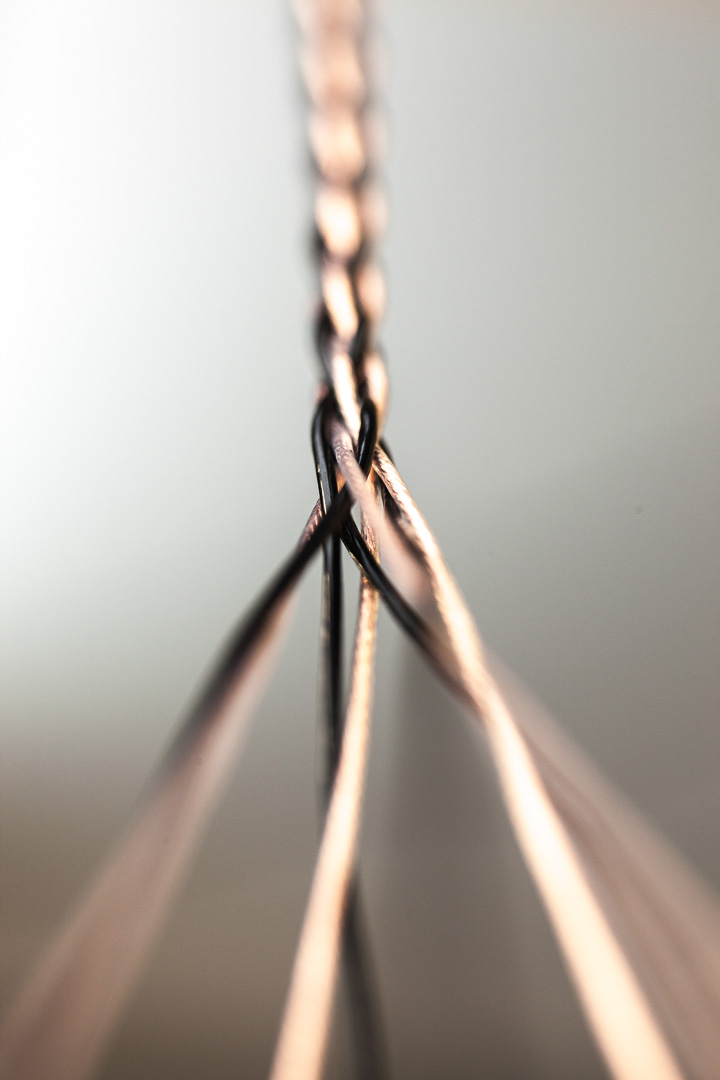
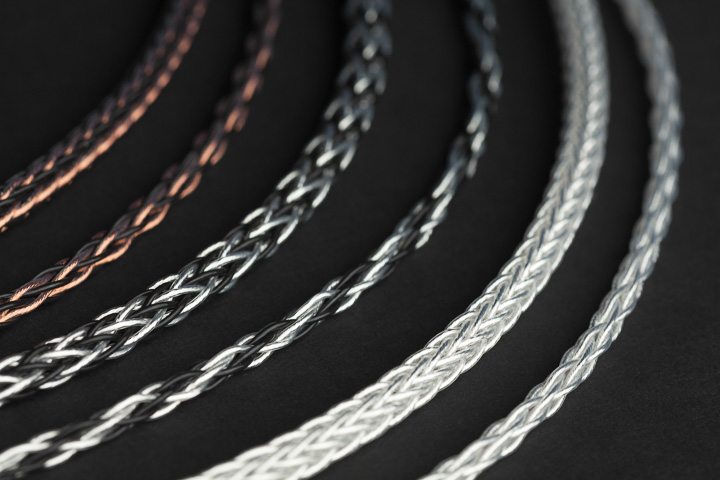
The Axios headphone cables use a braided topology that harks back to the design of Kimber’s very first commercial products: namely, the braided 8-wire 4PR and 16-wire 8PR speaker cables. In a recent interview with Hi-Fi+, company founder Ray Kimber explained that the genesis of his cable designs came through a concerted effort to use braiding strategies to create cables that were highly resistant to noise both within and above the audio band. The result was an across-the-board improvement in sound quality that could be observed in music listening, but that also could be verified through measurements (where the cables simply transmitted less noise than competing designs did). Over the years both conductor and dielectric (that is, insulator) materials have improved, but the number one design goal has remained the same: that is, to reduce both audio frequency and high-frequency noise to allow the unobstructed flow of high-purity music.

The Axios cables use a 16-wire braided design that uses, says Kimber, “a very flexible OFHC copper wire braid comprised of 16 FEP-insulated 24 gauge stranded conductors.” Further, Kimber adds, “we developed a new precision hand-braided process, which allows the conductors to seamlessly separate from 16 wires to 8 wires within the transition, eliminating the need for a solder joint.” A quick trip to Kimber’s Axios-specific web site (https://axios.kimber.com/configure) reveals that the firm offers Axios cable sets to fit upper-tier Audeze, Denon, ENIGMAcoustics, Focal, HiFiMAN, McIntosh, MrSpeakers, Oppo, Pioneer, Sennheiser, and Sony headphones. In each case, connectors for the headphone ends of the cables are made of “hand-polished hardwoods to match the beauty of (the) headphones.” In turn, buyers can specify both the lengths and the amplifier-end terminations for the cables they wish to order.


I first encountered Kimber Kable Axios headphone cables when the firm showed the product in prototype form at the Rocky Mountain Audio Fest/CanJam event in Autumn 2015. At that event the firm graciously loaned me a prototype set of Axios cables to try on my Audeze LCD-3F planar magnetic headphones. The only pre-condition of the loan, Kimber explained, was that they did not want me to do a formal review of the prototypes, since further running changes were expected before the cables would be put into production. Instead, the idea was that the Axios prototypes would provide a ‘taste of things to come’—and did they ever!

By way of supplying background, I should say that I have always regarded to Audeze LCD-3F as one of Audeze’s most nuanced and expressive headphones, so that in attaching a set of aftermarket cables to the headphones I really wasn’t convinced that much if any sonic improvement would result. But honestly my scepticism proved to be unfounded, as the Axios prototypes immediately triggered a significant leap upward in the overall sound quality of the Audeze, improving overall perceived resolution, transient clarity, dynamics, and especially sound-staging in dramatic ways. I almost could not believe my own ears, because with the Axios prototype cables in place the Audeze LCD-3Fs still sounded very much like themselves, only better—much better.

Seeking independent confirmation, I contacted my friend, fellow Audeze listener, and occasional Hi-Fi+ music reviewer Michael Mercer to ask if he had tried the Axios cables on his Audezes. “Oh yeah, man,” said Michael, “I’ve tried the Axios cables on my ‘cans’ and they’re pretty amazing. In fact, the cables almost made my Audezes sound like they had undergone a full-on design revision.” It was gratifying to see that my favourable reactions to the Axios cable were mirrored by the findings of a colleague, so that the only problem, at the time, was that I was that I wasn’t at liberty to share my observations with Hi-Fi+ readers—a situation that has since changed with the final release of the Axios cables.

Fast-forwarding to the present day, I’m pleased to say that I recently received a full production set of Axios headphone cables configured for use with my reference MrSpeakers ETHER Flow planar magnetic headphones. For my listening tests I listened to the ETHER Flows driven by a Questyle CMA600i balanced output headphone amp/DAC fed by a Lenovo/Windows/jRiver Media Center-based music server loaded with standard as well as high-res PCM and DSD material. During the tests, I compared back and forth between the ETHER Flows as fitted with their standard signal cables versus the same headphones fitted with Axios cables and the results proved very revealing.

While the standard MrSpeakers cable are quite good and give pleasing results, the Axios cables are better still and unlock considerably more of the performance potential of the ETHER Flow headphones. Specific improvements I heard included considerably finer resolution of low-level transient and textural details in the music, more focused and coherent rendition of layering within recordings (sometimes to the point of exposing low-level layers that had not been discernable through standard cables), superior bass control and pitch definition, and across-the-board improvements in soundstaging. Let me supply some musical examples to illustrate these points.

The hauntingly beautiful track ‘Rites’ (which is an excerpt from ‘Glimpses of Tibet’), as found on the 10th Anniversary of Rhymoi, 2003 – 2013 disc [Rhymoi, 16/44.1], features a mix of high percussion, mid-to-low-pitched brass, and very powerful low percussion. The track sounded promising when played through the ETHER Flows as fitted with their standard cables, but I couldn’t help but think that the sound seemed overly dampened—almost as is if listening through a thin, moist piece of cloth. Sure enough, once I installed the Axios cables the entire character of the sonic presentation changed for the better. The brass instruments suddenly had real bite and presence and the sheer richness and complexity of their harmonic structures became much more apparent—and more coherent. Then, when the low percussion came along, I heard a night/day difference where the drums sounded more powerful yet also more taut and focused in their presentation, complete with complex ‘skin sounds’ and that eerie very low frequency shuddering sensation that only really large drums are able to convey. Finally, the high percussion also sounded much better thanks to more sharply focused attack, sustain, and decay, plus the desirable characteristic of high frequency sounds that seem almost to ‘float’ on the open air. But the biggest benefit of the Axios cables involved the way they helped to weave disparate sonic elements together to form a cohesive whole—in the process creating a richer and far more three-dimensional soundstage.

For another example, try listening to ‘Midwestern Nights Dream’ from Pat Metheny’s Bright Size Life [ECM, DSD 64]. This track (and indeed the entire album) features Metheny on guitar, Bob Moses on percussion, and the late, great Jaco Pastorius on bass. Given the time period of the recording (released in 1976), part of its appeal draws on the fact that it is at once a showcase for Metheny’s then new ‘fluid’ or ‘liquid’ guitar tone, plus Pastorious’ also then new fretless bass sound with its famous “mwaaaah” tonalities and chime-like harmonics. It also helps that Metheny and Pastorius achieved a rare state of lyrical like-mindedness where two distinct musical personalities played as if with one common vision. This lovely recording sounds fine through most types of equipment and cables, but again the ETHER Flow/Axios cable distinguished itself by showing how Metheny’s guitar tone is not only fluid, but also has an agile, quicksilver aspect that reveals the underlying complexity and sophistication. Second, the Axios cables helped tease out the textural intricacy of Pastorius’ fretless bass notes, and the almost blindingly pure ringing sound of his bass harmonics. But most of all, the Axios cables clarified the brilliant ways in Metheny, Pastorius, and Moses found and exploited a common musical vision and groove.


The bottom line is that Kimber’s Axios headphone cables can and do help high-end headphones be all that they can be—often in quite dramatic ways. The Axios cable is not inexpensive, but it rewards the enthusiast’s investment by really delivering the goods, both in sonic terms and in service of the music. Very highly recommended.

TECHNICAL SPECIFICATIONS

Type: Braided, noise-resistant headphone signal cable.

Conductors: 16 stranded 24-gauge OFHC copper conductors

Dielectrics: FEP

Lengths/Configurations: Various lengths as required to fit Audeze, Denon, ENIGMAcoustics, Focal, HiFiMAN, McIntosh, MrSpeakers, Oppo, Pioneer, Sennheiser, and Sony headphones. Various amplifier-end terminations are available

Price: £698

Manufacturer Information: Kimber Kable

URL: www.kimber.com

Distributed in the UK by: Russ Andrews

URL: www.russandrews.com

Tel: +44(0)1539 797300 

B.M.C. Audio CS3 integrated amplifier

A couple of years ago, we raved about the B.M.C. Audio CS2 integrated amplifier, for a number of good reasons. Like the CD player/transport, DAC, and power amps – and supposedly like the phono stage – we liked the B.M.C ethos and its products because it all represents some of the truest aspects of high-end audio as it used to mean; high performance, significant build quality, and something ‘reassuringly expensive’ without being utterly financially unattainable. But this year, the CS2 received some useful upgrades and became the CS3. How could we resist the chance of a revisit?

Like its predecessor, the CS3 is a cleverly configurable amplifier that can be used as an integrated amplifier, or the power amp in a pre-power system. Part of the reason it can so readily be swapped from one to the other is that it’s in essence a power amplifier with what B.M.C. calls its Discrete Intelligent Gain Management system and a source selector. Usually, integrated amplifiers are a cross between a preamp and a power amplifier in one chassis. Used with a suitably equipped DAC, the whole gain structure of the amplifier is modified on the fly to suit the volume level set by the converter. This is different from signal attenuation, it’s more like changing the size of the amplifier relative to the volume level.

Discrete Intelligent Gain Management circuit moves the gain control out of the input and effectively controls the level of the output stage (thereby reducing input attenuation and excessive noise and distortion from additional amplifier stages). Of course, a ‘suitably equipped DAC’ is one of B.M.C.s own and this therefore relies fully on B.M.C.’s own system architecture. Without that we are just looking at a very heavy integrated amplifier, albeit one that retains that DIGM circuit as part of its internal make-up. From memory, the effect was more marked when used in harness with a whole B.M.C. system, but equally from memory CS3 seems to be a bit more volume-precise than CS2.

In outright, absolute terms, there’s not a great deal of difference between the CS3 and CS2 it replaces. They deliver identical specifications, have indentical inputs and outputs, and even the dimensions of the amplifiers are basically the same. The change is down to a revised circuit designed to increase stability and make the sound of the CS3 even less compressed and more dynamic than before. In theory there is an upgrade path between CS2 and CS3, but unless you were using them in mono amp mode, with a CS2 on one channel and a CS3 on the other, I would struggle to think why you should make the jump. Especially as that would mean loading that 40kg amplifier back into its box.

In today’s Class D, slimline world, this is a beast. Behind the big front panel, large white blue VU meters and huge volume and control knobs is an amplifier built for the big game. Open the amp up (not an easy task, it’s all vents and fins rather than a simple top-plate) and you are met with an exercise in transformer and capacitor use. This has not changed. It’s not simply a heavy chassis; it’s rooted in place thanks to massive power reserves. Any amplifier with 2kW of toroidal transformer in the power supply is very likely going to be strong and stable… and not in the ‘Theresa May’s mantra’ sense!

However, it’s not simply a big amplifier. Instead, this uses B.M.C.’s own LEF (Load Effect Free) design. This uses a very small single-ended Class-A output stage with a low-impedance voltage output. This stage, as well as the gain stages, has no feedback loop whatsoever. An independent circuit, not attached to the music signal, measures the current inside the voltage stage and keeps it constant by supplying an external phase independent current. Combined with a floating voltage cascade, the voltage stage hardly moves on its non-linear curve and thus doesn’t produce any THD. Uniquely, this is actually avoiding THD instead of correcting it by an overall loop.

Partner this to its Current Injection system (which replaces the gain stages by a special I/V converter that maintains a low impedance through to the loudspeaker output voltage, thereby preserving the original current of the signal source through the CS3) and – especially when used with other B.M.C. electronics – it’s pretty clear this is not just another 200W amplifier.

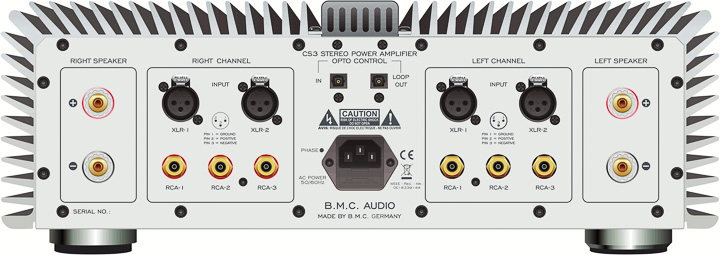
Like its predecessor, the amp has just three RCA single-ended inputs and two XLR balanced, as well as the Toslink-cabled opto control system, which allows B.M.C.s own DAC1 to take over preamplifier duties if called upon. There’s not much in the way of control, either; the big knobs turn the amp on and alter the volume, while the two buttons run through the inputs and dim that big white blue display. The display has both power meters and a zero-66 volume level in 1dB steps (although using the conventional ‘more is louder’ relative scale than the counter intuitive dB scale), and the relevant input is indicated along the top of the dial. Forget balance, tape loops or tone controls – this is old school purist high-end, and arguably all the better for it.

Given the weight, the huge warning on the box telling users not to rest the amplifier on its knobs, or store it fascia down, is probably wise. As is finding at least a couple of strong people to lift it out of the box.


Like the CS2, the CD player, and DAC before it, there’s actually not much you need say about the sonic performance of the CS3. And what you do say, is often just a reflection of the weaker aspects of other products in its price class. In other words, “X isn’t as detailed as the CS3” or especially  “Y isn’t as dynamic as the CS3”. But, even pulling out these aspects is doing the B.M.C. Audio something of a disservice, because it implies individuated aspects of a performance, where the CS3 –like its predecessor shines in delivering the whole package.

You don’t focus on the ephemera here. You aren’t listening for the detail or defining the soundstage. You are listening to music, as a complete and contiguous whole. It’s like it manages to combine the grace of a good valve amp with the power of good solid state. That combination of effortless power and a lot of respect for the music makes the CS3 the perfect foil for some of the larger, more demanding, and great sounding loudspeakers out there. And yet, used with more humble loudspeakers and you get a smaller, more taut sound. The CS3 is the combination of mail’d fist in velvet glove with a gentle soul at its base. It’s tempting to use this amplifier with difficult loudspeaker loads at high volumes, because the amp can take it and it’s fun, but this is also an amplifier for the long haul. It sounds good, honest, and accurate whatever you throw at it, or whatever you throw it at.

Having some water under the bridge between the CS2 and CS3 does make for some observations, that either I missed last time, or maybe have become more important to me over the last few years. The sound of the B.M.C. is very much in the big amp design, but in some respects its very much in the older big amp, er, camp. This is a surprisingly fast sounding amplifier all things considered, but it’s not the most rhythmically precise as I’ve heard of late. I do think I am becoming more aware of rhythmic properties of music recently, or more particularly, I’ve become less tolerant of their absence. I’ve still not quite reached that level of tunesmithery that means you can walk into a room, listen to someone count off a four-four beat, and then walk straight out saying “it doesn’t time”, but that temporal and rhythmic precision I once had from smaller Naim amps is calling again, and it’s somewhat found wanting here. This is an incredibly powerful amplifier that puts a smile on your face, makes music sound exciting and percussive when called for, but there’s just that niggling little need to tap your foot along with the beat, which this gets so close to fully achieving. For many, this is a non-issue, and the combination of dynamic range, excellent soundstaging, and almost perfect vocal articulation will outweigh any perceived pace issues. But I stuck on ‘Come Together’ from Abbey Road by The Beatles [Parlophone, CD] and Ringo Starr’s louche drum style was almost too correct.

Regardless, the CS3 presents the sound it’s fed honestly and accurately. It’s fundamentally neutral to the core, and that is what makes it so attractive to high-end loudspeakers. I’m finding it a little difficult to be entirely rational about this because of what it represents (high-end the way it always used to be) as much as how it sounds, but the fact is it sounds extremely good indeed.

We’ve lost our way a little, and the musical examples audio reviewers pull out of the hat can sometimes reflect this. It’s a function of preaching to the choir and not having enough new blood to be able to play a more diverse range of albums. But the CS3 needs none of that selective audiophile album nonsense. It’s just as comfortable playing Puscifer as it is being cerebral to a Mozart piano concerto. And while that doesn’t make for pulling out good musical examples to highlight performance aspects (just point the amp at your collection and you’ll find such examples) it does make for an amplifier that at once ticks the audiophile and the everyman boxes alike.

A brief word on cables. Don’t get too fussed by them. B.M.C. still makes its own monocrystal cable at a less heady price point than the usual suspects and that works extremely well. But, frankly, the CS3 is not a fussy amplifier in terms of cable demands. I found it worked extremely well with Cardas Clear interconnects and speaker cables, and I didn’t feel the need to push the envelope to something in the hyper-price league. The CS3 is best used in balanced operation if it is not to be in an all B.M.C. rig. Single-ended is pretty good, but not quite as essential as balanced and you would be strongly recommended to go for this connection if it were at all possible. But, more importantly, remember the ‘it’s not fussy’ line.

Having lived with the CS3, I am reminded of the CS2, and the question deserves repeating – Is it worth upgrading or changing from one to the other? The answer is a resounding ‘no’. Not because the CS3 is worse than the CS2. It’s ever so slightly better, in fact. And that’s why I suggest holding off. If you have a CS2, you already have a great amp with years of life in it. If you haven’t, check out the CS3, because it does practically everything a classic Krell does, for less.


I was surprised by the CS2 and what it did so well is aped by the CS3, and it still highlights the state of the rivals at the price. There are a lot of amps at this price point, but few seem to hold that goal of ‘high fidelity’ in as such high esteem. Some place emphasis on aspects of musical performance or on shaping the tonal balance in manners euphonic, quixotic, exotic, or neurotic. And some will be drawn to one of these outcomes. But is it right? The B.M.C. Audio CS3 asks this question of its rivals, and many will shy from the answer.

What held for the CS2, and still holds for the CD and DAC, holds just as much with the B.M.C. Audio CS3. This is the intelligent choice in high‑end audio right now. Aside from the CI monoblock option, you have to spend more – vastly more, an order of magnitude more in fact – to achieve any significant uptick in performance in every aspect apart from possibly its portrayal of musical timing, and even that’s questionable. There are many who say there’s no such thing as a law of diminishing returns in high-end audio, but I’d disagree. For me, it starts where B.M.C. Audio stops.

TECHNICAL SPECIFICATIONS

Type: Integrated amplifier:

Inputs: 2× balanced XLR and 2× unbalanced RCA

Input Impedance: 50kΩ to ground, 100kΩ differential at XLR

Input Sensitivity: max 750mV (RCA), 1.5V (XLR)

Output: 2× 200W/8Ω, 2× 360W/4Ω

Frequency response: 20Hz–20kHz +0dB/-0.08dB @ 1W

THD+N under 0.1%: from 0.3mW to 150W

Signal/Noise ratio at DIGM 40 (relative to 1W): 103dB

Damping factor: 250

Dimensions (W×H×D): 43.5 × 45 × 15cm

Weight: 40kg

Price: €5,998

Manufacturer: B.M.C. Audio GmbH

URL: www.bmc-audio.com

Tel: +49 30 692 006 061 

Lejonklou Sagatun Mono 1.3 preamplifier and Tundra Mono 2.2 power amplifiers

A surface look at Lejonklou’s top amps would likely file them under ‘quirky’. A fully dual-mono preamplifier and power amplifier, with a relatively low power output, the kind of minimalism that borders on outright nihilism, and a decidedly ‘Scandiwegian’ nomenclature puts this relatively unknown four-boxer in the ‘huh?’ camp. Then you listen to them.

Lejonklou – the brand – is the brain-child of Uppsala-based Fredrik Lejonklou, an electronics engineer and music lover who is perhaps best-known for his excellent moving magnet phono stages. Lejonklou (the man and the brand) has been strongly influenced by Linn and Naim (reputedly from his teenage years) and in particular the classic ‘Tune Dem’ used by Linn Products to evaluate and demonstrate its audio products. However, the Sagatun Mono and Tundra Mono arguably take the Tune Dem farther than Linn does today.

The amplifiers all use a dual Switch Mode Power Supplies (SMPS), arranged not as one-per-channel – which is common – but always as one for positive rail and one for negative rail. This arrangement is twice as expensive as normal SMPS designs, but with no increase in power. When one power supply (in the power amps, where power is needed) pushes the loudspeaker drive units out, the second power supply is resting. And when the second power supply is pulling the drive units in, the first power supply is resting. 

The reason for this design is not more power, but more control of that power. In each SMPS, there is a feedback loop that makes sure the output voltage is stable. When using a single power supply, with positive and negative voltages (the standard arrangement), only one feedback loop is possible, despite this loop affecting both voltages. When the amp needs to deliver a positive current to push the speaker drive units out, the feedback loop will adjust the switching signal inside the SMPS in order to keep the voltage at the output perfectly stable. This works well for the positive rail BUT at the same time, the negative rail will also be adjusted! So instead of staying stable, the negative rail will fluctuate each time the positive rail delivers current. And vice versa. The only way to stop the postive and negative rails from affecting each other in this way is to use TWO power supplies, each with their own feedback loops.

The 40W Tundra Mono uses the latest – and supposedly the best – Thermal Interface Material (TIM) that quickly moves any heat generated by the output devices on to 1.2kg of copper heatsink (from whence it dissipates to the aluminium case and to the air). There is also a spring loaded transistor clamp which keeps the pressure against the TIM and copper constant at all temperatures, and a trimmable main idling current, which is useful in settings where heat could remain a problem (such as inside a cabinet). The amount of cooling affects the idling current and therefore the performance of all amplifiers, but this trim function reduces the potential problem to a minimum. It’s like designing the amplifier for its surroundings. This requires plugging the supplied multimeter into the Status Port, turning the trim dial, and repeating the process a few hours later when everything has stabilised. This is explained in the supplied manual, which is useful if a little terse. Or minimalist, as befits the amplifier.


In a way, it’s how the amp is built rather than the circuit itself that matters. The amp is built by hour upon hour of listening tests, to every aspect, every component (which often ends up being manually re-measured and selected to extremely tight tolerances (Fredrik claims less than 0.1% tolerance for resistors), as well as stand-offs, fasteners, temperature levels, and more. This doesn’t mean the circuit is unimportant – the amplifiers are engineered well, and then evaluated, in an iterative process. The engineering integrates with the listening tests. This is a painstaking process in all respects, but is akin to blueprinting a car engine. It’s the amp, just at its very best.

Connecting the amp is easy, but requires a quick read of the manual. At the back of each Sagatun are eight phono inputs. Ignore the colour coding of the plugs themselves and think more of the legends on the back of the amplifier. The leftmost pair of phono sockets are coded red (as in ‘do not use’) and yellow for a single-input, always switched to that channel, amplifier. The next four are four line inputs for a more conventional switched preamplifier, and the rightmost pair are preamplifier outputs.

To connect a single source amp, simply connect the left hand output of your source to the yellow input of one Sagatun, connect one of the outputs to the left Tundra power amp, connect that to the left hand loudspeaker and then repeat with the right hand channel. If you have more than one input, ignore the yellow-marked input and connect inputs one, two, three, and four in order. It’s probably best to connect one input to left and right preamps, then move on to the next, if you don’t want to end up with a mix of inputs.

To get synchronised volume controls, the two Sagatun Mono amps are connected by a Toslink control link, with two connectors marked ‘Master’ and ‘Servant’ (a tribute to Depeche Mode!) and a switch between the two. The Master amplifier receives remote commands and sends those commands and front panel controls to the Servant, and the Servant will obey commands sent from the Master. These can be daisy-chained, for someone wanting a spot of multichannel action, and the combination of thin, light, and cool-running boxes makes this more of a practical – if hard-core – proposition than most.

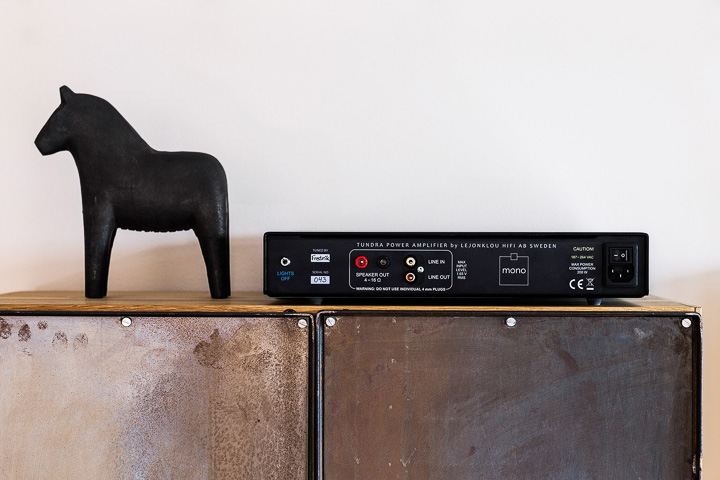
The Tundra mono amp makes the Sagatun look like it positively bristles with inputs. Aside from the aforementioned status port and trim dial, it has a single phono input, a single phono output (for bi-amping), and a single set of 4mm banana plug sockets. That’s pretty much it. The amplifier has two stages of thermal protection (at 50°C, the amp gradually limits its maximum output and, if that doesn’t work, at 70°C, it goes into mute until the heatsink is sufficiently chilled out), but short and overload protection was omitted for the sake of the performance. If you short the speaker terminals, or drive the amplifier beyond ‘orange’ on the Sagatun’s volume light, you can damage the amplifier.

The amplifiers are not designed to be stacked atop of one another. The four, slightly adjustable rubber feet are designed to fit on shelves, and will leave a residue on the top-plate of the amplifier below. Using the Tune Dem to draw these conclusions, Lejonklou recommends the Harmoni rack by Nokturne Audio, but Quadraspire makes a good alternative. The Tune Dem applies to everything down to recommended cabling, even to the point of preferring discontinued and older versions of current cables, and eschewing the ‘looks like a python, costs as much as an AC Cobra’ designs. The best – in Fredrik’s opinion – is Linn’s early silver interconnects (new ones are OK, but not quite as good as the early models), Linn’s now discontinued K-400 bi-wired speaker cable (preferably anything over 2.48m of the cable). Aftermarket power cords are not recommended, and the thicker black standard three-core power cords are sufficient (Fredrik has performed Tune Dems on different kinds of standard power cord and did come up with specific recommendations on the power cords of every country apart from Switzerland and Australia!


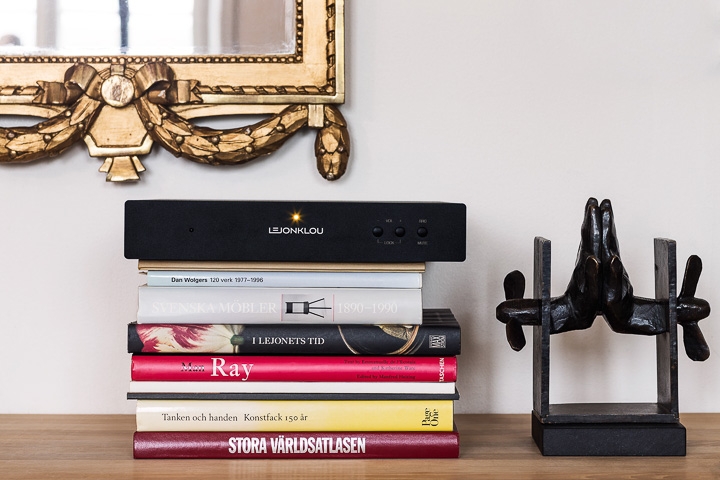
Minimalism reigns supreme here. The mono preamps bristle with just three buttons and a single light above the name. The buttons raise or lower the volume control (and act as a child lock if you press them both together – this can make for some interesting moments for those of us who have a habit of mashing buttons), while the third button – marked SRC/Mute – runs through the four inputs or mutes the amp if pressed and held. These relate to volume, source, and mute controls on an RC5 remote control. The single light is deceptively useful, as it blinks and runs through a series of different colours to denote volume level, input selected, whether it’s run in unity gain, mute, or running at -12dB part mute (which can only be activated by a remote, but is useful for lowering the volume while talking on the phone, or if it’s connected to the TV and the adverts are played at peak loudness). The Tundra mono has two blue LEDs, which can be turned off.

The preamps are best left perma-powered (they don’t draw much current and don’t get warm), but the power amps come on song after an hour, and are best powered down if the system is left fallow for any length of time. I don’t know whether or not my samples came extensively run in or brand new out of the box, but their performance didn’t vastly improve over hours of listening. What you hear from day one is what you get.
What you get is a remarkably taut, precise, and exceptionally entertaining sound. OK, those who want a big, loose, flabby, flubby sound, full of saccharine sweetness, and buttery richness will want to look elsewhere. But, not everyone views music through the medium of diabetes and furred arteries, and the precision the Lejonklou Quartet brings to music is extraordinarily persuasive.

I must admit to there being a listening learning curve with the Lejonklou Four. At first listen, you think the sound a little lean in the bass, slightly drier sounding in the midrange, and that presents a small, forward soundstage. As you progress with the amplifier combination, you start to discover that your focus changes. That leanness in the bass is in fact a taut, overhang-free bottom-end that is both extremely well controlled and – most importantly rhythmically ‘right’. That drier than usual midrange becomes more about expressing the harmonic and melodic structure, the metre of the music, and the lyricism of the musicians, rather than the ephemera of how ‘nice’ the sound gets.

Perhaps the best way of demonstrating this presentation is with the title track from the album Room 29 by Jarvis Cocker and Chilly Gonzales [DG]. The album – set around and played in Hollywood’s Chateau Marmont – can easily be just a pleasant, slightly bland, spatial event of piano and voice. You’ll listen to it, nod along politely, and leave the rest of the recording unplayed. Through the Lejonklou, though, the poignant piano rhythms coupled with the metre of Cocker’s sing-speak sarcasm as he says “help yourself to pretzels”, locks you in place and the whole album has to be played. Rinse and repeat with the rest of your collection. You realise most amps focus on the wrong parts of the music. In fact, they often don’t focus on the music at all. However, the Lejonklou amps burrow into your musical DNA, and it’s one hell of a heady retrovirus!

The elephants in the room are, for once, not hidden. The Tundras are 40W amps that omit overload protection, so no playing it with insensitive loudspeakers to thrash levels (it goes surprisingly loud with the right speakers, but party levels are not recommended). Meanwhile the Sagatun is a two box, dual-mono, minimalist preamp design, and that compromises ease of use ‘somewhat’. There are no bells and whistles, and if you aren’t good with remembering flashing lights and colour schemes, you might want to keep the manual out as a cheat sheet.

Room elephants be damned! To my mind, the Lejonklou Sagatun and Tundra Mono amps are how amplifiers are supposed to sound. There is a tendency for some amplifiers to follow Beecham’s quip – “The English may not like music, but they absolutely love the sound it makes” – in that they make music sound beautiful, but completely free from what makes people passionate about music itself. The Lejonklou Four invert this: they get to the core of what makes people enjoy music. Recommended!

TECHNICAL SPECIFICATIONS

Lejonklou Sagatun Mono 1.3 preamplifier

Inputs: one RCA (purist mode) or four RCA mono inputs

Signal input impedance (all inputs): 10 kΩ

Signal input maximum level: 5VAC

Frequency range: 2Hz to 200kHz

Volume range: -80 to +20 dB in 1dB steps

Output impedance: 300Ω

Output recommended load: More than 1kΩ

Output Level: 0 to 7.5VAC

Dimensions (W×H×D): 35 × 6.9 × 35cm per chassis

Weight: 3.4 kg per chassis

Price: £3,050 per channel

Lejonklou Tundra Mono 2.2 power amplifier

Inputs: one RCA mono input

Output power (all ratings continuous): 40W into 8Ω 20Hz–20kHz RMS (at less than 0.1% THD) and 57W into 4Ω 20Hz–20kHz

Frequency range: (-3 dB) DC to 130 kHz

Signal input impedance: 10kΩ

Signal input maximum level: 1.65VAC and 40mVDC

Signal gain: 20.8dB

Output impedance/Rec. load: 0.05Ω/4–16Ω

Output peak voltage 26 V

Dimensions (W×H×D): 35 × 6.9 × 35cm per chassis

Weight: 4.4 kg per chassis

Price: £2,850 per channel

Manufactured by: Lejonklou HiFi AB

URL: www.lejonklou.com

Sold in the UK by: Hidden Systems Ltd

URL: www.hiddensystems.co.uk

Tel: +44(0)1252 845400 

D is for diamond: Transfiguration creates special limited ‘D’ edition of flagship Proteus phono cartridge

Hand-crafted in Japan by Immutable Music’s Seiji Yoshioka, Transfiguration moving coil (MC) phono cartridges have been hailed as being among the world’s most musically honest. This is no accident, since their design has always been guided by two firm principles: first, to extract the most minute, natural musical detail from a record’s groove and second, to get out of the way. So when it’s said that a Transfiguration cartridge ‘lacks character’, it’s a compliment. Says Yoshioka, “The best audio components are those that simply don’t seem to exist – so good that they add nothing, subtract nothing.”

It’s precisely this quest for ever-more natural musical detail that led Yoshioka to develop a very special, limited edition of Transfiguration’s flagship Proteus cartridge: the new Proteus D. ‘D’ is for the diamond cantilever, which explains why this is a limited edition. “The production of a diamond cantilever is a unique challenge,” explains Yoshioka. “Of course it’s expensive, but more than that, to craft it requires an extremely highly skilled technician.” In most other respects, the design and specifications of the ‘D’ largely match those of the ‘standard’ Proteus – for want of a better term, since there’s rather little that’s ‘standard’ about it. 


Its patented yokeless double-ring-magnet design provides an extremely accurate coil /magnet interface, in which the exceptionally pure (99.9997%) 5N silver wire coils are positioned right at the focal point of the magnetic flux field. This ground-breaking construction, which underpins all four models in the Transfiguration range, was conceived to remove the variations in flux introduced by traditional MC designs and is key to the range’s stunningly lifelike musicality.

The Proteus’ design also features push-pull damping. Its multi-layered double dampers are made from a specifically-developed stabilising compound comprising different types of elastomer. Insensitive to temperature changes, they provide excellent stylus / coil alignment and control, and highly precise tracking ability. The double dampers in the new limited edition Proteus D have been specially re-designed for the diamond cantilever.

Crafted to provide a substantial amount of information without sacrificing musicality, the Proteus D has an advanced ability to resolve musical detail, with excellent air and a finelytuned capacity to deliver superior handling of soft passages, inter-transient silences and subtle, low-level harmonics. It allows the midrange to breathe more freely while liberating the highs to further extend their reach.

Inevitably, the better the system with which a Proteus D is partnered, the more musical detail it will reveal, bringing to light seemingly brand new information and emotion that was previously hidden in a record’s grooves. And it doesn’t disappoint in the looks department either, with its sleek pitch-black body engraved with a ‘D’ for diamond.


Technical specifications: Transfiguration Proteus

Body Precision machined solid aluminium, resonance controlled

Cantilever 0.3mm solid diamond

Stylus Micro-ridge diamond, 2.5 x 75μm

Core & coils Ultra grade 3S-μ-metal square core with 5N silver coils

Magnet Neodymium, front & rear

Weight 7.8g

Electrical output voltage 0.2mV (3.54cm/s, 1kHz)

Internal impedance 1Ω

Frequency response 10Hz – 20kHz + 1.5dB; 20Hz – 40kHz +2dB

Channel separation > 30dB (200Hz – 1kHz)

Recommended tracking

force 2g

Pricing and availability

The limited edition Transfiguration Proteus D is available now, priced at £6,750 (incl. VAT).

Consumer contacts for publication

transfigurationcartridges.co.uk

UK distributor: Decent Audio

Tel: 056 0205 4669

Email: [email protected]

Web: www.decentaudio.co.uk

Unit 11, Castlegate Mill

Quayside, Stockton-on-Tees

County Durham TS18 1BZ

Press contact

For more information, product samples or high-resolution print-ready images please contact

David Denyer on 07976 646 404 or [email protected]

Ends / ©DDPR / No embargo

News Round Up 3 October 2017

Dynaudio’s ‘Music’ Wireless Multiroom system

From the Dynaudio Press Release

Skanderborg, Denmark – September 28, 2017: Dynaudio has announced Music – a family of four intelligent wireless speakers.

Dynaudio Music provides one-touch simplicity. It adapts seamlessly (and automatically) to any room or position, and to surrounding noise levels – so music always sounds its best. It even gives personalised playlists featuring only the music its users love with Music Now. All at the touch of a button.

Intelligent playlists

The accompanying free app for iOS and Android uses Dynaudio’s sophisticated Music Now algorithm to learn users’ musical tastes and play automatically generated playlists with one touch of a button on the speaker.

It means there’s no need to scroll through endless playlists, only to get bored trying to find something to listen to. This is just like turning on a radio – but the station is guaranteed to play music the listener wants to hear. (The added benefit? No irritating DJs.)

The speaker connects to popular music-streaming services including TIDAL and Spotify.

Each Music speaker has five presets. These can be filled with anything accessible from the app: smart Music Now playlists (from multiple user profiles), internet radio stations, TIDAL albums, artists, Spotify playlists and more. TIDAL content can be accessed straight from the app, while Spotify can be added to presets from the ‘Now Playing’ screen.

Intelligent DSP

Built-in RoomAdapt technology senses where the speaker has been placed (in a corner, up against a rear wall or in free space) and optimises performance to always deliver the best sound possible. You’ll hear it most in the clean, accurate bass and midrange. Essential musical details will always be clear too, thanks to NoiseAdapt – even when the room is noisy, and the speaker volume is low. There’s no need to crank the volume to hear tunes properly when the conversation gets louder, and there’s no need to tweak the tone controls either.

It’s all based on Dynaudio’s expertise in DSP (digital signal processing), gained from researching and developing high-end active speakers, professional studio set-ups and cutting-edge in-car hi-fi systems.

Intelligent features

There are four speakers in the family. All are active (each driver has a dedicated high-performance class-D amplifier specifically tuned to match it), and they all have slightly different features to help them fit different lifestyles and situations.

All the speakers use Dynaudio’s proprietary MSP cone material in their woofers and midrange drivers (the same material used across the company’s entire product family, right up to the range-topping Evidence Platinum series). Their soft-dome tweeters are based on Dynaudio’s high-end speakers. And it’s all been tuned by the same team who work on its money-no-object hi-fi speakers and no-compromise pro studio systems.

Music 1 (£450) is battery- and mains-powered. It has one 4in woofer and a 1in soft-dome tweeter. Total power is 80W (each driver has its own 40W amplifier), and its battery lasts up to eight hours.

Music 3 (£575) is battery- and mains-powered. It has one 5in woofer and two 1in soft-dome tweeters. Total power is 120W (each driver has its own 40W amplifier), its battery lasts up to eight hours, and the unit comes with a remote control.

Music 5 (£700) is mains-powered. It has one 5in woofer, two 3in midrange drivers and two 1in softdome tweeters. It delivers a total of 250W (each driver has its own 50W amplifier), and the unit comes with a remote control.

Music 7 (£875) is mains-powered. It has two 5in woofers, two 3in midrange drivers and two 1in softdome tweeters. Total power is 300W (each driver has its own 50W amplifier), and the unit comes with a remote control.

All the speakers in the family can stream via Wi-Fi, Spotify Connect, aptX Bluetooth and Apple AirPlay, and can access DLNA devices on users’ home networks. They all have USB inputs for iOS audio and charging iOS devices, and can accept 3.5mm analogue inputs. The Music 5 and Music 7 add digital optical inputs to the mix (both support signals up to 24-bit/96kHz), while the Music 7 also has an HDMI connector with Audio Return Channel to turn it into a soundbar.

Up to six speakers can be connected at a time and arranged into multiroom groups, or controlled individually from the Dynaudio app.

Traditional Dynaudio craftsmanship

Each model is available in Light Grey, Dark Grey, Red and Blue cloth finishes, custom-made by the acclaimed Danish textile house Gabriel, and is constructed from honest, high-quality materials – including a one-piece brushed aluminium surround on the Music 5 and Music 7. It’s a product built to last – both in terms of style and wear-and-tear. The front grille cloths on the Music 5 and Music 7 are interchangeable too, so you can change the look as you change your tastes. Both the Music 5 and Music 7 can be wall-mounted using a dedicated steel wall-bracket.

And that design? It’s typically Danish, typically high quality and typically innovative – as you’d expect from Dynaudio. Plus there’s some added inspiration from origami, traditional Chinese boat sails… and even stealth fighter jets.

At launch, all Music speakers will come with a free 90-day TIDAL trial, so users can get started straight away.

Hegel H190 integrated amplifier

From the Hegel press release:

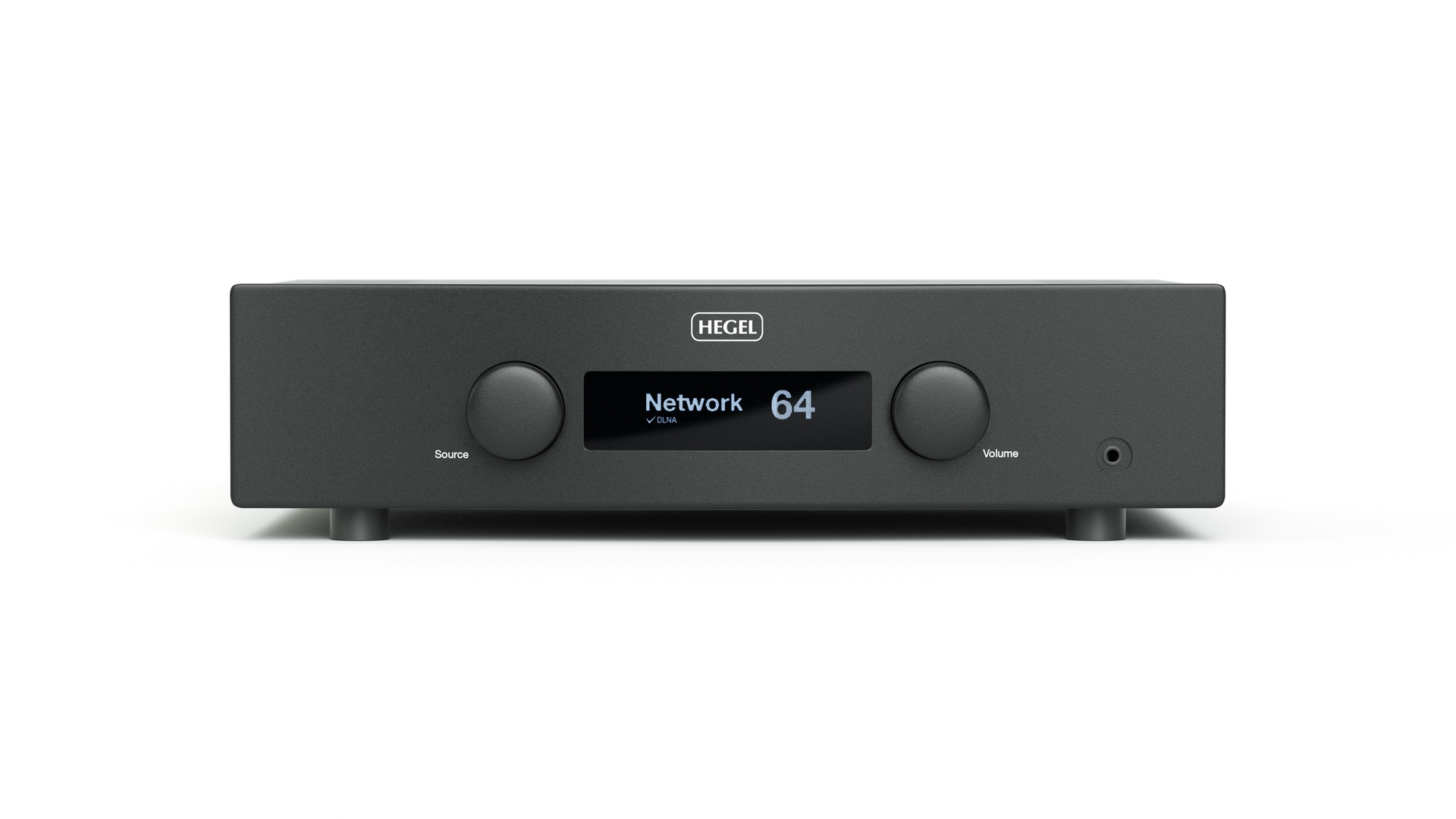
Hegel presents the H190, an amp with DLNA streaming capabilities that can play music from any streaming platform including AirPlay.  With configurable inputs, a high end DAC, and a front facing headphone output you can enjoy ease of use with ultimate sound quality. In black or white, with an oled display, the H190 is beautiful enough to be the centerpiece in any system and powerful enough to drive almost any loudspeaker on the market. 

With a dampening factor of over 4000, the H190 is powerful enough to drive almost any loudspeaker currently on the market, especially the big ones! Plug in your loudspeakers and start streaming music over AirPlay, or any other DLNA streamer, quickly and easily. The high end DAC ensures precision decoding, providing the best foundation of sound for your entire set up. The 2×150 watt SoundEngine2 error cancelling amplifier prevents distortion and preserves the details and dynamic range in the original music signal. The H190 also features a sturdy 6.3mm Headphone output that is front facing, so you can easily plug and unplug as your listening style changes over the course of a day. With powerful technology inside of a modern casing, the H190 is the Hegel embodiment of Powerful Design.

Technical Specifications: H190 Integrated Amplifier

Power output: 2*150W in 8 ohms

2*250W in 4 ohms,

Minimum load: 2 ohms

Analog Inputs: 1*balanced (XLR),

2*unbalanced (RCA),

Digital Inputs: 1*coaxial S/PDIF,

3*optical S/PDIF,

1*USB,

1*Network

Line level Output: 1*unbalanced fixed(RCA),

1*unbalanced variable(RCA)

Frequency response: 5Hz-100kHz

Signal-to-noise ratio: More than 100dB

Crosstalk: Less than -100dB

Distortion: Less than 0.01% @50W 8 Ohms 1kHz

Intermodulation: Less than 0.01% (19kHz + 20kHz)

Damping factor: More than 4000

(At main power output stage)

Dimensions: 12cm x 43cm x 41cm (HxWxD),

19kg shipment weight.

Dimension US: 7,72î x 16,93î x 16,15î (HxWxD),

41,89 lbs shipment weight.

Expected UK Price: £3,200 inc VAT

Jeff Rowland Design Group Capri S2 preamplifier

I wonder if Jeff Rowland ever read EF Schumacher’s popular tome Small is Beautiful, a guide of sorts to the benefits of keeping a business small, a state of affairs that many audio manufacturers have taken to heart, albeit not necessarily by choice. The Capri S2 preamplifier also embodies that philosophy: it is no bigger than it needs to be. In fact, by American high end standards it’s positively portable at just over 35cm wide, but it’s also pretty dense as the 4.26kg weight attests. Construction is typical Jeff Rowland machined-from-solid aluminium; his products always look great but that beauty is more than skin deep. But the skin is misleading; those peaks you see give the impression that the surface undulates, but close inspection reveals it to be totally flat.

In its standard state, the Capri S2 is a line stage with two single-ended and two balanced inputs plus a home theatre bypass, which seems an unusual input array for what appears to be a purist product. But ‘home theater’ is bigger in the US than in many markets, and even audiophile brands have to cater for market trends once in a while. Usefully, if you don’t want this feature, an internal jumper can transform it into a regular, volume controlled input. Output is via RCA and XLR and that about covers the back panel. Behind the inputs is transformer coupling circuitry chosen for universal compatibility with different sources, identical gain for unbalanced inputs and noise rejection. This isn’t a TVC (transformer volume control) however, such things being solely the domain of passive components.

The volume control has usefully small increments of half a decibel that can be achieved with the remote control or the beautifully turned knob. The latter is speed sensitive, so can give you big changes quickly as well. The easy to read volume display can be switched off with the handset or you can move an internal jumper that turns it off after five seconds if its yellow/green hue offends. The remote is not as impressive as the casework sadly, but that keeps costs down, it has mute, phase and channel balance switches alongside the usual volume and input selectors.

The compact size is aided by the fact that this Jeff Rowland, like the majority of products from the brand, has a switch-mode power supply, so there’s no need for a big mains transformer nor for different transformers to suit different mains voltages. The supply is described as a low noise, high current, dual regulated switch-mode, which is still quite a rare feature in the high end outside of products from Linn and Chord Electronics. However, the day cannot be far away when the puritans in high places decide that any products that draw more than a few watts are the spawn of Satan and banish them from our systems, so it could be a canny move.


Despite the diminutive nature of the Capri S2, it has space inside for an optional circuit board, which can be phono card that converts input 1 into an MM/MC input with three gain and loading options. Alternatively, you can get a plug-in DAC card that converts input 1 into an S/PDIF coaxial input that’s good for PCM up to 24-bit/192kHz. It would be more appealing if there was a USB connection but naturally there isn’t such a socket on the preamplifier in its line stage guise, which limits the DAC’s appeal to the streaming generation unless they have a bridge with coax out such as the AURALiC ARIES. Sadly, there is no provision for DAC and phono, as they both plug into the same slots.

I initially hooked the Capri S2 up to a Marantz SA-10 being used as a DAC, and connected my regular ATC P1 power amplifier with Bowers & Wilkins 802 D3 speakers. The Marantz was still running in so I didn’t expect too much, but hearing Emma Kirkby’s voice on Handel’s Messiah [Academy of Ancient Music, Hogwood, Loiseau Lyre] it was clear that things were working rather well. This is obviously a great recording and in the Capri’s hands, it takes on a depth of image and richness of tone that is very appealing, thanks to strong presence from the singer in particular. It inspired me to try the same thing with the CAD 1543 MkII DAC and a direct USB link to the Melco server (previously I used an ARIES LE between the server and DAC). This brought out more of the depth and openness of the recording, producing an unusually natural, even sublime sound from that voice. As I’m not that familiar with the recording I substituted my even more diminutive preamp of reference, the Townshend Audio Allegri. This passive device went further in terms of transparency and openness again, indicating that the Capri S2 while clearly very neutral and revealing does add a subtle polish to the sound; a slight veil that is hard to spot on it’s own but becomes apparent with the contrast.

Returning to the Capri S2 and Alice Coltrane’s ‘Journey in Satchidananda’ from the Impulse album of the same name, I was encompassed by the heavy sound of double bass and sparkle of percussion, harp, and drone. What struck me here was how well the preamplifier tracked the micro-dynamics of the various instruments, the changes in level between notes being particularly well presented. The sound remains slightly constrained overall compared to a passive, but this doesn’t get in the way of musical flow or detail. In fact, it’s replete with the nuances of the various instruments in the mix, all of which are well separated and easy to follow. The composer’s harp playing being particularly well resolved in the context of such a broad acoustic cosmos, and when it sounds this good it’s hard not to drift away on the vibe.

A stiff drink (Assam tea) later, I had pulled myself together and got down to the tough but necessary task of further listening. Up to this point, the Capri S2 had been connected to the power amp with single ended cable, but given Jeff Rowland’s clear predilection for balanced connections I tried that instead. This made small but worthwhile improvements to the results, notably with regard to low-end gravitas. The bass now had more authority, which is not an uncommon finding in my experience, but the image seemed to have greater depth and more clear-cut layering. Even lyrical intelligibility seemed better with the Messiah piece, so listening continued with this connection. Timing is not the Capri S2’s strongest point but neither is it disastrous; alternative preamps do seem to get to the rhythmic parts more effectively, but they frequently lose out too much elsewhere. The emphasis here is more on detail resolution, which makes it easy to listen right into a piece of music and understand what each instrument or voice is contributing. That means that complex pieces no longer seem so dense for instance, which is a good sign of coherence. It also gives each note it’s due weight in terms of attack and decay, which is the opposite to a fast sound I guess and one which suits material where the emphasis is on melody rather than transients. But, the Capri S2 treads a careful line between the melody and rhythm, and remains diffidently neutral at all times.


It’s worth noting that this Jeff Rowland does not sound like it has a switch mode power supply, as there’s no graininess or brightness at all. In fact, it couldn’t be smoother, it’s the most polished SMPS device I’ve encountered. And this does the Capri S2 a lot of favours when bringing out the tonal richness of everything you play. It’s not just classical sopranos who benefit; Tom Waits’ ‘In Shades’ [Heart Attack & Vine, Ayslum] also has great depth to the guitar and organ, and the burble of the dining audience is clearly separated from the music, a result in part of the impressive low level resolution on offer. This is a very quiet preamp indeed, which means that very little fails to get to its outputs. This in turn means there’s plenty of dynamic range available in the resulting sound.

At first glance, the price seems pretty high for such a compact device, but the Jeff Rowland Capri S2 is not only superbly built, finished and thought out but its sound quality has a similarly deep sheen. Size matters when it comes to some things – loudspeakers, listening rooms, cakes – but small is clearly beautiful where preamplifiers are concerned.

TECHNICAL SPECIFICATIONS

Type: Solid state line-stage preamplifier with optional DAC and phono cards

Valve complement: N/A

Analogue inputs: Two pairs of single ended inputs (via RCA jacks) two pairs of balanced inputs (via XLR connectors) one single-ended HT bypass input (via RCA jacks)

Analogue outputs: One pair of balanced outputs (via XLR connectors), one pair of single-ended outputs (via RCA jacks)

Input impedance: Not specified

Output impedance: Not specified

Bandwidth: Not specified

Gain: 99.5dB

Distortion: Not specified

Signal to Noise Ratio: Not specified

Dimensions (H×W×D): 67 × 350 × 157mm

Weight: 4.26kg

Price: £4,300

Manufacturer: Jeff Rowland Design Group

URL: jeffrowlandgroup.com

UK Distributor: Signature Systems

Tel: +44 (0)7738 007776 

URL: www.signaturesystems.co.uk 

Meet Your Maker: Paul Speltz, of AntiCables

As part of the Hi-Fi+ Guide to Audio Cables and Power Products (https://hifiplus.com/buyers_guides/6/), we spoke to Paul Speltz of AntiCables about the technologies used by the company, the history and future of AntiCables, and more…

Hi-Fi+: How and when did you first discover that differences in audio cables could actually affect the sound of hi-fi systems? Were you surprised at the time?

Paul Speltz: That would have been too long ago for me to remember specifically. You see, in addition to running the ANTICABLES, I am also an electronic engineer in the telecom industry. For 32 years I have been a board level designer, creating circuitry used to transfer an analog signal from point A to point B over long distances. Understanding signal transmission has been my job for years, so I feel like I have always known cables matter, even before I started DYI’ing my own audio cables back in the 90’s.

What was the first range of cable products you designed and when did it enter the market? How did it compare to other cables at the time?

Our first product was the ZERO-Autoformers, which when used with mono block amplifiers took the place of speaker cables. They were first introduced early 2001. The “ZEROs” were used to increase the impedance of any speaker, so it would be “easier” for an amplifier to drive. 

Improvements were made to the autoformer’s lead out wire. Long story short, the wire was so good, it in itself became its own product called “Anti-Cable Speaker Wires”. I named them this because the un-jacketed red coated wire didn’t look like, cost like, or sound like typical speaker cables. Since “cable” is basically wire with thick jacketing, and since it didn’t use thick jacketing, they were the Anti-Cables.

I should explain. Every time I tried dressing up my good sounding wire with jacketing so it looked like a speaker cable, it sounded like a speaker cable. Jacketing causes dielectric effect distortion that time smears the music signal and makes cables sound like cables. I decided to give up the jacketing, call them the “Anti-Cables”, and sell them in their naked form. The product was so popular that ANTICABLES later became the business name.

How has the audio cable industry evolved over the past several years? What are the pros and cons of the path the industry has taken?

This answer might be a bit dated, and may offer little insight, but the ability to sell direct to customers still feels the biggest change to me. It is what enabled me to go into business years ago.

The “cons” are, there are a lot more competitors, and a lot more for the consumer to sort through. The “pros” are, the competition keeps me on my toes. I am constantly looking for ways to push for even higher performance and greater value to remain competitive, and the customer benefits.


Some audio cable manufacturers focus primarily on premium-priced products, but your firm offers some ranges of cables that are far more sensibly priced. What led you to create ranges of value-minded cables?

Through the years, I personally was not willing to spend the asking price of some of the cable offerings I wanted in my system, so I now get a kick out of being able to offer higher performing cables at lower than typical prices.

I do not base our product prices on where they “fit” in the marketplace. In other words, I don’t say since our product “X” sounds better than their product “Y”, we should ask more for it. Instead, I base our asking price on the cost of materials, the cost of labor, and add on enough margin to cover business expenses.

Also, since I still hold my original career job as the Senior Electronic Engineer for a telecom/security equipment manufacturer, I don’t need to sell cables to “pay the mortgage”, so I am able to keep the ANTICABLES as a fun business.

What do you personally consider to be the ‘sweet spot’ product (or products) in your range in terms of maximum performance per dollar ($), pound (£), or euro (€)? What sets those products apart?

Our original “speaker wires”, from 14 years ago, have been through 11 improvements and are now called our Level 2.1 Speaker Wires. Anyone asking where to start with our products in their system will probably hear me recommending these, (or our Level 3.1 which is the same speaker wire, but doubled up). At the cost of only $8/ft. per speaker, they offer ridiculously good sound for the cost.

Customers that fall in love with these speaker wires typically come back next for interconnects, and then finish out with our power cords.

Might I say, don’t underestimate the importance of a properly designed power cord. As a second sweet spot, I’d consider our Level 3 Power Cord, which was our #1 selling product for 2016, because of its cost to performance ratio.

In developing value-minded audio cables, which design parameters have the greatest impact on overall sound? Conductors? Dielectrics? Geometry? Shielding and Jacket Design? Connectors? Other variables?

Initially, I have to say the largest impact was dielectric material. After all, the name ANTICABLES came from the fact that we offered red coated wire, instead of thick plastic jacketed cable, and the reason for doing so was to eliminate as much dielectric effect distortion as possible.

More recently you will hear me tell customers that “everything matters”. I even did a shoot-out between corrosion inhibitors, which are audibly distinguishable, even on the contacts of our AC power cord, in a well resolving system. 

Our most significant recent improvements have been with metallurgy. Not only the material itself, but also the wire drawing process, which required me bringing on a Material Scientist for assistance.

As an audio cable designer, how do you strike a balance between performance on the one hand and price on the other? Is it possible to optimize both?

Designing anything from a railroad bridge to an audio interconnect requires first knowing all the variables. Second, understanding that optimizing one variable may de-optimize other variables. For example, heavy shielding increases capacitance, but the goal for an audio interconnect is to have very low capacitance, but it also needs to be shielded, so there is no way to ideally optimize both. So…

Third is to prioritize the importance of each variable. This is where designers have different opinions, because we all come from a different set of experiences. Then finally, design towards achieving the highest optimization of the highest priority variables.

Following this strategy allows me to find that balance.

Manufacturers sometimes speak in figurative terms about the ‘special sauce’ that makes their products different and better than those of their competitors. If you are at liberty to say, what’s your ‘special sauce’?

My answer to this question might actually be the better answer to your previous question, as well.

My special sauce is that I design towards simplicity. Having a less-is-more focus gives me best results and costs less as well. If I find a design is getting complicated, I’ll reset and start over. For example, instead of trying to band-aid fix dielectric effect distortion by adding batteries, I simply got rid of as much dielectric material as possible to address the problem.  


We have two admittedly loaded questions for you. Just how close do your value-minded cables come to the performance of your flagship models? What characteristics do they have in common and what are the most noticeable differences?

My largest number of offerings is with RCA analog interconnects, so taking those, I’d say there is a notably large difference in performance between Level 1 and Level 6.2 RCA ICs. What they do have in common is their tonality, in which I strive for neutrality. What is gained as you walk up the levels is increased resolution. What is achieved with increased resolution, is it gets you closer and closer to the music. Closer to the feeling of real musicians playing real instruments.

What do you think the next ‘great leaps forward’ in audio cable design will be? How do you think audio cables will be different five years from now?

Tough question…  Because of good things I had heard from trusted audiophiles that speak highly of their $15,000 speaker cables that use integral magnets, I had wondered if magnets would be the next new frontier.

But directly comparing a similarly priced magnet-based RCA interconnects to our Level 6.2 RCA interconnects, the magnetic ICs did nothing better than our less expensive Level 6.2 ICs, so I am not sure that is where the next great leap will be achieved, but it is still quite interesting.

I think rather than a great leap, I feel the industry will continue to make gradual incremental improvements. I’d personally like to see more improvements in connector metallurgy. The compromise here is the better sounding metals are too malleable for contacts, and the harder machineable metal alloys are not the best sounding conductors. The solution may reside in a housing design that can manage the better sounding softer metal when used in a connector. Text Box:

ECLIPSE’S ‘INVISIBLE-SPEAKER’ 3D AUDIO EXPERIENCE IS COMING TO NEW YORK’S AES SHOW THIS OCTOBER (18th-20th)

3rd October 2017, London: ECLIPSE, the high-performance loudspeaker division within Fujitsu Ten, the multi-billion-dollar global technology giant, will be demonstrating the unique benefits of its accurate waveform reproduction technology with a 9.1-channel 3D audio demonstration that highlights the speakers’ extraordinary ‘invisibility’ within the soundstage, at this year’s Audio Engineering Society convention in New York (October 18th to 20th). http://www.ECLIPSE-td.com/uk/

With a trend towards 3D audio at this year’s show, ECLIPSE has created a strikingly visual 9.1-channel system that perfectly showcases the unique designs behind the products and enables visitors to listen ‘invisibly ’to the audio and not the loudspeaker. 

ECLIPSE’s frame-mounted AES 2017 system comprises nine TD508MK3 speakers (£960 per pair) plus the Japanese specialist’s flagship subwoofer, the TD725SWMK2 (£5,100), which has been designed to seamlessly integrate with the passive loudspeakers.

ECLIPSE’s speaker range employs a number of proprietary technologies throughout its speaker range to enable a more accurate reproduction of waveforms.


About the TD508MK3 loudspeaker

The TD508MK3 features ECLIPSE’s newly developed 8cm fiberglass drive unit combined with a range of waveform reproduction technology. Its range of adjustment and flexibility, including settings for both ceiling and wall-mounting, makes the TD508MK3 ideal for hi-fi and home cinema environments, plus installations in contemporary homes and spaces, and commercial venues. The speaker is available with a purpose-designed stand or mounting bracket (CB1) for a supplement. Full details here.

About the TD725SWMK2 subwoofer

Like its TD520SW stablemate, the TD725SWMK2 uses dual drive units that are comparatively small in diameter but can be driven at high speed. The back-to-back units are connected with an aluminium shaft and driven in-phase, the generated reaction force forms a strong base in place of the ground anchor found in ECLIPSE loudspeakers. The drivers ‘float’ inside the cabinet and special materials are used to suppress vibration. An ICEpower made high-output digital power amplifier is employed which enables a smaller internal circuit while keeping high linearity at maximum output. Full details here.

AES show attendees are invited to come and meet to ECLIPSE’s staff and discover why some of the world’s best known engineers use ECLIPSE. Company representatives at the event will include Hiroshi Kowaki of Fujitsu Ten.


Find ECLIPSE at AES 2017

ECLIPSE (by Fujitsu 10) will be located on Stand 2D04 (Level 2) see below; map here. AES is held at the Jacob Javits Centre, New York, October 18th to 20th http://www.aes.org/


Price and availability

TD508MK3 speaker (pair) £960; TD725SWMK2 subwoofer (£5,100), both are available now
 

ECLIPSE images

Please click here for AES 2017 images and here for general ECLIPSE product images (scroll)

PR contact:

Dan George, Dan George Communications
+44 (0)7899 808918 or  [email protected]

About ECLIPSE

With extraordinary R&D resources at its disposal, ECLIPSE has crafted a visually stunning range of uncompromising loudspeakers, including desktop, home cinema and subwoofer models, which have been delighting studio engineers, musicians and music and movie lovers since 2001.

Compared to conventional loudspeakers, which focus on reproducing a flat and wide frequency response, ECLIPSE speakers focus on the accurate reproduction of the sound waveform. This means the emphasis is not just limited to tone and rhythm, but the dynamic transients that are essential for expressing musicians’ skill and creativity. ECLIPSE technology makes every TD series loudspeaker sound unimaginably lifelike, with incredible accuracy, expression and effortless delivery.

Everything about the TD series’ design, from the use of single full-range drivers to egg-shaped cabinets, has been skilfully implemented by ECLIPSE engineers who understand that accurate sound waveform performance is achieved by engineering-out all the factors that compromise conventional boxy loudspeakers. Put simply, the ECLIPSE TD series lets you listen to the music, not the loudspeaker.

For more information about ECLIPSE, the group and its businesses, please visit:
http://www.ECLIPSE-td.com/uk/ and http://www.fujitsu-ten.com/

 +44 (0)20 7328 4499


Introducing the Raidho X-5 and XT-5

Introducing the Raidho X-5 and XT-5 

The Danes are famous adventurers, building remarkable wooden ships and sailing them faster or further than anyone else, crossing the widest seas, reaching new lands, extending our horizons. More recently we have become renowned as World-leaders in loudspeaker design, developing new technologies, creating musical masterpieces and recreating musical masterworks. At Raidho we like to think that the new X-5 series is quintessentially Danish, combining our present with our past – but also our future. When we describe the Raidho XT-5 as our flagship design, for us it’s about more than just the price. The XT-5 stands tall and proud – like a mast against the sky. Its lines are long and sleek – like the hull of the fastest ships. But above all else, its performance breaks new ground – allowing the music to transport the listener further than ever before.


Designed with a single goal – to deliver not just performance, but THE performance – the X-5 and XT-5 speakers pair the legendary Raidho Ribbon Tweeter™ with no fewer than six of our latest (and significantly more powerful) Ceramix™ drive units, creating speaker systems capable of extraordinary resolution, bandwidth, headroom and power handling. From the subtlest nuance or tiniest vibration to the loudest orchestral crescendo or rock climax, nothing escapes or challenges the Raidho X-5s. Instead the X-5s allow the music to challenge the listener. The result is breath-taking musical experience: the presence and immediacy of great recordings; the excitement and power of the live event; the raw emotion of the greatest players and singers. We can sum it up in a single phrase – as each new listener settles down and embarks on the voyage of discovery that is the Raidho X-5 or XT-5, we simply say, “Enjoy the ride”. After all – it’s a Danish tradition!


Making The Best Better – Or, Time For T

At the heart of all Raidho speakers lie our proprietary driver designs, the brilliant simplicity of our ribbon tweeter, the astonishing dynamic capabilities of our Ceramix™ units. The X-5 Series uses the latest developments of both, but the bass and mid drivers offer a step-change in performance over previous versions, with huge developmental effort expended on maximising both the power and power handling of their motors. The result is unprecedented dynamic capabilities from a dynamic driver, coupled to incredibly robust construction that will handle incredible levels of continuous, clean power. Deployed in the X-5, our latest Ceramix™ drivers offer remarkable – and remarkably affordable – musical performance. 

But we wanted to take things further. As impressive as the capabilities of our deep ceramic cone technology are, experience with the CVD process that we used to create our incredible (and incredibly costly) Diamond drivers means that we know what’s possible. The goal became to approach or even match the performance of the D-Series drivers – at a far more affordable price: the result is our new Titanium/Ceramic sandwich membrane. We started by taking our existing three-layer aluminium/ceramic sandwich and on each side depositing two layers of a carefully calculated combination of Titanium and Titanium Nitride particles, using a high-temperature sputter process, to create a composite, seven-layer membrane. The twin titanium coatings act as incredibly dense constraining layers that further increase the stiffness of the diaphragm while reducing internal resonance and overall Q. These incredibly sophisticated new cones grace the XT-5, a speaker that’s even better than the outstanding X-5. In terms of price and performance, engineering and execution, it’s the most complete speaker we have ever made. 


Form and Function – Musical Majesty and a Majestic Finish 

The stunning musical performance of the Raidho X-5 Series deserves an equally striking appearance, a finish that builds on their sleek lines, elegant proportions and commanding visual presence. Maple veneers are hard and closely grained, their sonic properties well-known and widely exploited. The beautiful Birdseye figuring occurs in less than 1% of the Sugar Maple Population, its patterning and character as distinctive to each individual tree as fingerprints to each person. Even rarer still is the conjunction of Birdseye and Burl, the tree’s natural response to injury, a hardened callus that surrounds and isolates the intrusion, like a pearl growing around a grain of sand. Add the disruptive effects of both Birdseye and Burl to the natural qualities of Maple and you introduce diverse, random elements to the grain structure, spots and whorls that are at once uniquely beautiful and uniquely challenging to work with. Birdseye Maple Burl is amongst the rarest and most beautiful veneers. It has also always been the exclusive preserve of only the most skilled of craftsmen.  

It has taken the latest diamond and tungsten carbide, segmented spiral cutting heads and most sophisticated, high-speed CNC technology to make Birdseye Maple Burl an available – if expensive – veneer, usually confined to the luxury interiors of private jets and super-cars. But at Raidho we believe that the ground-breaking musical performance of the X-5 Series deserves the best and most beautiful finishes possible, that its lines and heritage demand the finest and rarest of woods to grace its cabinet. So, as well as classic piano black, the X-5 Series will be available in an optional Birdseye Maple Burl finish. Take one look at the stunning contrast of sharp lines and soaring surfaces with the organic intricacies of the natural wood finish and we are sure that you will agree, this really is beauty beyond price – but at a price that is surprisingly affordable. 


The X-5 Series –Not Just Technology or Design Philosophy, More A Musical Way Of Life 

What makes our X-5 Series our new flagship product? It’s not the most expensive speaker range we make – but it is the pinnacle of our current thinking. New materials, new technologies, our latest engineering and most luxurious finishes – the Raidho X-5 Series boasts them all. At this point we could talk about the resulting increase in resolution and micro-dynamic definition, the deeper and more natural bass response, or the drop-in system noise floor. But instead we’d prefer you to listen. We’d like you to hear the dramatic increase in clarity and musical impact. We’d love you to experience the emphatic dynamics and natural, expressive range. But most of all we want to take you on a new musical adventure: to rediscover old favourites, familiar tracks but to hear them – really hear them – for the first time: to marvel at new music and new artists, new opportunities and new discoveries: to fall in love again, with your system and with listening, with your music, your past and your future.  

Raidho X-5 Series – Pointing The Way 

Expected Recommended Retail Prices: 

Raidho X-5 Black: 26,900 EUR. 

Raidho X-5 Birdseye Maple Burl or personalized color: 31,500 EUR. 

Raidho XT-5 Black: 35,500 EUR. 

Raidho XT-5 Birdseye Maple Burl or personalized color: 39,600 EUR.