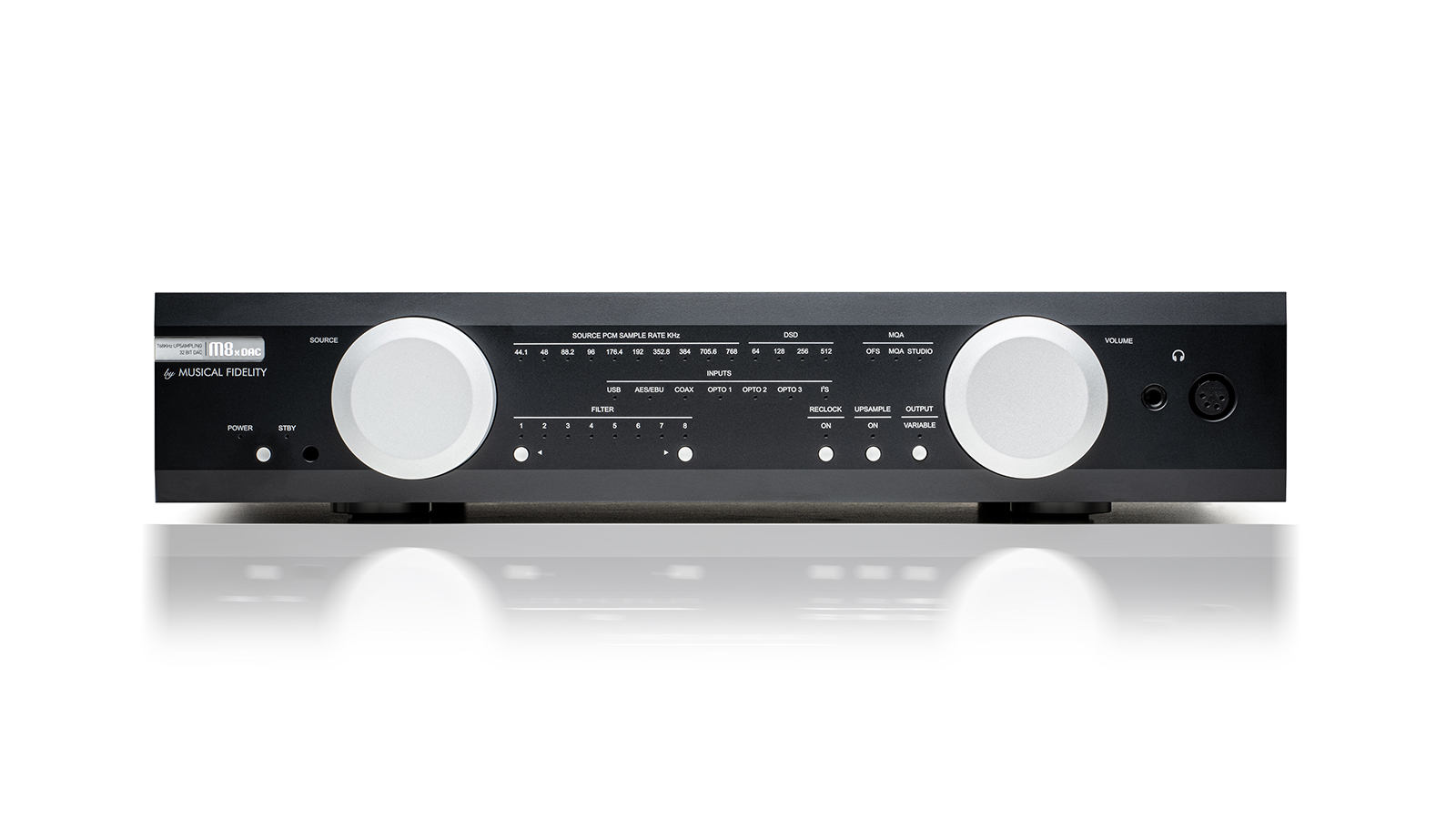
Heinz Lichtenegger has been busy since buying Musical Fidelity in 2018. Refreshing the core entry-level and mid-range offerings. Swooping up to the Nu-Vista valve-based products that now constitute true flagships. With the odd ‘diversion’ along the way, including the revitalised A1 amplifier, hot in both senses.
In amongst that, the M8xi amplifier launched in 2020, continuing the ‘Super-Integrated’ theme first seen in the 1990’s with the A1000. The latest version delivers a whopping 550 watts into eight ohms. It was recently joined by a phono stage, the M8x Vinyl. And now the company has added the M8x DAC that we’re considering here, which represents Musical Fidelity’s one-from-the-top DAC. That’s often the sweet spot in manufacturer’s ranges, is that the case here? And are the gains over more affordable DACs worthwhile, or do DACs at this level all sound the same these days? Let’s see.
What it does
The M8x is a DAC that can operate fixed-output into an integrated amp or preamp, or variable-output directly into a power amplifier or active speakers. I tried both. There’s no streaming. For that, Musical Fidelity suggests its MX-Stream, closely based on Pro-ject’s Stream Box S2 Ultra used in this review. Sonically they matched well.
The M8x proves to be a tweaker’s delight. Select your own filter? Check – choose from eight of the beggars. Upsampling of PCM signals to 352.8/384kHz? Check. Defeatable if required. Reclocking the incoming signal to the M8x’s internal clock? Check. Also defeatable. And not forgetting the current must-have I²S input. It’s for a forthcoming MF CD transport. I used the corresponding output of Pro-ject’s RS2T CD transport to test its veracity.
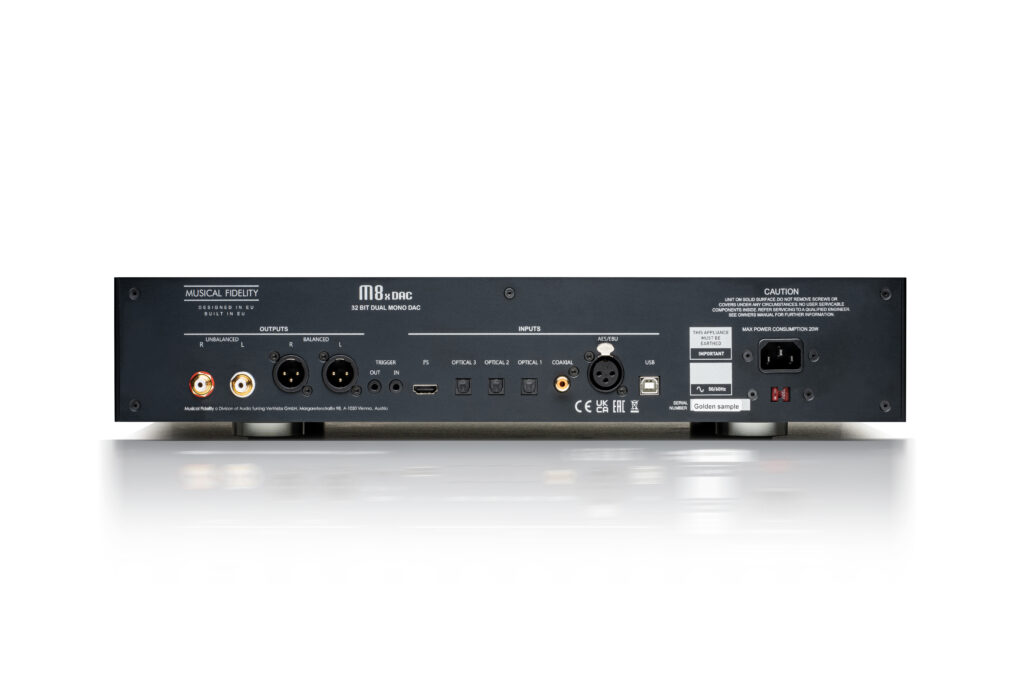
Other digital inputs include USB-B (for computers), coax, AES/EBU and three optical ones. Standard HDMI is absent though, which is a shame. The USB input reaches PCM 768 kHz and DSD 256 (native DSD 512). Windows users must download a driver but it’s not onerous; I needed it for the excellent Presto Music via Audirvana on my laptop.
There’s also MQA, despite Tidal having dropped it. “MQA CDs are popular in the Far East” was the distributor’s response. Fair enough. The coax, optical and AES/EBU inputs also handle MQA but not DSD. On PCM those inputs peak at 24bit, 192kHz precision.
Both single-ended (RCA) and balanced (XLR) analogue outputs are provided. As are headphone counterparts – a 6.35mm single-ended socket and an XLR balanced one. Musical Fidelity lauds the M8x’s headphone ability so I paid it due attention.
Only three of the 13 rows on the remote control are for the M8x. No matter, selecting inputs is useful, ditto switching filters. You can also independently switch reclocking and upsampling on or off. And clearly, a volume control is de rigeur for variable-output mode.
Aesthetics
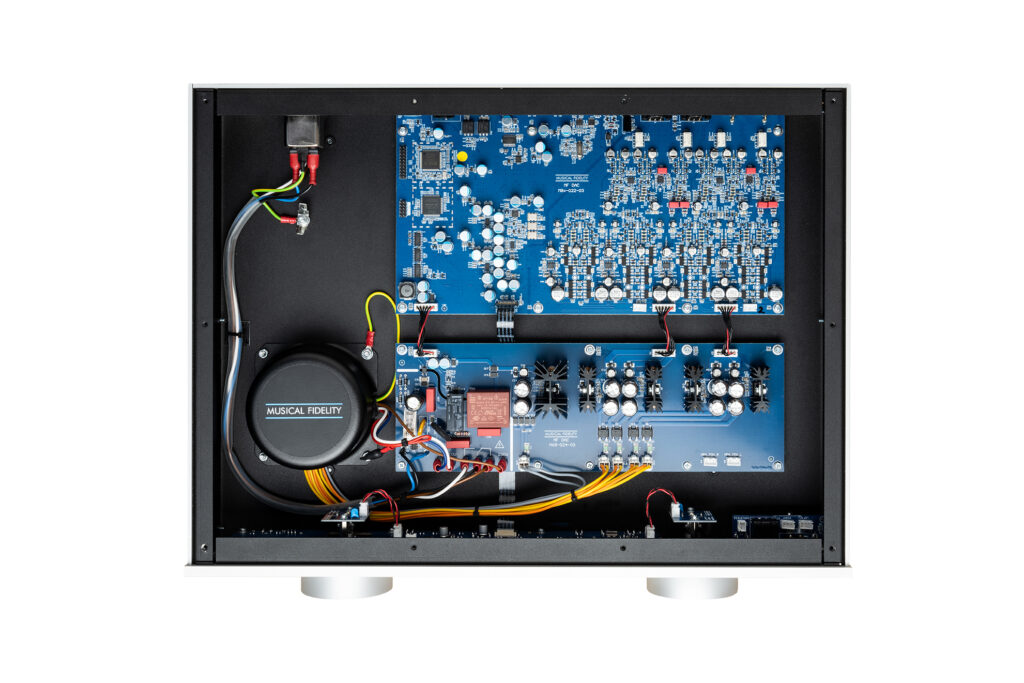
Physically the M8x is a beast at 483mm wide x 381mm deep, dwarfing my resident Mytek Liberty 2 DAC. Why so big? The M8x uses discrete components rather than integrated circuits, which take up space. It’s fully balanced, requiring double the electronics. There’s a sizeable toroidal transformer, too. And not forgetting the need to match the other M8 components.
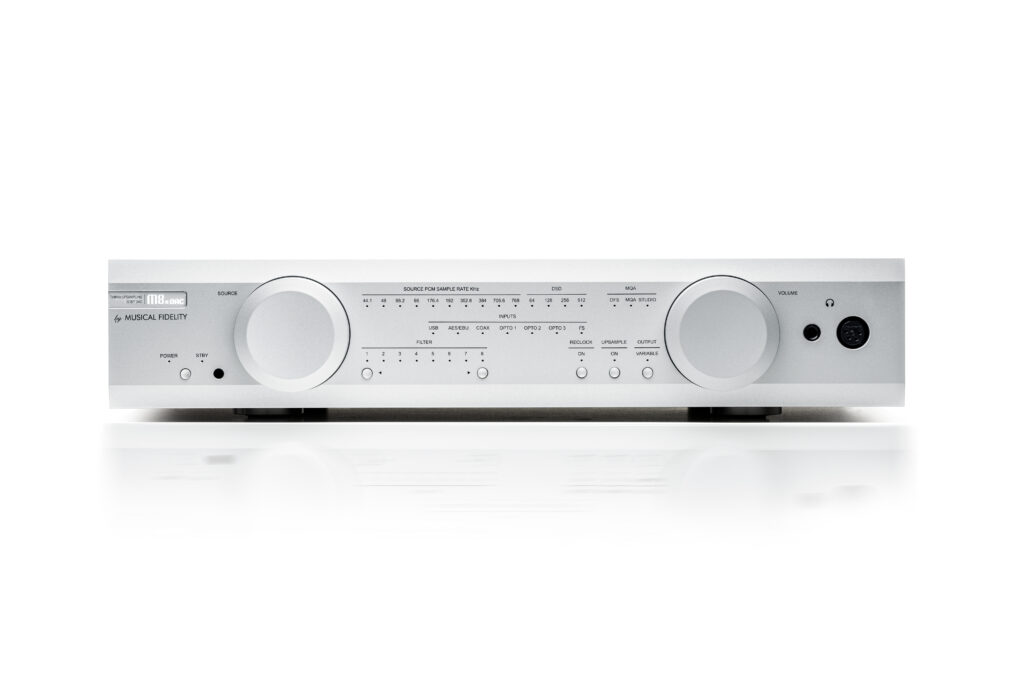
Two finishes are available, all-silver or black with silver control dials. My preference is the former, your eyes may vary. Build quality is very nice if not quite ‘heroic’ as per the marketing. Overall the vibe is more studio-device than luxury-purchase, reinforced by the numerous fascia LEDs that light up like a Christmas tree. The Mytek is similar so I can’t complain.
Engineering chops
The M8x prioritises function over form, omitting a screen to minimise EMI for example. Wi-Fi and Bluetooth are also missing in action, both of which are absent to reduce RFI. Other key design criteria include those discrete components in fully-balanced topology, separate power supplies for the M8x’s digital and analogue circuitry and discrete Class A amplification. Dual ES9038Q2M chips in dual-differential mode sit at the core of the DAC.
Why the Q2M chips, designed for low-power applications? Surely the Pro versions wouldn’t add much to the cost? Simon Powell of distributor Henley Audio was refreshingly honest. He was asking himself the same question.
The Pro versions do measure better but not by much. And as always, the chip maketh not the DAC, the surrounding electronics of real importance. A point reinforced by the £9,999 Nu-Vista DAC using the same ES9038Q2M chips. Clearly Musical Fidelity has faith in them.
Listening
The M8x sat alongside the Mytek Liberty 2, both playing into Prima Luna’s £6,500 EVO 300H amplifier. That drove MoFi SourcePoint 8 speakers. Streamer was the Pro-ject S2 Ultra. It’s my regular ensemble and performs well. I’ve been wondering whether it would sing even more sweetly with a better DAC though. Time to find out.
It didn’t take long, there was clear water between the Mytek and Musical Fidelity. The M8x sounded more refined, more detailed, the soundstage bigger than the Liberty. Bass was stronger, the music had more texture. The M8x sounded more like live musicians playing in the room.
That was true even with ‘artificial’ music like Telefon Tel Aviv’s ‘I Dream Of It Often’ {Ghostly]. The Mytek’s sheer amorphous power was replaced with multi-layered bass that upped the shock and awe quotient further but also revealed previously unheard complexity. There was an lot going on in that wall of sound. ‘The music has grown up, it’s not just a powerplay now’ read my listening notes. The M8x got me closer to the music.
Lady Blackbird’s ‘Slave To The Rhythm’ [Universal] was similar, the music as big and bold as her, the soundstage one you could walk around. Ditto ‘Dune: House Atreides’ from Zimmer Live [Sony Classical]. When the orchestral forces burst onto the scene two minutes in, the M8x conveyed power and energy whilst also resolving the different strands much better than the Mytek.
Slowing things down, ‘Bimini’ from Michel Petrucciani’s Power of Three [Blue Note] was very engaging through the Musical Fidelity. At one point Petrucciani repeats the same note continually, the M8x highlighting the differing pressures applied to the keys. Likewise subtle intonations in Wayne Shorter’s saxophone were now audible, giving more insight. Overall the piece was more refined.
The pro’s view
During the review my buddy Derek Nash joined in. As a recording engineer (Gold Disc, Jamie Cullum) and top saxophonist (20 years with Jools Holland) he straddles the creative / technical divide. To him the Mytek was more studio-like; better clarity and treble, but also more clinical. The M8 had a much better lower end, meaning the acoustic was more evident. He could hear the room more. The M8 was more natural, more analogue and the Mytek sounded digital. His words, not mine! And it’s not cliché: he’s no audiophile. Overall he really took to the M8x.
We also tried the numerous digital filters, which quickly blended into one. Filter six was a smidgeon punchier low down but we couldn’t decide if we preferred it. The others all sounded very similar. That’s what I usually find. Set one then forget would be my recommendation.
I²S – the next big thing?
Developed 40 years ago, the I²S protocol allows different manufacturer’s integrated circuits within a device to communicate. More recently audio manufacturers repurposed it to work between devices, supposedly improving sound quality.
My listening said it didn’t make much difference. Using a Pro-ject RS2T CD transport there was maybe the tiniest bit more clarity over I²S against AES/EBU. Possibly. It’s a rabbit hole I’d avoid though, any variance of academic interest only.
Reclocking and upsampling
As was the case initially with reclocking. Using the Pro-ject streamer I couldn’t tell whether reclocking was on or off. Through Pro-ject’s lesser DS2T CD transport reclocking did help though. Jasmine from Keith Jarrett and Charlie Haden [ECM] cut through a little more, the piano clearer, the bass more distinct. Not a huge difference, but worth having. At which point I left the reclocking switched on. Why not?
Distinct gains were heard with the M8x upsampling PCM to 352.8kHz. Treble was even more filigreed, bass slightly firmer, the overall sound more relaxed in the positive sense. Detail was further enhanced, instruments and performers better delineated.
‘By The Tides’ by Ange Hardy and Lukas Drinkwater [Findings, Story] is simple folk at its best. Upsampling highlighted the interplay between the guitars better. The top end was also slightly sweeter, more refined. Improvements akin to moving from the Mytek to the M8x DAC, just not as big a step. Switching to Bonnie Raitt’s ‘I Can’t Make You Love Me’ from Road Tested [Capitol], upsampling enhanced the live feel of the recording, the venue’s acoustic even more apparent. In short, upsampling was always beneficial, so I left it switched on.
Volume control
Switching to the Prima Luna’s HT (home theatre) input bypassed its pre-amp completely, allowing the M8x’s volume control to strut its stuff. The Prima Luna’s pre-amp still sounded a little better, the M8x’s volume control cooler, the top end not as refined, dynamics slightly blunted.
Back to ‘Dune: House Atreides,’ the switch from quietly-haunting to full-on was more explosive through the pre-amp. The Prima Luna also made it easier to distinguish what made up that cacophony of sound. But, through speakers the differences were small, sufficiently so to make directly driving a power amp or active speakers viable in my view.
That the M8x uses the ESS DAC’s standard on-chip volume, something I hadn’t realised, was therefore a surprise. That’s a shame given the M8x’s engineering credentials elsewhere.
Headphone listening
Finally, a quick and satisfying blast of the M8x’s headphone stage, crafted from discrete components. Balanced output is specified as 3.9W/8Ω, 3.2W/32Ω and 400mW/300Ω, enough for demanding headphones. And most of it is in Class A. It had me at ‘discrete components.’
Numerous headphones were tried – Drop 6XX (Sennheiser 650s by any other name), Audioquest Nighthawk Carbons, Meze 99 Classics, Grado SR80x and Koss’ £35 Porta Pros (yes honestly).
All of which sounded beautiful through the M8x. Abundant detail coupled to a sweet top end that worked with rather than against the Sennheisers and Grados (which can tip over into stridence). Bass was gloriously full when needed (Telefon Tel Aviv), controlled yet powerful when appropriate, such as Jaap van Zweden’s wonderful version of Britten’s War Requiem [Challenge].
Schiit’s overperforming Jotunheim is my headamp benchmark. The M8x sounded very similar indeed, justifying the claims Musical Fidelity makes about its headphone amplifier. Only on palpability did the Jotunheim pull ahead, giving a notably better impression of being there. It would seem that’s down to the M8x’s volume control. When it was in circuit but maxed-out, with volume handled by the Schiit, the sound had less life. Reverting to fixed-output on the M8x restored its presence. A shame, but whilst Head-Fi enthusiasts may look to a separate headphone amplifier most of us wouldn’t.
Conclusions
Some of the M8x’s features – defeatable upsampling and reclocking, digital filters and I²S input – are superfluous to me. But, that’s my set and forget nature. Others will rightly appreciate the flexibility. And given it did no sonic harm then why not?
I confess disappointment at the M8x’s on-chip volume. I was happy with it driving a power amp directly but would always wonder if things could be even better. It also slightly undermined a really good headphone stage.
None of which negates the core conclusion. The M8x is a stonking fixed-output DAC, combining strong detail retrieval with a powerful low end and a lovely organic sound. Clinical it is not. It thoroughly trounced my Mytek Liberty 2, itself no slouch. Stepping up from £1-2k DACs is clearly worthwhile. If I can now just blag a review of the Nu-Vista DAC I’ll let you know if the M8x occupies Musical Fidelity’s sweetspot. Don’t bet against it.
Sonically the M8x took my £15k+system up several notches, bringing more out of the other components. Again and again, the system’s new-found vitality brought a smile to my face and drew me closer to the music. The M8x isn’t cheap but fully justifies its asking price. This is no range-filler, it’s a valuable addition to the Musical Fidelity roster. Bravo Heinz!
Technical specifications
- DAC chip: 2x ES9038Q2M (dual mono) with 8x digital filter
- Total correlated jitter: <100 femtoseconds peak to peak
- Output impedance: < 100 ohms
- Headphone Outputs: 6.3mm stereo jack unbalanced; 4-pin XLR balanced
- Power (balanced output): 3.9W / 8 ohms; 3.2W / 32 ohms; 400mW / 300 ohms
- Output impedance: < 5 ohms
- Digital Inputs: 1x USB input: USB Audio Class 2 requires USB 2.0 or higher on computer
- USB PCM up to 768kHz, up to DSD256 via DoP and native DSD512
- Full MQA decoding by hardware
- 3x Optical input: up to 24bit / PCM 192kHz, MQA 384kHz, DoP DSD 64
- 1x Coaxial input: up to 24bit / PCM 192kHz, MQA 384kHz, DoP DSD 64
- 1x AES/EBU input: 1x up to 24bit / PCM 192kHz, MQA 384kHz, DoP DSD 64
- 1x CD I²S (MCLK out 16,9344MHz)
- Analogue Outputs: 1 pair line level RCA fix/var @ 2V RMS at 0dBFS, 1 pair line level XLR fix/var @ 4V RMS at 0dBFS
- General: Power consumption: 70 Watts maximum, <0.5 W in standby
- Trigger In/Out
- Dimensions (WxHxD): 483 x 102 x 381 mm
- Weight: 10.6 kg
- Price: £3,600, €3,999, $4,299
Manufacturer
Musical Fidelity
UK distributor
Henley Audio
+44(0)1235 511166
Tags: DAC MUSICAL FIDELITY M8X
Trending Articles
See all
By Phil Wright
More articles from this author
Read Next From Review
See all
HIFISTAY Sound Wings+
- Sep 16, 2026
Marantz Model 10
- Sep 16, 2026
DeVore Fidelity O/Bronze
- Sep 16, 2026
Network Acoustics Origin
- Sep 16, 2026