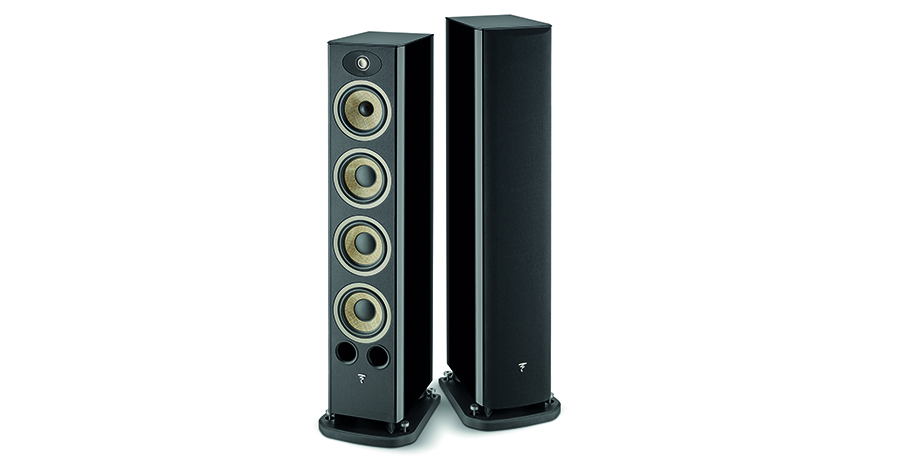
When Focal launched the original Aria range back in 2013, it did something that no previous Focal speaker had previously achieved… for me. Before it, I had admired Focal products, respected them, and even coveted them at points, but I’d never truly loved what they did. The Arias arrived, still doing all I expected Focal speakers to do. However, they did so with a level of out-and-out fun that hadn’t previously been part of the repertoire. Subsequent launches above and below the Arias have maintained this essence of joy. This means any update to its source has always piqued my interest. So, how does the Focal Aria X No3 floorstanding loudspeaker, from its revised Aria line, shape up?
The No3 is the second-highest model in the range, a like-for-like replacement of the outgoing Aria model. A single stand-mount is joined by three floorstanding models, which unusually retain both supporting centre, surround and subwoofer options too. The No3 is exactly the same height as the range-topping Aria X No 4. However, as it uses more significant 203mm bass drivers, it is significantly wider. This means that No3, while comparatively svelte, is a fairly large speaker in its own right.
Aria developments
The driver complement is recognisably similar to the original Aria models but includes many of the developments that Focal has been working on in the ensuing decade. The tweeter is an aluminium and magnesium alloy unit that employs the M-shaped profile the company has been moving to in its tweeter and headphone drivers over the last few years. It was first used in the Vestia range, which overlaps the lower levels of the Aria X models. The tweeter itself sits in a urethane plate. This acts as a shallow waveguide with a claimed upper-frequency response of 30kHz.
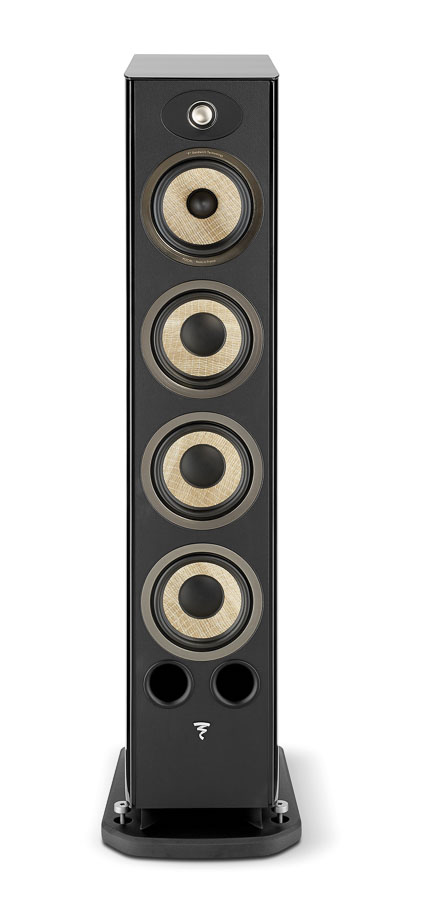
This is partnered with four 165mm ‘F Sandwich’, a term that Focal proudly emblazons on the driver surround. It’s a name that has consistently baffled those less committed. These use a layer of flax fibre sandwiched between two layers of glass fibre. Focal claims this results in a combination with ideal acoustic properties. It’s also vastly easier to make than the composite designs used in the Sopra and Utopia models. They are used on the Kanta No1s that have been resident here as test speaker units.
While all four units are the same size, the uppermost unit is set up as a dedicated midrange unit. It features a distinct dust cap and motor assembly to facilitate its operation across a frequency range of 260Hz to 3.1kHz. The three lower drivers are dedicated bass drivers. They extend down to the claimed low-frequency roll-off of 39Hz at the ±3dB measurement point, starting from 260Hz.
Port smart
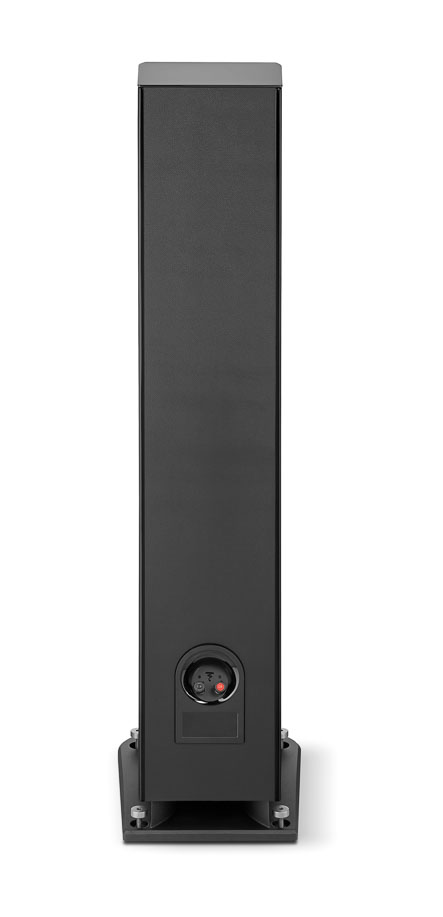
One of the most significant changes for the Aria X concerns how these drivers are ported. The lower section of the cabinet contains both a pair of forward-firing ports and a lower-firing port that acts against a plinth that works as a fixed boundary. The plinth is a very smart piece of industrial design, as it ships with the spikes already fitted but placed in a raised position. You can attach the plinth, move the Focal to the desired location, and then deploy the spikes via a supplied tool once the Focal Aria X No3 is where you want it.
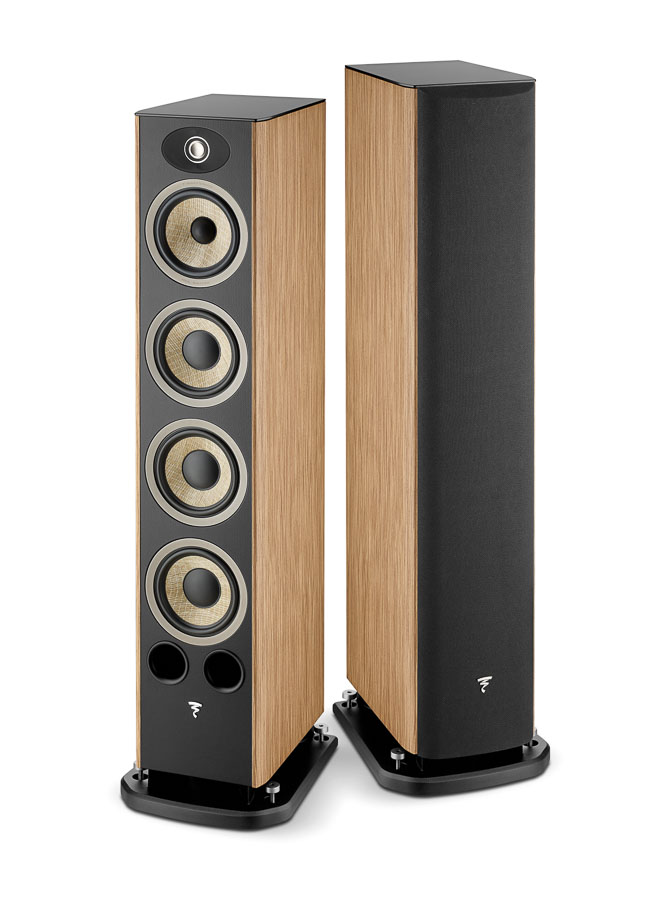
At over a metre tall, the Focal is an imposing speaker and is littered with touches that have you convinced it costs more than it does. The non-parallel sides and separate top plate all feel of a very high standard, and the speaker itself is a good-looking bit of kit.
Fine finish
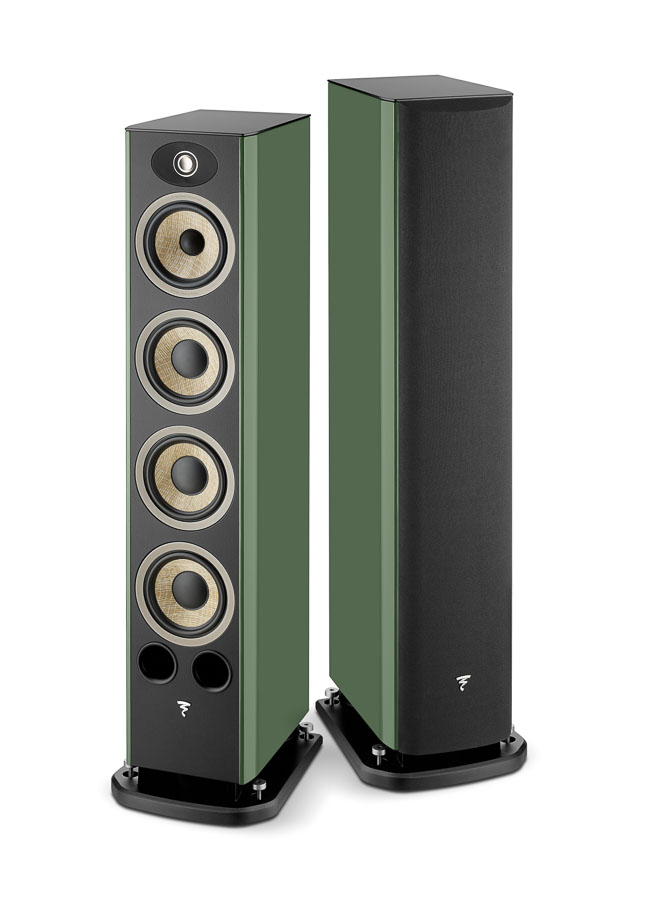
In addition to the expected gloss black and ‘Prime’ walnut options, Focal has also made them available in ‘Moss Green High Gloss’, in which the review samples were supplied. This won’t be a perfect fit for every living space, but it looks genuinely excellent, giving the speaker an identity and working well with the black front baffle and flax drivers.
The engineering changes that have gone into the Aria X are not night and day different to the original. Still, one fairly profound difference to the old model revealed itself early on. The original Aria might have ushered in some changes in how much fun a Focal speaker could be, but it was very much in keeping with older designs in terms of the effort that went into positioning it. The Focal Aria X No3, by contrast, has been happy in most locations and angles I have tried it in. So long as it is two metres apart and at least two metres from the listening position, I’ve enjoyed consistently good results. The claimed sensitivity of 92dB/w feels a little high. Meanwhile, the minimum impedance dip of 2.8 ohms means that a reasonable amount of power will be needed to get the best from them.
Worth it!
That best is worth working for though. The way the Focal tackles Regina Spektor’s Live in London [Sire] encapsulates everything it does so well. The space of the venue and the energy of the audience is palpable and well worked into the presentation. When the opening On the Radio begins, the piano’s weight and scale, even relative to the venue is readily apparent. Spektor herself sounds utterly convincing; her energy and staccato vocal style are perfectly delivered.
And above all, it’s fun. This woman loves to perform live in front of an audience psyched to be there, and without losing a single nuance in the recording itself, the Focal radiates this joy into every aspect of the performance. Even better news is this joy is measured and never dominates material that is more considered and reflective. A lovely run through Bill Fay’s Countless Branches [Dead Oceans] doesn’t seek to lift the mood of this gentle and heartfelt body of songs—instead the Focal concentrates on the consistent tonal excellence that has defined their offerings for many years.
Double-priced comparisons
Indeed, there have been points during my time with the Focal Aria X No3 when I made comparisons to the Bowers & Wilkins 702 S3 Signature that passed through shortly before and wore a price tag double that of the Focal. When you lean on the Focal, it doesn’t have the same composure as the Bowers & Wilkins and neither can it hit quite as hard in the bottom end, but until you are pushing it firmly into the realms of the antisocial, the differences are tiny.
Other improvements to the Focal have ensured that the gap to more expensive rivals is closer than they might like. This still wouldn’t be my choice of speaker to listen exclusively to victims of the late nineties and early noughties loudness war, and it will always make it clear when a recording is a little on the hard side. The key difference is that it does so with an almost apologetic edge; making you aware of issues in the background rather than highlighting them to the extent of masking any good in the recording. It does this while still being able to respond to high-quality recordings. A considered Sunday morning in front of Talk Talk’s Spirit of Eden [Parlophone] was a chance for the Focal to truly shine at sounding big, believable and utterly unforced in how it goes about making music.
Aria Evolved
What is interesting for me is that this also meant the Aria lets me still find joy in this minimalist set of songs in exactly the same way as it does with the rather more overtly ballistic 1999 by Cassius [Virgin]. Time signatures are nailed down and the effortless flow of music is captured in a way that makes the reproduction an art and science. So long as your partnering equipment is up to supplying the power and not tripping over itself, the Focal effortlessly builds on the achievements of its ancestors.
The fact that it does this while not significantly adding to the price of a range of speakers that have already done a very good job of holding their value over their long lives means that the Focal Aria X No3 winds up looking like superb value, too. This is a large, attractive, and superbly made speaker that takes on rivals at considerably higher price points. In short, it continues to mix key Focal attributes with a welcome sense of joie de vivre.
Technical specifications
- Type Bass-reflex 3-way floorstanding loudspeaker
- Speaker drivers 3 x 6.5” (16.5cm) Flax bass
- 6.5” (16.5cm) Flax midrange with TMD® surround
- Aluminium/Magnesium ‘M’-shaped inverted dome TAM tweeter
- Frequency response (+/-3dB) 39Hz – 30kHz
- Response at -6dB 32Hz
- Sensitivity 92dB Nominal impedance 8Ω
- Minimum impedance 2.8Ω
- Recommended amp power 40 – 300W
- Crossover frequency 260Hz/3,100Hz
- Dimensions (HxLxD) 451/4×115/8×145/8” (115×29.4×37.1cm)
- Weight 63.93lbs (29kg)
- Price; £3,499, $5,198, €4,000 per pair
Manufacturer
Focal
Trending Articles
See all
Acoustic Energy Corinium floorstanding loudspeaker
- Dec 23, 2024
Raidho TD2.2
- Jun 21, 2023
Trending Articles

By Ed Selley
More articles from this author
Read Next From Review
See all
HIFISTAY Sound Wings+
- Sep 16, 2026
Marantz Model 10
- Sep 16, 2026
DeVore Fidelity O/Bronze
- Sep 16, 2026
Network Acoustics Origin
- Sep 16, 2026