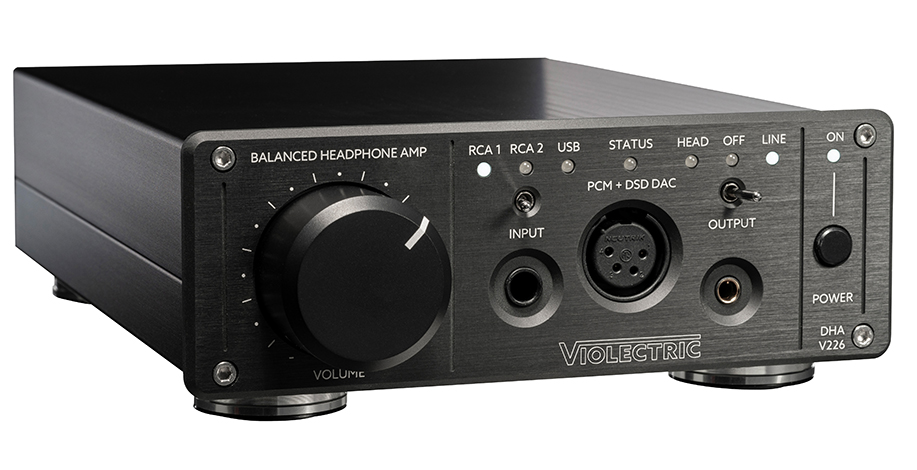
You can forgive attentive readers of hi-fi+ for doing a double-take at the Violectric DHA V226. Even a cursory glance at the design language employed on the front panel of the V226 suggests that it might be a very close cousin to the Niimbus US 5 PRO. Just so. The DHA V226 is designed and manufactured in Germany by the same team responsible for the Niimbus. However, it has a retail price of £1,300 compared to the US 5 PRO’s £5,140.
Lifting the lid
Lifting their respective lids makes the relationship between the DHA V226 and the Niimbus even more apparent. Violectric’s design head, Fried Reim, has not entirely made a mini-Niimbus in the V226. His flagship amplifier features a more complex circuit, higher-quality components, a stiffer and more robust power supply, and a significantly superior volume control arrangement. Even so, the power supply and gain circuit employed in the Violectric DHA V226 feature essentially the same design principles. However, they result in half the output power of the Niimbus in a chassis some 50% smaller.
However, unlike the Niimbus, which is purely a headphone amp, the Violectric DHA V226 also contains a DAC. This is based around a 32-bit Cirrus Logic CS43131 chip. The V226 can, therefore, handle PCM up to 384 kHz and DSD 64-256. It costs £3,840 less than the Niimbus. Additionally, buyers get the same five-year guarantee.
Design choices
Some might be disappointed that the V226’s only digital input is a USB-C socket. Adding a S/PDIF input would have been challenging both from a real-estate viewpoint – the rear panel on the Violectric DHA V226 is already crammed – and would have required additional circuitry. This has implications for cost and internal layout. Violectric has also assumed that most customers for a one-box solution at this price point want to connect to a tablet, a phone or a DAP. Thus, USB is the de facto standard.
Headphone amplifiers must have an adjustable gain because headphones vary so much between makes and types in their need for current and Voltage. Sources have variable outputs, too. With fixed gain, headphone A might be dangerously loud, while headphone B is hopelessly quiet. Fried Reim is a thinker and a bold engineer, not afraid to do things his way. Evidence of this engineering boldness is at the rear of the Violectric DHA V226. Here, we find DIP switches that adjust the gain in seven steps from -18dB to +18dB.
Take a DIP
Unlike most alternative amplifier designs, the critical thing to note is that Reim’s DIP switches allow pre-gain or sensitivity to be adjusted, not output gain. While an alternative headamp might switch its output between low, medium and high gain settings, Violectric amplifiers have fixed output gain. In the case of the V226, it is + 2dB unbalanced and 4dB balanced. Reim argues that the advantage of this approach is that you can optimise the entire amplification path for the lowest noise and maximum load driving ability, whether connected to high-efficiency IEMs or low-efficiency dynamic headphones.
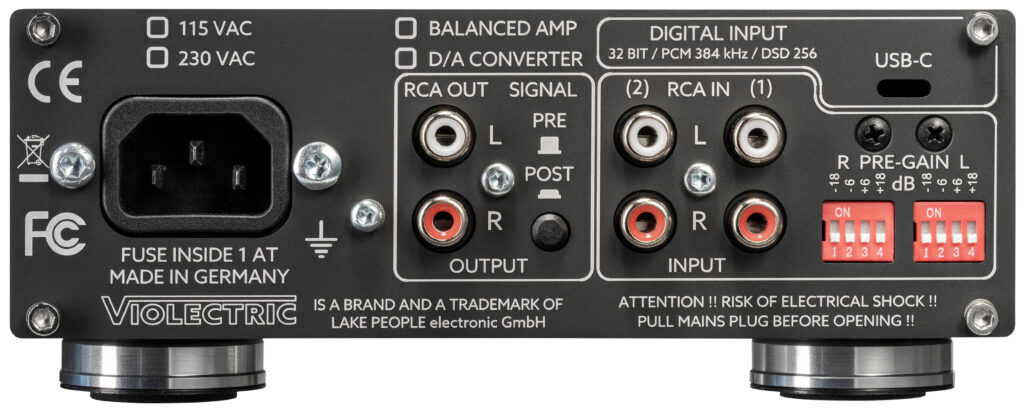
Also on the back panel of the V226 are two pairs of analogue RCA inputs and a single pair of RCA line stage outputs. A push button configures the line stage for operation with or without the integral ALPS RK27 volume control. On the front panel are status LEDs, miniature toggle switches that allow inputs and outputs to be selected, a large rotary volume control, single-ended 6.3mm TRS socket, plus 4-pin XLR and 4.4mm Pentaconn sockets. The latter are both balanced, of course. The Violectric DHA V226 mirrors Reim’s other designs by incorporating protection for headphones and IEMs from DC. They are electrically isolated on start-up and shutdown to prevent possible damage. Output impedance is 0.5 Ohms, input impedance 10 kOhms.
Warmed up
The run-in and warmed-up review sample V226 was connected to a 5th-generation iPad Air using the standard Apple USB cable. A Susvara headphone was connected to the V226’s XLR socket. Qobuz was launched on the iPad, and Zsela Thompson’s first studio album, Big For You (released mid-June this year), was played.
It’s quite a while since I last heard a Cirrus chip in a DAC. The V226 reminded me how, while they might be less ubiquitous than the common-or-garden ESS equivalent, the Cirrus series sounds very good indeed. To my ears, it is perhaps as resolving yet notably more natural-sounding. The amplification that follows the DAC stage in the V226 is linear to plus or minus half a dB from 5Hz to 250kHz. It features a dynamic range of 131dB and THD+N of 102dB.
Through its XLR and Pentaconn outlets, the V226 delivers 23.2 Volts in a 600 Ohm load and 1.5mW at 16 Ohms. Into 100 Ohms, the output is 3.5mW. The damping factor into 50 Ohms is 200 single-ended and 100 balanced. The above are all respectable rather than exceptional figures. Still, the Violectric DHA V226 could drive the Susvara headphones to such a standard that I could happily adjust to living with the result.
Bass-ics
Having just set aside the Niimbus US 5 PRO, despite its simpler circuitry and much lower cost, the V226 sounds noticeably Niimbus-like. That’s not to suggest it’s in the same league in terms of sonic quality. Rather, it exhibits the recognisable Violectric house sound. This sound combines flowing musical naturalism with clean, tightly controlled muscularity and transparency.
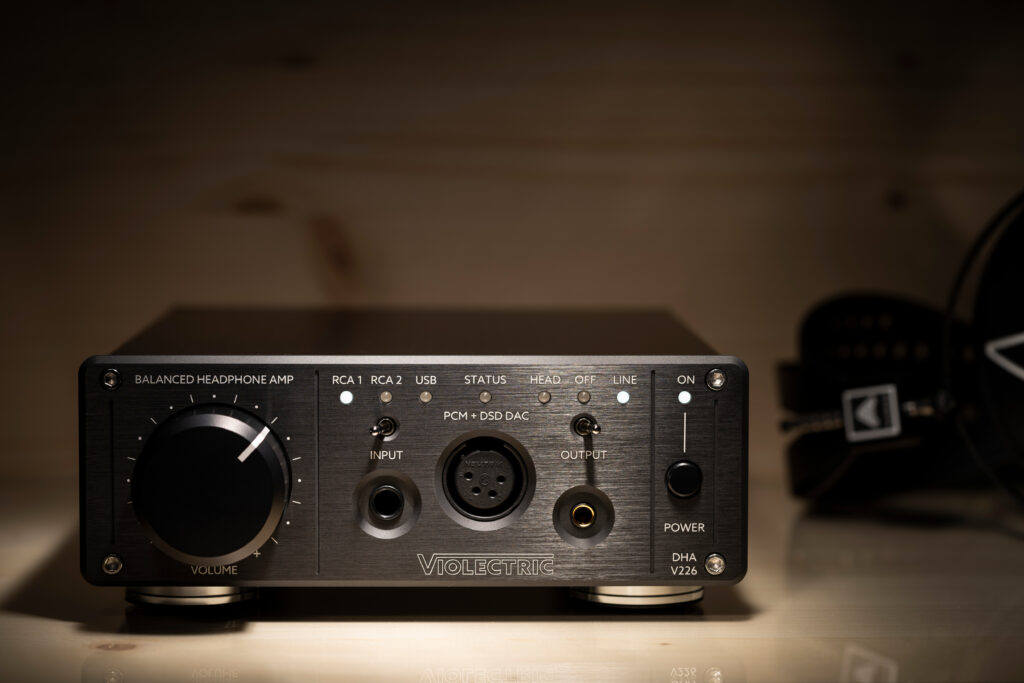
The keyed-bass stabs that punctuate the track ‘Fire Escape’ on Big For You were rendered by the Violectric DHA V226 driving the Susvara with very satisfying power and texture. Simultaneously, over and around them floated the smoky, breathiness of Zsela’s intriguing voice. She reminds me of a young Joan Armatrading. Her voice was given an appropriate balance of intimacy and prominence. The V226 presents a nicely layered sound stage too. Changing the system configuration and using the V226 as a headphone amplifier revealed its more profound competence.
I removed the Niimbus US 5 PRO from the circuit, replacing it with the V226 and connecting that to the reference Mola Mola Tambaqui DAC using XLR-to-RCA converters. Despite the balanced-to-single-ended hack, not something I would do out of choice, the results were rather sobering, given that I have recently spent my money buying the Niimbus. Yes, the Niimbus gives reassuringly superior results in terms of transparency, dynamic expression and tonal density when fed by the Tambaqui. Still, the little Violectric DHA V2266, when given the same high-quality input, was not quite as far behind as I had imagined it would be.
Come on!
The Tambaqui is superior by all measures to the Cirrus chip in the Violectric DHA V2266, but come on. What should we reasonably expect given the enormous price difference? The more sensible and balanced way to view this is that as a combined DAC/amplifier combination, the V226 is far from disgracing itself in posher company.
Violectric’s studio-cum-industrial design language may not be to all tastes. However, electronically and functionally, the V226 has an awful lot going for it. There’s more than a whiff of diminishing returns here, as there is with pretty much all of audio. As I re-packed theViolectric DHA V226 for return to the UK distributor, I did so with the conviction. Anyone who buys one is going to have good reason to heartily congratulate themselves for making such a smart conservatively priced choice.
Technical specifications
- Type: headphone amplifier/DAC/line stage preamplifier
- DAC: 32-bit with typical 130 dB dynamic range, -115 dB THD+N
- Power 3500mW into 100 Ohm, 23V RMS into 600 Ohm
- Inputs 1 x analogue stereo inputs (unbalanced via RCA), 1 x digital input (USB-C with up to 32-bit and up to 384kHz for PCM signals, DSD 64 256)
- Outputs: 1 x 4-pin XLR, balanced / 1 x Pentaconn, bal. / 1 x 6.3 mm jack, unbalanced.
- Line Out: Stereo outputs (unbalanced via RCA)
- Dimensions: (W x H x D): 17 x 5.5 x 29 cm
- Weight: 3 kg
- Price: £1,300, $1,599, €1,599
Manufacturer
Violectric
UK distributor
Electromod
+(0)1494 956558
Tags: DAC HEADPHONE AMPLIFIER LINE STAGE VIOLECTRIC DHA V226
Trending Articles
See all
By Kevin Fiske
More articles from this author

Read Next From Review
See all
Eversolo T8
- Oct 13, 2026

Acoustic Energy AE Active
- Oct 13, 2026
Reiki Audio SuperSwitch X/Pro X PSU
- Oct 06, 2026
Audiobyte SuperVOX
- Oct 06, 2026