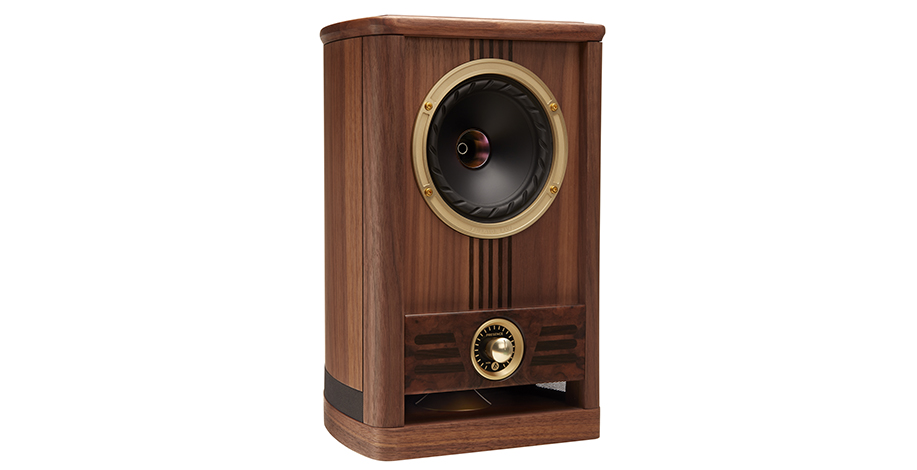
Very few loudspeaker manufacturers appear fully-formed as if from nowhere. But the Fyne Audio Vintage 5 comes from different stock. ‘Fully-formed’ was how it felt in 2017 when Fyne Audio exploded onto the scene. Before we could get our bearings, it had brought out several complete ranges. Fyne offered a range of solutions, from budget to high-performance, from the outset. Before we’d recovered from that, it brought out several more. It then revised and updated the ranges, introducing enhanced variants with upgraded drive units. Fyne has certainly been busy, but when your core team comprises several of the key personnel from the old Tannoy company, you’re probably better equipped to hit the ground running than most fledgeling speaker companies.
Most of those earlier ranges were designed to a modern aesthetic style. That is, with slightly curvaceous cabinets and high gloss finishes. They fit well in a contemporary room. However, you know these guys had a hankering to revisit the classic, old-school designs their erstwhile employer was known for. And more recently, Fyne has done just that. The company has two new ranges. There’s the Vintage Classics in simpler, rectangular, pro-audio-inspired cabinets. Then there is the Vintage range, featuring more finely worked, boat-backed, and elegantly veneered cabinets. Their sophistication is more than skin deep. The Vintage series is mostly substantial floorstanding designs. They sport 10”, 12” or 15” versions of Fyne’s top-spec IsoFlare coaxial driver, as also seen in their F-series. However, there’s also the baby of the range, the Vintage 5. As its name suggests, sports a 5” version of the drive unit, in a cute-as-a-button compact bookshelf design.
Mini Monitor
The Vintage 5 is similarly sized to the classic BBC LS3/5a mini monitors. That means a cabinet volume of around five litres. The Fyne Audio Vintage 5 will never provide the room-filling output of its larger siblings. Nor does it have the sort of scale and weight they can deliver. But it does sound bigger and bolder than those diminutive proportions might suggest. So, don’t dismiss it out of hand if, like me, the BBC models don’t deliver the goods for you.
This is likely to be the Vintage 5’s biggest problem, though. At around £3,750 a pair, it’s pricey for a dinky stand-mount speaker. Especially when the BBC clones (themselves usually at the ‘luxury’ end of the small speaker market) are coming in at under £3k. They, too, are competing on price with larger models elsewhere, which may produce a room-filling sound effect a bit better. Therefore, many prospective purchasers may take one look at the size and one look at the price and dismiss it outright. That could be a mistake…
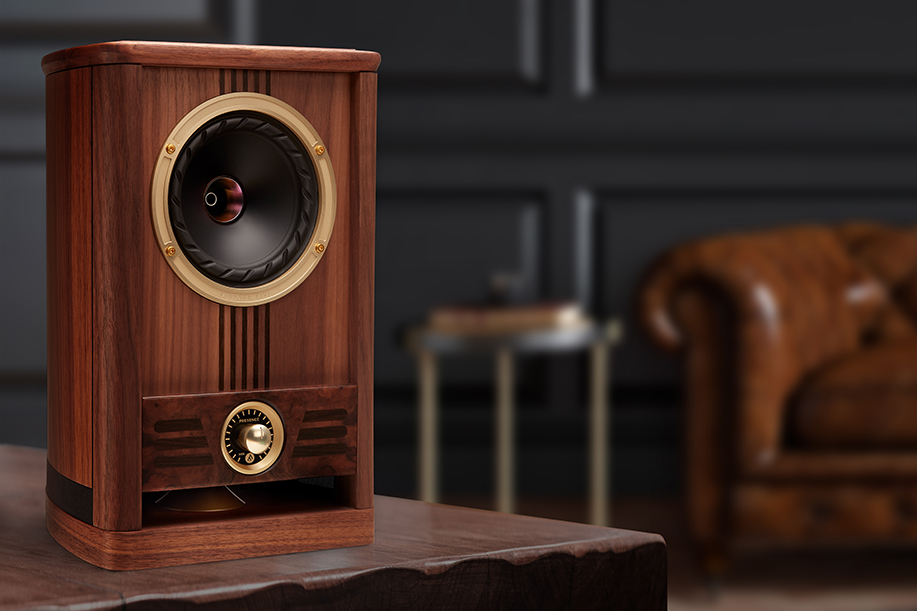
If you close your eyes, it’s not difficult to imagine this is a bigger loudspeaker – it feels less constrained by its dimensions than most rivals, less reserved and more willing to step up and boogie. Once you get beyond the bottom octave in the bass, there’s little to remind you that these are tiny enclosures. The fundamental notes are still there, just not quite as fully fleshed out as a bigger driver can manage. But even here, there’s a winning side to this trade-off. The Vintage 5s exhibit an extraordinary level of focus. Larger, multi-driver assemblies struggle to achieve a degree of coherence comparable to this.
Driver configuration
With the coaxial driver configuration, the compression tweeter is so close-coupled to the mid/bass cone that it is literally and sonically closer to the ideal of a point source. The small size emphasises the nature of that relationship all the more. Stand-mount loudspeakers are often said to ‘disappear’ sonically much more readily than larger, floorstanding designs. That’s especially true of the Vintage 5.
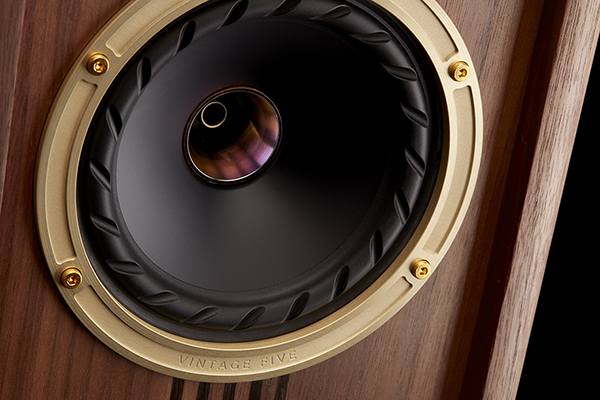
The drive unit is the 5” variant of the top-spec IsoFlare coaxial driver. It features the super-light magnesium compression tweeter, multifibre paper cone, and Fyne’s proprietary fluted driver surround. This last is said to reduce coloration from edge reflections. Fyne Audio produces lesser versions of this driver, though they all share similar technology and cone profiles. However, the Vintage series shares the most sophisticated drivers with the F1 series. As with all the models, it’s a reflex ported design. The enclosure itself isn’t the full height of the cabinet. Instead, it extends down to a few centimetres above the baseplate, and the port exits from the middle of the bottom of this box. It is directed by a tractrix-profile (a curved cone) diffuser to vent radially in all directions through apertures in the front, sides and rear at the foot of the cabinet.
Cabinet of delights
The cabinet construction is also a particular delight. Beautifully finished in exquisitely jointed, wax-finished Walnut veneer (Fyne provides a small tin for refreshing this), there’s a craftsmanship to these cabinets that you rarely see at this price. These are not inexpensive loudspeakers, especially considering their diminutive size. To add a little context, the next smallest model, the floorstanding Vintage 10, is £18,000, and the largest, the Vintage 15, is £30,000. There can be little doubt that the cabinetry contributes somewhat to the cost. However, it also quickly becomes clear that the Vintage 5s are not some cynical marketing gimmick designed to sell off the halo effect of their bigger siblings. There’s a genuine level of serious performance available here, which earns them their place in this illustrious lineup.
The Fyne Audio Vintage 5s may need a little more room around them to breathe than those sealed box BBC designs. However, this wasn’t limiting in my room because I’m not siting them on a shelf, or a wall. Fyne do sell suitable 60cm stands, whereas I used the Vintage 5s on my own 60cm MusicWorks acrylic speaker stands. These might not be a good aesthetic match, but they do perform well. Because the diffuser allows the port to vent omnidirectionally, the proximity of the port exit to reflecting surfaces isn’t quite as much of an issue as it can be in some instances. Siting these a little nearer to the wall than I usually do did help add a little more body to the bass output.
Bottom-end mass
Solo piano isn’t a bad test of whether you’re going to miss the bottom end mass. So, Alfred Brendel playing the Arietta from Beethoven’s last piano sonata, Op.111 [Philips], and the first thing you notice is the way he measures out every note; there’s a considered, thoughtful quality to the playing here. It brings a cohesiveness to the, somewhat disparate, theme and variations form that some speakers have failed to portray.
There’s sufficient weight to the lower registers. However, the articulation and the placement of the notes are so exquisitely delivered that it wouldn’t matter if the bass were a little shy because the music is rendered so intelligible. Similarly, Graham Fitkin’s ‘The Cone Gatherers’ from Flak [Fitkin] might not put a concert grand piano in your living room. Still, it delivers a very convincing ‘salon’ acoustic that anchors the listener firmly in the performance space, even if not adjacent to the instrument.
After Kim
Coming directly after listening to my own FinkTeam Kims, with their 200mm two-way design, the period of readjustment was remarkably and surprisingly brief. Once I’d got the speaker placement settled, the coherence and the levels of musical communication on offer from these diminutive boxes quickly dispelled any misgivings about their ability to scale. It was easy just to get on with enjoying the music.
Take ‘Miel et Ciendres’ from Dhafer Youssef’s album Divine Shadows [Jazzwise], the speakers’ articulation and focus are such that you really feel the way he plays the Oud, the small embellishments, the speed and delicacy of his fingerwork that propels the track; the string quartet accompanying the piece has form and structure, the percussion tight and solid. ‘Wind and Shadows’ from the same album, the polyrhythms are very well articulated, and thus make more sense working with what the Oud is doing. The insistent rhythm is captivating; almost, but never quite tripping over its feet, it adds an exciting and propulsive dimension to this track. This is a performance as good as any I’ve heard, and largely down to that extraordinary level of coherence achieved by this small, coaxial drive unit.
Personal performance
Last year I was fortunate to go to a live performance of the set featured on Esperanza Spalding and Fred Hersch Alive at the Village Vanguard [Palmetto]. Sadly, not at the Village Vanguard, but all the better for seeing these two extraordinary performers together. Spalding’s chatty, conversational style of delivery, married to Hersch’s freewheeling, idiosyncratic piano makes for a very personal performance, where you, the audience, are very much drawn into the proceedings. The speakers’ ability to disappear brought out the intimacy of this gig. It captured and recreated the atmosphere, allowing me to recall my response to the performance that evening vividly. This, surely, is what hi-fi is meant to do.
If you’re still bothered about the Fyne Audio Vintage 5’s ability to do scale and mass, put on Christopher Seitzen, Incantations [Sony Music]. ‘Indoafrica’ from Avner Dorman’s concerto ‘Frozen in Time’ sounds full, vivid and fleshed out, Seitzen’s percussion convincingly set off by the Romanian National Symphony Orchestra. The opening percussive crash explodes from the Vintage 5s in a way that makes wanting any more seem churlish and insensitive. Their sheer articulation, speed and cohesiveness bring a sense of real energy and dynamism to Seitzen’s marimba playing. This, coupled with an orchestra clearly positioned behind, allows for a more appreciable dialogue between percussion and ensemble.
Presence
Another interesting feature of the Vintage series is the ‘presence’ control. The crossover is user adjustable via a dial on the front panel, allowing the listener to tweak the energy levels in and around the presence region. It’s subtle, like so many aspects of this loudspeaker. This further enhances the flexibility by allowing for a degree of adjustment for different rooms or listener preferences. It’s more restrained than many a tone control: turned fully down, Simon Phillips’ drums on ‘Spark’ from Hiromi’s album Spark [Telarc] have more ‘body’; turned fully up, they have more ‘skin’ for example, but there’s no gross shift in overall tonality of the music.
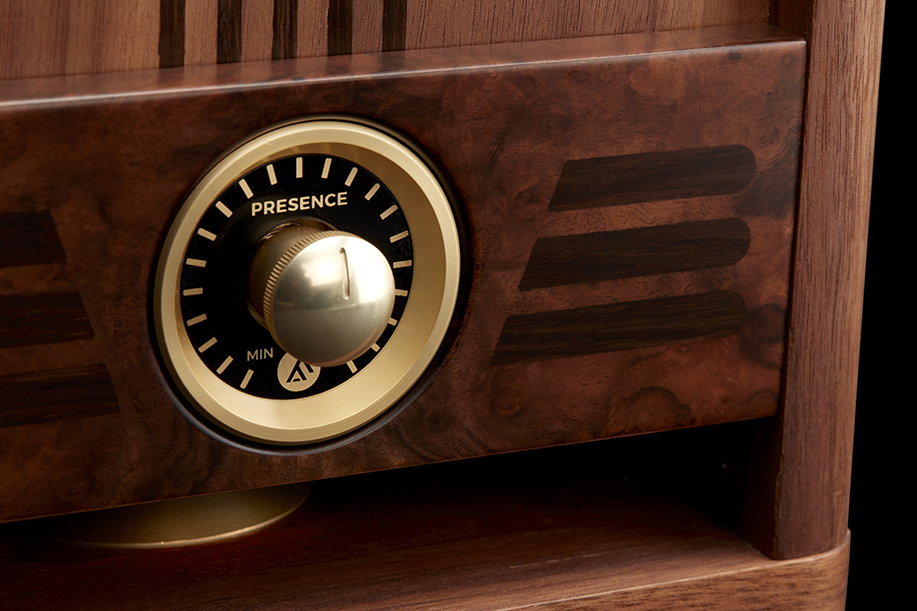
What the Fyne Audio Vintage 5 does deliver on this track is more insight into the way Hiromi’s percussive style marries so well with Phillips’ percussion technique. It’s clear each is very sensitive to the playing of the other at every point. The presence control does give a little more flexibility while you’re playing with placement to get the best balance of bass weight and articulation, or if your room is a little unhelpful sonically, but for the most part, I left it set to the 12 o’clock ‘neutral’ position.
Supertrax
Not long after the Vintage 5s arrived, Fyne Audio announced the Supertrax supertweeter (these guys are incorrigible, and I’m starting to wonder if they ever sleep). I won’t steal anybody’s thunder, but if anybody out there is wondering whether there’s any sense in adding a £3k supertweeter to a £3.75k loudspeaker, the answer might surprise you. Or, if you’ve digested my thoughts above, it might not. Revisiting the Seitzen album, Incantations, the marimba gains structure and tonal depth, the orchestra occupies a clearer, better delineated and more three-dimensional space. For some reason, Fyne Audio hasn’t released a Vintage 8. This could use the 8” driver from the F1.8. Come on, guys, what have you been doing all this time? But in its absence, I have an odd feeling a Vintage 5 plus Supertrax could step up to the plate.
The Fyne Audio Vintage 5 doesn’t so much occupy a niche, as create a niche. It delivers a performance which is so far outside what I expect from even the best miniature loudspeakers that it confounds expectations. There’s a level of coherence and cohesiveness here that makes even the best integrated 2-driver designs feel slightly disconnected. Look elsewhere if you have a big space to fill and an extensive Mahler collection. However, in a smallish suburban room like my British Standard suburban semi-detached offers, who could ask for anything more? I got rhythm? Yes indeed.
Technical specifications
- Type: Two-way bookshelf/standmounting loudspeaker, reflex ported, downwards-firing port with Tractrix diffuser.
- Driver complement: 1 x 125mm IsoFlare point source driver, multi-fibre bass / midrange cone, FyneFlute surround with 19mm magnesium dome compression tweeter, neodymium magnet system
- Crossover frequency: 1.9kHz
- Crossover type: Single wired passive low loss, 2nd order low pass, 1st order high pass. Deep Cryogenically Treated
- Power handling: 50W (RMS, continuous), 200W (peak)
- Frequency response: (-6dB in room, typical) 46Hz-38kHz
- Impedance: Nominal 8Ω
- Sensitivity: 87dB @ 2.83V / 1 metre
- Dimensions (HxWxD): cabinet: 350 x 219 x 260mm
- Weight: 6.2Kg each
- Finishes: Walnut
- Price: £3,750, $4,999, €4,500 per pair
Manufacturer
Fyne Audio Limited
+44 (0)141 428 4008
Trending Articles
See all
Xavian Unica
- Apr 07, 2026
Trending Articles

By Steve Dickinson
More articles from this author

Read Next From Review
See all
Reiki Audio SuperSwitch X/Pro X PSU
- Oct 06, 2026
Audiobyte SuperVOX
- Oct 06, 2026
Unitra WSH-805
- Sep 29, 2026
Wilson Audio Sabrina V
- Sep 29, 2026